China Agricultural Commodities Market Size & Growth Rate
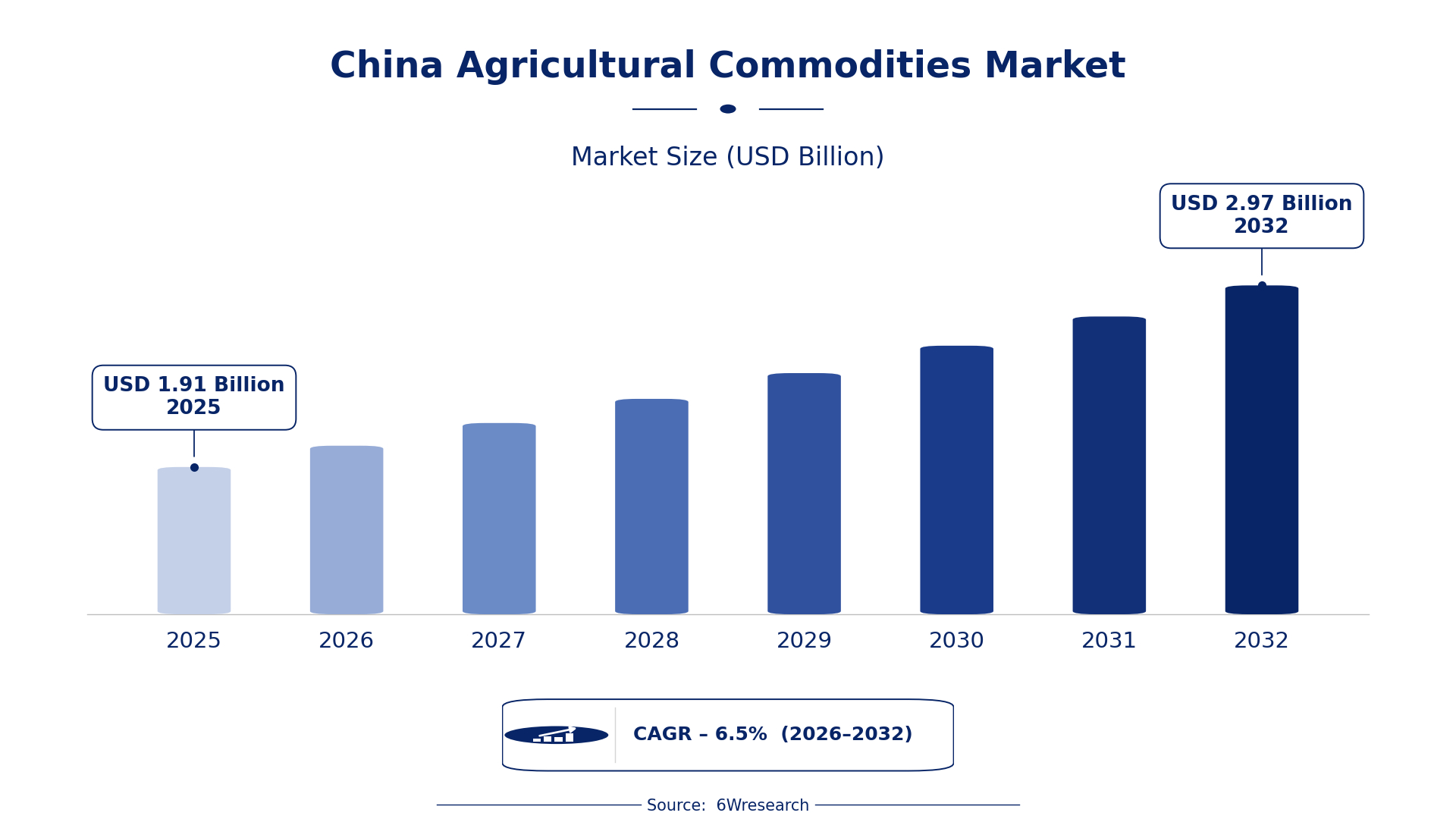
According to 6Wresearch internal database and industry insights, the China Agricultural Commodities Market was valued at USD 1.91 billion in 2025 and is projected to reach USD 2.97 billion by 2032, growing at a CAGR of approximately 6.5% during 2026–2032.
China Agricultural Commodities Market Highlights
| Report Metric | Details |
| Report Name | China Agricultural Commodities Market |
| Market Size 2025 | USD 1.91 billion |
| Market Size 2032 | USD 2.97 billion |
| Absolute Growth 2025–2032 | USD 1.06 billion |
| CAGR 2026–2032 | 6.5% |
| Peak Annual Growth | 9.1% in 2026 |
| Forecast Period | 2026–2032 |
| Historical Data | 2022–2025 |
| Base Year | 2025 |
| Leading Agricultural Commodities Market, 2025 | Grains (39% share) |
| Leading Commodity Type, 2025 | Raw (43% share) |
| Leading Processing Type, 2025 | Commodity Traders (46% share) |
| Leading Distribution Channel, 2025 | Food Processors (48% share) |
| Fastest-Growing Agricultural Commodities Market | Fruits (8.2% CAGR) |
| Fastest-Growing Commodity Type | Fresh/Packaged (8.5% CAGR) |
| Fastest-Growing Processing Type | Online Exchanges (8.5% CAGR) |
| Fastest-Growing Distribution Channel | Supermarket Chains (8.9% CAGR) |
| Growing Sector | Food Processing |
| Key End Users | Food Processors, Commodity Traders, Supermarket Chains, Textile Manufacturers |
China Agricultural Commodities Market Year-wise Growth Rate and Key Drivers (2022–2032)
This graph illustrates the annual growth rates of the market from 2022 to 2032, highlighting a steady upward trajectory and projected market expansion over the forecast period.
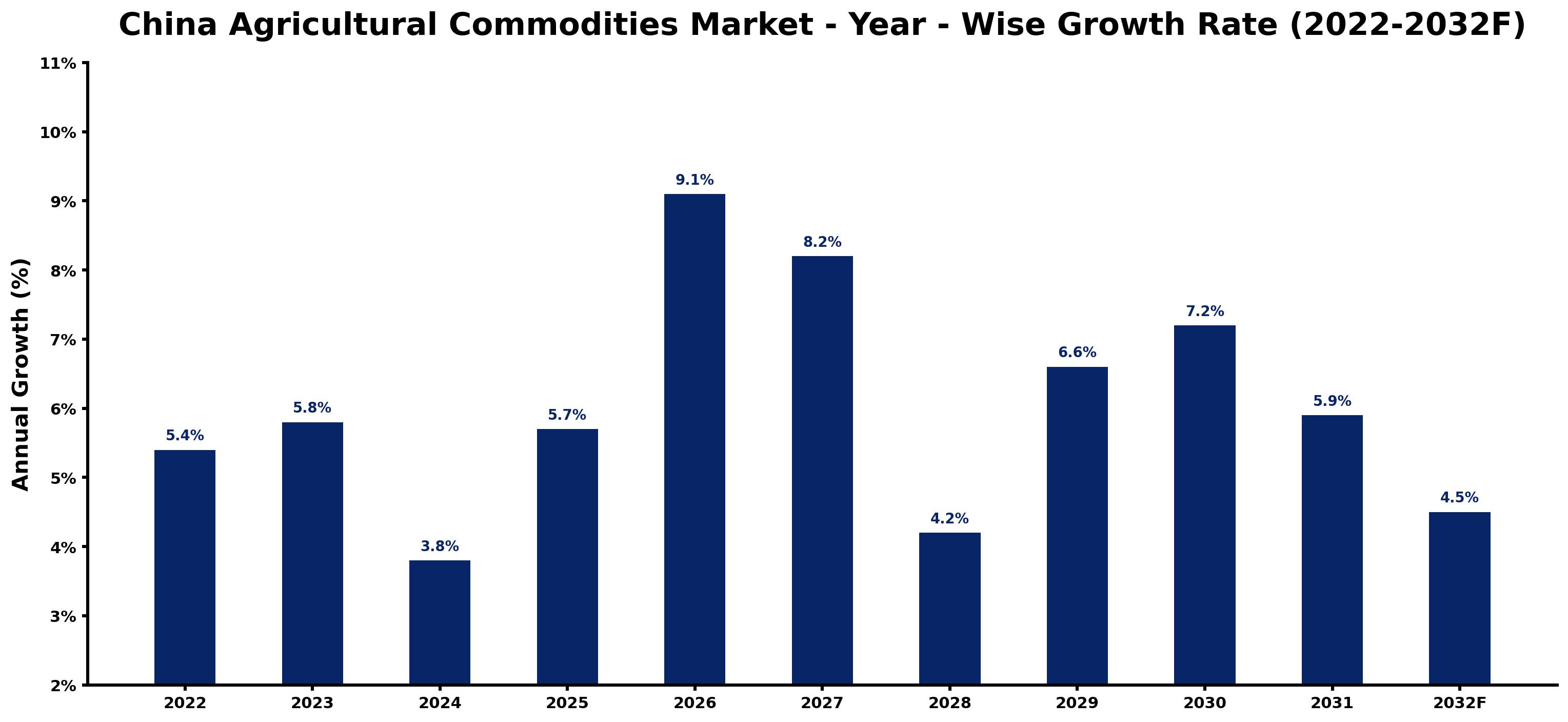
Each row of the following table gives one year's estimated growth and the event or demand shift that explains it.
| Year | Estimated Annual Growth (%) | Market Rationale |
| 2022 | 5.4 | The market exhibited solid growth due to high domestic demand for food commodities. |
| 2023 | 5.8 | Growth accelerated as agricultural exports reached approximately $70 billion, boosting market activity. |
| 2024 | 3.8 | A slowdown occurred as production faced challenges from adverse weather conditions affecting yields. |
| 2025 | 5.7 | Market growth rebounded with the implementation of the National Food Security Strategy to enhance grain production. |
| 2026 | 9.1 | The market peaked as demand surged, driven by increased consumption and export opportunities. |
| 2027 | 8.2 | Growth slowed as the market adjusted to the previous year's peak levels. |
| 2028 | 4.2 | A further slowdown was observed due to market saturation in certain commodity segments, particularly grains. |
| 2029 | 6.6 | Demand increased again as fruit exports rose, attracting more international buyers and boosting sales. |
| 2030 | 7.2 | Market growth continued as the textile industry expanded, increasing cotton consumption and demand. |
| 2031 | 5.9 | Growth decelerated as competition intensified among local producers in various segments. |
| 2032 | 4.5 | A slowdown persisted, influenced by evolving consumer preferences and market dynamics in agricultural products. |
Note: Market size estimations and growth projections presented in this report are based on 6Wresearch's proprietary forecasting methodology, utilizing the latest available industry data, government publications, and primary research inputs.
China Agricultural Commodities Market Synopsis
The Agricultural Commodities Market in China includes a variety of products from farming, such as grains, oilseeds, fruits, and cotton. These commodities play a crucial role in food, feed, and textiles. The market is expanding due to increasing domestic consumption and agricultural exports, which were valued at around $70 billion in 2022. The National Food Security Strategy and the Green Agricultural Development Plan are key drivers of this growth, promoting sustainable practices and boosting production capacity. Domestic users, including food processors and retail sectors, are major contributors to this demand.
Market Dynamics Impact Analysis (2026–2032)
| Factor | Type | Impact | Primary Segment Affected |
| Rising domestic consumption of food commodities | Driver | High | Grains |
| Increased agricultural exports to international markets | Driver | High | Fruits |
| Growing demand for eco-friendly farming practices | Opportunity | Medium | Cotton |
| Expansion of online trading platforms for agricultural products | Opportunity | Medium | Oilseeds |
| Weather-related challenges affecting crop yields | Restraint | High | Grains |
| Competition from international agricultural markets | Restraint | Medium | Fruits |
| Dependence on traditional farming methods | Challenge | High | Cotton |
| Rising operational costs for producers | Challenge | Medium | Oilseeds |
Evaluation of Drivers in China Agricultural Commodities Market (2026–2032)
The main growth drivers and the segments they affect most are set out below.
| Drivers | Primary Segment Affected | Why It Matters (Evidence) |
| High domestic demand for grains | Grains | Approximately 600 million tons of grains were produced in 2022, driving purchases from food processors. |
| Strong export growth in fruits | Fruits | The fruit market was valued at about 300 billion yuan in 2023, attracting international buyers. |
| Increased production of oilseeds for cooking oils | Oilseeds | Oilseed production reached 18 million tons in 2021, boosting demand from food manufacturers. |
| Expansion of the textile industry driving cotton demand | Cotton | The textile industry generated over $200 billion in revenue in 2022, increasing cotton purchases. |
| Growing agricultural cooperatives supporting farmers | Commodity Traders | Over 2,000 agricultural cooperatives exist, enhancing market access and liquidity for producers. |
Expansion of the Agricultural Commodities market in China is backed by rising domestic consumption, increased agricultural exports, and the growth of agricultural cooperatives. The production of grains reached approximately 600 million tons in 2022, driving demand from food processors. In 2023, the fruit market was valued at about 300 billion yuan, attracting international buyers eager for quality produce. Oilseed production, which reached 18 million tons in 2021, has boosted demand from food manufacturers looking for reliable sources. The textile industry, generating over $200 billion in revenue in 2022, has increased cotton purchases, further stimulating market growth.
Evaluation of Restraints in China Agricultural Commodities Market
Below mentioned are some major restraints and their influence on market dynamics.
| Market Restraint | Primary Segment Affected | Why It Matters (Evidence) |
| Weather-related challenges affecting crop yields | Grains | Adverse weather conditions have impacted grain production, leading to supply constraints and reduced availability. |
| Competition from international agricultural markets | Fruits | International producers offer competitive pricing, affecting local market share and profitability for domestic growers. |
| Dependence on traditional farming methods | Cotton | Many producers rely on outdated practices, limiting productivity and efficiency, which affects overall output. |
| Rising operational costs for producers | Oilseeds | Increased costs for inputs such as seeds and fertilizers strain profit margins for oilseed farmers. |
| Market saturation in certain commodity segments | Grains | Overproduction in previous years has led to reduced prices and profit margins for grain producers. |
China Agricultural Commodities Market Challenges
The China Agricultural Commodities Market still faces several significant issues, beginning with buyers grappling with high prices stemming from volatile input costs, which can increase by up to 15% in a single year. Suppliers struggle with limited access to modern agricultural technology, resulting in production delays that can extend by several weeks, ultimately raising costs for farmers. Intense competition exists among over 2,000 agricultural cooperatives, making it difficult for smaller producers to establish a foothold in the market. A lack of skilled labour in advanced farming techniques restricts productivity, leading to potential losses of around $14 billion annually for the agricultural sector.
Trends in the China Agricultural Commodities Market
Buyers and suppliers in the China Agricultural Commodities Market are adjusting to the following trends.
- Launch of the Green Agricultural Development Plan: The Green Agricultural Development Plan, approved in 2023 with a budget of 10 billion yuan, promotes eco-friendly farming practices. This initiative encourages sustainable methods among producers, improving market appeal and environmental impact.
- Shift towards Online Trading Platforms: Commodity Traders are increasingly using online exchanges for transactions, driven by technological advancements. This shift is reflected in an 8.5% CAGR for online exchanges, making trading more accessible and efficient.
- Increased Demand for Fresh Produce: Food processors are prioritising fresh and packaged fruits, which is evident from the rising market value. The segment is growing at a CAGR of 8.2%, indicating strong consumer preferences for quality produce.
- Expansion of Agricultural Cooperatives: The establishment of over 2,000 agricultural cooperatives since 2020 has improved market access for farmers. This network enhances liquidity and support for local producers, enabling better market positioning.
Investment Opportunities in the China Agricultural Commodities Market
Below are the investment opportunities with the strongest case in the China Agricultural Commodities Market.
- 10 billion yuan budget for eco-friendly farming: The Green Agricultural Development Plan presents an opportunity for investment in sustainable agricultural practices. Producers can partner with local cooperatives to implement eco-friendly initiatives and improve their market presence.
- Growing fruit export market valued at 300 billion yuan: The significant valuation of the fruit market presents an opportunity for exporters to expand their reach. Collaborating with international buyers can enhance market share and profitability.
- Emerging online trading platforms: The rise of online exchanges, projected to grow at 8.5%, presents a chance for traders to innovate. Entering partnerships with tech firms can facilitate this transition and improve trading efficiency.
- Increased demand for cotton in textiles: The textile industry, generating over $200 billion, offers an opportunity for cotton producers. Establishing joint ventures with manufacturers can improve production capabilities and market access.
Government Initiatives in the China Agricultural Commodities Market
The Green Agricultural Development Plan, approved in 2023, introduces a budget of 10 billion yuan to promote sustainable practices in agriculture. This initiative complements the National Food Security Strategy launched in 2021, which focuses on increasing grain production and self-sufficiency by 2025. Together, these measures aim to modernise agricultural practices and improve productivity across the sector, benefiting both producers and consumers.
The Modern Agricultural Development Program, initiated in 2022, allocates funding to support sustainable practices and technology adoption in farming. Additionally, the Agricultural Product Export Promotion Program, launched by the Ministry of Commerce in 2021, aims to enhance international competitiveness, providing resources for exporters to access global markets and improve their operations.
Future Insight of the China Agricultural Commodities Market
By 2032, the China Agricultural Commodities Market will undergo significant changes driven by initiatives like the 'Green Agricultural Development Plan' and the 'Modern Agricultural Development Program.' These strategies will promote sustainable practices and the adoption of advanced technologies, improving productivity for both buyers and suppliers. The National Food Security Strategy aims to boost grain self-sufficiency, reinforcing supply chains. Additionally, the installed base of agricultural machinery is projected to grow, facilitating more efficient farming operations and enhancing overall output.
Market Segmentation Analysis
The analysis below covers each segmentation, its leading category in 2025 and its fastest-growing category through 2032.
By Agricultural Commodities Market – Grains Dominated, Fruits Expected to Grow Fastest
According to Ravi Bhandari, Research Head at 6Wresearch, Grains accounted for a 39% market share by agricultural commodities market in 2025. Grains hold the largest share in China's agricultural commodities market due to their critical role in ensuring food security and providing animal feed. With approximately 600 million tons produced in 2022, grains are indispensable for both domestic consumption and export activities. Fruits are set to record the highest CAGR in this split, 8.2% over 2026–2032. Fruits are the fastest-growing segment, driven by rising domestic consumption and strong export demand, with the fruit market valued at about 300 billion yuan in 2023. This growth reflects a shift towards healthier eating habits and a preference for fresh produce among consumers. Suppliers should focus on expanding their fruit offerings to capitalise on the growing consumer demand for fresh products.
By Commodity Type – Raw Dominated, Fresh/Packaged Expected to Grow Fastest
With a 43% revenue share in 2025, Raw was the largest commodity type category. Raw agricultural commodities lead the market as they serve as foundational products for further processing in various sectors. Their essential role in the supply chain ensures consistent demand from processors and manufacturers alike. Over 2026–2032, Fresh/Packaged is expected to post the fastest growth, at a CAGR of 8.5%. Fresh/Packaged commodities are experiencing rapid growth due to changing consumer preferences for convenience and quality, making them increasingly relevant in the consumer market. This trend underscores the rising demand for fresh options in everyday diets. Suppliers need to adjust their strategies to incorporate more fresh and packaged offerings to align with consumer expectations.
By Processing Type – Commodity Traders Dominated, Online Exchanges Expected to Grow Fastest
Commodity Traders took a 46% share of processing type in 2025, more than any other category. Commodity Traders dominate the processing types as they facilitate market access and maintain liquidity for agricultural products. Their established networks and expertise are crucial for ensuring smooth transactions within the market. The quickest growth will come from Online Exchanges, forecast to expand at a CAGR of 8.5% between 2026 and 2032. Online Exchanges are emerging as a rapidly growing trading platform, reflecting a shift towards digital solutions in the agricultural sector. This growth is fuelled by the demand for efficiency and transparency in trading processes. Suppliers should explore online platforms to broaden their market reach and improve operational efficiency.
By Distribution Channel – Food Processors Dominated, Supermarket Chains Expected to Grow Fastest
The largest distribution channel category in 2025 was Food Processors, with a 48% share of total revenue. Food Processors represent the largest share in distribution channels, being major consumers of agricultural products and directly influencing demand. Their pivotal role in converting raw commodities into consumable goods ensures a reliable supply chain. Supermarket Chains are projected to grow fastest, at a CAGR of 8.9% during 2026–2032. Supermarket Chains are the fastest-growing distribution channel, highlighting the increasing importance of retail in delivering agricultural products to consumers. Their extensive reach and convenience make them essential in the distribution framework. Suppliers must strengthen their partnerships with supermarket chains to effectively distribute their products and meet rising consumer demand.
Key Attractiveness of the Report
- 10 Years of Market Numbers
- Historical Data Starting from 2022 to 2025
- Base Year 2025
- Forecast Data until 2032
- Key Performance Indicators Impacting the Market
- Major Upcoming Developments and Projects
Key Highlights of the Report:
- China Agricultural Commodities Market Outlook
- Market Size of China Agricultural Commodities Market, 2025
- Forecast of China Agricultural Commodities Market, 2032
- Historical Data and Forecast of China Agricultural Commodities Revenues & Volume for the Period 2022 - 2032F
- China Agricultural Commodities Market Trend Evolution
- China Agricultural Commodities Market Drivers and Challenges
- China Agricultural Commodities Price Trends
- China Agricultural Commodities Porter's Five Forces
- China Agricultural Commodities Industry Life Cycle
- Historical Data and Forecast of China Agricultural Commodities Market Revenues & Volume By Agricultural Commodities Market for the Period 2022 - 2032F
- Historical Data and Forecast of China Agricultural Commodities Market Revenues & Volume By Grains for the Period 2022 - 2032F
- Historical Data and Forecast of China Agricultural Commodities Market Revenues & Volume By Oilseeds for the Period 2022 - 2032F
- Historical Data and Forecast of China Agricultural Commodities Market Revenues & Volume By Fruits for the Period 2022 - 2032F
- Historical Data and Forecast of China Agricultural Commodities Market Revenues & Volume By Cotton for the Period 2022 - 2032F
- Historical Data and Forecast of China Agricultural Commodities Market Revenues & Volume By Commodity Type for the Period 2022 - 2032F
- Historical Data and Forecast of China Agricultural Commodities Market Revenues & Volume By Raw for the Period 2022 - 2032F
- Historical Data and Forecast of China Agricultural Commodities Market Revenues & Volume By Crushed for the Period 2022 - 2032F
- Historical Data and Forecast of China Agricultural Commodities Market Revenues & Volume By Fresh/Packaged for the Period 2022 - 2032F
- Historical Data and Forecast of China Agricultural Commodities Market Revenues & Volume By Ginned/Baled for the Period 2022 - 2032F
- Historical Data and Forecast of China Agricultural Commodities Market Revenues & Volume By Processing Type for the Period 2022 - 2032F
- Historical Data and Forecast of China Agricultural Commodities Market Revenues & Volume By Commodity Traders for the Period 2022 - 2032F
- Historical Data and Forecast of China Agricultural Commodities Market Revenues & Volume By Export Channels for the Period 2022 - 2032F
- Historical Data and Forecast of China Agricultural Commodities Market Revenues & Volume By Direct-to-Retail for the Period 2022 - 2032F
- Historical Data and Forecast of China Agricultural Commodities Market Revenues & Volume By Online Exchanges for the Period 2022 - 2032F
- Historical Data and Forecast of China Agricultural Commodities Market Revenues & Volume By Distribution Channel for the Period 2022 - 2032F
- Historical Data and Forecast of China Agricultural Commodities Market Revenues & Volume By Wholesale Buyers for the Period 2022 - 2032F
- Historical Data and Forecast of China Agricultural Commodities Market Revenues & Volume By Food Processors for the Period 2022 - 2032F
- Historical Data and Forecast of China Agricultural Commodities Market Revenues & Volume By Supermarket Chains for the Period 2022 - 2032F
- Historical Data and Forecast of China Agricultural Commodities Market Revenues & Volume By Textile Manufacturers for the Period 2022 - 2032F
- China Agricultural Commodities Import Export Trade Statistics
- Market Opportunity Assessment By Agricultural Commodities Market
- Market Opportunity Assessment By Commodity Type
- Market Opportunity Assessment By Processing Type
- Market Opportunity Assessment By Distribution Channel
- China Agricultural Commodities Top Companies Market Share
- China Agricultural Commodities Competitive Benchmarking By Technical and Operational Parameters
- China Agricultural Commodities Company Profiles
- China Agricultural Commodities Key Strategic Recommendations
Market Covered
This report examines the market across the segments below.
By Agricultural Commodities Market
- Grains
- Oilseeds
- Fruits
- Cotton
By Commodity Type
- Raw
- Crushed
- Fresh/Packaged
- Ginned/Baled
By Processing Type
- Commodity Traders
- Export Channels
- Direct-to-Retail
- Online Exchanges
By Distribution Channel
- Wholesale Buyers
- Food Processors
- Supermarket Chains
- Textile Manufacturers































