China Agricultural Insecticides Market Size & Growth Rate
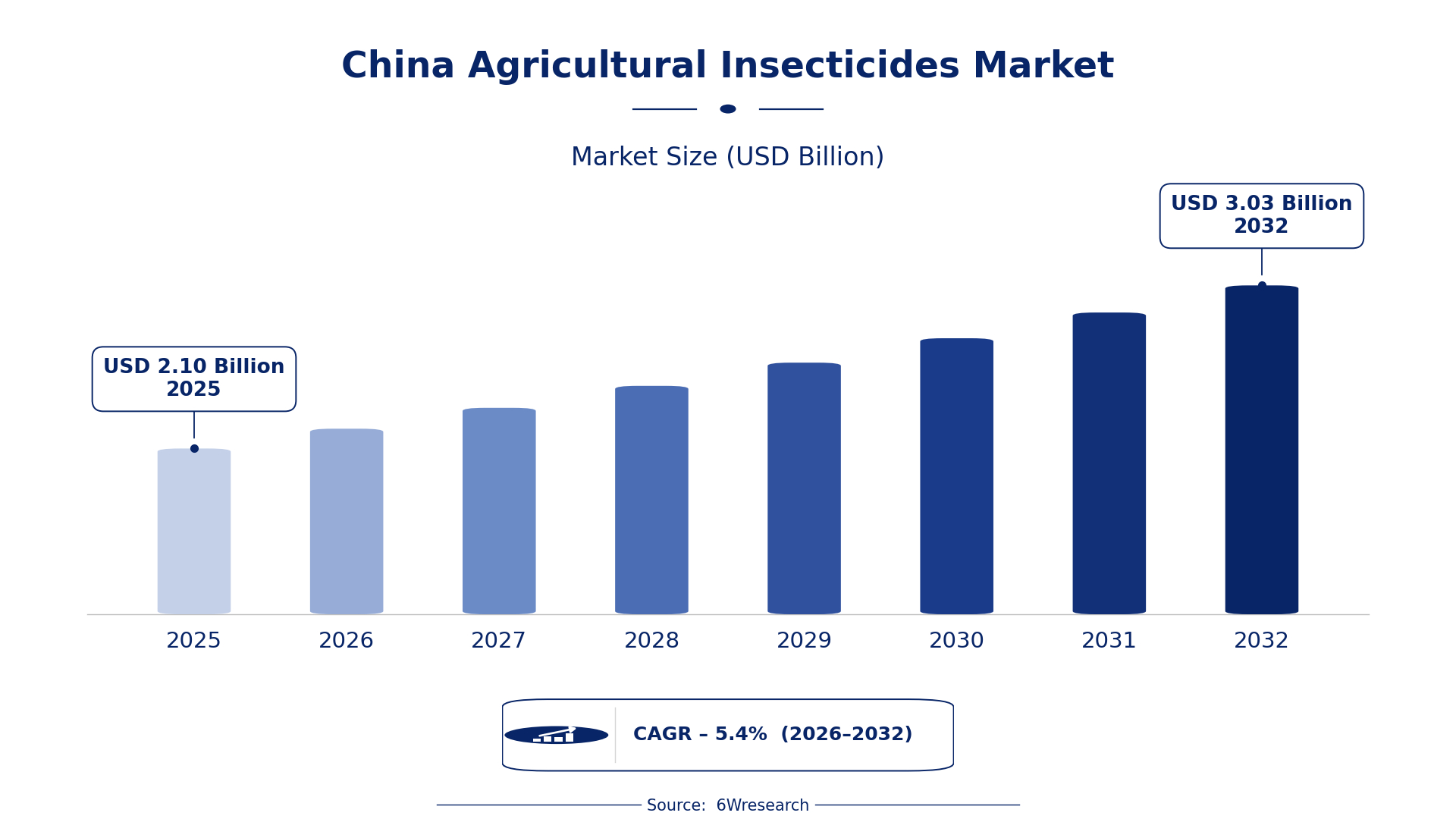
According to 6Wresearch internal database and industry insights, the China Agricultural Insecticides Market was valued at USD 2.10 billion in 2025 and is projected to reach USD 3.03 billion by 2032, growing at a CAGR of approximately 5.4% during 2026–2032.
China Agricultural Insecticides Market Highlights
| Report Metric | Details |
| Report Name | China Agricultural Insecticides Market |
| Market Size 2025 | USD 2.10 billion |
| Market Size 2032 | USD 3.03 billion |
| Absolute Growth 2025–2032 | USD 0.93 billion |
| CAGR 2026–2032 | 5.4% |
| Peak Annual Growth | 7.7% in 2032 |
| Forecast Period | 2026–2032 |
| Historical Data | 2022–2025 |
| Base Year | 2025 |
| Leading Agricultural Insecticides Market, 2025 | Pyrethroids (51% share) |
| Leading Product Type, 2025 | Leaf-Eating Insects (50% share) |
| Leading Target Insects, 2025 | Direct Sales (40% share) |
| Leading Distribution Channel, 2025 | Sugarcane Growers (44% share) |
| Fastest-Growing Agricultural Insecticides Market | Bio-Insecticides (7.3% CAGR) |
| Fastest-Growing Product Type | Eco-friendly Targets (7.2% CAGR) |
| Fastest-Growing Target Insects | Agri Shops (8.1% CAGR) |
| Fastest-Growing Distribution Channel | Cotton Farmers (8.2% CAGR) |
| Growing Sector | Cotton Farming |
| Key End Users | Cotton Farmers, Fruit Growers, Sugarcane Growers, Organic Farms |
China Agricultural Insecticides Market Year-wise Growth Rate and Key Drivers (2022–2032)
This graph illustrates the annual growth rates of the market from 2022 to 2032, highlighting a steady upward trajectory and projected market expansion over the forecast period.
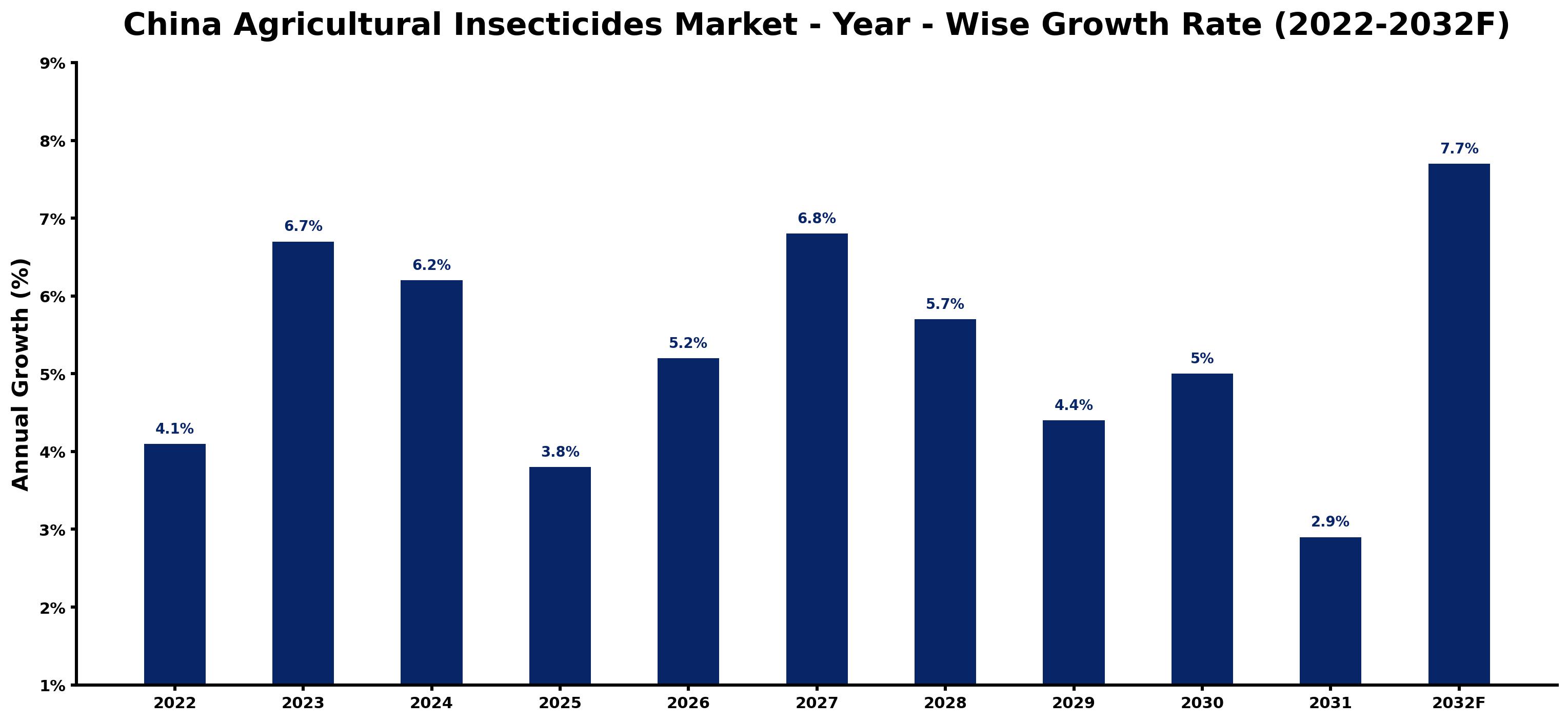
The table below sets out the estimated growth rate for each year and the main factor behind it.
| Year | Estimated Annual Growth (%) | Market Rationale |
| 2022 | 4.1 | The market experienced steady growth due to existing agricultural practices and pest management needs, supported by the National Agro-Tech Extension and Service Center's initiatives. |
| 2023 | 6.7 | Increased demand for effective pest control methods boosted market performance as the cotton industry expanded in regions like Xinjiang. |
| 2024 | 6.2 | The growth rate slowed as farmers began adopting more sustainable practices, influenced by the Integrated Pest Management Promotion Program. |
| 2025 | 3.8 | A decrease in growth was noted as the market adjusted to new regulations and standards set by the updated 'Pesticide Registration Management Regulations'. |
| 2026 | 5.2 | The market is expected to rebound with improved pest management techniques and farmer education initiatives through the National Pesticide Industry Association. |
| 2027 | 6.8 | Higher demand for effective insecticides will drive growth as crop yields are prioritised, particularly in the cotton sector. |
| 2028 | 5.7 | Growth is projected to slow as farmers increasingly explore eco-friendly alternatives and practices, driven by the 'China Green Food Development Center'. |
| 2029 | 4.4 | The market will continue to grow, albeit at a slower pace, as farmers adjust to changing regulations and the push for sustainable practices. |
| 2030 | 5.0 | An uptick in growth is expected as new insecticide formulations gain popularity among farmers, particularly in the fruit growing regions. |
| 2031 | 2.9 | The growth rate will slow as the market stabilises under new regulatory frameworks, influenced by the government's target to reduce pesticide use by 30%. |
| 2032 | 7.7 | A surge in demand is expected as the market adapts to innovative pest control solutions, particularly in the bio-insecticides segment. |
Note: Market size estimations and growth projections presented in this report are based on 6Wresearch's proprietary forecasting methodology, utilizing the latest available industry data, government publications, and primary research inputs.
China Agricultural Insecticides Market Synopsis
The China Agricultural Insecticides Market includes chemical substances designed to control pests that threaten crops. These insecticides are created through chemical synthesis or biological processes, primarily aimed at protecting crops and ensuring food security. Demand from farmers is increasing, particularly in the cotton sector, alongside the adoption of integrated pest management practices. The government's 'Green Agriculture Development Plan' targets a 30% reduction in pesticide use by 2025, further stimulating the need for effective insecticides. In 2022, over 1.5 million tons of agricultural insecticides were produced, showcasing robust sector activity.
Market Dynamics Impact Analysis (2026–2032)
| Factor | Type | Impact | Primary Segment Affected |
| Increased focus on sustainable farming practices | Driver | High | Bio-Insecticides |
| Growing population of farmers seeking effective pest control | Driver | High | Organophosphates |
| Rising interest in eco-friendly pest management solutions | Opportunity | High | Eco-friendly Targets |
| Expansion of the cotton farming sector in key regions | Opportunity | High | Cotton Farmers |
| Regulatory challenges affecting pesticide approval processes | Restraint | High | Neonicotinoids |
| Limited awareness among farmers about new pest management techniques | Restraint | Medium | Bio-Insecticides |
| Market faces challenges from stringent regulatory compliance requirements | Challenge | High | Pyrethroids |
| Competition from alternative pest control methods is intensifying | Challenge | Medium | Pyrethroids |
Evaluation of Drivers in China Agricultural Insecticides Market (2026–2032)
Key forces behind demand, with the segment each one moves most, are listed below.
| Drivers | Primary Segment Affected | Why It Matters (Evidence) |
| Rising adoption of integrated pest management practices | Bio-Insecticides | This approach encourages farmers to use more sustainable pest control methods, increasing demand for bio-insecticides, which accounted for about 10% of the market in 2023. |
| Growing cotton industry in regions like Xinjiang | Organophosphates | The cotton industry in China is a major user of insecticides, particularly in Xinjiang province, driving demand for effective pest control solutions. |
| Government initiatives promoting eco-friendly practices | Eco-friendly Targets | The 'Green Agriculture Development Plan' aims to reduce pesticide use by 30% by 2025, encouraging farmers to seek eco-friendly alternatives, thereby boosting demand for bio-insecticides. |
| Increase in the number of farmers in China | Cotton Farmers | With approximately 200 million farmers in China, there is a growing market for agricultural insecticides to enhance crop yields and ensure food security. |
| Rising awareness of pest management among farmers | Neonicotinoids | Education initiatives are leading to greater adoption of neonicotinoids, which are effective against sap-sucking insects, driving market growth. |
Expansion of the Agricultural Insecticides market in China is backed by rising adoption of integrated pest management practices and a growing population of farmers. In 2022, the agricultural sector produced over 1.5 million tons of insecticides, reflecting strong demand. The cotton industry is a major user of these products, driving purchases of organophosphates, particularly in Xinjiang. The number of farmers in China, approximately 200 million, continues to expand, creating a larger customer base for agricultural insecticides.
Evaluation of Restraints in China Agricultural Insecticides Market
The table below lists the restraints and the evidence behind each.
| Market Restraint | Primary Segment Affected | Why It Matters (Evidence) |
| Stringent regulatory compliance requirements for pesticide approval | Neonicotinoids | The updated 'Pesticide Registration Management Regulations' in 2022 have made it more challenging for new products to enter the market, impacting availability. |
| Limited awareness about sustainable pest management techniques | Bio-Insecticides | Many farmers remain unaware of the benefits of bio-insecticides, slowing their adoption despite growing interest in eco-friendly solutions. |
| High costs associated with developing new insecticide formulations | Organophosphates | Investment in research and development for effective organophosphate products can be prohibitive, limiting market entry for smaller producers. |
| Concerns over pesticide residue and food safety | Pyrethroids | Increased scrutiny from consumers and regulatory bodies regarding pesticide residues can deter farmers from using certain insecticides. |
| Competition from alternative pest control methods | Eco-friendly Targets | As farmers explore organic and alternative pest control methods, the demand for traditional insecticides may face challenges. |
China Agricultural Insecticides Market Challenges
The China Agricultural Insecticides Market faces practical challenges, starting with supply chain inefficiencies. In 2022, the annual pesticide application rate reached around 1.5 million tons, straining logistics for producers and delaying product availability for farmers. Technological limitations are apparent, as many manufacturers depend on outdated chemical synthesis methods, raising production costs for buyers. Competition from bio-insecticides, which comprised about 10% of the market in 2023, pressures traditional insecticide producers to innovate or risk losing market share. Regulatory changes, such as the updated 'Pesticide Registration Management Regulations' in 2021, complicate the approval process, causing further delays for suppliers.
Trends in the China Agricultural Insecticides Market
Several trends are reshaping the China Agricultural Insecticides Market; the most important are set out below.
- Shift towards Eco-friendly Pest Management: Since 2021, there has been a noticeable shift towards eco-friendly pest management practices in China. The 'China Green Food Development Center' promotes these methods, with bio-insecticides making up about 10% of the market in 2023.
- Rise of Direct Sales Channels: In 2022, direct sales emerged as a preferred method for reaching farmers in China. This channel accounted for 40% of the market share, reflecting the growing need for accessible pest control solutions.
- Increase in Organic Farming Practices: Organic farming is gaining traction, with over 3 million hectares certified as organic by 2023. This trend is pushing farmers to seek eco-friendly pest control solutions that comply with organic standards.
- Adoption of Integrated Pest Management Strategies: The Integrated Pest Management Promotion Program, established in 2023, is educating farmers on sustainable pest control, leading to increased adoption of eco-friendly practices and products.
Investment Opportunities in the China Agricultural Insecticides Market
The following opportunities in the China Agricultural Insecticides Market pair current demand with a clear way in.
- Cotton Farmers Seeking Effective Solutions: Cotton farmers in Xinjiang are increasingly in search of effective pest control solutions, with the market for agricultural insecticides projected to grow, reaching USD 3.03 billion by 2032.
- Partnerships with Local Agricultural Cooperatives: With the rising demand for bio-insecticides, forming partnerships with local agricultural cooperatives can facilitate market entry and improve distribution channels for suppliers.
- Investment in Eco-friendly Product Development: As the market for eco-friendly pest control expands, investing in the development of bio-insecticides presents a notable opportunity, particularly with government support for sustainable practices.
- Expansion in Fruit Growing Regions: Fruit growers, especially in regions with 15 million hectares planted, are seeking effective pest control solutions, creating opportunities for suppliers of agricultural insecticides.
Government Initiatives in the China Agricultural Insecticides Market
The 'Green Agriculture Development Plan', launched in 2021 by the Ministry of Agriculture and Rural Affairs, aims to reduce pesticide use by 30% by 2025. This initiative encourages farmers to adopt more sustainable practices and enhances the regulatory framework for pesticide use. Additionally, the 'Pesticide Registration Management Regulations', updated in 2022, streamline the approval process for new products, ensuring safety and efficacy assessments are met. These measures support producers in complying with regulations while promoting environmentally-friendly pest control solutions.
The National Agro-Tech Extension and Service Center promotes integrated pest management practices, providing education and resources to farmers. This agency supports initiatives that help farmers transition to more sustainable pest control methods, enhancing their knowledge and encouraging the use of bio-insecticides. Additionally, the 'Integrated Pest Management Promotion Program', established in 2023, funds educational workshops and training sessions for farmers, focusing on sustainable pest control techniques. These efforts are essential in shaping the future of pest management in China, ensuring that buyers have access to effective and environmentally-friendly solutions.
Future Insight of the China Agricultural Insecticides Market
The China Agricultural Insecticides Market is set for notable developments by 2032, influenced by several key factors. The government's commitment to reducing pesticide use under the 'Green Agriculture Development Plan' will drive suppliers towards sustainable practices. Technological advancements in pest management, propelled by research from institutions like the Cotton Research Institute, will improve product efficacy and safety. The area of certified organic farming, exceeding 3 million hectares, will create new opportunities for producers to develop eco-friendly solutions. The market for neonicotinoids is expected to grow, driven by their effectiveness against sap-sucking insects.
Market Segmentation Analysis
Each segment group is reviewed below, with the leader by share and the fastest grower by CAGR.
By Agricultural Insecticides Market – Pyrethroids Dominated, Bio-Insecticides Expected to Grow Fastest
According to Ravi Bhandari, Research Head at 6Wresearch, Pyrethroids accounted for a 51% market share by agricultural insecticides market in 2025. Pyrethroids hold the largest market share due to their proven effectiveness against a wide range of pests, making them indispensable for farmers. In regions like Xinjiang, where cotton production is prevalent, pyrethroids are extensively applied to protect crops from infestations. The quickest growth will come from Bio-Insecticides, forecast to expand at a CAGR of 7.3% between 2026 and 2032. Bio-insecticides are experiencing rapid growth as farmers increasingly prefer environmentally friendly pest control options. The rising focus on sustainable agriculture and government policies aimed at reducing pesticide usage are driving this segment's expansion. Suppliers must focus on developing eco-friendly agricultural insecticides to meet the growing demand for sustainable solutions.
By Product Type – Leaf-Eating Insects Dominated, Eco-friendly Targets Expected to Grow Fastest
Leaf-Eating Insects took a 50% share of product type in 2025, more than any other category. Leaf-eating insects account for the largest market share as they are a primary target for agricultural insecticides, necessitating effective control measures. This segment's significance is highlighted by the widespread use of insecticides across various crops to combat these pests. Over 2026–2032, Eco-friendly Targets are expected to post the fastest growth, at a CAGR of 7.2%. Eco-friendly targets are gaining momentum as consumer preferences shift towards sustainable agricultural practices. The growing interest in organic farming and eco-conscious products is driving the rapid expansion of this segment. Suppliers must adapt their product offerings to include eco-friendly options to meet the evolving market demands.
By Target Insects – Direct Sales Dominated, Agri Shops Expected to Grow Fastest
In 2025, Direct Sales led the target insects split with a 40% share. Direct sales capture the largest market share as they offer a straightforward method for farmers to purchase insecticides directly from suppliers. This method is particularly effective in reaching China's vast farmer population, estimated at around 200 million. Agri Shops are set to record the highest CAGR in this split, 8.1% over 2026–2032. Agri shops are the fastest-growing distribution channel, providing farmers with convenient access to insecticides. The proliferation of agri shops across rural areas facilitates easier procurement of essential pest control products for farmers. Suppliers should enhance collaboration with agri shops to improve distribution and better serve the needs of farmers.
By Distribution Channel – Sugarcane Growers Dominated, Cotton Farmers Expected to Grow Fastest
The largest distribution channel category in 2025 was Sugarcane Growers, with a 44% share of total revenue. Sugarcane growers represent the largest share in the distribution channel, relying heavily on insecticides for effective pest management. Their significant agricultural presence ensures a steady demand for pest control solutions. Cotton Farmers are projected to grow fastest, at a CAGR of 8.2% during 2026–2032. Cotton farmers are the fastest-growing group in this channel, driven by the high pest pressures associated with cotton cultivation. As cotton remains a key crop in China, the need for effective insecticides is on the rise. Suppliers should build strong relationships with cotton farmers to leverage the increasing demand in this vital agricultural sector.
Key Attractiveness of the Report
- 10 Years of Market Numbers
- Historical Data Starting from 2022 to 2025
- Base Year 2025
- Forecast Data until 2032
- Key Performance Indicators Impacting the Market
- Major Upcoming Developments and Projects
Key Highlights of the Report:
- China Agricultural Insecticides Market Outlook
- Market Size of China Agricultural Insecticides Market, 2025
- Forecast of China Agricultural Insecticides Market, 2032
- Historical Data and Forecast of China Agricultural Insecticides Revenues & Volume for the Period 2022 - 2032F
- China Agricultural Insecticides Market Trend Evolution
- China Agricultural Insecticides Market Drivers and Challenges
- China Agricultural Insecticides Price Trends
- China Agricultural Insecticides Porter's Five Forces
- China Agricultural Insecticides Industry Life Cycle
- Historical Data and Forecast of China Agricultural Insecticides Market Revenues & Volume By Agricultural Insecticides Market for the Period 2022 - 2032F
- Historical Data and Forecast of China Agricultural Insecticides Market Revenues & Volume By Organophosphates for the Period 2022 - 2032F
- Historical Data and Forecast of China Agricultural Insecticides Market Revenues & Volume By Pyrethroids for the Period 2022 - 2032F
- Historical Data and Forecast of China Agricultural Insecticides Market Revenues & Volume By Neonicotinoids for the Period 2022 - 2032F
- Historical Data and Forecast of China Agricultural Insecticides Market Revenues & Volume By Bio-Insecticides for the Period 2022 - 2032F
- Historical Data and Forecast of China Agricultural Insecticides Market Revenues & Volume By Product Type for the Period 2022 - 2032F
- Historical Data and Forecast of China Agricultural Insecticides Market Revenues & Volume By Leaf-Eating Insects for the Period 2022 - 2032F
- Historical Data and Forecast of China Agricultural Insecticides Market Revenues & Volume By Flying Insects for the Period 2022 - 2032F
- Historical Data and Forecast of China Agricultural Insecticides Market Revenues & Volume By Sap-Sucking Insects for the Period 2022 - 2032F
- Historical Data and Forecast of China Agricultural Insecticides Market Revenues & Volume By Eco-friendly Targets for the Period 2022 - 2032F
- Historical Data and Forecast of China Agricultural Insecticides Market Revenues & Volume By Target Insects for the Period 2022 - 2032F
- Historical Data and Forecast of China Agricultural Insecticides Market Revenues & Volume By Direct Sales for the Period 2022 - 2032F
- Historical Data and Forecast of China Agricultural Insecticides Market Revenues & Volume By Agri Shops for the Period 2022 - 2032F
- Historical Data and Forecast of China Agricultural Insecticides Market Revenues & Volume By Online Platforms for the Period 2022 - 2032F
- Historical Data and Forecast of China Agricultural Insecticides Market Revenues & Volume By Specialty Stores for the Period 2022 - 2032F
- Historical Data and Forecast of China Agricultural Insecticides Market Revenues & Volume By Distribution Channel for the Period 2022 - 2032F
- Historical Data and Forecast of China Agricultural Insecticides Market Revenues & Volume By Sugarcane Growers for the Period 2022 - 2032F
- Historical Data and Forecast of China Agricultural Insecticides Market Revenues & Volume By Cotton Farmers for the Period 2022 - 2032F
- Historical Data and Forecast of China Agricultural Insecticides Market Revenues & Volume By Fruit Growers for the Period 2022 - 2032F
- Historical Data and Forecast of China Agricultural Insecticides Market Revenues & Volume By Organic Farms for the Period 2022 - 2032F
- China Agricultural Insecticides Import Export Trade Statistics
- Market Opportunity Assessment By Agricultural Insecticides Market
- Market Opportunity Assessment By Product Type
- Market Opportunity Assessment By Target Insects
- Market Opportunity Assessment By Distribution Channel
- China Agricultural Insecticides Top Companies Market Share
- China Agricultural Insecticides Competitive Benchmarking By Technical and Operational Parameters
- China Agricultural Insecticides Company Profiles
- China Agricultural Insecticides Key Strategic Recommendations
Market Covered
Segments analysed in this report are listed below.
By Agricultural Insecticides Market
- Organophosphates
- Pyrethroids
- Neonicotinoids
- Bio-Insecticides
By Product Type
- Leaf-Eating Insects
- Flying Insects
- Sap-Sucking Insects
- Eco-friendly Targets
By Target Insects
- Direct Sales
- Agri Shops
- Online Platforms
- Specialty Stores
By Distribution Channel
- Sugarcane Growers
- Cotton Farmers
- Fruit Growers
- Organic Farms































