China Agricultural Repellents Market Size & Growth Rate
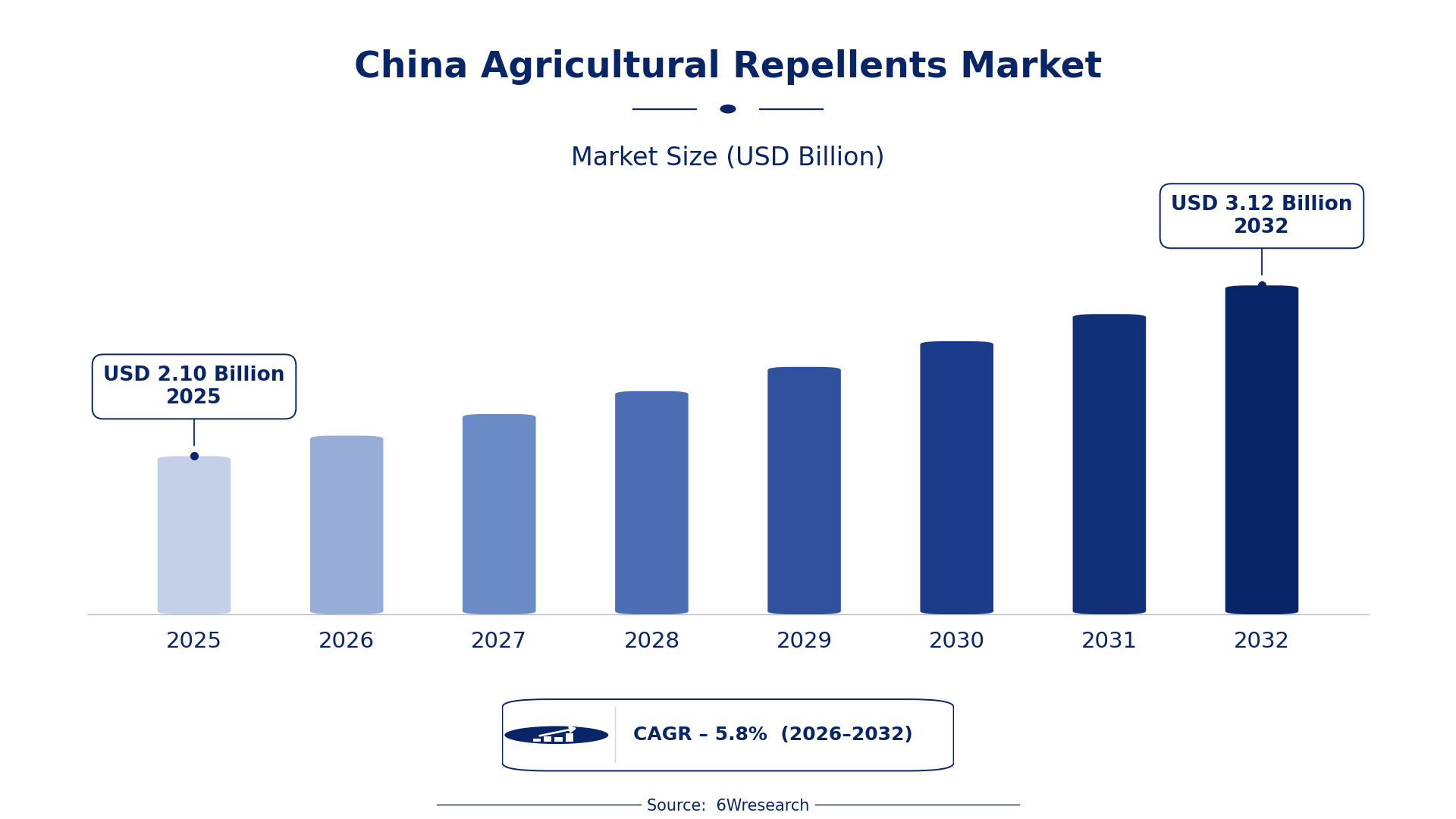
According to 6Wresearch internal database and industry insights, the China Agricultural Repellents Market was valued at USD 2.10 billion in 2025 and is projected to reach USD 3.12 billion by 2032, growing at a CAGR of approximately 5.8% during 2026–2032.
China Agricultural Repellents Market Highlights
| Report Metric | Details |
| Report Name | China Agricultural Repellents Market |
| Market Size 2025 | USD 2.10 billion |
| Market Size 2032 | USD 3.12 billion |
| Absolute Growth 2025–2032 | USD 1.02 billion |
| CAGR 2026–2032 | 5.8% |
| Peak Annual Growth | 8.6% in 2032 |
| Forecast Period | 2026–2032 |
| Historical Data | 2022–2025 |
| Base Year | 2025 |
| Leading Agricultural Repellents Market, 2025 | Chemical Repellents (49% share) |
| Leading Product Type, 2025 | Insects (47% share) |
| Leading Target Type, 2025 | Agri Retailers (50% share) |
| Leading Distribution Channel, 2025 | Crop Growers (52% share) |
| Fastest-Growing Agricultural Repellents Market | Natural Repellents (8.0% CAGR) |
| Fastest-Growing Product Type | Herbivores (7.0% CAGR) |
| Fastest-Growing Target Type | Online Platforms (8.4% CAGR) |
| Fastest-Growing Distribution Channel | Organic Farms (7.2% CAGR) |
| Growing Sector | Organic Farming |
| Key End Users | Crop Growers, Agri Retailers, Organic Farms, Horticulture Units |
China Agricultural Repellents Market Year-wise Growth Rate and Key Drivers (2022–2032)
This graph illustrates the annual growth rates of the market from 2022 to 2032, highlighting a steady upward trajectory and projected market expansion over the forecast period.
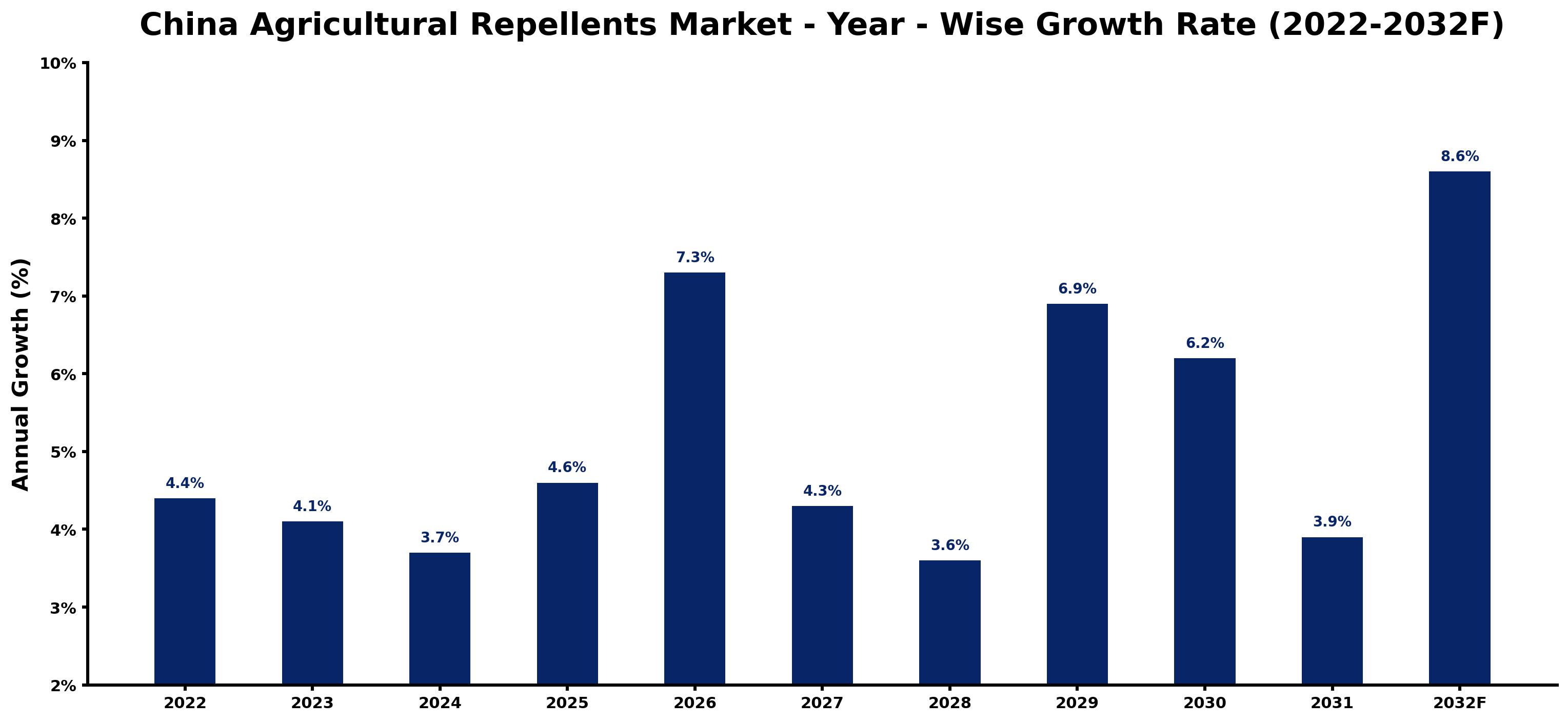
The table below sets out the estimated growth rate for each year and the main factor behind it.
| Year | Estimated Annual Growth (%) | Market Rationale |
| 2022 | 4.4 | The agricultural sector employed over 300 million people, driving demand for pest control solutions. |
| 2023 | 4.1 | Natural repellents gained traction as organic farming increased by 20% annually, boosting their demand. |
| 2024 | 3.7 | The market saw a slowdown as the focus shifted to integrating more sustainable practices in pest management. |
| 2025 | 4.6 | Chemical repellents remained dominant, capturing 49% of the market share, as crop yields improved. |
| 2026 | 7.3 | The introduction of the Green Agriculture Development Plan is expected to spur growth in sustainable pest management solutions. |
| 2027 | 4.3 | Demand for natural repellents will continue to rise, reflecting a growing consumer preference for eco-friendly products. |
| 2028 | 3.6 | The market is projected to experience a slowdown as the focus on chemical regulations intensifies, affecting availability. |
| 2029 | 6.9 | Online platforms are expected to surge, with a 30% increase in sales, improving access to agricultural repellents. |
| 2030 | 6.2 | The market is projected to slow as the government pushes for stricter regulations on chemical use in agriculture. |
| 2031 | 3.9 | The Integrated Pest Management strategy will encourage the adoption of natural alternatives, supporting growth. |
| 2032 | 8.6 | The market is expected to peak with an 8.6% growth rate, driven by increased investments in sustainable practices. |
Note: Market size estimations and growth projections presented in this report are based on 6Wresearch's proprietary forecasting methodology, utilizing the latest available industry data, government publications, and primary research inputs.
China Agricultural Repellents Market Synopsis
The China Agricultural Repellents Market covers substances used to deter pests from crops, made from natural or synthetic chemicals. These repellents protect crops from damage and improve agricultural yields. The market is growing due to the agricultural sector, which employs over 300 million people. The Green Agriculture Development Plan and rising organic farming are key drivers, alongside increased online sales of agricultural products. Demand for eco-friendly pest control methods is shaping the market's future, supported by government initiatives.
Market Dynamics Impact Analysis (2026–2032)
| Factor | Type | Impact | Primary Segment Affected |
| Growing organic farming practices drive demand for natural repellents. | Driver | High | Natural Repellents |
| Increased online sales channels enhance accessibility for farmers. | Driver | High | Online Platforms |
| Rising consumer preference for eco-friendly products presents a market opportunity. | Opportunity | High | Natural Repellents |
| The shift towards sustainable pest management creates demand for innovative solutions. | Opportunity | High | Chemical Repellents |
| Stricter regulations on chemical use may limit product availability. | Restraint | High | Chemical Repellents |
| Limited awareness of natural alternatives restricts market growth. | Restraint | Medium | Natural Repellents |
| High production costs for natural repellents pose challenges to suppliers. | Challenge | Medium | Natural Repellents |
| Competition from cheaper chemical alternatives affects market penetration. | Challenge | Medium | Chemical Repellents |
Evaluation of Drivers in China Agricultural Repellents Market (2026–2032)
The main growth drivers and the segments they affect most are set out below.
| Drivers | Primary Segment Affected | Why It Matters (Evidence) |
| Growing demand for organic produce increases the need for natural repellents. | Natural Repellents | Organic farming in China has increased by 20% annually, boosting demand for eco-friendly pest control. |
| The rise of e-commerce platforms facilitates easier access to agricultural products. | Online Platforms | Online sales of agricultural products surged by 30% last year, improving purchasing options for farmers. |
| Government initiatives promote sustainable practices in pest management. | Chemical Repellents | The Green Agriculture Development Plan allocates 500 million yuan for sustainable pest management solutions. |
| Increased awareness of pest management strategies drives product adoption. | Chemical Repellents | The National Agro-Tech Extension and Service Center trains farmers on effective pest management techniques. |
| The need for effective rodent control in grain storage drives demand for repellents. | Rodents | China's grain storage capacity exceeds 600 million tons, necessitating effective pest management solutions. |
Organic farming has surged by 20% annually, boosting demand for natural repellents. The allocation of 500 million yuan for research on pest management solutions promotes effective practices. The growing need for effective rodent control in grain storage further drives demand for repellents.
Evaluation of Restraints in China Agricultural Repellents Market
The following restraints limit how fast demand can grow.
| Market Restraint | Primary Segment Affected | Why It Matters (Evidence) |
| Stricter regulations on chemical repellents limit product availability. | Chemical Repellents | In 2021, the Ministry of Ecology and Environment introduced stricter regulations to protect biodiversity. |
| Limited awareness of natural alternatives restricts market growth. | Natural Repellents | Many farmers remain unaware of effective natural pest control options, despite the rise in organic farming. |
| High production costs for natural repellents impact pricing. | Natural Repellents | Natural repellents account for approximately 15% of the market, limiting their competitiveness against chemicals. |
| Competition from cheaper chemical alternatives affects market penetration. | Chemical Repellents | Chemical repellents dominate the market with a 49% share, making it challenging for natural options. |
| Market fragmentation complicates distribution and access for farmers. | Natural Repellents | The presence of over 50,000 agri-retailers creates a complex environment for natural repellent distribution. |
China Agricultural Repellents Market Challenges
The China Agricultural Repellents Market faces several challenges, beginning with supply chain inefficiencies. With over 50,000 agri-retailers, farmers often encounter inconsistent availability, which can postpone pest control measures by weeks during critical periods. Escalating production costs for natural repellents, which constitute about 15% of the market, strain farmers' budgets, as these options can be up to 30% pricier than synthetic alternatives. A shortage of skilled workers in pest management techniques limits effective usage, resulting in an estimated 20% reduction in crop yields for those unable to implement best practices. Competition from unregulated products complicates the market, as cheaper, non-compliant options attract buyers, potentially jeopardising safety and quality standards.
Trends in the China Agricultural Repellents Market
The trends below show where the China Agricultural Repellents Market is heading.
- Shift from Chemical to Natural Repellents: Since 2020, there has been a noticeable shift towards using natural repellents in agriculture. The Organic Agriculture Development Plan aims for a 30% increase in organic farmland by 2025, reflecting this trend.
- Increase in Online Sales Channels: The rise of e-commerce platforms has transformed how agricultural products are purchased. In the last year, online sales surged by 30%, making it easier for farmers to access repellents.
- Growing Adoption of Integrated Pest Management: The Integrated Pest Management strategy has gained traction among farmers. This approach reduces reliance on chemical pesticides, promoting sustainable practices in agriculture.
- Emergence of Ultrasonic Repellents: Ultrasonic repellents are gaining popularity, particularly among urban gardeners. Their use is increasing as small-scale farmers seek effective pest control methods.
Investment Opportunities in the China Agricultural Repellents Market
The following opportunities in the China Agricultural Repellents Market pair current demand with a clear way in.
- Agri Retailers Seeking Eco-Friendly Products: Agri retailers are increasingly looking for natural repellents to meet consumer demand. With a 15% market share for natural options, there is a gap to fill.
- Investment in Sustainable Practices: The Green Agriculture Development Plan encourages collaboration with local farmers to implement eco-friendly practices, with a budget of 500 million yuan allocated for research.
- Growing Demand from Organic Farms: Organic farms are expanding rapidly, creating a need for natural repellents. With organic farming increasing by 20% annually, suppliers can enter this market through partnerships.
- Expansion of Online Platforms: The surge in online sales channels presents an opportunity for suppliers. With a 30% increase in online agricultural product sales, entering this market can improve distribution.
Government Initiatives in the China Agricultural Repellents Market
The Ministry of Agriculture and Rural Affairs oversees pesticide regulations, ensuring safety standards for agricultural repellents. The 'Integrated Pest Management' strategy was updated in 2021 to reduce reliance on chemical pesticides and promote natural alternatives. The National Agro-Tech Extension and Service Center provides training programs for farmers on modern pest control techniques, having trained 100,000 farmers in 2022. Additionally, the Horticultural Society of China promotes environmentally friendly pest control methods among growers, supporting sustainable practices in horticulture.
The 'Green Agriculture Development Plan' launched in 2023 aims to promote sustainable pest management, with a budget of 500 million yuan allocated for research. This initiative supports farmers in adopting eco-friendly practices and enhances the overall quality of agricultural products. The program encourages collaboration between local farmers and agricultural experts to implement innovative pest control solutions.
Future Insight of the China Agricultural Repellents Market
Several forward-looking factors should support the China Agricultural Repellents Market over the coming years. The 'Green Agriculture Development Plan' aims to promote sustainable pest management practices, significantly increasing demand for environmentally friendly solutions. By 2023, the government allocated 500 million yuan for research on pest management solutions, driving advancements in the field. The rise of drone technology for pesticide application is expected to enhance operational efficiency, while organic farming growth at 20% annually will further elevate the need for natural pest deterrents. Training programs from the National Agro-Tech Extension and Service Center will equip farmers with essential pest management skills.
Market Segmentation Analysis
The analysis below covers each segmentation, its leading category in 2025 and its fastest-growing category through 2032.
By Agricultural Repellents Market – Chemical Repellents Dominated, Natural Repellents Expected to Grow Fastest
According to Ravi Bhandari, Research Head at 6Wresearch, in 2025, Chemical Repellents led the agricultural repellents market split with a 49% share. Chemical repellents dominate the market due to their widespread effectiveness in pest control, essential for protecting China's vast agricultural output. With over 13 million tons of agricultural products produced in 2022, the reliance on these solutions is clear. Natural Repellents are projected to grow fastest, at a CAGR of 8.0% during 2026–2032. Natural repellents are experiencing rapid growth, driven by a 20% annual increase in organic farming, which prioritises environmentally friendly pest control methods. This trend aligns with the government's 'Green Agriculture Development Plan' promoting sustainable practices. Suppliers should focus on developing eco-friendly products to meet the rising demand for natural repellents.
By Product Type – Insects Dominated, Herbivores Expected to Grow Fastest
Insects held a 47% share of the China Agricultural Repellents Market by product type in 2025. Insects hold the largest share of the agricultural repellents market due to their significant impact on crop yields, necessitating effective pest management solutions. For instance, the need to protect crops from damage caused by various insect populations drives the demand for insect repellents. The quickest growth will come from Herbivores, forecast to expand at a CAGR of 7.0% between 2026 and 2032. Herbivores represent the fastest-growing segment, primarily due to the increasing concerns over large pests like deer and rabbits that threaten crops. As farmers seek targeted solutions to manage these threats, the herbivore segment is expected to expand rapidly, further widening the lead of insect repellents. Suppliers must develop targeted products to effectively address the challenges posed by herbivores, ensuring they capture this growing market.
By Target Type – Agri Retailers Dominated, Online Platforms Expected to Grow Fastest
Agri Retailers took a 50% share of target type in 2025, more than any other category. Agri retailers dominate the market share as they serve as the primary source for farmers to procure agricultural repellents. With a vast network of over 50,000 retailers across China, they play a crucial role in the distribution of these products, ensuring accessibility for farmers. Online Platforms are set to record the highest CAGR in this split, 8.4% over 2026–2032. Online platforms are the fastest-growing channel, with a notable 30% increase in online sales of agricultural products, including repellents. This trend indicates a shift in purchasing behaviour, as farmers increasingly prefer the convenience of online shopping, which will further enhance the market share of online platforms. Suppliers should enhance their digital marketing strategies and online presence to tap into the growing trend of online purchasing in the agricultural sector.
By Distribution Channel – Crop Growers Dominated, Organic Farms Expected to Grow Fastest
Crop Growers accounted for a 52% market share by distribution channel in 2025. Crop growers are the leading users of agricultural repellents, employing these products extensively to safeguard their crops from pest infestations. Their significant role in agricultural production underscores their importance in the market for repellents, as they require effective solutions for pest management. Over 2026–2032, Organic Farms are expected to post the fastest growth, at a CAGR of 7.2%. Organic farms are the fastest-growing distribution channel, driven by their commitment to using natural repellents to adhere to organic standards. This growth reflects the broader trend towards sustainable farming practices, indicating a rising demand for environmentally friendly pest control solutions. Suppliers should focus on developing products that meet the specific requirements of organic farms to seize this growth opportunity.
Key Attractiveness of the Report
- 10 Years of Market Numbers
- Historical Data Starting from 2022 to 2025
- Base Year 2025
- Forecast Data until 2032
- Key Performance Indicators Impacting the Market
- Major Upcoming Developments and Projects
Key Highlights of the Report:
- China Agricultural Repellents Market Outlook
- Market Size of China Agricultural Repellents Market, 2025
- Forecast of China Agricultural Repellents Market, 2032
- Historical Data and Forecast of China Agricultural Repellents Revenues & Volume for the Period 2022 - 2032F
- China Agricultural Repellents Market Trend Evolution
- China Agricultural Repellents Market Drivers and Challenges
- China Agricultural Repellents Price Trends
- China Agricultural Repellents Porter's Five Forces
- China Agricultural Repellents Industry Life Cycle
- Historical Data and Forecast of China Agricultural Repellents Market Revenues & Volume By Agricultural Repellents Market for the Period 2022 - 2032F
- Historical Data and Forecast of China Agricultural Repellents Market Revenues & Volume By Natural Repellents for the Period 2022 - 2032F
- Historical Data and Forecast of China Agricultural Repellents Market Revenues & Volume By Chemical Repellents for the Period 2022 - 2032F
- Historical Data and Forecast of China Agricultural Repellents Market Revenues & Volume By Ultrasonic Repellents for the Period 2022 - 2032F
- Historical Data and Forecast of China Agricultural Repellents Market Revenues & Volume By Scent-Based Repellents for the Period 2022 - 2032F
- Historical Data and Forecast of China Agricultural Repellents Market Revenues & Volume By Product Type for the Period 2022 - 2032F
- Historical Data and Forecast of China Agricultural Repellents Market Revenues & Volume By Herbivores for the Period 2022 - 2032F
- Historical Data and Forecast of China Agricultural Repellents Market Revenues & Volume By Insects for the Period 2022 - 2032F
- Historical Data and Forecast of China Agricultural Repellents Market Revenues & Volume By Birds for the Period 2022 - 2032F
- Historical Data and Forecast of China Agricultural Repellents Market Revenues & Volume By Rodents for the Period 2022 - 2032F
- Historical Data and Forecast of China Agricultural Repellents Market Revenues & Volume By Target Type for the Period 2022 - 2032F
- Historical Data and Forecast of China Agricultural Repellents Market Revenues & Volume By Online Platforms for the Period 2022 - 2032F
- Historical Data and Forecast of China Agricultural Repellents Market Revenues & Volume By Agri Retailers for the Period 2022 - 2032F
- Historical Data and Forecast of China Agricultural Repellents Market Revenues & Volume By Direct Sales for the Period 2022 - 2032F
- Historical Data and Forecast of China Agricultural Repellents Market Revenues & Volume By Specialty Stores for the Period 2022 - 2032F
- Historical Data and Forecast of China Agricultural Repellents Market Revenues & Volume By Distribution Channel for the Period 2022 - 2032F
- Historical Data and Forecast of China Agricultural Repellents Market Revenues & Volume By Organic Farms for the Period 2022 - 2032F
- Historical Data and Forecast of China Agricultural Repellents Market Revenues & Volume By Crop Growers for the Period 2022 - 2032F
- Historical Data and Forecast of China Agricultural Repellents Market Revenues & Volume By Horticulture Units for the Period 2022 - 2032F
- Historical Data and Forecast of China Agricultural Repellents Market Revenues & Volume By Grain Storage Sites for the Period 2022 - 2032F
- China Agricultural Repellents Import Export Trade Statistics
- Market Opportunity Assessment By Agricultural Repellents Market
- Market Opportunity Assessment By Product Type
- Market Opportunity Assessment By Target Type
- Market Opportunity Assessment By Distribution Channel
- China Agricultural Repellents Top Companies Market Share
- China Agricultural Repellents Competitive Benchmarking By Technical and Operational Parameters
- China Agricultural Repellents Company Profiles
- China Agricultural Repellents Key Strategic Recommendations
Market Covered
Segments analysed in this report are listed below.
By Agricultural Repellents Market
- Natural Repellents
- Chemical Repellents
- Ultrasonic Repellents
- Scent-Based Repellents
By Product Type
- Herbivores
- Insects
- Birds
- Rodents
By Target Type
- Online Platforms
- Agri Retailers
- Direct Sales
- Specialty Stores
By Distribution Channel
- Organic Farms
- Crop Growers
- Horticulture Units
- Grain Storage Sites































