China AI in Air Traffic Management Market Size & Growth Rate
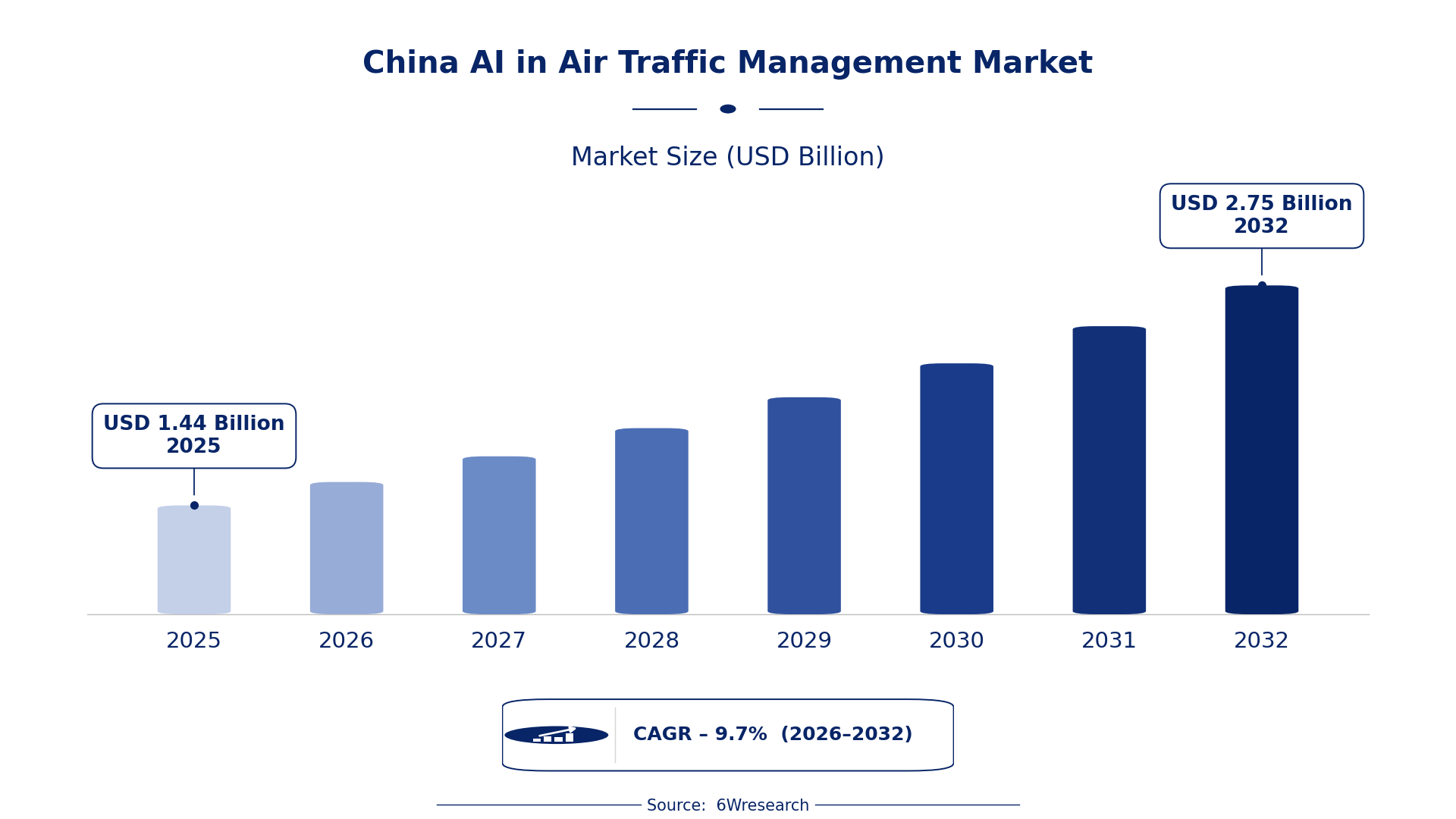
According to 6Wresearch internal database and industry insights, the China AI in Air Traffic Management Market was valued at USD 1.44 billion in 2025 and is projected to reach USD 2.75 billion by 2032, growing at a CAGR of approximately 9.7% during 2026–2032.
China AI in Air Traffic Management Market Highlights
| Report Metric | Details |
| Report Name | China AI in Air Traffic Management Market |
| Market Size 2025 | USD 1.44 billion |
| Market Size 2032 | USD 2.75 billion |
| Absolute Growth 2025–2032 | USD 1.31 billion |
| CAGR 2026–2032 | 9.7% |
| Peak Annual Growth | 12.3% in 2030 |
| Forecast Period | 2026–2032 |
| Historical Data | 2022–2025 |
| Base Year | 2025 |
| Leading Application Area, 2025 | Flight Scheduling (45% share) |
| Leading AI Type, 2025 | Real-time AI Systems (42% share) |
| Leading Distribution Channel, 2025 | Government Contracts (51% share) |
| Leading End User, 2025 | Airport Authorities (41% share) |
| Fastest-Growing Application Area | Surveillance & Monitoring (11.5% CAGR) |
| Fastest-Growing AI Type | Reinforcement Learning (11.4% CAGR) |
| Fastest-Growing Distribution Channel | Aviation Tech Platforms (11.5% CAGR) |
| Fastest-Growing End User | Civil Aviation Departments (11.6% CAGR) |
| Growing Sector | air traffic management |
| Key End Users | Airport Authorities, Air Traffic Controllers, Civil Aviation Departments |
China AI in Air Traffic Management Market Year-wise Growth Rate and Key Drivers (2022–2032)
This graph illustrates the annual growth rates of the market from 2022 to 2032, highlighting a steady upward trajectory and projected market expansion over the forecast period.
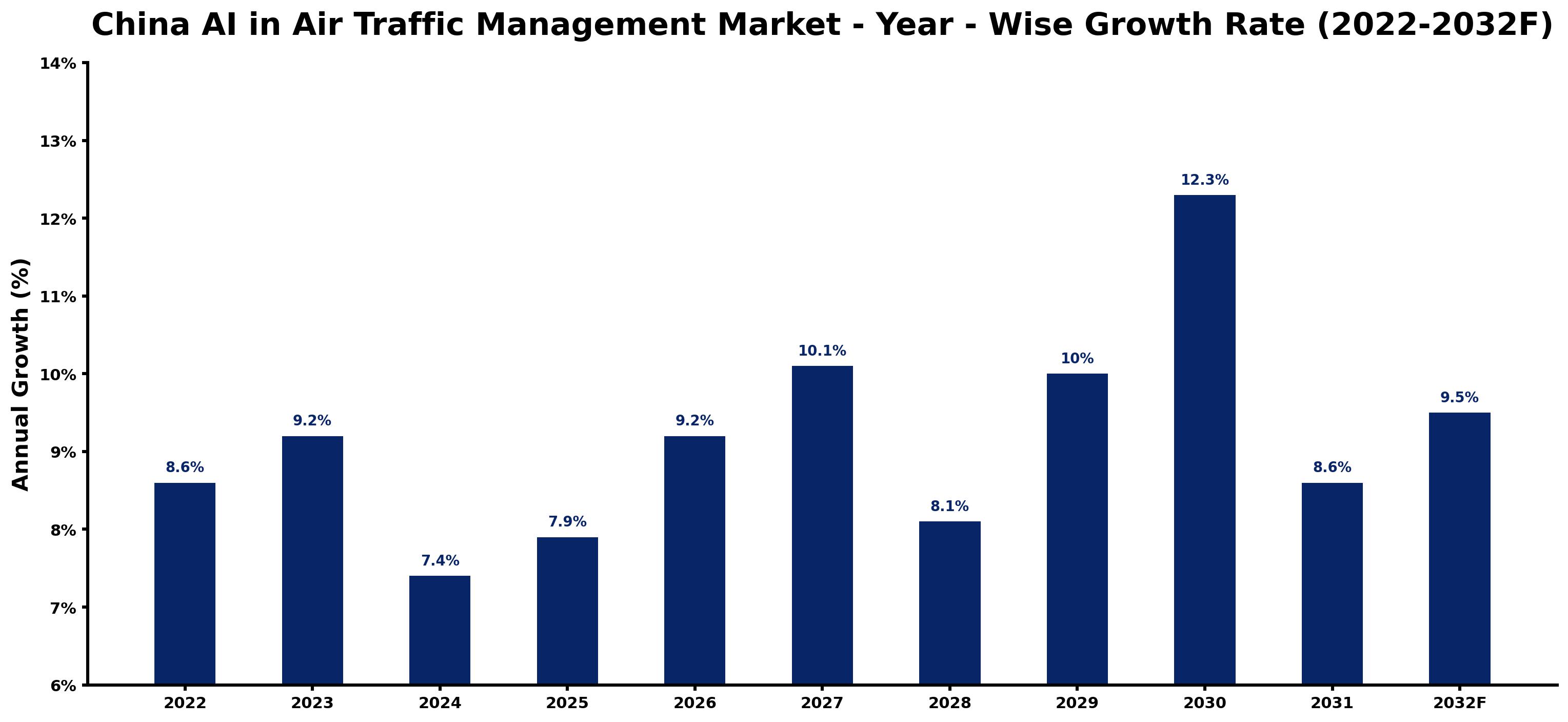
The following table presents the estimated annual growth rate for each year together with the principal factor influencing market performance.
| Year | Estimated Annual Growth (%) | Market Rationale |
| 2022 | 8.6 | The market experienced steady growth as the national AI strategy began to influence air traffic management. |
| 2023 | 9.2 | Increased investments in the 'Smart Airport' program supported faster growth than the previous year. |
| 2024 | 7.4 | Growth slowed as some projects faced delays in integrating AI technologies. |
| 2025 | 7.9 | A surge in demand for efficient flight scheduling contributed to renewed growth. |
| 2026 | 9.2 | The market is expected to rebound with strong investments in AI systems for air traffic management. |
| 2027 | 10.1 | Growing adoption of AI tools among air traffic controllers will drive demand higher. |
| 2028 | 8.1 | A slight slowdown is expected as the market adjusts to new technology implementations. |
| 2029 | 10.0 | Demand is projected to surge again as more airports integrate advanced AI solutions. |
| 2030 | 12.3 | The market is expected to peak with substantial investments in AI technologies for operational efficiency. |
| 2031 | 8.6 | Growth will decelerate as the market begins to stabilise after rapid expansion. |
| 2032 | 9.5 | The market is projected to maintain a healthy growth rate as AI applications become standard. |
Note: Market size estimations and growth projections presented in this report are based on 6Wresearch's proprietary forecasting methodology, utilizing the latest available industry data, government publications, and primary research inputs.
China AI in Air Traffic Management Market Synopsis
AI in Air Traffic Management in China utilises artificial intelligence technologies to optimise operations. These systems improve flight scheduling, prevent collisions, and enhance surveillance capabilities. The China AI in Air Traffic Management Market is projected to grow substantially, driven by a national AI strategy and rising passenger traffic, with 1.3 billion passengers expected by 2025. Government contracts and modernisation efforts are key demand sources, further propelling market expansion.
Market Dynamics Impact Analysis (2026–2032)
| Factor | Type | Impact | Primary Segment Affected |
| Increased government funding for AI projects enhances operational efficiency. | Driver | High | Government Contracts |
| Growing passenger traffic drives the need for advanced air traffic management solutions. | Driver | High | Airport Authorities |
| Investment in AI technologies is rising due to modernization efforts in airports. | Opportunity | High | Aviation Tech Platforms |
| The integration of AI in new airport projects presents significant investment potential. | Opportunity | High | Real-time AI Systems |
| Limited awareness among smaller airports about AI benefits may hinder adoption. | Restraint | Medium | Aviation Tech Platforms |
| High initial costs of AI implementation can deter potential buyers. | Restraint | Medium | Government Contracts |
| The AI in Air Traffic Management market in China faces regulatory complexities. | Challenge | High | Civil Aviation Departments |
| The rapid pace of technological change can create integration challenges. | Challenge | Medium | Airport Authorities |
Evaluation of Drivers in China AI in Air Traffic Management Market (2026–2032)
The table below links each growth driver to the segment it affects and the evidence for it.
| Drivers | Primary Segment Affected | Why It Matters (Evidence) |
| Increased government funding for AI projects improves operational efficiency. | Government Contracts | The CAAC allocated $500 million for the Air Traffic Management Modernization Program, boosting AI integration. |
| Growing passenger traffic drives the need for advanced air traffic management solutions. | Airport Authorities | With 1.3 billion passengers projected by 2025, airports are investing in AI to manage increased demands. |
| Investment in AI technologies is rising due to modernization efforts in airports. | Aviation Tech Platforms | The Smart Airport program initiated in 2023 promotes AI adoption in over 240 airports. |
| The integration of AI in new airport projects presents investment potential. | Real-time AI Systems | AI systems are being implemented in 70% of new airport projects, driving demand for advanced solutions. |
| The national AI strategy promotes the adoption of AI technologies in civil aviation. | Civil Aviation Departments | The AI in Civil Aviation Development Plan aims for a 30% efficiency increase by 2025. |
The Civil Aviation Administration of China allocated $500 million for modernisation efforts, enhancing operational efficiency. With 1.3 billion passengers anticipated by 2025, airport authorities are increasingly adopting AI solutions to manage rising demand. AI systems are being implemented in 70% of new airport projects, reflecting strong demand for advanced air traffic management solutions.
Evaluation of Restraints in China AI in Air Traffic Management Market
The table below lists the restraints and the evidence behind each.
| Market Restraint | Primary Segment Affected | Why It Matters (Evidence) |
| Limited awareness among smaller airports about AI benefits may hinder adoption. | Aviation Tech Platforms | Many smaller airports lack the knowledge to implement AI technologies effectively, resulting in slower adoption rates. |
| High initial costs of AI implementation can deter potential buyers. | Government Contracts | The investment required for AI systems may discourage budget-constrained airports from adopting new technologies. |
| Regulatory complexities can slow down the integration of AI technologies. | Civil Aviation Departments | Compliance with various regulations can delay the implementation of AI solutions in air traffic management. |
| Integration challenges arise from the rapid pace of technological change. | Airport Authorities | Airports may struggle to keep up with evolving AI technologies, causing potential delays in adoption. |
| Concerns about data security can hinder AI implementation. | Aviation Tech Platforms | Airports are cautious about the risks associated with data breaches, which can slow down AI adoption. |
China AI in Air Traffic Management Market Challenges
The China AI in Air Traffic Management market faces intense competition, with numerous firms vying for limited government contracts, leading to price wars that erode profit margins for producers. A shortage of skilled professionals exists, as many air traffic controllers lack adequate training in AI technologies, resulting in operational inefficiencies that can delay project timelines for airports. Supply chain disruptions occur due to reliance on specific technology providers, causing implementation delays that hinder airport operations. High integration costs for advanced AI systems strain budgets, forcing many airports to postpone modernisation efforts and negatively impacting air traffic efficiency.
Trends in the China AI in Air Traffic Management Market
Four trends stand out in the China AI in Air Traffic Management Market.
- Shift from Traditional to AI-Driven Air Traffic Management: Since 2021, the adoption of AI technologies has transformed air traffic management practices. The CAAC's 'AI in Civil Aviation Development Plan' aims for a 30% efficiency increase by 2025, encouraging airports to integrate AI solutions.
- Growing Focus on Smart Airports: In 2023, the launch of the 'Smart Airport' programme marked a shift towards AI-driven operations. Over 240 airports are now integrating AI technologies, with a projected 15% increase in air traffic efficiency.
- Increased Collaboration with AI Vendors: Airport Authorities are increasingly collaborating with AI vendors to improve operational efficiency. The integration of AI systems in 70% of new airport projects demonstrates a commitment to modernising air traffic management.
- Emergence of Predictive Analytics in Air Traffic Management: Predictive analytics is gaining traction in air traffic management, improving decision-making processes. The integration of these technologies is expected to enhance overall operational efficiency across airports.
Investment Opportunities in the China AI in Air Traffic Management Market
Below are the investment opportunities with the strongest case in the China AI in Air Traffic Management Market.
- AI Vendors Targeting Airport Authorities: With over 240 airports in China, there is an opportunity for AI vendors to provide solutions. The projected increase in air traffic efficiency highlights the growing need for efficient air traffic management.
- Investment Opportunities in Government Contracts: The CAAC's $500 million investment in modernisation presents an opportunity for AI technology providers. Engaging with government contracts can facilitate entry into the market.
- Demand for AI Solutions in New Airport Projects: The integration of AI systems in new airport projects creates a demand for advanced technologies. Suppliers can partner with construction firms to provide AI solutions.
- Growing Demand for Real-time AI Systems: As the market evolves, the demand for real-time AI systems is expected to rise. Airport Authorities are increasingly looking for solutions to optimise flight schedules and improve safety.
Government Initiatives in the China AI in Air Traffic Management Market
The CAAC oversees the implementation of AI technologies in air traffic management, approving projects that align with national strategies. The 'AI in Civil Aviation Development Plan' launched in 2021 aims to integrate AI technologies into air traffic management, targeting a 30% efficiency increase by 2025. The Ministry of Industry and Information Technology (MIIT) initiated the 'Smart Transportation' program in 2022, focusing on AI applications in air traffic systems. This program funds projects aimed at improving efficiency and safety in air traffic management, ensuring that airports receive the necessary support for AI integration. The updated national standards for air traffic management in 2023 further emphasise AI integration, enhancing safety protocols for all stakeholders.
The CAAC and MIIT are responsible for approving and funding various AI-related projects. The CAAC's 'Smart Airport' program, initiated in 2023, supports the integration of AI technologies in over 240 airports. Additionally, the CAAC's budget for the Air Traffic Management Modernization Program ensures that airports can implement advanced AI solutions effectively. These initiatives provide a framework for improving operational efficiency and safety in air traffic management, allowing airports to meet the demands of increasing passenger volumes.
Future Insight of the China AI in Air Traffic Management Market
The outlook for the China AI in Air Traffic Management market by 2032 will be shaped by the national AI strategy and the 'Smart Airport' programme, which will drive technological advancements. The aerospace sector's projected $1 trillion investment in AI technologies will spur innovation in air traffic management. The 'Digital China' initiative will promote wider AI adoption, enabling airports to manage increasing passenger volumes more effectively. By then, AI systems will be integrated into 70% of new airport projects, significantly enhancing operational safety and efficiency.
Market Segmentation Analysis
The report offers a comprehensive study of the following market segments and their leading categories in the market.
By Application Area – Flight Scheduling Dominated, Surveillance & Monitoring Expected to Grow Fastest
According to Ravi Bhandari, Research Head at 6Wresearch, the largest application area category in 2025 was Flight Scheduling, with a 45% share of total revenue. Flight scheduling commands the largest market share as it is vital for optimising flight timings across China's extensive network of over 240 airports. The Civil Aviation Administration of China's national strategy has significantly propelled the integration of advanced technologies into flight scheduling processes. Surveillance & Monitoring is projected to grow fastest, at a CAGR of 11.5% during 2026–2032. Surveillance and monitoring is witnessing rapid growth due to the escalating demand for real-time oversight of air traffic, particularly in key regions like Beijing-Tianjin-Hebei. The launch of the Smart Airport program in 2023 has further catalysed the adoption of advanced technologies in this segment. This trend indicates that suppliers must prioritise the development of solutions tailored for surveillance to effectively address the increasing demands from airport authorities.
By AI Type – Real-time AI Systems Dominated, Reinforcement Learning Expected to Grow Fastest
With a 42% revenue share in 2025, Real-time AI Systems was the largest ai type category. Real-time systems dominate the market share as they are essential for immediate operational responses in air traffic management. Their critical role in enhancing efficiency has been recognised through various government initiatives aimed at integrating advanced technologies into aviation operations. The quickest growth will come from Reinforcement Learning, forecast to expand at a CAGR of 11.4% between 2026 and 2032. Reinforcement learning is emerging as the fastest-growing segment due to its potential applications in specific operational scenarios, despite its current limited implementation. As the aerospace sector invests heavily in advanced technologies, this method is likely to see increased adoption in the future. Suppliers should explore opportunities in reinforcement learning to align with the anticipated growth in applications within air traffic management.
By Distribution Channel – Government Contracts Dominated, Aviation Tech Platforms Expected to Grow Fastest
Government Contracts accounted for a 51% market share by distribution channel in 2025. Government contracts represent the largest share of the market as they provide substantial funding for projects in air traffic management. These contracts are pivotal for the successful implementation of advanced technologies across various airports in China. Aviation Tech Platforms are set to record the highest CAGR in this split, 11.5% over 2026–2032. Aviation tech platforms are the fastest-growing distribution channel, driven by their role in providing the necessary infrastructure for applications. The increasing number of integration projects in new airport developments further fuels this growth. This shift suggests that suppliers should strengthen partnerships with aviation tech platforms to enhance their market presence and reach.
By End User – Airport Authorities Dominated, Civil Aviation Departments Expected to Grow Fastest
Airport Authorities took a 41% share of end user in 2025, more than any other category. Airport authorities hold the largest market share as they are responsible for implementing solutions that improve operational efficiency across numerous airports. Their proactive approach in adopting advanced technologies has been instrumental in driving advancements in air traffic management. Over 2026–2032, Civil Aviation Departments are expected to post the fastest growth, at a CAGR of 11.6%. Civil aviation departments are experiencing the fastest growth as they regulate and oversee the implementation of technologies in the aviation sector. Their increasing focus on modernising air traffic management systems is propelling this segment forward. This indicates that suppliers should engage with civil aviation departments to align their offerings with regulatory needs and technological advancements.
Key Attractiveness of the Report
- 10 Years of Market Numbers
- Historical Data Starting from 2022 to 2025
- Base Year 2025
- Forecast Data until 2032
- Key Performance Indicators Impacting the Market
- Major Upcoming Developments and Projects
Key Highlights of the Report:
- China AI in Air Traffic Management Market Outlook
- Market Size of China AI in Air Traffic Management Market, 2025
- Forecast of China AI in Air Traffic Management Market, 2032
- Historical Data and Forecast of China AI in Air Traffic Management Revenues & Volume for the Period 2022 - 2032F
- China AI in Air Traffic Management Market Trend Evolution
- China AI in Air Traffic Management Market Drivers and Challenges
- China AI in Air Traffic Management Price Trends
- China AI in Air Traffic Management Porter's Five Forces
- China AI in Air Traffic Management Industry Life Cycle
- Historical Data and Forecast of China AI in Air Traffic Management Market Revenues & Volume By Application Area for the Period 2022 - 2032F
- Historical Data and Forecast of China AI in Air Traffic Management Market Revenues & Volume By Flight Scheduling for the Period 2022 - 2032F
- Historical Data and Forecast of China AI in Air Traffic Management Market Revenues & Volume By Collision Avoidance for the Period 2022 - 2032F
- Historical Data and Forecast of China AI in Air Traffic Management Market Revenues & Volume By Route Optimization for the Period 2022 - 2032F
- Historical Data and Forecast of China AI in Air Traffic Management Market Revenues & Volume By Surveillance & Monitoring for the Period 2022 - 2032F
- Historical Data and Forecast of China AI in Air Traffic Management Market Revenues & Volume By AI Type for the Period 2022 - 2032F
- Historical Data and Forecast of China AI in Air Traffic Management Market Revenues & Volume By Predictive Analytics for the Period 2022 - 2032F
- Historical Data and Forecast of China AI in Air Traffic Management Market Revenues & Volume By Real-time AI Systems for the Period 2022 - 2032F
- Historical Data and Forecast of China AI in Air Traffic Management Market Revenues & Volume By Reinforcement Learning for the Period 2022 - 2032F
- Historical Data and Forecast of China AI in Air Traffic Management Market Revenues & Volume By Vision AI for the Period 2022 - 2032F
- Historical Data and Forecast of China AI in Air Traffic Management Market Revenues & Volume By Distribution Channel for the Period 2022 - 2032F
- Historical Data and Forecast of China AI in Air Traffic Management Market Revenues & Volume By Aviation Tech Platforms for the Period 2022 - 2032F
- Historical Data and Forecast of China AI in Air Traffic Management Market Revenues & Volume By Direct Aviation Vendors for the Period 2022 - 2032F
- Historical Data and Forecast of China AI in Air Traffic Management Market Revenues & Volume By Government Contracts for the Period 2022 - 2032F
- Historical Data and Forecast of China AI in Air Traffic Management Market Revenues & Volume By Defense Distributors for the Period 2022 - 2032F
- Historical Data and Forecast of China AI in Air Traffic Management Market Revenues & Volume By End User for the Period 2022 - 2032F
- Historical Data and Forecast of China AI in Air Traffic Management Market Revenues & Volume By Airport Authorities for the Period 2022 - 2032F
- Historical Data and Forecast of China AI in Air Traffic Management Market Revenues & Volume By Air Traffic Controllers for the Period 2022 - 2032F
- Historical Data and Forecast of China AI in Air Traffic Management Market Revenues & Volume By Civil Aviation Departments for the Period 2022 - 2032F
- Historical Data and Forecast of China AI in Air Traffic Management Market Revenues & Volume By Aerospace & Defense Organizations for the Period 2022 - 2032F
- China AI in Air Traffic Management Import Export Trade Statistics
- Market Opportunity Assessment By Application Area
- Market Opportunity Assessment By AI Type
- Market Opportunity Assessment By Distribution Channel
- Market Opportunity Assessment By End User
- China AI in Air Traffic Management Top Companies Market Share
- China AI in Air Traffic Management Competitive Benchmarking By Technical and Operational Parameters
- China AI in Air Traffic Management Company Profiles
- China AI in Air Traffic Management Key Strategic Recommendations
Market Covered
The report offers an extensive study of the following market segments.
By Application Area
- Flight Scheduling
- Collision Avoidance
- Route Optimization
- Surveillance & Monitoring
By AI Type
- Predictive Analytics
- Real-time AI Systems
- Reinforcement Learning
- Vision AI
By Distribution Channel
- Aviation Tech Platforms
- Direct Aviation Vendors
- Government Contracts
- Defense Distributors
By End User
- Airport Authorities
- Air Traffic Controllers
- Civil Aviation Departments
- Aerospace & Defense Organizations































