China AI in Biopharma Market Size & Growth Rate
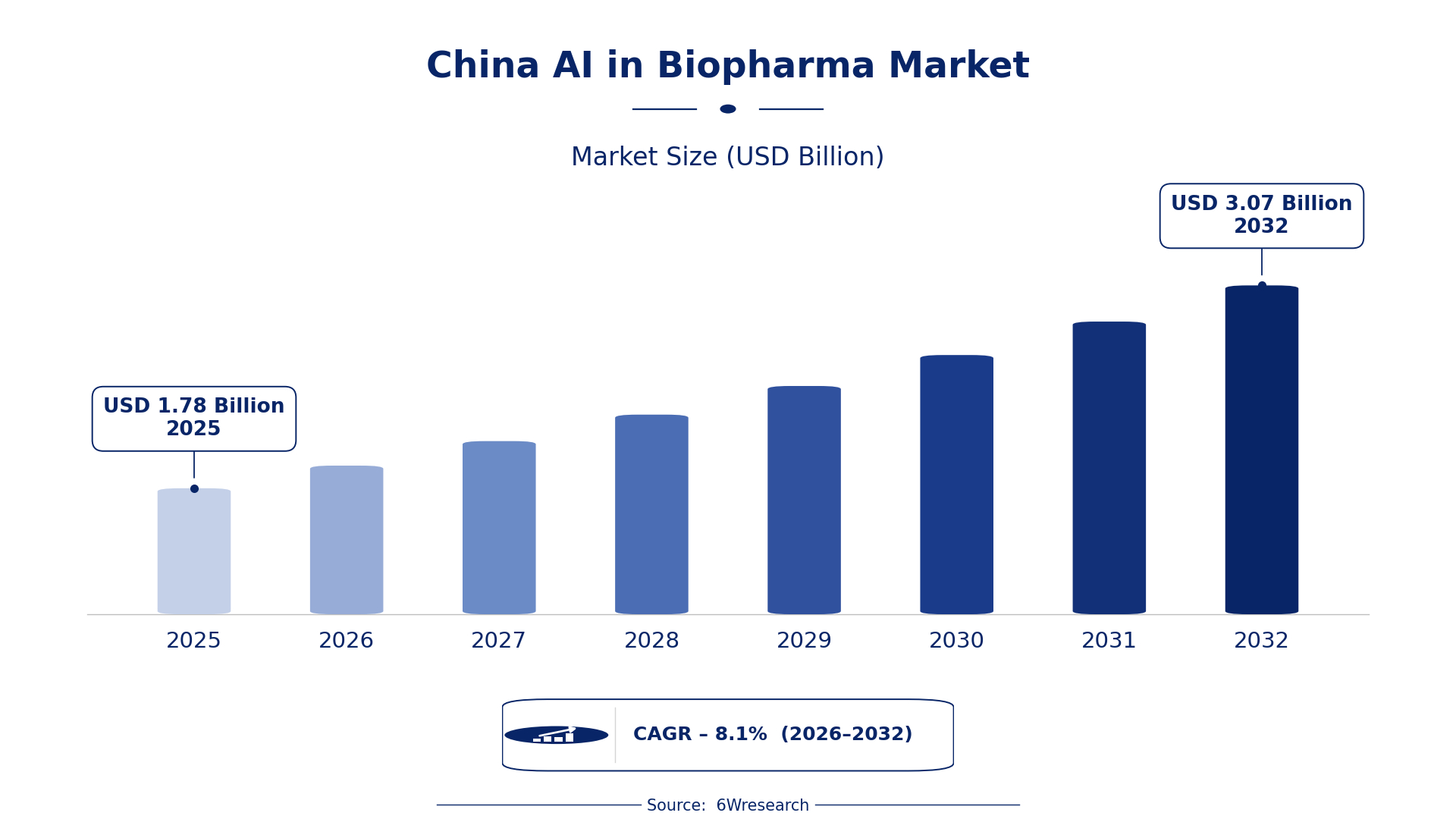
According to 6Wresearch internal database and industry insights, the China AI in Biopharma Market was valued at USD 1.78 billion in 2025 and is projected to reach USD 3.07 billion by 2032, growing at a CAGR of approximately 8.1% during 2026–2032.
China AI in Biopharma Market Highlights
| Report Metric | Details |
| Report Name | China AI in Biopharma Market |
| Market Size 2025 | USD 1.78 billion |
| Market Size 2032 | USD 3.07 billion |
| Absolute Growth 2025–2032 | USD 1.29 billion |
| CAGR 2026–2032 | 8.1% |
| Peak Annual Growth | 10.4% in 2031 |
| Forecast Period | 2026–2032 |
| Historical Data | 2022–2025 |
| Base Year | 2025 |
| Leading Application Area, 2025 | Drug Target Discovery (40% share) |
| Leading AI Technique, 2025 | Deep Learning (35% share) |
| Leading Distribution Channel, 2025 | Biotech SaaS Platforms (36% share) |
| Leading End User, 2025 | Biopharmaceutical Companies (38% share) |
| Fastest-Growing Application Area | Biomarker Identification (10.4% CAGR) |
| Fastest-Growing AI Technique | Predictive Analytics (9.8% CAGR) |
| Fastest-Growing Distribution Channel | B2B Research Networks (10.5% CAGR) |
| Fastest-Growing End User | Clinical Research Organizations (9.2% CAGR) |
| Growing Sector | Biopharmaceutical |
| Key End Users | Biopharmaceutical Companies, Clinical Research Organizations, Regulatory Compliance Teams |
China AI in Biopharma Market Year-wise Growth Rate and Key Drivers (2022–2032)
This graph illustrates the annual growth rates of the market from 2022 to 2032, highlighting a steady upward trajectory and projected market expansion over the forecast period.
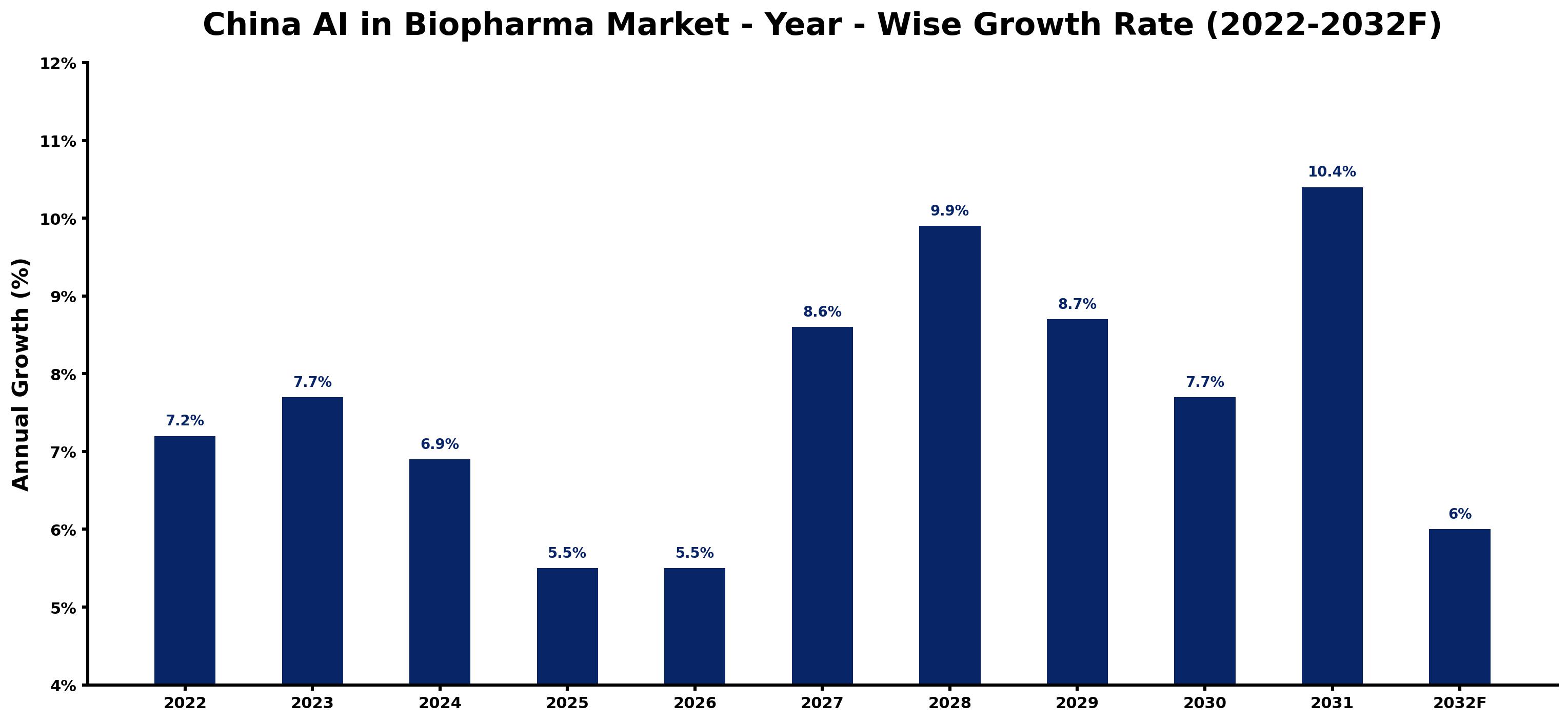
The following table presents the estimated annual growth rate for each year together with the principal factor influencing market performance.
| Year | Estimated Annual Growth (%) | Market Rationale |
| 2022 | 7.2 | The market experienced steady growth as AI technologies began to gain traction in clinical settings. |
| 2023 | 7.7 | Adoption of AI technologies in clinical trials increased, driven by the 'AI in Healthcare' initiative. |
| 2024 | 6.9 | Growth slowed as companies adjusted to regulatory changes and refined their AI strategies. |
| 2025 | 5.5 | The market continued to grow, although at a slower rate, as firms focused on integrating AI into existing processes. |
| 2026 | 5.5 | Growth remained stable as the industry adapted to the evolving regulatory framework. |
| 2027 | 8.6 | A resurgence in demand occurred as biopharmaceutical companies expanded their AI capabilities. |
| 2028 | 9.9 | Continued investment in AI technologies led to increased efficiency in drug development processes. |
| 2029 | 8.7 | Growth slowed slightly as firms faced challenges in scaling AI solutions effectively. |
| 2030 | 7.7 | The market maintained a steady growth rate as AI integration became more commonplace. |
| 2031 | 10.4 | A peak in growth was reached as AI technologies revolutionised drug discovery and clinical trials. |
| 2032 | 6.0 | The market is projected to grow at a slower pace as saturation begins to set in. |
Note: Market size estimations and growth projections presented in this report are based on 6Wresearch's proprietary forecasting methodology, utilizing the latest available industry data, government publications, and primary research inputs.
China AI in Biopharma Market Synopsis
AI in Biopharma Market in China involves the use of artificial intelligence technologies within the biopharmaceutical sector, concentrating on drug discovery, clinical trials, and patient safety monitoring. This method employs advanced algorithms and extensive datasets to boost efficiency and safety in drug development. The AI in Biopharma Market is growing due to rising adoption by biopharmaceutical companies and clinical research organisations, spurred by initiatives like the 'AI in Healthcare' programme and substantial funding for AI healthcare projects. In 2023, the government allocated $500 million to improve AI integration in biopharma, indicating strong demand from research institutions.
Market Dynamics Impact Analysis (2026–2032)
| Factor | Type | Impact | Primary Segment Affected |
| Increased integration of AI technologies in clinical trials improves efficiency and outcomes. | Driver | High | Clinical Trial Design |
| Growing demand for faster drug discovery processes drives investment in AI solutions. | Driver | High | Drug Target Discovery |
| Investment in AI-driven platforms is rising as companies seek to enhance research capabilities. | Opportunity | High | Biotech SaaS Platforms |
| The need for personalized medicine creates opportunities for AI in biomarker identification. | Opportunity | High | Biomarker Identification |
| Regulatory hurdles can delay the adoption of AI technologies in biopharma. | Restraint | High | Drug Target Discovery |
| Limited availability of skilled professionals in AI hampers market growth. | Restraint | Medium | Clinical Trial Design |
| Data privacy concerns pose challenges for AI implementation in biopharma. | Challenge | High | Pharmacovigilance |
| High costs associated with AI technology integration can deter smaller firms from adoption. | Challenge | Medium | Biotech SaaS Platforms |
Evaluation of Drivers in China AI in Biopharma Market (2026–2032)
The table below links each growth driver to the segment it affects and the evidence for it.
| Drivers | Primary Segment Affected | Why It Matters (Evidence) |
| Integration of AI in clinical trials improves efficiency and reduces time to market. | Clinical Trial Design | Over 80% of clinical trials in China now incorporate AI technologies, improving patient selection. |
| Demand for rapid drug discovery fuels investment in AI solutions. | Drug Target Discovery | AI-driven drug discovery platforms have reduced time to market by 30%, attracting biopharmaceutical companies. |
| Increased collaboration among research institutions drives AI adoption. | Biotech SaaS Platforms | The China Biopharmaceutical Industry Association reported a 15% increase in AI adoption among members in 2022. |
| Focus on patient safety monitoring increases demand for AI tools. | Pharmacovigilance | Clinical Research Organizations in China conduct over 1,000 trials annually using AI tools for safety monitoring. |
| Government initiatives support AI integration in biopharma. | Biomarker Identification | The 'AI in Healthcare' initiative launched in 2023 aims to promote research collaboration. |
The AI in Biopharma market in China is expanding as end-use demand for faster drug discovery, improved clinical trial efficiency, and enhanced patient safety monitoring rises. Over 80% of clinical trials now incorporate AI technologies, streamlining processes and improving outcomes. AI-driven platforms have reduced time to market by 30%, prompting biopharmaceutical companies to invest in these solutions. The China Biopharmaceutical Industry Association reported a 15% increase in AI adoption among members in 2022, reflecting strong industry support. Investment in AI healthcare projects is significant, with $500 million allocated from 2022 to 2025, driving further demand.
Evaluation of Restraints in China AI in Biopharma Market
Below mentioned are some major restraints and their influence on market dynamics.
| Market Restraint | Primary Segment Affected | Why It Matters (Evidence) |
| Regulatory hurdles can delay AI adoption in biopharma, complicating compliance processes. | Drug Target Discovery | The National Medical Products Administration updated its guidelines for AI applications in drug development in 2021. |
| Limited availability of skilled professionals in AI hampers market growth, affecting implementation. | Clinical Trial Design | The government announced plans to double the number of AI-trained professionals in biopharma by 2025. |
| Data privacy concerns pose challenges for AI implementation, affecting user trust. | Pharmacovigilance | ISO 9001 standards are increasingly adopted by biopharma companies for quality management in AI applications. |
| High costs associated with AI technology integration can deter smaller firms from adoption. | Biotech SaaS Platforms | Investment in AI healthcare projects is substantial, with $500 million allocated from 2022 to 2025. |
| Market fragmentation complicates the integration of AI solutions across different platforms. | Drug Target Discovery | The Ministry of Science and Technology has established a task force to promote AI technologies in the pharmaceutical sector. |
China AI in Biopharma Market Challenges
Over 80% of clinical trials in China now incorporate AI technologies, but fierce competition among biopharma firms raises costs for buyers, limiting their research budgets and reducing the scope of projects. Suppliers struggle with outdated technology, which hampers their ability to implement AI solutions efficiently, potentially delaying project timelines by 25%. Supply chain inefficiencies arise as AI tools require specific data inputs, and the lack of standardised data formats can waste suppliers' time and resources. Regulatory challenges persist, as evolving guidelines from the National Medical Products Administration create uncertainty, delaying product approvals and hindering market entry for new innovations.
Trends in the China AI in Biopharma Market
Several trends are reshaping the China AI in Biopharma Market; the most important are set out below.
- Shanghai Leading AI-driven Clinical Trials: Shanghai is leading in AI-driven clinical trials, with over 80% of trials incorporating AI technologies. This shift improves efficiency and patient outcomes, reflecting a broader trend in the biopharma sector.
- Biopharmaceutical Companies Adopting AI Solutions: Biopharmaceutical companies are increasingly adopting AI solutions to streamline drug discovery processes. In 2022, a 15% increase in AI adoption was reported, highlighting a shift towards technology integration.
- AI in Pharmacovigilance Gaining Traction: The 'AI in Healthcare' initiative launched in 2023 aims to boost AI adoption in pharmacovigilance, focusing on patient safety monitoring and regulatory compliance.
- Increased Funding for AI Healthcare Projects: The Ministry of Science and Technology allocated $500 million for AI healthcare projects from 2022 to 2025. This investment is expected to drive innovation and collaboration in the biopharma sector.
Investment Opportunities in the China AI in Biopharma Market
Some of the investment opportunities in the China AI in Biopharma Market are mentioned below.
- Growing Demand for AI-driven Drug Discovery Platforms: The demand for AI-driven drug discovery platforms is increasing, with a reported 30% reduction in time to market. Biopharmaceutical companies are eager to invest in these technologies to improve efficiency.
- Forming Partnerships for AI Integration: Now is an opportune moment to form partnerships for AI integration in biopharma, as the government aims to double AI-trained professionals by 2025. Collaborating with local firms can facilitate market entry.
- Investment in AI Solutions for Clinical Trials: Investment opportunities are emerging in AI solutions for clinical trials, especially as over 80% of trials now incorporate AI technologies. Clinical Research Organisations are actively seeking innovative tools.
- Expanding AI Applications in Biomarker Identification: The rising need for personalised medicine creates opportunities in biomarker identification, with a projected increase in demand. Investing in AI solutions can cater to this growing market.
Government Initiatives in the China AI in Biopharma Market
The 'AI in Healthcare' initiative launched by the Ministry of Science and Technology in 2023 seeks to promote AI adoption in biopharma with a budget of $500 million. This initiative builds on previous guidelines issued by the National Medical Products Administration in 2021, which streamlined regulatory processes for AI applications in drug development. The initiative enhances collaboration among research institutions and drives innovation in the sector, allowing for quicker integration of AI technologies.
In 2022, the State Council introduced the '14th Five-Year Plan for Biotechnology Development', focusing on AI integration in biopharma. The Ministry of Industry and Information Technology established a task force to promote AI technologies in the pharmaceutical sector, ensuring that firms receive the necessary support and resources for implementation. This plan aims to improve the overall efficiency and effectiveness of biopharmaceutical research and development, benefiting producers and buyers alike.
Future Insight of the China AI in Biopharma Market
Several forward-looking factors should support the AI in Biopharma market in China over the coming years. The launch of the 'AI in Healthcare' initiative in 2023 will enhance collaboration among research institutions, driving innovation. With the government allocating $500 million for AI healthcare projects from 2022 to 2025, investment in technology will rise. The plan to double the number of AI-trained professionals in biopharma by 2025 will ensure a skilled workforce, meeting the growing demands of the sector.
Market Segmentation Analysis
The report offers a comprehensive study of the following market segments and their leading categories in the market.
By Application Area – Drug Target Discovery Dominated, Biomarker Identification Expected to Grow Fastest
According to Ravi Bhandari, Research Head at 6Wresearch, in 2025, Drug Target Discovery led the application area split with a 40% share. Drug Target Discovery holds the largest share as it is essential for identifying potential drug candidates efficiently, a critical need in biopharmaceutical development. The significant integration of AI in this area is evident from the over 80% of clinical trials in China now incorporating AI technologies. Biomarker Identification is projected to grow fastest, at a CAGR of 10.4% during 2026–2032. Biomarker Identification is rapidly growing due to its importance in personalising treatment approaches, a trend increasingly emphasised in modern healthcare. The 15% increase in AI adoption among biopharmaceutical industry members in 2022 further illustrates the momentum behind this segment's expansion. This means suppliers should focus on enhancing capabilities in drug target discovery and biomarker identification to meet the evolving demands of biopharmaceutical companies.
By AI Technique – Deep Learning Dominated, Predictive Analytics Expected to Grow Fastest
Deep Learning accounted for a 35% market share by ai technique in 2025. Deep Learning commands the largest share because it is widely utilised for processing complex biological data, which is crucial for effective drug development. Its extensive application across numerous biopharmaceutical projects underscores its significance in the industry. Predictive Analytics is set to record the highest CAGR in this split, 9.8% over 2026–2032. Predictive Analytics is experiencing rapid growth as it is vital for forecasting drug responses and outcomes, increasingly important for successful clinical trials. The allocation of $500 million for AI healthcare projects is expected to further boost this segment's development. This indicates that suppliers should prioritise advancements in predictive analytics to cater to the rising demand for accurate forecasting in drug development.
By Distribution Channel – Biotech SaaS Platforms Dominated, B2B Research Networks Expected to Grow Fastest
The largest distribution channel category in 2025 was Biotech SaaS Platforms, with a 36% share of total revenue. Biotech SaaS Platforms dominate the market share as they provide essential access to AI tools for biopharmaceutical companies, streamlining their research and development efforts. The convenience offered by these platforms has made them a preferred choice among industry users. Over 2026–2032, B2B Research Networks are expected to post the fastest growth, at a CAGR of 10.5%. B2B Research Networks are rapidly growing as they effectively connect biopharma companies for collaborative research, which is crucial for expediting drug development. The high number of clinical trials conducted annually using AI tools highlights the increasing reliance on these networks in the sector. This suggests that suppliers should consider expanding their offerings through B2B research networks to enhance collaboration within the biopharmaceutical industry.
By End User – Biopharmaceutical Companies Dominated, Clinical Research Organizations Expected to Grow Fastest
Biopharmaceutical Companies took a 38% share of end user in 2025, more than any other category. Biopharmaceutical Companies represent the largest share as they are the primary users of AI technologies for drug development, driving substantial demand in the market. Their reliance on AI for various processes highlights the significance of this segment in the overall biopharma landscape. The quickest growth will come from Clinical Research Organizations, forecast to expand at a CAGR of 9.2% between 2026 and 2032. Clinical Research Organizations are experiencing rapid growth as they increasingly utilise AI for managing clinical trials, a vital aspect of drug development. The over 1,000 trials conducted annually using AI tools indicates a strong upward trend in this segment. This means suppliers should tailor their solutions to meet the specific needs of clinical research organizations to capitalise on this growth opportunity.
Key Attractiveness of the Report
- 10 Years of Market Numbers
- Historical Data Starting from 2022 to 2025
- Base Year 2025
- Forecast Data until 2032
- Key Performance Indicators Impacting the Market
- Major Upcoming Developments and Projects
Key Highlights of the Report:
- China AI in Biopharma Market Outlook
- Market Size of China AI in Biopharma Market, 2025
- Forecast of China AI in Biopharma Market, 2032
- Historical Data and Forecast of China AI in Biopharma Revenues & Volume for the Period 2022 - 2032F
- China AI in Biopharma Market Trend Evolution
- China AI in Biopharma Market Drivers and Challenges
- China AI in Biopharma Price Trends
- China AI in Biopharma Porter's Five Forces
- China AI in Biopharma Industry Life Cycle
- Historical Data and Forecast of China AI in Biopharma Market Revenues & Volume By Application Area for the Period 2022 - 2032F
- Historical Data and Forecast of China AI in Biopharma Market Revenues & Volume By Drug Target Discovery for the Period 2022 - 2032F
- Historical Data and Forecast of China AI in Biopharma Market Revenues & Volume By Clinical Trial Design for the Period 2022 - 2032F
- Historical Data and Forecast of China AI in Biopharma Market Revenues & Volume By Biomarker Identification for the Period 2022 - 2032F
- Historical Data and Forecast of China AI in Biopharma Market Revenues & Volume By Pharmacovigilance for the Period 2022 - 2032F
- Historical Data and Forecast of China AI in Biopharma Market Revenues & Volume By AI Technique for the Period 2022 - 2032F
- Historical Data and Forecast of China AI in Biopharma Market Revenues & Volume By Deep Learning for the Period 2022 - 2032F
- Historical Data and Forecast of China AI in Biopharma Market Revenues & Volume By Predictive Analytics for the Period 2022 - 2032F
- Historical Data and Forecast of China AI in Biopharma Market Revenues & Volume By Pattern Recognition for the Period 2022 - 2032F
- Historical Data and Forecast of China AI in Biopharma Market Revenues & Volume By NLP-based Monitoring for the Period 2022 - 2032F
- Historical Data and Forecast of China AI in Biopharma Market Revenues & Volume By Distribution Channel for the Period 2022 - 2032F
- Historical Data and Forecast of China AI in Biopharma Market Revenues & Volume By Biotech SaaS Platforms for the Period 2022 - 2032F
- Historical Data and Forecast of China AI in Biopharma Market Revenues & Volume By B2B Research Networks for the Period 2022 - 2032F
- Historical Data and Forecast of China AI in Biopharma Market Revenues & Volume By Direct Enterprise Sales for the Period 2022 - 2032F
- Historical Data and Forecast of China AI in Biopharma Market Revenues & Volume By Online AI Suites for the Period 2022 - 2032F
- Historical Data and Forecast of China AI in Biopharma Market Revenues & Volume By End User for the Period 2022 - 2032F
- Historical Data and Forecast of China AI in Biopharma Market Revenues & Volume By Biopharmaceutical Companies for the Period 2022 - 2032F
- Historical Data and Forecast of China AI in Biopharma Market Revenues & Volume By Clinical Research Organizations for the Period 2022 - 2032F
- Historical Data and Forecast of China AI in Biopharma Market Revenues & Volume By Molecular Labs for the Period 2022 - 2032F
- Historical Data and Forecast of China AI in Biopharma Market Revenues & Volume By Regulatory Compliance Teams for the Period 2022 - 2032F
- China AI in Biopharma Import Export Trade Statistics
- Market Opportunity Assessment By Application Area
- Market Opportunity Assessment By AI Technique
- Market Opportunity Assessment By Distribution Channel
- Market Opportunity Assessment By End User
- China AI in Biopharma Top Companies Market Share
- China AI in Biopharma Competitive Benchmarking By Technical and Operational Parameters
- China AI in Biopharma Company Profiles
- China AI in Biopharma Key Strategic Recommendations
Market Covered
This report examines the market across the segments below.
By Application Area
- Drug Target Discovery
- Clinical Trial Design
- Biomarker Identification
- Pharmacovigilance
By AI Technique
- Deep Learning
- Predictive Analytics
- Pattern Recognition
- NLP-based Monitoring
By Distribution Channel
- Biotech SaaS Platforms
- B2B Research Networks
- Direct Enterprise Sales
- Online AI Suites
By End User
- Biopharmaceutical Companies
- Clinical Research Organizations
- Molecular Labs
- Regulatory Compliance Teams































