China AI in Cardiovascular Imaging Market Size & Growth Rate
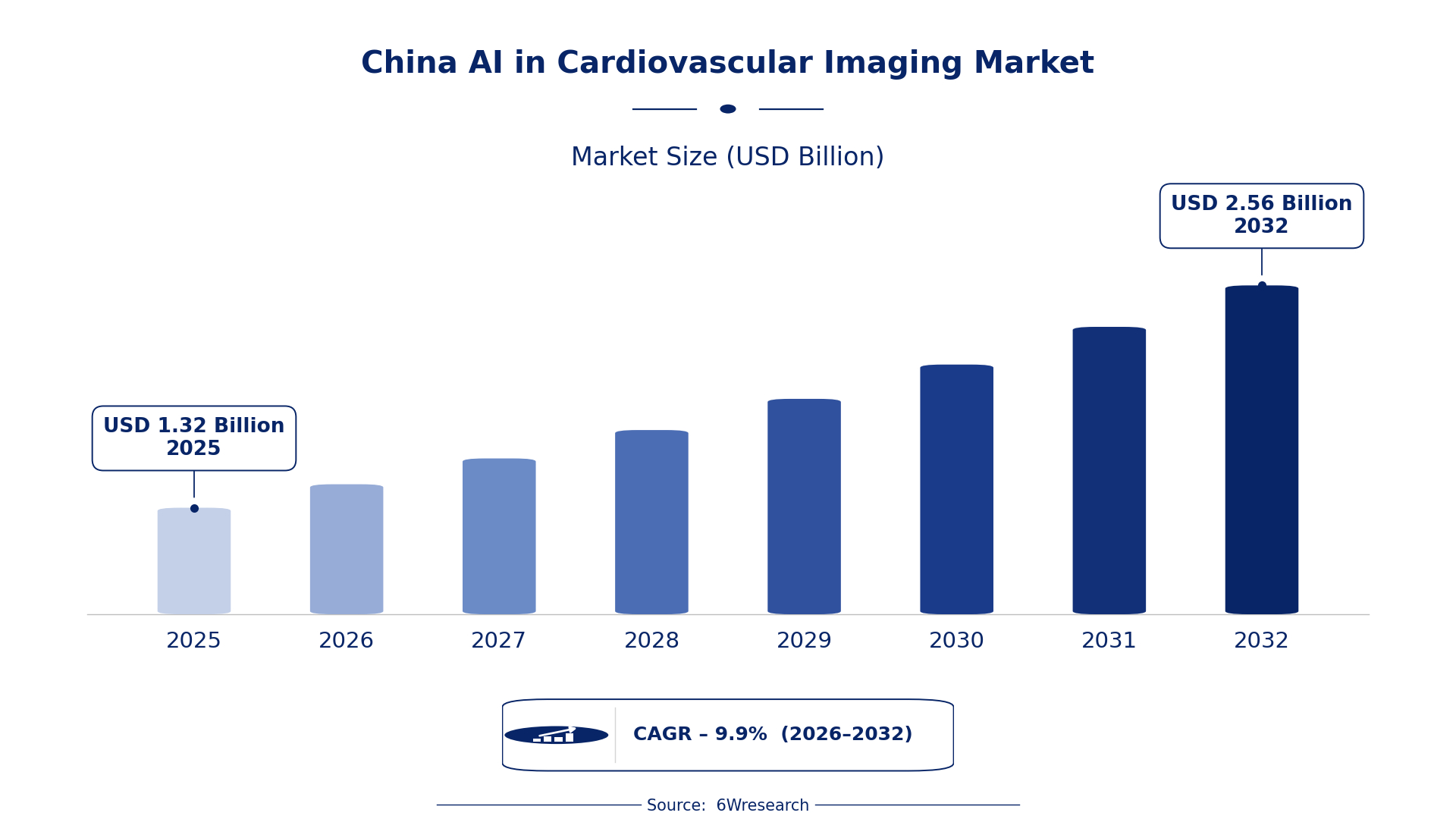
According to 6Wresearch internal database and industry insights, the China AI in Cardiovascular Imaging Market was valued at USD 1.32 billion in 2025 and is projected to reach USD 2.56 billion by 2032, growing at a CAGR of approximately 9.9% during 2026–2032.
China AI in Cardiovascular Imaging Market Highlights
| Report Metric | Details |
| Report Name | China AI in Cardiovascular Imaging Market |
| Market Size 2025 | USD 1.32 billion |
| Market Size 2032 | USD 2.56 billion |
| Absolute Growth 2025–2032 | USD 1.24 billion |
| CAGR 2026–2032 | 9.9% |
| Peak Annual Growth | 12.3% in 2032 |
| Forecast Period | 2026–2032 |
| Historical Data | 2022–2025 |
| Base Year | 2025 |
| Leading Imaging Type, 2025 | Echocardiography (49% share) |
| Leading AI Functionality, 2025 | Image Segmentation (47% share) |
| Leading Distribution Channel, 2025 | HealthTech Platforms (38% share) |
| Leading End User, 2025 | Hospitals (38% share) |
| Fastest-Growing Imaging Type | Cardiac MRI (12.7% CAGR) |
| Fastest-Growing AI Functionality | Anomaly Detection (11.3% CAGR) |
| Fastest-Growing End User | Heart Care Clinics (11.6% CAGR) |
| Growing Sector | Hospitals |
| Key End Users | Hospitals, HealthTech Platforms, Direct Healthcare Providers, Cardiology Departments |
China AI in Cardiovascular Imaging Market Year-wise Growth Rate and Key Drivers (2022–2032)
This graph illustrates the annual growth rates of the market from 2022 to 2032, highlighting a steady upward trajectory and projected market expansion over the forecast period.
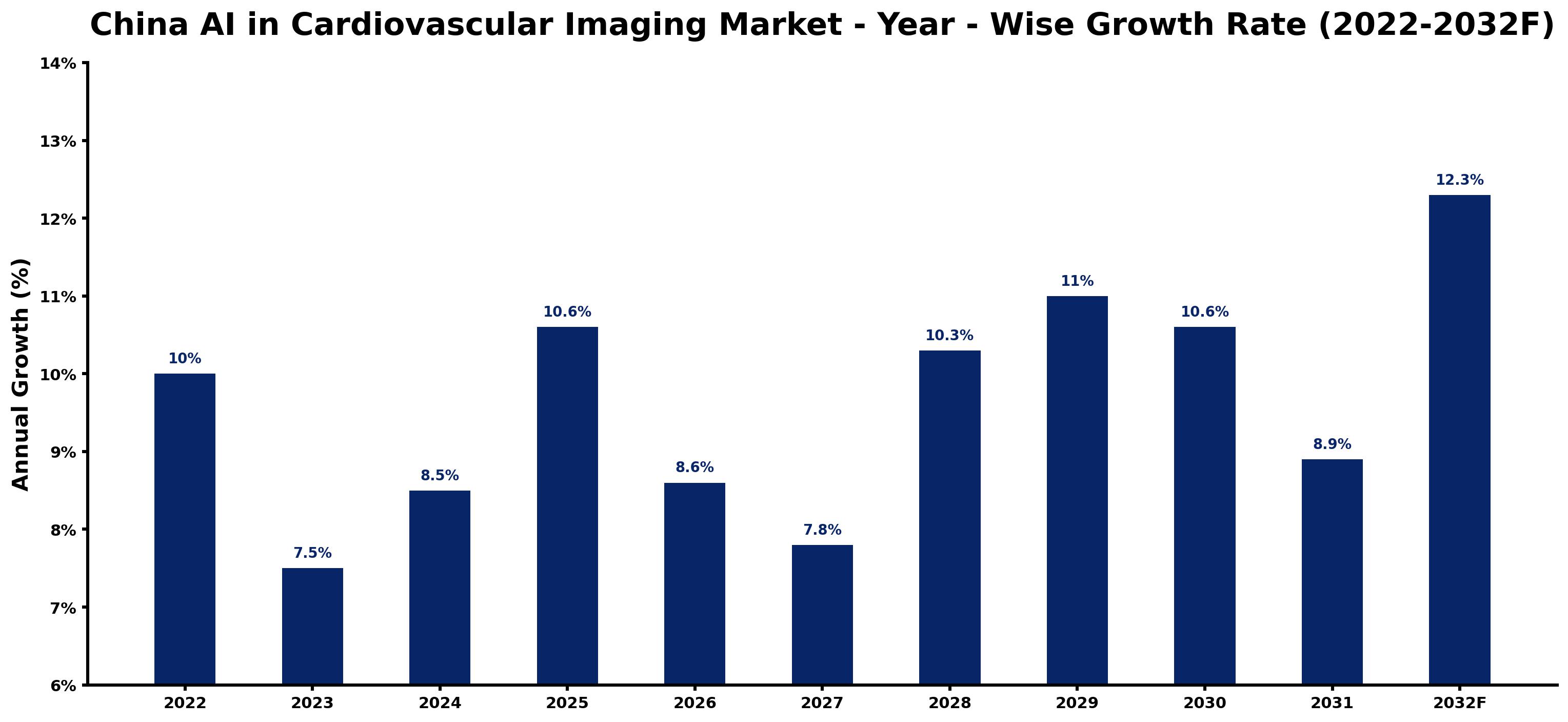
Annual growth estimates for each year appear below with the principal reason behind them, explaining the shifts that set the pace of the market.
| Year | Estimated Annual Growth (%) | Market Rationale |
| 2022 | 10.0 | The market showed strong activity with over 1,000 hospitals equipped with advanced imaging technologies. |
| 2023 | 7.5 | Growth slowed as hospitals adapted to new AI technologies and integrated them into workflows. |
| 2024 | 8.5 | Demand increased as hospitals expanded their AI capabilities, improving diagnostic accuracy. |
| 2025 | 10.6 | The market peaked due to heightened investments in advanced imaging technologies and training. |
| 2026 | 8.6 | Growth slowed as the 'Healthy China 2030' initiative began to influence AI adoption strategies. |
| 2027 | 7.8 | The market continued to grow as hospitals focused on improving imaging efficiency through AI tools. |
| 2028 | 10.3 | Demand surged as new AI functionalities were introduced, improving patient outcomes significantly. |
| 2029 | 11.0 | Growth accelerated with increased adoption of AI tools in cardiology practices across urban hospitals. |
| 2030 | 10.6 | The market experienced a slowdown as hospitals consolidated their AI investments and optimised existing technologies. |
| 2031 | 8.9 | Growth slowed as the market matured, focusing on optimising existing technologies and workflows. |
| 2032 | 12.3 | The market rebounded with renewed interest in innovative AI solutions for imaging, driven by new funding initiatives. |
Note: Market size estimations and growth projections presented in this report are based on 6Wresearch's proprietary forecasting methodology, utilizing the latest available industry data, government publications, and primary research inputs.
China AI in Cardiovascular Imaging Market Synopsis
The China AI in Cardiovascular Imaging Market utilises artificial intelligence to improve imaging techniques for heart-related conditions. This technology boosts diagnostic accuracy and automates measurements, benefiting hospitals and healthcare providers. The market is expanding due to strong demand from these institutions, supported by initiatives like the 'Healthy China 2030' programme. With a population of approximately 1.4 billion, the potential for AI in medical imaging is vast, driving investments and advancements in the sector.
Market Dynamics Impact Analysis (2026–2032)
| Factor | Type | Impact | Primary Segment Affected |
| Increasing adoption of AI technologies in hospitals enhances diagnostic capabilities. | Driver | High | Hospitals |
| The rise in cardiovascular diseases creates a demand for advanced imaging solutions. | Driver | High | Echocardiography |
| The fast-track approval pathway for AI diagnostic tools expedites market entry. | Opportunity | High | Medical Imaging Vendors |
| Growing funding for AI healthcare innovations supports new product development. | Opportunity | High | HealthTech Platforms |
| Integration challenges with existing imaging systems may slow adoption rates. | Restraint | Medium | Hospitals |
| High costs associated with AI technology implementation can limit accessibility. | Restraint | Medium | Direct Healthcare Providers |
| Limited skilled personnel in AI technologies affects implementation success. | Challenge | High | Echocardiography |
| Regulatory hurdles may delay the introduction of new AI imaging solutions. | Challenge | High | Medical Imaging Vendors |
Evaluation of Drivers in China AI in Cardiovascular Imaging Market (2026–2032)
The factors lifting demand, and the evidence behind each, are summarised below.
| Drivers | Primary Segment Affected | Why It Matters (Evidence) |
| Increased investment in AI technologies improves imaging capabilities. | HealthTech Platforms | Funding for AI healthcare innovations reached 500 million yuan in 2023, boosting technology integration. |
| Rising prevalence of cardiovascular diseases drives demand for advanced imaging solutions. | Cardiologists | The need for effective imaging solutions is critical due to the growing number of cardiovascular patients. |
| The 'Healthy China 2030' initiative promotes advanced imaging technologies in hospitals. | Hospitals | This initiative aims to improve cardiovascular health, increasing the adoption of AI imaging solutions. |
| The integration of AI tools improves workflow efficiency in imaging departments. | Radiology Departments | The adoption rate of AI in medical imaging is projected to reach 30% by 2025. |
| The growing population of approximately 1.4 billion creates a vast market for imaging solutions. | Direct Healthcare Providers | This demographic factor significantly increases the demand for cardiovascular imaging technologies. |
In 2023, funding for AI healthcare innovations reached 500 million yuan, facilitating technology integration in hospitals. The projected adoption of AI in medical imaging will reach 30% by 2025, indicating strong market growth. The increasing population of approximately 1.4 billion creates a substantial demand for effective imaging solutions.
Evaluation of Restraints in China AI in Cardiovascular Imaging Market
The main factors holding the market back are set out below.
| Market Restraint | Primary Segment Affected | Why It Matters (Evidence) |
| Integration challenges with existing imaging systems can hinder adoption. | Hospitals | Many hospitals face difficulties in incorporating new AI technologies into their current systems, leading to delays in implementation. |
| High costs associated with AI technology implementation limit accessibility. | Direct Healthcare Providers | Budget constraints prevent many healthcare providers from adopting advanced imaging solutions effectively, with initial costs often exceeding 1 million yuan. |
| Limited skilled personnel in AI technologies affects implementation success. | Echocardiography | A shortage of trained professionals can slow down the effective use of AI tools in clinical settings, impacting patient care. |
| Regulatory hurdles may delay the introduction of new AI imaging solutions. | Medical Imaging Vendors | Stringent regulations can slow down the approval process for new AI products, impacting market entry and innovation. |
| Concerns over data privacy and security may restrict AI adoption. | HealthTech Platforms | Healthcare providers are cautious about integrating AI due to potential data breaches and compliance issues, which can hinder adoption. |
China AI in Cardiovascular Imaging Market Challenges
In the China AI in Cardiovascular Imaging market, buyers face high initial costs, with advanced imaging technologies often requiring investments exceeding 1 million yuan per hospital. Technology compatibility issues arise, as many existing systems do not support new AI solutions, leading to delays in implementation for healthcare providers. A skills gap exists, with over 100,000 cardiologists needing training in AI tools, which slows technology adoption. Regulatory compliance presents another hurdle, as adherence to the China Food and Drug Administration's guidelines can prolong the approval process for new AI imaging software, impacting suppliers' time-to-market.
Trends in the China AI in Cardiovascular Imaging Market
Below mentioned are some of the trends shaping the China AI in Cardiovascular Imaging Market growth.
- Shift from Traditional Imaging to AI-Driven Techniques: Hospitals across China are increasingly adopting AI-driven imaging techniques, improving diagnostic accuracy. In 2023, over 1,000 hospitals implemented advanced cardiovascular imaging technologies.
- Transition to Real-Time Imaging Solutions: HealthTech Platforms are focusing on real-time imaging solutions to improve patient assessments. The adoption rate of AI in medical imaging is expected to reach 30% by 2025.
- Emergence of AI in Cardiac MRI: Cardiac MRI is becoming a preferred imaging method due to its detailed assessments. This segment is projected to grow at a CAGR of 12.7% from 2026 to 2032.
- Prioritisation of Anomaly Detection in Imaging: Anomaly detection is gaining traction as a critical function in AI imaging. This segment is expected to grow at a CAGR of 11.3% from 2026 to 2032.
Investment Opportunities in the China AI in Cardiovascular Imaging Market
Investors looking at the China AI in Cardiovascular Imaging Market should consider the following areas.
- Form Joint Ventures for AI Development: With a projected market size of USD 1.32 billion by 2025, forming joint ventures in AI development can be beneficial. Hospitals are seeking advanced imaging solutions to improve patient care.
- Supply AI Diagnostic Tools to Healthcare Providers: The growing demand for AI diagnostic tools presents a significant opportunity. Hospitals are increasingly looking for innovative solutions to enhance patient care and diagnostic accuracy.
- Invest in AI Training Programs for Healthcare Professionals: With a notable gap in skilled personnel, investing in training programs can meet the demand for AI expertise in imaging. This will enable healthcare providers to effectively utilise AI tools.
- Access Funding from Government Initiatives: The 600 million yuan funding for AI healthcare innovations provides an opportunity for investment. HealthTech Platforms can benefit from this financial support to develop advanced AI solutions.
Government Initiatives in the China AI in Cardiovascular Imaging Market
In 2021, the National Health Commission launched the 'AI in Healthcare Development Plan', aiming to integrate AI technologies in medical imaging. This plan targets a 25% increase in efficiency by 2025, improving healthcare delivery. The initiative complements existing regulations and promotes the adoption of effective solutions in hospitals across China, enhancing the overall effectiveness of AI in cardiovascular imaging.
The Ministry of Science and Technology supports the 'AI Medical Imaging Research Program', which funds projects with a budget of 600 million yuan. This program facilitates the development of advanced imaging technologies, enabling healthcare providers to access modern tools. By streamlining funding processes, it encourages collaboration between research institutions and healthcare facilities, ultimately improving patient care through advancements in AI technologies.
Future Insight of the China AI in Cardiovascular Imaging Market
Several forward-looking factors are expected to support the AI in Cardiovascular Imaging market in China over the coming years. The 'Healthy China 2030' initiative will drive investment in healthcare technologies, enhancing the infrastructure for AI solutions. By 2025, urban hospitals are projected to adopt AI in medical imaging at a rate of 30%, improving diagnostic accuracy. Funding from the Ministry of Industry and Information Technology is set to accelerate AI healthcare innovations, creating new opportunities for suppliers and enhancing service delivery for buyers.
Market Segmentation Analysis
The report offers a comprehensive study of the following market segments and their leading categories in the market.
By Imaging Type – Echocardiography Dominated, Cardiac MRI Expected to Grow Fastest
According to Ravi Bhandari, Research Head at 6Wresearch, Echocardiography took a 49% share of imaging type in 2025, more than any other category. Echocardiography holds the largest share in the China AI in Cardiovascular Imaging Market due to its extensive application in over 1,000 hospitals, making it a primary method for assessing heart function. This imaging type is essential for routine diagnostics, particularly in urban healthcare settings where demand is substantial. Cardiac MRI is set to record the highest CAGR in this split, 12.7% over 2026–2032. Cardiac MRI is experiencing rapid growth as it provides comprehensive assessments for complex cardiac cases, appealing to hospitals seeking advanced diagnostic capabilities. With increasing investments in healthcare innovations, its adoption is likely to accelerate further. Suppliers should focus on enhancing their offerings in echocardiography while also investing in Cardiac MRI technologies to capture emerging opportunities.
By AI Functionality – Image Segmentation Dominated, Anomaly Detection Expected to Grow Fastest
With a 47% revenue share in 2025, Image Segmentation was the largest ai functionality category. Image Segmentation commands the largest share as it is crucial for accurately identifying cardiac structures, which is essential for effective diagnosis and treatment planning. Its integration into imaging tools is widely adopted across hospitals, significantly improving diagnostic accuracy. The quickest growth will come from Anomaly Detection, forecast to expand at a CAGR of 11.3% between 2026 and 2032. Anomaly Detection is growing rapidly, driven by its critical role in identifying irregularities in heart function, which is increasingly important for patient monitoring and timely interventions. As healthcare providers prioritise early detection, this functionality will see heightened demand. Buyers should seek imaging solutions that prioritise image segmentation while also considering tools that enhance anomaly detection capabilities.
By Distribution Channel – HealthTech Platforms Dominated and Is Expected to Record the Fastest Growth
HealthTech Platforms accounted for a 38% market share by distribution channel in 2025. HealthTech Platforms dominate the market share as they effectively integrate imaging tools into clinical practice, streamlining workflows for healthcare providers. Their widespread adoption in urban hospitals ensures they remain the primary channel for AI in cardiovascular imaging. Its lead should widen, with a projected CAGR of 11.8% during 2026–2032, the highest in this split. HealthTech Platforms are also the fastest-growing channel, propelled by increasing digital transformation in healthcare that demands seamless integration of technologies. This trend will likely continue as more healthcare facilities embrace digital solutions. Suppliers must ensure their imaging solutions are compatible with HealthTech Platforms to maximise reach and effectiveness.
By End User – Hospitals Dominated, Heart Care Clinics Expected to Grow Fastest
The largest end user category in 2025 was Hospitals, with a 38% share of total revenue. Hospitals represent the largest share of the market as they are the main institutions adopting advanced imaging technologies, driven by the need for improved diagnostic capabilities. Their substantial infrastructure supports the integration of sophisticated imaging solutions. Heart Care Clinics are projected to grow fastest, at a CAGR of 11.6% during 2026–2032. Heart Care Clinics are the fastest-growing end user, utilising imaging for patient assessments and monitoring, which is becoming increasingly essential in personalised care. As these clinics expand, their demand for advanced imaging solutions will rise significantly. Suppliers should tailor their offerings to meet the specific needs of hospitals while also targeting the growing segment of heart care clinics.
Key Attractiveness of the Report
- 10 Years of Market Numbers
- Historical Data Starting from 2022 to 2025
- Base Year 2025
- Forecast Data until 2032
- Key Performance Indicators Impacting the Market
- Major Upcoming Developments and Projects
Key Highlights of the Report:
- China AI in Cardiovascular Imaging Market Outlook
- Market Size of China AI in Cardiovascular Imaging Market, 2025
- Forecast of China AI in Cardiovascular Imaging Market, 2032
- Historical Data and Forecast of China AI in Cardiovascular Imaging Revenues & Volume for the Period 2022 - 2032F
- China AI in Cardiovascular Imaging Market Trend Evolution
- China AI in Cardiovascular Imaging Market Drivers and Challenges
- China AI in Cardiovascular Imaging Price Trends
- China AI in Cardiovascular Imaging Porter's Five Forces
- China AI in Cardiovascular Imaging Industry Life Cycle
- Historical Data and Forecast of China AI in Cardiovascular Imaging Market Revenues & Volume By Imaging Type for the Period 2022 - 2032F
- Historical Data and Forecast of China AI in Cardiovascular Imaging Market Revenues & Volume By Echocardiography for the Period 2022 - 2032F
- Historical Data and Forecast of China AI in Cardiovascular Imaging Market Revenues & Volume By CT Angiography for the Period 2022 - 2032F
- Historical Data and Forecast of China AI in Cardiovascular Imaging Market Revenues & Volume By Cardiac MRI for the Period 2022 - 2032F
- Historical Data and Forecast of China AI in Cardiovascular Imaging Market Revenues & Volume By Ultrasound Analysis for the Period 2022 - 2032F
- Historical Data and Forecast of China AI in Cardiovascular Imaging Market Revenues & Volume By AI Functionality for the Period 2022 - 2032F
- Historical Data and Forecast of China AI in Cardiovascular Imaging Market Revenues & Volume By Image Segmentation for the Period 2022 - 2032F
- Historical Data and Forecast of China AI in Cardiovascular Imaging Market Revenues & Volume By Anomaly Detection for the Period 2022 - 2032F
- Historical Data and Forecast of China AI in Cardiovascular Imaging Market Revenues & Volume By Risk Stratification for the Period 2022 - 2032F
- Historical Data and Forecast of China AI in Cardiovascular Imaging Market Revenues & Volume By Measurement Automation for the Period 2022 - 2032F
- Historical Data and Forecast of China AI in Cardiovascular Imaging Market Revenues & Volume By Distribution Channel for the Period 2022 - 2032F
- Historical Data and Forecast of China AI in Cardiovascular Imaging Market Revenues & Volume By HealthTech Platforms for the Period 2022 - 2032F
- Historical Data and Forecast of China AI in Cardiovascular Imaging Market Revenues & Volume By Medical Imaging Vendors for the Period 2022 - 2032F
- Historical Data and Forecast of China AI in Cardiovascular Imaging Market Revenues & Volume By SaaS Diagnostic Tools for the Period 2022 - 2032F
- Historical Data and Forecast of China AI in Cardiovascular Imaging Market Revenues & Volume By Direct Healthcare Providers for the Period 2022 - 2032F
- Historical Data and Forecast of China AI in Cardiovascular Imaging Market Revenues & Volume By End User for the Period 2022 - 2032F
- Historical Data and Forecast of China AI in Cardiovascular Imaging Market Revenues & Volume By Cardiologists for the Period 2022 - 2032F
- Historical Data and Forecast of China AI in Cardiovascular Imaging Market Revenues & Volume By Heart Care Clinics for the Period 2022 - 2032F
- Historical Data and Forecast of China AI in Cardiovascular Imaging Market Revenues & Volume By Hospitals for the Period 2022 - 2032F
- Historical Data and Forecast of China AI in Cardiovascular Imaging Market Revenues & Volume By Radiology Departments for the Period 2022 - 2032F
- China AI in Cardiovascular Imaging Import Export Trade Statistics
- Market Opportunity Assessment By Imaging Type
- Market Opportunity Assessment By AI Functionality
- Market Opportunity Assessment By Distribution Channel
- Market Opportunity Assessment By End User
- China AI in Cardiovascular Imaging Top Companies Market Share
- China AI in Cardiovascular Imaging Competitive Benchmarking By Technical and Operational Parameters
- China AI in Cardiovascular Imaging Company Profiles
- China AI in Cardiovascular Imaging Key Strategic Recommendations
Market Covered
Segments analysed in this report are listed below.
By Imaging Type
- Echocardiography
- CT Angiography
- Cardiac MRI
- Ultrasound Analysis
By AI Functionality
- Image Segmentation
- Anomaly Detection
- Risk Stratification
- Measurement Automation
By Distribution Channel
- HealthTech Platforms
- Medical Imaging Vendors
- SaaS Diagnostic Tools
- Direct Healthcare Providers
By End User
- Cardiologists
- Heart Care Clinics
- Hospitals
- Radiology Departments































