China AI in Electronics Market Size & Growth Rate
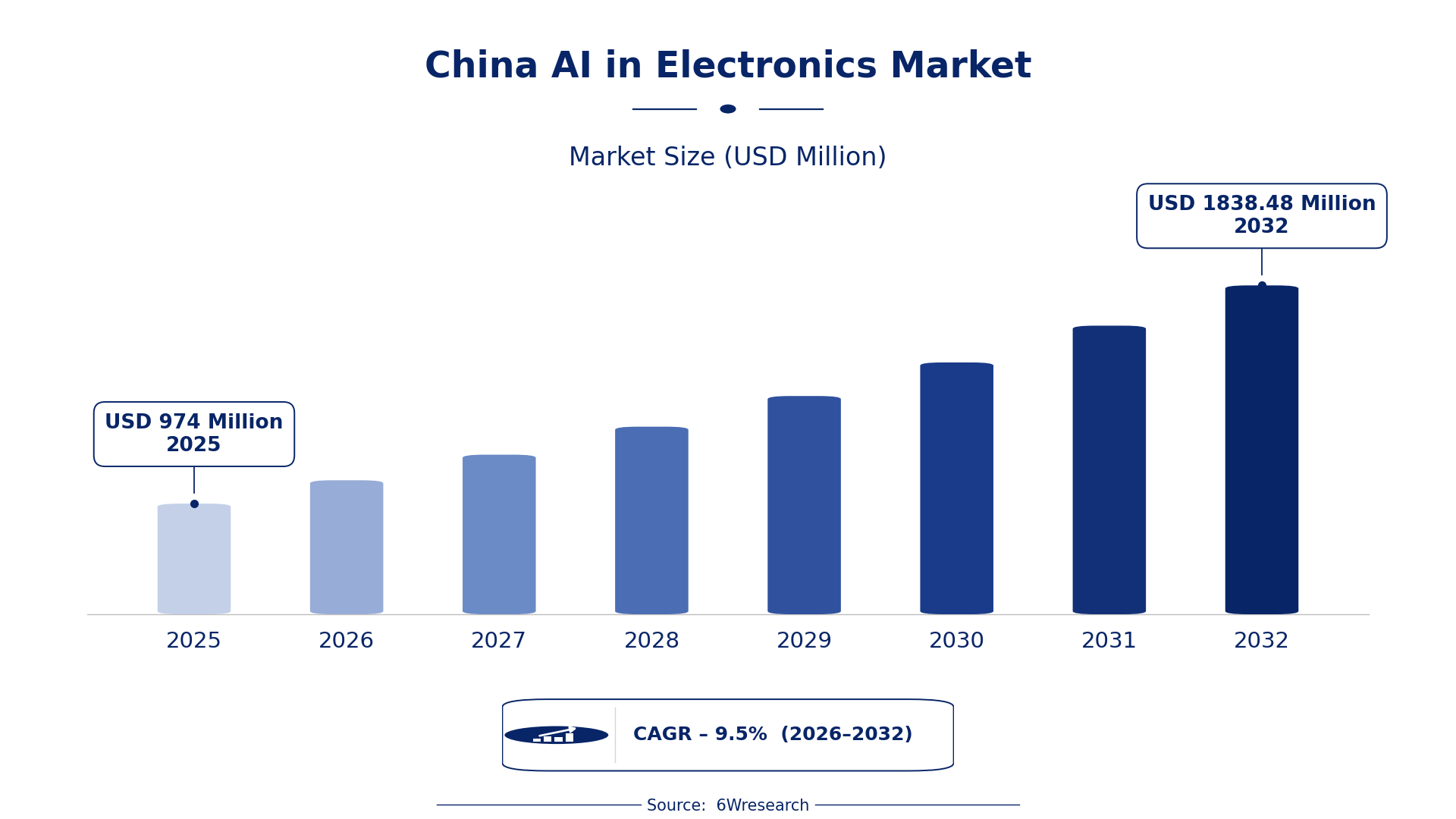
According to 6Wresearch internal database and industry insights, the China AI in Electronics Market was valued at USD 974.0 million in 2025 and is projected to reach USD 1,838.48 million by 2032, growing at a CAGR of approximately 9.5% during 2026–2032.
China AI in Electronics Market Highlights
| Report Metric | Details |
| Report Name | China AI in Electronics Market |
| Market Size 2025 | USD 974.0 million |
| Market Size 2032 | USD 1,838.48 million |
| Absolute Growth 2025–2032 | USD 864.48 million |
| CAGR 2026–2032 | 9.5% |
| Peak Annual Growth | 11.8% in 2031 |
| Forecast Period | 2026–2032 |
| Historical Data | 2022–2025 |
| Base Year | 2025 |
| Leading Application Area, 2025 | Smart Home Devices (48% share) |
| Leading AI Component, 2025 | SoC with ML Cores (36% share) |
| Leading Distribution Channel, 2025 | OEM Direct Sales (38% share) |
| Leading End User, 2025 | Consumer Electronics Companies (51% share) |
| Fastest-Growing Application Area | Predictive Maintenance (11.7% CAGR) |
| Fastest-Growing AI Component | ML Algorithms (10.8% CAGR) |
| Fastest-Growing End User | IoT Product Developers (11.9% CAGR) |
| Growing Sector | Consumer Electronics |
| Key End Users | Consumer Electronics Companies, Device Manufacturers, IoT Product Developers |
China AI in Electronics Market Year-wise Growth Rate and Key Drivers (2022–2032)
This graph illustrates the annual growth rates of the market from 2022 to 2032, highlighting a steady upward trajectory and projected market expansion over the forecast period.
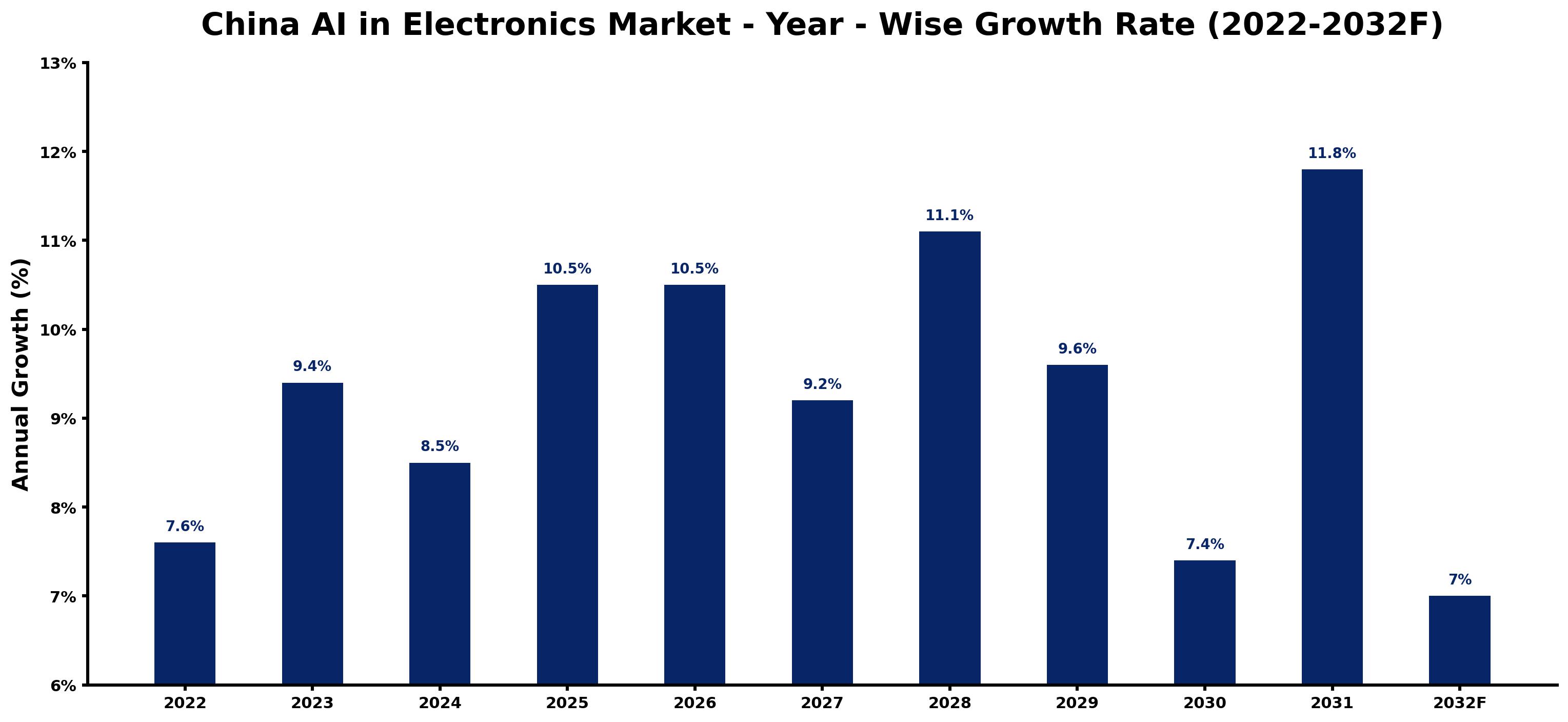
The following table presents the estimated annual growth rate for each year together with the principal factor influencing market performance.
| Year | Estimated Annual Growth (%) | Market Rationale |
| 2022 | 7.6 | The market experienced steady growth as smart home devices gained traction among urban households. |
| 2023 | 9.4 | Demand surged due to consumer electronics companies integrating AI features, supported by the National AI Innovation Action Plan. |
| 2024 | 8.5 | Growth slowed slightly as manufacturers faced challenges in meeting regulatory compliance for AI products. |
| 2025 | 10.5 | The market peaked with strong sales of smart home devices and AI chips, driven by consumer interest in automation. |
| 2026 | 10.5 | Growth is expected to decelerate as manufacturers adapt to shifting consumer preferences and market dynamics. |
| 2027 | 9.2 | Demand is projected to continue slowing as competition intensifies among device manufacturers. |
| 2028 | 11.1 | A resurgence in demand for predictive maintenance solutions is anticipated to drive market growth. |
| 2029 | 9.6 | Market growth is expected to slow again as competition among electronics producers increases. |
| 2030 | 7.4 | Growth is expected to moderate as the market stabilises following previous peaks in demand. |
| 2031 | 11.8 | A new wave of AI innovations is projected to drive the market to its highest growth rate. |
| 2032 | 7.0 | The market is expected to grow steadily as AI integration becomes standard across various applications. |
Note: Market size estimations and growth projections presented in this report are based on 6Wresearch's proprietary forecasting methodology, utilizing the latest available industry data, government publications, and primary research inputs.
China AI in Electronics Market Synopsis
AI in Electronics in China involves the integration of artificial intelligence technologies in electronic devices to enhance functionality and efficiency. This includes smart home automation, predictive maintenance, and energy optimisation. Demand is driven by the increasing adoption of smart home devices and AI-enabled consumer electronics. The National AI Development Plan aims for AI to contribute 1 trillion yuan to GDP by 2030, further supporting market growth.
Market Dynamics Impact Analysis (2026–2032)
| Factor | Type | Impact | Primary Segment Affected |
| Increasing consumer adoption of smart home devices | Driver | High | Smart Home Devices |
| Growing demand for predictive maintenance in industries | Driver | High | Predictive Maintenance |
| Emerging opportunities in energy optimization solutions | Opportunity | High | Energy Optimization |
| Rising demand for AI-enabled consumer electronics | Opportunity | High | Consumer Electronics Companies |
| Challenges in sourcing high-quality AI components | Restraint | Medium | Embedded AI Chips |
| Regulatory compliance costs for AI technologies | Restraint | Medium | Smart Home Devices |
| Talent shortages in AI development and integration | Challenge | High | Device Manufacturers |
| High competition among electronics manufacturers | Challenge | Medium | Consumer Electronics Companies |
Evaluation of Drivers in China AI in Electronics Market (2026–2032)
The factors lifting demand, and the evidence behind each, are summarised below.
| Drivers | Primary Segment Affected | Why It Matters (Evidence) |
| Growing investment in smart home technology | Smart Home Devices | In 2022, China's smart home device market reached 200 million units sold, driving demand for AI integration. |
| Increased focus on predictive maintenance | Predictive Maintenance | AI predicts equipment failures, improving operational efficiency and reducing downtime for manufacturers. |
| Rising consumer electronics sales | Consumer Electronics Companies | As of 2023, 60% of consumer electronics companies reported using AI in product development, boosting sales. |
| Expansion of AI capabilities in semiconductor production | Embedded AI Chips | China produced 1.5 billion semiconductor chips in 2021, many equipped with AI functionalities. |
| Government support for AI initiatives | Smart Home Devices | The National AI Innovation Action Plan aims to enhance AI capabilities in electronics by 2025. |
The AI in Electronics market in China is growing on the back of substantial investments in smart home technology and predictive maintenance solutions. In 2022, the smart home device market reached 200 million units sold, driving demand for AI integration. With 60% of consumer electronics companies reporting AI usage in product development as of 2023, sales are expected to rise. The production of 1.5 billion semiconductor chips in 2021, many with AI capabilities, supports this growth.
Evaluation of Restraints in China AI in Electronics Market
Below mentioned are some major restraints and their influence on market dynamics.
| Market Restraint | Primary Segment Affected | Why It Matters (Evidence) |
| High costs associated with AI technology integration | Embedded AI Chips | Producers face increased expenses in integrating AI components, affecting pricing strategies. |
| Regulatory compliance requirements for AI products | Smart Home Devices | Manufacturers must meet stringent standards, increasing time and costs for product approvals. |
| Limited availability of skilled AI professionals | Device Manufacturers | Talent shortages hinder development and integration of AI technologies in products. |
| Intense competition among electronics manufacturers | Consumer Electronics Companies | High competition leads to price wars, limiting profit margins for producers. |
| Supply chain disruptions affecting component availability | Smart Home Devices | Disruptions can delay production timelines and increase costs for manufacturers. |
China AI in Electronics Market Challenges
In 2022, producers in the China AI in Electronics market faced regulatory hurdles, as the National Standard for AI in Electronics mandated stringent quality and safety protocols, delaying product launches by an average of six months. Distributors struggle with intense competition, as over 500 AI startups in the sector drive innovation, forcing established players to invest heavily in research and development to maintain market share. Supply chain disruptions continue, with semiconductor shortages from 2021 impacting production timelines, resulting in revenue losses of up to 20% for manufacturers. Buyers are confronted with rising costs, as the average urban household now owns three smart devices, increasing demand for advanced AI features that elevate prices.
Trends in the China AI in Electronics Market
Four trends stand out in the China AI in Electronics Market.
- Shift towards Smart Home Automation: In 2023, consumer electronics companies increasingly focused on smart home automation, integrating AI technologies. The average household in urban China owns three smart devices, indicating a strong demand for these products.
- Emergence of Predictive Maintenance Solutions: Starting in 2023, industries began adopting predictive maintenance solutions powered by AI. This shift is driven by the need for operational efficiency, as AI predicts equipment failures effectively, reducing downtime.
- Growing Integration of AI in Consumer Electronics: In 2023, 60% of consumer electronics companies reported using AI in product development. This trend highlights the increasing reliance on AI technologies to improve product features and user experience.
- Expansion of AI Capabilities in Semiconductor Production: The Guangdong province has emerged as a hub for semiconductor production, with 1.5 billion chips produced in 2021. This growth supports the integration of AI technologies in various electronic applications.
Investment Opportunities in the China AI in Electronics Market
Investors looking at the China AI in Electronics Market should consider the following areas.
- Rising Demand for Energy Optimization Solutions: With China's IoT market projected to reach 1 trillion yuan by 2025, there is a strong opportunity for energy optimisation solutions. Device manufacturers can invest in AI technologies to meet this demand.
- Expansion of Smart Home Device Offerings: The strong sales of smart home devices present an opportunity for manufacturers to expand their product lines. Investing in AI integration can attract more consumers looking for automation solutions.
- Investment in AI Research and Development: The National Development and Reform Commission approved a budget of 5 billion yuan for AI research in electronics. This funding creates opportunities for startups and established companies to innovate.
- Growth in Predictive Maintenance Applications: As industries increasingly adopt predictive maintenance, there is a growing need for AI solutions. IoT product developers can capitalise on this trend by creating advanced AI-driven applications.
Government Initiatives in the China AI in Electronics Market
The National AI Innovation Action Plan, issued by the State Council in 2021, aims to improve AI capabilities in electronics by 2025. This initiative supports various projects and fosters innovation in the sector. The Ministry of Industry and Information Technology launched the 'AI + Manufacturing' initiative in 2022 to integrate AI into manufacturing processes, facilitating collaboration among industry players. These measures create a conducive environment for AI integration, benefiting both producers and consumers.
In 2023, the National Development and Reform Commission approved a budget of 5 billion yuan for AI research in electronics. This funding supports various projects aimed at developing AI applications in consumer electronics, facilitating innovation and collaboration among industry players. The Ministry of Science and Technology's AI Research Program, initiated in 2020, focuses on advancing AI technologies, further improving the capabilities of the electronics sector. These initiatives promote growth and competitiveness in the market.
Future Insight of the China AI in Electronics Market
The China AI in Electronics market will undergo significant changes by 2032, driven by advancements in smart home automation and energy optimisation. The National AI Development Plan aims for AI to contribute 1 trillion yuan to GDP by 2030, fostering further investment in AI technologies across the electronics sector. By 2025, the IoT market is projected to reach 1 trillion yuan, enhancing device connectivity and functionality. With AI algorithms integrated into 70% of new electronic products launched in 2023, suppliers must adapt quickly to meet evolving consumer expectations.
Market Segmentation Analysis
The analysis below covers each segmentation, its leading category in 2025 and its fastest-growing category through 2032.
By Application Area – Smart Home Devices Dominated, Predictive Maintenance Expected to Grow Fastest
According to Shubham Padhi, Research Analyst at 6Wresearch, the largest application area category in 2025 was Smart Home Devices, with a 48% share of total revenue. Smart home devices dominate the market share due to their widespread adoption in urban households, with an average of three devices per household. This segment thrives on the increasing consumer demand for home automation, making these devices essential for enhancing convenience and efficiency in daily life. Predictive Maintenance is projected to grow fastest, at a CAGR of 11.7% during 2026–2032. Predictive maintenance is witnessing rapid growth as industries implement AI to anticipate equipment failures, thus improving operational efficiency. The recognition of AI's potential in predictive maintenance across various sectors is propelling its swift adoption. Suppliers should focus on enhancing smart home device capabilities to cater to the growing consumer demand.
By AI Component – SoC with ML Cores Dominated, ML Algorithms Expected to Grow Fastest
With a 36% revenue share in 2025, SoC with ML Cores was the largest ai component category. SoC with ML cores capture the largest market share as they are vital for enabling advanced functionalities in a wide range of electronic devices. Their integration is essential for manufacturers aiming to enhance product performance and user experience. ML Algorithms are set to record the highest CAGR in this split, 10.8% over 2026–2032. ML algorithms are on a fast growth trajectory due to their critical role in facilitating machine learning capabilities in electronics, which are increasingly sought after by developers. The rising demand for intelligent applications across multiple sectors is driving the need for sophisticated ML algorithms. Buyers should prioritise sourcing components with advanced ML capabilities to stay competitive in the market.
By Distribution Channel – OEM Direct Sales Dominated and Is Expected to Record the Fastest Growth
OEM Direct Sales took a 38% share of distribution channel in 2025, more than any other category. OEM direct sales lead the market share as they provide a direct pathway for manufacturers to sell AI-enabled products to consumers. This channel enhances control over product quality and fosters better customer engagement, which is vital in the electronics sector. OEM Direct Sales is also forecast to expand faster than any other category, at a CAGR of 12.0% over 2026–2032. OEM direct sales are also the fastest-growing channel, as manufacturers increasingly recognise the benefits of engaging directly with consumers. This trend is likely to continue as companies aim to strengthen their brand presence and customer loyalty. Suppliers must optimise their direct sales strategies to improve outreach and customer satisfaction.
By End User – Consumer Electronics Companies Dominated, IoT Product Developers Expected to Grow Fastest
In 2025, Consumer Electronics Companies led the end user split with a 51% share. Consumer electronics companies hold the largest market share as they are at the forefront of developing and marketing AI-integrated products that cater to consumer needs. Their established market presence and commitment to innovation position them as key players in the AI in electronics market. Over 2026–2032, IoT Product Developers are expected to post the fastest growth, at a CAGR of 11.9%. IoT product developers are experiencing the fastest growth as the demand for smart functionalities in devices escalates. Their focus on integrating AI technologies aligns with the increasing consumer preference for connected devices, enhancing their market position. Buyers should seek partnerships with IoT developers to capitalise on the growing trend of smart technology integration.
Key Attractiveness of the Report
- 10 Years of Market Numbers
- Historical Data Starting from 2022 to 2025
- Base Year 2025
- Forecast Data until 2032
- Key Performance Indicators Impacting the Market
- Major Upcoming Developments and Projects
Key Highlights of the Report:
- China AI in Electronics Market Outlook
- Market Size of China AI in Electronics Market, 2025
- Forecast of China AI in Electronics Market, 2032
- Historical Data and Forecast of China AI in Electronics Revenues & Volume for the Period 2022 - 2032F
- China AI in Electronics Market Trend Evolution
- China AI in Electronics Market Drivers and Challenges
- China AI in Electronics Price Trends
- China AI in Electronics Porter's Five Forces
- China AI in Electronics Industry Life Cycle
- Historical Data and Forecast of China AI in Electronics Market Revenues & Volume By Application Area for the Period 2022 - 2032F
- Historical Data and Forecast of China AI in Electronics Market Revenues & Volume By Smart Home Devices for the Period 2022 - 2032F
- Historical Data and Forecast of China AI in Electronics Market Revenues & Volume By Embedded AI Chips for the Period 2022 - 2032F
- Historical Data and Forecast of China AI in Electronics Market Revenues & Volume By Predictive Maintenance for the Period 2022 - 2032F
- Historical Data and Forecast of China AI in Electronics Market Revenues & Volume By Energy Optimization for the Period 2022 - 2032F
- Historical Data and Forecast of China AI in Electronics Market Revenues & Volume By AI Component for the Period 2022 - 2032F
- Historical Data and Forecast of China AI in Electronics Market Revenues & Volume By Voice Assistants for the Period 2022 - 2032F
- Historical Data and Forecast of China AI in Electronics Market Revenues & Volume By SoC with ML Cores for the Period 2022 - 2032F
- Historical Data and Forecast of China AI in Electronics Market Revenues & Volume By Sensor + AI for the Period 2022 - 2032F
- Historical Data and Forecast of China AI in Electronics Market Revenues & Volume By ML Algorithms for the Period 2022 - 2032F
- Historical Data and Forecast of China AI in Electronics Market Revenues & Volume By Distribution Channel for the Period 2022 - 2032F
- Historical Data and Forecast of China AI in Electronics Market Revenues & Volume By Consumer Electronics Stores for the Period 2022 - 2032F
- Historical Data and Forecast of China AI in Electronics Market Revenues & Volume By Semiconductor Platforms for the Period 2022 - 2032F
- Historical Data and Forecast of China AI in Electronics Market Revenues & Volume By Industrial Supply Chains for the Period 2022 - 2032F
- Historical Data and Forecast of China AI in Electronics Market Revenues & Volume By OEM Direct Sales for the Period 2022 - 2032F
- Historical Data and Forecast of China AI in Electronics Market Revenues & Volume By End User for the Period 2022 - 2032F
- Historical Data and Forecast of China AI in Electronics Market Revenues & Volume By IoT Product Developers for the Period 2022 - 2032F
- Historical Data and Forecast of China AI in Electronics Market Revenues & Volume By Device Manufacturers for the Period 2022 - 2032F
- Historical Data and Forecast of China AI in Electronics Market Revenues & Volume By Smart Appliance Producers for the Period 2022 - 2032F
- Historical Data and Forecast of China AI in Electronics Market Revenues & Volume By Consumer Electronics Companies for the Period 2022 - 2032F
- China AI in Electronics Import Export Trade Statistics
- Market Opportunity Assessment By Application Area
- Market Opportunity Assessment By AI Component
- Market Opportunity Assessment By Distribution Channel
- Market Opportunity Assessment By End User
- China AI in Electronics Top Companies Market Share
- China AI in Electronics Competitive Benchmarking By Technical and Operational Parameters
- China AI in Electronics Company Profiles
- China AI in Electronics Key Strategic Recommendations
Market Covered
Segments analysed in this report are listed below.
By Application Area
- Smart Home Devices
- Embedded AI Chips
- Predictive Maintenance
- Energy Optimization
By AI Component
- Voice Assistants
- SoC with ML Cores
- Sensor + AI
- ML Algorithms
By Distribution Channel
- Consumer Electronics Stores
- Semiconductor Platforms
- Industrial Supply Chains
- OEM Direct Sales
By End User
- IoT Product Developers
- Device Manufacturers
- Smart Appliance Producers
- Consumer Electronics Companies































