China AI in Emergency Medicine Market Size & Growth Rate
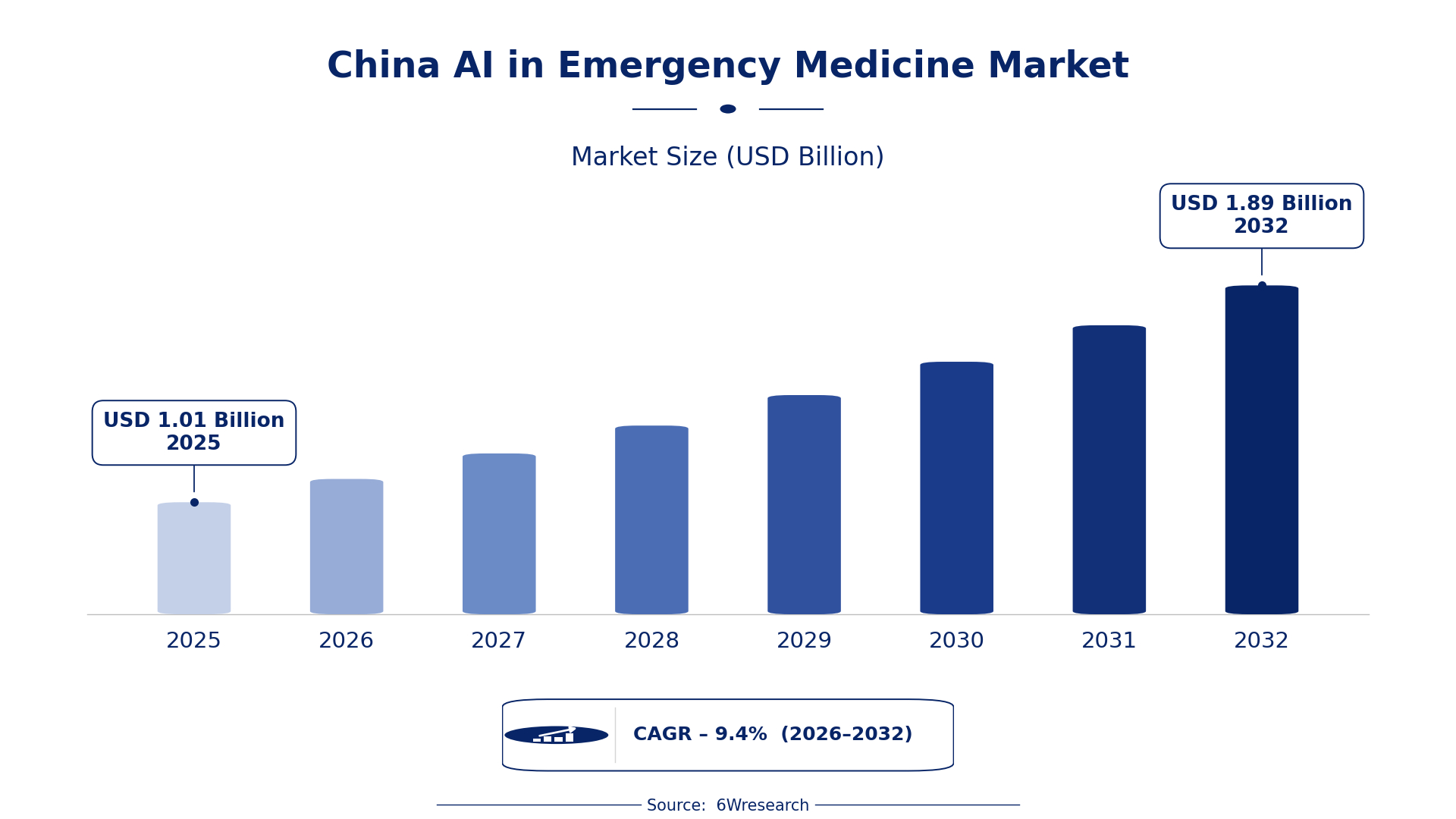
According to 6Wresearch internal database and industry insights, the China AI in Emergency Medicine Market was valued at USD 1.01 billion in 2025 and is projected to reach USD 1.89 billion by 2032, growing at a CAGR of approximately 9.4% during 2026–2032.
China AI in Emergency Medicine Market Highlights
| Report Metric | Details |
| Report Name | China AI in Emergency Medicine Market |
| Market Size 2025 | USD 1.01 billion |
| Market Size 2032 | USD 1.89 billion |
| Absolute Growth 2025–2032 | USD 0.88 billion |
| CAGR 2026–2032 | 9.4% |
| Peak Annual Growth | 12.0% in 2026 |
| Forecast Period | 2026–2032 |
| Historical Data | 2022–2025 |
| Base Year | 2025 |
| Leading Use Case, 2025 | Triage Optimization (41% share) |
| Leading AI Solution Type, 2025 | Real-Time Decision AI (50% share) |
| Leading Distribution Channel, 2025 | Emergency SaaS Tools (42% share) |
| Leading End User, 2025 | ER Doctors (48% share) |
| Fastest-Growing Use Case | Diagnosis Support (10.9% CAGR) |
| Fastest-Growing AI Solution Type | NLP & Imaging AI (10.5% CAGR) |
| Fastest-Growing Distribution Channel | HealthTech Distributors (11.1% CAGR) |
| Fastest-Growing End User | Trauma Centers (11.9% CAGR) |
| Growing Sector | Emergency Medical Services |
| Key End Users | Healthcare Providers, Emergency Departments, ER Doctors, Trauma Centers |
China AI in Emergency Medicine Market Year-wise Growth Rate and Key Drivers (2022–2032)
This graph illustrates the annual growth rates of the market from 2022 to 2032, highlighting a steady upward trajectory and projected market expansion over the forecast period.
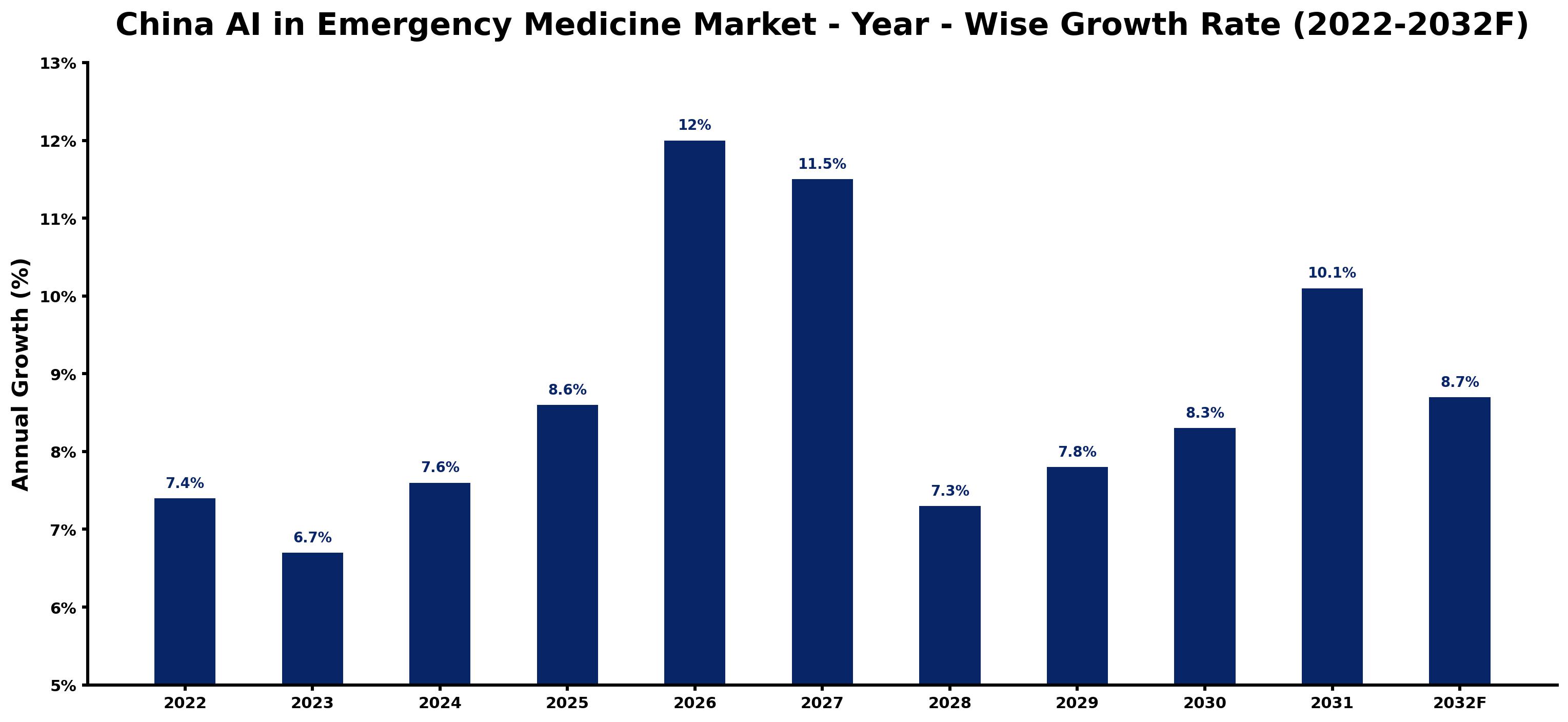
The table below sets out the estimated growth rate for each year and the main factor behind it.
| Year | Estimated Annual Growth (%) | Market Rationale |
| 2022 | 7.4 | Demand was driven by the integration of AI technologies in emergency medical services. |
| 2023 | 6.7 | Growth slowed due to the ongoing implementation of AI solutions across healthcare facilities. |
| 2024 | 7.6 | Increased adoption of AI tools in major hospitals accelerated growth rates. |
| 2025 | 8.6 | Improved triage processes contributed to a higher growth rate this year. |
| 2026 | 12.0 | The peak growth year is driven by significant investments in AI by healthcare providers. |
| 2027 | 11.5 | Growth slowed as the market began to stabilise after rapid expansion. |
| 2028 | 7.3 | The market is expected to grow as AI technologies become more integrated into emergency care. |
| 2029 | 7.8 | Demand increased as more trauma centers adopted AI technologies for patient care. |
| 2030 | 8.3 | Growth is projected to accelerate again due to improved ambulance routing systems. |
| 2031 | 10.1 | The market is expected to rise in growth driven by the expansion of emergency departments. |
| 2032 | 8.7 | Growth is anticipated to slow as the market reaches a more mature phase. |
Note: Market size estimations and growth projections presented in this report are based on 6Wresearch's proprietary forecasting methodology, utilizing the latest available industry data, government publications, and primary research inputs.
China AI in Emergency Medicine Market Synopsis
AI in Emergency Medicine in China utilises artificial intelligence technologies to improve emergency care. It enhances triage processes, supports diagnosis, optimises ambulance routing, and prioritises patient care. The China AI in Emergency Medicine Market is expanding due to rising demand from healthcare providers and hospitals adopting AI solutions. Key initiatives like the 'Smart Healthcare' program and the 'Healthy China 2030' initiative are driving this trend, with over 2,000 emergency departments utilising AI technologies as of 2023.
Market Dynamics Impact Analysis (2026–2032)
| Factor | Type | Impact | Primary Segment Affected |
| Growing adoption of AI tools in emergency departments | Driver | High | Emergency Departments |
| Increased funding for AI development in healthcare | Driver | High | Triage Optimization |
| Integration of AI in triage processes | Opportunity | High | Triage Optimization |
| Expansion of emergency SaaS tools in urban areas | Opportunity | High | Emergency SaaS Tools |
| Limited access to AI technologies in rural regions | Restraint | Medium | Emergency Departments |
| High costs associated with AI implementation | Restraint | High | Triage Optimization |
| Challenges in data privacy and security regulations | Challenge | High | Emergency Departments |
| Resistance from medical staff to adopt new technologies | Challenge | Medium | Triage Optimization |
Evaluation of Drivers in China AI in Emergency Medicine Market (2026–2032)
Below mentioned are some major drivers and their influence on market dynamics.
| Drivers | Primary Segment Affected | Why It Matters (Evidence) |
| Increased adoption of AI tools in emergency departments | Emergency Departments | Over 2,000 emergency departments in China are utilising AI technologies, improving patient care outcomes. |
| Expansion of emergency SaaS tools in urban areas | Emergency SaaS Tools | Adoption of emergency SaaS tools in tier-1 cities has improved operational efficiency, benefiting healthcare providers. |
| Integration of AI in triage processes | Triage Optimization | The 'Smart Healthcare' program promotes AI for efficient patient management in emergencies, improving response times. |
| Increased funding for AI development in healthcare | Triage Optimization | The Chinese government allocated 500 million yuan for AI development in healthcare, facilitating innovations in emergency services. |
| Implementation of AI-based diagnosis support tools | Diagnosis Support | AI diagnosis support tools are being implemented in over 50% of major hospitals, improving diagnostic accuracy. |
In 2023, over 2,000 emergency departments utilised AI technologies, leading to improved patient outcomes. AI-based diagnosis support tools are being implemented in more than half of major hospitals, improving the accuracy of medical assessments. This trend is particularly evident in tier-1 cities like Beijing and Shanghai, where operational efficiency is significantly enhanced.
Evaluation of Restraints in China AI in Emergency Medicine Market
The main factors holding the market back are set out below.
| Market Restraint | Primary Segment Affected | Why It Matters (Evidence) |
| Limited access to AI technologies in rural regions | Emergency Departments | Rural healthcare facilities often lack the infrastructure to implement advanced AI solutions, hindering patient care. |
| High costs associated with AI implementation | Triage Optimization | Many hospitals face budget constraints, making it difficult to invest in AI technologies, which limits their capabilities. |
| Challenges in data privacy and security regulations | Emergency Departments | Compliance with stringent regulations can delay the adoption of AI in emergency care, impacting operational efficiency. |
| Resistance from medical staff to adopt new technologies | Triage Optimization | Some medical professionals are hesitant to integrate AI tools into their workflows, affecting overall implementation rates. |
| Insufficient training programs for AI technologies | Emergency Departments | A lack of training hinders effective use of AI solutions in emergency settings, leading to suboptimal patient management. |
China AI in Emergency Medicine Market Challenges
The China AI in Emergency Medicine market faces several practical problems, beginning with technology integration. Many emergency departments struggle to implement AI solutions effectively due to outdated IT infrastructure, which delays enhancements in patient care for hospitals. A shortage of trained personnel hampers the adoption of AI tools, resulting in longer response times, with the average urban ambulance response time exceeding the targeted 8 minutes for buyers seeking efficient emergency services. Compliance with ISO 13485 standards adds extra costs for producers, slowing down product rollout and limiting availability. Competition among healthcare providers intensifies as they race to adopt AI, increasing pricing pressure on suppliers.
Trends in the China AI in Emergency Medicine Market
Buyers and suppliers in the China AI in Emergency Medicine Market are adjusting to the following trends.
- Shift in Emergency Care Practices: Healthcare providers in China are increasingly adopting AI technologies for emergency care. The 'Smart Healthcare' program has led to over 2,000 emergency departments implementing AI solutions, improving patient outcomes.
- Emergence of Real-Time Decision AI: Real-Time Decision AI is becoming essential in emergency medicine. This technology supports immediate decision-making in critical situations, with its adoption growing rapidly across major hospitals, improving patient management.
- Transition to Emergency SaaS Tools: Emergency SaaS Tools are gaining traction in urban areas, particularly in tier-1 cities like Beijing. Their adoption has improved operational efficiency in emergency medical services, benefiting healthcare providers.
- Integration of AI in Triage Processes: The integration of AI in triage processes began in 2022, significantly improving patient management. This shift is supported by the 'Healthy China 2030' initiative, which aims to enhance healthcare services.
Investment Opportunities in the China AI in Emergency Medicine Market
Below are the investment opportunities with the strongest case in the China AI in Emergency Medicine Market.
- AI-Based Diagnosis Support Tools: The need for AI-based diagnosis support tools in hospitals is growing, with over 50% implementation expected by 2025. Partnering with healthcare providers will facilitate entry into this market.
- Emergency SaaS Tools Expansion: Urban areas are increasingly adopting emergency SaaS tools, presenting a notable investment opportunity. Collaborating with local healthcare providers can enhance market entry and operational efficiency.
- Triage Optimization Solutions: The demand for triage optimization solutions is rising, particularly in emergency departments. Investing in AI technologies now can position suppliers favourably as adoption increases across healthcare facilities.
- HealthTech Distributors Growth: HealthTech distributors are expanding their reach, with an expected growth rate of 11.1%. Forming joint ventures with these distributors can facilitate access to a broader market and enhance distribution.
Government Initiatives in the China AI in Emergency Medicine Market
The regulatory framework for AI in Emergency Medicine in China has evolved with important measures. The 'Healthy China 2030' initiative, launched in 2016, aims to improve healthcare services, including emergency care through AI integration. Additionally, the National Health Commission's 'Smart Healthcare' program, initiated in 2022, focuses on integrating AI into emergency medical services. These initiatives encourage healthcare providers to adopt AI technologies, improving patient outcomes and operational efficiency. The China Medical Association has also established guidelines for AI use in emergency medicine, ensuring compliance and safety in implementation.
The National Health Commission plays a vital role in funding AI research and development in healthcare. It supports various programs aimed at enhancing the integration of AI technologies in emergency medicine. In 2023, the commission allocated 500 million yuan specifically for AI development in healthcare, facilitating the growth of AI solutions in emergency departments. Furthermore, the Ministry of Industry and Information Technology oversees the implementation of standards like ISO 13485, ensuring quality management in AI applications, which benefits producers and buyers alike.
Future Insight of the China AI in Emergency Medicine Market
The China AI in Emergency Medicine market is expected to evolve significantly by 2032, influenced by the 'Smart Healthcare' program and the 'Healthy China 2030' initiative. By 2025, predictive AI will be integrated into 30% of trauma centers, enhancing patient outcomes. Government funding for AI research will encourage advancements in emergency care technologies. The establishment of guidelines by the China Medical Association will standardise practices, facilitating better integration of AI solutions across healthcare facilities.
Market Segmentation Analysis
The analysis below covers each segmentation, its leading category in 2025 and its fastest-growing category through 2032.
By Use Case – Triage Optimization Dominated, Diagnosis Support Expected to Grow Fastest
According to Shubham Padhi, Research Analyst at 6Wresearch, the largest use case category in 2025 was Triage Optimization, with a 41% share of total revenue. Triage Optimization holds the largest share as it is essential for managing patient flow efficiently during emergencies. With over 2,000 emergency departments in China utilising AI technologies, effective triage is crucial for improving patient outcomes. Diagnosis Support is set to record the highest CAGR in this split, 10.9% over 2026–2032. Diagnosis Support is experiencing rapid growth, driven by the increasing implementation of AI-based diagnosis tools in hospitals, with over 50% of major hospitals expected to adopt these solutions by 2025. This trend underscores the importance of accurate and timely medical assessments in emergency care. Suppliers should enhance solutions for triage and diagnosis to meet the growing demand in emergency medicine.
By AI Solution Type – Real-Time Decision AI Dominated, NLP & Imaging AI Expected to Grow Fastest
Real-Time Decision AI held a 50% share of the China AI in Emergency Medicine Market by ai solution type in 2025. Real-Time Decision AI commands the largest share due to its provision of immediate support in critical situations, which is vital for emergency medical services. This capability is increasingly recognised as essential by healthcare providers aiming to improve patient outcomes. Over 2026–2032, NLP & Imaging AI is expected to post the fastest growth, at a CAGR of 10.5%. NLP & Imaging AI is the fastest-growing segment, driven by the need for improved data interpretation in emergency settings. As technologies advance, their integration into medical imaging and language processing becomes crucial for timely decision-making. Buyers should prioritise solutions that offer real-time decision-making and advanced imaging capabilities to remain competitive in emergency care.
By Distribution Channel – Emergency SaaS Tools Dominated, HealthTech Distributors Expected to Grow Fastest
With a 42% revenue share in 2025, Emergency SaaS Tools was the largest distribution channel category. Emergency SaaS Tools dominate market share due to their widespread adoption for real-time emergency management across healthcare facilities. Their ability to streamline operations makes them indispensable in urban areas with high demand for emergency services. HealthTech Distributors are projected to grow fastest, at a CAGR of 11.1% during 2026–2032. HealthTech Distributors are rapidly growing as they facilitate access to AI solutions, reflecting the increasing reliance on technology in healthcare. As more providers seek these tools, the role of distributors in connecting them will expand significantly. Suppliers must strengthen partnerships with distributors to enhance market reach and ensure timely delivery of solutions.
By End User – ER Doctors Dominated, Trauma Centers Expected to Grow Fastest
In 2025, ER Doctors led the end user split with a 48% share. ER Doctors represent the largest share of users as they are the primary operators of tools for patient care in emergencies. Their direct involvement in patient management makes them key stakeholders in the adoption of these technologies. The quickest growth will come from Trauma Centers, forecast to expand at a CAGR of 11.9% between 2026 and 2032. Trauma Centers are witnessing the fastest growth in AI usage, heavily relying on advanced technologies for enhanced emergency care. This trend indicates a shift towards more specialised applications in critical care settings. Suppliers should tailor offerings to meet the specific needs of ER Doctors and Trauma Centers to effectively capture market share.
Key Attractiveness of the Report
- 10 Years of Market Numbers
- Historical Data Starting from 2022 to 2025
- Base Year 2025
- Forecast Data until 2032
- Key Performance Indicators Impacting the Market
- Major Upcoming Developments and Projects
Key Highlights of the Report:
- China AI in Emergency Medicine Market Outlook
- Market Size of China AI in Emergency Medicine Market, 2025
- Forecast of China AI in Emergency Medicine Market, 2032
- Historical Data and Forecast of China AI in Emergency Medicine Revenues & Volume for the Period 2022 - 2032F
- China AI in Emergency Medicine Market Trend Evolution
- China AI in Emergency Medicine Market Drivers and Challenges
- China AI in Emergency Medicine Price Trends
- China AI in Emergency Medicine Porter's Five Forces
- China AI in Emergency Medicine Industry Life Cycle
- Historical Data and Forecast of China AI in Emergency Medicine Market Revenues & Volume By Use Case for the Period 2022 - 2032F
- Historical Data and Forecast of China AI in Emergency Medicine Market Revenues & Volume By Triage Optimization for the Period 2022 - 2032F
- Historical Data and Forecast of China AI in Emergency Medicine Market Revenues & Volume By Diagnosis Support for the Period 2022 - 2032F
- Historical Data and Forecast of China AI in Emergency Medicine Market Revenues & Volume By Ambulance Routing for the Period 2022 - 2032F
- Historical Data and Forecast of China AI in Emergency Medicine Market Revenues & Volume By Patient Prioritization for the Period 2022 - 2032F
- Historical Data and Forecast of China AI in Emergency Medicine Market Revenues & Volume By AI Solution Type for the Period 2022 - 2032F
- Historical Data and Forecast of China AI in Emergency Medicine Market Revenues & Volume By Real-Time Decision AI for the Period 2022 - 2032F
- Historical Data and Forecast of China AI in Emergency Medicine Market Revenues & Volume By NLP & Imaging AI for the Period 2022 - 2032F
- Historical Data and Forecast of China AI in Emergency Medicine Market Revenues & Volume By Predictive AI + GIS for the Period 2022 - 2032F
- Historical Data and Forecast of China AI in Emergency Medicine Market Revenues & Volume By Risk Stratification for the Period 2022 - 2032F
- Historical Data and Forecast of China AI in Emergency Medicine Market Revenues & Volume By Distribution Channel for the Period 2022 - 2032F
- Historical Data and Forecast of China AI in Emergency Medicine Market Revenues & Volume By Emergency SaaS Tools for the Period 2022 - 2032F
- Historical Data and Forecast of China AI in Emergency Medicine Market Revenues & Volume By HealthTech Distributors for the Period 2022 - 2032F
- Historical Data and Forecast of China AI in Emergency Medicine Market Revenues & Volume By Integrated Healthcare Systems for the Period 2022 - 2032F
- Historical Data and Forecast of China AI in Emergency Medicine Market Revenues & Volume By Hospital IT Systems for the Period 2022 - 2032F
- Historical Data and Forecast of China AI in Emergency Medicine Market Revenues & Volume By End User for the Period 2022 - 2032F
- Historical Data and Forecast of China AI in Emergency Medicine Market Revenues & Volume By ER Doctors for the Period 2022 - 2032F
- Historical Data and Forecast of China AI in Emergency Medicine Market Revenues & Volume By Trauma Centers for the Period 2022 - 2032F
- Historical Data and Forecast of China AI in Emergency Medicine Market Revenues & Volume By EMS Services for the Period 2022 - 2032F
- Historical Data and Forecast of China AI in Emergency Medicine Market Revenues & Volume By Emergency Departments for the Period 2022 - 2032F
- China AI in Emergency Medicine Import Export Trade Statistics
- Market Opportunity Assessment By Use Case
- Market Opportunity Assessment By AI Solution Type
- Market Opportunity Assessment By Distribution Channel
- Market Opportunity Assessment By End User
- China AI in Emergency Medicine Top Companies Market Share
- China AI in Emergency Medicine Competitive Benchmarking By Technical and Operational Parameters
- China AI in Emergency Medicine Company Profiles
- China AI in Emergency Medicine Key Strategic Recommendations
Market Covered
The report offers an extensive study of the following market segments.
By Use Case
- Triage Optimization
- Diagnosis Support
- Ambulance Routing
- Patient Prioritization
By AI Solution Type
- Real-Time Decision AI
- NLP & Imaging AI
- Predictive AI + GIS
- Risk Stratification
By Distribution Channel
- Emergency SaaS Tools
- HealthTech Distributors
- Integrated Healthcare Systems
- Hospital IT Systems
By End User
- ER Doctors
- Trauma Centers
- EMS Services
- Emergency Departments































