China AI in Enterprise Software Market Size & Growth Rate
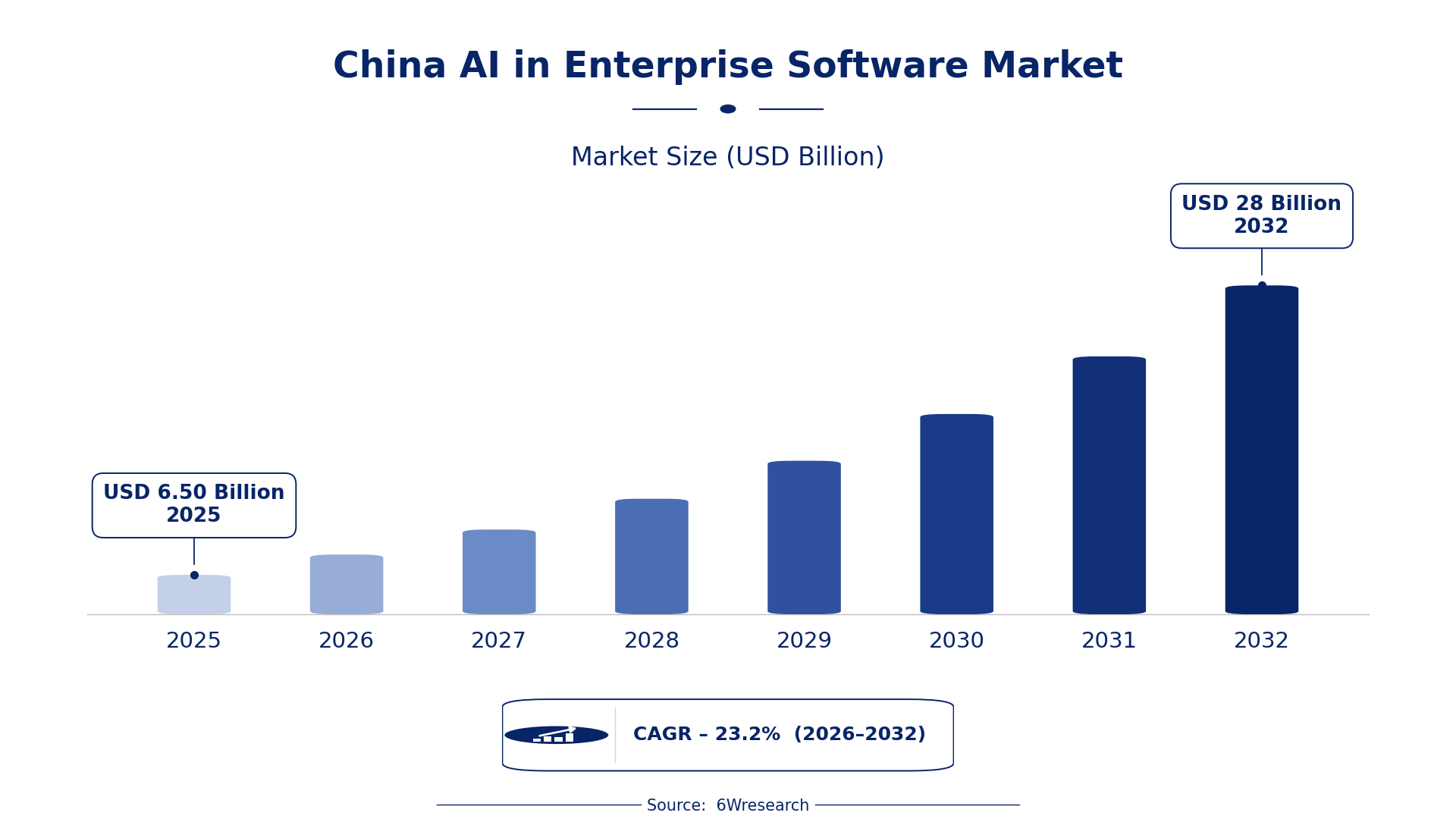
According to 6Wresearch internal database and industry insights, the China AI in Enterprise Software Market was valued at USD 6.5 billion in 2025 and is projected to reach USD 28 billion by 2032, growing at a CAGR of approximately 23.2% during 2026–2032.
China AI in Enterprise Software Market Highlights
| Report Metric | Details |
| Report Name | China AI in Enterprise Software Market |
| Market Size 2025 | USD 6.5 billion |
| Market Size 2032 | USD 28 billion |
| Absolute Growth 2025–2032 | USD 21.50 billion |
| CAGR 2026–2032 | 23.2% |
| Peak Annual Growth | 24.9% in 2031 |
| Forecast Period | 2026–2032 |
| Historical Data | 2022–2025 |
| Base Year | 2025 |
| Leading Software Type, 2025 | ERP with AI (44% share) |
| Leading AI Functionality, 2025 | Demand Forecasting (42% share) |
| Leading Distribution Channel, 2025 | SaaS Portals (36% share) |
| Leading End User, 2025 | Large Enterprises (43% share) |
| Fastest-Growing Software Type | HR Software (25.6% CAGR) |
| Fastest-Growing Distribution Channel | Direct Software Vendors (25.1% CAGR) |
| Fastest-Growing End User | HR Departments (24.8% CAGR) |
| Growing Sector | E-commerce and Retail |
| Key End Users | Large Enterprises, SMEs, HR Departments, E-commerce Companies |
China AI in Enterprise Software Market Year-wise Growth Rate and Key Drivers (2022–2032)
This graph illustrates the annual growth rates of the market from 2022 to 2032, highlighting a steady upward trajectory and projected market expansion over the forecast period.
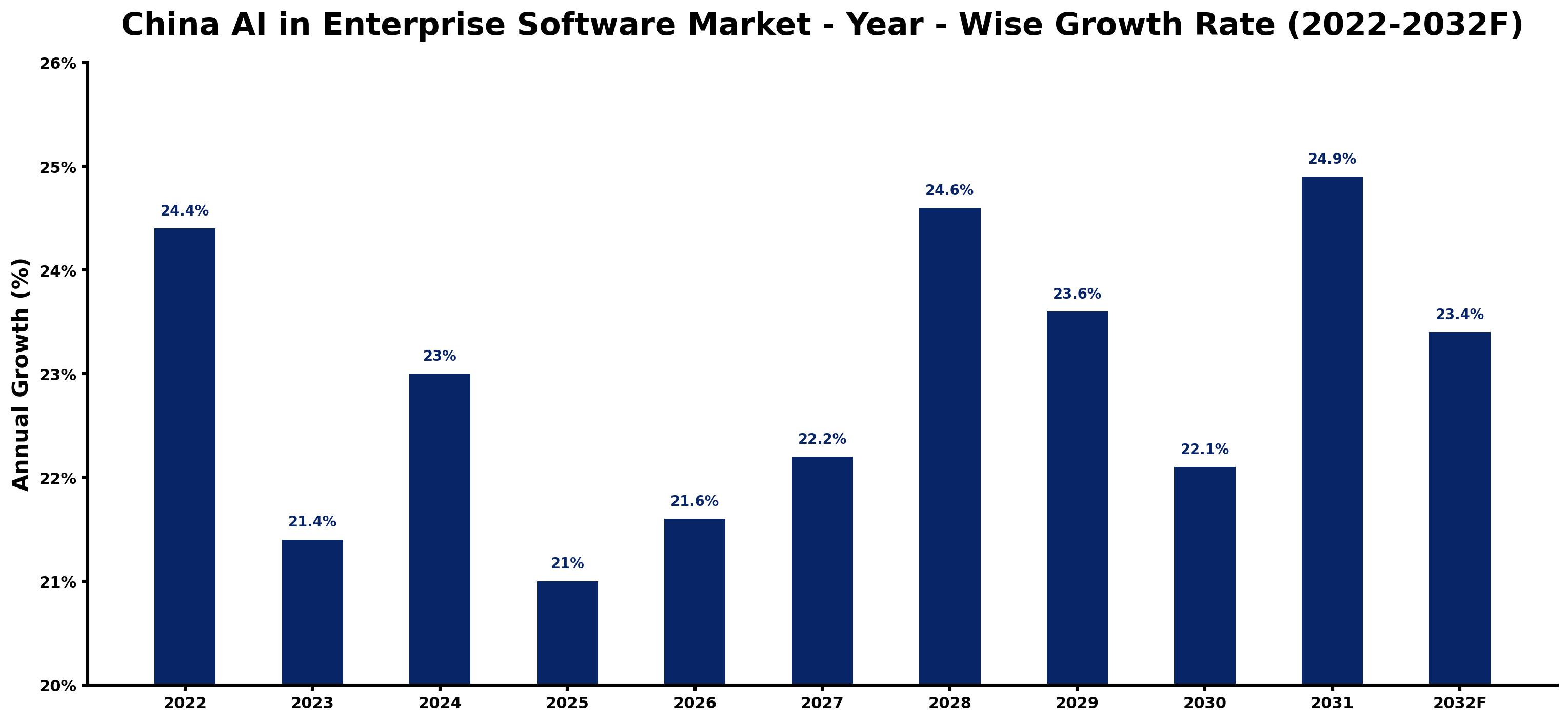
Each row of the following table gives one year's estimated growth and the event or demand shift that explains it.
| Year | Estimated Annual Growth (%) | Market Rationale |
| 2022 | 24.4 | The market experienced growth due to increased AI adoption among enterprises, particularly in manufacturing and retail. |
| 2023 | 21.4 | Growth slowed as companies adjusted to new AI technologies and integration processes, impacting implementation timelines. |
| 2024 | 23.0 | Demand rose as businesses sought to improve operational efficiency through AI solutions, especially in HR and ERP systems. |
| 2025 | 21.0 | Growth slowed again as market saturation began to affect expansion rates, particularly among SMEs. |
| 2026 | 21.6 | A renewed interest in AI capabilities is expected to drive demand higher, supported by the 'AI Innovation Action Plan'. |
| 2027 | 22.2 | Investment in AI technologies continues to rise, boosting market growth further, especially in large enterprises. |
| 2028 | 24.6 | The market is projected to see increased demand as AI integration becomes standard across various sectors. |
| 2029 | 23.6 | Growth slows as competition intensifies among software providers in the sector, affecting pricing strategies. |
| 2030 | 22.1 | Market expansion is expected to continue, albeit at a slower pace than before, as firms consolidate. |
| 2031 | 24.9 | A surge in AI adoption across various sectors will drive peak growth rates, particularly in ERP and CRM solutions. |
| 2032 | 23.4 | Demand remains strong, but growth moderates as the market matures and compliance standards tighten. |
Note: Market size estimations and growth projections presented in this report are based on 6Wresearch's proprietary forecasting methodology, utilizing the latest available industry data, government publications, and primary research inputs.
China AI in Enterprise Software Market Synopsis
AI in Enterprise Software in China incorporates artificial intelligence into traditional business applications, streamlining processes and refining decision-making. The ERP segment is at the forefront, driven by demand from the manufacturing and retail sectors, while initiatives from the Ministry of Industry and Information Technology encourage AI integration across various industries.
Market Dynamics Impact Analysis (2026–2032)
| Factor | Type | Impact | Primary Segment Affected |
| Growing demand for AI-driven CRM solutions among e-commerce companies | Driver | High | CRM with AI |
| Increasing adoption of AI in HR software for talent management | Driver | High | HR Software |
| Rising need for efficient resource planning in manufacturing | Opportunity | High | ERP with AI |
| Expansion of SaaS portals among SMEs for software delivery | Opportunity | Medium | SaaS Portals |
| Challenges in ensuring compliance with updated national standards | Restraint | High | ERP with AI |
| Limited awareness of AI capabilities among smaller enterprises | Restraint | Medium | HR Software |
| Integration complexities of AI technologies within existing systems | Challenge | High | Project Management Tools |
| High costs associated with AI software implementation | Challenge | Medium | ERP with AI |
Evaluation of Drivers in China AI in Enterprise Software Market (2026–2032)
Key forces behind demand, with the segment each one moves most, are listed below.
| Drivers | Primary Segment Affected | Why It Matters (Evidence) |
| Increased demand for AI-driven CRM solutions | CRM with AI | E-commerce companies are adopting AI solutions to improve customer engagement, contributing to a market growth of 21.4% in 2023. |
| Growing investment in HR software for talent management | HR Software | Manufacturing sectors are increasingly integrating AI for better resource management and operational efficiency, with over 50,000 large enterprises using AI in HR software in 2023. |
| Expansion of SaaS portals for software delivery | SaaS Portals | SMEs are increasingly using SaaS solutions, leading to a 30% increase in usage among these businesses in 2023. |
| Government initiatives promoting AI integration | ERP with AI | The Ministry of Industry and Information Technology's support encourages enterprises to adopt AI technologies, with funding of 1 billion yuan allocated for AI research. |
| Rising demand for project management tools with AI capabilities | Project Management Tools | Technology firms are increasingly seeking AI-enhanced project management solutions to improve collaboration and efficiency. |
Market growth for AI in Enterprise Software in China is underpinned by increased demand for AI-driven CRM solutions, growing investment in HR software, and the rising need for efficient resource planning. In 2023, over 50,000 large enterprises adopted AI in HR software, streamlining their recruitment processes. The manufacturing sector is integrating AI in ERP systems, driven by operational efficiency needs.
Evaluation of Restraints in China AI in Enterprise Software Market
The following restraints limit how fast demand can grow.
| Market Restraint | Primary Segment Affected | Why It Matters (Evidence) |
| Compliance challenges with updated national standards | ERP with AI | The National Standard for AI Software updated in 2022 requires producers to ensure compliance, complicating integration. |
| Limited awareness of AI capabilities among SMEs | HR Software | Many small enterprises lack understanding of AI benefits, hindering adoption rates. |
| Integration complexities within existing systems | Project Management Tools | Businesses face challenges in integrating AI tools with current project management systems, delaying implementation. |
| High costs associated with AI software implementation | ERP with AI | The substantial investment required for AI integration can deter smaller enterprises from adoption. |
| Insufficient talent skilled in AI technologies | CRM with AI | The shortage of trained professionals limits the effective deployment of AI solutions in enterprises. |
China AI in Enterprise Software Market Challenges
Buyers in the China AI in enterprise software market contend with fierce competition, as numerous companies strive for market share, which can diminish pricing power and affect quality. Distributors face difficulties in integrating AI functionalities into existing systems, leading to delays that frustrate buyers seeking timely solutions. Producers encounter challenges in sourcing high-quality datasets necessary for effective AI training, complicating development and extending project timelines. Rising costs linked to AI research and development, supported by a 1 billion yuan government fund, restrict financial resources for software enhancements, limiting access to advanced tools for buyers.
Trends in the China AI in Enterprise Software Market
Buyers and suppliers in the China AI in Enterprise Software Market are adjusting to the following trends.
- AI Innovation Action Plan Promoting Integration: The 'AI Innovation Action Plan' launched in 2023 aims to integrate AI into enterprises, targeting 500 key companies to boost productivity. This initiative is set to increase software adoption among these firms.
- Shift Towards SaaS Portals for Software Delivery: SaaS portals are becoming the preferred method for software delivery, with a 30% rise in usage among SMEs in 2023. This trend reflects a shift towards more accessible and scalable solutions for businesses.
- Growing Adoption of AI in HR Software: The demand for AI in HR software is on the rise, particularly among large enterprises, with over 50,000 adopting these solutions in 2023. This indicates a broader trend towards automation in talent management.
- Increased Focus on Compliance Standards: The updated National Standard for AI Software in 2022 has led to a heightened focus on compliance among producers. This shift ensures improved quality and interoperability in AI solutions throughout the market.
Investment Opportunities in the China AI in Enterprise Software Market
Investors looking at the China AI in Enterprise Software Market should consider the following areas.
- AI-Driven CRM Solutions: With the growth of e-commerce, there is an increasing demand for AI-driven CRM solutions, especially among retail businesses. Investing in these technologies can enhance customer engagement and retention, as e-commerce is projected to expand by 20% annually.
- HR Software for Talent Management: This is an ideal time to invest in HR software that includes AI capabilities, as large enterprises aim to streamline their recruitment processes. Collaborating with local firms can ease market entry, particularly in urban areas with high enterprise concentrations.
- SaaS Portals for Software Delivery: The rising use of SaaS portals among SMEs offers an opportunity to provide cloud-based AI solutions. Partnering with local distributors can help access this growing market, especially in tier-one cities.
- AI Integration Consulting Services: As enterprises face integration challenges, offering consulting services for AI implementation can be profitable. Focusing on large enterprises seeking to improve operational efficiency can yield substantial returns, particularly in the manufacturing sector.
Government Initiatives in the China AI in Enterprise Software Market
The Ministry of Industry and Information Technology oversees the 'AI Innovation Action Plan', which promotes AI integration in enterprises. This initiative focuses on 500 key companies, providing funding and resources to support AI capabilities. Additionally, the Ministry of Education's 'AI Talent Development Program' aims to train 100,000 professionals by 2025, addressing the growing demand for skilled workers in AI. These measures ensure that enterprises have access to the necessary talent and resources to implement AI technologies effectively.
The National Development and Reform Commission updated the 'Guidelines for AI Development' in 2022, aiming to enhance AI capabilities in enterprise software. This framework guides enterprises in adopting AI technologies, ensuring compliance with national standards and improving operational efficiency. The AI Task Force under the Ministry of Science and Technology also plays a role in overseeing AI development, facilitating collaboration among industries and academia to foster innovation. These initiatives collectively support the growth of AI in enterprise software applications.
Future Insight of the China AI in Enterprise Software Market
The China AI in enterprise software market is set to evolve significantly by 2032, driven by government initiatives that encourage AI adoption across various sectors. The ERP segment will continue to prosper as manufacturing and retail industries increasingly utilise AI to optimise operations. A projected 30% increase in SaaS portal usage among SMEs will further drive demand for AI solutions. The updated National Standard for AI Software will enhance compliance and interoperability, creating a more favourable environment for both buyers and suppliers.
Market Segmentation Analysis
The report offers a comprehensive study of the following market segments and their leading categories in the market.
By Software Type – ERP with AI Dominated, HR Software Expected to Grow Fastest
According to Shubham Padhi, Research Analyst at 6Wresearch, with a 44% revenue share in 2025, ERP with AI was the largest software type category. The ERP segment holds the largest share as it plays a crucial role in resource planning and management, particularly for industries like manufacturing and retail. These sectors rely heavily on ERP systems to enhance operational efficiency and streamline processes, making it a top choice for enterprises. HR Software is projected to grow fastest, at a CAGR of 25.6% during 2026–2032. The HR Software segment is experiencing rapid growth due to the increasing need for organisations to improve their human resource processes and talent management. With over 50,000 large enterprises adopting these systems in 2023, this trend is likely to continue, further solidifying its position in the market. Suppliers should focus on developing HR software features to meet the growing demand from large enterprises.
By AI Functionality – Demand Forecasting Dominated and Is Expected to Record the Fastest Growth
Demand Forecasting took a 42% share of ai functionality in 2025, more than any other category. Demand Forecasting commands the largest market share as it is essential for effective sales and inventory planning, making it indispensable for businesses. Its integration into various enterprise software solutions allows companies to make informed decisions based on predictive analytics, driving its widespread use. Demand Forecasting is also forecast to expand faster than any other category, at a CAGR of 25.8% over 2026–2032. Demand Forecasting is also the fastest-growing functionality due to its increasing importance in optimising supply chains and inventory management. As businesses strive for greater efficiency, the reliance on accurate forecasting will further boost its adoption. This trend indicates that suppliers should enhance demand forecasting capabilities to capitalise on emerging market opportunities.
By Distribution Channel – SaaS Portals Dominated, Direct Software Vendors Expected to Grow Fastest
In 2025, SaaS Portals led the distribution channel split with a 36% share. SaaS Portals dominate the market share as they serve as the primary distribution channel for delivering enterprise software solutions. Their accessibility and user-friendly nature make them a preferred option for many businesses, facilitating widespread adoption across various sectors. Over 2026–2032, Direct Software Vendors are expected to post the fastest growth, at a CAGR of 25.1%. Direct Software Vendors are the fastest-growing channel as traditional software sales evolve to meet the rising demand for advanced solutions. This shift highlights the necessity for vendors to improve their offerings and support services to remain competitive. Suppliers should strengthen partnerships with direct software vendors to expand their market reach and improve service delivery.
By End User – Large Enterprises Dominated, HR Departments Expected to Grow Fastest
Large Enterprises accounted for a 43% market share by end user in 2025. Large Enterprises represent the largest share of the market as they are significant users of software aimed at enhancing operational efficiency. Their substantial resources and demand for advanced solutions drive significant investments in enterprise software technologies. HR Departments are set to record the highest CAGR in this split, 24.8% over 2026–2032. HR Departments are the fastest-growing end user segment as they increasingly adopt software for recruitment and management processes. This growth reflects a broader trend of integrating technology into human resources to enhance efficiency and decision-making. Suppliers must tailor their solutions to address the specific needs of HR departments as they become key players in the enterprise software market.
Key Attractiveness of the Report
- 10 Years of Market Numbers
- Historical Data Starting from 2022 to 2025
- Base Year 2025
- Forecast Data until 2032
- Key Performance Indicators Impacting the Market
- Major Upcoming Developments and Projects
Key Highlights of the Report:
- China AI in Enterprise Software Market Outlook
- Market Size of China AI in Enterprise Software Market, 2025
- Forecast of China AI in Enterprise Software Market, 2032
- Historical Data and Forecast of China AI in Enterprise Software Revenues & Volume for the Period 2022 - 2032F
- China AI in Enterprise Software Market Trend Evolution
- China AI in Enterprise Software Market Drivers and Challenges
- China AI in Enterprise Software Price Trends
- China AI in Enterprise Software Porter's Five Forces
- China AI in Enterprise Software Industry Life Cycle
- Historical Data and Forecast of China AI in Enterprise Software Market Revenues & Volume By Software Type for the Period 2022 - 2032F
- Historical Data and Forecast of China AI in Enterprise Software Market Revenues & Volume By ERP with AI for the Period 2022 - 2032F
- Historical Data and Forecast of China AI in Enterprise Software Market Revenues & Volume By CRM with AI for the Period 2022 - 2032F
- Historical Data and Forecast of China AI in Enterprise Software Market Revenues & Volume By HR Software for the Period 2022 - 2032F
- Historical Data and Forecast of China AI in Enterprise Software Market Revenues & Volume By Project Management Tools for the Period 2022 - 2032F
- Historical Data and Forecast of China AI in Enterprise Software Market Revenues & Volume By AI Functionality for the Period 2022 - 2032F
- Historical Data and Forecast of China AI in Enterprise Software Market Revenues & Volume By Demand Forecasting for the Period 2022 - 2032F
- Historical Data and Forecast of China AI in Enterprise Software Market Revenues & Volume By Customer Insight Engine for the Period 2022 - 2032F
- Historical Data and Forecast of China AI in Enterprise Software Market Revenues & Volume By Talent Prediction for the Period 2022 - 2032F
- Historical Data and Forecast of China AI in Enterprise Software Market Revenues & Volume By Task Automation for the Period 2022 - 2032F
- Historical Data and Forecast of China AI in Enterprise Software Market Revenues & Volume By Distribution Channel for the Period 2022 - 2032F
- Historical Data and Forecast of China AI in Enterprise Software Market Revenues & Volume By SaaS Portals for the Period 2022 - 2032F
- Historical Data and Forecast of China AI in Enterprise Software Market Revenues & Volume By Direct Software Vendors for the Period 2022 - 2032F
- Historical Data and Forecast of China AI in Enterprise Software Market Revenues & Volume By Online B2B Platforms for the Period 2022 - 2032F
- Historical Data and Forecast of China AI in Enterprise Software Market Revenues & Volume By Subscription Licensing for the Period 2022 - 2032F
- Historical Data and Forecast of China AI in Enterprise Software Market Revenues & Volume By End User for the Period 2022 - 2032F
- Historical Data and Forecast of China AI in Enterprise Software Market Revenues & Volume By Large Enterprises for the Period 2022 - 2032F
- Historical Data and Forecast of China AI in Enterprise Software Market Revenues & Volume By Marketing Teams for the Period 2022 - 2032F
- Historical Data and Forecast of China AI in Enterprise Software Market Revenues & Volume By HR Departments for the Period 2022 - 2032F
- Historical Data and Forecast of China AI in Enterprise Software Market Revenues & Volume By Consulting Firms for the Period 2022 - 2032F
- China AI in Enterprise Software Import Export Trade Statistics
- Market Opportunity Assessment By Software Type
- Market Opportunity Assessment By AI Functionality
- Market Opportunity Assessment By Distribution Channel
- Market Opportunity Assessment By End User
- China AI in Enterprise Software Top Companies Market Share
- China AI in Enterprise Software Competitive Benchmarking By Technical and Operational Parameters
- China AI in Enterprise Software Company Profiles
- China AI in Enterprise Software Key Strategic Recommendations
Market Covered
Segments analysed in this report are listed below.
By Software Type
- ERP with AI
- CRM with AI
- HR Software
- Project Management Tools
By AI Functionality
- Demand Forecasting
- Customer Insight Engine
- Talent Prediction
- Task Automation
By Distribution Channel
- SaaS Portals
- Direct Software Vendors
- Online B2B Platforms
- Subscription Licensing
By End User
- Large Enterprises
- Marketing Teams
- HR Departments
- Consulting Firms































