China AI in Financial Analytics Market Size & Growth Rate
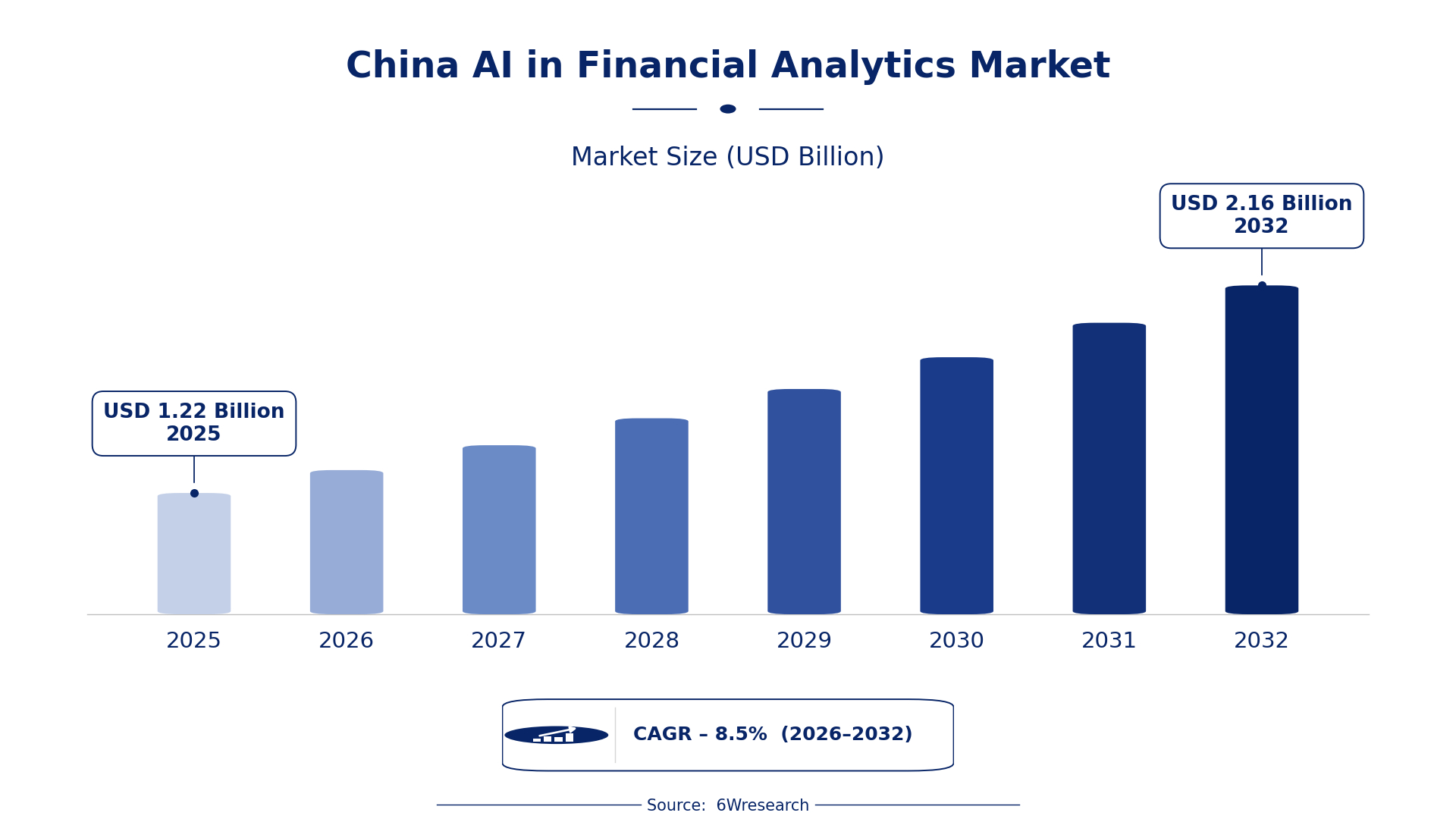
According to 6Wresearch internal database and industry insights, the China AI in Financial Analytics Market was valued at USD 1.22 billion in 2025 and is projected to reach USD 2.16 billion by 2032, growing at a CAGR of approximately 8.5% during 2026–2032.
China AI in Financial Analytics Market Highlights
| Report Metric | Details |
| Report Name | China AI in Financial Analytics Market |
| Market Size 2025 | USD 1.22 billion |
| Market Size 2032 | USD 2.16 billion |
| Absolute Growth 2025–2032 | USD 0.94 billion |
| CAGR 2026–2032 | 8.5% |
| Peak Annual Growth | 10.9% in 2030 |
| Forecast Period | 2026–2032 |
| Historical Data | 2022–2025 |
| Base Year | 2025 |
| Leading Application Type, 2025 | Portfolio Analysis (35% share) |
| Leading AI Technique, 2025 | Predictive Analytics (47% share) |
| Leading Distribution Channel, 2025 | Fintech SaaS Platforms (40% share) |
| Leading End User, 2025 | Investment Banks (46% share) |
| Fastest-Growing Application Type | Budget Optimization (9.8% CAGR) |
| Fastest-Growing AI Technique | Machine Learning (11.2% CAGR) |
| Fastest-Growing End User | Lending Institutions (10.2% CAGR) |
| Growing Sector | Fintech |
| Key End Users | Investment Banks, Asset Managers, Lending Institutions, CFO Offices |
China AI in Financial Analytics Market Year-wise Growth Rate and Key Drivers (2022–2032)
This graph illustrates the annual growth rates of the market from 2022 to 2032, highlighting a steady upward trajectory and projected market expansion over the forecast period.
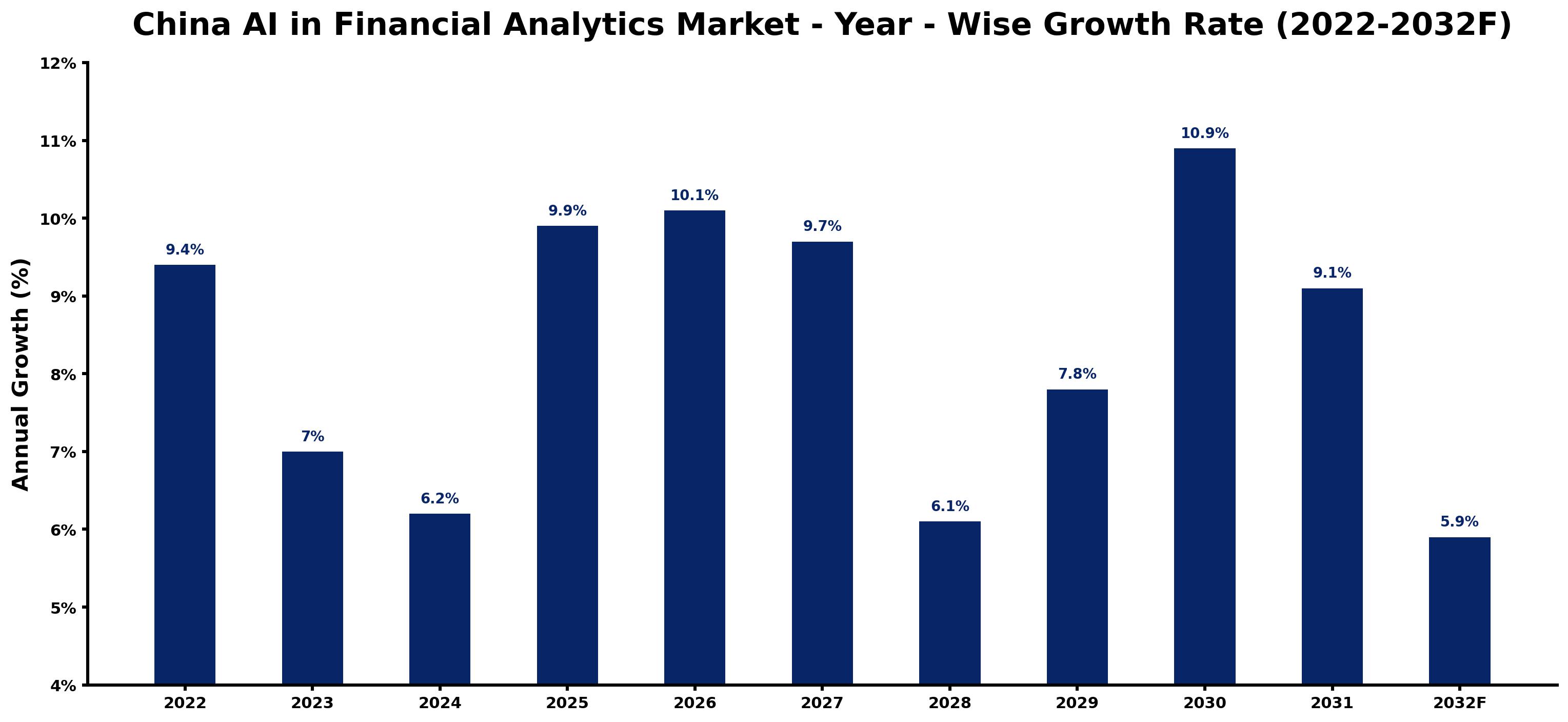
Year by year, the estimates below pair each growth rate with the development that shaped it.
| Year | Estimated Annual Growth (%) | Market Rationale |
| 2022 | 9.4 | The market experienced solid growth due to increasing adoption of AI technologies in financial services. |
| 2023 | 7.0 | Growth slowed as firms adjusted to new AI regulations and market conditions. |
| 2024 | 6.2 | The market continued to grow, albeit at a slower pace, as companies focused on improving existing systems. |
| 2025 | 9.9 | Growth accelerated again with rising investments in AI for trading and risk management. |
| 2026 | 10.1 | The market is expected to expand further as demand for predictive analytics increases among financial institutions. |
| 2027 | 9.7 | Growth slows slightly as market participants consolidate their positions and refine strategies. |
| 2028 | 6.1 | The market is projected to see another slowdown as firms focus on cost efficiencies and operational improvements. |
| 2029 | 7.8 | Growth picks up again as fintech innovation drives new applications of AI in finance. |
| 2030 | 10.9 | The peak growth year is expected as AI adoption reaches critical mass across financial sectors. |
| 2031 | 9.1 | Growth slows as the market matures and firms optimise their AI implementations through the AI and Financial Services Innovation Program. |
| 2032 | 5.9 | The market continues to grow, driven by sustained demand for advanced financial analytics solutions. |
Note: Market size estimations and growth projections presented in this report are based on 6Wresearch's proprietary forecasting methodology, utilizing the latest available industry data, government publications, and primary research inputs.
China AI in Financial Analytics Market Synopsis
AI in Financial Analytics in China involves the application of artificial intelligence technologies to analyse financial data and enhance decision-making processes. This includes uses such as portfolio management and credit scoring. The China AI in Financial Analytics Market is growing due to increasing demand from investment banks and fintech companies, backed by government initiatives like the Digital Finance Strategy.
Market Dynamics Impact Analysis (2026–2032)
| Factor | Type | Impact | Primary Segment Affected |
| Increasing investment in fintech innovation and AI technologies | Driver | High | Fintech SaaS Platforms |
| Growing adoption of predictive analytics for market analysis | Driver | High | Predictive Analytics |
| Expansion of AI tools in portfolio management | Opportunity | High | Asset Managers |
| Emerging demand for budget optimisation solutions | Opportunity | Medium | Budget Optimization |
| Regulatory compliance costs associated with AI integration | Restraint | High | Investment Banks |
| Data security concerns impacting AI deployment | Restraint | Medium | Fintech SaaS Platforms |
| Talent shortages in AI and data analytics fields | Challenge | High | Portfolio Analysis |
| High initial investment costs for AI technologies | Challenge | Medium | Portfolio Analysis |
Evaluation of Drivers in China AI in Financial Analytics Market (2026–2032)
The factors lifting demand, and the evidence behind each, are summarised below.
| Drivers | Primary Segment Affected | Why It Matters (Evidence) |
| Increased investment in fintech innovation | Fintech SaaS Platforms | This investment is driving demand for advanced analytics tools, with an estimated budget of 10 billion yuan for fintech initiatives. |
| Adoption of predictive analytics for trading | Predictive Analytics | Investment banks are increasingly using predictive analytics, with over 60% implementing AI tools for market analysis. |
| Growing demand for real-time reporting | Cloud-Based Analytics | The Shanghai Stock Exchange is integrating AI for real-time reporting, improving decision-making capabilities. |
| Focus on improving credit scoring accuracy | Credit Scoring | Lending institutions are relying on AI to improve credit assessments, reflecting the need for better risk management. |
| Expansion of AI in portfolio management | Portfolio Analysis | More than 60% of asset managers are implementing AI tools to optimise investment strategies. |
Market growth in China for AI in Financial Analytics rests on increasing end-use demand from various financial institutions and a strong supply response from technology providers. The number of fintech companies in China reached over 1,500, driving innovation and competition in the sector. In 2022, the total assets of China's banking sector exceeded 300 trillion yuan, reflecting a strong financial environment. The annual budget for fintech innovation is estimated at 10 billion yuan, further supporting the adoption of AI technologies. The integration of AI tools for portfolio management is embraced by over 60% of asset managers, indicating a shift towards data-driven decision-making in finance.
Evaluation of Restraints in China AI in Financial Analytics Market
The key brakes on demand, and where they bite hardest, are shown below.
| Market Restraint | Primary Segment Affected | Why It Matters (Evidence) |
| Concerns over data security and privacy | Fintech SaaS Platforms | Data security issues can delay AI deployment, affecting the competitiveness of fintech solutions. |
| Limited availability of skilled AI professionals | Portfolio Analysis | Talent shortages in AI and data analytics fields hinder the growth potential of financial analytics applications. |
| High initial investment costs for AI technologies | Credit Scoring | The substantial upfront costs for implementing AI solutions can deter smaller firms from adopting these technologies. |
| Regulatory uncertainties surrounding AI usage | Credit Scoring | Unclear regulations can create hesitation among firms to invest in AI technologies, slowing market growth. |
| Integration challenges with existing systems | Real-Time Reporting | Outdated infrastructure can hinder the effective deployment of AI solutions, delaying project timelines. |
China AI in Financial Analytics Market Challenges
Buyers and suppliers in the China AI in Financial Analytics market encounter a skills shortage, as the rapid growth of fintech has outstripped the availability of qualified professionals. This gap arises from a lack of educational programmes that effectively merge AI and finance, causing delays for firms aiming to implement advanced analytics solutions. Technology integration presents another hurdle; many organisations still depend on outdated systems that do not support AI, leading to increased operational costs and inefficiencies. High implementation costs deter smaller firms from entering the market, restricting innovation and competition. Regulatory changes may also disrupt supply chains, creating delays and uncertainty for financial institutions reliant on AI technologies.
Trends in the China AI in Financial Analytics Market
Several trends are reshaping the China AI in Financial Analytics Market; the most important are set out below.
- AI Integration Strategy Promoting Adoption: The National Development and Reform Commission's AI Integration Strategy aims to boost AI usage in financial analytics by 40% by 2025. This initiative encourages financial institutions to adopt AI technologies, improving their operational efficiencies.
- Investment Banks Increasing AI Adoption: Investment banks in China are increasingly adopting AI for trading and risk management, reflecting a trend towards data-driven decision-making. In 2023, over 60% of these banks implemented AI tools for market analysis.
- Fintech SaaS Platforms Gaining Popularity: Fintech SaaS Platforms are becoming the leading distribution channel for AI in financial analytics, holding a 40% market share in 2025. This trend is driven by the need for scalable solutions in financial services.
- Rise of Predictive Analytics: Predictive Analytics is set to dominate the AI technique segment, holding a 47% share in 2025. This growth is driven by the increasing need for accurate forecasting in financial markets.
Investment Opportunities in the China AI in Financial Analytics Market
Several openings in the China AI in Financial Analytics Market merit attention from investors.
- Joint Ventures with Local Fintech Firms: Investing in partnerships with local fintech firms in Shenzhen, a major hub for innovation, presents a strong opportunity. This region hosts numerous startups and financial institutions, making it an ideal location for collaboration.
- Supply of AI Tools for Portfolio Management: With over 60% of asset managers implementing AI tools, there is a substantial opportunity to supply advanced analytics solutions. Targeting asset managers in major cities like Shanghai can yield significant returns.
- Approval for AI-Driven Financial Solutions: The growing need for AI-driven financial solutions presents an opportunity for firms to seek regulatory approvals. Engaging with the China Banking and Insurance Regulatory Commission can facilitate market entry.
- Investment in Budget Optimization Technologies: The increasing focus on budget optimisation creates an opportunity for suppliers of AI technologies. Targeting CFO offices in large corporations can lead to successful partnerships.
Government Initiatives in the China AI in Financial Analytics Market
In 2021, the State Council launched the '14th Five-Year Plan for Digital Economy Development' to promote AI in financial services, targeting a 30% increase in digital finance adoption by 2025. This plan aims to integrate AI technologies into financial analytics, driving efficiency and innovation across the sector. The initiative is expected to stimulate investments in AI applications and improve overall service delivery.
In 2023, the Ministry of Finance initiated the 'AI and Financial Services Innovation Program' with a budget of 5 billion yuan to support AI research in finance. This program aims to fund projects that improve the integration of AI into financial analytics, benefiting both producers and buyers in the market. The China Securities Regulatory Commission also updated regulations in 2022 to facilitate the use of AI in stock trading, ensuring compliance while promoting innovation.
Future Insight of the China AI in Financial Analytics Market
The China AI in Financial Analytics market is set for significant evolution by 2032, driven by multiple forward-looking factors. The National Development and Reform Commission's push for AI integration will streamline processes and improve decision-making across the sector. An estimated 300 trillion yuan in total assets within the banking sector will encourage investments in AI solutions. Ongoing development of ISO 27001 standards will bolster data security, fostering greater user trust. As Shenzhen continues to thrive as a fintech hub, collaboration between startups and established financial institutions will propel advancements in AI applications.
Market Segmentation Analysis
Each segment group is reviewed below, with the leader by share and the fastest grower by CAGR.
By Application Type – Portfolio Analysis Dominated, Budget Optimization Expected to Grow Fastest
According to Shubham Padhi, Research Analyst at 6Wresearch, Portfolio Analysis held a 35% share of the China AI in Financial Analytics Market by application type in 2025. Portfolio analysis commands the largest share in China's AI in financial analytics market as it is crucial for managing investment portfolios effectively. The robust implementation of AI tools by over 60% of asset managers illustrates the strong demand for sophisticated portfolio management solutions. Budget Optimization is projected to grow fastest, at a CAGR of 9.8% during 2026–2032. Budget optimization is experiencing rapid growth as organisations strive for more efficient resource allocation strategies. The estimated annual budget of 10 billion yuan for fintech innovation initiatives underscores the increasing focus on optimising financial processes and resource management. Suppliers should focus on developing solutions for budget optimisation to cater to the rising demand in the market.
By AI Technique – Predictive Analytics Dominated, Machine Learning Expected to Grow Fastest
In 2025, Predictive Analytics led the ai technique split with a 47% share. Predictive analytics holds the largest share in the market due to its critical role in forecasting financial trends and risks, essential for informed decision-making. Its widespread application in investment banking highlights its importance in strategic financial planning and risk management. The quickest growth will come from Machine Learning, forecast to expand at a CAGR of 11.2% between 2026 and 2032. Machine learning is the fastest-growing technique as it enables systems to learn from data and adapt over time, which is vital for responding to market changes. The growing adoption of machine learning across various financial applications signals its promising potential for future growth. Buyers should invest in machine learning capabilities to improve their analytical precision and maintain a competitive edge.
By Distribution Channel – Fintech SaaS Platforms Dominated and Is Expected to Record the Fastest Growth
The largest distribution channel category in 2025 was Fintech SaaS Platforms, with a 40% share of total revenue. Fintech SaaS platforms dominate the distribution channel, offering essential tools for financial analytics that cater to a diverse range of users. Their capacity to provide scalable and flexible solutions makes them a preferred choice among financial institutions looking for efficiency. Its lead should widen, with a projected CAGR of 9.8% during 2026–2032, the highest in this split. Fintech SaaS platforms are also the fastest-growing channel, as their accessibility aligns with the rising demand for digital financial solutions. This growth trend is expected to persist as more institutions transition towards cloud-based services for their analytics needs. Suppliers must ensure their offerings are compatible with fintech SaaS platforms to maximise their market reach.
By End User – Investment Banks Dominated, Lending Institutions Expected to Grow Fastest
With a 46% revenue share in 2025, Investment Banks was the largest end user category. Investment banks represent the largest share of the end-user segment, leveraging analytics for market analysis and trading, which are core to their operations. Their significant assets and reliance on data-driven decision-making highlight their crucial role in the financial analytics ecosystem. Over 2026–2032, Lending Institutions are expected to post the fastest growth, at a CAGR of 10.2%. Lending institutions are the fastest-growing end-user segment, increasingly relying on analytics for credit assessments to improve their lending decisions. This trend reflects a broader shift towards data-driven financial services in the lending sector. Suppliers should customise their solutions to meet the specific needs of lending institutions to capture this emerging market.
Key Attractiveness of the Report
- 10 Years of Market Numbers
- Historical Data Starting from 2022 to 2025
- Base Year 2025
- Forecast Data until 2032
- Key Performance Indicators Impacting the Market
- Major Upcoming Developments and Projects
Key Highlights of the Report:
- China AI in Financial Analytics Market Outlook
- Market Size of China AI in Financial Analytics Market, 2025
- Forecast of China AI in Financial Analytics Market, 2032
- Historical Data and Forecast of China AI in Financial Analytics Revenues & Volume for the Period 2022 - 2032F
- China AI in Financial Analytics Market Trend Evolution
- China AI in Financial Analytics Market Drivers and Challenges
- China AI in Financial Analytics Price Trends
- China AI in Financial Analytics Porter's Five Forces
- China AI in Financial Analytics Industry Life Cycle
- Historical Data and Forecast of China AI in Financial Analytics Market Revenues & Volume By Application Type for the Period 2022 - 2032F
- Historical Data and Forecast of China AI in Financial Analytics Market Revenues & Volume By Portfolio Analysis for the Period 2022 - 2032F
- Historical Data and Forecast of China AI in Financial Analytics Market Revenues & Volume By Credit Scoring for the Period 2022 - 2032F
- Historical Data and Forecast of China AI in Financial Analytics Market Revenues & Volume By Budget Optimization for the Period 2022 - 2032F
- Historical Data and Forecast of China AI in Financial Analytics Market Revenues & Volume By Real-Time Reporting for the Period 2022 - 2032F
- Historical Data and Forecast of China AI in Financial Analytics Market Revenues & Volume By AI Technique for the Period 2022 - 2032F
- Historical Data and Forecast of China AI in Financial Analytics Market Revenues & Volume By Predictive Analytics for the Period 2022 - 2032F
- Historical Data and Forecast of China AI in Financial Analytics Market Revenues & Volume By Machine Learning for the Period 2022 - 2032F
- Historical Data and Forecast of China AI in Financial Analytics Market Revenues & Volume By Anomaly Detection for the Period 2022 - 2032F
- Historical Data and Forecast of China AI in Financial Analytics Market Revenues & Volume By Natural Language Gen for the Period 2022 - 2032F
- Historical Data and Forecast of China AI in Financial Analytics Market Revenues & Volume By Distribution Channel for the Period 2022 - 2032F
- Historical Data and Forecast of China AI in Financial Analytics Market Revenues & Volume By Fintech SaaS Platforms for the Period 2022 - 2032F
- Historical Data and Forecast of China AI in Financial Analytics Market Revenues & Volume By Banking Software Vendors for the Period 2022 - 2032F
- Historical Data and Forecast of China AI in Financial Analytics Market Revenues & Volume By Online Financial Tools for the Period 2022 - 2032F
- Historical Data and Forecast of China AI in Financial Analytics Market Revenues & Volume By Cloud-Based Analytics for the Period 2022 - 2032F
- Historical Data and Forecast of China AI in Financial Analytics Market Revenues & Volume By End User for the Period 2022 - 2032F
- Historical Data and Forecast of China AI in Financial Analytics Market Revenues & Volume By Asset Managers for the Period 2022 - 2032F
- Historical Data and Forecast of China AI in Financial Analytics Market Revenues & Volume By Lending Institutions for the Period 2022 - 2032F
- Historical Data and Forecast of China AI in Financial Analytics Market Revenues & Volume By CFO Offices for the Period 2022 - 2032F
- Historical Data and Forecast of China AI in Financial Analytics Market Revenues & Volume By Investment Banks for the Period 2022 - 2032F
- China AI in Financial Analytics Import Export Trade Statistics
- Market Opportunity Assessment By Application Type
- Market Opportunity Assessment By AI Technique
- Market Opportunity Assessment By Distribution Channel
- Market Opportunity Assessment By End User
- China AI in Financial Analytics Top Companies Market Share
- China AI in Financial Analytics Competitive Benchmarking By Technical and Operational Parameters
- China AI in Financial Analytics Company Profiles
- China AI in Financial Analytics Key Strategic Recommendations
Market Covered
Segments analysed in this report are listed below.
By Application Type
- Portfolio Analysis
- Credit Scoring
- Budget Optimization
- Real-Time Reporting
By AI Technique
- Predictive Analytics
- Machine Learning
- Anomaly Detection
- Natural Language Gen
By Distribution Channel
- Fintech SaaS Platforms
- Banking Software Vendors
- Online Financial Tools
- Cloud-Based Analytics
By End User
- Asset Managers
- Lending Institutions
- CFO Offices
- Investment Banks































