China AI in Financial Trading Market Size & Growth Rate
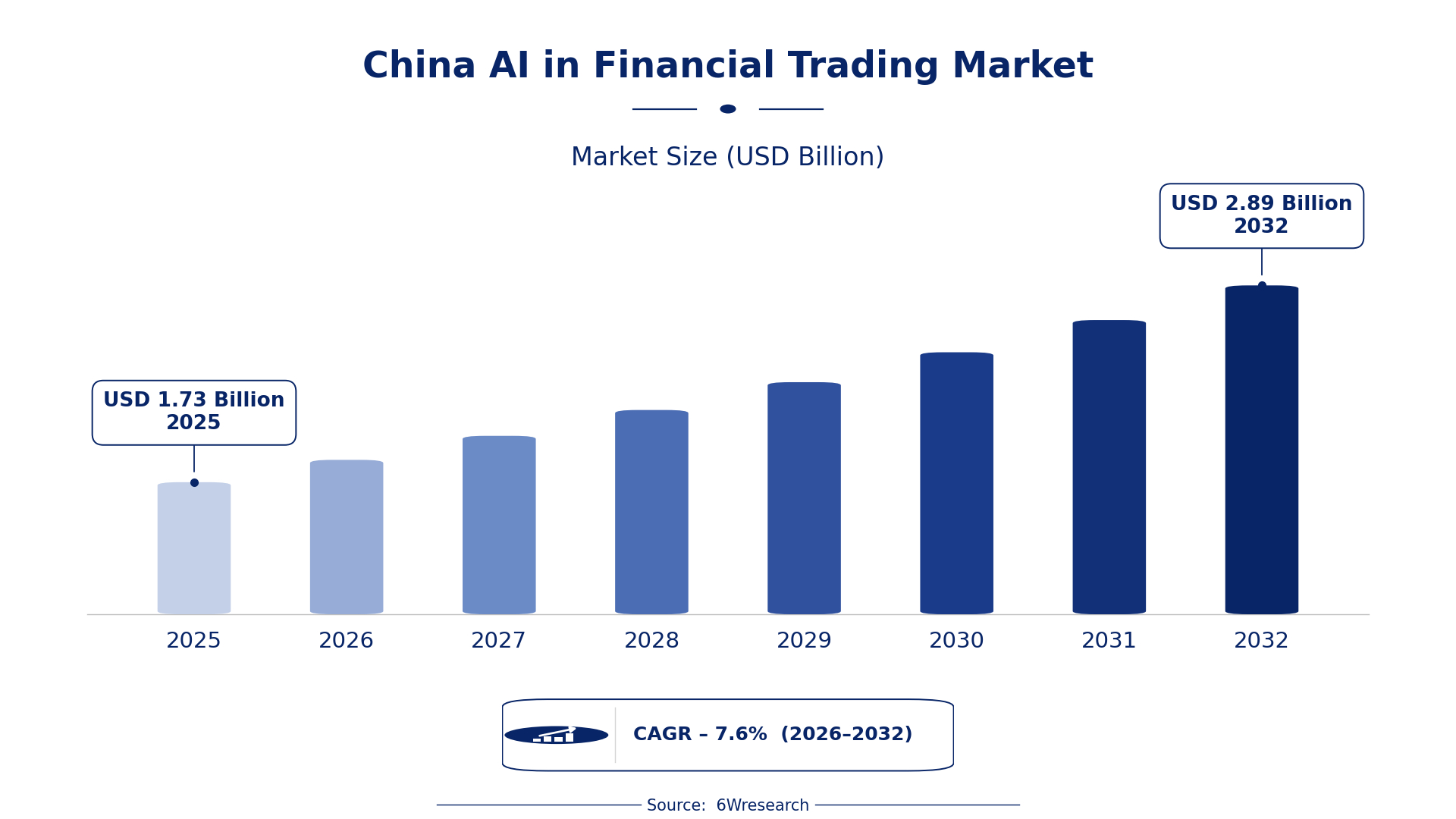
According to 6Wresearch internal database and industry insights, the China AI in Financial Trading Market was valued at USD 1.73 billion in 2025 and is projected to reach USD 2.89 billion by 2032, growing at a CAGR of approximately 7.6% during 2026–2032.
China AI in Financial Trading Market Highlights
| Report Metric | Details |
| Report Name | China AI in Financial Trading Market |
| Market Size 2025 | USD 1.73 billion |
| Market Size 2032 | USD 2.89 billion |
| Absolute Growth 2025–2032 | USD 1.16 billion |
| CAGR 2026–2032 | 7.6% |
| Peak Annual Growth | 10.1% in 2026 |
| Forecast Period | 2026–2032 |
| Historical Data | 2022–2025 |
| Base Year | 2025 |
| Leading Trading Type, 2025 | High-Frequency Trading (45% share) |
| Leading AI Engine Type, 2025 | Deep Learning Algorithms (39% share) |
| Leading Distribution Channel, 2025 | Direct Fintech Vendors (54% share) |
| Leading End User, 2025 | Institutional Traders (43% share) |
| Fastest-Growing Trading Type | Sentiment-Based Trading (9.1% CAGR) |
| Fastest-Growing AI Engine Type | NLP Analysis (10.0% CAGR) |
| Fastest-Growing Distribution Channel | Cloud Platforms (9.8% CAGR) |
| Fastest-Growing End User | Quantitative Analysts (9.7% CAGR) |
| Growing Sector | Quantitative Analysts |
| Key End Users | Institutional Traders, Hedge Funds, Individual Traders, Quantitative Analysts |
China AI in Financial Trading Market Year-wise Growth Rate and Key Drivers (2022–2032)
This graph illustrates the annual growth rates of the market from 2022 to 2032, highlighting a steady upward trajectory and projected market expansion over the forecast period.
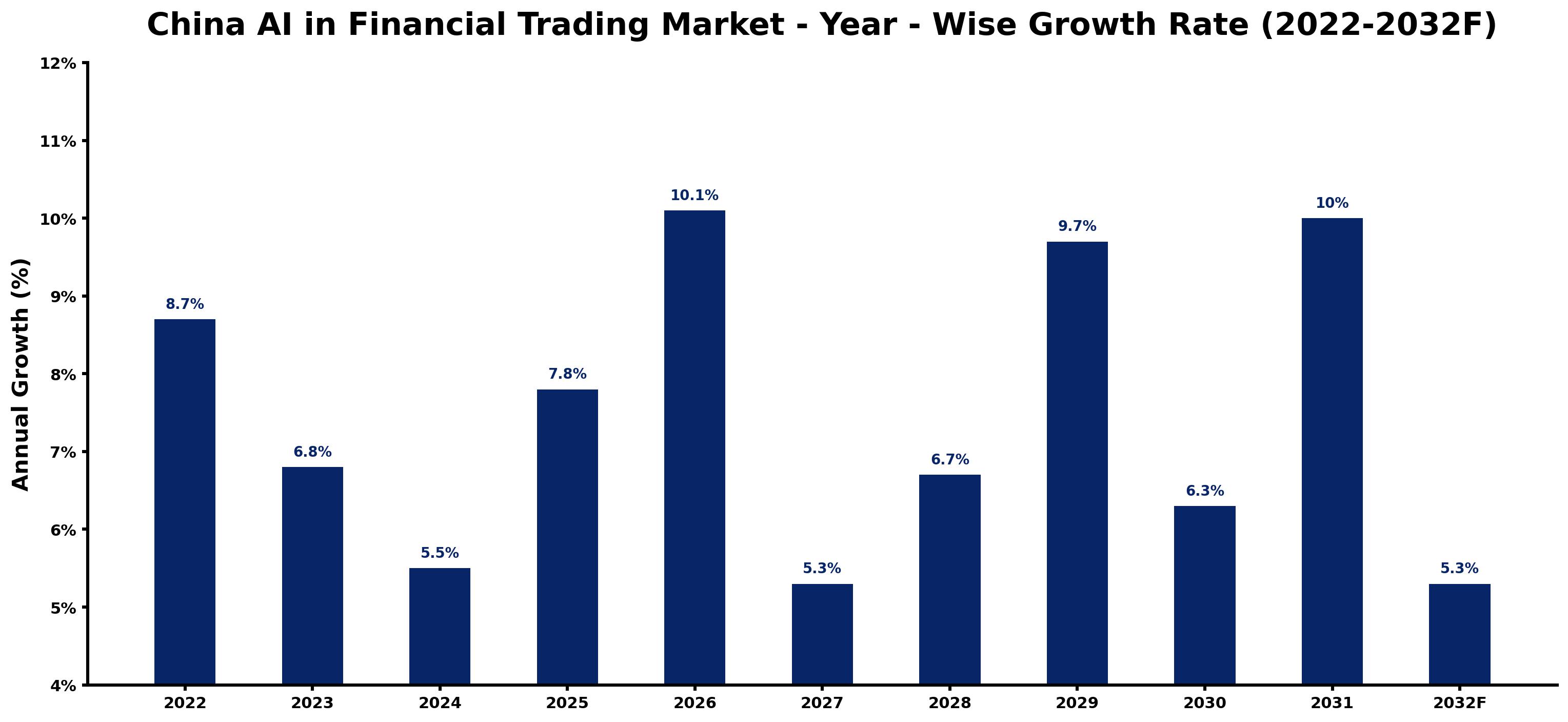
The following table presents the estimated annual growth rate for each year together with the principal factor influencing market performance.
| Year | Estimated Annual Growth (%) | Market Rationale |
| 2022 | 8.7 | The number of institutional traders reached approximately 1.5 million, driving demand for AI solutions. |
| 2023 | 6.8 | The integration of AI technologies slowed growth as firms adjusted to new compliance standards. |
| 2024 | 5.5 | Algorithmic trading strategies gained traction among institutional traders, boosting market expansion. |
| 2025 | 7.8 | Demand surged as AI technologies became essential for optimising trading strategies. |
| 2026 | 10.1 | The introduction of advanced trading algorithms is expected to peak market growth this year. |
| 2027 | 5.3 | Growth will slow as the market stabilises after rapid technological adoption. |
| 2028 | 6.7 | Increased adoption of NLP analysis in trading will contribute to a rebound in growth. |
| 2029 | 9.7 | The market will experience renewed interest as institutional traders seek advanced AI tools. |
| 2030 | 6.3 | Growth will slow as the market matures and demand becomes more stable. |
| 2031 | 10.0 | A resurgence in AI adoption among hedge funds will drive market growth this year. |
| 2032 | 5.3 | The market will stabilise as AI technologies become standard in trading practices. |
Note: Market size estimations and growth projections presented in this report are based on 6Wresearch's proprietary forecasting methodology, utilizing the latest available industry data, government publications, and primary research inputs.
China AI in Financial Trading Market Synopsis
The China AI in Financial Trading Market involves the application of artificial intelligence technologies to analyse market data and execute trades. The market is expanding due to a substantial population of retail traders and institutional demand for advanced trading technologies. As of 2023, over 70% of hedge funds in China utilise AI technologies for trading, reflecting a strong shift towards automation and data-driven strategies. Various government initiatives and strategic plans support the ongoing integration of AI into financial services.
Market Dynamics Impact Analysis (2026–2032)
| Factor | Type | Impact | Primary Segment Affected |
| Growing number of institutional traders adopting AI for trading strategies. | Driver | High | Institutional Traders |
| Increased adoption of deep learning algorithms for algorithmic trading. | Driver | High | Algorithmic Trading |
| Rising demand for AI-driven trading tools among retail traders. | Opportunity | High | Individual Traders |
| Emerging interest in NLP analysis for trading insights. | Opportunity | Medium | NLP Analysis |
| Compliance challenges with new AI regulations affecting implementation. | Restraint | Medium | Algorithmic Trading |
| Limited access to advanced AI technologies for smaller firms. | Restraint | High | Individual Traders |
| Intense competition among fintech vendors impacting pricing strategies. | Challenge | Medium | Direct Fintech Vendors |
| Rapid technological changes leading to potential obsolescence of tools. | Challenge | High | Cloud Platforms |
Evaluation of Drivers in China AI in Financial Trading Market (2026–2032)
The factors lifting demand, and the evidence behind each, are summarised below.
| Drivers | Primary Segment Affected | Why It Matters (Evidence) |
| Growing investment in AI technologies by financial institutions. | Institutional Traders | This investment drives demand for AI-driven solutions, as evidenced by approximately 1.5 million institutional traders in China. |
| High-frequency trading strategies utilising AI for rapid execution. | High-Frequency Trading | These strategies require advanced algorithms, driving demand for AI tools that can process data in real-time. |
| Increased trading volumes in China's stock market exceeding 1 trillion yuan daily. | Algorithmic Trading | This high volume necessitates automated trading solutions to manage risks and optimise strategies effectively. |
| The rise of hedge funds adopting AI technologies for performance improvement. | Hedge Funds | Over 70% of hedge funds in China use AI, indicating a strong demand for innovative trading solutions. |
| Growing interest in sentiment-based trading strategies among traders. | Sentiment-Based Trading | This trend is reflected in the increasing use of NLP analysis, which has grown by 30% in major financial hubs. |
Growth in the AI in Financial Trading market in China comes from substantial investments in AI technologies by financial institutions, which enhance their trading capabilities. The average trading volume in China's stock market exceeds 1 trillion yuan daily, necessitating automated solutions for risk management. Over 70% of hedge funds in China utilise AI technologies, driving demand for advanced trading tools. High-frequency trading strategies employ AI for rapid execution, further boosting the market. The rise of sentiment-based trading strategies, supported by a 30% growth in NLP analysis, reflects a shift towards data-driven decision-making in trading.
Evaluation of Restraints in China AI in Financial Trading Market
The main factors holding the market back are set out below.
| Market Restraint | Primary Segment Affected | Why It Matters (Evidence) |
| Compliance challenges with the China Securities Regulatory Commission's guidelines. | Algorithmic Trading | These guidelines require firms to ensure risk management, complicating the integration of AI technologies. |
| Limited access to advanced AI technologies for smaller financial firms. | Individual Traders | Smaller firms often lack the resources to invest in the latest AI tools, hindering their competitive edge. |
| High competition among fintech vendors affecting pricing strategies. | Direct Fintech Vendors | Intense competition can lead to price wars, impacting profitability for vendors. |
| Rapid technological changes leading to potential obsolescence of tools. | Cloud Platforms | As technology evolves, platforms must continuously update to remain relevant, increasing operational costs. |
| Data privacy concerns impacting AI adoption in trading. | Institutional Traders | Regulatory scrutiny over data usage can limit the implementation of AI solutions. |
China AI in Financial Trading Market Challenges
In the China AI in Financial Trading market, institutional traders encounter technological hurdles as legacy systems struggle to accommodate advanced AI functionalities. This challenge stems from outdated infrastructure, leading to trading delays that can cost traders up to 5% of their annual profits. Buyers face high acquisition costs for AI tools, often exceeding 1 million yuan, restricting access for smaller firms. Competition intensifies as over 70% of hedge funds already employ AI, placing those without these technologies at a disadvantage. A skills gap persists, as a shortage of qualified AI professionals causes project delays for firms reliant on external expertise.
Trends in the China AI in Financial Trading Market
Below mentioned are some of the trends shaping the China AI in Financial Trading Market growth.
- Retail Traders Adopting AI-Driven Tools: Retail traders in China are increasingly looking for advanced AI trading tools to improve their strategies. With an estimated 200 million retail traders, the demand for these solutions is significant, reflecting a shift towards automation.
- Expansion of Algorithmic Trading: Algorithmic trading is rapidly expanding, particularly in Shanghai and Shenzhen, where deep learning algorithms are widely adopted. This trend is driven by the need for speed and efficiency in executing trades, with a notable increase in trading volume.
- Growing Use of NLP Analysis: Natural Language Processing analysis is becoming more prevalent in trading strategies, with a 30% increase in adoption over the past year. This trend is particularly strong in major financial hubs like Shanghai and Shenzhen, indicating a shift in trading practices.
- Rise of Sentiment-Based Trading: Sentiment-based trading strategies are gaining traction among traders, with increasing interest in AI tools that analyse market sentiment. The demand for these tools is evident in the growing number of users in the retail trading sector.
Investment Opportunities in the China AI in Financial Trading Market
Several openings in the China AI in Financial Trading Market merit attention from investors.
- Retail Traders Seeking Advanced AI Tools: Retail traders in China are increasingly looking for advanced AI trading tools to improve their strategies. With an estimated 200 million retail traders, there is a significant opportunity for suppliers to meet this demand.
- Collaborating with Fintech Vendors: Partnering with direct fintech vendors can provide access to innovative AI technologies. This is particularly relevant in regions like Shanghai, where fintech innovation is thriving and demand for AI solutions is high.
- Investment in Cloud Platforms: Investing in cloud platforms that host AI applications for trading is a timely opportunity. As the market grows, demand for accessible AI solutions will increase, particularly among institutional traders.
- Focus on NLP Analysis Tools: There is a growing need for NLP analysis tools among quantitative analysts. This presents an opportunity for firms to develop and supply innovative solutions that cater to this demand.
Government Initiatives in the China AI in Financial Trading Market
The 14th Five-Year Plan for Economic and Social Development, issued by the National Development and Reform Commission in 2021, highlights the importance of AI in enhancing financial services. This framework encourages financial institutions to adopt AI technologies, ensuring compliance and risk management. The Ministry of Industry and Information Technology's AI Innovation Action Plan, launched in 2020, promotes the integration of AI across various sectors, including finance. By 2022, the China Securities Regulatory Commission published guidelines for AI in financial trading, which set standards for implementation and usage. These measures collectively aim to improve efficiency and transparency in financial markets, benefiting both producers and buyers.
The Financial Stability and Development Committee initiated a program in 2023 to support the adoption of AI technologies in financial institutions. This initiative provides funding for projects that enhance AI capabilities and encourages collaboration between fintech companies and traditional financial institutions. Institutional traders leverage these programs to access advanced AI tools, improving their trading strategies. The Shanghai Stock Exchange's 2023 programme focuses on enhancing AI capabilities in trading, fostering innovation and efficiency. These efforts ensure that buyers can effectively utilise AI technologies to optimise their trading processes.
Future Insight of the China AI in Financial Trading Market
Several forward-looking factors should support the China AI in Financial Trading market in the coming years. The National Development and Reform Commission's initiative for AI integration is set to enhance trading efficiency and strategy optimisation. The Shanghai Stock Exchange's 2023 programme aims to improve AI capabilities, fostering innovation in trading practices. The AI Technology Innovation Action Plan from the State Council is expected to drive advancements in financial services, creating new opportunities for buyers and suppliers.
Market Segmentation Analysis
The analysis below covers each segmentation, its leading category in 2025 and its fastest-growing category through 2032.
By Trading Type – High-Frequency Trading Dominated, Sentiment-Based Trading Expected to Grow Fastest
According to Shubham Padhi, Research Analyst at 6Wresearch, with a 45% revenue share in 2025, High-Frequency Trading was the largest trading type category. High-Frequency Trading leads the market share as it allows for rapid execution, appealing to institutional traders who require speed to capitalise on market movements. The average trading volume in China's stock market exceeding 1 trillion yuan daily illustrates the demand for such swift trading methods. The quickest growth will come from Sentiment-Based Trading, forecast to expand at a CAGR of 9.1% between 2026 and 2032. Sentiment-Based Trading is seeing the fastest growth as it effectively gauges market sentiment, which is increasingly vital for trading strategies. The 30% rise in the use of NLP analysis in trading reflects a shift towards more sentiment-aware approaches. This trend indicates that suppliers should prioritise the development of sentiment analysis tools to meet the changing demands of traders.
By AI Engine Type – Deep Learning Algorithms Dominated, NLP Analysis Expected to Grow Fastest
Deep Learning Algorithms held a 39% share of the China AI in Financial Trading Market by ai engine type in 2025. Deep Learning Algorithms dominate the market share as they are vital for analysing intricate financial data patterns that traders rely on for informed decisions. Their widespread application in key financial hubs like Shanghai and Shenzhen underscores their importance in executing effective trading strategies. NLP Analysis is set to record the highest CAGR in this split, 10.0% over 2026–2032. NLP Analysis is rapidly expanding due to its ability to extract meaningful insights from news and social media, which are increasingly influencing trading choices. The 30% surge in NLP usage over the past year highlights a shift towards incorporating real-time sentiment analysis in trading methodologies. This indicates that suppliers should prioritise enhancing NLP functionalities to meet the growing demand for sentiment-based trading solutions.
By Distribution Channel – Direct Fintech Vendors Dominated, Cloud Platforms Expected to Grow Fastest
In 2025, Direct Fintech Vendors led the distribution channel split with a 54% share. Direct Fintech Vendors hold the largest market share by providing customised solutions directly to financial institutions, ensuring they meet specific operational needs. This direct engagement builds strong partnerships and trust, which are essential for the uptake of advanced trading technologies. Cloud Platforms are projected to grow fastest, at a CAGR of 9.8% during 2026–2032. Cloud Platforms are witnessing the fastest growth as they offer scalable solutions that make AI applications readily available to users. The increasing dependence on cloud infrastructure for hosting trading tools reflects a broader trend towards flexibility and operational efficiency in the financial sector. Suppliers should concentrate on developing cloud-based offerings to align with the market's transition towards accessible and scalable trading technologies.
By End User – Institutional Traders Dominated, Quantitative Analysts Expected to Grow Fastest
The largest end user category in 2025 was Institutional Traders, with a 43% share of total revenue. Institutional Traders account for the largest market share as they employ AI for executing large-scale trading strategies that require advanced analytical tools for optimal results. With around 1.5 million institutional traders in China, the demand for AI solutions in this segment remains robust and significant. Over 2026–2032, Quantitative Analysts are expected to post the fastest growth, at a CAGR of 9.7%. Quantitative Analysts are the fastest-growing group, using AI for sophisticated data analysis and model development, which are crucial for effective trading strategies. The rising complexity of the financial landscape necessitates the skills of quantitative analysts who can adeptly apply AI technologies. This suggests that suppliers should focus on creating specialised tools that cater to the distinct requirements of quantitative analysts in the financial trading industry.
Key Attractiveness of the Report
- 10 Years of Market Numbers
- Historical Data Starting from 2022 to 2025
- Base Year 2025
- Forecast Data until 2032
- Key Performance Indicators Impacting the Market
- Major Upcoming Developments and Projects
Key Highlights of the Report:
- China AI in Financial Trading Market Outlook
- Market Size of China AI in Financial Trading Market, 2025
- Forecast of China AI in Financial Trading Market, 2032
- Historical Data and Forecast of China AI in Financial Trading Revenues & Volume for the Period 2022 - 2032F
- China AI in Financial Trading Market Trend Evolution
- China AI in Financial Trading Market Drivers and Challenges
- China AI in Financial Trading Price Trends
- China AI in Financial Trading Porter's Five Forces
- China AI in Financial Trading Industry Life Cycle
- Historical Data and Forecast of China AI in Financial Trading Market Revenues & Volume By Trading Type for the Period 2022 - 2032F
- Historical Data and Forecast of China AI in Financial Trading Market Revenues & Volume By High-Frequency Trading for the Period 2022 - 2032F
- Historical Data and Forecast of China AI in Financial Trading Market Revenues & Volume By Algorithmic Trading for the Period 2022 - 2032F
- Historical Data and Forecast of China AI in Financial Trading Market Revenues & Volume By Sentiment-Based Trading for the Period 2022 - 2032F
- Historical Data and Forecast of China AI in Financial Trading Market Revenues & Volume By Crypto Trading Bots for the Period 2022 - 2032F
- Historical Data and Forecast of China AI in Financial Trading Market Revenues & Volume By AI Engine Type for the Period 2022 - 2032F
- Historical Data and Forecast of China AI in Financial Trading Market Revenues & Volume By Deep Learning Algorithms for the Period 2022 - 2032F
- Historical Data and Forecast of China AI in Financial Trading Market Revenues & Volume By Predictive Models for the Period 2022 - 2032F
- Historical Data and Forecast of China AI in Financial Trading Market Revenues & Volume By NLP Analysis for the Period 2022 - 2032F
- Historical Data and Forecast of China AI in Financial Trading Market Revenues & Volume By Autonomous Agents for the Period 2022 - 2032F
- Historical Data and Forecast of China AI in Financial Trading Market Revenues & Volume By Distribution Channel for the Period 2022 - 2032F
- Historical Data and Forecast of China AI in Financial Trading Market Revenues & Volume By Direct Fintech Vendors for the Period 2022 - 2032F
- Historical Data and Forecast of China AI in Financial Trading Market Revenues & Volume By Cloud Platforms for the Period 2022 - 2032F
- Historical Data and Forecast of China AI in Financial Trading Market Revenues & Volume By Market Data Platforms for the Period 2022 - 2032F
- Historical Data and Forecast of China AI in Financial Trading Market Revenues & Volume By Crypto Exchange APIs for the Period 2022 - 2032F
- Historical Data and Forecast of China AI in Financial Trading Market Revenues & Volume By End User for the Period 2022 - 2032F
- Historical Data and Forecast of China AI in Financial Trading Market Revenues & Volume By Institutional Traders for the Period 2022 - 2032F
- Historical Data and Forecast of China AI in Financial Trading Market Revenues & Volume By Quantitative Analysts for the Period 2022 - 2032F
- Historical Data and Forecast of China AI in Financial Trading Market Revenues & Volume By Hedge Funds for the Period 2022 - 2032F
- Historical Data and Forecast of China AI in Financial Trading Market Revenues & Volume By Individual Traders for the Period 2022 - 2032F
- China AI in Financial Trading Import Export Trade Statistics
- Market Opportunity Assessment By Trading Type
- Market Opportunity Assessment By AI Engine Type
- Market Opportunity Assessment By Distribution Channel
- Market Opportunity Assessment By End User
- China AI in Financial Trading Top Companies Market Share
- China AI in Financial Trading Competitive Benchmarking By Technical and Operational Parameters
- China AI in Financial Trading Company Profiles
- China AI in Financial Trading Key Strategic Recommendations
Market Covered
Segments analysed in this report are listed below.
By Trading Type
- High-Frequency Trading
- Algorithmic Trading
- Sentiment-Based Trading
- Crypto Trading Bots
By AI Engine Type
- Deep Learning Algorithms
- Predictive Models
- NLP Analysis
- Autonomous Agents
By Distribution Channel
- Direct Fintech Vendors
- Cloud Platforms
- Market Data Platforms
- Crypto Exchange APIs
By End User
- Institutional Traders
- Quantitative Analysts
- Hedge Funds
- Individual Traders































