China AI in Fleet Management Market Size & Growth Rate
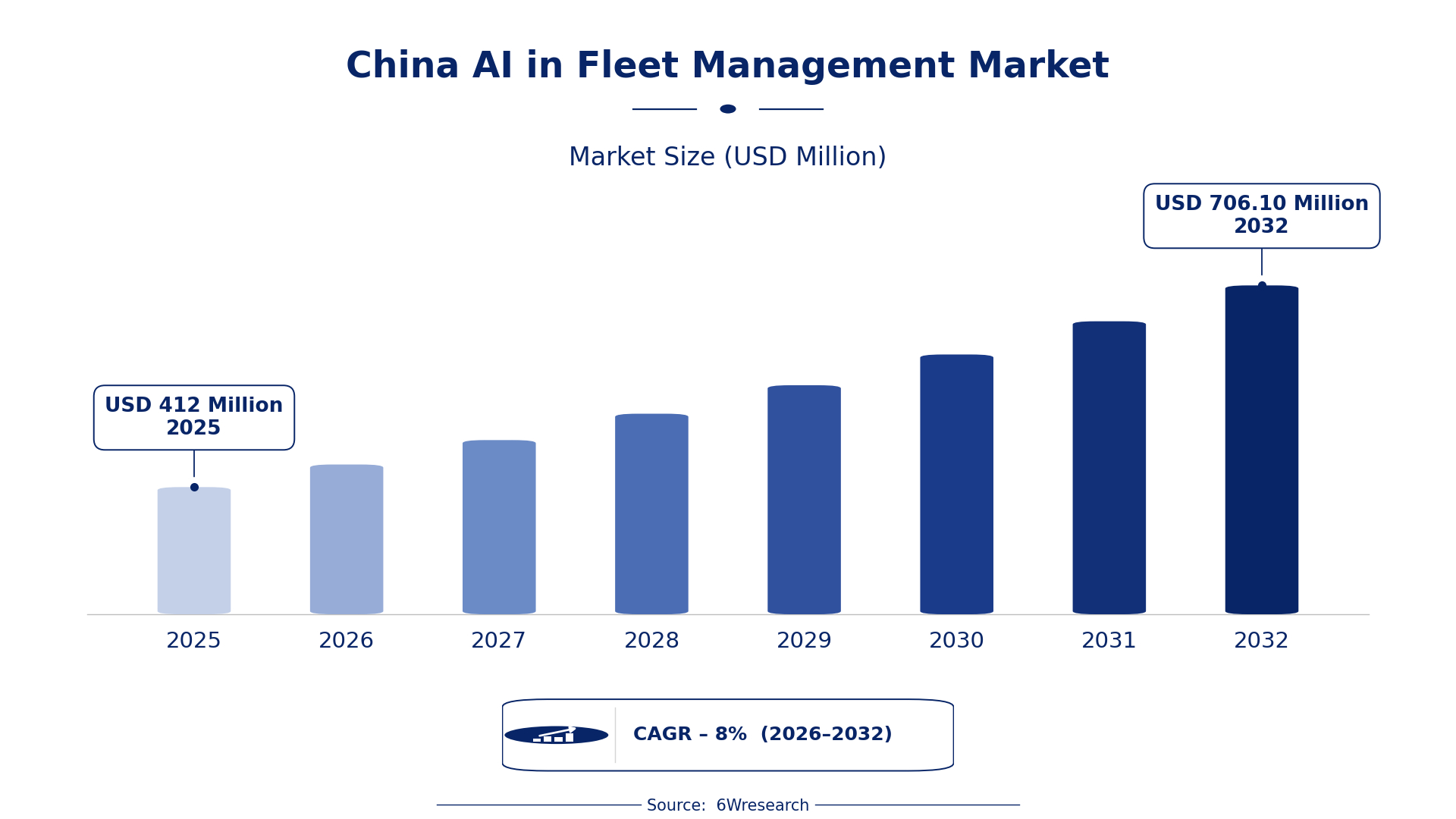
According to 6Wresearch internal database and industry insights, the China AI in Fleet Management Market was valued at USD 412.0 million in 2025 and is projected to reach USD 706.10 million by 2032, growing at a CAGR of approximately 8% during 2026–2032.
China AI in Fleet Management Market Highlights
| Report Metric | Details |
| Report Name | China AI in Fleet Management Market |
| Market Size 2025 | USD 412.0 million |
| Market Size 2032 | USD 706.10 million |
| Absolute Growth 2025–2032 | USD 294.10 million |
| CAGR 2026–2032 | 8% |
| Peak Annual Growth | 10.3% in 2028 |
| Forecast Period | 2026–2032 |
| Historical Data | 2022–2025 |
| Base Year | 2025 |
| Leading Fleet Type, 2025 | Delivery Fleets (49% share) |
| Leading AI Application, 2025 | Route Optimization (48% share) |
| Leading Distribution Channel, 2025 | SaaS Fleet Platforms (43% share) |
| Leading End User, 2025 | Logistics Companies (44% share) |
| Fastest-Growing Fleet Type | Trucking & Haulage (9.7% CAGR) |
| Fastest-Growing AI Application | Predictive Maintenance (10.7% CAGR) |
| Fastest-Growing End User | Freight Operators (10.1% CAGR) |
| Growing Sector | Logistics and Transportation |
| Key End Users | Logistics Companies, Government Transport Agencies, Freight Operators |
China AI in Fleet Management Market Year-wise Growth Rate and Key Drivers (2022–2032)
This graph illustrates the annual growth rates of the market from 2022 to 2032, highlighting a steady upward trajectory and projected market expansion over the forecast period.
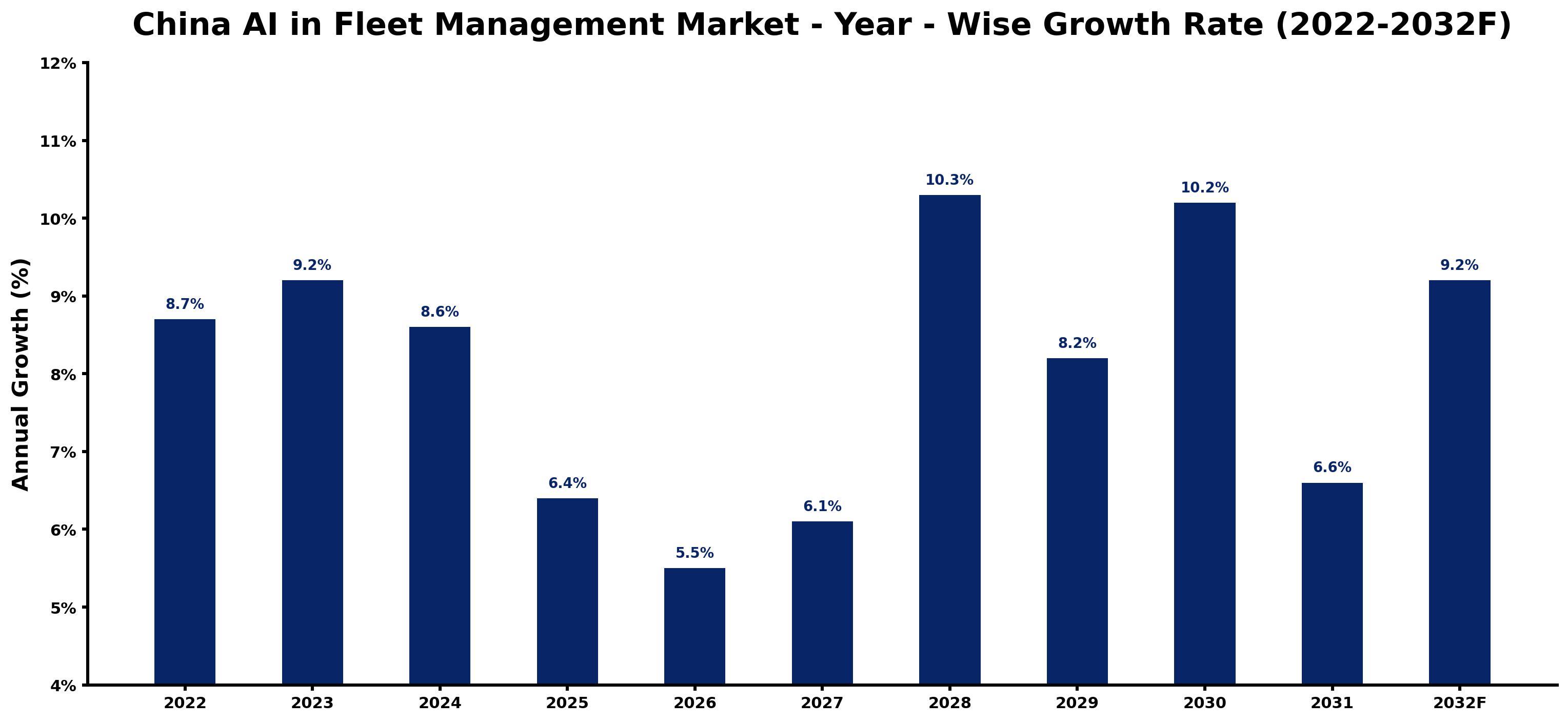
Year by year, the estimates below pair each growth rate with the development that shaped it.
| Year | Estimated Annual Growth (%) | Market Rationale |
| 2022 | 8.7 | The market experienced steady growth due to increased adoption of AI technologies by logistics companies. |
| 2023 | 9.2 | Demand accelerated as the logistics industry generated over 15 trillion yuan in revenue. |
| 2024 | 8.6 | Growth slowed slightly as logistics companies adjusted to new AI implementations in fleet management. |
| 2025 | 6.4 | The market continued to grow, but at a slower pace as logistics costs remained high. |
| 2026 | 5.5 | A further slowdown occurred as companies faced challenges in integrating AI solutions effectively. |
| 2027 | 6.1 | Growth picked up again as logistics companies invested more in AI for operational efficiency. |
| 2028 | 10.3 | The market peaked as AI adoption surged, driven by government initiatives and industry demand. |
| 2029 | 8.2 | Growth slowed again as the market began to stabilise after rapid expansion. |
| 2030 | 10.2 | A rebound in growth occurred as logistics firms improved their AI capabilities for better performance. |
| 2031 | 6.6 | Growth slowed once more as companies focused on optimising existing AI systems. |
| 2032 | 9.2 | The market is expected to grow as demand for efficient fleet management continues to rise. |
Note: Market size estimations and growth projections presented in this report are based on 6Wresearch's proprietary forecasting methodology, utilizing the latest available industry data, government publications, and primary research inputs.
China AI in Fleet Management Market Synopsis
The AI in Fleet Management market in China involves the use of artificial intelligence technologies to optimise fleet operations and improve efficiency. This includes applications such as route optimisation and predictive maintenance, which are critical for logistics and transportation. The China AI in Fleet Management Market is expanding due to increasing demand from logistics companies and government initiatives promoting smart transportation systems. With over 60% of logistics firms adopting AI technologies by 2023, the market is set for substantial growth.
Market Dynamics Impact Analysis (2026–2032)
| Factor | Type | Impact | Primary Segment Affected |
| Increased adoption of AI technologies by logistics companies enhances operational efficiency. | Driver | High | Logistics Companies |
| Government initiatives promote smart transportation systems, driving demand for AI solutions. | Driver | High | Government Transport Agencies |
| Growing urbanisation in China creates a need for efficient transport solutions. | Opportunity | High | Public Transport |
| The push for green logistics opens avenues for AI integration in fleet operations. | Opportunity | Medium | Logistics Companies |
| High costs of AI implementation can deter smaller logistics firms from adoption. | Restraint | High | Logistics Companies |
| Limited understanding of AI technologies among some fleet operators hampers growth. | Restraint | Medium | Freight Operators |
| Integration challenges exist as companies struggle to adapt existing systems to AI. | Challenge | High | Trucking & Haulage |
| The rapid pace of technological change can lead to obsolescence of current systems. | Challenge | Medium | Delivery Fleets |
Evaluation of Drivers in China AI in Fleet Management Market (2026–2032)
The table below links each growth driver to the segment it affects and the evidence for it.
| Drivers | Primary Segment Affected | Why It Matters (Evidence) |
| Increased investment in AI technologies reduces costs and improves fleet operations. | Logistics Companies | Over 60% of logistics companies are adopting AI technologies by 2023. |
| Government initiatives support AI integration in transportation, driving demand. | Government Transport Agencies | The Ministry of Transport promotes smart transportation systems through AI integration. |
| The need for efficient route optimisation drives AI adoption in fleet management. | Route Optimization | China has over 3 million delivery vehicles operating in urban areas. |
| Predictive maintenance reduces operational costs and improves vehicle reliability. | Predictive Maintenance | The average fleet size for trucking companies in China is approximately 50 vehicles. |
| Growing demand for driver behaviour analysis improves safety and efficiency. | Driver Behavior Analysis | The public transport sector in China serves over 10 billion passengers annually. |
Expansion of the AI in Fleet Management market in China is backed by rising demand for efficient fleet operations and support for smart transportation. Over 60% of logistics companies are adopting AI technologies by 2023, which improves operational efficiency. The public transport sector serves over 10 billion passengers annually, driving the need for predictive maintenance and route optimisation. The average fleet size for trucking companies is approximately 50 vehicles, which increases the demand for AI solutions. As logistics costs remain a focus, AI integration becomes essential for reducing expenses and improving service quality.
Evaluation of Restraints in China AI in Fleet Management Market
Below mentioned are some major restraints and their influence on market dynamics.
| Market Restraint | Primary Segment Affected | Why It Matters (Evidence) |
| High implementation costs deter smaller logistics firms from adopting AI solutions. | Logistics Companies | The average cost of implementing AI technologies can exceed 1 million yuan. |
| Limited understanding of AI technologies among fleet operators hampers adoption. | Freight Operators | Many operators lack the technical expertise to implement AI effectively. |
| Integration challenges exist as companies struggle to adapt existing systems to AI. | Trucking & Haulage | Legacy systems often complicate the integration of new AI technologies. |
| Concerns about data security and privacy can slow AI adoption in fleets. | Delivery Fleets | Fleet operators worry about potential breaches and data misuse. |
| Regulatory compliance can be a barrier for AI implementation in transport. | Government Transport Agencies | Strict regulations require extensive documentation and testing for AI solutions. |
China AI in Fleet Management Market Challenges
The China AI in Fleet Management market faces several challenges, starting with fierce competition among logistics companies that drives prices down and squeezes profit margins for buyers, complicating investments in new technologies. Supply chain disruptions can delay the acquisition of AI technology solutions, extending project timelines by up to six months for producers and affecting operational efficiency. Buyers often struggle to integrate AI systems into their existing frameworks, leading to increased costs and potential operational disruptions. A shortage of skilled workers proficient in AI technologies restricts suppliers' ability to meet the growing demand, resulting in project delays for logistics firms.
Trends in the China AI in Fleet Management Market
Below mentioned are some of the trends shaping the China AI in Fleet Management Market growth.
- Shift from Traditional to AI-Driven Fleet Management: Since 2021, logistics companies have increasingly adopted AI technologies to optimise fleet operations. Over 60% of logistics firms are now integrating AI solutions, reflecting a shift in operational strategies.
- Rise of Predictive Maintenance Applications: In 2023, predictive maintenance has become a key focus for logistics companies, with a projected growth of 10.7% in this application area. This trend is driven by the need to reduce downtime and improve vehicle reliability.
- Growing Emphasis on Green Logistics: The Green Logistics Development Program launched in 2023 promotes sustainable practices using AI technologies. This initiative supports the integration of AI in logistics to reduce environmental impact.
- Increased Focus on Route Optimization: Route optimization has gained traction since 2022, with 48% market share in 2025. This application is critical for reducing travel time and fuel consumption in urban logistics.
Investment Opportunities in the China AI in Fleet Management Market
Some of the investment opportunities in the China AI in Fleet Management Market are mentioned below.
- Investment in AI for Green Logistics: With the government targeting reduced logistics costs below 14% of GDP by 2025, there is an opportunity for investment in AI solutions. Logistics companies can partner with local tech firms to improve sustainability.
- Expansion of SaaS Fleet Platforms: The government's goal of 30% AI adoption in public transport by 2025 presents a prime opportunity. Public transport agencies can collaborate with AI developers to improve service quality and efficiency.
- Enhancing Driver Behavior Analysis: As safety becomes a priority, there is a growing need for AI solutions in driver behaviour analysis. Logistics companies can invest in AI technologies to improve safety and reduce accident rates.
- Boosting Predictive Maintenance Investments: With the average fleet size for trucking companies around 50 vehicles, there is a strong need for predictive maintenance solutions. Logistics firms can invest in AI technologies to enhance vehicle reliability.
Government Initiatives in the China AI in Fleet Management Market
The 'Smart Transportation Development Plan' launched by the Ministry of Transport in 2021 aims to improve AI integration in transport systems. This plan promotes the modernisation of public transport and logistics through AI technologies. Following this, the '14th Five-Year Plan' emphasised AI's role in logistics and transportation, promoting investments and innovation. In 2022, the Ministry of Industry and Information Technology initiated the 'AI in Transportation' program with a budget of 1 billion yuan to support innovation in this sector. These measures collectively aim to boost AI adoption and improve operational efficiency across the industry.
Public transport agencies are utilising the 'Green Logistics Development Program' established in 2023 to promote sustainable practices using AI technologies. This program provides funding for projects that integrate AI into public transport systems, improving efficiency and service quality. The Ministry of Transport oversees these initiatives, ensuring compliance with national standards. Additionally, the National Development and Reform Commission supports AI integration in logistics through various funding schemes, facilitating the adoption of innovative technologies.
Future Insight of the China AI in Fleet Management Market
By 2032, buyers and suppliers in the China AI in Fleet Management market will witness transformative changes driven by several key factors. The government’s focus on smart transportation systems will facilitate a rise in AI adoption, with a target of 30% in public transport by 2025. The logistics sector's revenue, exceeding 15 trillion yuan in 2022, will encourage further investment in AI technologies. The integration of ISO 9001 standards among logistics firms will enhance service quality, while national initiatives promoting green logistics will open new avenues for AI applications.
Market Segmentation Analysis
Each segment group is reviewed below, with the leader by share and the fastest grower by CAGR.
By Fleet Type – Delivery Fleets Dominated, Trucking & Haulage Expected to Grow Fastest
According to Shubham Padhi, Research Analyst at 6Wresearch, with a 49% revenue share in 2025, Delivery Fleets was the largest fleet type category. Delivery fleets dominate the market due to their critical role in optimising delivery routes and schedules, essential for meeting the demands of China's logistics sector. With over 3 million delivery vehicles operating in urban areas, this segment's strong installed base supports its significant market share. The quickest growth will come from Trucking & Haulage, forecast to expand at a CAGR of 9.7% between 2026 and 2032. Trucking and haulage is experiencing rapid growth as companies strive to manage large fleets more efficiently and reduce operational costs. This aligns with the government's aim to lower logistics costs to below 14% of GDP by 2025, driving investment in advanced solutions. Suppliers should focus on enhancing their offerings for trucking and haulage to meet the increasing demand in this segment.
By AI Application – Route Optimization Dominated, Predictive Maintenance Expected to Grow Fastest
The largest ai application category in 2025 was Route Optimization, with a 48% share of total revenue. Route optimisation leads the market as it effectively reduces travel time and fuel consumption, making it vital for logistics firms pursuing operational efficiency. Given that China's logistics industry generated over 15 trillion yuan in revenue in 2022, this application is essential for many operators. Predictive Maintenance is projected to grow fastest, at a CAGR of 10.7% during 2026–2032. Predictive maintenance is rapidly gaining traction as it prevents breakdowns and ensures vehicle reliability, crucial in a competitive environment. The government's initiative to achieve 30% AI adoption in public transport by 2025 further accelerates this growth as operators seek to enhance fleet dependability. Buyers should prioritise AI solutions that improve predictive maintenance to enhance fleet reliability and minimise downtime.
By Distribution Channel – SaaS Fleet Platforms Dominated and Is Expected to Record the Fastest Growth
SaaS Fleet Platforms held a 43% share of the China AI in Fleet Management Market by distribution channel in 2025. SaaS fleet platforms are the leading distribution channel as they serve as the primary delivery method for fleet management solutions, allowing for scalable and flexible implementation. Their widespread adoption is evidenced by over 60% of logistics companies in China embracing these platforms by 2023, solidifying their market share. SaaS Fleet Platforms are also forecast to expand faster than any other category, at a CAGR of 9.6% over 2026–2032. SaaS fleet platforms are also the fastest-growing distribution channel, providing real-time data and analytics essential for optimising fleet operations. As more companies recognise the benefits of cloud-based solutions, demand for these platforms is expected to continue rising. Suppliers must refine their SaaS offerings to align with the increasing demand for advanced fleet management solutions.
By End User – Logistics Companies Dominated, Freight Operators Expected to Grow Fastest
In 2025, Logistics Companies led the end user split with a 44% share. Logistics companies are the primary end users of AI in fleet management, leveraging these technologies to enhance operational efficiency in a competitive landscape. Their substantial market share reflects the need to streamline processes in an industry that generated over 15 trillion yuan in revenue in 2022. Freight Operators are set to record the highest CAGR in this split, 10.1% over 2026–2032. Freight operators represent the fastest-growing end user group as they increasingly adopt AI to improve logistics and operational efficiency, responding to the rising demand for effective transport solutions. The growth of urban populations, reaching 1 billion in 2023, intensifies this need for efficiency. Suppliers should customise their AI solutions to meet the specific requirements of freight operators to capitalise on this growth opportunity.
Key Attractiveness of the Report
- 10 Years of Market Numbers
- Historical Data Starting from 2022 to 2025
- Base Year 2025
- Forecast Data until 2032
- Key Performance Indicators Impacting the Market
- Major Upcoming Developments and Projects
Key Highlights of the Report:
- China AI in Fleet Management Market Outlook
- Market Size of China AI in Fleet Management Market, 2025
- Forecast of China AI in Fleet Management Market, 2032
- Historical Data and Forecast of China AI in Fleet Management Revenues & Volume for the Period 2022 - 2032F
- China AI in Fleet Management Market Trend Evolution
- China AI in Fleet Management Market Drivers and Challenges
- China AI in Fleet Management Price Trends
- China AI in Fleet Management Porter's Five Forces
- China AI in Fleet Management Industry Life Cycle
- Historical Data and Forecast of China AI in Fleet Management Market Revenues & Volume By Fleet Type for the Period 2022 - 2032F
- Historical Data and Forecast of China AI in Fleet Management Market Revenues & Volume By Delivery Fleets for the Period 2022 - 2032F
- Historical Data and Forecast of China AI in Fleet Management Market Revenues & Volume By Public Transport for the Period 2022 - 2032F
- Historical Data and Forecast of China AI in Fleet Management Market Revenues & Volume By Trucking & Haulage for the Period 2022 - 2032F
- Historical Data and Forecast of China AI in Fleet Management Market Revenues & Volume By Car Rental Fleets for the Period 2022 - 2032F
- Historical Data and Forecast of China AI in Fleet Management Market Revenues & Volume By AI Application for the Period 2022 - 2032F
- Historical Data and Forecast of China AI in Fleet Management Market Revenues & Volume By Route Optimization for the Period 2022 - 2032F
- Historical Data and Forecast of China AI in Fleet Management Market Revenues & Volume By Predictive Maintenance for the Period 2022 - 2032F
- Historical Data and Forecast of China AI in Fleet Management Market Revenues & Volume By Driver Behavior Analysis for the Period 2022 - 2032F
- Historical Data and Forecast of China AI in Fleet Management Market Revenues & Volume By Asset Utilization AI for the Period 2022 - 2032F
- Historical Data and Forecast of China AI in Fleet Management Market Revenues & Volume By Distribution Channel for the Period 2022 - 2032F
- Historical Data and Forecast of China AI in Fleet Management Market Revenues & Volume By SaaS Fleet Platforms for the Period 2022 - 2032F
- Historical Data and Forecast of China AI in Fleet Management Market Revenues & Volume By Online Transport Systems for the Period 2022 - 2032F
- Historical Data and Forecast of China AI in Fleet Management Market Revenues & Volume By Fleet Hardware Vendors for the Period 2022 - 2032F
- Historical Data and Forecast of China AI in Fleet Management Market Revenues & Volume By Mobility Tech Resellers for the Period 2022 - 2032F
- Historical Data and Forecast of China AI in Fleet Management Market Revenues & Volume By End User for the Period 2022 - 2032F
- Historical Data and Forecast of China AI in Fleet Management Market Revenues & Volume By Logistics Companies for the Period 2022 - 2032F
- Historical Data and Forecast of China AI in Fleet Management Market Revenues & Volume By Government Transport Agencies for the Period 2022 - 2032F
- Historical Data and Forecast of China AI in Fleet Management Market Revenues & Volume By Freight Operators for the Period 2022 - 2032F
- Historical Data and Forecast of China AI in Fleet Management Market Revenues & Volume By Car Leasing Firms for the Period 2022 - 2032F
- China AI in Fleet Management Import Export Trade Statistics
- Market Opportunity Assessment By Fleet Type
- Market Opportunity Assessment By AI Application
- Market Opportunity Assessment By Distribution Channel
- Market Opportunity Assessment By End User
- China AI in Fleet Management Top Companies Market Share
- China AI in Fleet Management Competitive Benchmarking By Technical and Operational Parameters
- China AI in Fleet Management Company Profiles
- China AI in Fleet Management Key Strategic Recommendations
Market Covered
The report offers an extensive study of the following market segments.
By Fleet Type
- Delivery Fleets
- Public Transport
- Trucking & Haulage
- Car Rental Fleets
By AI Application
- Route Optimization
- Predictive Maintenance
- Driver Behavior Analysis
- Asset Utilization AI
By Distribution Channel
- SaaS Fleet Platforms
- Online Transport Systems
- Fleet Hardware Vendors
- Mobility Tech Resellers
By End User
- Logistics Companies
- Government Transport Agencies
- Freight Operators
- Car Leasing Firms































