China AI in Imaging Market Size & Growth Rate
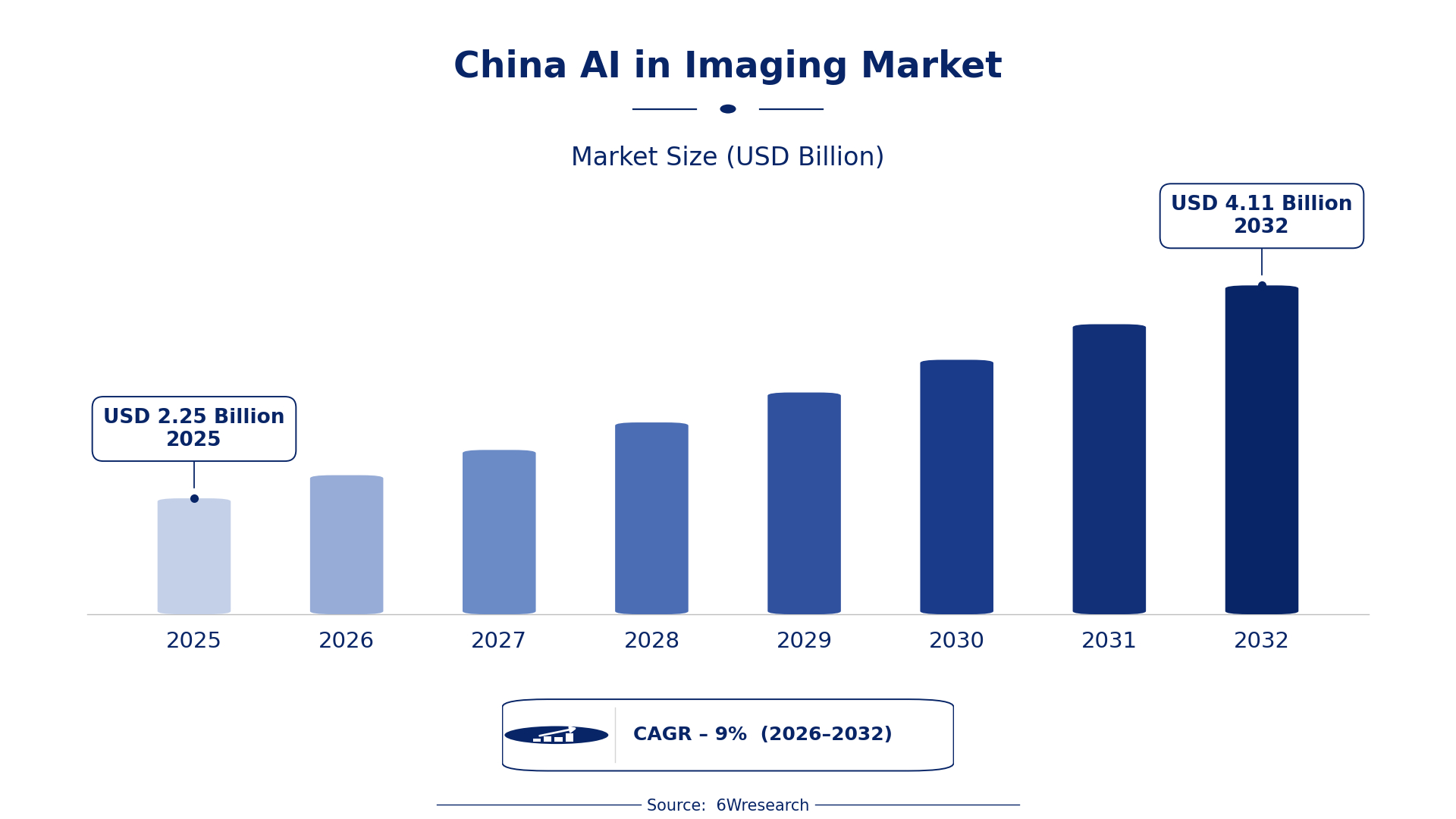
According to 6Wresearch internal database and industry insights, the China AI in Imaging Market was valued at USD 2.25 billion in 2025 and is projected to reach USD 4.11 billion by 2032, growing at a CAGR of approximately 9% during 2026–2032.
China AI in Imaging Market Highlights
| Report Metric | Details |
| Report Name | China AI in Imaging Market |
| Market Size 2025 | USD 2.25 billion |
| Market Size 2032 | USD 4.11 billion |
| Absolute Growth 2025–2032 | USD 1.86 billion |
| CAGR 2026–2032 | 9% |
| Peak Annual Growth | 11.8% in 2032 |
| Forecast Period | 2026–2032 |
| Historical Data | 2022–2025 |
| Base Year | 2025 |
| Leading Imaging Type, 2025 | Radiology (46% share) |
| Leading AI Capability, 2025 | Pattern Recognition (49% share) |
| Leading Distribution Channel, 2025 | Diagnostic SaaS Platforms (45% share) |
| Leading End User, 2025 | Radiology Labs (38% share) |
| Fastest-Growing Imaging Type | Pathology Imaging (10.7% CAGR) |
| Fastest-Growing AI Capability | Cellular Image Analysis (11.7% CAGR) |
| Fastest-Growing End User | Cancer Centers (11.4% CAGR) |
| Growing Sector | Radiology |
| Key End Users | Radiology Labs, Cancer Centers, General Hospitals, Vision Clinics |
China AI in Imaging Market Year-wise Growth Rate and Key Drivers (2022–2032)
This graph illustrates the annual growth rates of the market from 2022 to 2032, highlighting a steady upward trajectory and projected market expansion over the forecast period.
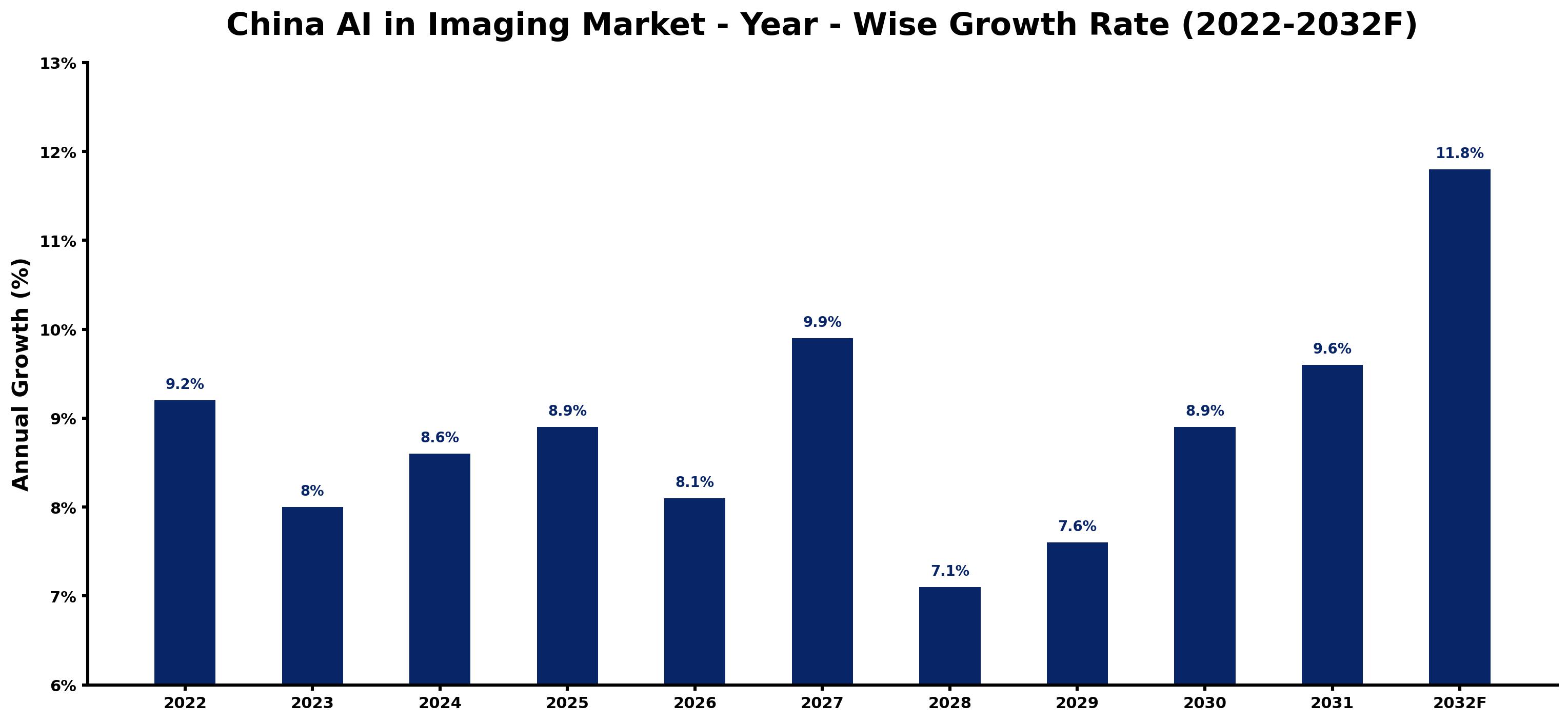
Annual growth estimates for each year appear below with the principal reason behind them, explaining the shifts that set the pace of the market.
| Year | Estimated Annual Growth (%) | Market Rationale |
| 2022 | 9.2 | The market was valued at approximately 1.5 billion USD, reflecting strong demand. |
| 2023 | 8.0 | Growth slowed due to market adjustments and increased competition in AI technologies. |
| 2024 | 8.6 | The introduction of new imaging technologies spurred faster growth compared to the previous year. |
| 2025 | 8.9 | Demand increased as hospitals aimed to integrate AI technologies in 80% of facilities by 2025. |
| 2026 | 8.1 | Growth slowed as the market adapted to evolving regulatory standards and competition. |
| 2027 | 9.9 | Investment in AI healthcare projects rose, driving faster growth in the imaging sector. |
| 2028 | 7.1 | The market experienced a slowdown as integration challenges persisted in healthcare systems. |
| 2029 | 7.6 | Demand for advanced imaging solutions increased, leading to a quicker recovery in growth rates. |
| 2030 | 8.9 | The market rebounded as hospitals implemented AI solutions across various departments. |
| 2031 | 9.6 | Investment in AI imaging technologies continued to rise, supporting overall market growth. |
| 2032 | 11.8 | The market is expected to peak as AI technologies become standard in healthcare diagnostics. |
Note: Market size estimations and growth projections presented in this report are based on 6Wresearch's proprietary forecasting methodology, utilizing the latest available industry data, government publications, and primary research inputs.
China AI in Imaging Market Synopsis
AI in Imaging in China involves the application of artificial intelligence technologies in medical imaging to improve diagnostic accuracy and efficiency. This technology utilises advanced algorithms and machine learning techniques to analyse medical images. The AI in Imaging Market is expanding due to rising demand from urban hospitals and healthcare facilities. The National Health Commission's goal to integrate AI in 80% of hospitals by 2025 serves as a strong driver. Furthermore, the increasing incidence of diseases calls for enhanced diagnostic tools, further elevating market potential.
Market Dynamics Impact Analysis (2026–2032)
| Factor | Type | Impact | Primary Segment Affected |
| Growing investment in AI healthcare initiatives | Driver | High | Radiology |
| Increasing adoption of AI technologies in hospitals | Driver | High | Pathology Imaging |
| Significant growth in cancer cases driving demand | Opportunity | High | Cancer Centers |
| Expansion of AI imaging solutions in urban hospitals | Opportunity | High | General Hospitals |
| Challenges in regulatory compliance for AI devices | Restraint | High | Diagnostic SaaS Platforms |
| Limited access to advanced imaging technologies in rural areas | Restraint | Medium | Ophthalmology Imaging |
| Integration issues with existing hospital IT systems | Challenge | High | Hospital IT Vendors |
| High costs associated with AI technology implementation | Challenge | Medium | Radiology Labs |
Evaluation of Drivers in China AI in Imaging Market (2026–2032)
Key forces behind demand, with the segment each one moves most, are listed below.
| Drivers | Primary Segment Affected | Why It Matters (Evidence) |
| Increased funding for AI healthcare projects | Pathology Imaging | The Ministry of Science and Technology allocated 5 billion CNY for AI healthcare projects, improving diagnostic capabilities. |
| Rising demand for accurate diagnostics | Radiology | The average population served by a general hospital in China is around 300,000, necessitating advanced imaging solutions. |
| Integration of AI in healthcare systems | Diagnostic SaaS Platforms | The National Health Commission's target for AI integration in hospitals promotes SaaS platforms for efficient diagnostics. |
| Growing cancer cases in China | Cancer Centers | With over 1,000 cancer centers utilizing advanced imaging technologies, demand for AI solutions is increasing. |
| Expansion of AI imaging in urban hospitals | General Hospitals | China has over 30,000 hospitals, many adopting AI imaging solutions to improve patient care. |
With over 30,000 hospitals nationwide, the demand for advanced imaging solutions is considerable. As cancer cases increase, the necessity for precise diagnostics is becoming more pronounced, particularly in cancer centres. The target for AI integration in hospitals is encouraging the adoption of SaaS platforms for more efficient diagnostics.
Evaluation of Restraints in China AI in Imaging Market
The table below lists the restraints and the evidence behind each.
| Market Restraint | Primary Segment Affected | Why It Matters (Evidence) |
| Regulatory compliance challenges for AI devices | Diagnostic SaaS Platforms | The National Medical Products Administration oversees regulations, complicating market entry for new AI imaging solutions. |
| Limited access to advanced technologies in rural areas | Ophthalmology Imaging | Many rural hospitals lack the infrastructure to implement AI imaging solutions effectively. |
| Integration issues with existing hospital IT systems | Hospital IT Vendors | Legacy systems in hospitals hinder the integration of new AI technologies. |
| High costs associated with AI technology implementation | Radiology Labs | Investment in AI imaging technologies can be prohibitive for smaller radiology labs. |
| Market competition driving down profit margins | Cancer Centers | As more centers adopt AI technologies, competition increases, affecting profitability. |
China AI in Imaging Market Challenges
Buyers and suppliers in the China AI in Imaging market encounter a skills shortage, as many healthcare professionals lack training in advanced AI technologies. This gap arises because educational institutions have not fully incorporated AI into their medical curricula, hindering the effective use of these solutions in hospitals. Additionally, sourcing high-quality imaging equipment presents supply chain challenges, resulting in project delays that can obstruct timely patient diagnosis. Rising costs for AI in Imaging solutions are another concern, with the average investment per hospital increasing by 15% annually, putting pressure on budgets for essential healthcare services.
Trends in the China AI in Imaging Market
Four trends stand out in the China AI in Imaging Market.
- Shift from Traditional Imaging to AI Solutions: China is transitioning towards AI imaging solutions, especially in urban hospitals. The 'AI Innovation Action Plan' launched in 2021 aims to promote AI integration, targeting 80% implementation by 2025.
- Transition from Manual to Automated Diagnostics: The shift to automated diagnostics is clear in the increasing use of AI technologies in medical imaging. In 2022, the AI in Imaging market was valued at approximately 1.5 billion USD, reflecting this trend.
- Emergence of AI in Pathology Imaging: Pathology imaging is becoming a key growth area, driven by the rise in cancer cases. The sector is projected to grow significantly, with a CAGR of 10.7% through 2032.
- Expansion of Diagnostic SaaS Platforms: The rise of Diagnostic SaaS Platforms is changing how AI imaging solutions are delivered. With a 45% market share in 2025, this model is becoming the preferred choice for healthcare providers.
Investment Opportunities in the China AI in Imaging Market
Several openings in the China AI in Imaging Market merit attention from investors.
- Gap in AI Imaging Solutions for Rural Hospitals: With over 30,000 hospitals in China, there is a gap in AI imaging solutions for rural areas. Investing in tailored solutions can meet the needs of these underserved facilities.
- Growing Demand for AI in Cancer Diagnostics: The increasing number of cancer cases presents an opportunity for AI imaging technologies. Cancer centers are actively seeking advanced diagnostic tools to improve patient outcomes.
- Investment in AI Imaging for General Hospitals: The push for AI integration in general hospitals creates opportunities for suppliers of imaging technologies. Collaborating with urban hospitals can facilitate market entry and expansion.
- Timing for AI Technology Adoption: As the National Health Commission targets 80% AI integration by 2025, the timing is ripe for investment in AI imaging solutions. This initiative encourages hospitals to adopt advanced technologies.
Government Initiatives in the China AI in Imaging Market
The 'AI in Healthcare Development Action Plan' launched by the National Health Commission in 2021 aims to improve AI integration in medical imaging by 2025. This measure builds on previous initiatives, including the '13th Five-Year Plan for Health', which set targets for AI applications in hospitals. The focus on AI technologies is expected to improve diagnostic accuracy and efficiency across healthcare facilities, benefitting both producers and buyers of AI imaging solutions.
In 2022, the Ministry of Science and Technology announced a budget of 5 billion CNY for AI healthcare projects, specifically targeting imaging technologies. This funding supports the development of new solutions and the integration of AI into existing systems. The National Medical Products Administration oversees the approval of AI medical devices, ensuring compliance with safety and quality standards, which facilitates market entry for new technologies.
Future Insight of the China AI in Imaging Market
Several forward-looking factors should support the AI in Imaging market in China over the coming years. The integration of AI technologies in 80% of hospitals by 2025 will facilitate widespread adoption and improve diagnostic capabilities. Government initiatives, including the 'AI Innovation Action Plan', will drive advancements in healthcare AI. The 'Healthy China 2030' initiative aims to upgrade healthcare technologies, ensuring hospitals can access effective solutions to meet growing patient demands. Pathology imaging will expand significantly due to rising cancer cases, with over 1,000 cancer centres adopting advanced imaging solutions.
Market Segmentation Analysis
Each segment group is reviewed below, with the leader by share and the fastest grower by CAGR.
By Imaging Type – Radiology Dominated, Pathology Imaging Expected to Grow Fastest
According to Shubham Padhi, Research Analyst at 6Wresearch, in 2025, Radiology led the imaging type split with a 46% share. Radiology holds the largest market share due to its essential role in diagnosing and planning treatment for various medical conditions. The integration of AI imaging solutions in approximately 30,000 hospitals across China highlights its critical importance in healthcare delivery. Over 2026–2032, Pathology Imaging is expected to post the fastest growth, at a CAGR of 10.7%. Pathology Imaging is experiencing rapid growth, primarily driven by the increasing cancer incidence in the country. The demand for advanced imaging technologies in over 1,000 cancer centers illustrates the urgency for improved diagnostic capabilities in this area. This indicates that suppliers should focus on developing specialised solutions for both radiology and pathology imaging to meet the rising demands of healthcare providers.
By AI Capability – Pattern Recognition Dominated, Cellular Image Analysis Expected to Grow Fastest
Pattern Recognition held a 49% share of the China AI in Imaging Market by ai capability in 2025. Pattern Recognition is the leading capability as it is fundamental for identifying patterns in medical images, which is vital for accurate diagnostics. This capability is extensively utilised across various imaging modalities in hospitals and laboratories, ensuring its dominance in the market. The quickest growth will come from Cellular Image Analysis, forecast to expand at a CAGR of 11.7% between 2026 and 2032. Cellular Image Analysis is witnessing swift growth, driven by the necessity for precise examination of cellular structures in pathology, particularly for cancer diagnostics. The increasing focus on pathology imaging in cancer centers supports this upward trend in demand. Suppliers should invest in advancing pattern recognition and cellular image analysis technologies to capitalise on the expanding opportunities within the market.
By Distribution Channel – Diagnostic SaaS Platforms Dominated and Is Expected to Record the Fastest Growth
With a 45% revenue share in 2025, Diagnostic SaaS Platforms was the largest distribution channel category. Diagnostic SaaS Platforms dominate the market as they represent the primary delivery method for AI imaging solutions, enabling easy access for healthcare providers. This model aligns well with the increasing digitisation of healthcare services in urban areas. Its lead should widen, with a projected CAGR of 10.5% during 2026–2032, the highest in this split. The growth of Diagnostic SaaS Platforms is anticipated to persist as they offer scalable and efficient solutions for AI imaging, addressing the rising demand from hospitals and laboratories. Their established market presence ensures they remain at the forefront. This suggests that suppliers should prioritise the development of SaaS-based solutions to capitalise on the growing trend towards digital healthcare.
By End User – Radiology Labs Dominated, Cancer Centers Expected to Grow Fastest
Radiology Labs accounted for a 38% market share by end user in 2025. Radiology Labs are the primary users of AI imaging technologies, holding a substantial market share due to their critical role in diagnostics. The high volume of imaging procedures conducted in these labs significantly drives their demand for advanced AI solutions. Cancer Centers are projected to grow fastest, at a CAGR of 11.4% during 2026–2032. Cancer Centers are rapidly adopting AI technologies for enhanced diagnostics, reflecting the urgent need for improved cancer detection and monitoring. The rising prevalence of cancer cases in China further fuels this growth in demand. This highlights the necessity for suppliers to tailor their offerings to meet the specific requirements of radiology labs and cancer centers.
Key Attractiveness of the Report
- 10 Years of Market Numbers
- Historical Data Starting from 2022 to 2025
- Base Year 2025
- Forecast Data until 2032
- Key Performance Indicators Impacting the Market
- Major Upcoming Developments and Projects
Key Highlights of the Report:
- China AI in Imaging Market Outlook
- Market Size of China AI in Imaging Market, 2025
- Forecast of China AI in Imaging Market, 2032
- Historical Data and Forecast of China AI in Imaging Revenues & Volume for the Period 2022 - 2032F
- China AI in Imaging Market Trend Evolution
- China AI in Imaging Market Drivers and Challenges
- China AI in Imaging Price Trends
- China AI in Imaging Porter's Five Forces
- China AI in Imaging Industry Life Cycle
- Historical Data and Forecast of China AI in Imaging Market Revenues & Volume By Imaging Type for the Period 2022 - 2032F
- Historical Data and Forecast of China AI in Imaging Market Revenues & Volume By Radiology for the Period 2022 - 2032F
- Historical Data and Forecast of China AI in Imaging Market Revenues & Volume By Pathology Imaging for the Period 2022 - 2032F
- Historical Data and Forecast of China AI in Imaging Market Revenues & Volume By Ophthalmology Imaging for the Period 2022 - 2032F
- Historical Data and Forecast of China AI in Imaging Market Revenues & Volume By Ultrasound Imaging for the Period 2022 - 2032F
- Historical Data and Forecast of China AI in Imaging Market Revenues & Volume By AI Capability for the Period 2022 - 2032F
- Historical Data and Forecast of China AI in Imaging Market Revenues & Volume By Pattern Recognition for the Period 2022 - 2032F
- Historical Data and Forecast of China AI in Imaging Market Revenues & Volume By Cellular Image Analysis for the Period 2022 - 2032F
- Historical Data and Forecast of China AI in Imaging Market Revenues & Volume By Retinal Image Processing for the Period 2022 - 2032F
- Historical Data and Forecast of China AI in Imaging Market Revenues & Volume By Real-time Signal Analysis for the Period 2022 - 2032F
- Historical Data and Forecast of China AI in Imaging Market Revenues & Volume By Distribution Channel for the Period 2022 - 2032F
- Historical Data and Forecast of China AI in Imaging Market Revenues & Volume By Diagnostic SaaS Platforms for the Period 2022 - 2032F
- Historical Data and Forecast of China AI in Imaging Market Revenues & Volume By Hospital IT Vendors for the Period 2022 - 2032F
- Historical Data and Forecast of China AI in Imaging Market Revenues & Volume By Eye Health Portals for the Period 2022 - 2032F
- Historical Data and Forecast of China AI in Imaging Market Revenues & Volume By Medical Device Suppliers for the Period 2022 - 2032F
- Historical Data and Forecast of China AI in Imaging Market Revenues & Volume By End User for the Period 2022 - 2032F
- Historical Data and Forecast of China AI in Imaging Market Revenues & Volume By Radiology Labs for the Period 2022 - 2032F
- Historical Data and Forecast of China AI in Imaging Market Revenues & Volume By Cancer Centers for the Period 2022 - 2032F
- Historical Data and Forecast of China AI in Imaging Market Revenues & Volume By Vision Clinics for the Period 2022 - 2032F
- Historical Data and Forecast of China AI in Imaging Market Revenues & Volume By General Hospitals for the Period 2022 - 2032F
- China AI in Imaging Import Export Trade Statistics
- Market Opportunity Assessment By Imaging Type
- Market Opportunity Assessment By AI Capability
- Market Opportunity Assessment By Distribution Channel
- Market Opportunity Assessment By End User
- China AI in Imaging Top Companies Market Share
- China AI in Imaging Competitive Benchmarking By Technical and Operational Parameters
- China AI in Imaging Company Profiles
- China AI in Imaging Key Strategic Recommendations
Market Covered
This report examines the market across the segments below.
By Imaging Type
- Radiology
- Pathology Imaging
- Ophthalmology Imaging
- Ultrasound Imaging
By AI Capability
- Pattern Recognition
- Cellular Image Analysis
- Retinal Image Processing
- Real-time Signal Analysis
By Distribution Channel
- Diagnostic SaaS Platforms
- Hospital IT Vendors
- Eye Health Portals
- Medical Device Suppliers
By End User
- Radiology Labs
- Cancer Centers
- Vision Clinics
- General Hospitals































