China AI in Industrial Automation Market Size & Growth Rate
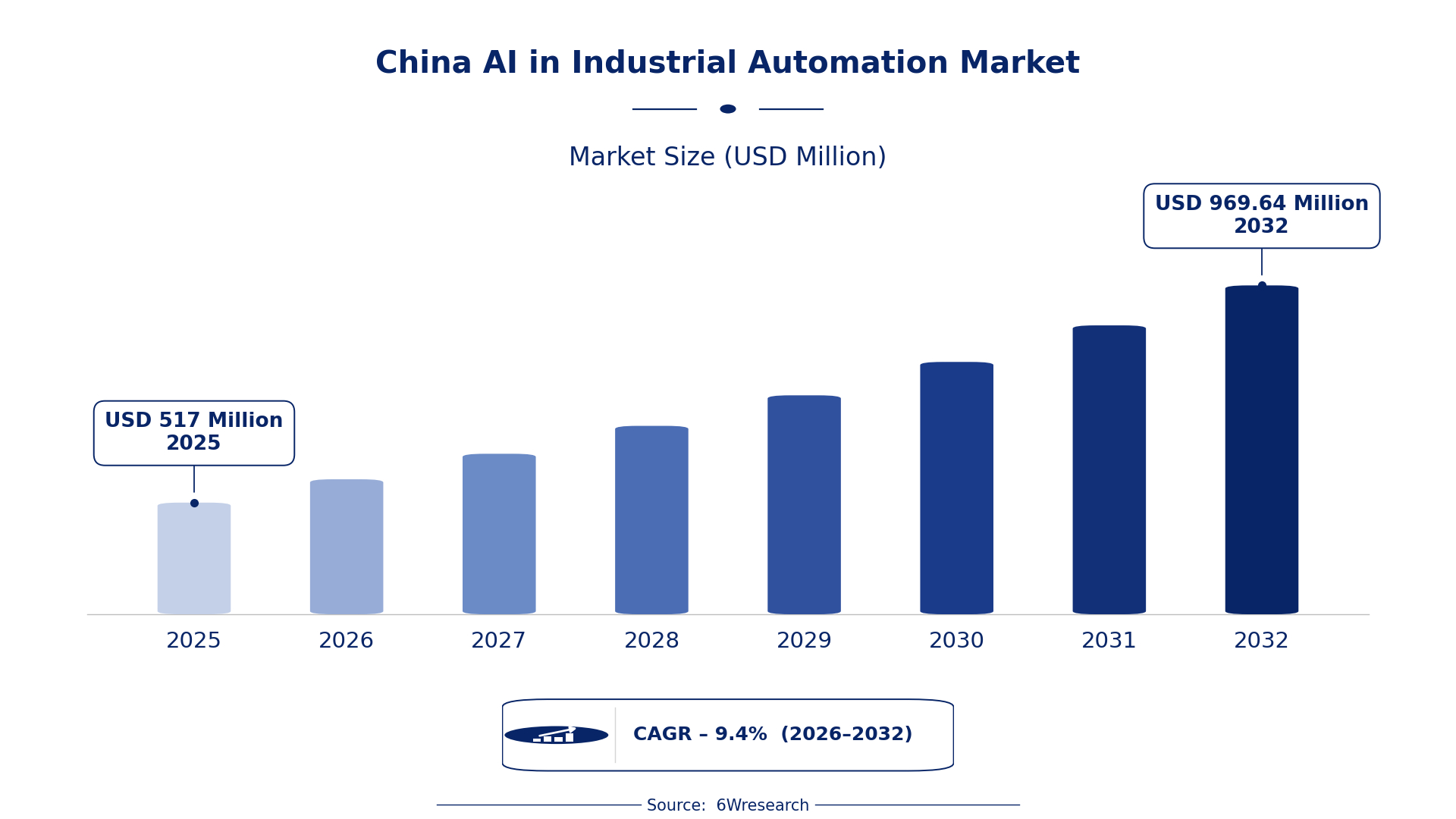
According to 6Wresearch internal database and industry insights, the China AI in Industrial Automation Market was valued at USD 517.0 million in 2025 and is projected to reach USD 969.64 million by 2032, growing at a CAGR of approximately 9.4% during 2026–2032.
China AI in Industrial Automation Market Highlights
| Report Metric | Details |
| Report Name | China AI in Industrial Automation Market |
| Market Size 2025 | USD 517.0 million |
| Market Size 2032 | USD 969.64 million |
| Absolute Growth 2025–2032 | USD 452.64 million |
| CAGR 2026–2032 | 9.4% |
| Peak Annual Growth | 11.5% in 2029 |
| Forecast Period | 2026–2032 |
| Historical Data | 2022–2025 |
| Base Year | 2025 |
| Leading Industry Area, 2025 | Process Automation (43% share) |
| Leading AI Use Case, 2025 | ML-Controlled Systems (48% share) |
| Leading Distribution Channel, 2025 | Automation Vendors (41% share) |
| Leading End User, 2025 | Manufacturing Plants (43% share) |
| Fastest-Growing Industry Area | Quality Inspection (10.5% CAGR) |
| Fastest-Growing AI Use Case | Vision AI (11.4% CAGR) |
| Fastest-Growing Distribution Channel | B2B Energy Integrators (11.0% CAGR) |
| Fastest-Growing End User | Smart Factory Managers (10.9% CAGR) |
| Growing Sector | Manufacturing |
| Key End Users | Manufacturing Plants, Automation Vendors, Assembly Line Operators, Smart Factory Managers |
China AI in Industrial Automation Market Year-wise Growth Rate and Key Drivers (2022–2032)
This graph illustrates the annual growth rates of the market from 2022 to 2032, highlighting a steady upward trajectory and projected market expansion over the forecast period.
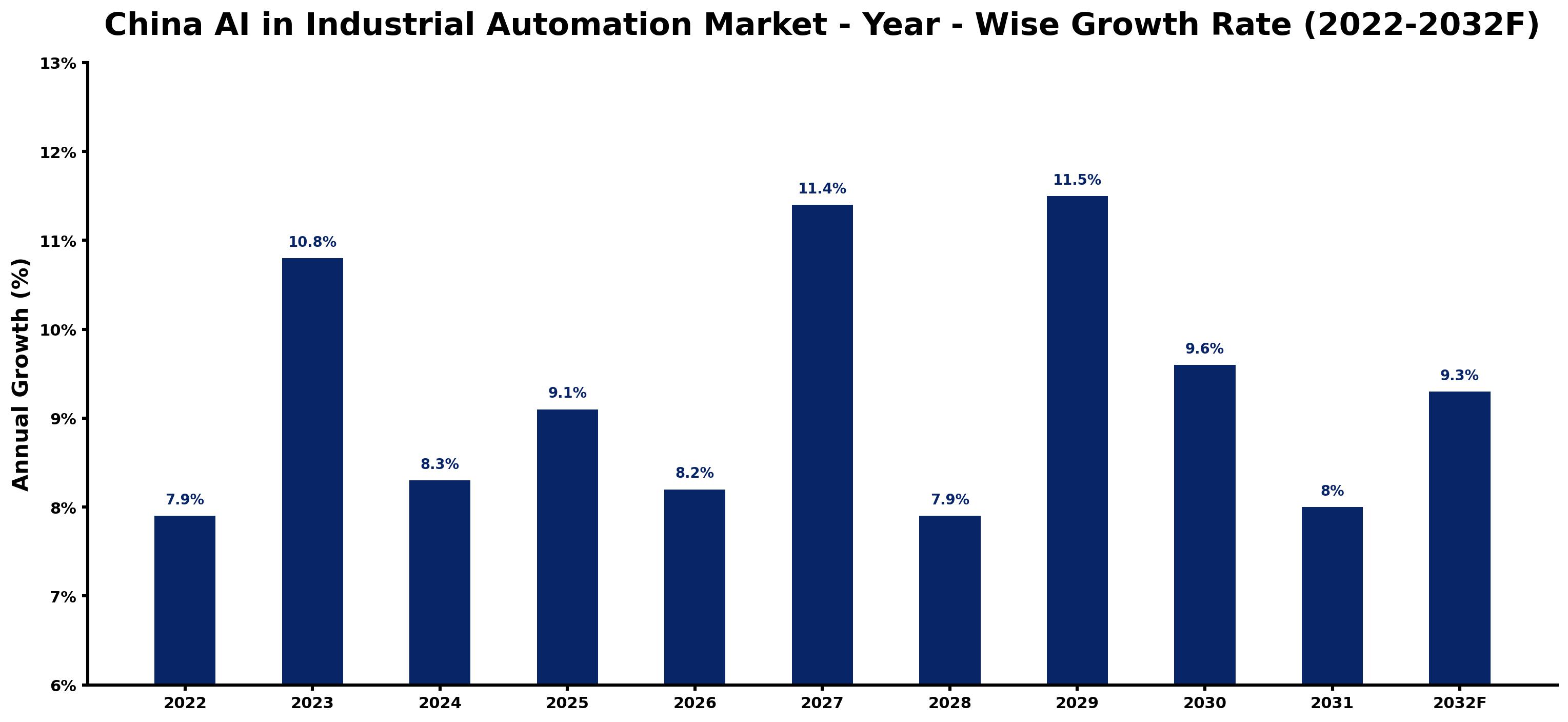
The following table presents the estimated annual growth rate for each year together with the principal factor influencing market performance.
| Year | Estimated Annual Growth (%) | Market Rationale |
| 2022 | 7.9 | The market experienced steady growth due to ongoing investments in smart factory initiatives. |
| 2023 | 10.8 | Growth accelerated as the smart factory market reached approximately 200 billion yuan. |
| 2024 | 8.3 | A slowdown occurred as companies adjusted to new AI technologies and processes. |
| 2025 | 9.1 | Demand increased as over 60% of manufacturing plants adopted AI for automation. |
| 2026 | 8.2 | Growth slowed due to the time required for implementing advanced AI solutions. |
| 2027 | 11.4 | The market rebounded with increased investments in AI-driven process automation. |
| 2028 | 7.9 | Growth decelerated as companies focused on optimising existing AI implementations. |
| 2029 | 11.5 | The market peaked as demand surged for innovative AI applications in manufacturing. |
| 2030 | 9.6 | Growth slowed as the market matured and adoption reached saturation levels. |
| 2031 | 8.0 | A further slowdown occurred as companies consolidated their AI investments. |
| 2032 | 9.3 | Demand increased again as new AI technologies emerged in industrial automation. |
Note: Market size estimations and growth projections presented in this report are based on 6Wresearch's proprietary forecasting methodology, utilizing the latest available industry data, government publications, and primary research inputs.
China AI in Industrial Automation Market Synopsis
AI in Industrial Automation Market in China encompasses the integration of AI technologies into industrial processes to improve efficiency and productivity. Key applications include predictive maintenance, quality inspection, and process automation. The market is expanding rapidly, driven by substantial investments in smart factory initiatives and the widespread adoption of AI in manufacturing plants. In 2022, the smart factory market was valued at approximately 200 billion yuan, indicating strong demand for automation solutions. Ongoing government support and the push for advanced manufacturing further stimulate this growth.
Market Dynamics Impact Analysis (2026–2032)
| Factor | Type | Impact | Primary Segment Affected |
| Growing adoption of predictive maintenance solutions enhances equipment reliability and reduces downtime. | Driver | High | Predictive Maintenance |
| Increased demand for quality inspection technologies improves product quality and reduces defects. | Driver | High | Quality Inspection |
| The current gap in AI integration presents opportunities for automation vendors to expand their offerings. | Opportunity | High | Automation Vendors |
| Investments in smart manufacturing technologies in the Yangtze River Delta region create new market opportunities. | Opportunity | High | Manufacturing Plants |
| High initial investment costs for AI technologies may deter smaller manufacturers from adoption. | Restraint | Medium | Manufacturing Plants |
| Limited skilled workforce in AI technologies can hinder implementation and operational efficiency. | Restraint | Medium | Automation Vendors |
| The AI in Industrial Automation market in China faces practical problems related to skilled labour shortages. | Challenge | High | Manufacturing Plants |
| Integration challenges with existing systems can delay the adoption of new AI technologies. | Challenge | High | Automation Vendors |
Evaluation of Drivers in China AI in Industrial Automation Market (2026–2032)
The main growth drivers and the segments they affect most are set out below.
| Drivers | Primary Segment Affected | Why It Matters (Evidence) |
| Increased investments in smart factory initiatives drive demand for predictive maintenance solutions. | Predictive Maintenance | In 2023, the Chinese government allocated 10 billion yuan for AI technology development in industrial applications. |
| Growing demand for quality inspection technologies boosts product quality across sectors. | Quality Inspection | ISO 9001 is widely adopted in manufacturing sectors, ensuring effective quality management. |
| The rise of smart manufacturing creates opportunities for automation vendors to expand their market presence. | Automation Vendors | The 'Made in China 2025' initiative emphasises AI integration in manufacturing, driving demand for solutions. |
| The need for energy optimization drives demand for AI solutions in industrial applications. | Energy Optimization | By 2025, over 60% of manufacturing plants in China are expected to adopt AI for process automation. |
| The trend towards process automation increases demand for ML-controlled systems. | ML-Controlled Systems | The Guangdong province is investing heavily in AI capabilities, promoting innovation in industrial automation. |
By 2025, over 60% of manufacturing plants are expected to implement AI for process automation, leading to enhanced operational efficiency. The emphasis on quality management through ISO 9001 standards further drives the demand for quality inspection technologies. Significant investments in the Guangdong province are fostering innovation and adoption of ML-controlled systems across various industries.
Evaluation of Restraints in China AI in Industrial Automation Market
The key brakes on demand, and where they bite hardest, are shown below.
| Market Restraint | Primary Segment Affected | Why It Matters (Evidence) |
| High initial investment costs for AI technologies may deter smaller manufacturers from adoption. | Manufacturing Plants | Many small manufacturers lack the financial resources to invest in advanced AI solutions, limiting their competitiveness. |
| Limited skilled workforce in AI technologies can hinder implementation and operational efficiency. | Automation Vendors | The shortage of qualified personnel delays the integration of AI systems, affecting project timelines. |
| Integration challenges with existing systems can delay the adoption of new AI technologies. | Automation Vendors | Many manufacturers face difficulties in adapting AI solutions to legacy systems, resulting in increased costs. |
| Concerns over data security and privacy may restrict AI adoption in sensitive industries. | Manufacturing Plants | Manufacturers in sectors like pharmaceuticals are cautious about data breaches, impacting their AI investments. |
| Regulatory compliance requirements can complicate the implementation of AI technologies. | Manufacturing Plants | Manufacturers must navigate complex regulations that govern AI applications, increasing operational burdens. |
China AI in Industrial Automation Market Challenges
The China AI in Industrial Automation market faces several practical issues, starting with intense competition among producers that drives prices down and reduces profit margins. This situation arises from the rapid adoption of AI technologies, compelling producers to cut costs to stay competitive, which ultimately affects their financial sustainability. Regulatory challenges also exist; compliance with evolving standards requires significant investment, costing producers around 5% of their operational budget. Additionally, many producers encounter difficulties integrating advanced AI systems, which delays automation projects and prolongs time-to-market for new products. Finally, a shortage of skilled professionals in AI limits producers' ability to effectively leverage these technologies, leading to potential productivity losses for buyers seeking efficient solutions.
Trends in the China AI in Industrial Automation Market
Several trends are reshaping the China AI in Industrial Automation Market; the most important are set out below.
- Shift towards Smart Manufacturing: Manufacturing plants are increasingly adopting AI technologies to boost operational efficiency. In 2022, over 60% of plants began integrating AI for process automation, reflecting a growing trend towards smart manufacturing.
- Emergence of Vision AI: The 'Smart Manufacturing Pilot Demonstration' programme has accelerated the adoption of Vision AI in quality inspection. This initiative has led to a projected CAGR of 11.4% for Vision AI from 2026 to 2032.
- Increased Focus on Energy Optimisation: The Guangdong province has launched a programme to enhance AI capabilities in local industries, with energy optimisation being a key focus area. This initiative aims to reduce energy consumption across manufacturing sectors.
- Expansion of Predictive Maintenance Solutions: The Ministry of Industry and Information Technology's support for predictive maintenance has led to notable advancements in AI technologies. The market for predictive maintenance is expected to grow rapidly as manufacturers seek to minimise downtime.
Investment Opportunities in the China AI in Industrial Automation Market
Below are the investment opportunities with the strongest case in the China AI in Industrial Automation Market.
- Current Investment Gap: With the smart factory market valued at approximately 200 billion yuan, there exists a significant investment gap in AI technologies. Automation vendors can capitalise on this opportunity by offering tailored solutions to manufacturing plants.
- Growing Demand for Quality Inspection: As over 60% of manufacturing plants adopt AI, there is a rising demand for quality inspection technologies. Suppliers can enter this market by partnering with local manufacturers to provide advanced AI solutions.
- Investment in Smart Factory Initiatives: The Yangtze River Delta region is witnessing substantial investments in smart manufacturing technologies. Companies can explore joint ventures with local firms to enhance their AI capabilities in this industrial hub.
- Entry through Local Partnerships: The current focus on AI integration presents opportunities for foreign companies to enter the market. Establishing joint ventures with local automation vendors can facilitate access to the growing demand for AI solutions.
Government Initiatives in the China AI in Industrial Automation Market
The 'New Generation Artificial Intelligence Development Plan' launched by the State Council in 2021 aims to position China as a global leader in AI by 2030. This plan encourages manufacturers to adopt AI technologies, improving productivity and competitiveness. Additionally, the 'Digital Economy Development Plan' introduced in 2021 supports AI integration across various sectors, including manufacturing, by promoting research and development initiatives.
In 2022, the National Development and Reform Commission approved a budget of 5 billion yuan for AI research in industrial applications. The Ministry of Industry and Information Technology oversees the 'Smart Manufacturing Pilot Demonstration' programme, which funds projects that promote AI adoption in manufacturing. These initiatives aim to enhance the technological capabilities of local industries and improve overall efficiency.
Future Insight of the China AI in Industrial Automation Market
The China AI in Industrial Automation market is set for substantial advancements by 2032, driven by several pivotal factors. The government's commitment to AI technology development, with an allocation of 10 billion yuan, will enhance capabilities across various sectors. The 'Made in China 2025' initiative is expected to accelerate AI adoption in manufacturing, with over 170 million workers benefiting from improved efficiencies. Furthermore, the rise of smart factories in regions like the Yangtze River Delta will open new avenues for suppliers and buyers, creating a more streamlined industrial environment.
Market Segmentation Analysis
Each segment group is reviewed below, with the leader by share and the fastest grower by CAGR.
By Industry Area – Process Automation Dominated, Quality Inspection Expected to Grow Fastest
According to Shubham Padhi, Research Analyst at 6Wresearch, the largest industry area category in 2025 was Process Automation, with a 43% share of total revenue. Process Automation holds the largest market share due to its ability to automate repetitive tasks, which is essential for improving efficiency in China's vast manufacturing sector. The 'Made in China 2025' initiative highlights the government's focus on integrating automation technologies across diverse industries. Quality Inspection is projected to grow fastest, at a CAGR of 10.5% during 2026–2032. Quality Inspection is experiencing rapid growth as manufacturers increasingly adopt automated checks to enhance product quality and reduce defects. Significant investments in smart manufacturing technologies in regions like Beijing-Tianjin-Hebei are driving this demand. Suppliers should focus on developing advanced solutions for quality inspection to meet the rising demand from manufacturers.
By AI Use Case – ML-Controlled Systems Dominated, Vision AI Expected to Grow Fastest
ML-Controlled Systems held a 48% share of the China AI in Industrial Automation Market by ai use case in 2025. ML-Controlled Systems dominate the market share as they provide adaptive control of industrial processes based on data insights, which is crucial for optimising operations. This capability is particularly important in sectors where real-time adjustments can lead to substantial efficiency gains. Over 2026–2032, Vision AI is expected to post the fastest growth, at a CAGR of 11.4%. Vision AI is the fastest growing use case, enabling automated visual inspections that significantly improve quality control in manufacturing. The increase in AI patents in China, exceeding 1 million in 2022, underscores the industry's commitment to advancing visual inspection technologies. Buyers should prioritise investing in Vision AI solutions to enhance quality control and maintain a competitive advantage.
By Distribution Channel – Automation Vendors Dominated, B2B Energy Integrators Expected to Grow Fastest
Automation Vendors accounted for a 41% market share by distribution channel in 2025. Automation Vendors hold the largest market share as they provide essential technologies and solutions for integrating AI into industrial processes. Their importance is highlighted by the Chinese government's allocation of 10 billion yuan for AI technology development in industrial applications. B2B Energy Integrators are set to record the highest CAGR in this split, 11.0% over 2026–2032. B2B Energy Integrators are the fastest growing channel, implementing AI solutions tailored for energy management in industries. This growth is fuelled by the increasing emphasis on efficiency and sustainability in manufacturing operations. Suppliers should explore collaborations with B2B Energy Integrators to broaden their market presence.
By End User – Manufacturing Plants Dominated, Smart Factory Managers Expected to Grow Fastest
In 2025, Manufacturing Plants led the end user split with a 43% share. Manufacturing Plants represent the largest share of the market as primary users of AI technologies aimed at improving production processes. The ongoing investments in smart factory initiatives highlight the critical role these facilities play in adopting AI solutions. The quickest growth will come from Smart Factory Managers, forecast to expand at a CAGR of 10.9% between 2026 and 2032. Smart Factory Managers are the fastest growing end user group, as they oversee the implementation of AI technologies in smart factories, ensuring operational efficiency. This trend reflects the broader shift towards smart manufacturing across China. Suppliers must tailor their offerings to meet the specific needs of Smart Factory Managers to capitalise on this growth.
Key Attractiveness of the Report
- 10 Years of Market Numbers
- Historical Data Starting from 2022 to 2025
- Base Year 2025
- Forecast Data until 2032
- Key Performance Indicators Impacting the Market
- Major Upcoming Developments and Projects
Key Highlights of the Report:
- China AI in Industrial Automation Market Outlook
- Market Size of China AI in Industrial Automation Market, 2025
- Forecast of China AI in Industrial Automation Market, 2032
- Historical Data and Forecast of China AI in Industrial Automation Revenues & Volume for the Period 2022 - 2032F
- China AI in Industrial Automation Market Trend Evolution
- China AI in Industrial Automation Market Drivers and Challenges
- China AI in Industrial Automation Price Trends
- China AI in Industrial Automation Porter's Five Forces
- China AI in Industrial Automation Industry Life Cycle
- Historical Data and Forecast of China AI in Industrial Automation Market Revenues & Volume By Industry Area for the Period 2022 - 2032F
- Historical Data and Forecast of China AI in Industrial Automation Market Revenues & Volume By Predictive Maintenance for the Period 2022 - 2032F
- Historical Data and Forecast of China AI in Industrial Automation Market Revenues & Volume By Quality Inspection for the Period 2022 - 2032F
- Historical Data and Forecast of China AI in Industrial Automation Market Revenues & Volume By Energy Optimization for the Period 2022 - 2032F
- Historical Data and Forecast of China AI in Industrial Automation Market Revenues & Volume By Process Automation for the Period 2022 - 2032F
- Historical Data and Forecast of China AI in Industrial Automation Market Revenues & Volume By AI Use Case for the Period 2022 - 2032F
- Historical Data and Forecast of China AI in Industrial Automation Market Revenues & Volume By Sensor-based AI for the Period 2022 - 2032F
- Historical Data and Forecast of China AI in Industrial Automation Market Revenues & Volume By Vision AI for the Period 2022 - 2032F
- Historical Data and Forecast of China AI in Industrial Automation Market Revenues & Volume By ML-Controlled Systems for the Period 2022 - 2032F
- Historical Data and Forecast of China AI in Industrial Automation Market Revenues & Volume By Autonomous Controllers for the Period 2022 - 2032F
- Historical Data and Forecast of China AI in Industrial Automation Market Revenues & Volume By Distribution Channel for the Period 2022 - 2032F
- Historical Data and Forecast of China AI in Industrial Automation Market Revenues & Volume By Automation Vendors for the Period 2022 - 2032F
- Historical Data and Forecast of China AI in Industrial Automation Market Revenues & Volume By Robotics OEMs for the Period 2022 - 2032F
- Historical Data and Forecast of China AI in Industrial Automation Market Revenues & Volume By B2B Energy Integrators for the Period 2022 - 2032F
- Historical Data and Forecast of China AI in Industrial Automation Market Revenues & Volume By Direct Industry Sales for the Period 2022 - 2032F
- Historical Data and Forecast of China AI in Industrial Automation Market Revenues & Volume By End User for the Period 2022 - 2032F
- Historical Data and Forecast of China AI in Industrial Automation Market Revenues & Volume By Manufacturing Plants for the Period 2022 - 2032F
- Historical Data and Forecast of China AI in Industrial Automation Market Revenues & Volume By Assembly Line Operators for the Period 2022 - 2032F
- Historical Data and Forecast of China AI in Industrial Automation Market Revenues & Volume By Smart Factory Managers for the Period 2022 - 2032F
- Historical Data and Forecast of China AI in Industrial Automation Market Revenues & Volume By Heavy Machinery Manufacturers for the Period 2022 - 2032F
- China AI in Industrial Automation Import Export Trade Statistics
- Market Opportunity Assessment By Industry Area
- Market Opportunity Assessment By AI Use Case
- Market Opportunity Assessment By Distribution Channel
- Market Opportunity Assessment By End User
- China AI in Industrial Automation Top Companies Market Share
- China AI in Industrial Automation Competitive Benchmarking By Technical and Operational Parameters
- China AI in Industrial Automation Company Profiles
- China AI in Industrial Automation Key Strategic Recommendations
Market Covered
The report offers an extensive study of the following market segments.
By Industry Area
- Predictive Maintenance
- Quality Inspection
- Energy Optimization
- Process Automation
By AI Use Case
- Sensor-based AI
- Vision AI
- ML-Controlled Systems
- Autonomous Controllers
By Distribution Channel
- Automation Vendors
- Robotics OEMs
- B2B Energy Integrators
- Direct Industry Sales
By End User
- Manufacturing Plants
- Assembly Line Operators
- Smart Factory Managers
- Heavy Machinery Manufacturers































