China AI in Military Operations Market Size & Growth Rate
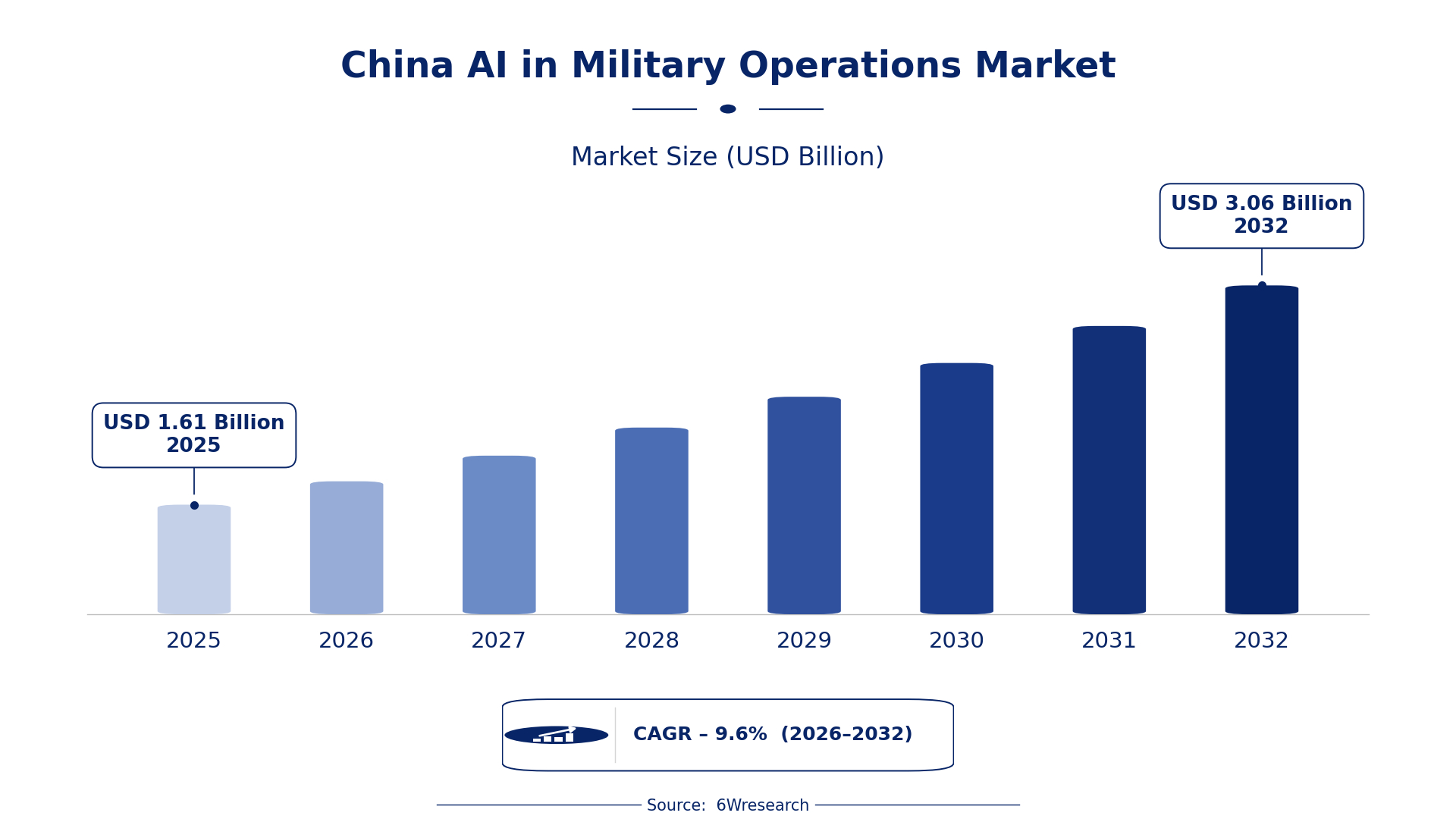
According to 6Wresearch internal database and industry insights, the China AI in Military Operations Market was valued at USD 1.61 billion in 2025 and is projected to reach USD 3.06 billion by 2032, growing at a CAGR of approximately 9.6% during 2026–2032.
China AI in Military Operations Market Highlights
| Report Metric | Details |
| Report Name | China AI in Military Operations Market |
| Market Size 2025 | USD 1.61 billion |
| Market Size 2032 | USD 3.06 billion |
| Absolute Growth 2025–2032 | USD 1.45 billion |
| CAGR 2026–2032 | 9.6% |
| Peak Annual Growth | 11.7% in 2029 |
| Forecast Period | 2026–2032 |
| Historical Data | 2022–2025 |
| Base Year | 2025 |
| Leading Operation Type, 2025 | Surveillance & Recon (55% share) |
| Leading AI Capability, 2025 | Threat Detection Systems (38% share) |
| Leading Distribution Channel, 2025 | Government Procurement (40% share) |
| Leading End User, 2025 | Armed Forces (48% share) |
| Fastest-Growing Operation Type | Battlefield Management (10.7% CAGR) |
| Fastest-Growing AI Capability | Predictive Analytics (11.1% CAGR) |
| Fastest-Growing Distribution Channel | Military AI Vendors (11.6% CAGR) |
| Fastest-Growing End User | Tactical Command Centers (11.8% CAGR) |
| Growing Sector | Military Operations |
| Key End Users | Armed Forces, Military Intelligence Units, Tactical Command Centers, Cybersecurity Divisions |
China AI in Military Operations Market Year-wise Growth Rate and Key Drivers (2022–2032)
This graph illustrates the annual growth rates of the market from 2022 to 2032, highlighting a steady upward trajectory and projected market expansion over the forecast period.
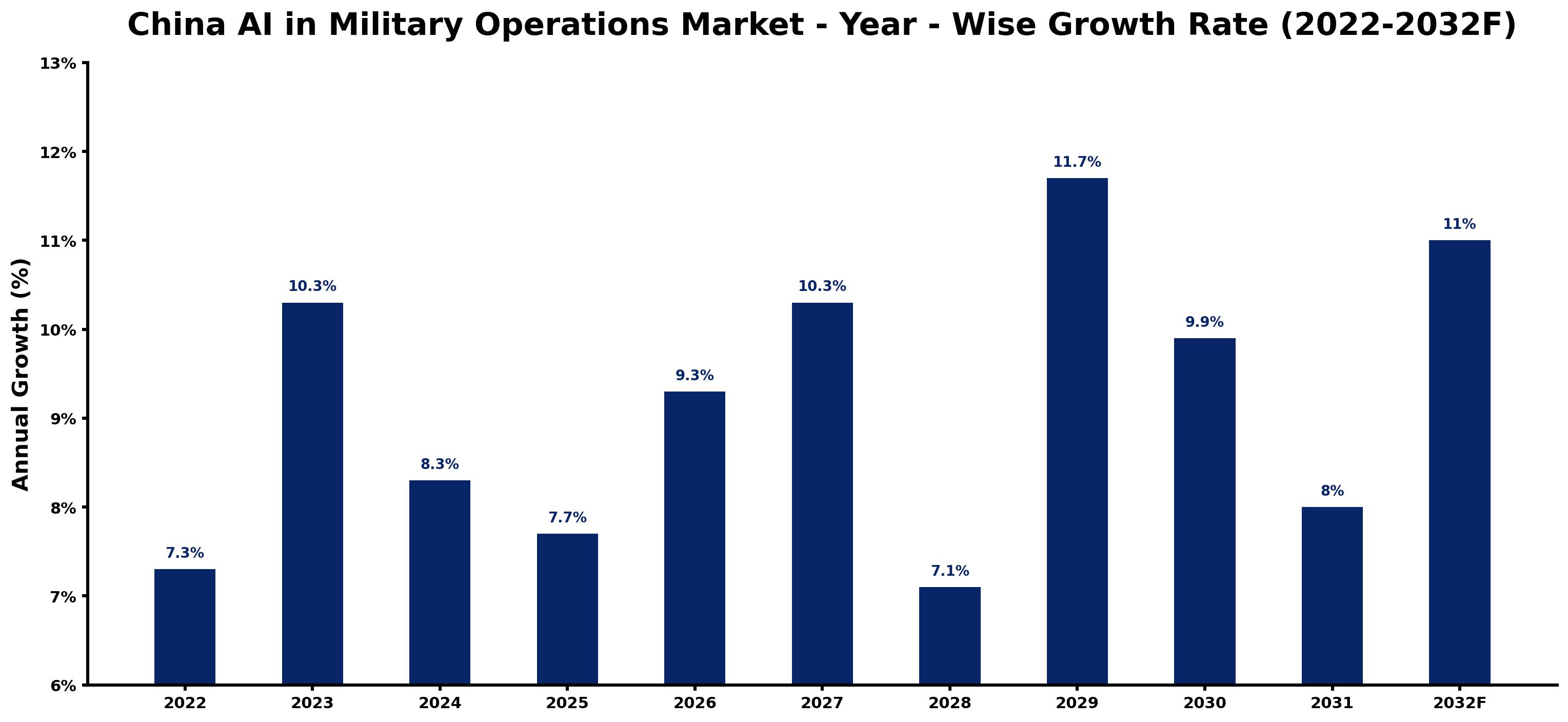
The following table presents the estimated annual growth rate for each year together with the principal factor influencing market performance.
| Year | Estimated Annual Growth (%) | Market Rationale |
| 2022 | 7.3 | The market experienced steady growth as military applications for AI technologies gained traction through the 'AI Military Strategy Plan'. |
| 2023 | 10.3 | Increased funding from the military budget boosted AI technology development, particularly in autonomous systems and surveillance applications. |
| 2024 | 8.3 | Government initiatives aimed at improving military capabilities led to a slowdown in growth, affecting procurement timelines for AI technologies. |
| 2025 | 7.7 | The ongoing integration of AI in military operations continued to support growth, driven by the 'AI Military Strategy Plan'. |
| 2026 | 9.3 | Demand for AI-driven solutions in battlefield management is expected to rise, accelerating growth in military applications and logistics. |
| 2027 | 10.3 | Sustained investment in AI technologies by the military will further propel market expansion, particularly in threat detection systems and cyber defense. |
| 2028 | 7.1 | Growth is projected to slow as the market adjusts to rapid advancements in AI capabilities and integration challenges in military operations. |
| 2029 | 11.7 | A surge in demand for threat detection systems is expected to drive peak growth in the market, aligning with military operational needs. |
| 2030 | 9.9 | The market will see a slowdown as focus shifts towards refining existing AI technologies and improving operational efficiency in military applications. |
| 2031 | 8.0 | Continued investment in AI for military applications will maintain growth, albeit at a reduced rate due to budget constraints and project delays. |
| 2032 | 11.0 | A renewed focus on AI integration in military operations is expected to boost growth once more, driven by strategic initiatives and funding. |
Note: Market size estimations and growth projections presented in this report are based on 6Wresearch's proprietary forecasting methodology, utilizing the latest available industry data, government publications, and primary research inputs.
China AI in Military Operations Market Synopsis
The integration of AI technologies into military strategies and operations in China is transforming military capabilities. This integration supports surveillance, automates weapon systems, and improves battlefield management. The China AI in Military Operations Market is expanding due to substantial military investments and government initiatives. In 2023, the military budget for AI technology development reached ¥1 trillion, reflecting the government's commitment to advancing military capabilities through AI. The launch of the 'AI Military Strategy Plan' in 2022 is driving further demand for AI technologies in military applications.
Market Dynamics Impact Analysis (2026–2032)
| Factor | Type | Impact | Primary Segment Affected |
| Increased military budget allocations for AI technology development are driving demand. | Driver | High | Autonomous Weapons |
| Growing domestic military applications are creating new opportunities for AI integration. | Driver | High | Surveillance & Recon |
| The establishment of AI research institutes is fostering innovation and development. | Opportunity | High | Cyber Defense |
| The rising number of military AI projects presents significant investment opportunities. | Opportunity | Medium | Battlefield Management |
| Regulatory challenges related to AI integration may hinder market growth. | Restraint | High | Threat Detection Systems |
| Concerns over cybersecurity threats can limit the adoption of AI technologies. | Restraint | Medium | Cyber Defense |
| The need for skilled personnel to implement AI technologies poses a challenge. | Challenge | High | Military Intelligence Units |
| Technological complexities in integrating AI systems can delay deployment. | Challenge | Medium | Tactical Command Centers |
Evaluation of Drivers in China AI in Military Operations Market (2026–2032)
Below mentioned are some major drivers and their influence on market dynamics.
| Drivers | Primary Segment Affected | Why It Matters (Evidence) |
| Substantial military investments | Surveillance & Recon | The military budget for AI technology development reached ¥1 trillion in 2023, driving demand for advanced surveillance systems. |
| Growing need for real-time threat identification | Threat Detection Systems | AI technologies are crucial for identifying and responding to threats, enhancing military operational capabilities. |
| Increased focus on autonomous systems | Autonomous Weapons | The establishment of dedicated AI research institutes supports the development of autonomous weapon systems, improving combat efficiency. |
| Demand for enhanced logistical capabilities | Battlefield Management | AI-driven predictive analytics are being used in logistics for troop deployment, streamlining military operations. |
| Integration of AI in training programs | Armed Forces | AI is being integrated into training programs for over 100,000 military personnel, improving operational readiness. |
Growth in the AI in Military Operations market in China comes from substantial military investments, increasing demand for advanced surveillance and autonomous systems. The military budget for AI technology development reached ¥1 trillion in 2023, driving procurement of AI solutions for various applications. The establishment of dedicated AI research institutes supports innovation and development, resulting in new military applications and capabilities. Over 200 AI projects are underway, creating opportunities for military applications and enhancing operational efficiency across various units. AI-driven predictive analytics are improving logistics for troop deployment, further streamlining military operations.
Evaluation of Restraints in China AI in Military Operations Market
The key brakes on demand, and where they bite hardest, are shown below.
| Market Restraint | Primary Segment Affected | Why It Matters (Evidence) |
| Regulatory challenges related to AI integration may hinder market growth. | Threat Detection Systems | The Cybersecurity Law of 2017 mandates military integration of AI technologies, complicating compliance for producers and delaying projects by several months. |
| Concerns over cybersecurity threats can limit the adoption of AI technologies. | Cyber Defense | The establishment of the Cyber Defense Agency in 2020 highlights the growing need for secure AI systems, impacting procurement timelines for military applications. |
| The need for skilled personnel to implement AI technologies poses a challenge. | Military Intelligence Units | The Ministry of National Defense reported a 30% increase in AI-related military projects in 2023, intensifying the demand for skilled workers in military applications. |
| Technological complexities in integrating AI systems can delay deployment. | Tactical Command Centers | Integrating AI technologies into existing military frameworks requires substantial time and resources, affecting project timelines and operational readiness. |
| Budget constraints may limit the scope of AI projects. | Autonomous Weapons | The Defense Modernization Initiative allocated ¥200 billion for 2023, which may not cover all proposed AI advancements and projects. |
China AI in Military Operations Market Challenges
The China AI in Military Operations market still faces several challenges, with technology integration being a primary concern. Many military applications struggle with outdated systems that cannot effectively incorporate advanced AI, delaying project timelines for buyers by up to 18 months. Buyers also encounter high costs due to the limited availability of skilled personnel; training over 100,000 military personnel in AI technologies incurs substantial expenses. Regulatory hurdles complicate procurement processes, as the Cybersecurity Law of 2017 mandates compliance with strict AI standards, extending lead times for suppliers by several months.
Trends in the China AI in Military Operations Market
Four trends stand out in the China AI in Military Operations Market.
- Shift towards Enhanced Surveillance Capabilities: The launch of the 'AI Military Strategy Plan' in 2022 has accelerated the deployment of AI surveillance systems in military operations, with a reported increase in efficiency by 30% in operational tasks.
- Transition to Autonomous Weapons Systems: Since 2023, the focus on autonomous weapons systems has intensified, with the military budget for AI technology development reaching ¥1 trillion, facilitating advancements in combat efficiency and effectiveness.
- Emergence of Predictive Analytics in Military Logistics: AI-driven predictive analytics have been integrated into logistics operations, improving troop deployment efficiency, with over 50% of military intelligence operations now utilising these technologies for better decision-making.
- Increased Focus on Cyber Defense: The establishment of the Cyber Defense Agency in 2020 has led to enhanced military cybersecurity capabilities, with funding of ¥500 million annually for AI research and development initiatives.
Investment Opportunities in the China AI in Military Operations Market
Several openings in the China AI in Military Operations Market merit attention from investors.
- Investment in AI Research Institutes: The establishment of AI research institutes in Beijing presents investment opportunities, with the military budget for AI technology development reaching ¥1 trillion in 2023, encouraging partnerships with local entities for innovation.
- Expansion of Autonomous Weapons Development: Now is an opportune time to invest in autonomous weapons systems, as the military aims for full AI integration by 2035, creating demand for advanced technologies and capabilities in the defense sector.
- Collaboration with Military Intelligence Units: Collaborating with military intelligence units offers a chance to supply AI solutions, as the Ministry of National Defense reported a 30% increase in AI-related projects in 2023, enhancing operational efficiency.
- Focus on Cybersecurity Solutions: The growing emphasis on cybersecurity presents opportunities to supply secure AI technologies, particularly as the Cyber Defense Agency allocates substantial funding annually for research and development.
Government Initiatives in the China AI in Military Operations Market
The Cybersecurity Law enacted in 2017 mandates the integration of AI technologies into national defense, requiring military producers to comply with stringent security measures and protocols. The 'AI Military Strategy Plan' launched by the Ministry of Defense in 2022 aims to enhance military capabilities through AI by 2025, directing resources towards AI research and development initiatives. This law and strategy ensure that military applications of AI are advanced and secure, shaping the framework for military operations and procurement processes.
The Defense Science and Technology Agency oversees funding for AI research and development, approving projects that align with national defense initiatives. The agency allocates ¥500 million annually for research funding, supporting the development of secure AI technologies. Additionally, the National Defense Science and Technology Innovation Plan, initiated in 2021, focuses on AI research and development for military applications, ensuring that producers have access to necessary resources and support for their projects.
Future Insight of the China AI in Military Operations Market
Transformative changes are expected in the China AI in Military Operations market by 2032, driven by strategic government initiatives. The Ministry of Defense's 'AI Military Strategy Plan' will improve operational capabilities, while the National AI Development Plan aims to position China as a leader in military AI by 2030. With over 200 AI projects in various stages of development, the integration of AI technologies into training programs will enhance efficiency. Additionally, the establishment of dedicated research institutes will further advance AI innovation in military applications.
Market Segmentation Analysis
The analysis below covers each segmentation, its leading category in 2025 and its fastest-growing category through 2032.
By Operation Type – Surveillance & Recon Dominated, Battlefield Management Expected to Grow Fastest
According to Shubham Padhi, Research Analyst at 6Wresearch, with a 55% revenue share in 2025, Surveillance & Recon was the largest operation type category. Surveillance & Recon holds the largest share as it is essential for intelligence gathering and monitoring enemy movements. The deployment of AI surveillance systems in regions like Xinjiang exemplifies its critical role in military operations. Battlefield Management is set to record the highest CAGR in this split, 10.7% over 2026–2032. Battlefield Management is witnessing rapid growth because it significantly enhances decision-making and resource allocation during military engagements. As battlefield scenarios become increasingly complex, the demand for advanced management solutions will continue to rise. Suppliers should focus on developing advanced solutions tailored for battlefield management to meet the growing military demands.
By AI Capability – Threat Detection Systems Dominated, Predictive Analytics Expected to Grow Fastest
The largest ai capability category in 2025 was Threat Detection Systems, with a 38% share of total revenue. Threat Detection Systems dominate the market share as they are vital for real-time identification and response to threats. Their integration into military intelligence operations, where a substantial portion of tasks relies on these systems, highlights their significance. The quickest growth will come from Predictive Analytics, forecast to expand at a CAGR of 11.1% between 2026 and 2032. Predictive Analytics is growing swiftly as it provides essential insights for forecasting potential threats and operational outcomes. The military's increasing emphasis on data-driven strategies further accelerates this segment's rapid expansion. Suppliers must prioritise the development of predictive analytics tools to align with the military's strategic focus on threat anticipation.
By Distribution Channel – Government Procurement Dominated, Military AI Vendors Expected to Grow Fastest
Government Procurement held a 40% share of the China AI in Military Operations Market by distribution channel in 2025. Government Procurement leads the market as it is the primary channel through which AI technologies are acquired for military applications. The substantial military budget of ¥1 trillion in 2023 highlights the government's commitment to integrating AI in defence. Over 2026–2032, Military AI Vendors are expected to post the fastest growth, at a CAGR of 11.6%. Military AI Vendors are rapidly expanding as they offer specialised AI solutions tailored for military use. The establishment of dedicated AI research institutes indicates a growing demand for these vendors' services. This suggests that suppliers should strengthen partnerships with military AI vendors to effectively penetrate the government procurement channel.
By End User – Armed Forces Dominated, Tactical Command Centers Expected to Grow Fastest
In 2025, Armed Forces led the end user split with a 48% share. The Armed Forces represent the largest share as they are the primary users of AI for various operational enhancements. The PLA's goal of achieving full AI integration by 2035 reflects the military's commitment to adopting AI technologies. Tactical Command Centers are projected to grow fastest, at a CAGR of 11.8% during 2026–2032. Tactical Command Centers are experiencing the fastest growth due to their crucial role in real-time decision-making and enhanced situational awareness. The complexity of military operations necessitates advanced solutions in these centres, driving their rapid development. This indicates that suppliers should concentrate on creating AI solutions specifically designed for the unique needs of tactical command centres.
Key Attractiveness of the Report
- 10 Years of Market Numbers
- Historical Data Starting from 2022 to 2025
- Base Year 2025
- Forecast Data until 2032
- Key Performance Indicators Impacting the Market
- Major Upcoming Developments and Projects
Key Highlights of the Report:
- China AI in Military Operations Market Outlook
- Market Size of China AI in Military Operations Market, 2025
- Forecast of China AI in Military Operations Market, 2032
- Historical Data and Forecast of China AI in Military Operations Revenues & Volume for the Period 2022 - 2032F
- China AI in Military Operations Market Trend Evolution
- China AI in Military Operations Market Drivers and Challenges
- China AI in Military Operations Price Trends
- China AI in Military Operations Porter's Five Forces
- China AI in Military Operations Industry Life Cycle
- Historical Data and Forecast of China AI in Military Operations Market Revenues & Volume By Operation Type for the Period 2022 - 2032F
- Historical Data and Forecast of China AI in Military Operations Market Revenues & Volume By Surveillance & Recon for the Period 2022 - 2032F
- Historical Data and Forecast of China AI in Military Operations Market Revenues & Volume By Autonomous Weapons for the Period 2022 - 2032F
- Historical Data and Forecast of China AI in Military Operations Market Revenues & Volume By Battlefield Management for the Period 2022 - 2032F
- Historical Data and Forecast of China AI in Military Operations Market Revenues & Volume By Cyber Defense for the Period 2022 - 2032F
- Historical Data and Forecast of China AI in Military Operations Market Revenues & Volume By AI Capability for the Period 2022 - 2032F
- Historical Data and Forecast of China AI in Military Operations Market Revenues & Volume By Computer Vision for the Period 2022 - 2032F
- Historical Data and Forecast of China AI in Military Operations Market Revenues & Volume By Reinforcement Learning for the Period 2022 - 2032F
- Historical Data and Forecast of China AI in Military Operations Market Revenues & Volume By Predictive Analytics for the Period 2022 - 2032F
- Historical Data and Forecast of China AI in Military Operations Market Revenues & Volume By Threat Detection Systems for the Period 2022 - 2032F
- Historical Data and Forecast of China AI in Military Operations Market Revenues & Volume By Distribution Channel for the Period 2022 - 2032F
- Historical Data and Forecast of China AI in Military Operations Market Revenues & Volume By Defense Contractors for the Period 2022 - 2032F
- Historical Data and Forecast of China AI in Military Operations Market Revenues & Volume By Government Procurement for the Period 2022 - 2032F
- Historical Data and Forecast of China AI in Military Operations Market Revenues & Volume By Military AI Vendors for the Period 2022 - 2032F
- Historical Data and Forecast of China AI in Military Operations Market Revenues & Volume By Secure Software Providers for the Period 2022 - 2032F
- Historical Data and Forecast of China AI in Military Operations Market Revenues & Volume By End User for the Period 2022 - 2032F
- Historical Data and Forecast of China AI in Military Operations Market Revenues & Volume By Military Intelligence Units for the Period 2022 - 2032F
- Historical Data and Forecast of China AI in Military Operations Market Revenues & Volume By Armed Forces for the Period 2022 - 2032F
- Historical Data and Forecast of China AI in Military Operations Market Revenues & Volume By Tactical Command Centers for the Period 2022 - 2032F
- Historical Data and Forecast of China AI in Military Operations Market Revenues & Volume By Cybersecurity Divisions for the Period 2022 - 2032F
- China AI in Military Operations Import Export Trade Statistics
- Market Opportunity Assessment By Operation Type
- Market Opportunity Assessment By AI Capability
- Market Opportunity Assessment By Distribution Channel
- Market Opportunity Assessment By End User
- China AI in Military Operations Top Companies Market Share
- China AI in Military Operations Competitive Benchmarking By Technical and Operational Parameters
- China AI in Military Operations Company Profiles
- China AI in Military Operations Key Strategic Recommendations
Market Covered
Segments analysed in this report are listed below.
By Operation Type
- Surveillance & Recon
- Autonomous Weapons
- Battlefield Management
- Cyber Defense
By AI Capability
- Computer Vision
- Reinforcement Learning
- Predictive Analytics
- Threat Detection Systems
By Distribution Channel
- Defense Contractors
- Government Procurement
- Military AI Vendors
- Secure Software Providers
By End User
- Military Intelligence Units
- Armed Forces
- Tactical Command Centers
- Cybersecurity Divisions































