China AI in Telehealth Market Size & Growth Rate
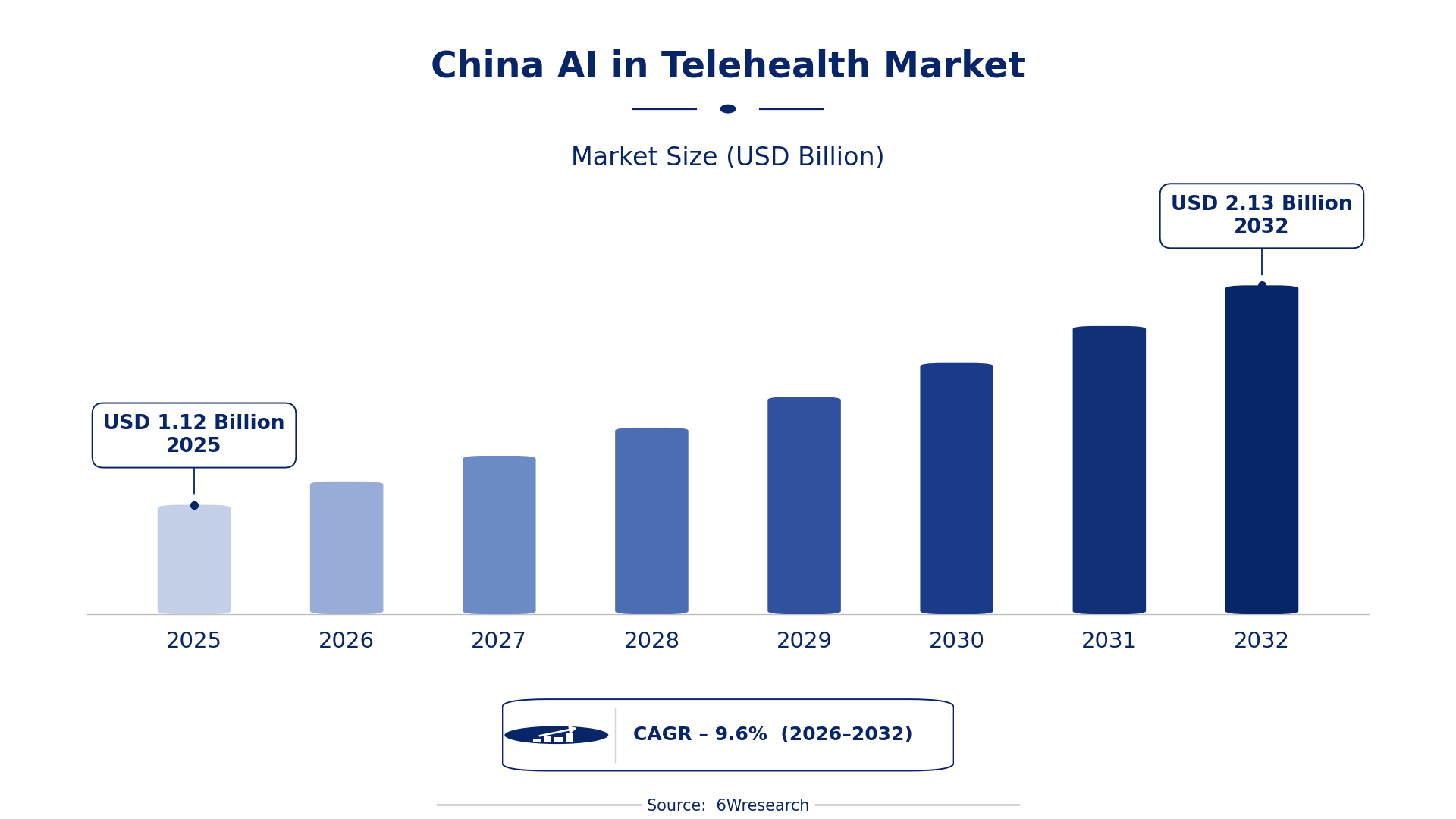
According to 6Wresearch internal database and industry insights, the China AI in Telehealth Market was valued at USD 1.12 billion in 2025 and is projected to reach USD 2.13 billion by 2032, growing at a CAGR of approximately 9.6% during 2026–2032.
China AI in Telehealth Market Highlights
| Report Metric | Details |
| Report Name | China AI in Telehealth Market |
| Market Size 2025 | USD 1.12 billion |
| Market Size 2032 | USD 2.13 billion |
| Absolute Growth 2025–2032 | USD 1.01 billion |
| CAGR 2026–2032 | 9.6% |
| Peak Annual Growth | 12.1% in 2026 |
| Forecast Period | 2026–2032 |
| Historical Data | 2022–2025 |
| Base Year | 2025 |
| Leading Service Type, 2025 | Virtual Consultations (46% share) |
| Leading AI Application, 2025 | Chatbots & NLP (46% share) |
| Leading Distribution Channel, 2025 | Digital Health Platforms (44% share) |
| Leading End User, 2025 | Remote Patients (38% share) |
| Fastest-Growing Service Type | Mental Health (12.1% CAGR) |
| Fastest-Growing AI Application | Real-Time Data AI (11.7% CAGR) |
| Fastest-Growing End User | Chronic Care Providers (11.7% CAGR) |
| Growing Sector | Real-Time Data AI |
| Key End Users | Chatbots & NLP, Real-Time Data AI, Emotion AI, Predictive Scheduling |
China AI in Telehealth Market Year-wise Growth Rate and Key Drivers (2022–2032)
This graph illustrates the annual growth rates of the market from 2022 to 2032, highlighting a steady upward trajectory and projected market expansion over the forecast period.
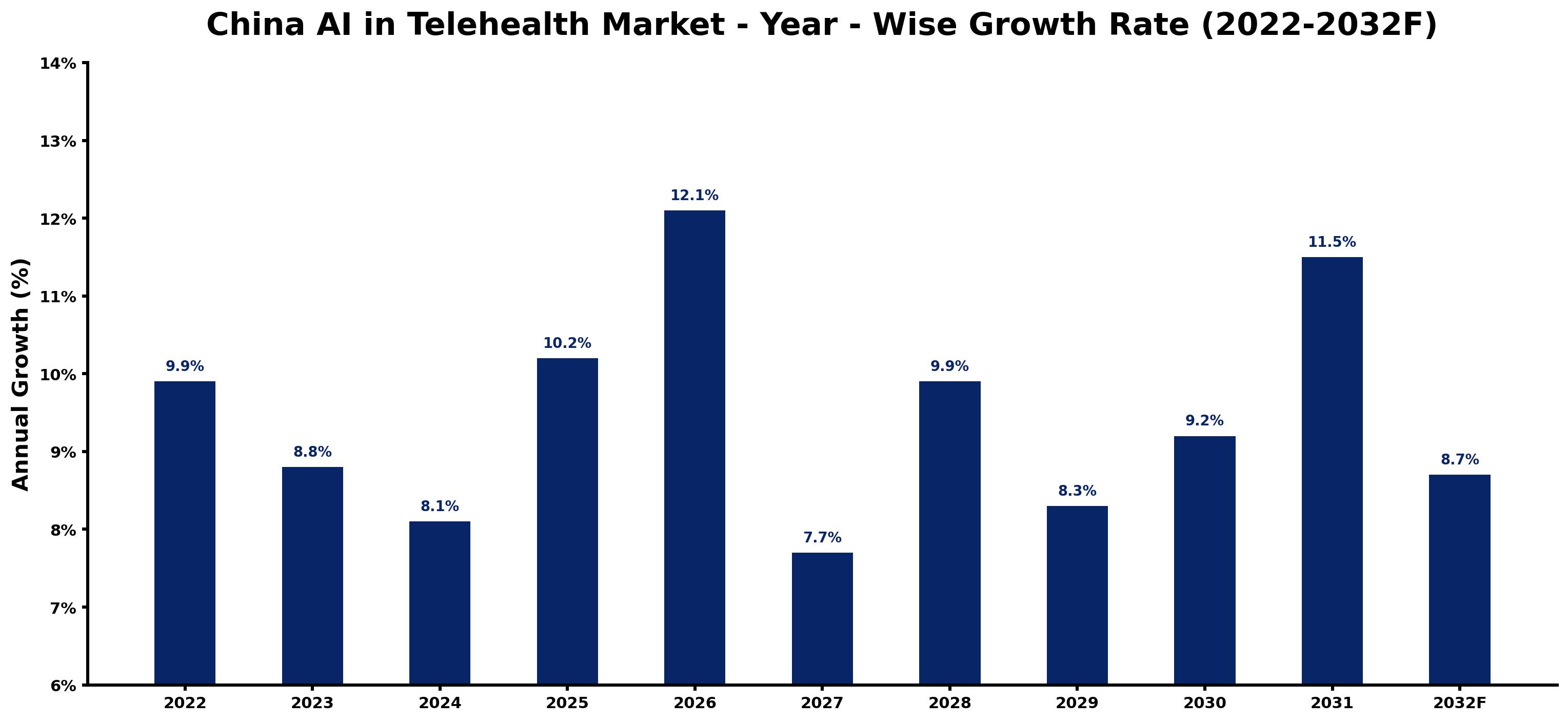
The table below sets out the estimated growth rate for each year and the main factor behind it.
| Year | Estimated Annual Growth (%) | Market Rationale |
| 2022 | 9.9 | The market experienced strong demand due to the ongoing integration of AI technologies in healthcare delivery. |
| 2023 | 8.8 | Growth slowed as hospitals focused on improving existing telehealth services and user experience. |
| 2024 | 8.1 | Demand continued to slow as the market adjusted to new regulations and standards. |
| 2025 | 10.2 | A surge in telehealth consultations occurred as healthcare providers expanded their offerings. |
| 2026 | 12.1 | The peak growth rate is expected to be driven by increased investments in AI technologies for patient management. |
| 2027 | 7.7 | Growth is projected to slow as competition intensifies among telehealth platforms and services. |
| 2028 | 9.9 | A renewed interest in telehealth is anticipated, driven by rising chronic disease prevalence. |
| 2029 | 8.3 | Demand is expected to slow as the market matures and user expectations evolve. |
| 2030 | 9.2 | Growth will pick up as more healthcare providers adopt AI-driven telehealth solutions. |
| 2031 | 11.5 | A significant increase in telehealth usage is projected as mental health awareness rises. |
| 2032 | 8.7 | Growth is expected to slow as the market approaches saturation with established service providers. |
Note: Market size estimations and growth projections presented in this report are based on 6Wresearch's proprietary forecasting methodology, utilizing the latest available industry data, government publications, and primary research inputs.
China AI in Telehealth Market Synopsis
The China AI in Telehealth Market involves the use of artificial intelligence technologies to improve healthcare delivery via telecommunication. This integration supports virtual consultations, remote monitoring, and mental health assistance for patients. The market is growing due to the rising incidence of chronic diseases and an ageing population. In 2022, more than 400 million telehealth consultations took place, demonstrating strong demand. Initiatives like the 'Digital Health Initiative' further promote growth by improving telehealth services nationwide.
Market Dynamics Impact Analysis (2026–2032)
| Factor | Type | Impact | Primary Segment Affected |
| Increasing prevalence of chronic diseases drives demand for remote monitoring solutions. | Driver | High | Remote Monitoring |
| Rising mental health awareness creates demand for teletherapy services. | Driver | High | Mental Health |
| Expansion of telehealth infrastructure in rural areas presents investment opportunities. | Opportunity | High | Virtual Consultations |
| Growing user base for digital health platforms offers new market entry points. | Opportunity | High | Digital Health Platforms |
| Regulatory compliance costs can burden telehealth providers. | Restraint | High | Virtual Consultations |
| Limited access to high-speed internet in rural areas restricts service delivery. | Restraint | Medium | Remote Monitoring |
| High operational costs for maintaining AI technologies challenge providers. | Challenge | High | Virtual Consultations |
| Delays in regulatory approvals can hinder the introduction of new services. | Challenge | Medium | Virtual Consultations |
Evaluation of Drivers in China AI in Telehealth Market (2026–2032)
The factors lifting demand, and the evidence behind each, are summarised below.
| Drivers | Primary Segment Affected | Why It Matters (Evidence) |
| Integration of AI technologies improves patient management capabilities. | Virtual Consultations | Over 80% of healthcare providers in China utilize AI for patient management, leading to increased adoption. |
| Growing demand for virtual consultations drives telehealth service expansion. | Virtual Consultations | In 2022, over 400 million telehealth consultations were conducted, reflecting a strong market need. |
| Rising chronic disease prevalence necessitates remote monitoring solutions. | Remote Monitoring | The average age of telehealth users is 45 years, with many requiring chronic disease management. |
| Government initiatives promote telehealth service adoption. | Virtual Consultations | The 'Digital Health Initiative' launched in 2021 aims to improve telehealth services, particularly in rural areas. |
| Increased patient satisfaction boosts telehealth usage. | Mental Health | In 2023, 60% of patients reported satisfaction with telehealth services, encouraging further adoption. |
Market growth for AI in Telehealth in China is underpinned by rising demand for virtual consultations, remote monitoring solutions, and mental health support. In 2022, over 400 million telehealth consultations were conducted, indicating strong market need. Many telehealth users, averaging 45 years old, require chronic disease management. Sixty percent of patients reported satisfaction with telehealth services in 2023, encouraging further adoption across the healthcare sector.
Evaluation of Restraints in China AI in Telehealth Market
The main factors holding the market back are set out below.
| Market Restraint | Primary Segment Affected | Why It Matters (Evidence) |
| Regulatory compliance costs can burden telehealth providers. | Virtual Consultations | Compliance with standards like GB/T 35273-2020 increases operational expenses for providers. |
| Limited access to high-speed internet in rural areas restricts service delivery. | Remote Monitoring | As of 2023, many rural areas lack the necessary infrastructure for effective telehealth. |
| High operational costs for maintaining AI technologies challenge providers. | Virtual Consultations | The integration of advanced AI systems requires substantial investment and resources. |
| Delays in regulatory approvals can hinder the introduction of new services. | Remote Patients | New telehealth technologies face lengthy approval processes, affecting timely market entry. |
| User trust issues can limit telehealth adoption. | Mental Health | Concerns over data privacy and service quality may deter potential users from engaging. |
China AI in Telehealth Market Challenges
The China AI in Telehealth market struggles with a technology gap, as many platforms lack advanced AI features, leading to suboptimal patient care for healthcare providers. Buyers experience dissatisfaction due to inconsistent service quality, which can increase wait times for virtual consultations by up to 20%. Compliance with the national standard GB/T 35273-2020 complicates operations for producers, delaying service launches and raising costs by 15%. Regulatory updates, such as the revised 'Telehealth Services Regulation', create uncertainty, forcing distributors to adapt quickly and potentially limiting service availability for patients.
Trends in the China AI in Telehealth Market
Four trends stand out in the China AI in Telehealth Market.
- Shift Towards Remote Patient Monitoring: Remote patients are increasingly turning to telehealth services for chronic disease management. In 2023, 30% of telehealth users reported using wearable devices to monitor their health, reflecting a growing trend towards integrated health solutions.
- Emergence of AI-Driven Mental Health Services: Since 2020, there has been a notable rise in teletherapy centres due to heightened mental health awareness. Teletherapy centres in China have increased by 25% from 2020 to 2023, indicating a shift in service availability.
- Growing Adoption of Digital Health Platforms: Digital health platforms have emerged as the primary distribution channel for telehealth services. As of 2023, over 200 digital health platforms are actively providing telehealth services, underscoring the sector's expansion.
- Increased Use of Mobile Applications for Telehealth: The year 2022 marked a rise in mobile application usage for telehealth services. In that year, 40% of telehealth services were delivered through mobile applications, showcasing a shift towards mobile accessibility.
Investment Opportunities in the China AI in Telehealth Market
Several openings in the China AI in Telehealth Market merit attention from investors.
- Investment in Telehealth Infrastructure: The Chinese government has allocated 5 billion yuan for telehealth infrastructure development in rural areas by 2025. This investment offers opportunities for companies to provide necessary technologies and services.
- Expansion of AI Applications in Telehealth: With over 80% of healthcare providers employing AI, there is a pressing need for advanced AI solutions. Companies can focus on chronic care providers to effectively meet this demand.
- Development of Wearable Health Monitoring Devices: The rising trend of wearable devices among telehealth users indicates a growing market. Suppliers can concentrate on creating wearable technologies to serve remote patients.
- Growth of Teletherapy Services: The increasing awareness of mental health issues generates demand for teletherapy services. Investing in teletherapy centres can help address the needs of chronic disease patients seeking mental health support.
Government Initiatives in the China AI in Telehealth Market
The 'Digital Health Initiative' launched by the Ministry of Industry and Information Technology in 2021 aims to improve telehealth services across China, with a focus on rural areas. This initiative is part of a broader strategy to enhance healthcare access and quality. In 2022, the National Health Commission introduced the 'Telehealth Services Regulation' to standardise telehealth practices and ensure patient safety. This regulation requires compliance with data privacy standards, affecting how telehealth services are delivered. Furthermore, the 'AI in Healthcare Development Plan' established by the Ministry of Science and Technology in 2021 promotes the use of AI in telehealth, prioritising research funding.
The Ministry of Health oversees the implementation of telehealth initiatives and approves funding for infrastructure projects. In 2023, a budget of 5 billion yuan was allocated for expanding telehealth infrastructure in underserved regions. This funding aims to improve service delivery and enhance patient access to telehealth solutions. Additionally, the Ministry of Industry and Information Technology supports the development of digital health platforms, facilitating the integration of AI technologies in healthcare.
Future Insight of the China AI in Telehealth Market
The China AI in Telehealth market is set for notable changes by 2032, primarily driven by the 'Digital Health Initiative' and the 'AI in Healthcare Development Plan'. The government aims to increase telehealth services by 30% by 2025, improving access for rural users. As teletherapy centres grow, mental health support will become more widely available, benefiting a broader range of patients. The use of wearable devices is expected to rise, with 30% of users likely to monitor their health remotely, promoting greater patient engagement.
Market Segmentation Analysis
Each segment group is reviewed below, with the leader by share and the fastest grower by CAGR.
By Service Type – Virtual Consultations Dominated, Mental Health Expected to Grow Fastest
According to Shubham Padhi, Research Analyst at 6Wresearch, Virtual Consultations took a 46% share of service type in 2025, more than any other category. Virtual consultations are essential in the China AI in Telehealth market, catering to the needs of chronic disease patients who require timely medical advice. With over 400 million telehealth consultations conducted in 2022, this segment showcases a robust demand for accessible healthcare services. The quickest growth will come from Mental Health, forecast to expand at a CAGR of 12.1% between 2026 and 2032. The mental health segment is experiencing rapid growth, as evidenced by a 25% increase in teletherapy centers from 2020 to 2023, reflecting heightened awareness of mental health issues. This increasing focus on mental health services positions the segment for substantial expansion in the coming years. Suppliers should prioritise enhancing virtual consultation capabilities while investing in mental health services to capture the growing demand.
By AI Application – Chatbots & NLP Dominated, Real-Time Data AI Expected to Grow Fastest
In 2025, Chatbots & NLP led the ai application split with a 46% share. Chatbots and NLP lead the AI application segment, significantly improving patient interaction and information retrieval in telehealth services. With over 80% of healthcare providers employing these technologies for patient management, they are crucial for optimising service delivery. Real-Time Data AI is projected to grow fastest, at a CAGR of 11.7% during 2026–2032. Real-time data AI is the fastest-growing application, essential for immediate patient data analysis as telehealth services expand. The integration of real-time analytics allows for more responsive healthcare solutions, driving its rapid adoption in the market. Providers should focus on developing real-time data AI solutions to address the increasing demand for efficient patient management in telehealth.
By Distribution Channel – Digital Health Platforms Dominated and Is Expected to Record the Fastest Growth
With a 44% revenue share in 2025, Digital Health Platforms was the largest distribution channel category. Digital health platforms dominate the distribution channel segment, serving as the backbone for telehealth service delivery in China. With over 200 active platforms, they enable seamless access to telehealth services for millions of users across the country. Digital Health Platforms are also forecast to expand faster than any other category, at a CAGR of 10.7% over 2026–2032. Digital health platforms are also the fastest-growing channel, quickly adapting to the rising demand for telehealth services. Their capacity to integrate various services positions them to capture a larger market share in the future. Suppliers should invest in enhancing digital health platforms to leverage their growth potential and improve overall service delivery.
By End User – Remote Patients Dominated, Chronic Care Providers Expected to Grow Fastest
Remote Patients held a 38% share of the China AI in Telehealth Market by end user in 2025. Remote patients constitute the largest share of end users in the China AI in Telehealth market, as they are the primary beneficiaries of these services. The average age of telehealth users is 45, with many being chronic disease patients who depend on these services for ongoing care. Chronic Care Providers are set to record the highest CAGR in this split, 11.7% over 2026–2032. Chronic care providers are the fastest-growing end user segment, increasingly adopting telehealth solutions to manage patient care effectively. The rising prevalence of chronic diseases necessitates innovative care approaches, driving this segment's growth. Suppliers should tailor their offerings to meet the specific needs of chronic care providers, ensuring effective support for patient management.
Key Attractiveness of the Report
- 10 Years of Market Numbers
- Historical Data Starting from 2022 to 2025
- Base Year 2025
- Forecast Data until 2032
- Key Performance Indicators Impacting the Market
- Major Upcoming Developments and Projects
Key Highlights of the Report:
- China AI in Telehealth Market Outlook
- Market Size of China AI in Telehealth Market, 2025
- Forecast of China AI in Telehealth Market, 2032
- Historical Data and Forecast of China AI in Telehealth Revenues & Volume for the Period 2022 - 2032F
- China AI in Telehealth Market Trend Evolution
- China AI in Telehealth Market Drivers and Challenges
- China AI in Telehealth Price Trends
- China AI in Telehealth Porter's Five Forces
- China AI in Telehealth Industry Life Cycle
- Historical Data and Forecast of China AI in Telehealth Market Revenues & Volume By Service Type for the Period 2022 - 2032F
- Historical Data and Forecast of China AI in Telehealth Market Revenues & Volume By Virtual Consultations for the Period 2022 - 2032F
- Historical Data and Forecast of China AI in Telehealth Market Revenues & Volume By Remote Monitoring for the Period 2022 - 2032F
- Historical Data and Forecast of China AI in Telehealth Market Revenues & Volume By Mental Health for the Period 2022 - 2032F
- Historical Data and Forecast of China AI in Telehealth Market Revenues & Volume By Appointment Triage for the Period 2022 - 2032F
- Historical Data and Forecast of China AI in Telehealth Market Revenues & Volume By AI Application for the Period 2022 - 2032F
- Historical Data and Forecast of China AI in Telehealth Market Revenues & Volume By Chatbots & NLP for the Period 2022 - 2032F
- Historical Data and Forecast of China AI in Telehealth Market Revenues & Volume By Real-Time Data AI for the Period 2022 - 2032F
- Historical Data and Forecast of China AI in Telehealth Market Revenues & Volume By Emotion AI for the Period 2022 - 2032F
- Historical Data and Forecast of China AI in Telehealth Market Revenues & Volume By Predictive Scheduling for the Period 2022 - 2032F
- Historical Data and Forecast of China AI in Telehealth Market Revenues & Volume By Distribution Channel for the Period 2022 - 2032F
- Historical Data and Forecast of China AI in Telehealth Market Revenues & Volume By Telehealth App Stores for the Period 2022 - 2032F
- Historical Data and Forecast of China AI in Telehealth Market Revenues & Volume By Wearable Device Vendors for the Period 2022 - 2032F
- Historical Data and Forecast of China AI in Telehealth Market Revenues & Volume By Digital Health Platforms for the Period 2022 - 2032F
- Historical Data and Forecast of China AI in Telehealth Market Revenues & Volume By Healthcare Portals for the Period 2022 - 2032F
- Historical Data and Forecast of China AI in Telehealth Market Revenues & Volume By End User for the Period 2022 - 2032F
- Historical Data and Forecast of China AI in Telehealth Market Revenues & Volume By Remote Patients for the Period 2022 - 2032F
- Historical Data and Forecast of China AI in Telehealth Market Revenues & Volume By Chronic Care Providers for the Period 2022 - 2032F
- Historical Data and Forecast of China AI in Telehealth Market Revenues & Volume By Teletherapy Centers for the Period 2022 - 2032F
- Historical Data and Forecast of China AI in Telehealth Market Revenues & Volume By Online Clinics for the Period 2022 - 2032F
- China AI in Telehealth Import Export Trade Statistics
- Market Opportunity Assessment By Service Type
- Market Opportunity Assessment By AI Application
- Market Opportunity Assessment By Distribution Channel
- Market Opportunity Assessment By End User
- China AI in Telehealth Top Companies Market Share
- China AI in Telehealth Competitive Benchmarking By Technical and Operational Parameters
- China AI in Telehealth Company Profiles
- China AI in Telehealth Key Strategic Recommendations
Market Covered
This report examines the market across the segments below.
By Service Type
- Virtual Consultations
- Remote Monitoring
- Mental Health
- Appointment Triage
By AI Application
- Chatbots & NLP
- Real-Time Data AI
- Emotion AI
- Predictive Scheduling
By Distribution Channel
- Telehealth App Stores
- Wearable Device Vendors
- Digital Health Platforms
- Healthcare Portals
By End User
- Remote Patients
- Chronic Care Providers
- Teletherapy Centers
- Online Clinics































