China AI Model Development Tools Market Size & Growth Rate
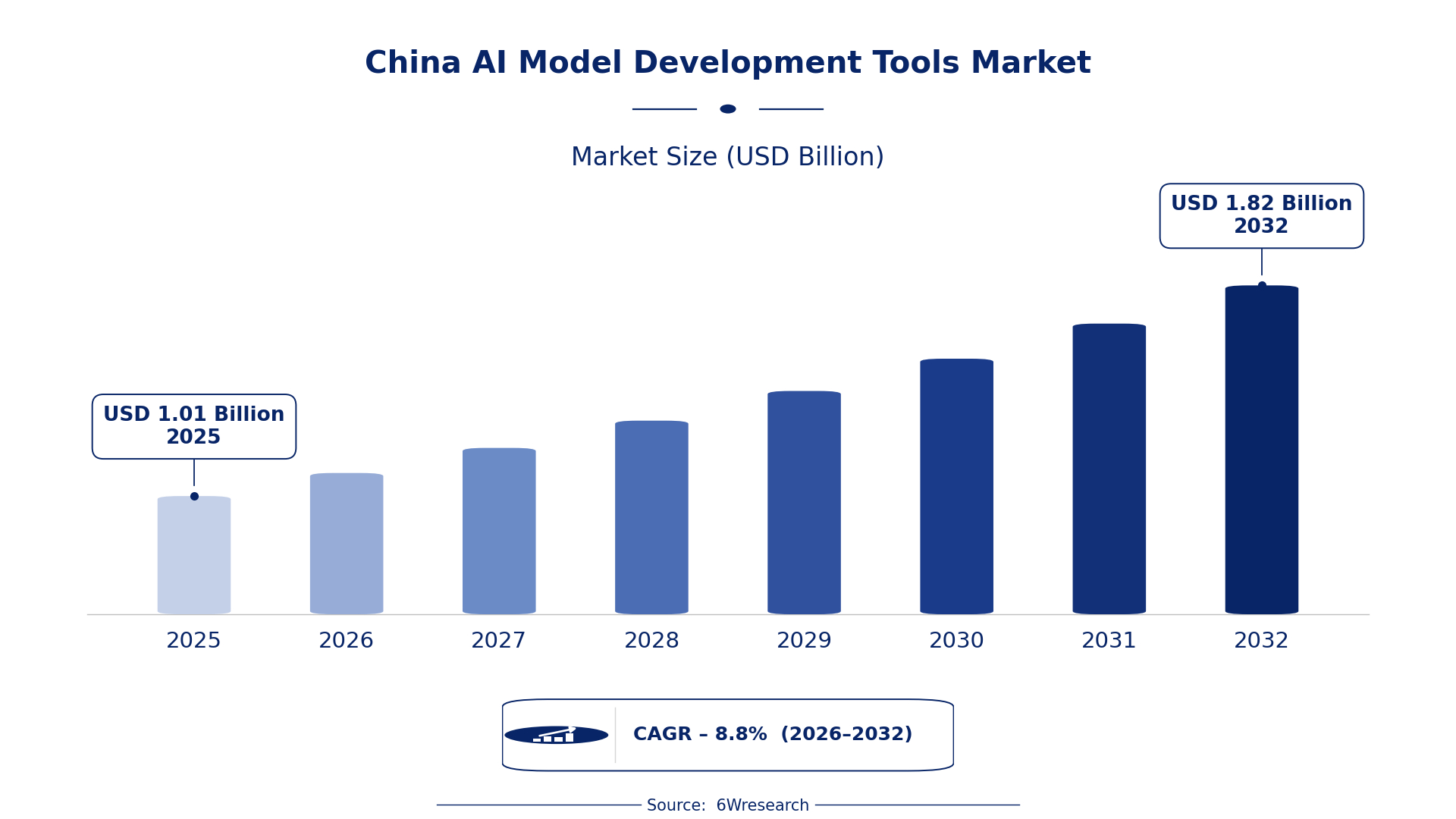
According to 6Wresearch internal database and industry insights, the China AI Model Development Tools Market was valued at USD 1.01 billion in 2025 and is projected to reach USD 1.82 billion by 2032, growing at a CAGR of approximately 8.8% during 2026–2032.
China AI Model Development Tools Market Highlights
| Report Metric | Details |
| Report Name | China AI Model Development Tools Market |
| Market Size 2025 | USD 1.01 billion |
| Market Size 2032 | USD 1.82 billion |
| Absolute Growth 2025–2032 | USD 0.81 billion |
| CAGR 2026–2032 | 8.8% |
| Peak Annual Growth | 10.7% in 2026 |
| Forecast Period | 2026–2032 |
| Historical Data | 2022–2025 |
| Base Year | 2025 |
| Leading Tool Type, 2025 | No-Code AI Builders (42% share) |
| Leading Core Feature, 2025 | Drag & Drop Models (44% share) |
| Leading Distribution Channel, 2025 | Cloud AI Platforms (37% share) |
| Leading End User, 2025 | Data Scientists (42% share) |
| Fastest-Growing Core Feature | End-to-End Workflow (11.5% CAGR) |
| Fastest-Growing Distribution Channel | SaaS Toolkits (11.4% CAGR) |
| Fastest-Growing End User | Citizen Developers (11.6% CAGR) |
| Growing Sector | education |
| Key End Users | data scientists, AI engineers, product managers, citizen developers |
China AI Model Development Tools Market Year-wise Growth Rate and Key Drivers (2022–2032)
This graph illustrates the annual growth rates of the market from 2022 to 2032, highlighting a steady upward trajectory and projected market expansion over the forecast period.
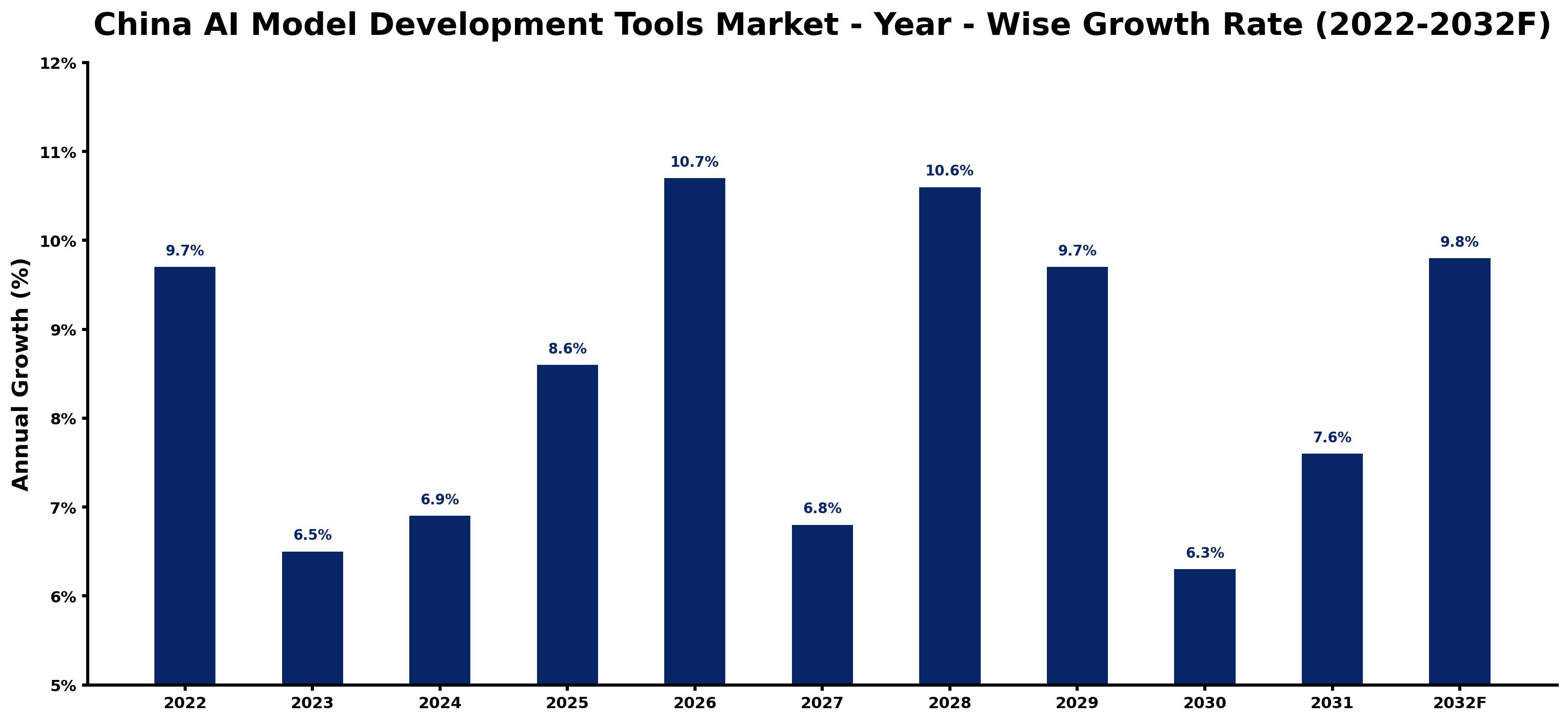
The following table presents the estimated annual growth rate for each year together with the principal factor influencing market performance.
| Year | Estimated Annual Growth (%) | Market Rationale |
| 2022 | 9.7 | The market exhibited strong activity, driven by rising interest in AI technologies. |
| 2023 | 6.5 | Growth slowed as businesses adjusted to evolving AI demand patterns and standards. |
| 2024 | 6.9 | An increase in adoption rates was noted as more enterprises sought AI solutions. |
| 2025 | 8.6 | The market expanded as small and medium enterprises increasingly adopted no-code tools. |
| 2026 | 10.7 | Peak growth occurred, fuelled by substantial investments in AI infrastructure and talent. |
| 2027 | 6.8 | A slowdown in growth was observed as the market matured and competition intensified. |
| 2028 | 10.6 | Growth accelerated again, with rising demand for end-to-end workflow solutions. |
| 2029 | 9.7 | The market experienced a slowdown as saturation began in certain segments. |
| 2030 | 6.3 | Growth decelerated as the focus shifted to refining existing AI models and tools. |
| 2031 | 7.6 | An uptick in growth was seen as new AI initiatives gained traction among developers. |
| 2032 | 9.8 | The market is expected to grow steadily, driven by ongoing technological advancements and government support. |
Note: Market size estimations and growth projections presented in this report are based on 6Wresearch's proprietary forecasting methodology, utilizing the latest available industry data, government publications, and primary research inputs.
China AI Model Development Tools Market Synopsis
AI Model Development Tools in China are software solutions that facilitate the creation, training, and deployment of AI models. These tools automate workflows and enable non-technical users to build AI applications. The China AI Model Development Tools Market is expanding due to substantial demand from sectors like technology and finance. Government initiatives, particularly the 'AI Innovation Action Plan' launched in 2023 with a budget of $1 billion, are enhancing AI technology adoption and innovation.
Market Dynamics Impact Analysis (2026–2032)
| Factor | Type | Impact | Primary Segment Affected |
| Growing demand for no-code AI tools among small and medium enterprises | Driver | High | No-Code AI Builders |
| Increased investment in AI infrastructure and talent development | Driver | High | MLOps Frameworks |
| Rising interest in AI capabilities within educational institutions | Opportunity | Medium | Visual AI Designers |
| Expansion of AI training programs in universities | Opportunity | Medium | Data Scientists |
| Limited availability of skilled AI professionals | Restraint | High | Code-based Platforms |
| Challenges in ensuring interoperability among different AI tools | Restraint | Medium | Cloud AI Platforms |
| High costs associated with developing custom AI solutions | Challenge | High | Customizable Model Building |
| Rapid technological advancements leading to obsolescence | Challenge | Medium | SaaS Toolkits |
Evaluation of Drivers in China AI Model Development Tools Market (2026–2032)
Below mentioned are some major drivers and their influence on market dynamics.
| Drivers | Primary Segment Affected | Why It Matters (Evidence) |
| Increased adoption of no-code AI tools | No-Code AI Builders | This trend is driven by the growing population of data scientists, projected to exceed 1 million by 2025. |
| Rising investments in AI infrastructure | MLOps Frameworks | Investment in AI technology is expected to reach $1 billion, improving model management capabilities. |
| Demand for educational AI tools | Visual AI Designers | Educational institutions are integrating AI training into curricula, boosting the need for user-friendly design tools. |
| Growth in AI tool marketplaces | AI Tool Marketplaces | User engagement in these platforms has surged by 40% since 2022, indicating rising interest. |
| Expansion of cloud-based solutions | Cloud AI Platforms | Major cities are seeing a surge in cloud AI platform usage among enterprises, driving demand. |
Market growth for AI Model Development Tools in China is underpinned by increased adoption of no-code AI tools, appealing to small and medium enterprises seeking to utilise AI without technical expertise. The population of data scientists is projected to exceed 1 million by 2025, creating a demand for solutions that streamline model development. Rising investments in AI infrastructure, with funding expected to reach $1 billion, improve capabilities for managing AI models. Educational institutions are integrating AI training into their curricula, further driving demand for user-friendly design solutions. Engagement in AI tool marketplaces has surged by 40% since 2022, reflecting a growing interest in accessible AI options.
Evaluation of Restraints in China AI Model Development Tools Market
The main factors holding the market back are set out below.
| Market Restraint | Primary Segment Affected | Why It Matters (Evidence) |
| Limited availability of skilled AI professionals | Code-based Platforms | The skills gap in AI development restricts the ability of companies to implement advanced solutions effectively. |
| Interoperability challenges among AI tools | Cloud AI Platforms | Inconsistent standards can hinder integration, affecting user satisfaction and adoption rates. |
| High costs of custom AI solutions | Customizable Model Building | The financial burden of developing bespoke solutions can deter smaller enterprises from investing. |
| Rapid technological advancements leading to obsolescence | SaaS Toolkits | Frequent updates and changes in technology can make existing tools quickly outdated. |
| Complexity in managing AI model lifecycles | MLOps Frameworks | The intricate nature of AI operations can overwhelm teams lacking experience in model management. |
China AI Model Development Tools Market Challenges
The China AI Model Development Tools market encounters several practical problems, starting with stringent regulations. Compliance with the national standard GB/T 39600-2020 can delay product launches for developers by up to six months, impacting their ability to meet market demands. A shortage of skilled professionals is another hurdle, as the rapid demand for AI tools outstrips the training of qualified workers, causing project delays for companies requiring expertise. Intense competition among developers results in aggressive pricing strategies, which can squeeze profit margins and threaten the viability of smaller firms. Lastly, supply chain disruptions from reliance on imported components can increase costs and extend lead times for producers, complicating their operations.
Trends in the China AI Model Development Tools Market
Below mentioned are some of the trends shaping the China AI Model Development Tools Market growth.
- Shift Towards No-Code AI Development: Small and medium enterprises in China are increasingly adopting no-code AI tools to build applications without programming skills. This trend is reflected in the growing interest in no-code solutions, with user engagement in AI tool marketplaces rising by 40% since 2022.
- Rise of Educational AI Tools: Educational institutions are integrating AI training into their curricula, improving the skill sets of future professionals. This shift is supported by the government's initiative targeting 100 universities by 2025, aiming to boost AI talent in the workforce.
- Growth of Cloud-Based AI Solutions: Major cities like Beijing and Shanghai are experiencing a surge in the adoption of cloud-based AI platforms. This trend is evident in the increasing usage rates among enterprises, driven by the need for scalable AI resources.
- Expansion of AI Training Programs: The State Council's initiative aims to increase AI talent training programs by 30% by 2025. This effort is vital for addressing the skills gap in the industry and ensuring a steady supply of qualified professionals.
Investment Opportunities in the China AI Model Development Tools Market
Several openings in the China AI Model Development Tools Market merit attention from investors.
- Demand for No-Code AI Tools: With the rising interest in AI among small and medium enterprises, there is an opportunity to supply no-code AI development tools. The demand is expected to grow as more businesses seek accessible solutions, particularly in urban areas like Beijing and Shanghai.
- Investment in AI Education: Educational institutions are increasingly looking for AI tools to enhance their curricula. This presents an opportunity to provide tailored solutions that meet the specific needs of universities and colleges, especially with government support for AI training programs.
- Growth of AI Tool Marketplaces: The rapid expansion of AI tool marketplaces indicates a need for diverse AI development tools. Suppliers can enter this space by partnering with local platforms to offer innovative solutions, tapping into the 40% increase in user engagement since 2022.
- Development of MLOps Frameworks: As AI engineers increasingly utilise MLOps frameworks, there is a growing market for tools that streamline model deployment. This opportunity is particularly strong in regions with high AI activity, driven by rising investments in infrastructure.
Government Initiatives in the China AI Model Development Tools Market
The 'AI Innovation Action Plan' launched in 2023 by the Ministry of Industry and Information Technology aims to boost AI technology development with a budget of $1 billion. This initiative builds on the 'New Generation Artificial Intelligence Development Plan' approved in 2021, which focuses on positioning China as a global AI leader by 2030. Together, these measures emphasise innovation and infrastructure development, ensuring that AI model development tools meet industry standards and user needs.
In 2023, the Ministry of Education announced a program to integrate AI training into higher education curricula, targeting 100 universities by 2025. This initiative is complemented by the State Council's 2022 initiative, which aims to increase AI talent training programs by 30% by 2025. These efforts are essential for addressing the skills gap in the AI industry, ensuring that future professionals are equipped with the necessary knowledge and skills.
Future Insight of the China AI Model Development Tools Market
The China AI Model Development Tools market is projected to evolve significantly by 2032, driven by key developments. The 'AI Innovation Action Plan' will catalyse technology adoption across various sectors, improving operational efficiency for buyers. By 2025, the population of data scientists is expected to exceed 1 million, providing a robust workforce for suppliers. The growing demand for no-code AI tools will empower small and medium enterprises to participate in AI development, expanding the market. Additionally, government funding of $1 billion for AI research will spur innovation, positioning China as a frontrunner in AI advancements.
Market Segmentation Analysis
Each segment group is reviewed below, with the leader by share and the fastest grower by CAGR.
By Tool Type – No-Code AI Builders Dominated and Is Expected to Record the Fastest Growth
According to Shubham Padhi, Research Analyst at 6Wresearch, No-Code AI Builders accounted for a 42% market share by tool type in 2025. No-Code AI Builders dominate the market as they cater to users who lack programming skills, allowing a wider audience to create AI models. This accessibility is particularly beneficial in sectors like small and medium enterprises, where technical expertise may be limited. The same category are also set to grow fastest, at a CAGR of 10.3% during 2026–2032. The rapid growth of No-Code AI Builders is propelled by the increasing demand for user-friendly solutions among non-technical users, especially in small and medium enterprises. This trend is further supported by the rising adoption of AI technologies across various industries in China, which will likely widen their lead. Suppliers should focus on enhancing no-code solutions to capture the growing market share among non-technical users.
By Core Feature – Drag & Drop Models Dominated, End-to-End Workflow Expected to Grow Fastest
Drag & Drop Models held a 44% share of the China AI Model Development Tools Market by core feature in 2025. Drag & Drop Models lead the market due to their simplicity, enabling users to easily manipulate components and streamline the model building process. This feature is particularly attractive to users who require efficiency and ease of use in their projects, ensuring a substantial market share. The quickest growth will come from End-to-End Workflow, forecast to expand at a CAGR of 11.5% between 2026 and 2032. End-to-End Workflow is experiencing the fastest growth as it addresses the need for comprehensive management of the development process. The increasing complexity of projects drives demand for tools that can handle all stages from inception to deployment, positioning this feature for continued expansion. Suppliers must invest in developing end-to-end solutions to meet the rising demand for comprehensive development tools.
By Distribution Channel – Cloud AI Platforms Dominated, SaaS Toolkits Expected to Grow Fastest
In 2025, Cloud AI Platforms led the distribution channel split with a 37% share. Cloud AI Platforms hold the largest share as they offer scalable resources essential for deploying models and applications, making them indispensable for enterprises. The flexibility and accessibility of cloud solutions are particularly appealing to businesses looking to leverage capabilities effectively. SaaS Toolkits are set to record the highest CAGR in this split, 11.4% over 2026–2032. SaaS Toolkits are growing quickly as they provide subscription-based access to development tools, appealing to a wide range of users. The shift towards cloud-based solutions is driving this trend, as companies seek cost-effective and flexible options that enhance their operational efficiency. Suppliers should prioritise the development of SaaS offerings to align with the increasing preference for subscription-based models.
By End User – Data Scientists Dominated, Citizen Developers Expected to Grow Fastest
The largest end user category in 2025 was Data Scientists, with a 42% share of total revenue. Data Scientists are the primary users of AI model development tools, utilising them for data analysis, model training, and evaluation. Their expertise and demand for advanced tools ensure that this segment maintains a strong market share, particularly in data-intensive sectors. Over 2026–2032, Citizen Developers are expected to post the fastest growth, at a CAGR of 11.6%. Citizen Developers are the fastest-growing user group, empowered to create AI applications without deep technical knowledge. This trend reflects the broader push towards democratising AI technology across various sectors, indicating a shift in how AI tools are utilised and developed. Suppliers should tailor their marketing strategies to attract and support the growing segment of citizen developers.
Key Attractiveness of the Report
- 10 Years of Market Numbers
- Historical Data Starting from 2022 to 2025
- Base Year 2025
- Forecast Data until 2032
- Key Performance Indicators Impacting the Market
- Major Upcoming Developments and Projects
Key Highlights of the Report:
- China AI Model Development Tools Market Outlook
- Market Size of China AI Model Development Tools Market, 2025
- Forecast of China AI Model Development Tools Market, 2032
- Historical Data and Forecast of China AI Model Development Tools Revenues & Volume for the Period 2022 - 2032F
- China AI Model Development Tools Market Trend Evolution
- China AI Model Development Tools Market Drivers and Challenges
- China AI Model Development Tools Price Trends
- China AI Model Development Tools Porter's Five Forces
- China AI Model Development Tools Industry Life Cycle
- Historical Data and Forecast of China AI Model Development Tools Market Revenues & Volume By Tool Type for the Period 2022 - 2032F
- Historical Data and Forecast of China AI Model Development Tools Market Revenues & Volume By No-Code AI Builders for the Period 2022 - 2032F
- Historical Data and Forecast of China AI Model Development Tools Market Revenues & Volume By MLOps Frameworks for the Period 2022 - 2032F
- Historical Data and Forecast of China AI Model Development Tools Market Revenues & Volume By Code-based Platforms for the Period 2022 - 2032F
- Historical Data and Forecast of China AI Model Development Tools Market Revenues & Volume By Visual AI Designers for the Period 2022 - 2032F
- Historical Data and Forecast of China AI Model Development Tools Market Revenues & Volume By Core Feature for the Period 2022 - 2032F
- Historical Data and Forecast of China AI Model Development Tools Market Revenues & Volume By Drag & Drop Models for the Period 2022 - 2032F
- Historical Data and Forecast of China AI Model Development Tools Market Revenues & Volume By End-to-End Workflow for the Period 2022 - 2032F
- Historical Data and Forecast of China AI Model Development Tools Market Revenues & Volume By Customizable Model Building for the Period 2022 - 2032F
- Historical Data and Forecast of China AI Model Development Tools Market Revenues & Volume By GUI-Based Model Tuning for the Period 2022 - 2032F
- Historical Data and Forecast of China AI Model Development Tools Market Revenues & Volume By Distribution Channel for the Period 2022 - 2032F
- Historical Data and Forecast of China AI Model Development Tools Market Revenues & Volume By Cloud AI Platforms for the Period 2022 - 2032F
- Historical Data and Forecast of China AI Model Development Tools Market Revenues & Volume By AI Tool Marketplaces for the Period 2022 - 2032F
- Historical Data and Forecast of China AI Model Development Tools Market Revenues & Volume By Open Source Hubs for the Period 2022 - 2032F
- Historical Data and Forecast of China AI Model Development Tools Market Revenues & Volume By SaaS Toolkits for the Period 2022 - 2032F
- Historical Data and Forecast of China AI Model Development Tools Market Revenues & Volume By End User for the Period 2022 - 2032F
- Historical Data and Forecast of China AI Model Development Tools Market Revenues & Volume By Product Managers for the Period 2022 - 2032F
- Historical Data and Forecast of China AI Model Development Tools Market Revenues & Volume By AI Engineers for the Period 2022 - 2032F
- Historical Data and Forecast of China AI Model Development Tools Market Revenues & Volume By Data Scientists for the Period 2022 - 2032F
- Historical Data and Forecast of China AI Model Development Tools Market Revenues & Volume By Citizen Developers for the Period 2022 - 2032F
- China AI Model Development Tools Import Export Trade Statistics
- Market Opportunity Assessment By Tool Type
- Market Opportunity Assessment By Core Feature
- Market Opportunity Assessment By Distribution Channel
- Market Opportunity Assessment By End User
- China AI Model Development Tools Top Companies Market Share
- China AI Model Development Tools Competitive Benchmarking By Technical and Operational Parameters
- China AI Model Development Tools Company Profiles
- China AI Model Development Tools Key Strategic Recommendations
Market Covered
Segments analysed in this report are listed below.
By Tool Type
- No-Code AI Builders
- MLOps Frameworks
- Code-based Platforms
- Visual AI Designers
By Core Feature
- Drag & Drop Models
- End-to-End Workflow
- Customizable Model Building
- GUI-Based Model Tuning
By Distribution Channel
- Cloud AI Platforms
- AI Tool Marketplaces
- Open Source Hubs
- SaaS Toolkits
By End User
- Product Managers
- AI Engineers
- Data Scientists
- Citizen Developers































