China AI Navigation Hardware Market Size & Growth Rate
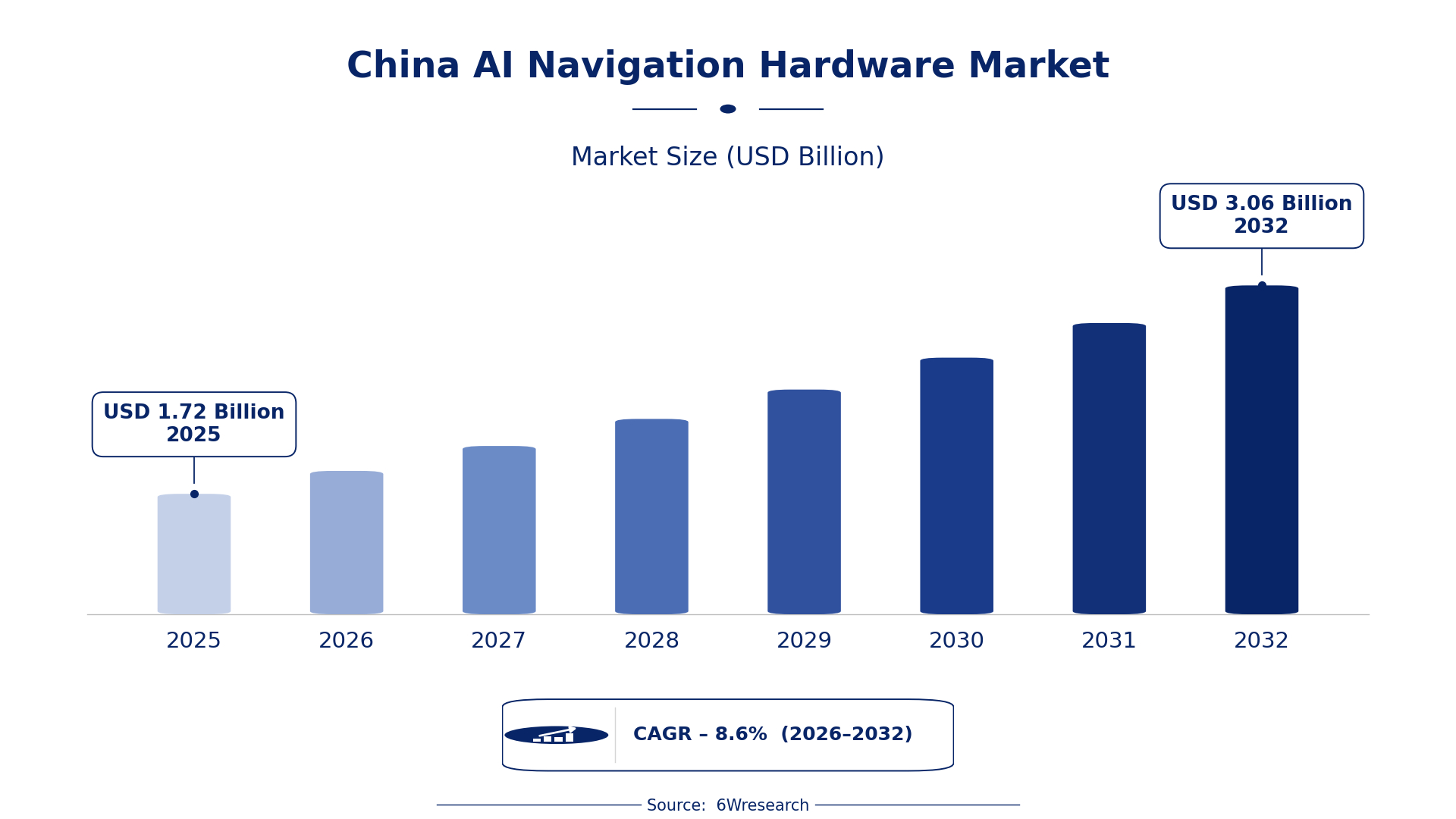
According to 6Wresearch internal database and industry insights, the China AI Navigation Hardware Market was valued at USD 1.72 billion in 2025 and is projected to reach USD 3.06 billion by 2032, growing at a CAGR of approximately 8.6% during 2026–2032.
China AI Navigation Hardware Market Highlights
| Report Metric | Details |
| Report Name | China AI Navigation Hardware Market |
| Market Size 2025 | USD 1.72 billion |
| Market Size 2032 | USD 3.06 billion |
| Absolute Growth 2025–2032 | USD 1.34 billion |
| CAGR 2026–2032 | 8.6% |
| Peak Annual Growth | 10.7% in 2028 |
| Forecast Period | 2026–2032 |
| Historical Data | 2022–2025 |
| Base Year | 2025 |
| Leading Hardware Type, 2025 | LiDAR Sensors (50% share) |
| Leading Integration Area, 2025 | Autonomous Systems (37% share) |
| Leading Distribution Channel, 2025 | Robotics Distributors (40% share) |
| Leading End User, 2025 | Vehicle Manufacturers (47% share) |
| Fastest-Growing Hardware Type | GPS Modules (10.9% CAGR) |
| Fastest-Growing Integration Area | Mapping Engines (10.6% CAGR) |
| Fastest-Growing Distribution Channel | OEM Sales (9.9% CAGR) |
| Fastest-Growing End User | Drone Companies (10.2% CAGR) |
| Growing Sector | autonomous vehicles |
| Key End Users | Vehicle Manufacturers, Drone Companies, Robot Developers |
China AI Navigation Hardware Market Year-wise Growth Rate and Key Drivers (2022–2032)
This graph illustrates the annual growth rates of the market from 2022 to 2032, highlighting a steady upward trajectory and projected market expansion over the forecast period.
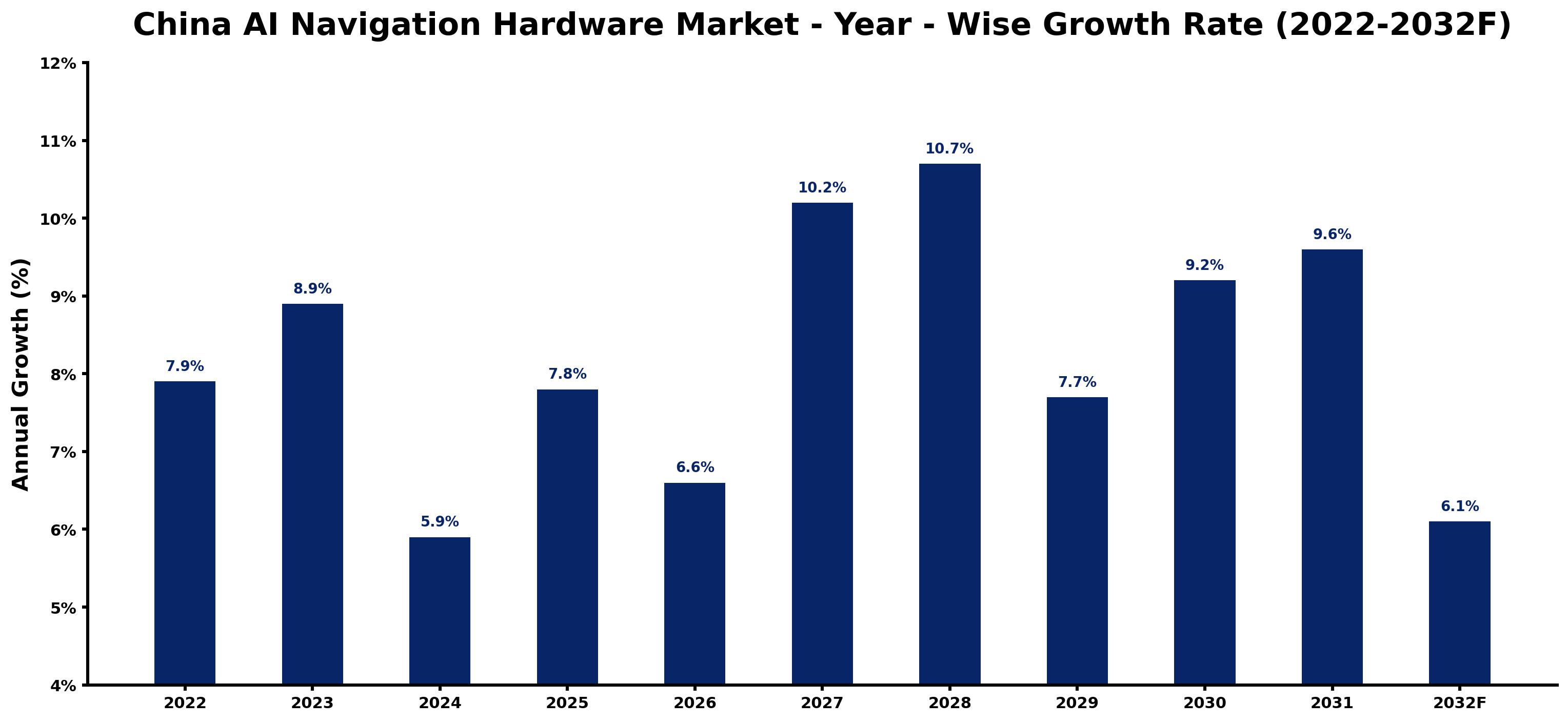
The table below sets out the estimated growth rate for each year and the main factor behind it.
| Year | Estimated Annual Growth (%) | Market Rationale |
| 2022 | 7.9 | The market experienced steady growth due to rising demand from the automotive sector. |
| 2023 | 8.9 | Increased investment in autonomous vehicle technology spurred faster growth this year. |
| 2024 | 5.9 | Growth slowed as manufacturers adjusted to supply chain challenges and market dynamics. |
| 2025 | 7.8 | The introduction of new AI navigation systems boosted market performance significantly. |
| 2026 | 6.6 | A slowdown occurred as the market stabilised after rapid expansions in previous years. |
| 2027 | 10.2 | Demand surged again, driven by advancements in AI and robotics integration. |
| 2028 | 10.7 | The peak growth rate was achieved as autonomous vehicle adoption accelerated. |
| 2029 | 7.7 | Growth slowed as market maturity began to set in, affecting investment levels. |
| 2030 | 9.2 | A renewed focus on smart city initiatives spurred demand for navigation hardware. |
| 2031 | 9.6 | Continued growth was supported by rising vehicle production and technology upgrades. |
| 2032 | 6.1 | Growth is expected to slow as the market approaches saturation in key areas. |
Note: Market size estimations and growth projections presented in this report are based on 6Wresearch's proprietary forecasting methodology, utilizing the latest available industry data, government publications, and primary research inputs.
China AI Navigation Hardware Market Synopsis
AI Navigation Hardware in China encompasses technologies such as LiDAR sensors, GPS modules, and AI cameras, essential for precise navigation in autonomous vehicles, drones, and robotics. The market is expanding rapidly, driven by the automotive and drone industries, which are thriving due to significant domestic demand and technological advancements. The government aims to have 5 million autonomous vehicles on the road by 2030, further fueling growth.
Market Dynamics Impact Analysis (2026–2032)
| Factor | Type | Impact | Primary Segment Affected |
| Rising investment in autonomous vehicle technology | Driver | High | Autonomous Systems |
| Growing demand from the drone industry | Driver | High | Drone Companies |
| Expansion of smart city projects | Opportunity | High | Vehicle Manufacturers |
| Increased funding for AI navigation research | Opportunity | High | Robot Developers |
| Supply chain disruptions affecting production | Restraint | High | LiDAR Sensors |
| High costs associated with advanced technology integration | Restraint | Medium | AI Cameras |
| Regulatory hurdles for autonomous vehicle deployment | Challenge | High | Vehicle Manufacturers |
| Limited consumer awareness about AI navigation benefits | Challenge | Medium | Drone Companies |
Evaluation of Drivers in China AI Navigation Hardware Market (2026–2032)
The factors lifting demand, and the evidence behind each, are summarised below.
| Drivers | Primary Segment Affected | Why It Matters (Evidence) |
| Investment in AI technology | AI Cameras | This investment is expected to enhance the capabilities of navigation systems, with the AI camera market growing rapidly, reflecting a shift towards smart city applications. |
| Increased vehicle production | Vehicle Manufacturers | China produced 26 million vehicles in 2022, driving demand for integrated navigation solutions that improve vehicle functionality. |
| Expansion of drone applications | Drone Companies | The drone industry was valued at over 20 billion USD in 2022, leading to higher demand for navigation hardware that supports various applications. |
| Government initiatives for autonomous driving | Autonomous Systems | The National Standard for Autonomous Driving aims to support the integration of AI navigation technologies in vehicles, enhancing operational efficiency. |
| Growing robotics sector | Robot Developers | With over 500 registered robotics companies in 2023, demand for advanced navigation hardware is increasing to enhance robotic functionalities. |
The AI Navigation Hardware market in China is growing due to substantial investment in AI technology, increased vehicle production, and the rise of drone applications. In 2022, China produced 26 million vehicles, creating a heightened demand for integrated navigation solutions that improve vehicle capabilities. The drone industry, worth over 20 billion USD, further stimulates the need for navigation hardware essential for diverse applications.
Evaluation of Restraints in China AI Navigation Hardware Market
The following restraints limit how fast demand can grow.
| Market Restraint | Primary Segment Affected | Why It Matters (Evidence) |
| Supply chain disruptions affecting production | LiDAR Sensors | These disruptions have led to delays in component availability, impacting the overall production timeline and costs for manufacturers. |
| High costs associated with advanced technology integration | AI Cameras | The complexity of integrating AI cameras into existing systems poses financial challenges for many manufacturers, increasing their operational costs. |
| Regulatory hurdles for autonomous vehicle deployment | Vehicle Manufacturers | Stringent regulations slow down the approval process for new technologies, delaying market entry and adoption for manufacturers. |
| Limited consumer awareness about AI navigation benefits | Drone Companies | A lack of understanding among consumers hampers the adoption of advanced navigation systems in the drone sector, affecting sales. |
| Competition from alternative navigation technologies | GPS Modules | Emerging technologies may divert investment and interest away from traditional navigation hardware, impacting market share. |
China AI Navigation Hardware Market Challenges
Producers in the China AI Navigation Hardware market face high costs due to reliance on imported components, inflating prices by up to 20% for essential parts like GPS modules. Buyers experience delays as the Ministry of Transport is still finalising regulations for autonomous vehicle operations, which can postpone product launches by several months. Manufacturers incur additional expenses from compliance with the recently implemented National Standard for Autonomous Driving, requiring modifications to existing products. Technology integration remains a hurdle, as many suppliers lack expertise in advanced software algorithms, which can stifle innovation and diminish competitiveness in a rapidly evolving market.
Trends in the China AI Navigation Hardware Market
Below mentioned are some of the trends shaping the China AI Navigation Hardware Market growth.
- Shift towards Smart City Initiatives: In 2023, the Intelligent Transportation System initiative aims to improve traffic management by 2025, promoting the integration of AI navigation technologies. This shift is expected to drive demand for navigation hardware.
- Increase in Autonomous Vehicle Testing: The Beijing-Tianjin-Hebei region is becoming a key area for autonomous vehicle testing, with the government aiming for 5 million autonomous vehicles on the road by 2030. This trend creates new opportunities for navigation hardware suppliers.
- Growth in Drone Manufacturing Hubs: Shenzhen is emerging as a major hub for drone manufacturing and innovation, with over 800,000 registered drones in 2022. This growth is increasing the demand for AI navigation hardware in the sector.
- Rising Integration of AI in Robotics: With over 500 registered robotics companies in China, the integration of AI navigation systems is becoming essential. This trend is expected to boost demand for advanced navigation hardware.
Investment Opportunities in the China AI Navigation Hardware Market
Some of the investment opportunities in the China AI Navigation Hardware Market are mentioned below.
- Investment in Smart City Infrastructure: The Intelligent Transportation System initiative aims to improve traffic management by 2025, creating a demand for advanced navigation hardware. Suppliers can partner with local governments to meet this need.
- Expansion of Drone Technology: The drone industry, valued at over 20 billion USD, presents a growing opportunity for AI navigation hardware suppliers. Collaborating with drone manufacturers in Guangdong province can facilitate market entry.
- Development of Autonomous Vehicle Solutions: With the government aiming for 5 million autonomous vehicles by 2030, there is a growing need for navigation hardware. Establishing partnerships with vehicle manufacturers can drive sales.
- Focus on Robotics Integration: The increasing number of robotics companies indicates a demand for advanced navigation systems. Suppliers can explore joint ventures with these companies to expand their market presence.
Government Initiatives in the China AI Navigation Hardware Market
The National Standard for Autonomous Driving (GB/T 40530-2021), implemented in 2021, set guidelines for integrating AI navigation technologies in vehicles. This standard ensures manufacturers comply with safety and operational requirements, aiding smoother market entry for new products. Additionally, the National Development and Reform Commission launched a plan to enhance AI integration in transportation by 2025, aiming to boost overall efficiency in the sector and assist manufacturers in adopting advanced technologies.
The Ministry of Industry and Information Technology oversees AI hardware development, approving funding for research in autonomous navigation technologies. In 2023, the government allocated substantial resources to support innovations in this field, improving the capabilities of navigation systems. Furthermore, the Ministry of Transport is developing regulations for autonomous vehicle operations, providing a clearer framework for manufacturers and users, ensuring compliance and safety in deploying AI navigation hardware.
Future Insight of the China AI Navigation Hardware Market
By 2032, buyers and suppliers in the China AI Navigation Hardware market can anticipate considerable advancements driven by government initiatives and industry standards. The target of 5 million autonomous vehicles on the road will create a strong demand for AI navigation systems. The Intelligent Transportation System initiative will enhance traffic management, leading to more efficient navigation solutions. Increased funding for research in autonomous navigation technologies will enable producers to develop cutting-edge products that meet the rising needs of the automotive and drone industries.
Market Segmentation Analysis
The analysis below covers each segmentation, its leading category in 2025 and its fastest-growing category through 2032.
By Hardware Type – LiDAR Sensors Dominated, GPS Modules Expected to Grow Fastest
According to Shubham Padhi, Research Analyst at 6Wresearch, LiDAR Sensors held a 50% share of the China AI Navigation Hardware Market by hardware type in 2025. LiDAR sensors dominate the market share as they are crucial for accurate mapping and navigation in autonomous systems. With the government's goal of having 5 million autonomous vehicles on the road by 2030, the demand for these sensors continues to rise significantly. GPS Modules are projected to grow fastest, at a CAGR of 10.9% during 2026–2032. GPS modules are experiencing rapid growth due to their critical function in location tracking across various applications, especially within the booming drone sector valued at over 20 billion USD in 2022. As AI navigation systems become more prevalent in vehicles, the demand for GPS technology is set to increase even further. This development suggests that suppliers should focus on enhancing GPS module offerings to align with the escalating demand in the AI navigation hardware market.
By Integration Area – Autonomous Systems Dominated, Mapping Engines Expected to Grow Fastest
With a 37% revenue share in 2025, Autonomous Systems was the largest integration area category. Autonomous systems hold the largest market share as they are the core component enabling self-driving technology, a priority for the Chinese government. The implementation of the National Standard for Autonomous Driving further solidifies their position in the market. The quickest growth will come from Mapping Engines, forecast to expand at a CAGR of 10.6% between 2026 and 2032. Mapping engines are growing quickly, driven by the need for accurate geographic representations in various applications. As the autonomous vehicle sector expands, the demand for sophisticated mapping solutions will increase correspondingly. Buyers should invest in advanced mapping engine technologies to ensure compatibility with emerging autonomous systems.
By Distribution Channel – Robotics Distributors Dominated, OEM Sales Expected to Grow Fastest
In 2025, Robotics Distributors led the distribution channel split with a 40% share. Robotics distributors lead in market share as they serve as a vital supply chain for delivering hardware to end users in the robotics sector. Their established networks facilitate the distribution of AI navigation hardware to various industries. OEM Sales is set to record the highest CAGR in this split, 9.9% over 2026–2032. OEM sales are growing rapidly as manufacturers seek to integrate navigation components directly into their products. With the automotive industry producing 26 million vehicles in 2022, OEM partnerships will become increasingly important. Suppliers need to strengthen relationships with OEMs to secure a foothold in the competitive AI navigation hardware market.
By End User – Vehicle Manufacturers Dominated, Drone Companies Expected to Grow Fastest
Vehicle Manufacturers accounted for a 47% market share by end user in 2025. Vehicle manufacturers represent the largest end users of navigation hardware, driven by the need to equip new vehicles with advanced navigation systems. The expectation that 30% of new vehicles will feature AI navigation in 2023 underscores their dominance in the market. Over 2026–2032, Drone Companies are expected to post the fastest growth, at a CAGR of 10.2%. Drone companies are the fastest-growing segment, capitalising on the increasing number of registered drones, which surpassed 800,000 in 2022. Their demand for navigation and control systems will continue to surge as the drone industry expands. Manufacturers should tailor their products to meet the specific needs of drone companies to capture this rapidly growing market segment.
Key Attractiveness of the Report
- 10 Years of Market Numbers
- Historical Data Starting from 2022 to 2025
- Base Year 2025
- Forecast Data until 2032
- Key Performance Indicators Impacting the Market
- Major Upcoming Developments and Projects
Key Highlights of the Report:
- China AI Navigation Hardware Market Outlook
- Market Size of China AI Navigation Hardware Market, 2025
- Forecast of China AI Navigation Hardware Market, 2032
- Historical Data and Forecast of China AI Navigation Hardware Revenues & Volume for the Period 2022 - 2032F
- China AI Navigation Hardware Market Trend Evolution
- China AI Navigation Hardware Market Drivers and Challenges
- China AI Navigation Hardware Price Trends
- China AI Navigation Hardware Porter's Five Forces
- China AI Navigation Hardware Industry Life Cycle
- Historical Data and Forecast of China AI Navigation Hardware Market Revenues & Volume By Hardware Type for the Period 2022 - 2032F
- Historical Data and Forecast of China AI Navigation Hardware Market Revenues & Volume By LiDAR Sensors for the Period 2022 - 2032F
- Historical Data and Forecast of China AI Navigation Hardware Market Revenues & Volume By GPS Modules for the Period 2022 - 2032F
- Historical Data and Forecast of China AI Navigation Hardware Market Revenues & Volume By IMU Sensors for the Period 2022 - 2032F
- Historical Data and Forecast of China AI Navigation Hardware Market Revenues & Volume By AI Cameras for the Period 2022 - 2032F
- Historical Data and Forecast of China AI Navigation Hardware Market Revenues & Volume By Integration Area for the Period 2022 - 2032F
- Historical Data and Forecast of China AI Navigation Hardware Market Revenues & Volume By Autonomous Systems for the Period 2022 - 2032F
- Historical Data and Forecast of China AI Navigation Hardware Market Revenues & Volume By Mapping Engines for the Period 2022 - 2032F
- Historical Data and Forecast of China AI Navigation Hardware Market Revenues & Volume By Positional Accuracy for the Period 2022 - 2032F
- Historical Data and Forecast of China AI Navigation Hardware Market Revenues & Volume By Object Detection for the Period 2022 - 2032F
- Historical Data and Forecast of China AI Navigation Hardware Market Revenues & Volume By Distribution Channel for the Period 2022 - 2032F
- Historical Data and Forecast of China AI Navigation Hardware Market Revenues & Volume By Robotics Distributors for the Period 2022 - 2032F
- Historical Data and Forecast of China AI Navigation Hardware Market Revenues & Volume By OEM Sales for the Period 2022 - 2032F
- Historical Data and Forecast of China AI Navigation Hardware Market Revenues & Volume By Electronic Suppliers for the Period 2022 - 2032F
- Historical Data and Forecast of China AI Navigation Hardware Market Revenues & Volume By Industrial Vendors for the Period 2022 - 2032F
- Historical Data and Forecast of China AI Navigation Hardware Market Revenues & Volume By End User for the Period 2022 - 2032F
- Historical Data and Forecast of China AI Navigation Hardware Market Revenues & Volume By Vehicle Manufacturers for the Period 2022 - 2032F
- Historical Data and Forecast of China AI Navigation Hardware Market Revenues & Volume By Drone Companies for the Period 2022 - 2032F
- Historical Data and Forecast of China AI Navigation Hardware Market Revenues & Volume By Robot Developers for the Period 2022 - 2032F
- Historical Data and Forecast of China AI Navigation Hardware Market Revenues & Volume By AGV Manufacturers for the Period 2022 - 2032F
- China AI Navigation Hardware Import Export Trade Statistics
- Market Opportunity Assessment By Hardware Type
- Market Opportunity Assessment By Integration Area
- Market Opportunity Assessment By Distribution Channel
- Market Opportunity Assessment By End User
- China AI Navigation Hardware Top Companies Market Share
- China AI Navigation Hardware Competitive Benchmarking By Technical and Operational Parameters
- China AI Navigation Hardware Company Profiles
- China AI Navigation Hardware Key Strategic Recommendations
Market Covered
Segments analysed in this report are listed below.
By Hardware Type
- LiDAR Sensors
- GPS Modules
- IMU Sensors
- AI Cameras
By Integration Area
- Autonomous Systems
- Mapping Engines
- Positional Accuracy
- Object Detection
By Distribution Channel
- Robotics Distributors
- OEM Sales
- Electronic Suppliers
- Industrial Vendors
By End User
- Vehicle Manufacturers
- Drone Companies
- Robot Developers
- AGV Manufacturers































