China AI Navigation Software Market Size & Growth Rate
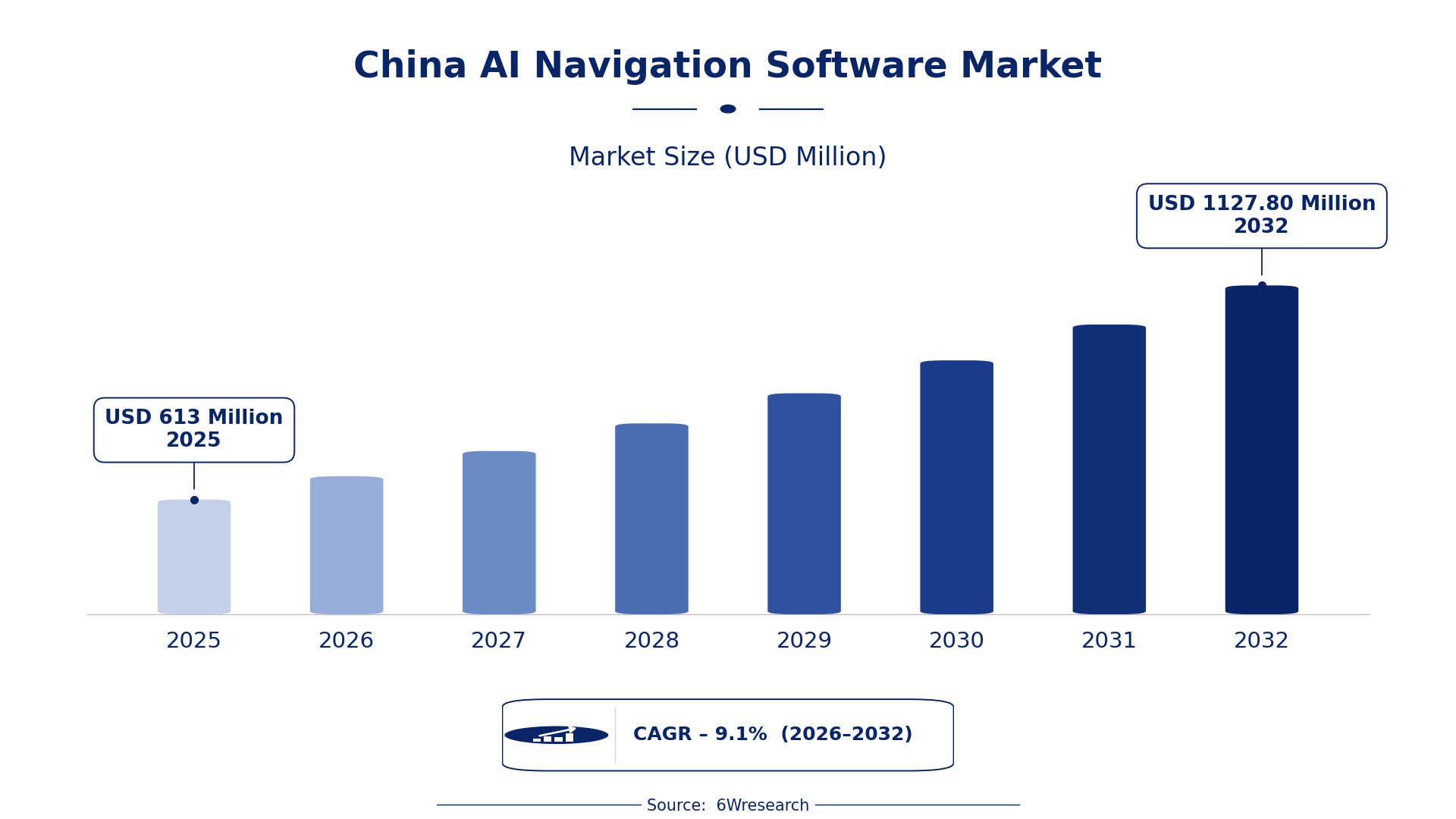
According to 6Wresearch internal database and industry insights, the China AI Navigation Software Market was valued at USD 613.0 million in 2025 and is projected to reach USD 1,127.80 million by 2032, growing at a CAGR of approximately 9.1% during 2026–2032.
China AI Navigation Software Market Highlights
| Report Metric | Details |
| Report Name | China AI Navigation Software Market |
| Market Size 2025 | USD 613.0 million |
| Market Size 2032 | USD 1,127.80 million |
| Absolute Growth 2025–2032 | USD 514.80 million |
| CAGR 2026–2032 | 9.1% |
| Peak Annual Growth | 10.6% in 2029 |
| Forecast Period | 2026–2032 |
| Historical Data | 2022–2025 |
| Base Year | 2025 |
| Leading Software Type, 2025 | Autonomous Driving (38% share) |
| Leading Feature Set, 2025 | Path Planning (38% share) |
| Leading Distribution Channel, 2025 | Mobility SaaS Platforms (43% share) |
| Leading End User, 2025 | EV Manufacturers (39% share) |
| Fastest-Growing Software Type | Drone Navigation (11.0% CAGR) |
| Fastest-Growing Feature Set | Real-Time Adaptation (10.9% CAGR) |
| Fastest-Growing Distribution Channel | UAV Software Vendors (10.3% CAGR) |
| Fastest-Growing End User | Aerospace Tech Companies (11.9% CAGR) |
| Growing Sector | automotive |
| Key End Users | automotive manufacturers, logistics firms, drone operators, smart city developers |
China AI Navigation Software Market Year-wise Growth Rate and Key Drivers (2022–2032)
This graph illustrates the annual growth rates of the market from 2022 to 2032, highlighting a steady upward trajectory and projected market expansion over the forecast period.
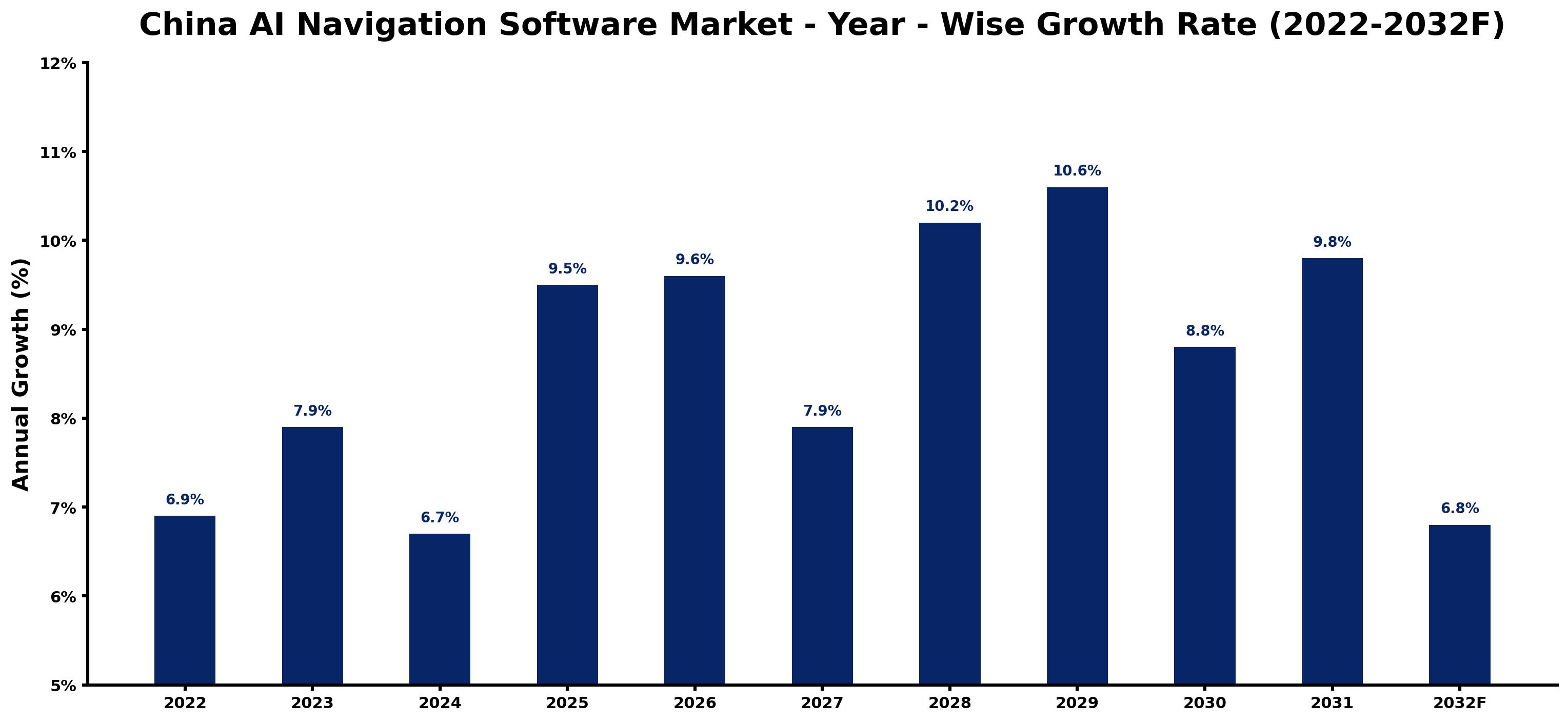
Year by year, the estimates below pair each growth rate with the development that shaped it.
| Year | Estimated Annual Growth (%) | Market Rationale |
| 2022 | 6.9 | The market experienced steady growth as AI technology began to integrate into navigation systems, driven by the Smart Transportation Development Plan. |
| 2023 | 7.9 | Demand surged due to increased adoption of AI navigation in the automotive sector, particularly among electric vehicle manufacturers. |
| 2024 | 6.7 | Growth slowed slightly as companies adjusted to new standards and regulations outlined in the National Standard for Intelligent Transportation Systems. |
| 2025 | 9.5 | A rise in electric vehicle production boosted the demand for navigation software, aligning with projections of over 20 million EVs. |
| 2026 | 9.6 | Investment in smart transportation initiatives, including the Intelligent Transportation System Construction Plan, will further stimulate market growth. |
| 2027 | 7.9 | Growth will decelerate as the market faces challenges in meeting evolving standards set by the National Standardization Administration. |
| 2028 | 10.2 | A resurgence in demand is expected due to advancements in real-time adaptation technologies, enhancing user experience. |
| 2029 | 10.6 | The peak growth rate will be achieved as drone navigation applications expand rapidly, supported by logistics and delivery services. |
| 2030 | 8.8 | Growth will slow as the market stabilises after reaching peak levels, influenced by compliance with updated regulations. |
| 2031 | 9.8 | A renewed focus on AI integration in logistics will spur demand once again, particularly in urban areas. |
| 2032 | 6.8 | The market is projected to grow steadily as indoor mapping solutions gain traction, driven by over 300 million smartphone users. |
Note: Market size estimations and growth projections presented in this report are based on 6Wresearch's proprietary forecasting methodology, utilizing the latest available industry data, government publications, and primary research inputs.
China AI Navigation Software Market Synopsis
The AI Navigation Software Market in China encompasses advanced technologies that improve navigation through artificial intelligence algorithms. This software is developed using complex programming and machine learning techniques, primarily for applications in autonomous driving, drone navigation, and indoor mapping. The market is expected to grow significantly due to the automotive sector's expansion, with over 20 million electric vehicles projected by 2025, alongside the ongoing Smart Transportation Development Plan launched in 2023. Additionally, the logistics industry is anticipated to adopt AI navigation software in more than 50% of operations by 2025, further driving demand.
Market Dynamics Impact Analysis (2026–2032)
| Factor | Type | Impact | Primary Segment Affected |
| Increasing adoption of AI in autonomous vehicles | Driver | High | Autonomous Driving |
| Rising demand for drone navigation in logistics | Driver | High | Drone Navigation |
| Expansion of smart city initiatives | Opportunity | High | Indoor Mapping |
| Investment in AI technologies by logistics firms | Opportunity | Medium | Marine Navigation |
| Challenges in meeting evolving AI standards | Restraint | High | Path Planning |
| Limited awareness of AI navigation benefits among users | Restraint | Medium | Real-Time Adaptation |
| High development costs for AI navigation software | Challenge | High | UAV Software Vendors |
| Regulatory hurdles in software approvals | Challenge | Medium | Mobility SaaS Platforms |
Evaluation of Drivers in China AI Navigation Software Market (2026–2032)
Key forces behind demand, with the segment each one moves most, are listed below.
| Drivers | Primary Segment Affected | Why It Matters (Evidence) |
| Rising electric vehicle production | Autonomous Driving | The automotive sector is projected to adopt AI navigation software extensively, with over 20 million electric vehicles expected by 2025, driving demand for navigation solutions. |
| Increased drone adoption in logistics | Drone Navigation | China's drone market is expected to see a 30% increase in AI navigation software adoption by 2025, driven by logistics and delivery services. |
| Government investment in AI technologies | Marine Navigation | The National Development and Reform Commission's 5 billion yuan investment in AI technologies will support navigation software development, enhancing safety and efficiency in maritime operations. |
| Growing smartphone user base | Indoor Mapping | With over 300 million smartphone users in China, the demand for indoor mapping solutions is increasing, prompting developers to enhance navigation software features. |
| Implementation of national standards | Path Planning | The National Standard for Intelligent Transportation Systems outlines requirements for navigation software, ensuring quality and interoperability, which boosts confidence among buyers. |
With over 20 million electric vehicles projected by 2025, demand for navigation software is anticipated to rise significantly. The drone market is set to see a 30% increase in AI navigation software adoption by 2025, driven by logistics needs. Additionally, the National Development and Reform Commission's investment of 5 billion yuan in AI technologies will support navigation software development, particularly in the marine sector. Rising smartphone usage, with over 300 million users, is further increasing demand for real-time adaptation features in navigation solutions.
Evaluation of Restraints in China AI Navigation Software Market
The following restraints limit how fast demand can grow.
| Market Restraint | Primary Segment Affected | Why It Matters (Evidence) |
| High development costs for AI navigation software | UAV Software Vendors | Development costs can exceed several million yuan, limiting smaller firms' ability to compete. |
| Limited awareness of AI navigation benefits among users | Real-Time Adaptation | Many potential users lack knowledge about the advantages of AI navigation, hindering market penetration. |
| Challenges in meeting evolving AI standards | Path Planning | Compliance with updated standards can delay product launches and increase costs for developers. |
| Regulatory hurdles in software approvals | Mobility SaaS Platforms | Navigating complex approval processes can prolong time-to-market for new software solutions. |
| Dependence on large datasets for training AI models | Drone Navigation | Accessing high-quality datasets remains a challenge, impacting software performance and reliability. |
China AI Navigation Software Market Challenges
The China AI navigation software market encounters notable technological challenges, causing delays for automotive manufacturers and potentially leading to annual revenue losses of 15%. Adherence to the National Standard for Intelligent Transportation Systems creates regulatory hurdles, extending approval timelines by six months for software developers. Supply chain complications arise from reliance on specific components, resulting in production delays that impede logistics firms requiring timely software updates. Heightened competition from emerging tech startups in regions like Guangdong compels established players to lower prices, which can squeeze profit margins for suppliers.
Trends in the China AI Navigation Software Market
The trends below show where the China AI Navigation Software Market is heading.
- Shift towards Smart Transportation Development: The 2023 'Smart Transportation Development Plan' encourages AI integration in transport systems, enhancing navigation capabilities. This initiative is set to propel advancements in AI navigation software adoption across the automotive and logistics sectors, improving operational efficiency.
- Increase in Drone Navigation Applications: With a projected 30% rise in AI navigation software adoption in China's drone market by 2025, logistics and delivery services are at the forefront of this trend, indicating a growing dependence on AI for operational efficiency.
- Focus on Indoor Mapping Solutions: China's urban areas, home to over 300 million smartphone users, are increasingly embracing indoor mapping solutions. This trend is driven by the demand for precise navigation in complex environments, enhancing user experience and accessibility.
- Expansion of AI Standards for Navigation Software: The National Standardization Administration's 'Guidelines for AI Navigation Software Standards' released in 2023 aim to ensure quality and interoperability, building trust among users and encouraging broader adoption of AI navigation solutions.
Investment Opportunities in the China AI Navigation Software Market
Below are the investment opportunities with the strongest case in the China AI Navigation Software Market.
- Partnerships with Local Tech Startups: Collaborating with tech startups in Guangdong province, a centre for AI navigation software, presents opportunities to innovate and broaden market reach, particularly with the expected increase in demand driven by the Smart Transportation Development Plan.
- Investment in Smart City Projects: With the Smart City Initiative launched in 2022, there is a notable gap in AI navigation solutions for urban planning, creating opportunities for investment and development in this area, especially in the Beijing-Tianjin-Hebei region.
- Focus on EV Manufacturers: The automotive sector's anticipated growth, with 20 million electric vehicles by 2025, offers a prime opportunity for suppliers of AI navigation software to cater to this expanding market, particularly in urban settings.
- Expansion into Logistics Operations: As China's logistics industry is set to implement AI navigation software in over 50% of operations by 2025, suppliers can target logistics firms to enhance operational efficiency and reduce costs.
Government Initiatives in the China AI Navigation Software Market
In 2021, the State Council approved the 'National AI Development Plan', aiming to position China as a global leader in AI technologies, including navigation systems, by 2030. This plan outlines strategic initiatives to improve AI capabilities across various sectors. In 2022, the Ministry of Transport initiated the 'Intelligent Transportation System Construction Plan', promoting the adoption of AI navigation technologies nationwide. Additionally, the National Development and Reform Commission's '14th Five-Year Plan for Digital Economy Development' includes initiatives to support AI navigation software development, focusing on transportation and logistics.
The Ministry of Industry and Information Technology launched the 'Smart Transportation Development Plan' in 2023, aiming to improve AI integration in transportation systems. This plan supports the development of navigation software by funding research and development projects. The National Standardization Administration's 'Guidelines for AI Navigation Software Standards' released in 2023 ensure quality and interoperability, benefiting both producers and buyers by establishing clear benchmarks for performance. The Civil Aviation Administration of China also updated regulations to promote the use of AI in drone navigation, facilitating smoother approvals for developers.
Future Insight of the China AI Navigation Software Market
The China AI navigation software market is set for substantial evolution by 2032, influenced by advancements in machine learning and government support through initiatives like the 'Smart Transportation Development Plan'. The automotive sector will see AI navigation integrated into over 20 million electric vehicles, significantly improving user experience and safety. The logistics industry is expected to implement AI navigation in more than 50% of operations, boosting efficiency and cutting costs. The 'AI for Transportation' program will further expand applications across public transport systems.
Market Segmentation Analysis
Each segment group is reviewed below, with the leader by share and the fastest grower by CAGR.
By Software Type – Autonomous Driving Dominated, Drone Navigation Expected to Grow Fastest
According to Shubham Padhi, Research Analyst at 6Wresearch, Autonomous Driving took a 38% share of software type in 2025, more than any other category. The Autonomous Driving segment holds the largest share in the China AI Navigation Software Market due to its essential role in the projected 20 million electric vehicles by 2025. This segment's prominence is reinforced by the automotive industry's commitment to enhancing safety and efficiency in self-driving technologies. The quickest growth will come from Drone Navigation, forecast to expand at a CAGR of 11.0% between 2026 and 2032. Drone Navigation is experiencing rapid growth, with a projected 30% increase in AI navigation software adoption by 2025, largely driven by logistics and delivery services. This surge reflects the increasing need for autonomous UAV operations, which will further solidify the segment's market share. Suppliers should prioritise the development of solutions tailored for both autonomous driving and drone navigation to leverage these expanding market opportunities.
By Feature Set – Path Planning Dominated, Real-Time Adaptation Expected to Grow Fastest
Path Planning accounted for a 38% market share by feature set in 2025. Path Planning commands the largest market share as it is vital for determining optimal routes, essential for both autonomous vehicles and drones. Its significance is highlighted by the necessity for precise navigation across various applications, ensuring operational safety and efficiency. Real-Time Adaptation is projected to grow fastest, at a CAGR of 10.9% during 2026–2032. Real-Time Adaptation is the fastest-growing feature set, spurred by the demand for navigation systems to dynamically adjust to changing conditions. This capability is increasingly crucial in fast-paced environments such as logistics and urban transport, further enhancing its market share. Buyers will gain from investing in software that integrates real-time adaptation to improve operational efficiency and responsiveness.
By Distribution Channel – Mobility SaaS Platforms Dominated, UAV Software Vendors Expected to Grow Fastest
In 2025, Mobility SaaS Platforms led the distribution channel split with a 43% share. Mobility SaaS Platforms dominate the distribution channel due to their essential role in delivering navigation services across diverse applications. Their extensive utilisation in the automotive and logistics sectors underscores their vital position in the market. UAV Software Vendors are set to record the highest CAGR in this split, 10.3% over 2026–2032. UAV Software Vendors are the fastest-growing distribution channel, facilitating the integration of navigation software into UAV systems. This growth mirrors the rising reliance on drones for logistics and delivery, driving demand for specialised software solutions and expanding their market share. Suppliers should explore partnerships with UAV software vendors to broaden their reach and enhance product offerings in the expanding drone market.
By End User – EV Manufacturers Dominated, Aerospace Tech Companies Expected to Grow Fastest
EV Manufacturers held a 39% share of the China AI Navigation Software Market by end user in 2025. EV Manufacturers lead the end-user segment as they heavily rely on navigation software to enhance electric vehicle functionalities. The anticipated growth in electric vehicle adoption in China highlights the significance of this segment in the AI navigation software market. Over 2026–2032, Aerospace Tech Companies are expected to post the fastest growth, at a CAGR of 11.9%. Aerospace Tech Companies are witnessing the fastest growth in this segment, increasingly employing navigation software for specific aerospace applications. This trend signals a growing demand for advanced navigation solutions within the aerospace sector, potentially expanding their market share further. Suppliers should customise their offerings to address the specific needs of aerospace tech companies, capitalising on the rising demand for navigation software in this field.
Key Attractiveness of the Report
- 10 Years of Market Numbers
- Historical Data Starting from 2022 to 2025
- Base Year 2025
- Forecast Data until 2032
- Key Performance Indicators Impacting the Market
- Major Upcoming Developments and Projects
Key Highlights of the Report:
- China AI Navigation Software Market Outlook
- Market Size of China AI Navigation Software Market, 2025
- Forecast of China AI Navigation Software Market, 2032
- Historical Data and Forecast of China AI Navigation Software Revenues & Volume for the Period 2022 - 2032F
- China AI Navigation Software Market Trend Evolution
- China AI Navigation Software Market Drivers and Challenges
- China AI Navigation Software Price Trends
- China AI Navigation Software Porter's Five Forces
- China AI Navigation Software Industry Life Cycle
- Historical Data and Forecast of China AI Navigation Software Market Revenues & Volume By Software Type for the Period 2022 - 2032F
- Historical Data and Forecast of China AI Navigation Software Market Revenues & Volume By Autonomous Driving for the Period 2022 - 2032F
- Historical Data and Forecast of China AI Navigation Software Market Revenues & Volume By Drone Navigation for the Period 2022 - 2032F
- Historical Data and Forecast of China AI Navigation Software Market Revenues & Volume By Indoor Mapping for the Period 2022 - 2032F
- Historical Data and Forecast of China AI Navigation Software Market Revenues & Volume By Marine Navigation for the Period 2022 - 2032F
- Historical Data and Forecast of China AI Navigation Software Market Revenues & Volume By Feature Set for the Period 2022 - 2032F
- Historical Data and Forecast of China AI Navigation Software Market Revenues & Volume By Path Planning for the Period 2022 - 2032F
- Historical Data and Forecast of China AI Navigation Software Market Revenues & Volume By Real-Time Adaptation for the Period 2022 - 2032F
- Historical Data and Forecast of China AI Navigation Software Market Revenues & Volume By SLAM Algorithms for the Period 2022 - 2032F
- Historical Data and Forecast of China AI Navigation Software Market Revenues & Volume By Route Optimization for the Period 2022 - 2032F
- Historical Data and Forecast of China AI Navigation Software Market Revenues & Volume By Distribution Channel for the Period 2022 - 2032F
- Historical Data and Forecast of China AI Navigation Software Market Revenues & Volume By Mobility SaaS Platforms for the Period 2022 - 2032F
- Historical Data and Forecast of China AI Navigation Software Market Revenues & Volume By UAV Software Vendors for the Period 2022 - 2032F
- Historical Data and Forecast of China AI Navigation Software Market Revenues & Volume By IoT & Smart Tech Marketplaces for the Period 2022 - 2032F
- Historical Data and Forecast of China AI Navigation Software Market Revenues & Volume By Maritime Software Vendors for the Period 2022 - 2032F
- Historical Data and Forecast of China AI Navigation Software Market Revenues & Volume By End User for the Period 2022 - 2032F
- Historical Data and Forecast of China AI Navigation Software Market Revenues & Volume By EV Manufacturers for the Period 2022 - 2032F
- Historical Data and Forecast of China AI Navigation Software Market Revenues & Volume By Aerospace Tech Companies for the Period 2022 - 2032F
- Historical Data and Forecast of China AI Navigation Software Market Revenues & Volume By Warehouse Automation Firms for the Period 2022 - 2032F
- Historical Data and Forecast of China AI Navigation Software Market Revenues & Volume By Naval Operations Centers for the Period 2022 - 2032F
- China AI Navigation Software Import Export Trade Statistics
- Market Opportunity Assessment By Software Type
- Market Opportunity Assessment By Feature Set
- Market Opportunity Assessment By Distribution Channel
- Market Opportunity Assessment By End User
- China AI Navigation Software Top Companies Market Share
- China AI Navigation Software Competitive Benchmarking By Technical and Operational Parameters
- China AI Navigation Software Company Profiles
- China AI Navigation Software Key Strategic Recommendations
Market Covered
Segments analysed in this report are listed below.
By Software Type
- Autonomous Driving
- Drone Navigation
- Indoor Mapping
- Marine Navigation
By Feature Set
- Path Planning
- Real-Time Adaptation
- SLAM Algorithms
- Route Optimization
By Distribution Channel
- Mobility SaaS Platforms
- UAV Software Vendors
- IoT & Smart Tech Marketplaces
- Maritime Software Vendors
By End User
- EV Manufacturers
- Aerospace Tech Companies
- Warehouse Automation Firms
- Naval Operations Centers































