China AI Ophthalmology Imaging Market Size & Growth Rate
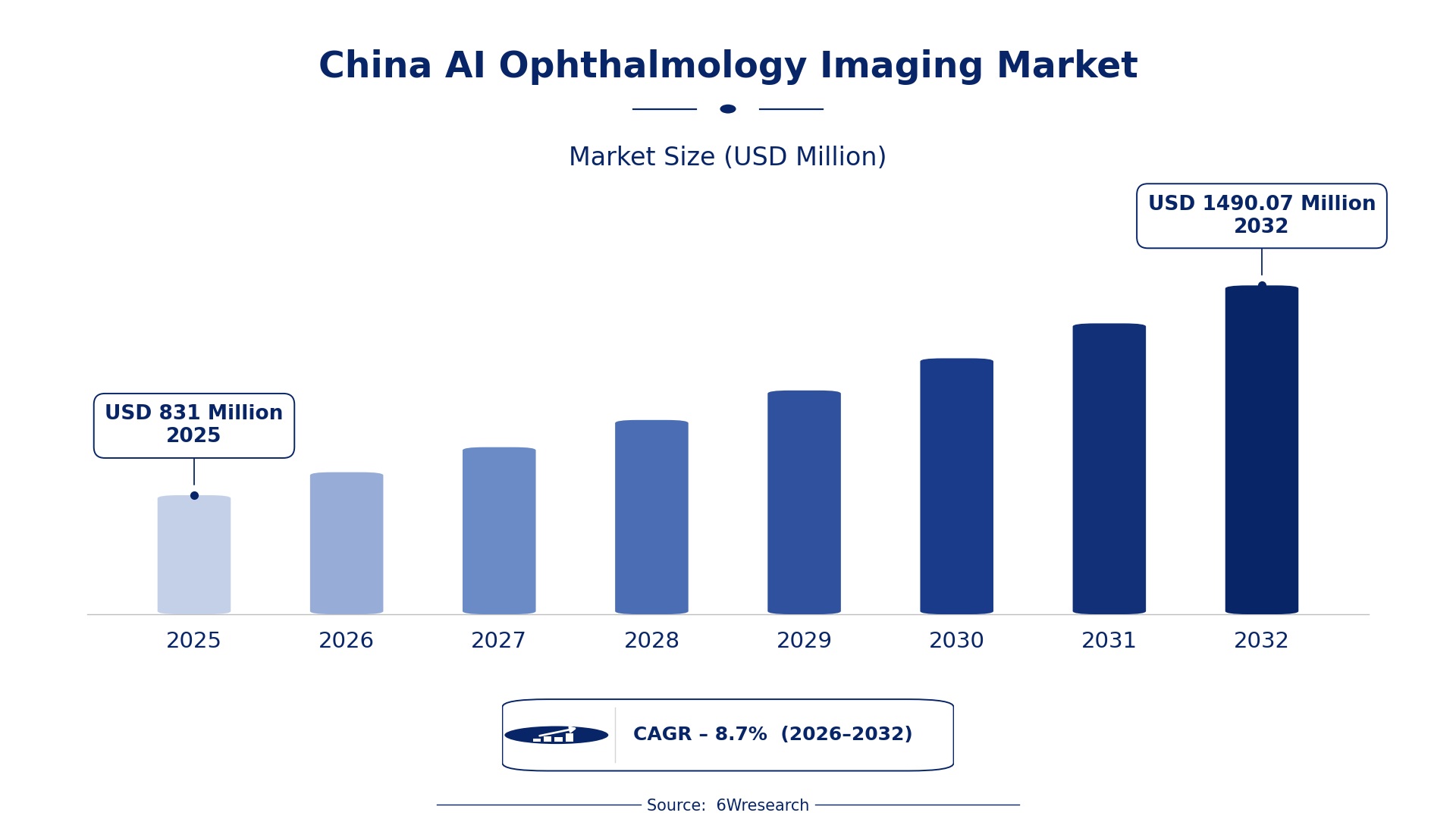
According to 6Wresearch internal database and industry insights, the China AI Ophthalmology Imaging Market was valued at USD 831.0 million in 2025 and is projected to reach USD 1,490.07 million by 2032, growing at a CAGR of approximately 8.7% during 2026–2032.
China AI Ophthalmology Imaging Market Highlights
| Report Metric | Details |
| Report Name | China AI Ophthalmology Imaging Market |
| Market Size 2025 | USD 831.0 million |
| Market Size 2032 | USD 1,490.07 million |
| Absolute Growth 2025–2032 | USD 659.07 million |
| CAGR 2026–2032 | 8.7% |
| Peak Annual Growth | 11.0% in 2026 |
| Forecast Period | 2026–2032 |
| Historical Data | 2022–2025 |
| Base Year | 2025 |
| Leading Imaging Type, 2025 | OCT Imaging (44% share) |
| Leading AI Functionality, 2025 | Disease Classification (40% share) |
| Leading Distribution Channel, 2025 | Vision AI Providers (33% share) |
| Leading End User, 2025 | Eye Hospitals (40% share) |
| Fastest-Growing Imaging Type | Retinal Scans (10.7% CAGR) |
| Fastest-Growing AI Functionality | Predictive Analytics (10.0% CAGR) |
| Fastest-Growing Distribution Channel | Health SaaS Portals (10.5% CAGR) |
| Fastest-Growing End User | Retinal Care Clinics (11.3% CAGR) |
| Growing Sector | Ophthalmology |
| Key End Users | Eye Hospitals, Retinal Care Clinics, Ophthalmologists |
China AI Ophthalmology Imaging Market Year-wise Growth Rate and Key Drivers (2022–2032)
This graph illustrates the annual growth rates of the market from 2022 to 2032, highlighting a steady upward trajectory and projected market expansion over the forecast period.
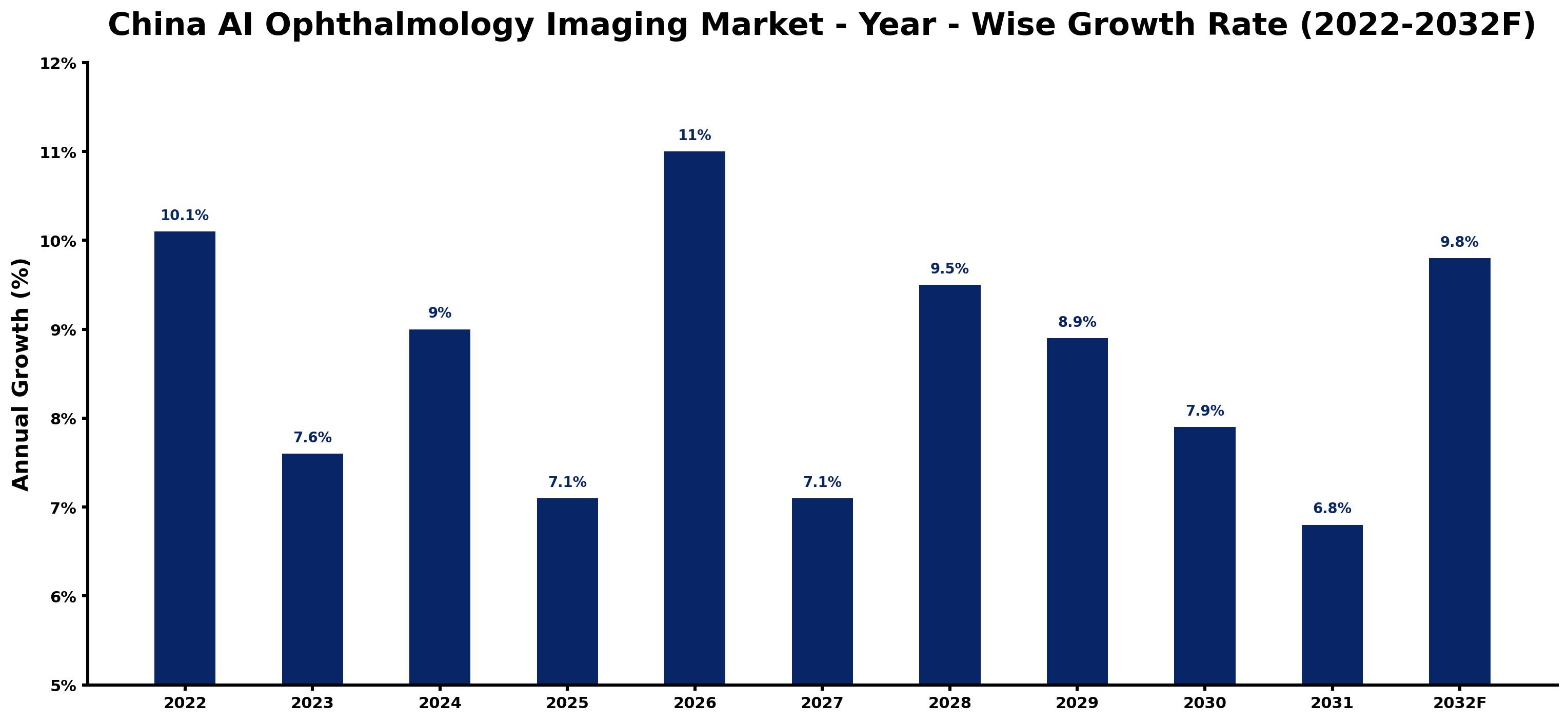
The table below sets out the estimated growth rate for each year and the main factor behind it.
| Year | Estimated Annual Growth (%) | Market Rationale |
| 2022 | 10.1 | The market experienced strong demand from healthcare providers and research institutions, driven by the rising prevalence of eye diseases. |
| 2023 | 7.6 | Growth slowed as the market adjusted to the implementation of the 'AI Medical Imaging Technology Standard' in 2021. |
| 2024 | 9.0 | Demand increased as more eye hospitals adopted AI-driven imaging solutions, particularly in urban centres. |
| 2025 | 7.1 | Growth slowed again due to market saturation in major urban centres, limiting new investments. |
| 2026 | 11.0 | A surge in investment from the government through the 'Healthy China 2030' initiative boosted demand for AI ophthalmology imaging. |
| 2027 | 7.1 | Growth is expected to stabilise as technology adoption matures, particularly in urban eye hospitals. |
| 2028 | 9.5 | Demand is projected to rise as new predictive analytics technologies gain traction among ophthalmologists, improving diagnostic capabilities. |
| 2029 | 8.9 | Growth will slow as the market matures and competition intensifies, particularly among diagnostic device vendors. |
| 2030 | 7.9 | Demand is expected to continue rising due to increasing awareness of diabetic retinopathy prevalence among the population. |
| 2031 | 6.8 | Growth will slow as the market faces challenges from regulatory changes and competition in advanced imaging technologies. |
| 2032 | 9.8 | Demand is projected to rise as new initiatives aim to improve AI integration in healthcare, particularly in eye hospitals. |
Note: Market size estimations and growth projections presented in this report are based on 6Wresearch's proprietary forecasting methodology, utilizing the latest available industry data, government publications, and primary research inputs.
China AI Ophthalmology Imaging Market Synopsis
AI Ophthalmology Imaging in China encompasses cutting-edge imaging technologies that leverage artificial intelligence for the diagnosis and monitoring of eye diseases. These technologies play a crucial role in detecting conditions such as glaucoma and diabetic retinopathy. Demand primarily stems from eye hospitals and healthcare providers, driven by the 'Healthy China 2030' initiative and the rising incidence of eye diseases within the population. In 2023, more than 1,000 eye hospitals are employing these advanced technologies, indicating robust growth in the market.
Market Dynamics Impact Analysis (2026–2032)
| Factor | Type | Impact | Primary Segment Affected |
| Increasing adoption of AI technologies in healthcare | Driver | High | Disease Classification |
| Growing prevalence of diabetic retinopathy | Driver | High | OCT Imaging |
| Investment in healthcare technology by urban hospitals | Opportunity | High | Eye Hospitals |
| Expansion of AI-driven imaging solutions in rural areas | Opportunity | Medium | Retinal Care Clinics |
| High costs associated with advanced imaging devices | Restraint | High | Fundus Imaging |
| Limited access to AI training for healthcare professionals | Restraint | Medium | OCT Imaging |
| Challenges in integrating AI solutions into existing systems | Challenge | High | Vision AI Providers |
| Regulatory hurdles affecting AI technology deployment | Challenge | Medium | Diagnostic Device Vendors |
Evaluation of Drivers in China AI Ophthalmology Imaging Market (2026–2032)
The table below links each growth driver to the segment it affects and the evidence for it.
| Drivers | Primary Segment Affected | Why It Matters (Evidence) |
| Surge in investment from the government | OCT Imaging | The Chinese government allocated 500 million CNY for AI healthcare initiatives in 2022, boosting demand for imaging solutions. |
| Growing number of ophthalmologists | Eye Hospitals | With around 30,000 ophthalmologists in 2022, eye hospitals are seeking advanced imaging technologies to meet patient needs. |
| Rise in diabetic retinopathy cases | Disease Classification | Approximately 10% of diabetic patients in China are affected, driving demand for diagnostic imaging solutions. |
| Adoption of predictive analytics in healthcare | Predictive Analytics | The increasing focus on forecasting disease progression encourages hospitals to invest in advanced imaging technologies. |
| Expansion of healthcare infrastructure in urban areas | Retinal Care Clinics | Major urban centres like Beijing and Shanghai are leading the way in adopting AI ophthalmology imaging. |
Market growth in China for AI Ophthalmology Imaging is propelled by the increasing adoption of imaging technologies, heightened healthcare investments, and the escalating prevalence of eye diseases. In 2022, around 30,000 ophthalmologists were available, stimulating demand for imaging solutions. Approximately 10% of diabetic patients in China experience diabetic retinopathy, creating a need for advanced diagnostic tools. Urban centres like Beijing and Shanghai are leading the charge in integrating AI technologies into healthcare, further driving demand for these solutions.
Evaluation of Restraints in China AI Ophthalmology Imaging Market
The table below lists the restraints and the evidence behind each.
| Market Restraint | Primary Segment Affected | Why It Matters (Evidence) |
| High costs of advanced imaging devices | Fundus Imaging | The high cost of OCT devices limits accessibility for smaller clinics, impacting their ability to invest in new technologies. |
| Limited training for healthcare professionals | OCT Imaging | A shortage of training programmes for AI technologies restricts effective implementation in eye hospitals. |
| Regulatory challenges for AI integration | Vision AI Providers | Regulatory hurdles can delay the deployment of AI solutions in ophthalmology, affecting market growth. |
| Market saturation in major urban areas | Disease Classification | The concentration of advanced imaging technologies in urban centres leads to slower growth in those regions. |
| Competition among diagnostic device vendors | Diagnostic Device Vendors | Intense competition can drive down prices, impacting profitability for suppliers of imaging technologies. |
China AI Ophthalmology Imaging Market Challenges
Buyers and suppliers in the China AI Ophthalmology Imaging market face escalating costs for advanced imaging technologies, with prices often exceeding 1 million CNY per unit. This financial burden limits hospitals' ability to invest in new equipment, resulting in delayed access to essential diagnostic services for patients. Rapid technological advancements create challenges for clinics attempting to adopt AI solutions, leading to reliance on outdated practices that compromise patient care. Additionally, supply chain disruptions hinder the availability of critical components, causing extended lead times for producers and negatively affecting service delivery for healthcare providers.
Trends in the China AI Ophthalmology Imaging Market
Four trends stand out in the China AI Ophthalmology Imaging Market.
- Increase in Urban Eye Care Facilities: By 2023, urban areas like Beijing and Shanghai have seen a rise in eye care facilities adopting AI imaging technologies, with over 1,000 hospitals now utilising advanced imaging solutions.
- Growing Focus on AI Integration in Healthcare: Since 2021, the Chinese government has prioritised AI integration in healthcare through initiatives like 'Healthy China 2030'. This focus is driving demand for AI ophthalmology imaging solutions.
- Shift towards Predictive Analytics in Imaging: In 2023, the adoption of predictive analytics in ophthalmology imaging is increasing, with a projected CAGR of 10.0%. This shift allows eye hospitals to forecast disease progression more accurately, improving patient care.
- Expansion of AI Imaging in Rural Areas: From 2022 onwards, efforts to expand AI imaging technologies into rural areas are underway, aiming to improve access to eye care services for underserved populations.
Investment Opportunities in the China AI Ophthalmology Imaging Market
Investors looking at the China AI Ophthalmology Imaging Market should consider the following areas.
- Investment in AI Imaging Technologies: Eye hospitals are increasingly pursuing advanced imaging solutions, with a substantial budget allocated for AI healthcare initiatives in 2022. Collaborating with local tech firms can facilitate market entry.
- Supply of Predictive Analytics Solutions: With projected growth for predictive analytics, there exists an opportunity to supply these solutions to eye hospitals. Partnering with healthcare providers can enhance market presence.
- Expansion into Rural Eye Care Clinics: The demand for AI imaging solutions in rural areas is on the rise, with a growing number of clinics seeking advanced technologies. Establishing partnerships with local healthcare providers can support market penetration.
- Focus on Disease Classification Technologies: As the prevalence of eye diseases increases, the demand for disease classification technologies is anticipated to grow. Investing in advanced imaging solutions can attract eye hospitals aiming to improve diagnostics.
Government Initiatives in the China AI Ophthalmology Imaging Market
The 'Healthy China 2030' initiative, launched in 2021 by the National Health Commission, aims to improve healthcare services, including the integration of AI in ophthalmology. This initiative encourages hospitals to adopt advanced imaging technologies, thereby increasing demand for AI solutions. The 'AI Medical Imaging Technology Standard', introduced in 2021 by the Ministry of Industry and Information Technology, regulates AI applications in medical imaging, ensuring quality and safety in the sector. In 2022, the Chinese government allocated a budget of 500 million CNY for AI healthcare initiatives, which includes support for ophthalmology imaging projects.
The 'Digital Health Promotion Program', initiated in 2023, supports the integration of digital technologies in medical practices, including AI ophthalmology imaging. This program provides funding for hospitals to adopt advanced imaging solutions and ensures compliance with established standards. The National Health Commission oversees this initiative, allowing hospitals to improve their diagnostic capabilities through AI technologies. Additionally, the 'China Association of Medical Equipment' supports the development of AI technologies in healthcare, facilitating the adoption of advanced imaging solutions.
Future Insight of the China AI Ophthalmology Imaging Market
The China AI Ophthalmology Imaging market will undergo transformative changes by 2032, driven by the government's 'Healthy China 2030' initiative aimed at integrating AI into healthcare. By then, the installed base of OCT devices is expected to exceed 10,000 units, greatly improving diagnostic capabilities for eye diseases. The establishment of the 'AI Medical Imaging Technology Standard' will streamline integration for suppliers, ensuring consistent quality across the sector. Increased government funding for AI healthcare initiatives will empower hospitals to invest in advanced imaging technologies, ultimately enhancing patient care.
Market Segmentation Analysis
The analysis below covers each segmentation, its leading category in 2025 and its fastest-growing category through 2032.
By Imaging Type – OCT Imaging Dominated, Retinal Scans Expected to Grow Fastest
According to Shubham Padhi, Research Analyst at 6Wresearch, in 2025, OCT Imaging led the imaging type split with a 44% share. OCT Imaging holds the largest share due to its critical role in providing detailed cross-sectional images of the retina, essential for accurate diagnoses. With over 10,000 OCT devices installed across China, this technology is pivotal in eye hospitals nationwide. The quickest growth will come from Retinal Scans, forecast to expand at a CAGR of 10.7% between 2026 and 2032. Retinal Scans are experiencing rapid growth as they offer comprehensive assessments of retinal health, addressing the increasing prevalence of diabetic retinopathy, which affects around 10% of diabetic patients. This rising demand for thorough evaluations is driving the adoption of retinal scanning technologies. Suppliers should focus on enhancing OCT Imaging capabilities to meet the growing demand for precise eye disease diagnostics.
By AI Functionality – Disease Classification Dominated, Predictive Analytics Expected to Grow Fastest
With a 40% revenue share in 2025, Disease Classification was the largest ai functionality category. Disease Classification leads the market share as it is vital for accurately categorising various eye diseases, ensuring effective treatment plans. The integration of AI in this area is supported by initiatives like the 'AI Medical Imaging Technology Standard' established in 2021. Predictive Analytics is projected to grow fastest, at a CAGR of 10.0% during 2026–2032. Predictive Analytics is the fastest-growing segment, driven by its ability to forecast disease progression using imaging data, which is increasingly sought after by healthcare providers. This trend aligns with the government's push for AI integration in medical imaging, enhancing its appeal. Buyers should invest in AI functionality that prioritises predictive analytics to improve patient outcomes and operational efficiency.
By Distribution Channel – Vision AI Providers Dominated, Health SaaS Portals Expected to Grow Fastest
The largest distribution channel category in 2025 was Vision AI Providers, with a 33% share of total revenue. Vision AI Providers dominate the market share as they are key players in delivering advanced AI solutions tailored for ophthalmology, meeting the needs of healthcare facilities. Their established relationships with eye hospitals facilitate widespread adoption of these technologies. Over 2026–2032, Health SaaS Portals are expected to post the fastest growth, at a CAGR of 10.5%. Health SaaS Portals are growing rapidly, providing essential platforms for accessing imaging data and analytics, which are becoming crucial for efficient patient management. The increasing digitalisation of healthcare services is propelling this segment forward. Suppliers must develop robust partnerships with Health SaaS Portals to expand their reach and enhance service delivery.
By End User – Eye Hospitals Dominated, Retinal Care Clinics Expected to Grow Fastest
Eye Hospitals held a 40% share of the China AI Ophthalmology Imaging Market by end user in 2025. Eye Hospitals command the largest share as they are the primary users of AI ophthalmology imaging technologies, catering to millions of patient visits annually. The concentration of over 1,000 eye hospitals in China underscores their pivotal role in this market. Retinal Care Clinics are set to record the highest CAGR in this split, 11.3% over 2026–2032. Retinal Care Clinics are witnessing the fastest growth, driven by their specialised focus on advanced imaging for patient care, particularly for conditions like diabetic retinopathy. This trend reflects the rising demand for targeted eye care services across urban centres. Providers should tailor their solutions to meet the specific needs of retinal care clinics to capitalise on this growth opportunity.
Key Attractiveness of the Report
- 10 Years of Market Numbers
- Historical Data Starting from 2022 to 2025
- Base Year 2025
- Forecast Data until 2032
- Key Performance Indicators Impacting the Market
- Major Upcoming Developments and Projects
Key Highlights of the Report:
- China AI Ophthalmology Imaging Market Outlook
- Market Size of China AI Ophthalmology Imaging Market, 2025
- Forecast of China AI Ophthalmology Imaging Market, 2032
- Historical Data and Forecast of China AI Ophthalmology Imaging Revenues & Volume for the Period 2022 - 2032F
- China AI Ophthalmology Imaging Market Trend Evolution
- China AI Ophthalmology Imaging Market Drivers and Challenges
- China AI Ophthalmology Imaging Price Trends
- China AI Ophthalmology Imaging Porter's Five Forces
- China AI Ophthalmology Imaging Industry Life Cycle
- Historical Data and Forecast of China AI Ophthalmology Imaging Market Revenues & Volume By Imaging Type for the Period 2022 - 2032F
- Historical Data and Forecast of China AI Ophthalmology Imaging Market Revenues & Volume By Fundus Imaging for the Period 2022 - 2032F
- Historical Data and Forecast of China AI Ophthalmology Imaging Market Revenues & Volume By OCT Imaging for the Period 2022 - 2032F
- Historical Data and Forecast of China AI Ophthalmology Imaging Market Revenues & Volume By Retinal Scans for the Period 2022 - 2032F
- Historical Data and Forecast of China AI Ophthalmology Imaging Market Revenues & Volume By Glaucoma Detection for the Period 2022 - 2032F
- Historical Data and Forecast of China AI Ophthalmology Imaging Market Revenues & Volume By AI Functionality for the Period 2022 - 2032F
- Historical Data and Forecast of China AI Ophthalmology Imaging Market Revenues & Volume By Disease Classification for the Period 2022 - 2032F
- Historical Data and Forecast of China AI Ophthalmology Imaging Market Revenues & Volume By Layer Segmentation for the Period 2022 - 2032F
- Historical Data and Forecast of China AI Ophthalmology Imaging Market Revenues & Volume By Pattern Recognition for the Period 2022 - 2032F
- Historical Data and Forecast of China AI Ophthalmology Imaging Market Revenues & Volume By Predictive Analytics for the Period 2022 - 2032F
- Historical Data and Forecast of China AI Ophthalmology Imaging Market Revenues & Volume By Distribution Channel for the Period 2022 - 2032F
- Historical Data and Forecast of China AI Ophthalmology Imaging Market Revenues & Volume By Vision AI Providers for the Period 2022 - 2032F
- Historical Data and Forecast of China AI Ophthalmology Imaging Market Revenues & Volume By Diagnostic Device Vendors for the Period 2022 - 2032F
- Historical Data and Forecast of China AI Ophthalmology Imaging Market Revenues & Volume By Health SaaS Portals for the Period 2022 - 2032F
- Historical Data and Forecast of China AI Ophthalmology Imaging Market Revenues & Volume By Hospital Tech Integrators for the Period 2022 - 2032F
- Historical Data and Forecast of China AI Ophthalmology Imaging Market Revenues & Volume By End User for the Period 2022 - 2032F
- Historical Data and Forecast of China AI Ophthalmology Imaging Market Revenues & Volume By Eye Hospitals for the Period 2022 - 2032F
- Historical Data and Forecast of China AI Ophthalmology Imaging Market Revenues & Volume By Retinal Care Clinics for the Period 2022 - 2032F
- Historical Data and Forecast of China AI Ophthalmology Imaging Market Revenues & Volume By Ophthalmologists for the Period 2022 - 2032F
- Historical Data and Forecast of China AI Ophthalmology Imaging Market Revenues & Volume By Vision Research Labs for the Period 2022 - 2032F
- China AI Ophthalmology Imaging Import Export Trade Statistics
- Market Opportunity Assessment By Imaging Type
- Market Opportunity Assessment By AI Functionality
- Market Opportunity Assessment By Distribution Channel
- Market Opportunity Assessment By End User
- China AI Ophthalmology Imaging Top Companies Market Share
- China AI Ophthalmology Imaging Competitive Benchmarking By Technical and Operational Parameters
- China AI Ophthalmology Imaging Company Profiles
- China AI Ophthalmology Imaging Key Strategic Recommendations
Market Covered
The report offers an extensive study of the following market segments.
By Imaging Type
- Fundus Imaging
- OCT Imaging
- Retinal Scans
- Glaucoma Detection
By AI Functionality
- Disease Classification
- Layer Segmentation
- Pattern Recognition
- Predictive Analytics
By Distribution Channel
- Vision AI Providers
- Diagnostic Device Vendors
- Health SaaS Portals
- Hospital Tech Integrators
By End User
- Eye Hospitals
- Retinal Care Clinics
- Ophthalmologists
- Vision Research Labs































