China AI Radiology Market Size & Growth Rate
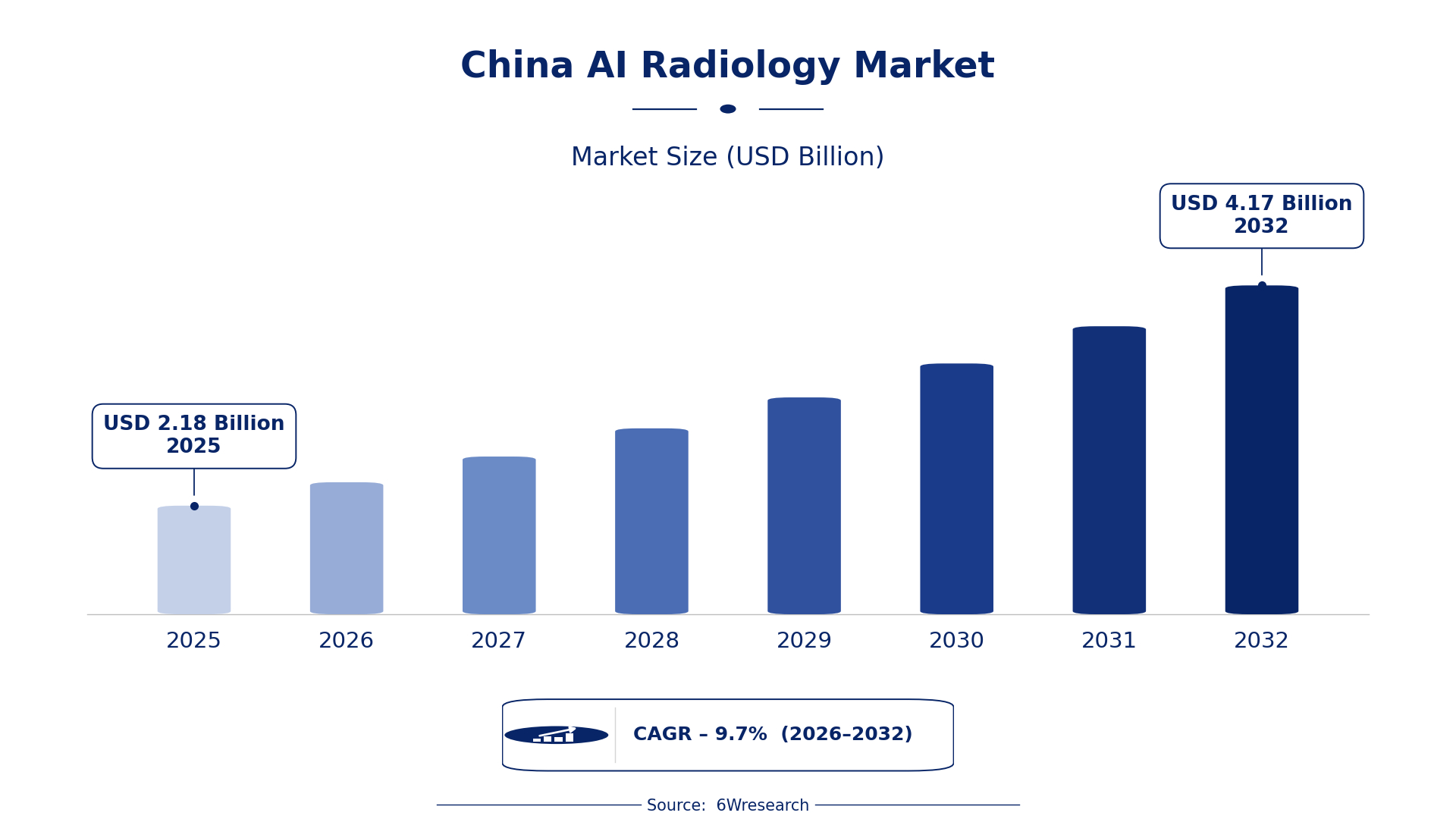
According to 6Wresearch internal database and industry insights, the China AI Radiology Market was valued at USD 2.18 billion in 2025 and is projected to reach USD 4.17 billion by 2032, growing at a CAGR of approximately 9.7% during 2026–2032.
China AI Radiology Market Highlights
| Report Metric | Details |
| Report Name | China AI Radiology Market |
| Market Size 2025 | USD 2.18 billion |
| Market Size 2032 | USD 4.17 billion |
| Absolute Growth 2025–2032 | USD 1.99 billion |
| CAGR 2026–2032 | 9.7% |
| Peak Annual Growth | 12.2% in 2026 |
| Forecast Period | 2026–2032 |
| Historical Data | 2022–2025 |
| Base Year | 2025 |
| Leading Radiology Type, 2025 | CT Imaging (45% share) |
| Leading AI Integration, 2025 | Tumor Detection (41% share) |
| Leading Distribution Channel, 2025 | Medical SaaS Platforms (40% share) |
| Leading End User, 2025 | Hospitals (43% share) |
| Fastest-Growing Radiology Type | Mammography (11.9% CAGR) |
| Fastest-Growing AI Integration | Pattern Recognition (11.8% CAGR) |
| Fastest-Growing End User | Imaging Centers (10.9% CAGR) |
| Growing Sector | Healthcare Technology |
| Key End Users | Hospitals, Imaging Centers, Radiologists, Medical SaaS Platforms |
China AI Radiology Market Year-wise Growth Rate and Key Drivers (2022–2032)
This graph illustrates the annual growth rates of the market from 2022 to 2032, highlighting a steady upward trajectory and projected market expansion over the forecast period.
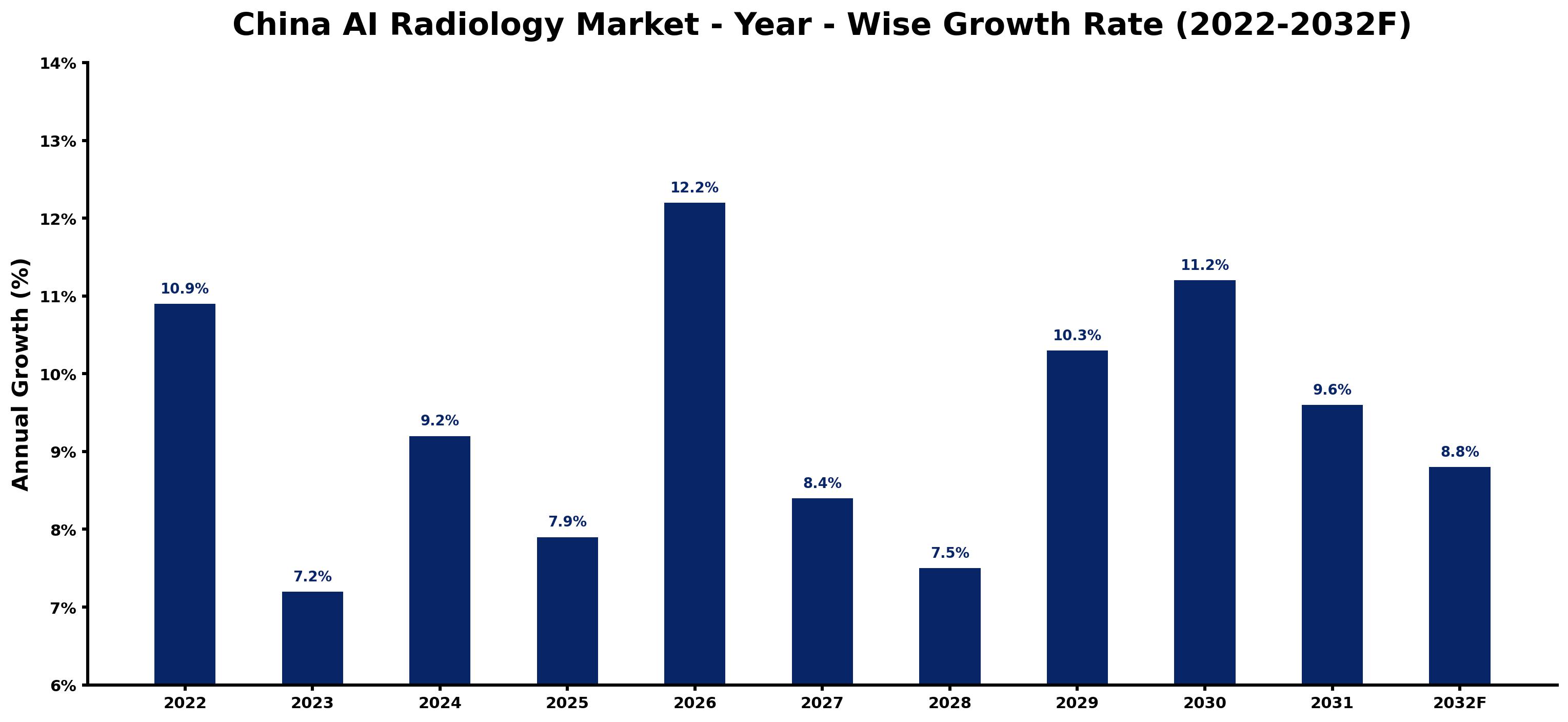
Each row of the following table gives one year's estimated growth and the event or demand shift that explains it.
| Year | Estimated Annual Growth (%) | Market Rationale |
| 2022 | 10.9 | The market experienced strong demand due to increased healthcare investments and technology adoption. |
| 2023 | 7.2 | Growth slowed as hospitals adjusted to new AI technologies and integration challenges. |
| 2024 | 9.2 | A rise in healthcare funding and AI applications led to faster growth this year. |
| 2025 | 7.9 | The market continued to expand as hospitals increased their AI capabilities and investments. |
| 2026 | 12.2 | A surge in healthcare technology funding and AI adoption is expected to drive growth this year. |
| 2027 | 8.4 | Growth is projected to slow as hospitals face integration challenges with existing systems. |
| 2028 | 7.5 | The 'Smart Healthcare Initiative' is expected to support AI integration, maintaining steady growth. |
| 2029 | 10.3 | An increase in AI-driven solutions for diagnostics will boost market growth this year. |
| 2030 | 11.2 | Healthcare providers will expand their AI capabilities, leading to further market growth. |
| 2031 | 9.6 | Growth is anticipated to slow as hospitals face challenges in scaling AI technologies effectively. |
| 2032 | 8.8 | The market is projected to continue growing as AI integration becomes standard in healthcare. |
Note: Market size estimations and growth projections presented in this report are based on 6Wresearch's proprietary forecasting methodology, utilizing the latest available industry data, government publications, and primary research inputs.
China AI Radiology Market Synopsis
AI Radiology Market in China involves integrating artificial intelligence technologies into radiological imaging processes, which improves diagnostic accuracy and efficiency. The China AI Radiology Market is growing due to increasing healthcare investments, with over 60% of urban hospitals adopting AI technologies by 2023. The National Health Commission's initiatives further support this growth, ensuring quality and safety in AI applications. This trend reflects a shift in how healthcare providers approach diagnostics, driven by technological advancements.
Market Dynamics Impact Analysis (2026–2032)
| Factor | Type | Impact | Primary Segment Affected |
| Growing investments in healthcare technology drive demand for AI solutions in diagnostics. | Driver | High | Tumor Detection |
| The rapid adoption of AI algorithms enhances diagnostic capabilities in hospitals. | Driver | High | Pattern Recognition |
| The increasing number of hospitals adopting AI technologies creates opportunities for suppliers. | Opportunity | High | Hospitals |
| The demand for efficient diagnostic solutions opens avenues for Medical SaaS Platforms. | Opportunity | High | Medical SaaS Platforms |
| Integration challenges with existing systems can hinder AI adoption in hospitals. | Restraint | High | Hospitals |
| Limited awareness of AI benefits among smaller healthcare facilities restricts market growth. | Restraint | Medium | Imaging Centers |
| High costs of AI implementation can deter smaller hospitals from adopting these technologies. | Challenge | High | Hospitals |
| Regulatory hurdles in AI approvals can delay the introduction of new solutions. | Challenge | Medium | Medical SaaS Platforms |
Evaluation of Drivers in China AI Radiology Market (2026–2032)
The main growth drivers and the segments they affect most are set out below.
| Drivers | Primary Segment Affected | Why It Matters (Evidence) |
| Increased healthcare investments support the adoption of AI technologies in diagnostics. | Tumor Detection | In 2023, the government allocated $500 million for healthcare technology advancements. |
| The integration of AI algorithms improves diagnostic accuracy and efficiency. | Pattern Recognition | AI algorithms for tumor detection have shown over 90% accuracy in clinical trials. |
| The expansion of urban hospitals adopting AI technologies boosts market demand. | Hospitals | Over 60% of urban hospitals in China have adopted AI technologies by 2023. |
| The rise of Medical SaaS Platforms offers AI-driven solutions for diagnostics. | Medical SaaS Platforms | These platforms provide essential data analysis tools for radiology departments. |
| Government initiatives promote AI integration in healthcare, enhancing market growth. | CT Imaging | The 'Smart Healthcare Initiative' launched in 2021 supports AI use in diagnostics. |
The AI Radiology market in China is growing on the back of increased healthcare investments, the rapid adoption of AI algorithms, and the expansion of urban hospitals. Urban hospitals have adopted AI technologies, improving diagnostic accuracy and efficiency. AI algorithms for tumour detection have shown over 90% accuracy in clinical trials, leading to greater trust in these technologies. The rise of Medical SaaS Platforms is providing solutions for data analysis in radiology departments, further boosting market growth.
Evaluation of Restraints in China AI Radiology Market
The table below lists the restraints and the evidence behind each.
| Market Restraint | Primary Segment Affected | Why It Matters (Evidence) |
| Integration challenges with existing systems can hinder AI adoption in hospitals. | Hospitals | Many hospitals face difficulties in merging AI technologies with their current infrastructure. |
| Limited awareness of AI benefits among smaller healthcare facilities restricts market growth. | Imaging Centers | Smaller facilities often lack the resources to understand and implement AI solutions. |
| High costs of AI implementation can deter smaller hospitals from adopting these technologies. | Hospitals | Smaller hospitals may find the investment in AI tools prohibitive given their budgets. |
| Regulatory hurdles in AI approvals can delay the introduction of new solutions. | Medical SaaS Platforms | Complex approval processes can slow down the deployment of new AI solutions. |
| Concerns over data privacy and security may limit AI adoption in healthcare. | Hospitals | Hospitals are cautious about integrating AI due to potential data breaches. |
China AI Radiology Market Challenges
The China AI Radiology market still faces several pressing issues, beginning with supply chain disruptions. Limited domestic production of AI radiology equipment forces hospitals to depend on imports, which made up 15% of total medical device imports in 2021, resulting in procurement delays. Rising costs are another hurdle; the need for advanced algorithms and machine learning technologies demands significant investment, increasing operational expenses for healthcare providers. Competition from numerous AI startups in the Shanghai region compels hospitals to adopt these technologies swiftly, which can strain their budgets. Buyers also encounter challenges with standardisation; inconsistent quality management practices under ISO 13485 lead to variable AI application across facilities, complicating integration efforts.
Trends in the China AI Radiology Market
Below mentioned are some of the trends shaping the China AI Radiology Market growth.
- Shift towards AI-Driven Diagnostic Solutions: Urban hospitals in China are increasingly adopting AI-driven diagnostic solutions, with over 60% having integrated AI technologies by 2023. This shift improves diagnostic accuracy and operational efficiency.
- Increased Adoption of Medical SaaS Platforms: Hospitals are increasingly turning to Medical SaaS Platforms for AI solutions, with these platforms holding a 40% market share in 2025. This trend reflects the growing need for efficient data analysis in radiology.
- Emergence of Advanced Tumour Detection Algorithms: The year 2023 marked the emergence of advanced tumour detection algorithms, achieving over 90% accuracy in clinical trials. This advancement is reshaping diagnostic practices across hospitals.
- Focus on Pattern Recognition Technologies: The focus on pattern recognition technologies is growing, with a CAGR of 11.8% expected from 2026 to 2032. This trend is driven by the need for improved diagnostic capabilities in imaging.
Investment Opportunities in the China AI Radiology Market
Below are the investment opportunities with the strongest case in the China AI Radiology Market.
- Partnerships with Hospitals: Now is the time to form partnerships with hospitals to supply AI-driven diagnostic tools, as over 60% have adopted AI technologies. This presents an opportunity for suppliers to increase their market presence.
- Investment in Medical SaaS Platforms: With a projected market share of 40% in 2025, investing in Medical SaaS Platforms is timely. These platforms are essential for hospitals seeking efficient AI solutions for data analysis.
- Development of AI Algorithms for Tumour Detection: The demand for AI algorithms for tumour detection is high, with clinical trials showing over 90% accuracy. Suppliers should focus on developing these algorithms to meet market needs.
- Expansion in Urban Healthcare Facilities: With healthcare investments increasing, there is a gap in AI integration in urban healthcare facilities. Suppliers can enter this market by partnering with local hospitals.
Government Initiatives in the China AI Radiology Market
The 'National Health Commission' approved the 'Radiology AI Standards' in 2023 to ensure quality and safety in AI applications. This measure builds on earlier initiatives, such as the 'Healthcare AI Development Plan' launched in 2021, which aimed to promote AI technologies in medical imaging. These standards will help streamline the integration of AI in radiology, ensuring that technologies meet safety and efficacy requirements. The 'AI in Healthcare Initiative' introduced by the 'Ministry of Industry and Information Technology' in 2022 supports hospitals in implementing AI technologies effectively, enhancing the overall quality of diagnostics.
In 2023, the 'Ministry of Science and Technology' initiated the 'AI Medical Research Program' with a budget of $200 million to support research and development in AI technologies. This program aims to boost the adoption of AI applications in healthcare settings. The 'National Healthcare Security Administration' also plays a role in funding healthcare technology advancements, ensuring that AI solutions are accessible to healthcare providers, thereby improving diagnostic capabilities.
Future Insight of the China AI Radiology Market
Several forward-looking factors should support the China AI Radiology market in the coming years. The National Health Commission's initiatives to promote AI integration will enhance diagnostic capabilities in healthcare settings. By 2032, over 60% of urban hospitals are expected to implement AI technologies in radiology, improving service delivery. The Smart Healthcare Initiative will encourage collaboration among stakeholders to standardise practices, ensuring consistent quality in AI diagnostics. Ongoing investments in healthcare technology will drive the development of more precise AI algorithms for medical imaging.
Market Segmentation Analysis
The report offers a comprehensive study of the following market segments and their leading categories in the market.
By Radiology Type – CT Imaging Dominated, Mammography Expected to Grow Fastest
According to Shubham Padhi, Research Analyst at 6Wresearch, CT Imaging took a 45% share of radiology type in 2025, more than any other category. CT Imaging holds the largest market share in China due to its extensive application in over 1,000 hospitals, providing detailed internal imaging and diagnosis. This technology's critical role in delivering accurate diagnostic insights ensures its continued dominance in the healthcare sector. Over 2026–2032, Mammography is expected to post the fastest growth, at a CAGR of 11.9%. Mammography is rapidly expanding, primarily due to its vital role in early breast cancer detection, which is increasingly emphasised in healthcare policies. The push from government initiatives to enhance cancer screening further accelerates this segment's growth. Suppliers should focus on enhancing mammography technologies to meet the rising demand for effective early detection solutions.
By AI Integration – Tumor Detection Dominated, Pattern Recognition Expected to Grow Fastest
With a 41% revenue share in 2025, Tumor Detection was the largest ai integration category. Tumor Detection leads the market share as it is essential for identifying malignancies in imaging studies, which are crucial for improving patient outcomes. The high accuracy rates of algorithms in clinical trials solidify its widespread adoption among healthcare providers. Pattern Recognition is set to record the highest CAGR in this split, 11.8% over 2026–2032. Pattern Recognition is experiencing significant growth, as it greatly improves the identification of complex patterns in medical images, which is necessary for accurate diagnostics. The increasing intricacy of medical imaging data drives the demand for advanced solutions, propelling this segment forward. Suppliers must concentrate on developing robust pattern recognition technologies to satisfy the growing need for precise diagnostic tools.
By Distribution Channel – Medical SaaS Platforms Dominated and Is Expected to Record the Fastest Growth
In 2025, Medical SaaS Platforms led the distribution channel split with a 40% share. Medical SaaS Platforms dominate the market share by providing essential solutions for radiological data analysis, making them vital for healthcare providers. Their capability to streamline processes and enhance diagnostic accuracy is a significant factor in their broad adoption across the industry. Medical SaaS Platforms are also forecast to expand faster than any other category, at a CAGR of 11.5% over 2026–2032. Medical SaaS Platforms are also the fastest-growing segment, fuelled by the rising necessity for efficient data management and analysis in radiology. As healthcare facilities aim to improve operational efficiency, reliance on these platforms is anticipated to increase. Suppliers should invest in advanced Medical SaaS solutions to capture the growing demand for effective radiological data management.
By End User – Hospitals Dominated, Imaging Centers Expected to Grow Fastest
Hospitals accounted for a 43% market share by end user in 2025. Hospitals represent the largest market share in AI radiology, as they are the primary facilities implementing AI technologies in their radiology departments. Their substantial resources and patient throughput enable effective implementation of advanced diagnostic solutions. Imaging Centers are projected to grow fastest, at a CAGR of 10.9% during 2026–2032. Imaging Centers are witnessing rapid growth, as these specialised facilities increasingly adopt AI for diagnostic imaging. The rising need for accessible and efficient imaging services is driving this segment's expansion. Suppliers should tailor their offerings to address the specific needs of imaging centers, which are becoming vital players in the AI radiology market.
Key Attractiveness of the Report
- 10 Years of Market Numbers
- Historical Data Starting from 2022 to 2025
- Base Year 2025
- Forecast Data until 2032
- Key Performance Indicators Impacting the Market
- Major Upcoming Developments and Projects
Key Highlights of the Report:
- China AI Radiology Market Outlook
- Market Size of China AI Radiology Market, 2025
- Forecast of China AI Radiology Market, 2032
- Historical Data and Forecast of China AI Radiology Revenues & Volume for the Period 2022 - 2032F
- China AI Radiology Market Trend Evolution
- China AI Radiology Market Drivers and Challenges
- China AI Radiology Price Trends
- China AI Radiology Porter's Five Forces
- China AI Radiology Industry Life Cycle
- Historical Data and Forecast of China AI Radiology Market Revenues & Volume By Radiology Type for the Period 2022 - 2032F
- Historical Data and Forecast of China AI Radiology Market Revenues & Volume By CT Imaging for the Period 2022 - 2032F
- Historical Data and Forecast of China AI Radiology Market Revenues & Volume By MRI Scans for the Period 2022 - 2032F
- Historical Data and Forecast of China AI Radiology Market Revenues & Volume By X-ray Imaging for the Period 2022 - 2032F
- Historical Data and Forecast of China AI Radiology Market Revenues & Volume By Mammography for the Period 2022 - 2032F
- Historical Data and Forecast of China AI Radiology Market Revenues & Volume By AI Integration for the Period 2022 - 2032F
- Historical Data and Forecast of China AI Radiology Market Revenues & Volume By Tumor Detection for the Period 2022 - 2032F
- Historical Data and Forecast of China AI Radiology Market Revenues & Volume By Pattern Recognition for the Period 2022 - 2032F
- Historical Data and Forecast of China AI Radiology Market Revenues & Volume By Abnormality Highlighting for the Period 2022 - 2032F
- Historical Data and Forecast of China AI Radiology Market Revenues & Volume By Risk Analysis for the Period 2022 - 2032F
- Historical Data and Forecast of China AI Radiology Market Revenues & Volume By Distribution Channel for the Period 2022 - 2032F
- Historical Data and Forecast of China AI Radiology Market Revenues & Volume By Diagnostic Equipment Dealers for the Period 2022 - 2032F
- Historical Data and Forecast of China AI Radiology Market Revenues & Volume By Medical SaaS Platforms for the Period 2022 - 2032F
- Historical Data and Forecast of China AI Radiology Market Revenues & Volume By Hospital IT Vendors for the Period 2022 - 2032F
- Historical Data and Forecast of China AI Radiology Market Revenues & Volume By Online Healthcare Portals for the Period 2022 - 2032F
- Historical Data and Forecast of China AI Radiology Market Revenues & Volume By End User for the Period 2022 - 2032F
- Historical Data and Forecast of China AI Radiology Market Revenues & Volume By Radiologists for the Period 2022 - 2032F
- Historical Data and Forecast of China AI Radiology Market Revenues & Volume By Hospitals for the Period 2022 - 2032F
- Historical Data and Forecast of China AI Radiology Market Revenues & Volume By Imaging Centers for the Period 2022 - 2032F
- Historical Data and Forecast of China AI Radiology Market Revenues & Volume By Women s Health Facilities for the Period 2022 - 2032F
- China AI Radiology Import Export Trade Statistics
- Market Opportunity Assessment By Radiology Type
- Market Opportunity Assessment By AI Integration
- Market Opportunity Assessment By Distribution Channel
- Market Opportunity Assessment By End User
- China AI Radiology Top Companies Market Share
- China AI Radiology Competitive Benchmarking By Technical and Operational Parameters
- China AI Radiology Company Profiles
- China AI Radiology Key Strategic Recommendations
Market Covered
This report examines the market across the segments below.
By Radiology Type
- CT Imaging
- MRI Scans
- X-ray Imaging
- Mammography
By AI Integration
- Tumor Detection
- Pattern Recognition
- Abnormality Highlighting
- Risk Analysis
By Distribution Channel
- Diagnostic Equipment Dealers
- Medical SaaS Platforms
- Hospital IT Vendors
- Online Healthcare Portals
By End User
- Radiologists
- Hospitals
- Imaging Centers
- Women's Health Facilities































