China AI Refactoring Tools Market Size & Growth Rate
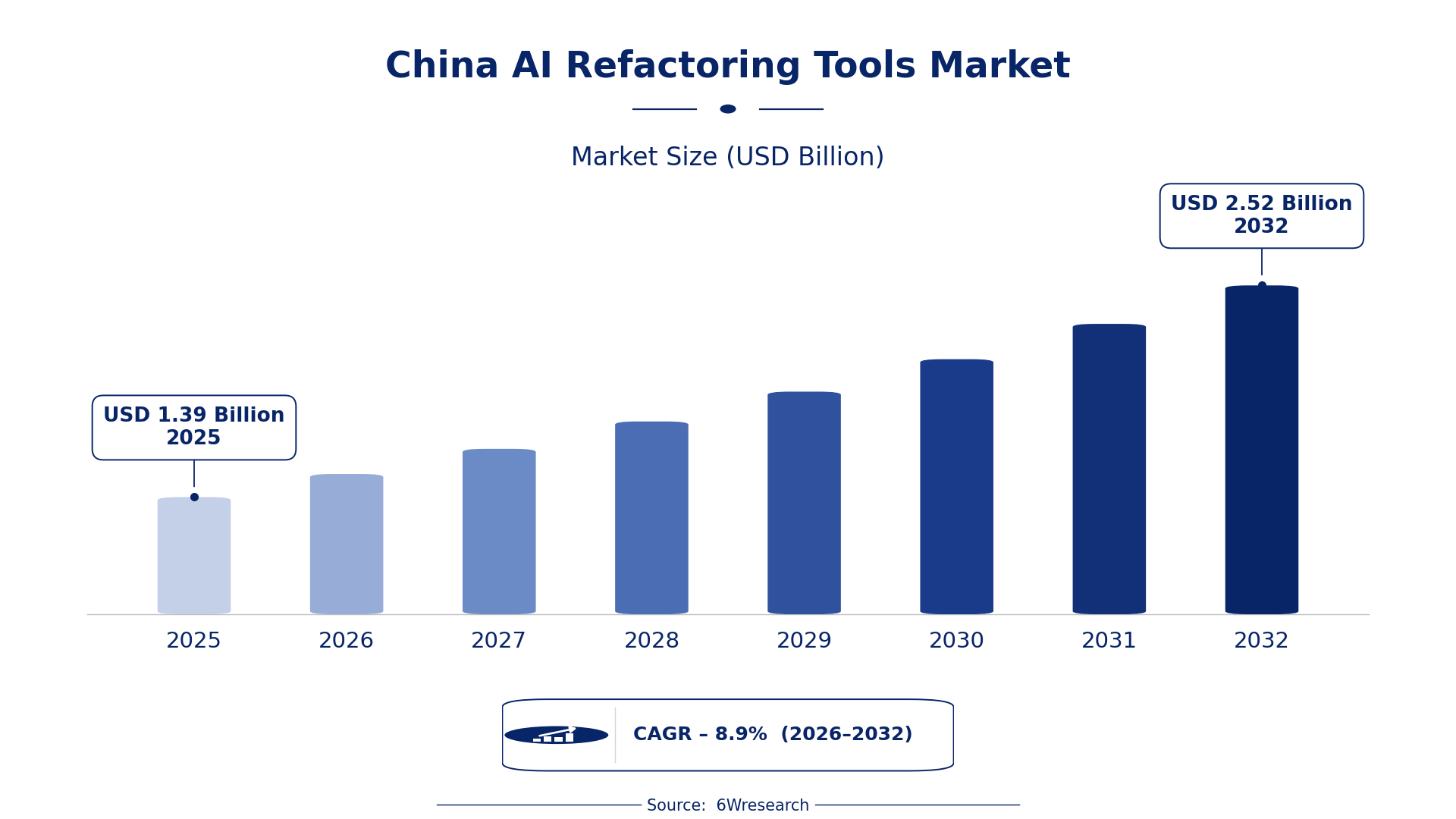
According to 6Wresearch internal database and industry insights, the China AI Refactoring Tools Market was valued at USD 1.39 billion in 2025 and is projected to reach USD 2.52 billion by 2032, growing at a CAGR of approximately 8.9% during 2026–2032.
China AI Refactoring Tools Market Highlights
| Report Metric | Details |
| Report Name | China AI Refactoring Tools Market |
| Market Size 2025 | USD 1.39 billion |
| Market Size 2032 | USD 2.52 billion |
| Absolute Growth 2025–2032 | USD 1.13 billion |
| CAGR 2026–2032 | 8.9% |
| Peak Annual Growth | 11.4% in 2028 |
| Forecast Period | 2026–2032 |
| Historical Data | 2022–2025 |
| Base Year | 2025 |
| Leading Tool Type, 2025 | Code Optimization (42% share) |
| Leading AI Capability, 2025 | Static Code Analysis (39% share) |
| Leading Distribution Channel, 2025 | Developer SaaS Tools (47% share) |
| Leading End User, 2025 | Software Development Teams (49% share) |
| Fastest-Growing Tool Type | Auto-Refactoring (11.6% CAGR) |
| Fastest-Growing AI Capability | Pattern Learning (10.2% CAGR) |
| Fastest-Growing Distribution Channel | DevOps Toolkits (10.4% CAGR) |
| Fastest-Growing End User | Engineering Departments (11.2% CAGR) |
| Growing Sector | Engineering Departments |
| Key End Users | Software Development Teams, Engineering Departments, Software Vendors, QA Teams |
China AI Refactoring Tools Market Year-wise Growth Rate and Key Drivers (2022–2032)
This graph illustrates the annual growth rates of the market from 2022 to 2032, highlighting a steady upward trajectory and projected market expansion over the forecast period.
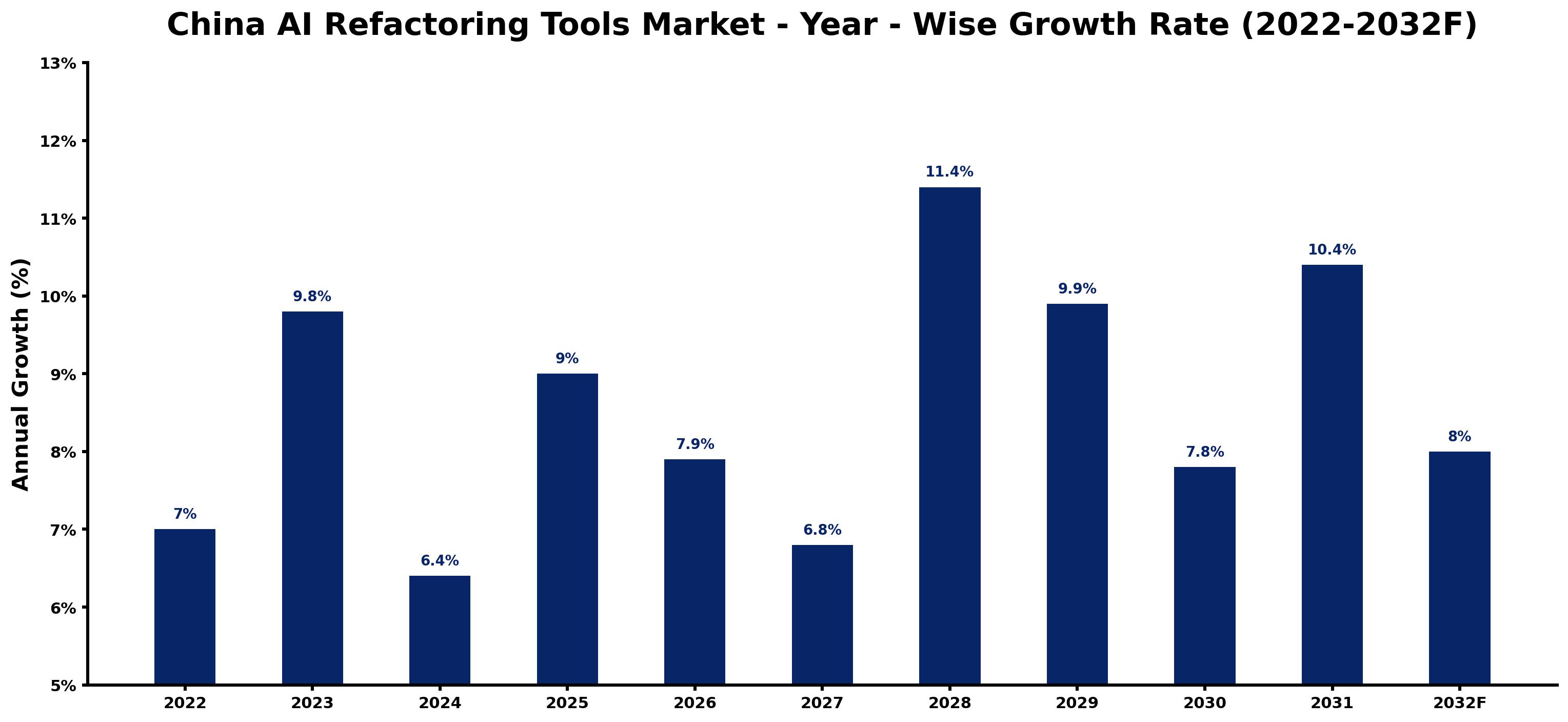
The table below sets out the estimated growth rate for each year and the main factor behind it.
| Year | Estimated Annual Growth (%) | Market Rationale |
| 2022 | 7.0 | The market saw growth due to a strong base of software developers engaged in various projects. |
| 2023 | 9.8 | Demand surged as the software industry generated over 8 trillion CNY in revenue. |
| 2024 | 6.4 | Growth slowed as some developers faced challenges in adopting new technologies. |
| 2025 | 9.0 | Increased adoption of Agile methodologies among software teams drove faster growth. |
| 2026 | 7.9 | Demand growth is expected to slow as developers adjust to evolving market needs. |
| 2027 | 6.8 | The market will continue to grow as software development teams seek efficiency improvements. |
| 2028 | 11.4 | A peak in growth is projected as AI-driven tools become essential for code management. |
| 2029 | 9.9 | Growth is expected to moderate as the market adjusts to rapid technological advancements. |
| 2030 | 7.8 | Continued demand for AI tools will keep the market expanding, albeit at a slower rate. |
| 2031 | 10.4 | A resurgence in growth is anticipated as more engineering departments adopt AI refactoring tools. |
| 2032 | 8.0 | The market is expected to grow steadily as software quality standards evolve. |
Note: Market size estimations and growth projections presented in this report are based on 6Wresearch's proprietary forecasting methodology, utilizing the latest available industry data, government publications, and primary research inputs.
China AI Refactoring Tools Market Synopsis
The AI Refactoring Tools Market in China includes software applications that optimise existing codebases using artificial intelligence. These tools enhance code quality, lower technical debt, and automate repetitive tasks. The market is expanding due to strong demand from software development teams and engineering departments. The software industry generated over 8 trillion CNY in revenue in 2022, propelling the adoption of AI-driven tools. The 'Digital China' initiative is anticipated to further improve software capabilities, contributing to the market's growth.
Market Dynamics Impact Analysis (2026–2032)
| Factor | Type | Impact | Primary Segment Affected |
| Growing number of software developers in China | Driver | High | Software Development Teams |
| Increased revenue in the software industry | Driver | High | Engineering Departments |
| Rising demand for AI-driven tools to improve efficiency | Opportunity | High | Software Development Teams |
| Expansion of Agile methodologies among software teams | Opportunity | High | Engineering Departments |
| Challenges in adopting new technologies among developers | Restraint | Medium | Software Development Teams |
| Limited awareness of AI refactoring tools' benefits | Restraint | Medium | Engineering Departments |
| The AI Refactoring Tools market in China faces a few practical problems, including high costs of implementation. | Challenge | High | Software Development Teams |
| Competition from established software development practices poses challenges. | Challenge | Medium | Engineering Departments |
Evaluation of Drivers in China AI Refactoring Tools Market (2026–2032)
Below mentioned are some major drivers and their influence on market dynamics.
| Drivers | Primary Segment Affected | Why It Matters (Evidence) |
| Growing number of software developers | Software Development Teams | With approximately 1.2 million developers in China, demand for AI refactoring tools is increasing as teams seek to improve productivity. |
| Revenue growth in the software industry | Engineering Departments | The software industry generated over 8 trillion CNY in 2022, prompting engineering departments to invest in AI-driven solutions. |
| Adoption of Agile methodologies | Software Development Teams | Over 70% of software teams in China adopt Agile methodologies, driving the need for tools that improve code quality. |
| Government initiatives supporting software innovation | Software Development Teams | The 'Digital China' initiative launched in 2023 aims to improve software capabilities, increasing demand for AI refactoring tools. |
| Focus on reducing technical debt | Software Development Teams | As technical debt rises, development teams are investing in AI tools to automate code improvements. |
The AI Refactoring Tools market in China is expanding due to increasing investment in software development and a growing demand for efficiency among developers. The software industry generated over 8 trillion CNY in revenue in 2022, encouraging engineering departments to pursue AI-driven solutions. The rising number of software developers is creating a need for advanced tools to boost productivity. As technical debt increases, development teams are turning to AI tools to automate code improvements.
Evaluation of Restraints in China AI Refactoring Tools Market
The following restraints limit how fast demand can grow.
| Market Restraint | Primary Segment Affected | Why It Matters (Evidence) |
| High costs of implementation | Software Development Teams | Many developers find the initial investment in AI refactoring tools to be a barrier, averaging around 100,000 CNY per tool. |
| Limited awareness of benefits | Engineering Departments | Some engineering departments are not fully aware of how AI tools can improve their workflows, hindering adoption. |
| Resistance to change in established practices | Software Development Teams | Developers accustomed to traditional coding practices may resist adopting AI-driven solutions, delaying project timelines. |
| Skill gaps in AI technologies | Engineering Departments | A lack of skilled personnel familiar with AI refactoring tools can hinder adoption and integration into workflows. |
| Concerns over data security | Software Development Teams | Developers may hesitate to use AI tools due to fears of compromising code security, affecting their willingness to adopt new technologies. |
China AI Refactoring Tools Market Challenges
The China AI Refactoring Tools market encounters several practical issues, starting with limited adoption among buyers. Many software development teams prefer traditional coding methods, which can delay project timelines by up to 20%. Supply chain inconsistencies restrict the availability of high-quality AI refactoring tools, limiting software teams' ability to enhance codebases effectively. High implementation costs, averaging around 100,000 CNY per tool, deter smaller firms and contribute to an accumulation of technical debt. Competition from international solutions pressures local developers, forcing them to prioritise price over innovation.
Trends in the China AI Refactoring Tools Market
Four trends stand out in the China AI Refactoring Tools Market.
- Shift from Manual to Automated Refactoring: Since 2023, engineering departments in China have increasingly adopted automated refactoring tools to improve code quality. This shift is expected to drive demand for AI-driven solutions up by 30% annually over the next five years.
- Growing Emphasis on Agile Methodologies: In 2023, software development teams in Beijing are prioritising Agile methodologies, leading to a surge in demand for AI refactoring tools. A significant portion of teams are now utilising these methodologies, increasing the need for enhanced coding efficiency.
- Increased Focus on Software Quality Standards: The introduction of the National Standard for Software Quality (GB/T 25000) in 2020 has led to a stronger focus on code quality among developers. This standard is prompting teams to adopt AI refactoring tools to ensure compliance, thereby enhancing their market competitiveness.
- Expansion of AI Capabilities in Development Tools: The 'Digital China' initiative launched in 2023 is promoting the integration of AI capabilities in software development tools. This initiative aims to improve software capabilities, resulting in projected growth in AI tool adoption.
Investment Opportunities in the China AI Refactoring Tools Market
Several openings in the China AI Refactoring Tools Market merit attention from investors.
- Beijing as a Hub for Software Development: Beijing is experiencing a surge in software development activities, with over 1.2 million developers. This presents an opportunity to supply AI refactoring tools to local teams looking to improve productivity.
- Demand for AI Tool Adoption: With the demand for AI-driven tools expected to rise by 30% annually, there is a gap in supply. Software vendors should focus on developing AI refactoring tools tailored for engineering departments.
- Timing for Investment in AI Solutions: As the software industry generated over 8 trillion CNY in revenue in 2022, now is an ideal time to invest in AI refactoring tools. Targeting software development teams can yield substantial returns.
- Partnerships with Local Developers: Forming partnerships with local software development teams can facilitate entry into the Chinese market. Collaborating with teams in Shanghai can improve the adoption of AI refactoring tools.
Government Initiatives in the China AI Refactoring Tools Market
The National Standard for Software Quality (GB/T 25000) established in 2020 influences software development practices in China. This standard requires that software products meet specific quality benchmarks, compelling developers to adopt AI refactoring tools to ensure compliance. By adhering to these standards, teams can improve code quality and reduce technical debt, ultimately enhancing their competitive edge in the market. The Ministry of Industry and Information Technology supports initiatives that promote software innovation, further encouraging the adoption of AI-driven solutions.
The China Software Industry Association plays a key role in promoting best practices and standards among software developers. Through various schemes, the association provides funding for projects aimed at improving software capabilities. Engineering departments benefit from these initiatives as they gain access to resources that facilitate the integration of AI refactoring tools into their workflows. Additionally, the association's efforts to raise awareness about the advantages of AI tools contribute to a more informed developer community.
Future Insight of the China AI Refactoring Tools Market
The China AI Refactoring Tools market is projected to evolve significantly by 2032, driven by key factors. The 'Digital China' initiative will improve software capabilities, creating a more supportive environment for AI tool integration. Demand for AI-driven tools will increase by 30% annually, indicating a shift towards automation in coding practices. These trends will enable suppliers to innovate and better meet the specific requirements of software developers.
Market Segmentation Analysis
The report offers a comprehensive study of the following market segments and their leading categories in the market.
By Tool Type – Code Optimization Dominated, Auto-Refactoring Expected to Grow Fastest
According to Shubham Padhi, Research Analyst at 6Wresearch, Code Optimization took a 42% share of tool type in 2025, more than any other category. Code Optimization holds the largest share because it directly improves code efficiency and performance, which is essential for software development teams. The robust presence of approximately 1.2 million software developers in China drives the demand for these tools, ensuring their widespread adoption. The quickest growth will come from Auto-Refactoring, forecast to expand at a CAGR of 11.6% between 2026 and 2032. Auto-Refactoring is rapidly growing as it automates code restructuring, enhancing readability significantly. The increasing adoption of Agile methodologies among over 70% of software teams will further accelerate the demand for such tools. Suppliers should focus on developing advanced Auto-Refactoring solutions to seize the expanding market share.
By AI Capability – Static Code Analysis Dominated, Pattern Learning Expected to Grow Fastest
In 2025, Static Code Analysis led the ai capability split with a 39% share. Static Code Analysis leads the market as it effectively identifies potential errors and vulnerabilities in code, crucial for maintaining software quality. This capability is highly sought after by the extensive number of software development teams in China, solidifying its market dominance. Over 2026–2032, Pattern Learning is expected to post the fastest growth, at a CAGR of 10.2%. Pattern Learning is projected to grow quickly as it enhances code quality through the application of learned best practices. The rising emphasis on best practices in software development will significantly boost its adoption among teams. Buyers should prioritise tools that incorporate Pattern Learning to maintain a competitive edge in software development.
By Distribution Channel – Developer SaaS Tools Dominated, DevOps Toolkits Expected to Grow Fastest
Developer SaaS Tools held a 47% share of the China AI Refactoring Tools Market by distribution channel in 2025. Developer SaaS Tools dominate the market as they are extensively used by developers for code management, allowing seamless integration into their workflows. This widespread adoption reflects the robust software development activities concentrated in major regions like Beijing and Shanghai. DevOps Toolkits are set to record the highest CAGR in this split, 10.4% over 2026–2032. DevOps Toolkits are rapidly gaining traction as they integrate into workflows for continuous integration, aligning with the industry's shift towards Agile practices. This trend indicates a growing preference for tools that support collaborative development processes. Suppliers must enhance their offerings in DevOps Toolkits to meet the increasing demand from software development teams.
By End User – Software Development Teams Dominated, Engineering Departments Expected to Grow Fastest
The largest end user category in 2025 was Software Development Teams, with a 49% share of total revenue. Software Development Teams account for the largest share of the market, as they are the primary users of refactoring tools essential for their ongoing projects. The substantial number of software developers in China significantly drives the demand for these tools. Engineering Departments are projected to grow fastest, at a CAGR of 11.2% during 2026–2032. Engineering Departments are experiencing the fastest growth as they increasingly utilise tools for project development, reflecting the industry's broader push for efficiency. This trend indicates a shift towards more structured development practices within these departments. Suppliers should tailor their solutions to address the specific needs of Engineering Departments to capture this growing segment.
Key Attractiveness of the Report
- 10 Years of Market Numbers
- Historical Data Starting from 2022 to 2025
- Base Year 2025
- Forecast Data until 2032
- Key Performance Indicators Impacting the Market
- Major Upcoming Developments and Projects
Key Highlights of the Report:
- China AI Refactoring Tools Market Outlook
- Market Size of China AI Refactoring Tools Market, 2025
- Forecast of China AI Refactoring Tools Market, 2032
- Historical Data and Forecast of China AI Refactoring Tools Revenues & Volume for the Period 2022 - 2032F
- China AI Refactoring Tools Market Trend Evolution
- China AI Refactoring Tools Market Drivers and Challenges
- China AI Refactoring Tools Price Trends
- China AI Refactoring Tools Porter's Five Forces
- China AI Refactoring Tools Industry Life Cycle
- Historical Data and Forecast of China AI Refactoring Tools Market Revenues & Volume By Tool Type for the Period 2022 - 2032F
- Historical Data and Forecast of China AI Refactoring Tools Market Revenues & Volume By Code Optimization for the Period 2022 - 2032F
- Historical Data and Forecast of China AI Refactoring Tools Market Revenues & Volume By Auto-Refactoring for the Period 2022 - 2032F
- Historical Data and Forecast of China AI Refactoring Tools Market Revenues & Volume By Language Conversion for the Period 2022 - 2032F
- Historical Data and Forecast of China AI Refactoring Tools Market Revenues & Volume By Test Generation for the Period 2022 - 2032F
- Historical Data and Forecast of China AI Refactoring Tools Market Revenues & Volume By AI Capability for the Period 2022 - 2032F
- Historical Data and Forecast of China AI Refactoring Tools Market Revenues & Volume By Static Code Analysis for the Period 2022 - 2032F
- Historical Data and Forecast of China AI Refactoring Tools Market Revenues & Volume By Pattern Learning for the Period 2022 - 2032F
- Historical Data and Forecast of China AI Refactoring Tools Market Revenues & Volume By NLP & Code AI for the Period 2022 - 2032F
- Historical Data and Forecast of China AI Refactoring Tools Market Revenues & Volume By Unit Test Suggestion for the Period 2022 - 2032F
- Historical Data and Forecast of China AI Refactoring Tools Market Revenues & Volume By Distribution Channel for the Period 2022 - 2032F
- Historical Data and Forecast of China AI Refactoring Tools Market Revenues & Volume By Developer SaaS Tools for the Period 2022 - 2032F
- Historical Data and Forecast of China AI Refactoring Tools Market Revenues & Volume By DevOps Toolkits for the Period 2022 - 2032F
- Historical Data and Forecast of China AI Refactoring Tools Market Revenues & Volume By IDE Marketplaces for the Period 2022 - 2032F
- Historical Data and Forecast of China AI Refactoring Tools Market Revenues & Volume By Online Code Platforms for the Period 2022 - 2032F
- Historical Data and Forecast of China AI Refactoring Tools Market Revenues & Volume By End User for the Period 2022 - 2032F
- Historical Data and Forecast of China AI Refactoring Tools Market Revenues & Volume By Software Development Teams for the Period 2022 - 2032F
- Historical Data and Forecast of China AI Refactoring Tools Market Revenues & Volume By Engineering Departments for the Period 2022 - 2032F
- Historical Data and Forecast of China AI Refactoring Tools Market Revenues & Volume By Software Vendors for the Period 2022 - 2032F
- Historical Data and Forecast of China AI Refactoring Tools Market Revenues & Volume By QA Teams for the Period 2022 - 2032F
- China AI Refactoring Tools Import Export Trade Statistics
- Market Opportunity Assessment By Tool Type
- Market Opportunity Assessment By AI Capability
- Market Opportunity Assessment By Distribution Channel
- Market Opportunity Assessment By End User
- China AI Refactoring Tools Top Companies Market Share
- China AI Refactoring Tools Competitive Benchmarking By Technical and Operational Parameters
- China AI Refactoring Tools Company Profiles
- China AI Refactoring Tools Key Strategic Recommendations
Market Covered
Segments analysed in this report are listed below.
By Tool Type
- Code Optimization
- Auto-Refactoring
- Language Conversion
- Test Generation
By AI Capability
- Static Code Analysis
- Pattern Learning
- NLP & Code AI
- Unit Test Suggestion
By Distribution Channel
- Developer SaaS Tools
- DevOps Toolkits
- IDE Marketplaces
- Online Code Platforms
By End User
- Software Development Teams
- Engineering Departments
- Software Vendors
- QA Teams































