China Facade Market Top 5 Importing Countries and Market Competition (HHI) Analysis
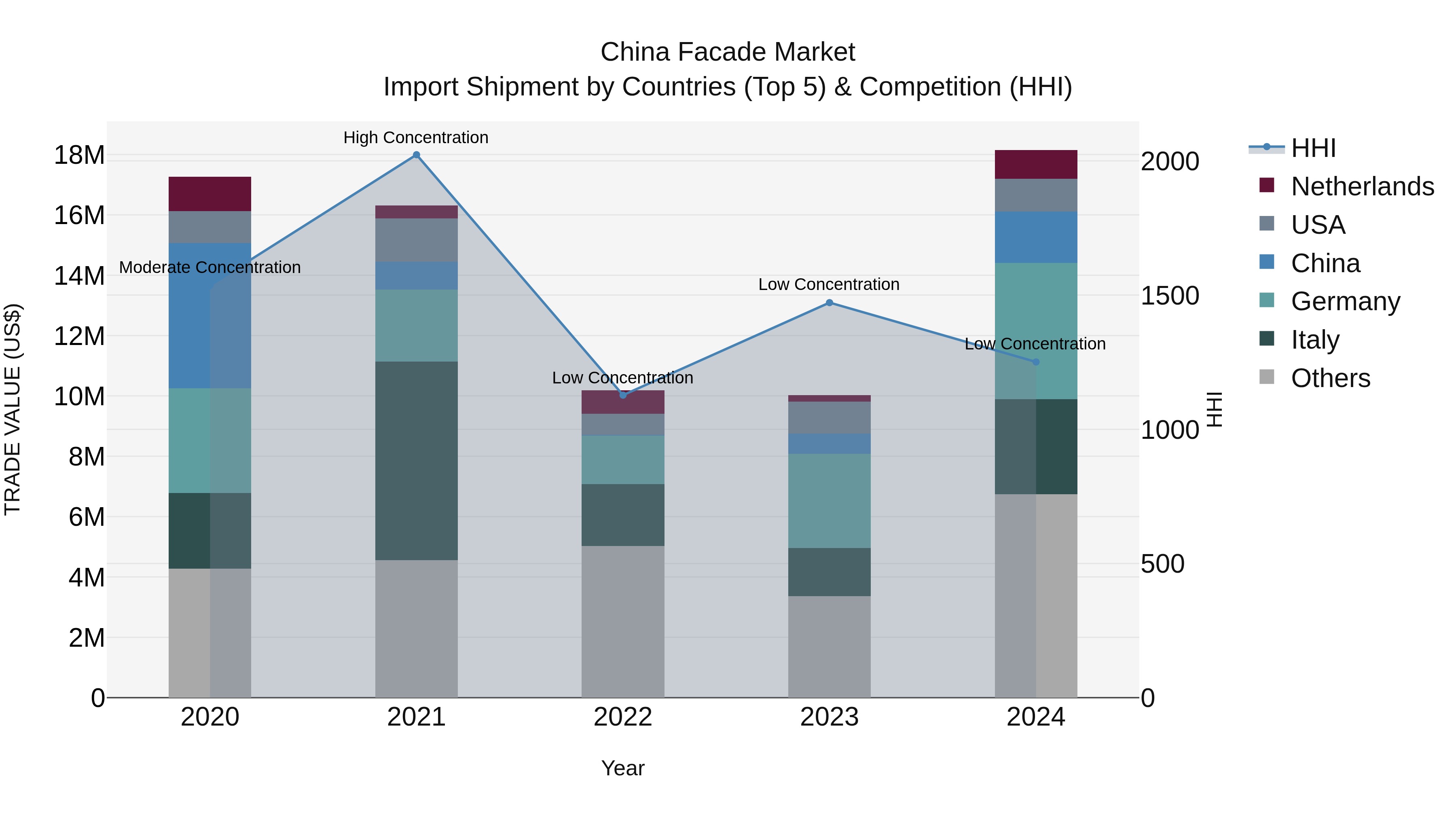
China facade import shipments in 2024 saw significant growth, with top exporting countries being Germany, Italy, Czechia, and Switzerland. The Herfindahl-Hirschman Index (HHI) indicated low market concentration, fostering competition. The compound annual growth rate (CAGR) from 2020 to 2024 was steady at 1.26, while the growth rate in 2024 spiked impressively at 81.01%. This data suggests a thriving market for facade imports in China, with diverse sources and strong momentum for further expansion.
China Facade Market Synopsis
The China facade market is experiencing rapid growth due to urbanization, infrastructure development, and increasing investments in commercial and residential construction projects. The market is driven by factors such as the demand for energy-efficient building solutions, advancements in facade technology, and a growing focus on sustainable construction practices. Key players in the market are focusing on innovative designs, materials, and technologies to meet the evolving needs of the construction industry. Additionally, government initiatives promoting green building practices and stringent regulations related to energy efficiency are further propelling the growth of the facade market in China. Overall, the China facade market presents significant opportunities for industry players looking to capitalize on the country`s booming construction sector.
China Facade Market Trends
The China Facade Market is witnessing several key trends. One prominent trend is the increasing demand for energy-efficient and sustainable facade solutions to reduce carbon emissions and improve building performance. This has led to a growing adoption of green building technologies such as double-skin facades, solar shading systems, and insulated glass panels. Another trend is the rise of smart facades integrated with IoT technology for better control over lighting, ventilation, and overall building management. Additionally, there is a growing preference for aesthetically pleasing and innovative facade designs that reflect the cultural identity and architectural heritage of China. Overall, the China Facade Market is evolving towards more sustainable, technologically advanced, and visually appealing solutions to meet the demands of modern construction projects.
China Facade Market Challenges
The China facade market faces several challenges, including intense competition among local and international players, regulatory complexities, and fluctuating raw material costs. Local players are increasingly gaining market share, posing a challenge to foreign companies. Additionally, stringent environmental regulations and building codes require compliance, impacting design and material choices. The market`s sensitivity to economic conditions and shifts in construction activity also present challenges, as demand can be unpredictable. Managing labor costs and skilled labor shortages further add to the complexities faced by companies operating in the China facade market. Overall, navigating these challenges requires a deep understanding of the local market dynamics and a strategic approach to remain competitive and profitable.
China Facade Market Investment Opportunities
The China Facade Market offers attractive investment opportunities due to the increasing demand for modern, energy-efficient building exteriors in the country`s rapidly growing urban areas. Key areas for investment include advanced facade materials such as high-performance glass, aluminum composite panels, and ventilated facades to meet stringent energy efficiency and sustainability requirements. Additionally, the market for smart facades incorporating technologies like sensors, automation, and renewable energy systems is expanding as building owners seek to optimize energy usage and enhance occupant comfort. With the Chinese government`s focus on urban development and environmental sustainability, investing in the China Facade Market presents opportunities for growth and innovation in the construction industry.
Jordan Agar Market Government Policies
The Chinese government has implemented various policies related to the facade market, with a focus on promoting energy efficiency and sustainability in building construction. The "Green Building Action Plan" encourages the use of environmentally friendly materials and technologies in facades to reduce energy consumption and carbon emissions. Additionally, the government has introduced standards and regulations for facade design and construction to ensure safety and quality. Incentives such as tax breaks and subsidies are also provided to encourage the adoption of energy-efficient facade solutions. Overall, the government`s policies aim to drive innovation and development in the facade market while addressing environmental concerns and promoting sustainable urban development.
China Facade Market Future Outlook
The future outlook for the China facade market appears promising, driven by rapid urbanization, increasing construction activities, and a growing focus on energy-efficient building solutions. The demand for aesthetically pleasing, durable, and sustainable building facades is expected to rise as the construction industry continues to expand. Additionally, government initiatives promoting green buildings and stringent regulations regarding energy efficiency are likely to boost the adoption of advanced facade systems in China. With a rising middle-class population and a shift towards smart building technologies, the market is anticipated to witness significant growth in the coming years. Overall, the China facade market is poised for substantial development, presenting opportunities for manufacturers, suppliers, and industry stakeholders to capitalize on the evolving architectural landscape.
Key Highlights of the Report:
- China Facade Market Outlook
- Market Size of China Facade Market, 2024
- Forecast of China Facade Market, 2031
- Historical Data and Forecast of China Facade Revenues & Volume for the Period 2021 - 2031
- China Facade Market Trend Evolution
- China Facade Market Drivers and Challenges
- China Facade Price Trends
- China Facade Porter's Five Forces
- China Facade Industry Life Cycle
- Historical Data and Forecast of China Facade Market Revenues & Volume By Product for the Period 2021 - 2031
- Historical Data and Forecast of China Facade Market Revenues & Volume By Ventilated Facades for the Period 2021 - 2031
- Historical Data and Forecast of China Facade Market Revenues & Volume By Non-ventilated Facades for the Period 2021 - 2031
- Historical Data and Forecast of China Facade Market Revenues & Volume By Others for the Period 2021 - 2031
- Historical Data and Forecast of China Facade Market Revenues & Volume By End-use for the Period 2021 - 2031
- Historical Data and Forecast of China Facade Market Revenues & Volume By Commercial for the Period 2021 - 2031
- Historical Data and Forecast of China Facade Market Revenues & Volume By Residential for the Period 2021 - 2031
- Historical Data and Forecast of China Facade Market Revenues & Volume By Industrial for the Period 2021 - 2031
- China Facade Import Export Trade Statistics
- Market Opportunity Assessment By Product
- Market Opportunity Assessment By End-use
- China Facade Top Companies Market Share
- China Facade Competitive Benchmarking By Technical and Operational Parameters
- China Facade Company Profiles
- China Facade Key Strategic Recommendations






































