China Hygiene Tools Market Size & Growth Rate
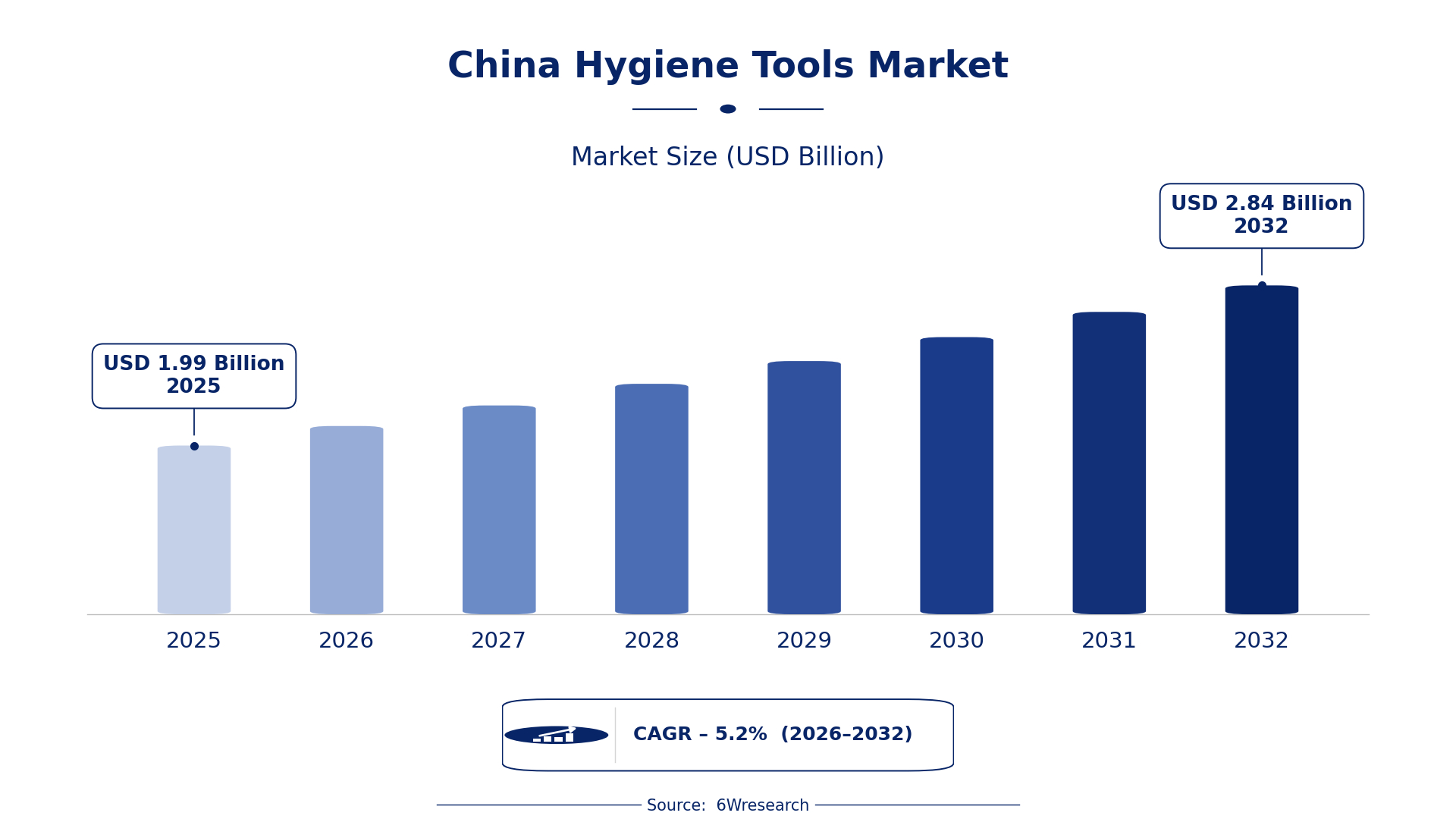
According to 6Wresearch internal database and industry insights, the China Hygiene Tools Market was valued at USD 1.99 billion in 2025 and is projected to reach USD 2.84 billion by 2032, growing at a CAGR of approximately 5.2% during 2026–2032.
China Hygiene Tools Market Highlights
| Report Metric | Details |
| Report Name | China Hygiene Tools Market |
| Market Size 2025 | USD 1.99 billion |
| Market Size 2032 | USD 2.84 billion |
| Absolute Growth 2025–2032 | USD 0.85 billion |
| CAGR 2026–2032 | 5.2% |
| Peak Annual Growth | 6.8% in 2030 |
| Forecast Period | 2026–2032 |
| Historical Data | 2022–2025 |
| Base Year | 2025 |
| Leading Tool Type, 2025 | Toilet Brushes (35% share) |
| Leading Material Used, 2025 | Plastic/Nylon (38% share) |
| Leading Application Area, 2025 | Bathroom Cleaning (42% share) |
| Leading End User, 2025 | Households (48% share) |
| Fastest-Growing Tool Type | Floor Mops (7.2% CAGR) |
| Fastest-Growing Material Used | Microfiber/Cotton (6.4% CAGR) |
| Fastest-Growing Application Area | Floor Hygiene (7.5% CAGR) |
| Fastest-Growing End User | Commercial Cleaners (6.8% CAGR) |
| Growing Sector | Household Cleaning |
| Key End Users | Households, Healthcare Facilities, Commercial Cleaners, Food Service Units |
China Hygiene Tools Market Year-wise Growth Rate and Key Drivers (2022–2032)
This graph illustrates the annual growth rates of the market from 2022 to 2032, highlighting a steady upward trajectory and projected market expansion over the forecast period.
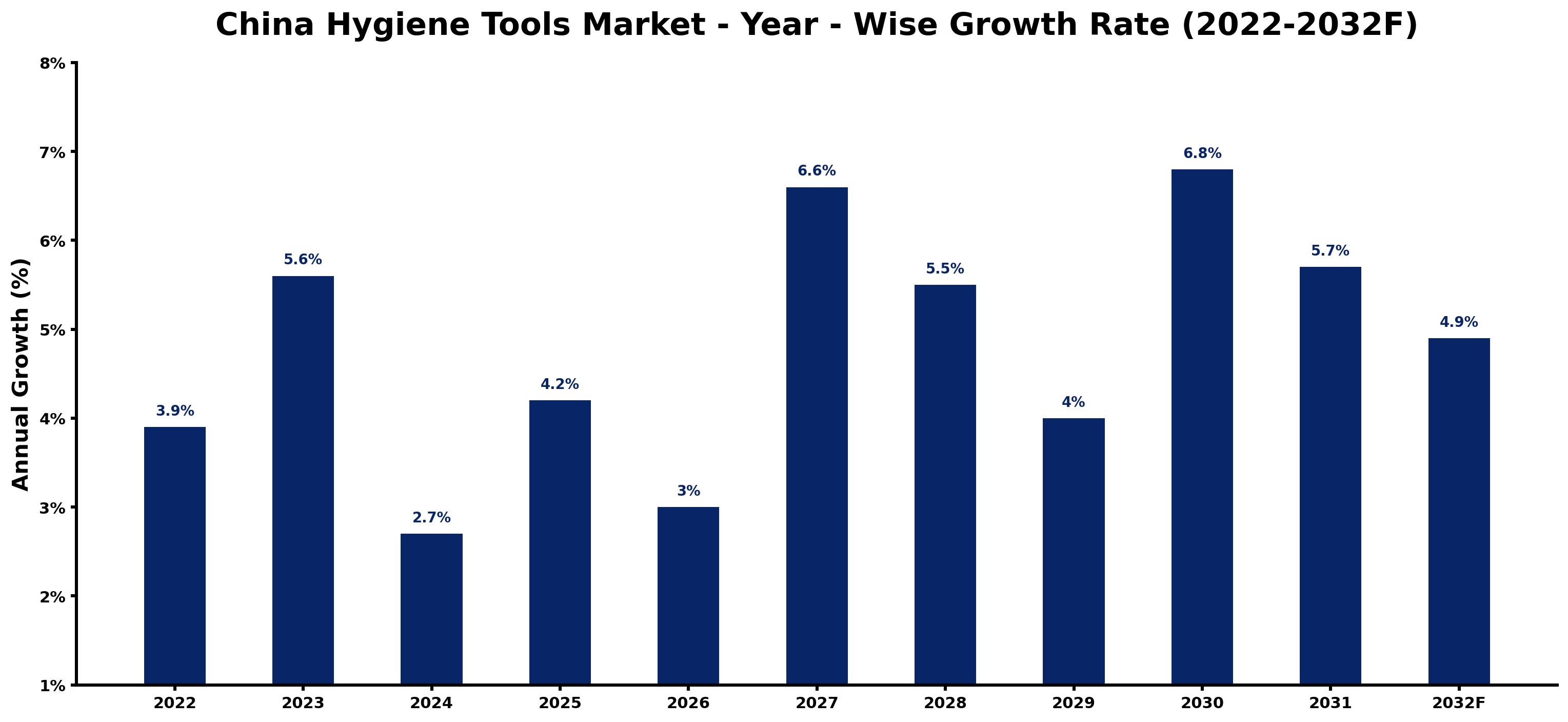
Annual growth estimates for each year appear below with the principal reason behind them, explaining the shifts that set the pace of the market.
| Year | Estimated Annual Growth (%) | Market Rationale |
| 2022 | 3.9 | The market showed steady demand due to a large population and increasing hygiene awareness. |
| 2023 | 5.6 | Demand surged as urban households adopted more hygiene tools amid rising cleanliness standards. |
| 2024 | 2.7 | A slowdown occurred as the market adjusted to previous high growth rates and changing consumer preferences. |
| 2025 | 4.2 | Demand increased again as households sought effective cleaning solutions and disposable products gained traction. |
| 2026 | 3.0 | Growth is expected to slow as consumer preferences shift towards premium products and market conditions normalise. |
| 2027 | 6.6 | A surge in demand is projected due to the growing commercial cleaning sector and increased healthcare facility needs. |
| 2028 | 5.5 | The market is expected to experience a slowdown as growth rates normalise after the previous year's peak. |
| 2029 | 4.0 | Demand will continue to slow as consumers focus on essential purchases amid economic adjustments. |
| 2030 | 6.8 | A significant growth spike is anticipated driven by new sanitation standards and increased healthcare spending. |
| 2031 | 5.7 | Growth is projected to decelerate as the market stabilises after rapid expansions in previous years. |
| 2032 | 4.9 | The market is expected to grow steadily as consumer awareness of hygiene remains high. |
Note: Market size estimations and growth projections presented in this report are based on 6Wresearch's proprietary forecasting methodology, utilizing the latest available industry data, government publications, and primary research inputs.
China Hygiene Tools Market Synopsis
Hygiene Tools in China include a range of cleaning implements designed to uphold cleanliness and sanitation. Constructed from materials such as plastic, nylon, and microfiber, these tools cater to household cleaning, commercial sanitation, and healthcare maintenance. The demand for Hygiene Tools in China is propelled by a growing urban population and healthcare facilities, along with heightened awareness of hygiene standards. In 2022, China's population was around 1.4 billion, which plays a crucial role in the increasing need for effective cleaning solutions.
Market Dynamics Impact Analysis (2026–2032)
| Factor | Type | Impact | Primary Segment Affected |
| High demand from urban households seeking effective cleaning solutions. | Driver | High | Households |
| Rising healthcare facility needs for sanitation tools boosts market growth. | Driver | High | Healthcare Facilities |
| Increasing adoption of eco-friendly hygiene products presents growth opportunities. | Opportunity | High | Plastic/Nylon |
| Growing commercial cleaning services create demand for various hygiene tools. | Opportunity | High | Commercial Cleaners |
| High competition among manufacturers may lead to price wars and reduced margins. | Restraint | Medium | Disposable Wipes Tools |
| Consumer preference for premium products may limit market access for budget brands. | Restraint | Medium | Floor Mops |
| Supply chain disruptions can delay product availability for buyers. | Challenge | High | Toilet Brushes |
| Increasing raw material costs may pressure producers and affect pricing. | Challenge | High | Toilet Brushes |
Evaluation of Drivers in China Hygiene Tools Market (2026–2032)
The table below links each growth driver to the segment it affects and the evidence for it.
| Drivers | Primary Segment Affected | Why It Matters (Evidence) |
| Growing urban population drives demand for hygiene tools in households. | Households | In 2022, approximately 1.4 billion people in China increased the need for effective cleaning tools. |
| Healthcare sector expansion boosts demand for sanitation tools. | Healthcare Facilities | With over 30,000 hospitals, the need for hygiene tools is critical for infection control. |
| Popularity of microfiber mops improves cleaning efficiency. | Floor Mops | Microfiber mops are increasingly preferred in urban areas for their superior cleaning capabilities. |
| Disposable wipes tools are gaining traction in food service units. | Disposable Wipes Tools | Their effectiveness for quick sanitation is driving higher adoption rates in food service sectors. |
| Government initiatives promote eco-friendly hygiene products. | Plastic/Nylon | The China Household Chemical Industry Association supports the development of sustainable cleaning tools. |
Market growth in China for Hygiene Tools rests on rising urban population, healthcare sector expansion, and increased demand for effective cleaning solutions. Approximately 1.4 billion people in China drive the need for hygiene tools, particularly in households. The healthcare sector, which includes over 30,000 hospitals, significantly boosts demand for sanitation tools. The popularity of microfiber mops in urban areas improves cleaning efficiency, while disposable wipes tools gain traction in food service units for quick sanitation.
Evaluation of Restraints in China Hygiene Tools Market
The key brakes on demand, and where they bite hardest, are shown below.
| Market Restraint | Primary Segment Affected | Why It Matters (Evidence) |
| High competition may lead to price wars among manufacturers. | Disposable Wipes Tools | This can reduce profit margins and affect product quality, impacting buyers' choices. |
| Consumer preference for premium products limits access for budget brands. | Floor Mops | This trend may restrict sales for lower-cost options, affecting market diversity. |
| Supply chain disruptions can delay product availability. | Toilet Brushes | Such delays can frustrate buyers and lead to lost sales opportunities. |
| Increasing raw material costs pressure producers. | Toilet Brushes | This can result in higher prices for consumers, affecting overall demand. |
| Regulatory compliance costs may burden manufacturers. | Toilet Brushes | Adhering to new standards can increase operational expenses and limit market entry. |
China Hygiene Tools Market Challenges
The China Hygiene Tools Market encounters several practical challenges, starting with outdated technology in production processes. Many manufacturers rely on traditional methods, resulting in inefficiencies that can raise production costs by up to 15% for suppliers. Buyers often face inconsistent quality, as the lack of modern standards leads to varied product performance, causing dissatisfaction in over 30% of households. Skills shortages in the workforce worsen these issues, with only 40% of workers trained for advanced cleaning tool production. Supply chain disruptions in Guangdong province can delay deliveries by an average of two weeks, affecting both suppliers and buyers.
Trends in the China Hygiene Tools Market
Below mentioned are some of the trends shaping the China Hygiene Tools Market growth.
- Shift Towards Eco-Friendly Hygiene Tools: China is increasingly embracing eco-friendly hygiene tools, with the National Health Commission advocating for sustainable practices. In 2023, a new national standard for hygiene tools was introduced to ensure product safety, motivating manufacturers to innovate with sustainable materials.
- Rise in Disposable Hygiene Products: The market for disposable hygiene products is growing as health concerns escalate. In 2022, disposable wipes gained traction in food service units, indicating a shift towards quick sanitation solutions.
- Growing Demand for Microfiber Cleaning Tools: Urban areas are seeing a rise in the use of microfiber cleaning tools. In 2023, microfiber mops gained popularity due to their effectiveness, resulting in increased sales in households.
- Healthcare Facilities Increasing Sanitation Standards: Healthcare facilities are raising their sanitation standards, which drives demand for hygiene tools. The National Health Commission of China supports these standards, leading to greater procurement of effective cleaning implements.
Investment Opportunities in the China Hygiene Tools Market
Some of the investment opportunities in the China Hygiene Tools Market are mentioned below.
- Commercial Cleaners Seeking Effective Hygiene Tools: The demand for hygiene tools from commercial cleaners is on the rise, with a projected market size of USD 1.99 billion by 2025. Suppliers can tap into this market by partnering with cleaning service providers.
- Households Increasing Spending on Cleaning Tools: Households are anticipated to spend around 200 RMB annually on cleaning tools. Suppliers can target this segment by providing affordable and effective hygiene solutions.
- Healthcare Facilities Upgrading Sanitation Equipment: Healthcare facilities are investing in advanced sanitation tools to comply with new standards. Suppliers can collaborate with hospitals to deliver innovative hygiene products.
- Food Service Units Adopting Quick Sanitation Solutions: Food service units are increasingly utilising disposable wipes for sanitation. This trend offers suppliers an opportunity to provide high-quality disposable products.
Government Initiatives in the China Hygiene Tools Market
The National Health Commission of China enforces sanitation standards in healthcare facilities, ensuring that hygiene tools meet safety requirements. This measure encourages manufacturers to innovate and improve product quality, benefiting both producers and consumers. Compliance with these standards is essential for market access, driving demand for certified products. In 2023, a new national standard for hygiene tools was implemented to ensure product safety, further supporting the market's growth.
The Ministry of Ecology and Environment oversees guidelines for sustainable materials in cleaning tools. This agency approves eco-friendly products and funds initiatives aimed at reducing environmental impact. By promoting the use of nonwoven materials in hygiene tools, the agency encourages manufacturers to adopt sustainable practices. These efforts aim to improve product safety while meeting consumer demand for environmentally friendly options.
Future Insight of the China Hygiene Tools Market
The China Hygiene Tools Market is set to undergo significant changes by 2032, influenced by several key factors. The introduction of new national standards for hygiene tools will improve product safety and reliability, benefiting both suppliers and buyers. The growing adoption of eco-friendly materials, backed by government initiatives, will attract environmentally-conscious consumers. The increasing demand for disposable hygiene products will open new growth avenues, while urban areas will continue to favour microfiber mops for their cleaning effectiveness.
Market Segmentation Analysis
The analysis below covers each segmentation, its leading category in 2025 and its fastest-growing category through 2032.
By Tool Type – Toilet Brushes Dominated, Floor Mops Expected to Grow Fastest
According to Bhawna Singh, Assistant Manager at 6Wresearch, with a 35% revenue share in 2025, Toilet Brushes was the largest tool type category. Toilet brushes command the largest market share as they are indispensable for bathroom sanitation, a necessity in every household across China. The high demand for reliable cleaning tools like toilet brushes is driven by the country's substantial population, which necessitates effective hygiene solutions. Floor Mops are projected to grow fastest, at a CAGR of 7.2% during 2026–2032. Floor mops are experiencing rapid growth as urban households increasingly adopt them for their superior cleaning effectiveness. The rising popularity of microfiber mops in urban areas highlights the trend towards enhanced cleaning efficiency, ensuring that floor hygiene is prioritised. Suppliers should focus on expanding their offerings in floor mops to capture the growing demand in urban markets.
By Material Used – Plastic/Nylon Dominated, Microfiber/Cotton Expected to Grow Fastest
In 2025, Plastic/Nylon led the material used split with a 38% share. Plastic and nylon materials dominate the market share due to their durability and cost-effectiveness, making them a common choice for hygiene tools. Their extensive use in manufacturing aligns with consumer preferences for reliable and long-lasting cleaning implements, ensuring consistent demand. The quickest growth will come from Microfiber/Cotton, forecast to expand at a CAGR of 6.4% between 2026 and 2032. Microfiber and cotton materials are gaining traction as they are preferred for their effective cleaning capabilities, particularly in urban households. The increasing awareness of cleanliness is driving a shift towards these more efficient cleaning materials, enhancing user satisfaction. Suppliers should consider diversifying their product lines to include more microfiber and cotton options to meet changing consumer preferences.
By Application Area – Bathroom Cleaning Dominated, Floor Hygiene Expected to Grow Fastest
Bathroom Cleaning took a 42% share of application area in 2025, more than any other category. Bathroom cleaning holds the largest market share as it is essential for hygiene maintenance in every household. The significant number of households in China contributes to the sustained demand for effective bathroom sanitation tools, ensuring a steady market. Over 2026–2032, Floor Hygiene is expected to post the fastest growth, at a CAGR of 7.5%. Floor hygiene is witnessing the fastest growth due to its critical importance in maintaining cleanliness across various settings, including homes and commercial spaces. The increasing focus on cleanliness in urban areas is a key factor driving this growth, reflecting changing consumer priorities. Suppliers should enhance their marketing strategies to highlight the importance of floor hygiene in both residential and commercial sectors.
By End User – Households Dominated, Commercial Cleaners Expected to Grow Fastest
The largest end user category in 2025 was Households, with a 48% share of total revenue. Households represent the largest market share as they are the primary end-users of hygiene tools, reflecting the high demand for cleanliness in domestic settings. The average household's annual expenditure of approximately 200 RMB on cleaning tools underscores this trend, indicating a robust market. Commercial Cleaners are set to record the highest CAGR in this split, 6.8% over 2026–2032. Commercial cleaners are experiencing the fastest growth due to significant demand from cleaning services that require efficient and effective hygiene tools. This sector's expansion aligns with the increasing focus on sanitation in public spaces, creating new opportunities for suppliers. Suppliers should target commercial cleaning services to capitalise on the growing demand for hygiene tools in this sector.
Key Attractiveness of the Report
- 10 Years of Market Numbers
- Historical Data Starting from 2022 to 2025
- Base Year 2025
- Forecast Data until 2032
- Key Performance Indicators Impacting the Market
- Major Upcoming Developments and Projects
Key Highlights of the Report:
- China Hygiene Tools Market Outlook
- Market Size of China Hygiene Tools Market, 2025
- Forecast of China Hygiene Tools Market, 2032
- Historical Data and Forecast of China Hygiene Tools Revenues & Volume for the Period 2022 - 2032F
- China Hygiene Tools Market Trend Evolution
- China Hygiene Tools Market Drivers and Challenges
- China Hygiene Tools Price Trends
- China Hygiene Tools Porter's Five Forces
- China Hygiene Tools Industry Life Cycle
- Historical Data and Forecast of China Hygiene Tools Market Revenues & Volume By Tool Type for the Period 2022 - 2032F
- Historical Data and Forecast of China Hygiene Tools Market Revenues & Volume By Toilet Brushes for the Period 2022 - 2032F
- Historical Data and Forecast of China Hygiene Tools Market Revenues & Volume By Floor Mops for the Period 2022 - 2032F
- Historical Data and Forecast of China Hygiene Tools Market Revenues & Volume By Hand Scrubbers for the Period 2022 - 2032F
- Historical Data and Forecast of China Hygiene Tools Market Revenues & Volume By Disposable Wipes Tools for the Period 2022 - 2032F
- Historical Data and Forecast of China Hygiene Tools Market Revenues & Volume By Material Used for the Period 2022 - 2032F
- Historical Data and Forecast of China Hygiene Tools Market Revenues & Volume By Plastic/Nylon for the Period 2022 - 2032F
- Historical Data and Forecast of China Hygiene Tools Market Revenues & Volume By Microfiber/Cotton for the Period 2022 - 2032F
- Historical Data and Forecast of China Hygiene Tools Market Revenues & Volume By Plastic for the Period 2022 - 2032F
- Historical Data and Forecast of China Hygiene Tools Market Revenues & Volume By Nonwoven for the Period 2022 - 2032F
- Historical Data and Forecast of China Hygiene Tools Market Revenues & Volume By Application Area for the Period 2022 - 2032F
- Historical Data and Forecast of China Hygiene Tools Market Revenues & Volume By Bathroom Cleaning for the Period 2022 - 2032F
- Historical Data and Forecast of China Hygiene Tools Market Revenues & Volume By Floor Hygiene for the Period 2022 - 2032F
- Historical Data and Forecast of China Hygiene Tools Market Revenues & Volume By Kitchen/Surface Cleaning for the Period 2022 - 2032F
- Historical Data and Forecast of China Hygiene Tools Market Revenues & Volume By Healthcare Facilities for the Period 2022 - 2032F
- Historical Data and Forecast of China Hygiene Tools Market Revenues & Volume By End User for the Period 2022 - 2032F
- Historical Data and Forecast of China Hygiene Tools Market Revenues & Volume By Households for the Period 2022 - 2032F
- Historical Data and Forecast of China Hygiene Tools Market Revenues & Volume By Commercial Cleaners for the Period 2022 - 2032F
- Historical Data and Forecast of China Hygiene Tools Market Revenues & Volume By Food Service Units for the Period 2022 - 2032F
- Historical Data and Forecast of China Hygiene Tools Market Revenues & Volume By Hospitals for the Period 2022 - 2032F
- China Hygiene Tools Import Export Trade Statistics
- Market Opportunity Assessment By Tool Type
- Market Opportunity Assessment By Material Used
- Market Opportunity Assessment By Application Area
- Market Opportunity Assessment By End User
- China Hygiene Tools Top Companies Market Share
- China Hygiene Tools Competitive Benchmarking By Technical and Operational Parameters
- China Hygiene Tools Company Profiles
- China Hygiene Tools Key Strategic Recommendations
Market Covered
The report offers an extensive study of the following market segments.
By Tool Type
- Toilet Brushes
- Floor Mops
- Hand Scrubbers
- Disposable Wipes Tools
By Material Used
- Plastic/Nylon
- Microfiber/Cotton
- Plastic
- Nonwoven
By Application Area
- Bathroom Cleaning
- Floor Hygiene
- Kitchen/Surface Cleaning
- Healthcare Facilities
By End User
- Households
- Commercial Cleaners
- Food Service Units
- Hospitals































