China Imaging Analytics Market Size & Growth Rate
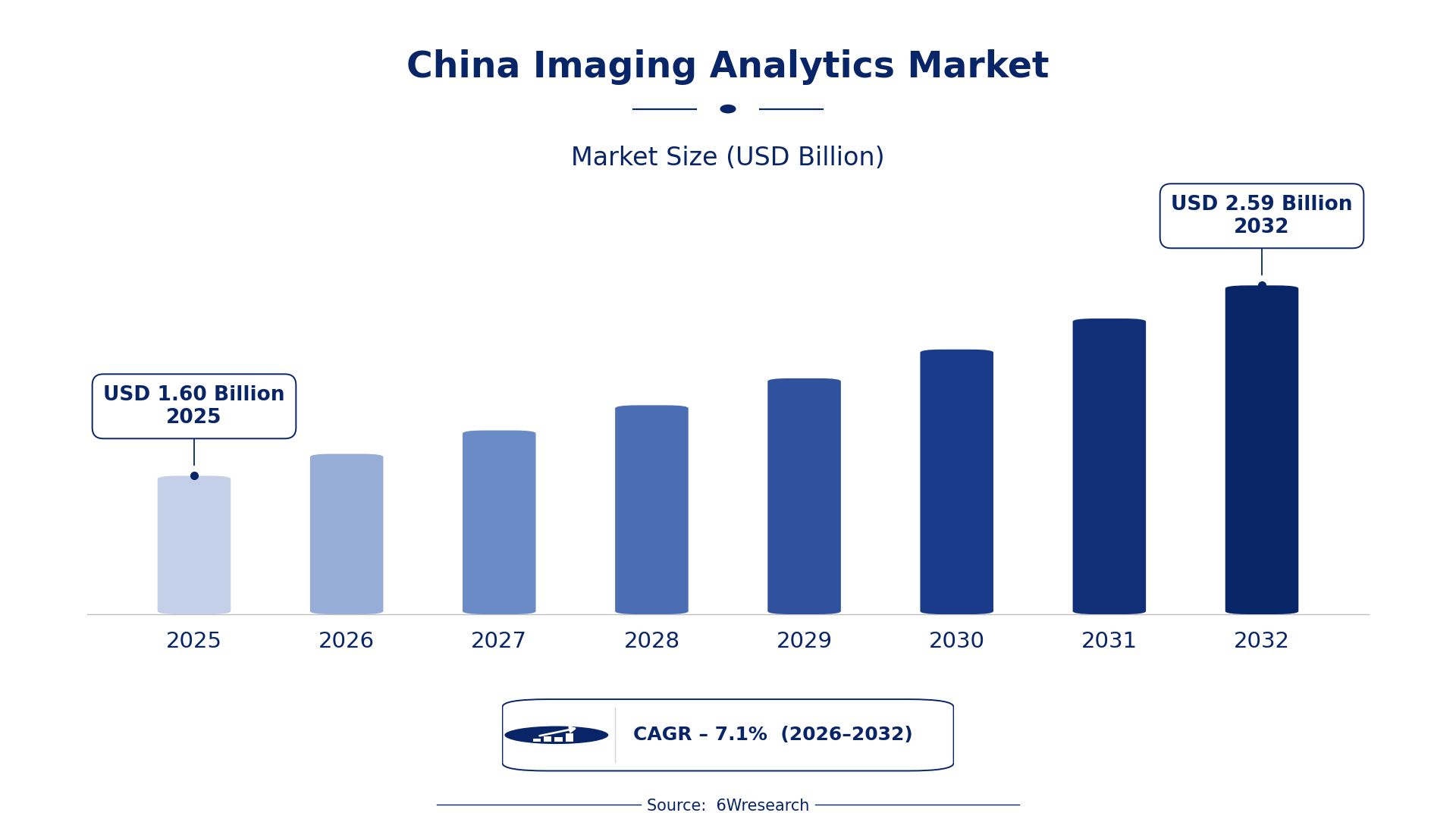
According to 6Wresearch internal database and industry insights, the China Imaging Analytics Market was valued at USD 1.60 billion in 2025 and is projected to reach USD 2.59 billion by 2032, growing at a CAGR of approximately 7.1% during 2026–2032.
China Imaging Analytics Market Highlights
| Report Metric | Details |
| Report Name | China Imaging Analytics Market |
| Market Size 2025 | USD 1.60 billion |
| Market Size 2032 | USD 2.59 billion |
| Absolute Growth 2025–2032 | USD 0.99 billion |
| CAGR 2026–2032 | 7.1% |
| Peak Annual Growth | 9.5% in 2029 |
| Forecast Period | 2026–2032 |
| Historical Data | 2022–2025 |
| Base Year | 2025 |
| Leading Analytics Type, 2025 | Predictive Analytics (47% share) |
| Leading Modality Source, 2025 | CT/MRI/PET (49% share) |
| Leading Technology Used, 2025 | AI & Machine Learning (48% share) |
| Leading End User, 2025 | Hospitals (52% share) |
| Fastest-Growing Analytics Type | Descriptive Analytics (8.5% CAGR) |
| Fastest-Growing Modality Source | Ultrasound/X-Ray (9.0% CAGR) |
| Fastest-Growing Technology Used | Cloud-Based Platforms (9.0% CAGR) |
| Fastest-Growing End User | Diagnostic Centers (9.7% CAGR) |
| Growing Sector | Healthcare |
| Key End Users | Hospitals, Diagnostic Centers, Radiology Labs |
China Imaging Analytics Market Year-wise Growth Rate and Key Drivers (2022–2032)
This graph illustrates the annual growth rates of the market from 2022 to 2032, highlighting a steady upward trajectory and projected market expansion over the forecast period.
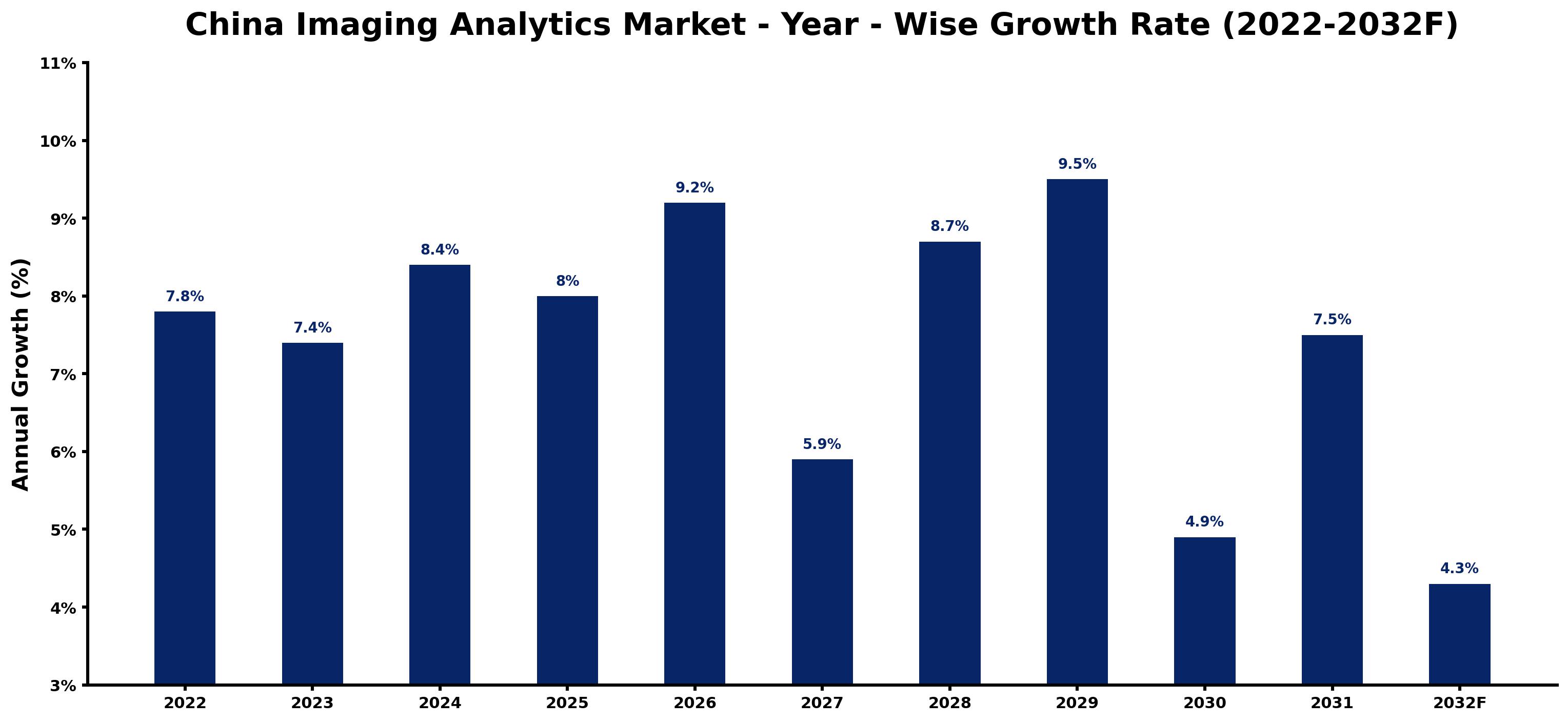
Year by year, the estimates below pair each growth rate with the development that shaped it.
| Year | Estimated Annual Growth (%) | Market Rationale |
| 2022 | 7.8 | The market experienced solid growth as hospitals invested in advanced imaging technologies. |
| 2023 | 7.4 | Growth slowed slightly due to adjustments following rapid technology adoption in hospitals. |
| 2024 | 8.4 | Demand surged as hospitals upgraded imaging equipment to improve diagnostic capabilities. |
| 2025 | 8.0 | Investment in imaging analytics remained strong, although growth rates moderated due to market saturation. |
| 2026 | 9.2 | A notable increase in demand is expected as urban hospitals expand their imaging analytics applications under the 'Healthy China 2030' initiative. |
| 2027 | 5.9 | Growth is projected to slow as market saturation begins to influence purchasing decisions among hospitals. |
| 2028 | 8.7 | Demand is expected to rebound as new AI technologies improve imaging analytics efficiency in urban healthcare facilities. |
| 2029 | 9.5 | The peak growth is anticipated to be driven by substantial investments in AI and machine learning in healthcare technologies. |
| 2030 | 4.9 | Growth is projected to slow again as the market begins to stabilise after rapid expansion of imaging analytics solutions. |
| 2031 | 7.5 | A resurgence in investment in imaging analytics is expected to lead to improved growth rates in hospitals and diagnostic centres. |
| 2032 | 4.3 | Growth is anticipated to slow as the market matures and competition intensifies among imaging analytics providers. |
Note: Market size estimations and growth projections presented in this report are based on 6Wresearch's proprietary forecasting methodology, utilizing the latest available industry data, government publications, and primary research inputs.
China Imaging Analytics Market Synopsis
Imaging Analytics in China encompasses the use of advanced computational techniques to analyse medical imaging data, primarily through AI and machine learning. This technology improves diagnostic accuracy and optimises treatment plans, particularly in hospitals and diagnostic centres. The China Imaging Analytics Market is growing due to increasing investments in healthcare technology and government initiatives like the 'Healthy China 2030' programme. With over 35,000 hospitals utilising imaging analytics, the demand for improved patient care continues to drive market expansion.
Market Dynamics Impact Analysis (2026–2032)
| Factor | Type | Impact | Primary Segment Affected |
| Increasing investments in AI technologies enhance diagnostic capabilities. | Driver | High | Predictive Analytics |
| Urban hospitals are seeking advanced imaging solutions to improve operational efficiency. | Driver | High | CT/MRI/PET |
| Rural hospitals are adopting imaging analytics for better healthcare outcomes. | Opportunity | Medium | Diagnostic Centers |
| The growing number of CT and MRI machines drives demand for imaging analytics solutions. | Opportunity | High | Hospitals |
| Regulatory challenges slow down the approval of new imaging analytics devices. | Restraint | High | AI & Machine Learning |
| Limited integration of imaging analytics in rural healthcare hampers market growth. | Restraint | Medium | Real-time Analytics |
| The Imaging Analytics market in China faces challenges from regulatory compliance and lengthy approval processes. | Challenge | High | Cloud-Based Platforms |
| Competition from alternative diagnostic technologies is increasing pressure on imaging analytics providers. | Challenge | Medium | Descriptive Analytics |
Evaluation of Drivers in China Imaging Analytics Market (2026–2032)
The main growth drivers and the segments they affect most are set out below.
| Drivers | Primary Segment Affected | Why It Matters (Evidence) |
| Increased funding for AI healthcare research boosts technology development. | AI & Machine Learning | The Chinese government allocated $1 billion in 2023 to support AI healthcare research, improving imaging analytics capabilities. |
| Growing hospital networks are investing in advanced imaging technologies. | Hospitals | With approximately 35,000 hospitals in China, many are upgrading their imaging systems to improve patient outcomes and operational efficiency. |
| The rising number of diagnostic centres is driving demand for imaging analytics. | Diagnostic Centers | The expansion of diagnostic centres in urban areas increases the need for advanced imaging analytics solutions to support their services. |
| Government initiatives promote the integration of AI in healthcare. | Predictive Analytics | The 'Healthy China 2030' initiative encourages hospitals to adopt AI technologies for better healthcare delivery and patient management. |
| Technological advancements in imaging modalities improve analytics capabilities. | CT/MRI/PET | The number of CT and MRI machines exceeded 40,000 in 2022, driving the demand for imaging analytics solutions among healthcare providers. |
Growth across the Imaging Analytics market in China is anchored in increasing investments in AI technologies, expanding networks of healthcare facilities, and rising demand from diagnostic centres. Many hospitals are upgrading their imaging systems to enhance patient outcomes, reflecting a broader trend in technology adoption. The number of CT and MRI machines exceeded 40,000 in 2022, boosting the need for advanced analytics in healthcare settings.
Evaluation of Restraints in China Imaging Analytics Market
The following restraints limit how fast demand can grow.
| Market Restraint | Primary Segment Affected | Why It Matters (Evidence) |
| Regulatory compliance challenges slow down the approval of new imaging analytics devices. | AI & Machine Learning | New guidelines introduced in 2022 by the State Administration for Market Regulation have complicated the approval process, causing delays. |
| Limited integration of imaging analytics in rural healthcare hampers market growth. | Real-time Analytics | Rural hospitals often lack the necessary infrastructure for advanced imaging analytics implementation, limiting their capabilities. |
| High costs of advanced imaging systems restrict adoption among smaller healthcare facilities. | Diagnostic Centers | Many diagnostic centres struggle to afford the latest imaging analytics technologies due to budget constraints and high initial investments. |
| Competition from alternative diagnostic technologies pressures imaging analytics providers. | Descriptive Analytics | Emerging technologies are attracting investment, diverting funds from traditional imaging analytics solutions, creating competitive pressure. |
| Market saturation in urban areas limits growth opportunities for imaging analytics. | CT/MRI/PET | Many urban hospitals have already adopted imaging analytics, slowing further growth and limiting new customer acquisition. |
China Imaging Analytics Market Challenges
In 2022, approximately 35,000 hospitals in China faced high costs associated with implementing imaging analytics, which can exceed $500,000 per facility. This financial burden often delays the adoption of advanced technologies, limiting operational efficiency for hospitals. A shortage of skilled professionals proficient in imaging analysis hampers progress, as only 20% of healthcare workers possess the necessary expertise. Regulatory hurdles also pose challenges; compliance with the China Food and Drug Administration's guidelines can take up to 18 months, causing further delays for suppliers. Buyers often encounter limited options, as a few vendors dominate the imaging analytics market, restricting competitive pricing.
Trends in the China Imaging Analytics Market
Buyers and suppliers in the China Imaging Analytics Market are adjusting to the following trends.
- Shift to AI-Driven Imaging Solutions: Beijing is at the forefront of the shift towards AI-driven imaging solutions, with hospitals increasingly adopting these technologies. In 2022, over 40% of hospitals in Beijing employed AI for imaging analytics, enhancing diagnostic accuracy.
- Rise in Cloud-Based Imaging Analytics: In 2023, the uptake of cloud-based imaging analytics platforms surged, with 30% of hospitals moving to these solutions. This transition enables better data storage and processing capabilities, enhancing operational efficiency.
- Transition from Traditional to Real-Time Analytics: Since 2021, hospitals have been transitioning towards real-time analytics, allowing for immediate insights during imaging procedures. This shift has been particularly notable in Shanghai, where 25% of hospitals have adopted real-time analytics.
- Emergence of Multimodal Imaging Techniques: The adoption of multimodal imaging techniques is increasing, with a 15% rise noted since 2022. This trend is supported by advancements in imaging technologies, particularly in urban healthcare facilities.
Investment Opportunities in the China Imaging Analytics Market
Below are the investment opportunities with the strongest case in the China Imaging Analytics Market.
- Hospitals Seeking Advanced Imaging Solutions: Urban hospitals are increasingly investing in advanced imaging analytics solutions, with a market gap of $500 million identified. Collaborating with local technology firms can facilitate entry into this expanding market.
- Diagnostic Centers Expanding Services: Diagnostic centres are broadening their services to include imaging analytics, driven by a notable increase in demand. Establishing joint ventures with local healthcare providers can enhance market penetration.
- Rural Healthcare Facilities Adopting Imaging Analytics: Rural healthcare facilities are now seeking to adopt imaging analytics, with a funding gap of $300 million identified. Partnering with local governments can provide the necessary support for implementation.
- Investment in AI Research and Development: With the Chinese government allocating $1 billion for AI healthcare research, there is a considerable opportunity for investment in imaging analytics technologies. Engaging with research institutions can stimulate innovation.
Government Initiatives in the China Imaging Analytics Market
The 'Digital Health Strategy' initiated in 2020 aims to integrate advanced technologies into public health systems, ensuring that imaging analytics becomes standard in healthcare facilities. The National Health Commission launched the 'AI in Healthcare Development Plan' in 2021 to promote AI applications, including imaging analytics, focusing on improvements in rural healthcare. This initiative aims to enhance healthcare delivery across China, particularly in underserved areas. The 'Healthy China 2030' programme further supports the integration of AI technologies in hospitals, improving operational efficiency and patient outcomes. The government has also established funding mechanisms to support these initiatives, ensuring that healthcare providers can access the necessary resources for implementation.
The National Medical Products Administration oversees the approval of AI-based medical devices, ensuring compliance with safety standards. The State Administration for Market Regulation introduced new guidelines in 2022 to streamline the approval process for AI-based imaging analytics devices, improving market access for innovators. The Ministry of Science and Technology announced a $500 million initiative in 2023 to support AI research in medical imaging. This funding is intended to stimulate innovation and development in imaging analytics technologies. These measures aim to facilitate market access for innovators and improve the overall quality of healthcare services.
Future Insight of the China Imaging Analytics Market
The China Imaging Analytics Market is set to evolve by 2032, primarily due to the government's 'Healthy China 2030' initiative, which promotes AI integration in healthcare. The Ministry of Health's program to enhance AI use in rural hospitals will significantly increase access to imaging technologies nationwide. The allocation of $1 billion for AI healthcare research will drive advancements in imaging solutions. With over 40,000 CT and MRI machines already in operation, hospitals will increasingly adopt analytics to improve diagnostic accuracy and patient outcomes.
Market Segmentation Analysis
The analysis below covers each segmentation, its leading category in 2025 and its fastest-growing category through 2032.
By Analytics Type – Predictive Analytics Dominated, Descriptive Analytics Expected to Grow Fastest
According to Sachin Kumar Rai, Senior Research Analyst at 6Wresearch, the largest analytics type category in 2025 was Predictive Analytics, with a 47% share of total revenue. Predictive analytics holds the largest share as it plays a crucial role in forecasting patient outcomes, essential for hospitals focused on enhancing care quality. Its widespread use in over 35,000 hospitals in China highlights its significance in improving diagnostic accuracy. Over 2026–2032, Descriptive Analytics is expected to post the fastest growth, at a CAGR of 8.5%. Descriptive analytics is rapidly gaining traction due to its ability to summarise imaging data effectively, aiding healthcare professionals in informed decision-making. The increasing demand for clear data interpretation in urban hospitals is a key factor driving this growth. Suppliers should prioritise developing robust descriptive analytics solutions to meet the rising demand in the healthcare sector.
By Modality Source – CT/MRI/PET Dominated, Ultrasound/X-Ray Expected to Grow Fastest
CT/MRI/PET held a 49% share of the China Imaging Analytics Market by modality source in 2025. CT, MRI, and PET modalities dominate the market as they are the primary imaging techniques employed in analytics applications across numerous hospitals. With over 40,000 units in operation, their established presence ensures a steady demand for imaging analytics. Ultrasound/X-Ray is projected to grow fastest, at a CAGR of 9.0% during 2026–2032. Ultrasound and X-Ray modalities are experiencing rapid growth as they are commonly used in diagnostic settings, particularly in rural hospitals where accessibility is improving. Recent government initiatives to enhance AI use in these areas are propelling this growth. Suppliers should consider expanding their offerings to include solutions tailored for ultrasound and X-Ray analytics to capture this emerging market.
By Technology Used – AI & Machine Learning Dominated, Cloud-Based Platforms Expected to Grow Fastest
In 2025, AI & Machine Learning led the technology used split with a 48% share. AI and machine learning technologies lead the market as they are the core drivers behind the development of imaging analytics solutions. Their application in hospitals has become essential for improving diagnostic capabilities and operational efficiency. Cloud-Based Platforms are set to record the highest CAGR in this split, 9.0% over 2026–2032. Cloud-based platforms are rapidly gaining traction as they facilitate efficient data storage and processing for analytics, crucial for hospitals with limited infrastructure. Their scalability and cost-effectiveness appeal to a growing number of healthcare facilities. Vendors should focus on cloud-based solutions to meet the increasing need for scalable analytics in the healthcare industry.
By End User – Hospitals Dominated, Diagnostic Centers Expected to Grow Fastest
Hospitals accounted for a 52% market share by end user in 2025. Hospitals are the primary end-users of imaging analytics solutions, extensively utilising them to improve patient care and operational efficiency. The sheer number of hospitals in China, approximately 35,000, underscores their dominant market share. The quickest growth will come from Diagnostic Centers, forecast to expand at a CAGR of 9.7% between 2026 and 2032. Diagnostic centers are witnessing the fastest growth as they increasingly adopt imaging analytics to enhance their analysis capabilities. This shift is driven by the rising demand for precise diagnostics in urban areas, where these centers are often located. This indicates a lucrative opportunity for suppliers to develop tailored solutions specifically for diagnostic centers.
Key Attractiveness of the Report
- 10 Years of Market Numbers
- Historical Data Starting from 2022 to 2025
- Base Year 2025
- Forecast Data until 2032
- Key Performance Indicators Impacting the Market
- Major Upcoming Developments and Projects
Key Highlights of the Report:
- China Imaging Analytics Market Outlook
- Market Size of China Imaging Analytics Market, 2025
- Forecast of China Imaging Analytics Market, 2032
- Historical Data and Forecast of China Imaging Analytics Revenues & Volume for the Period 2022 - 2032F
- China Imaging Analytics Market Trend Evolution
- China Imaging Analytics Market Drivers and Challenges
- China Imaging Analytics Price Trends
- China Imaging Analytics Porter's Five Forces
- China Imaging Analytics Industry Life Cycle
- Historical Data and Forecast of China Imaging Analytics Market Revenues & Volume By Analytics Type for the Period 2022 - 2032F
- Historical Data and Forecast of China Imaging Analytics Market Revenues & Volume By Predictive Analytics for the Period 2022 - 2032F
- Historical Data and Forecast of China Imaging Analytics Market Revenues & Volume By Descriptive Analytics for the Period 2022 - 2032F
- Historical Data and Forecast of China Imaging Analytics Market Revenues & Volume By Prescriptive Analytics for the Period 2022 - 2032F
- Historical Data and Forecast of China Imaging Analytics Market Revenues & Volume By Real-time Analytics for the Period 2022 - 2032F
- Historical Data and Forecast of China Imaging Analytics Market Revenues & Volume By Modality Source for the Period 2022 - 2032F
- Historical Data and Forecast of China Imaging Analytics Market Revenues & Volume By CT/MRI/PET for the Period 2022 - 2032F
- Historical Data and Forecast of China Imaging Analytics Market Revenues & Volume By Ultrasound/X-Ray for the Period 2022 - 2032F
- Historical Data and Forecast of China Imaging Analytics Market Revenues & Volume By Multimodal Imaging for the Period 2022 - 2032F
- Historical Data and Forecast of China Imaging Analytics Market Revenues & Volume By Wearable/POC Imaging for the Period 2022 - 2032F
- Historical Data and Forecast of China Imaging Analytics Market Revenues & Volume By Technology Used for the Period 2022 - 2032F
- Historical Data and Forecast of China Imaging Analytics Market Revenues & Volume By AI & Machine Learning for the Period 2022 - 2032F
- Historical Data and Forecast of China Imaging Analytics Market Revenues & Volume By Cloud-Based Platforms for the Period 2022 - 2032F
- Historical Data and Forecast of China Imaging Analytics Market Revenues & Volume By Deep Learning Models for the Period 2022 - 2032F
- Historical Data and Forecast of China Imaging Analytics Market Revenues & Volume By Edge AI for the Period 2022 - 2032F
- Historical Data and Forecast of China Imaging Analytics Market Revenues & Volume By End User for the Period 2022 - 2032F
- Historical Data and Forecast of China Imaging Analytics Market Revenues & Volume By Hospitals for the Period 2022 - 2032F
- Historical Data and Forecast of China Imaging Analytics Market Revenues & Volume By Diagnostic Centers for the Period 2022 - 2032F
- Historical Data and Forecast of China Imaging Analytics Market Revenues & Volume By Radiology Labs for the Period 2022 - 2032F
- Historical Data and Forecast of China Imaging Analytics Market Revenues & Volume By Mobile Health Apps for the Period 2022 - 2032F
- China Imaging Analytics Import Export Trade Statistics
- Market Opportunity Assessment By Analytics Type
- Market Opportunity Assessment By Modality Source
- Market Opportunity Assessment By Technology Used
- Market Opportunity Assessment By End User
- China Imaging Analytics Top Companies Market Share
- China Imaging Analytics Competitive Benchmarking By Technical and Operational Parameters
- China Imaging Analytics Company Profiles
- China Imaging Analytics Key Strategic Recommendations
Market Covered
The report offers an extensive study of the following market segments.
By Analytics Type
- Predictive Analytics
- Descriptive Analytics
- Prescriptive Analytics
- Real-time Analytics
By Modality Source
- CT/MRI/PET
- Ultrasound/X-Ray
- Multimodal Imaging
- Wearable/POC Imaging
By Technology Used
- AI & Machine Learning
- Cloud-Based Platforms
- Deep Learning Models
- Edge AI
By End User
- Hospitals
- Diagnostic Centers
- Radiology Labs
- Mobile Health Apps































