China Imaging Sensor Market Size & Growth Rate
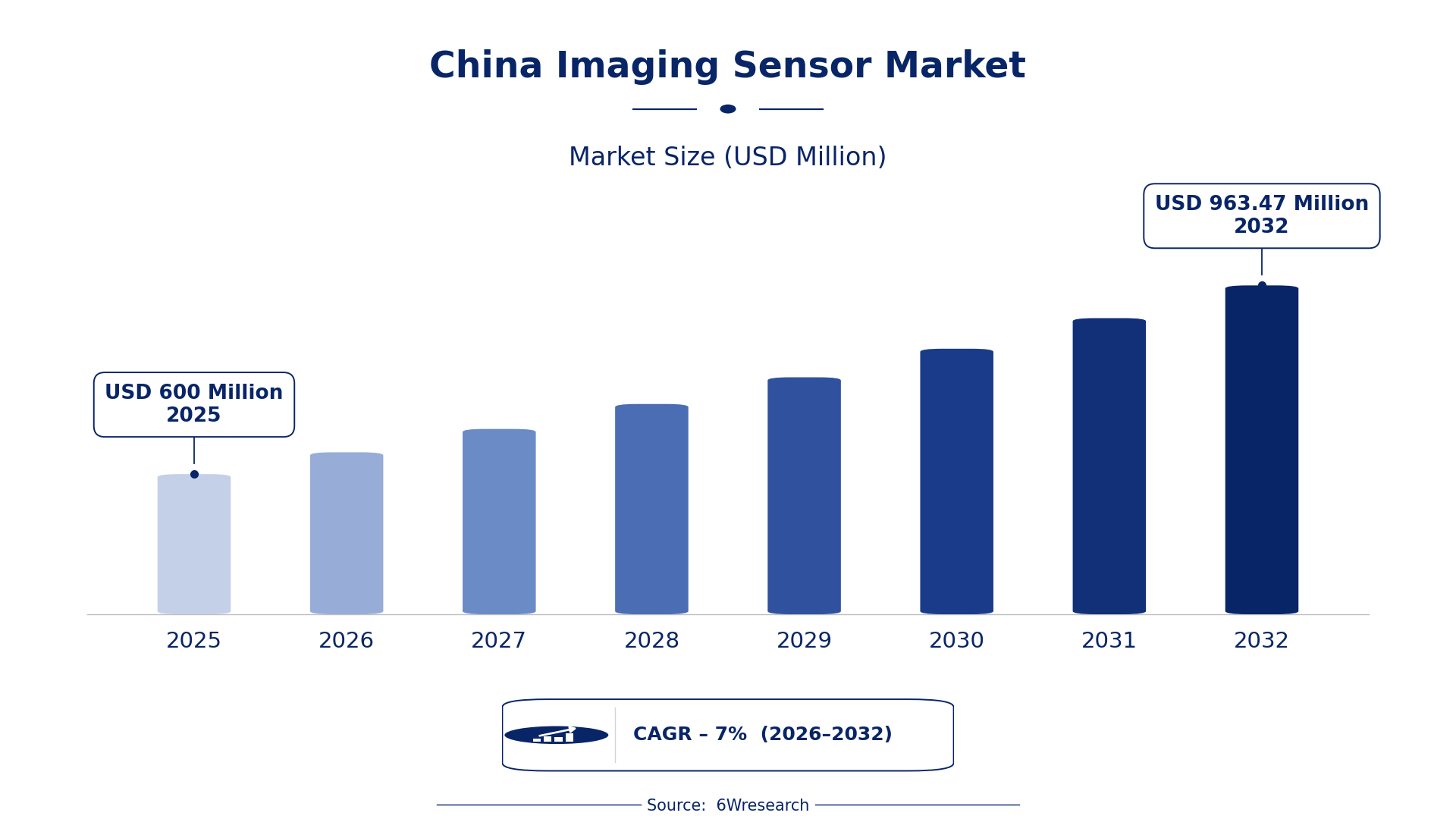
According to 6Wresearch internal database and industry insights, the China Imaging Sensor Market was valued at USD 600.0 million in 2025 and is projected to reach USD 963.47 million by 2032, growing at a CAGR of approximately 7% during 2026–2032.
China Imaging Sensor Market Highlights
| Report Metric | Details |
| Report Name | China Imaging Sensor Market |
| Market Size 2025 | USD 600.0 million |
| Market Size 2032 | USD 963.47 million |
| Absolute Growth 2025–2032 | USD 363.47 million |
| CAGR 2026–2032 | 7% |
| Peak Annual Growth | 9.2% in 2029 |
| Forecast Period | 2026–2032 |
| Historical Data | 2022–2025 |
| Base Year | 2025 |
| Leading Sensor Type, 2025 | CMOS Sensors (39% share) |
| Leading Image Format, 2025 | Digital RGB (39% share) |
| Leading Technology Used, 2025 | Active Pixel Sensor (36% share) |
| Leading End User, 2025 | Camera Manufacturers (39% share) |
| Fastest-Growing Sensor Type | Thermal Sensors (8.7% CAGR) |
| Fastest-Growing Image Format | IR/Heat Mapping (8.8% CAGR) |
| Fastest-Growing Technology Used | Infrared Arrays (9.5% CAGR) |
| Fastest-Growing End User | Medical Imaging OEMs (8.5% CAGR) |
| Growing Sector | medical imaging |
| Key End Users | camera manufacturers, medical imaging OEMs, surveillance & defense, autonomous vehicle makers |
China Imaging Sensor Market Year-wise Growth Rate and Key Drivers (2022–2032)
This graph illustrates the annual growth rates of the market from 2022 to 2032, highlighting a steady upward trajectory and projected market expansion over the forecast period.
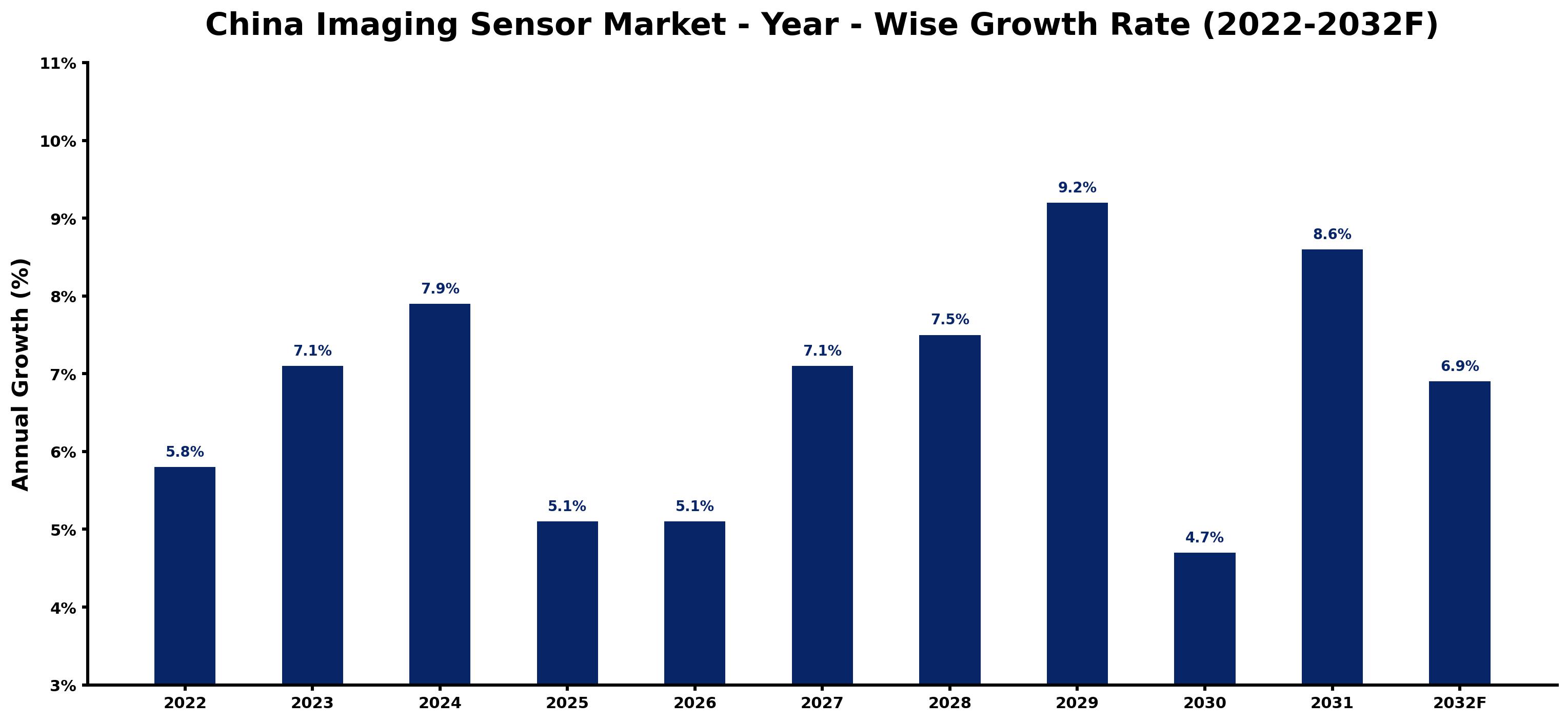
Year by year, the estimates below pair each growth rate with the development that shaped it.
| Year | Estimated Annual Growth (%) | Market Rationale |
| 2022 | 5.8 | The market experienced steady growth, driven by strong demand from consumer electronics. |
| 2023 | 7.1 | Growth accelerated due to increased investments in medical imaging technologies. |
| 2024 | 7.9 | The rise in surveillance applications contributed to continued market expansion. |
| 2025 | 5.1 | Growth slowed as market adjustments occurred following peak demand in prior years. |
| 2026 | 5.1 | A further slowdown was noted as the market stabilised after rapid growth phases. |
| 2027 | 7.1 | Demand surged again, particularly from autonomous vehicle manufacturers. |
| 2028 | 7.5 | The market continued to grow, supported by advancements in imaging technology. |
| 2029 | 9.2 | The peak growth rate was reached, driven by high-resolution sensor demand. |
| 2030 | 4.7 | A slowdown occurred as the market began to normalise after peak growth. |
| 2031 | 8.6 | Growth accelerated again, influenced by ongoing advancements in imaging applications. |
| 2032 | 6.9 | The market growth rate decreased slightly, but demand remained strong. |
Note: Market size estimations and growth projections presented in this report are based on 6Wresearch's proprietary forecasting methodology, utilizing the latest available industry data, government publications, and primary research inputs.
China Imaging Sensor Market Synopsis
The Imaging Sensor Market in China includes semiconductor devices that convert light into electronic signals, primarily utilised in cameras, medical imaging, and surveillance. These sensors are predominantly manufactured from silicon wafers using advanced processes. The market is expanding due to strong demand from domestic manufacturers and exports, with a valuation of approximately 15 billion USD in 2022. The 'Smart Manufacturing Initiative' launched in 2023 is advancing sensor technology capabilities, further propelling growth. As the country excels in electronics production, the Imaging Sensor Market is set to flourish in the coming years.
Market Dynamics Impact Analysis (2026–2032)
| Factor | Type | Impact | Primary Segment Affected |
| Rising investments in medical imaging technologies are driving demand for thermal sensors. | Driver | High | Thermal Sensors |
| Increasing adoption of autonomous vehicles is boosting demand for LiDAR image sensors. | Driver | High | LiDAR Image Sensors |
| The growing healthcare sector presents opportunities for suppliers of infrared sensors. | Opportunity | High | Infrared Arrays |
| The demand for high-resolution sensors is increasing due to telemedicine applications. | Opportunity | High | High-Resolution |
| The market faces challenges from the rapid technological advancements requiring constant updates. | Restraint | Medium | CMOS Sensors |
| Competition from international manufacturers can limit market share for local producers. | Restraint | Medium | CCD Sensors |
| The Imaging Sensor Market in China is held back by high R&D costs for new technologies. | Challenge | High | Active Pixel Sensor |
| Supply chain disruptions can delay the production of imaging sensors, affecting availability. | Challenge | High | Camera Manufacturers |
Evaluation of Drivers in China Imaging Sensor Market (2026–2032)
Below mentioned are some major drivers and their influence on market dynamics.
| Drivers | Primary Segment Affected | Why It Matters (Evidence) |
| Increased healthcare spending is driving demand for thermal sensors used in diagnostics. | Thermal Sensors | The installed base of medical imaging devices reached 1.5 million units in 2023, boosting demand. |
| The rise of autonomous vehicles is boosting demand for LiDAR image sensors in mapping and navigation. | LiDAR Image Sensors | The Beijing-Tianjin-Hebei region is a key area for autonomous vehicle testing, increasing requirements. |
| Growing demand for high-resolution sensors is driven by the telemedicine sector's expansion. | High-Resolution | High-resolution sensors are increasingly used in telemedicine applications, reflecting healthcare sector growth. |
| The expansion of the surveillance sector is increasing demand for imaging sensors in security applications. | CMOS Sensors | The annual growth rate of the surveillance sector is around 10% in China, driving sensor needs. |
| The push for smart manufacturing is improving the capabilities of imaging sensor technology. | Active Pixel Sensor | The 'Smart Manufacturing Initiative' launched in 2023 aims to improve sensor technology capabilities. |
Market growth in China for Imaging Sensor rests on increased healthcare spending, rising demand from autonomous vehicles, and the expansion of the surveillance sector. The installed base of medical imaging devices reached 1.5 million units in 2023, significantly boosting demand for thermal sensors. The Beijing-Tianjin-Hebei region is becoming a hub for autonomous vehicle testing, which is increasing requirements for advanced imaging technologies. High-resolution sensors are increasingly used in telemedicine applications, reflecting the growing healthcare sector's needs.
Evaluation of Restraints in China Imaging Sensor Market
The key brakes on demand, and where they bite hardest, are shown below.
| Market Restraint | Primary Segment Affected | Why It Matters (Evidence) |
| Intense competition among local manufacturers leads to aggressive pricing strategies. | CMOS Sensors | This rivalry erodes profit margins for suppliers, reducing their ability to invest in technological advancements. |
| Rising production costs, particularly from silicon wafers, inflate expenses. | Thermal Sensors | These increased costs can affect manufacturers' pricing strategies, ultimately raising prices for buyers. |
| Geopolitical tensions disrupt supply chains, causing shortages of critical components. | LiDAR Image Sensors | Such disruptions delay production timelines for clinics and hospitals dependent on imaging technologies. |
| Limited access to advanced research facilities hampers innovation. | High-Resolution | This restricts the development of new imaging technologies that could meet evolving market demands. |
| Stringent regulatory standards can slow down product approvals. | Infrared Arrays | Delays in compliance with the National Standard for Image Quality Evaluation can hinder market entry. |
China Imaging Sensor Market Challenges
In the China imaging sensor market, intense competition among local manufacturers drives aggressive pricing strategies, which erode profit margins for suppliers. This rivalry leads to reduced investment in research and development, costing producers potential technological advancements that could improve their offerings. Rising production costs, particularly from silicon wafers, can inflate expenses by up to 15%, affecting manufacturers' pricing strategies and ultimately increasing costs for buyers. Geopolitical tensions disrupt supply chains, resulting in shortages of critical components that delay production timelines for clinics and hospitals dependent on imaging technologies.
Trends in the China Imaging Sensor Market
Four trends stand out in the China Imaging Sensor Market.
- Shift Towards High-Resolution Imaging: The demand for high-resolution imaging is increasing, particularly in telemedicine applications. In 2023, high-resolution sensors saw a notable uptick in usage, reflecting the growing healthcare sector's needs.
- Transition to Smart Manufacturing: The adoption of smart manufacturing practices is transforming sensor production in China. The 'Smart Manufacturing Initiative' launched in 2023 aims to enhance sensor technology capabilities, resulting in more efficient production processes.
- Emergence of LiDAR Technologies: LiDAR technologies are gaining traction, particularly in autonomous vehicles. The Beijing-Tianjin-Hebei region is becoming a hub for LiDAR image sensor development, reflecting the increasing demand for advanced imaging solutions.
- Growing Importance of Thermal Sensors: Thermal sensors are increasingly being integrated into medical imaging systems. The market for thermal sensors is projected to grow significantly by 2025, supported by advancements in healthcare technology.
Investment Opportunities in the China Imaging Sensor Market
Several openings in the China Imaging Sensor Market merit attention from investors.
- Investment in Thermal Sensors: The market for thermal sensors is projected to grow, driven by healthcare demands. Suppliers can target medical imaging OEMs, particularly in urban areas where healthcare facilities are expanding.
- Expansion of LiDAR Technologies: There is a growing opportunity to supply LiDAR image sensors, particularly for autonomous vehicles. Collaborating with manufacturers in the Beijing-Tianjin-Hebei region can facilitate market entry.
- Development of High-Resolution Sensors: The increasing demand for high-resolution sensors in telemedicine presents a significant opportunity. Suppliers should focus on partnerships with medical imaging OEMs to meet this need.
- Focus on Infrared Sensors: The demand for infrared sensors is rising, particularly in the healthcare sector. Suppliers can enter the market by obtaining necessary certifications and collaborating with local manufacturers.
Government Initiatives in the China Imaging Sensor Market
In 2021, the Ministry of Industry and Information Technology launched the '14th Five-Year Plan for the Development of the Electronics Industry', which prioritises imaging sensor innovation and aims to enhance the technological capabilities of domestic manufacturers. Following this, the National Development and Reform Commission approved the 'National Strategy for the Development of Intelligent Manufacturing' in 2022, focusing on improving sensor technology and production efficiency. In 2023, the Ministry of Science and Technology initiated the 'National Key Research and Development Program' with a budget of 1 billion RMB to support advanced imaging technologies. These measures aim to strengthen the imaging sensor sector, ensuring compliance with international standards and promoting innovation.
The Ministry of Industry and Information Technology oversees the implementation of various initiatives that fund research and development in imaging technologies. The 'Smart Manufacturing Initiative', launched in 2023, allocates 500 million RMB for enhancing sensor technology capabilities across different sectors, including healthcare and surveillance. Additionally, the China National Institute of Standardization is responsible for the approval and regulation of imaging sensor standards, ensuring that products meet quality benchmarks. This regulatory framework supports manufacturers in maintaining competitive advantages while addressing the growing demand for advanced imaging solutions.
Future Insight of the China Imaging Sensor Market
The China imaging sensor market will undergo significant transformation by 2032, primarily driven by the 'Smart Manufacturing Initiative' that aims to improve sensor technology. This initiative will boost efficiency and performance in imaging devices, providing advantages for both buyers and suppliers. The installed base of medical imaging devices is expected to surpass 2 million units, creating expanded opportunities for healthcare providers. Advancements in LiDAR technologies, backed by government support, will enhance functionalities in autonomous vehicles, opening new markets for suppliers.
Market Segmentation Analysis
Each segment group is reviewed below, with the leader by share and the fastest grower by CAGR.
By Sensor Type – CMOS Sensors Dominated, Thermal Sensors Expected to Grow Fastest
According to Sachin Kumar Rai, Senior Research Analyst at 6Wresearch, CMOS Sensors took a 39% share of sensor type in 2025, more than any other category. CMOS sensors dominate the China Imaging Sensor Market due to their extensive use in consumer electronics and medical devices. The strong production capacity, with China manufacturing over 70% of global CMOS sensors, underscores their importance in meeting domestic and international demand. Thermal Sensors are projected to grow fastest, at a CAGR of 8.7% during 2026–2032. Thermal sensors are witnessing rapid growth, particularly driven by their increasing use in medical imaging and surveillance applications. The surveillance sector's annual growth rate of around 10% indicates a robust market for thermal imaging technologies. Suppliers should prioritise expanding their thermal sensor offerings to capitalise on the rising demand in healthcare and surveillance sectors.
By Image Format – Digital RGB Dominated, IR/Heat Mapping Expected to Grow Fastest
The largest image format category in 2025 was Digital RGB, with a 39% share of total revenue. Digital RGB is the leading format in the imaging sensor market, primarily due to its standardisation across various imaging applications, including consumer electronics. This widespread adoption ensures a consistent revenue share for manufacturers in this segment. The quickest growth will come from IR/Heat Mapping, forecast to expand at a CAGR of 8.8% between 2026 and 2032. IR/Heat Mapping is the fastest-growing format, largely attributed to its critical role in industrial and medical diagnostics, where precise temperature readings are essential. This growth is further supported by increasing investments in healthcare technologies. Suppliers should consider expanding their product lines to include IR/Heat Mapping solutions to capture the growing market opportunities in diagnostics.
By Technology Used – Active Pixel Sensor Dominated, Infrared Arrays Expected to Grow Fastest
In 2025, Active Pixel Sensor led the technology used split with a 36% share. Active Pixel Sensors lead the market as they are prevalent in consumer cameras and smartphones, which are widely adopted in China. This high level of integration ensures a steady demand from manufacturers, solidifying their market dominance. Over 2026–2032, Infrared Arrays are expected to post the fastest growth, at a CAGR of 9.5%. Infrared Arrays are growing quickly, primarily due to their essential role in thermal imaging applications that are increasingly sought after across various industries. The heightened demand for advanced thermal imaging solutions is driving this segment's rapid expansion. This trend indicates that suppliers should invest in the development of advanced infrared array technologies to take advantage of the growing market for thermal imaging.
By End User – Camera Manufacturers Dominated, Medical Imaging OEMs Expected to Grow Fastest
Camera Manufacturers held a 39% share of the China Imaging Sensor Market by end user in 2025. Camera manufacturers constitute the largest end-user group for imaging sensors, heavily relying on these components for their products. The concentration of camera production in key regions like Guangdong further strengthens their dominant market share in the imaging sensor sector. Medical Imaging OEMs are set to record the highest CAGR in this split, 8.5% over 2026–2032. Medical Imaging OEMs are the fastest-growing end-user segment, propelled by the rising need for diagnostic equipment in the healthcare sector. The installed base of medical imaging devices, which reached 1.5 million units in 2023, highlights the increasing demand for these sensors in medical applications. This trend suggests that suppliers should enhance partnerships with medical imaging OEMs to leverage the expanding opportunities in the healthcare market.
Key Attractiveness of the Report
- 10 Years of Market Numbers
- Historical Data Starting from 2022 to 2025
- Base Year 2025
- Forecast Data until 2032
- Key Performance Indicators Impacting the Market
- Major Upcoming Developments and Projects
Key Highlights of the Report:
- China Imaging Sensor Market Outlook
- Market Size of China Imaging Sensor Market, 2025
- Forecast of China Imaging Sensor Market, 2032
- Historical Data and Forecast of China Imaging Sensor Revenues & Volume for the Period 2022 - 2032F
- China Imaging Sensor Market Trend Evolution
- China Imaging Sensor Market Drivers and Challenges
- China Imaging Sensor Price Trends
- China Imaging Sensor Porter's Five Forces
- China Imaging Sensor Industry Life Cycle
- Historical Data and Forecast of China Imaging Sensor Market Revenues & Volume By Sensor Type for the Period 2022 - 2032F
- Historical Data and Forecast of China Imaging Sensor Market Revenues & Volume By CMOS Sensors for the Period 2022 - 2032F
- Historical Data and Forecast of China Imaging Sensor Market Revenues & Volume By CCD Sensors for the Period 2022 - 2032F
- Historical Data and Forecast of China Imaging Sensor Market Revenues & Volume By Thermal Sensors for the Period 2022 - 2032F
- Historical Data and Forecast of China Imaging Sensor Market Revenues & Volume By LiDAR Image Sensors for the Period 2022 - 2032F
- Historical Data and Forecast of China Imaging Sensor Market Revenues & Volume By Image Format for the Period 2022 - 2032F
- Historical Data and Forecast of China Imaging Sensor Market Revenues & Volume By Digital RGB for the Period 2022 - 2032F
- Historical Data and Forecast of China Imaging Sensor Market Revenues & Volume By High-Resolution for the Period 2022 - 2032F
- Historical Data and Forecast of China Imaging Sensor Market Revenues & Volume By IR/Heat Mapping for the Period 2022 - 2032F
- Historical Data and Forecast of China Imaging Sensor Market Revenues & Volume By Depth Perception for the Period 2022 - 2032F
- Historical Data and Forecast of China Imaging Sensor Market Revenues & Volume By Technology Used for the Period 2022 - 2032F
- Historical Data and Forecast of China Imaging Sensor Market Revenues & Volume By Active Pixel Sensor for the Period 2022 - 2032F
- Historical Data and Forecast of China Imaging Sensor Market Revenues & Volume By Charge-Coupled Device for the Period 2022 - 2032F
- Historical Data and Forecast of China Imaging Sensor Market Revenues & Volume By Infrared Arrays for the Period 2022 - 2032F
- Historical Data and Forecast of China Imaging Sensor Market Revenues & Volume By Laser + Photodetectors for the Period 2022 - 2032F
- Historical Data and Forecast of China Imaging Sensor Market Revenues & Volume By End User for the Period 2022 - 2032F
- Historical Data and Forecast of China Imaging Sensor Market Revenues & Volume By Camera Manufacturers for the Period 2022 - 2032F
- Historical Data and Forecast of China Imaging Sensor Market Revenues & Volume By Medical Imaging OEMs for the Period 2022 - 2032F
- Historical Data and Forecast of China Imaging Sensor Market Revenues & Volume By Surveillance & Defense for the Period 2022 - 2032F
- Historical Data and Forecast of China Imaging Sensor Market Revenues & Volume By Autonomous Vehicle Makers for the Period 2022 - 2032F
- China Imaging Sensor Import Export Trade Statistics
- Market Opportunity Assessment By Sensor Type
- Market Opportunity Assessment By Image Format
- Market Opportunity Assessment By Technology Used
- Market Opportunity Assessment By End User
- China Imaging Sensor Top Companies Market Share
- China Imaging Sensor Competitive Benchmarking By Technical and Operational Parameters
- China Imaging Sensor Company Profiles
- China Imaging Sensor Key Strategic Recommendations
Market Covered
The report offers an extensive study of the following market segments.
By Sensor Type
- CMOS Sensors
- CCD Sensors
- Thermal Sensors
- LiDAR Image Sensors
By Image Format
- Digital RGB
- High-Resolution
- IR/Heat Mapping
- Depth Perception
By Technology Used
- Active Pixel Sensor
- Charge-Coupled Device
- Infrared Arrays
- Laser + Photodetectors
By End User
- Camera Manufacturers
- Medical Imaging OEMs
- Surveillance & Defense
- Autonomous Vehicle Makers































