China Immunoglobulin Therapy Market Size & Growth Rate
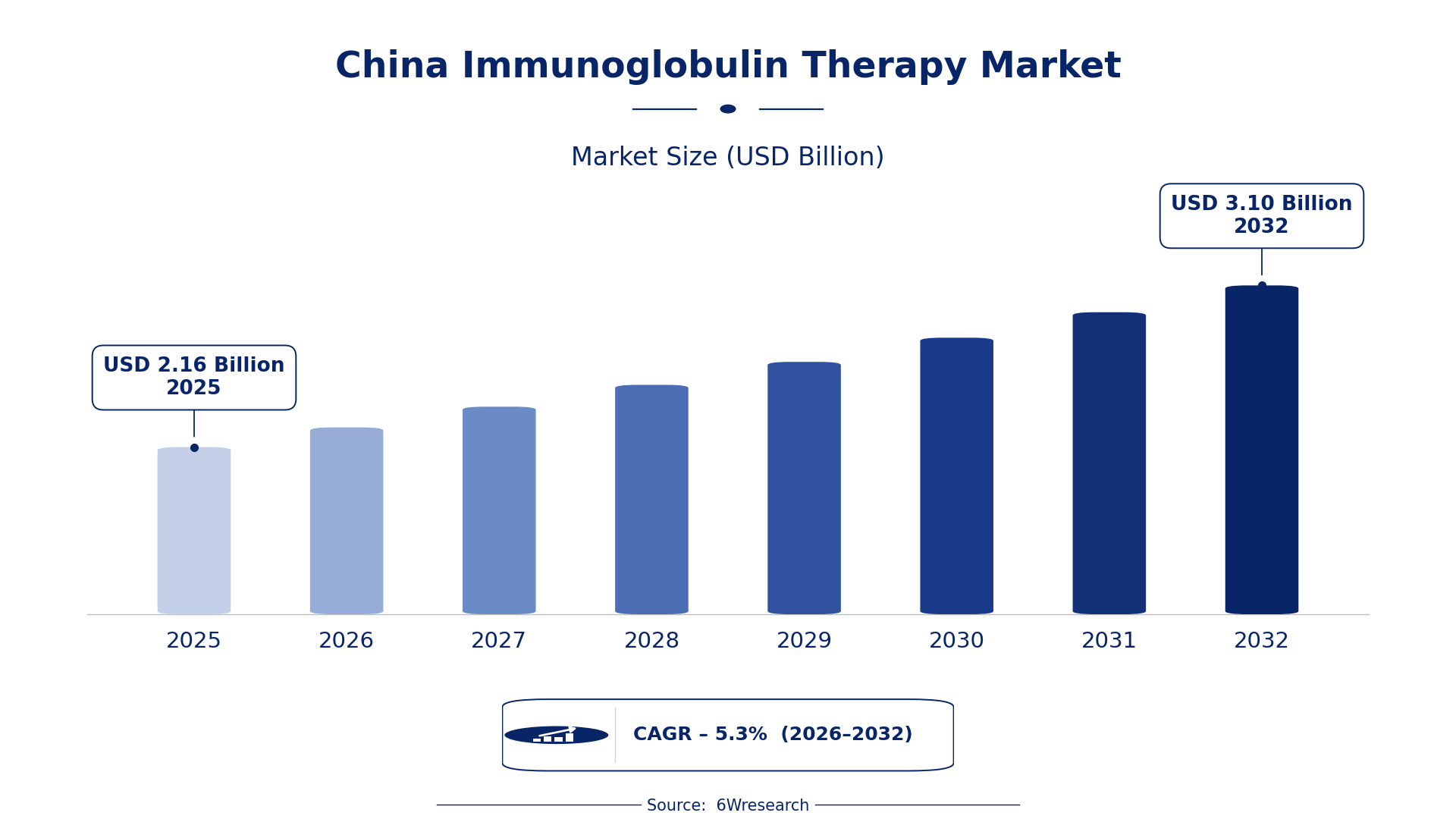
According to 6Wresearch internal database and industry insights, the China Immunoglobulin Therapy Market was valued at USD 2.16 billion in 2025 and is projected to reach USD 3.10 billion by 2032, growing at a CAGR of approximately 5.3% during 2026–2032.
China Immunoglobulin Therapy Market Highlights
| Report Metric | Details |
| Report Name | China Immunoglobulin Therapy Market |
| Market Size 2025 | USD 2.16 billion |
| Market Size 2032 | USD 3.10 billion |
| Absolute Growth 2025–2032 | USD 0.94 billion |
| CAGR 2026–2032 | 5.3% |
| Peak Annual Growth | 7.5% in 2027 |
| Forecast Period | 2026–2032 |
| Historical Data | 2022–2025 |
| Base Year | 2025 |
| Leading Therapy Type, 2025 | IVIG (36% share) |
| Leading Source Type, 2025 | Human Plasma Derived (39% share) |
| Leading Route of Administration, 2025 | Intravenous (42% share) |
| Leading End User, 2025 | Tertiary Hospitals (37% share) |
| Fastest-Growing Therapy Type | SCIG (7.8% CAGR) |
| Fastest-Growing Route of Administration | Home/Outpatient Setting (8.1% CAGR) |
| Fastest-Growing End User | Specialty Pharmacies (7.0% CAGR) |
| Growing Sector | Tertiary Hospitals |
| Key End Users | Tertiary Hospitals, Specialty Pharmacies, Transplant Centers |
China Immunoglobulin Therapy Market Year-wise Growth Rate and Key Drivers (2022–2032)
This graph illustrates the annual growth rates of the market from 2022 to 2032, highlighting a steady upward trajectory and projected market expansion over the forecast period.

Below, each year's estimated growth is shown next to the factor that most influenced it.
| Year | Estimated Annual Growth (%) | Market Rationale |
| 2022 | 5.9 | The market experienced steady growth due to the National Immunoglobulin Therapy Program improving access. |
| 2023 | 3.8 | Growth slowed as demand stabilised following a surge in previous years driven by the rise in primary immunodeficiency awareness. |
| 2024 | 5.7 | Demand rose again as hospitals expanded immunoglobulin therapy offerings under updated National Immunoglobulin Therapy Standards. |
| 2025 | 6.3 | The market peaked with substantial usage reported by tertiary hospitals due to rising patient numbers. |
| 2026 | 4.7 | Growth slowed as the market adjusted to increased supply levels from new production facilities in Shanghai. |
| 2027 | 7.5 | A surge in demand occurred due to new treatment protocols being adopted across healthcare settings nationwide. |
| 2028 | 3.2 | Growth decelerated as the market began to stabilise after rapid expansion in therapy options. |
| 2029 | 6.4 | Demand increased again as specialty pharmacies expanded their offerings of immunoglobulin products. |
| 2030 | 4.3 | Growth slowed as the market faced challenges in maintaining supply chains for human plasma. |
| 2031 | 6.3 | Demand rose as more patients sought treatment for autoimmune diseases amid rising prevalence. |
| 2032 | 4.7 | The market stabilised as new therapies entered the approval process under revised National Immunoglobulin Therapy Standards. |
Note: Market size estimations and growth projections presented in this report are based on 6Wresearch's proprietary forecasting methodology, utilizing the latest available industry data, government publications, and primary research inputs.
China Immunoglobulin Therapy Market Synopsis
Immunoglobulin Therapy in China utilises antibodies derived from human plasma to address various immune deficiencies and autoimmune disorders. This therapy, produced through the fractionation of human plasma, plays a crucial role in treating conditions like primary immunodeficiency diseases. The China Immunoglobulin Therapy Market is expanding, driven by increasing domestic demand from over 1,000 tertiary hospitals and a substantial population of approximately 300,000 individuals with primary immunodeficiency. Initiatives from the National Health Commission further improve accessibility, propelling market growth.
Market Dynamics Impact Analysis (2026–2032)
| Factor | Type | Impact | Primary Segment Affected |
| Increasing prevalence of autoimmune diseases | Driver | High | IVIG |
| Expansion of tertiary hospitals offering immunoglobulin therapy | Driver | High | Human Plasma Derived |
| Growing demand for home administration therapies | Opportunity | Medium | SCIG |
| Investment in immunoglobulin research and development | Opportunity | High | Hyperimmune Globulins |
| Regulatory hurdles for new therapies | Restraint | High | Recombinant Ig Therapy |
| Limited awareness among rural healthcare providers | Restraint | Medium | Intravenous |
| Challenges in maintaining supply chain efficiency | Challenge | High | Home/Outpatient Setting |
| High costs associated with immunoglobulin therapy | Challenge | Medium | Tertiary Hospitals |
Evaluation of Drivers in China Immunoglobulin Therapy Market (2026–2032)
Key forces behind demand, with the segment each one moves most, are listed below.
| Drivers | Primary Segment Affected | Why It Matters (Evidence) |
| Rising prevalence of autoimmune diseases | IVIG | The prevalence of autoimmune diseases is increasing, leading to higher demand for IVIG treatments in hospitals. |
| Expansion of tertiary hospitals | Human Plasma Derived | Over 1,000 tertiary hospitals are utilising immunoglobulin therapy, boosting demand for human plasma-derived products. |
| Growth of home administration options | SCIG | The rise in subcutaneous immunoglobulin therapy allows patients to self-administer, increasing overall therapy uptake. |
| Government funding for research | Hyperimmune Globulins | The government allocated $50 million for immunoglobulin research, enhancing development and availability of hyperimmune globulins. |
| Increased clinical trials | Recombinant Ig Therapy | Clinical research sites are actively recruiting for trials, indicating a growing interest in recombinant Ig therapies. |
The Immunoglobulin Therapy market in China is expanding as the rising prevalence of autoimmune diseases, the expansion of tertiary hospitals, and the growth of home administration options drive demand. In 2023, the National Health Commission reported a 15% increase in immunoglobulin therapy usage, reflecting heightened awareness among healthcare providers. The allocation of $50 million for immunoglobulin research supports the introduction of new therapies. More than 1,000 tertiary hospitals are utilising immunoglobulin therapy, further boosting demand. The trend towards self-administration through subcutaneous routes increases patient convenience and encourages more patients to seek treatment.
Evaluation of Restraints in China Immunoglobulin Therapy Market
The main factors holding the market back are set out below.
| Market Restraint | Primary Segment Affected | Why It Matters (Evidence) |
| Regulatory hurdles for new therapies | Recombinant Ig Therapy | Regulatory challenges can delay the approval of new immunoglobulin therapies, limiting market growth. |
| Limited awareness among rural healthcare providers | Intravenous | Many rural healthcare providers lack awareness of immunoglobulin therapy, affecting patient access to these treatments. |
| High costs associated with immunoglobulin therapy | Tertiary Hospitals | The high costs of immunoglobulin therapy can deter patients from seeking necessary treatments. |
| Supply chain inefficiencies | Home/Outpatient Setting | Challenges in maintaining efficient supply chains can lead to product shortages, impacting patient access. |
| Limited availability of specialized products | Hyperimmune Globulins | The scarcity of hyperimmune globulins can restrict treatment options for specific infections. |
China Immunoglobulin Therapy Market Challenges
The China Immunoglobulin Therapy Market encounters several practical issues, beginning with regulatory hurdles that delay product approvals, affecting over 1,000 tertiary hospitals reliant on timely access to essential therapies. Intense competition among suppliers drives prices down, squeezing profit margins for producers and limiting their capacity to invest in necessary quality improvements. A shortage of skilled professionals in immunology and plasma fractionation restricts facility capacity, leading to production delays and longer wait times for clinics needing therapies. Supply chain disruptions, particularly in sourcing human plasma, can create shortages that impact treatment availability for the estimated 300,000 individuals with primary immunodeficiency diseases.
Trends in the China Immunoglobulin Therapy Market
Buyers and suppliers in the China Immunoglobulin Therapy Market are adjusting to the following trends.
- Shift towards Home Administration: China is experiencing a shift towards home administration of immunoglobulin therapy, particularly with subcutaneous options. This trend began in 2023 as more patients sought convenience, leading to a 15% increase in home administration therapies.
- Growth in Clinical Trials: Clinical research sites in China are increasingly focusing on immunoglobulin therapy trials, with a reported 20% rise in recruitment for new therapies since 2022. This trend is expected to improve treatment options for patients.
- Increased Government Investment: The Chinese government has significantly increased investment in immunoglobulin research, allocating $50 million in 2023. This funding aims to improve access and innovation in immunoglobulin therapies across the country.
- Rising Demand for Specialty Pharmacies: Specialty pharmacies are expanding their offerings of immunoglobulin products, responding to a growing demand from patients. In 2023, these pharmacies reported a 10% increase in sales of immunoglobulin therapies.
Investment Opportunities in the China Immunoglobulin Therapy Market
Several openings in the China Immunoglobulin Therapy Market merit attention from investors.
- Growth of Specialty Pharmacies: The Shanghai region is seeing a rise in specialty pharmacies, with a 10% increase in immunoglobulin therapy sales in 2023. Investing in these pharmacies can improve distribution channels.
- Collaborations with Tertiary Hospitals: With over 1,000 tertiary hospitals in China, forming partnerships can facilitate better access to immunoglobulin therapies. Collaborating with these institutions can improve patient outreach and treatment availability.
- Investment in Home Administration Products: The market gap for home administration products is significant, with a projected growth of 8.1% in the coming years. Suppliers should focus on developing and marketing subcutaneous immunoglobulin therapies.
- Development of Innovative Therapies: The demand for innovative therapies is rising, supported by a $50 million government investment in immunoglobulin research. Companies should explore new treatment options to meet this growing need.
Government Initiatives in the China Immunoglobulin Therapy Market
The 'Immunoglobulin Therapy Accessibility Initiative' involves local health agencies that oversee the distribution of immunoglobulin therapies. These agencies ensure that hospitals and clinics comply with new standards and guidelines. Additionally, the National Development and Reform Commission announced a subsidy program in 2021 for hospitals providing immunoglobulin therapy to low-income patients. This program aims to alleviate financial barriers, allowing more patients to access necessary treatments. Such initiatives are crucial for improving the overall accessibility and affordability of immunoglobulin therapy in China.
The China Food and Drug Administration regulates immunoglobulin therapy products, ensuring compliance with the updated National Immunoglobulin Therapy Standards. This regulation helps maintain product quality and safety, benefiting both producers and patients. The Ministry of Health's guidelines also support healthcare providers in effectively administering immunoglobulin therapies, promoting best practices across the sector. These measures are vital for ensuring a reliable supply chain and improving treatment outcomes.
Future Insight of the China Immunoglobulin Therapy Market
Several forward-looking factors should support the China Immunoglobulin Therapy Market over the coming years. The National Immunoglobulin Therapy Program aims to improve treatment access, benefiting both hospitals and patients. By 2025, the Ministry of Health's initiative to enhance accessibility could potentially increase the number of patients receiving therapies significantly. Advances in production technology and adherence to ISO 13485 standards will ensure the quality and safety of immunoglobulin products, fostering confidence among healthcare providers and patients.
Market Segmentation Analysis
The analysis below covers each segmentation, its leading category in 2025 and its fastest-growing category through 2032.
By Therapy Type – IVIG Dominated, SCIG Expected to Grow Fastest
According to Sachin Kumar Rai, Senior Research Analyst at 6Wresearch, IVIG took a 36% share of therapy type in 2025, more than any other category. IVIG holds the largest share in the China Immunoglobulin Therapy Market as it is extensively used for treating primary immunodeficiency disorders, which affect a significant portion of the population. The 15% increase in immunoglobulin therapy usage reported by the National Health Commission highlights the critical role of IVIG in effective patient care. Over 2026–2032, SCIG is expected to post the fastest growth, at a CAGR of 7.8%. While IVIG leads the market, SCIG is experiencing rapid growth due to its convenience for home administration, which appeals to patients seeking accessible treatment options. The rising incidence of autoimmune diseases further propels the demand for SCIG, indicating a shift towards more patient-friendly therapies. Suppliers should focus on expanding SCIG availability to meet the increasing demand for convenient treatment options.
By Source Type – Human Plasma Derived Dominated and Is Expected to Record the Fastest Growth
Human Plasma Derived held a 39% share of the China Immunoglobulin Therapy Market by source type in 2025. Human Plasma Derived products dominate the market share as they are the primary source for immunoglobulin production, ensuring high-quality therapies are available for patients. The Shanghai region is pivotal in this production, significantly enhancing its market presence and reliability. Human Plasma Derived is also forecast to expand faster than any other category, at a CAGR of 7.3% over 2026–2032. The Human Plasma Derived segment is also the fastest-growing, supported by substantial government investments, including $50 million allocated for immunoglobulin research and development. This growth is expected to continue as initiatives like the National Immunoglobulin Therapy Program aim to improve accessibility. Suppliers must maintain a steady supply of Human Plasma Derived products to benefit from the increasing demand driven by government support.
By Route of Administration – Intravenous Dominated, Home/Outpatient Setting Expected to Grow Fastest
Intravenous accounted for a 42% market share by route of administration in 2025. Intravenous administration holds the largest market share as it is the standard method for delivering immunoglobulin therapy, particularly in tertiary hospitals. This established method is preferred for its effectiveness in treating various immune deficiencies, making it the go-to choice for healthcare providers. Home/Outpatient Setting is set to record the highest CAGR in this split, 8.1% over 2026–2032. The Home/Outpatient Setting is the fastest-growing segment, reflecting a trend towards patient convenience and self-administration. As more patients seek flexible treatment options, this segment is expected to expand rapidly, aligning with modern healthcare preferences. Providers should consider developing solutions that facilitate home administration to align with the shifting preferences of patients.
By End User – Tertiary Hospitals Dominated, Specialty Pharmacies Expected to Grow Fastest
In 2025, Tertiary Hospitals led the end user split with a 37% share. Tertiary Hospitals account for the largest share of the market as they are the primary end users of immunoglobulin therapy, addressing a wide range of immune deficiency cases. With over 1,000 tertiary hospitals in China, they are essential for delivering comprehensive patient care and ensuring effective treatment. The quickest growth will come from Specialty Pharmacies, forecast to expand at a CAGR of 7.0% between 2026 and 2032. Specialty Pharmacies are the fastest-growing segment, as they meet the specific needs of patients requiring immunoglobulin therapy and provide tailored distribution services. Their growth is driven by the rising demand for specialised healthcare solutions, positioning them as key players in the market. Suppliers should enhance collaborations with specialty pharmacies to optimise distribution channels and cater to diverse patient requirements.
Key Attractiveness of the Report
- 10 Years of Market Numbers
- Historical Data Starting from 2022 to 2025
- Base Year 2025
- Forecast Data until 2032
- Key Performance Indicators Impacting the Market
- Major Upcoming Developments and Projects
Key Highlights of the Report:
- China Immunoglobulin Therapy Market Outlook
- Market Size of China Immunoglobulin Therapy Market, 2025
- Forecast of China Immunoglobulin Therapy Market, 2032
- Historical Data and Forecast of China Immunoglobulin Therapy Revenues & Volume for the Period 2022 - 2032F
- China Immunoglobulin Therapy Market Trend Evolution
- China Immunoglobulin Therapy Market Drivers and Challenges
- China Immunoglobulin Therapy Price Trends
- China Immunoglobulin Therapy Porter's Five Forces
- China Immunoglobulin Therapy Industry Life Cycle
- Historical Data and Forecast of China Immunoglobulin Therapy Market Revenues & Volume By Therapy Type for the Period 2022 - 2032F
- Historical Data and Forecast of China Immunoglobulin Therapy Market Revenues & Volume By IVIG for the Period 2022 - 2032F
- Historical Data and Forecast of China Immunoglobulin Therapy Market Revenues & Volume By SCIG for the Period 2022 - 2032F
- Historical Data and Forecast of China Immunoglobulin Therapy Market Revenues & Volume By Hyperimmune Globulins for the Period 2022 - 2032F
- Historical Data and Forecast of China Immunoglobulin Therapy Market Revenues & Volume By Recombinant Ig Therapy for the Period 2022 - 2032F
- Historical Data and Forecast of China Immunoglobulin Therapy Market Revenues & Volume By Source Type for the Period 2022 - 2032F
- Historical Data and Forecast of China Immunoglobulin Therapy Market Revenues & Volume By Human Plasma Derived for the Period 2022 - 2032F
- Historical Data and Forecast of China Immunoglobulin Therapy Market Revenues & Volume By Subcutaneous for the Period 2022 - 2032F
- Historical Data and Forecast of China Immunoglobulin Therapy Market Revenues & Volume By High Antibody Concentration for the Period 2022 - 2032F
- Historical Data and Forecast of China Immunoglobulin Therapy Market Revenues & Volume By Lab-Synthesized for the Period 2022 - 2032F
- Historical Data and Forecast of China Immunoglobulin Therapy Market Revenues & Volume By Route of Administration for the Period 2022 - 2032F
- Historical Data and Forecast of China Immunoglobulin Therapy Market Revenues & Volume By Intravenous for the Period 2022 - 2032F
- Historical Data and Forecast of China Immunoglobulin Therapy Market Revenues & Volume By Home/Outpatient Setting for the Period 2022 - 2032F
- Historical Data and Forecast of China Immunoglobulin Therapy Market Revenues & Volume By IV for the Period 2022 - 2032F
- Historical Data and Forecast of China Immunoglobulin Therapy Market Revenues & Volume By Emerging Use for the Period 2022 - 2032F
- Historical Data and Forecast of China Immunoglobulin Therapy Market Revenues & Volume By End User for the Period 2022 - 2032F
- Historical Data and Forecast of China Immunoglobulin Therapy Market Revenues & Volume By Tertiary Hospitals for the Period 2022 - 2032F
- Historical Data and Forecast of China Immunoglobulin Therapy Market Revenues & Volume By Specialty Pharmacies for the Period 2022 - 2032F
- Historical Data and Forecast of China Immunoglobulin Therapy Market Revenues & Volume By Transplant Centers for the Period 2022 - 2032F
- Historical Data and Forecast of China Immunoglobulin Therapy Market Revenues & Volume By Clinical Research Sites for the Period 2022 - 2032F
- China Immunoglobulin Therapy Import Export Trade Statistics
- Market Opportunity Assessment By Therapy Type
- Market Opportunity Assessment By Source Type
- Market Opportunity Assessment By Route of Administration
- Market Opportunity Assessment By End User
- China Immunoglobulin Therapy Top Companies Market Share
- China Immunoglobulin Therapy Competitive Benchmarking By Technical and Operational Parameters
- China Immunoglobulin Therapy Company Profiles
- China Immunoglobulin Therapy Key Strategic Recommendations
Market Covered
This report examines the market across the segments below.
By Therapy Type
- IVIG
- SCIG
- Hyperimmune Globulins
- Recombinant Ig Therapy
By Source Type
- Human Plasma Derived
- Subcutaneous
- High Antibody Concentration
- Lab-Synthesized
By Route of Administration
- Intravenous
- Home/Outpatient Setting
- IV
- Emerging Use
By End User
- Tertiary Hospitals
- Specialty Pharmacies
- Transplant Centers
- Clinical Research Sites































