China Immunotherapy for Anemia Market Size & Growth Rate
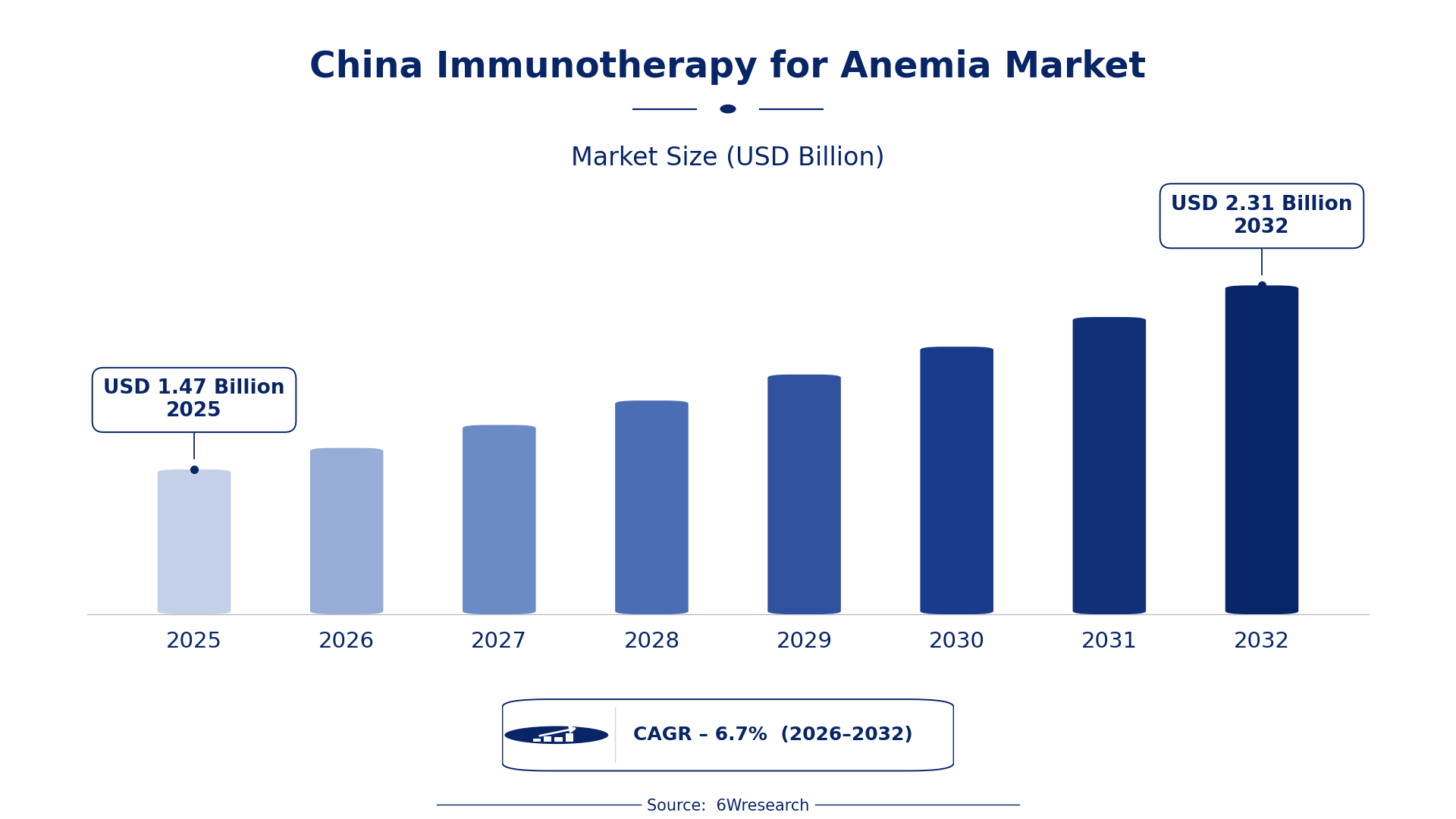
According to 6Wresearch internal database and industry insights, the China Immunotherapy for Anemia Market was valued at USD 1.47 billion in 2025 and is projected to reach USD 2.31 billion by 2032, growing at a CAGR of approximately 6.7% during 2026–2032.
China Immunotherapy for Anemia Market Highlights
| Report Metric | Details |
| Report Name | China Immunotherapy for Anemia Market |
| Market Size 2025 | USD 1.47 billion |
| Market Size 2032 | USD 2.31 billion |
| Absolute Growth 2025–2032 | USD 0.84 billion |
| CAGR 2026–2032 | 6.7% |
| Peak Annual Growth | 8.4% in 2029 |
| Forecast Period | 2026–2032 |
| Historical Data | 2022–2025 |
| Base Year | 2025 |
| Leading Therapy Type, 2025 | Monoclonal Antibodies (48% share) |
| Leading Drug Class, 2025 | Anti-hepcidin Agents (53% share) |
| Leading Administration Route, 2025 | IV/SC (35% share) |
| Leading End User, 2025 | Hematology Clinics (39% share) |
| Fastest-Growing Therapy Type | Novel Biologics (8.4% CAGR) |
| Fastest-Growing Drug Class | EPO + Immunotherapy (9.3% CAGR) |
| Fastest-Growing Administration Route | Injectable (8.4% CAGR) |
| Fastest-Growing End User | Oncology & Hematology Units (9.0% CAGR) |
| Growing Sector | Hematology Clinics |
| Key End Users | Hematology Clinics, Specialty Hospitals, Research Hospitals, Oncology Units |
China Immunotherapy for Anemia Market Year-wise Growth Rate and Key Drivers (2022–2032)
This graph illustrates the annual growth rates of the market from 2022 to 2032, highlighting a steady upward trajectory and projected market expansion over the forecast period.
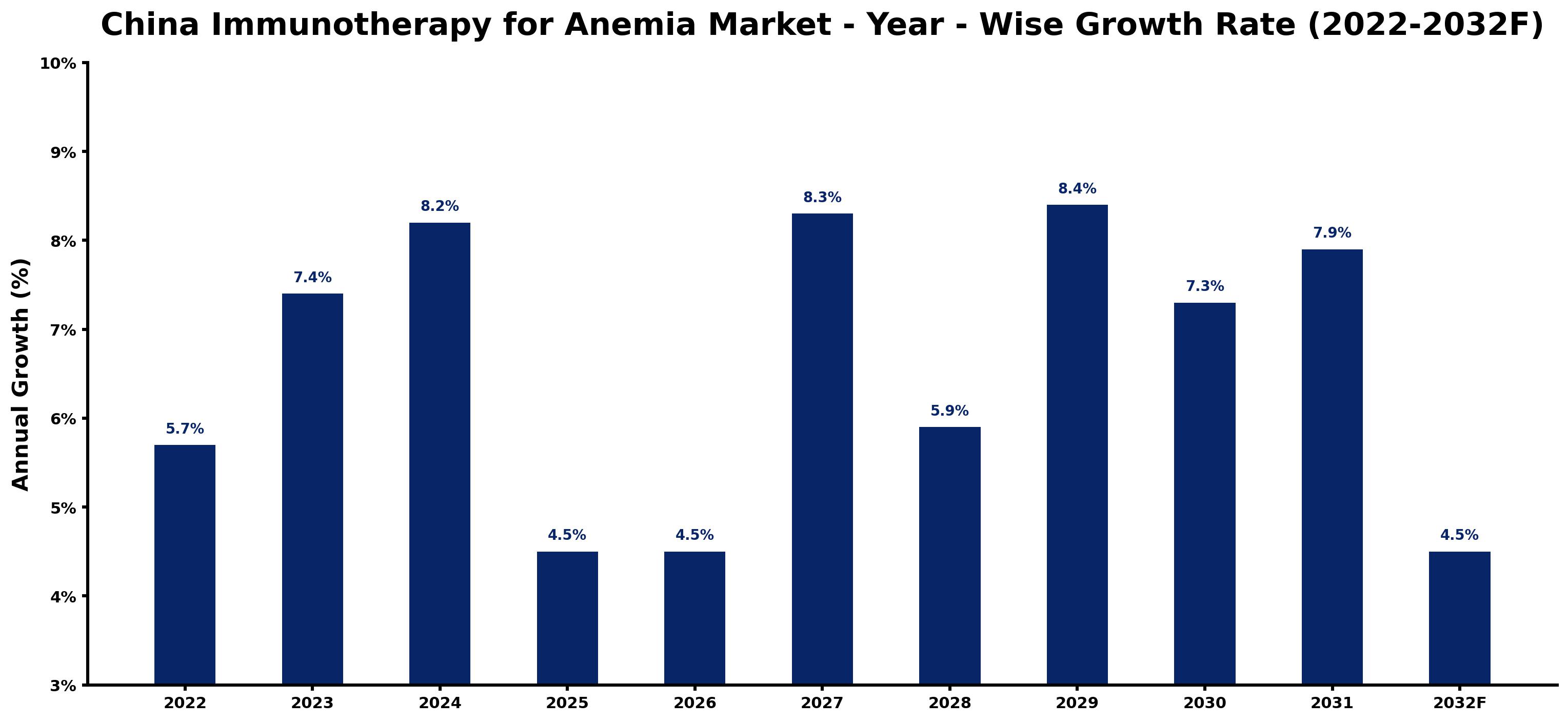
The table below sets out the estimated growth rate for each year and the main factor behind it.
| Year | Estimated Annual Growth (%) | Market Rationale |
| 2022 | 5.7 | The healthcare sector saw a rise in immunotherapy applications for anemia treatment. |
| 2023 | 7.4 | Increased awareness of immunotherapy benefits led to higher patient engagement. |
| 2024 | 8.2 | The National Cancer Control Program promoted immunotherapy, boosting treatment adoption. |
| 2025 | 4.5 | The growth rate slowed as market adjustments occurred following rapid expansion. |
| 2026 | 4.5 | Investment in research supported steady demand for immunotherapy. |
| 2027 | 8.3 | The introduction of new therapies revitalised interest in anemia treatments. |
| 2028 | 5.9 | Market growth decelerated as competition intensified among treatment options. |
| 2029 | 8.4 | The peak growth was driven by advancements in monoclonal antibody therapies. |
| 2030 | 7.3 | Demand stabilised as the market adjusted to new treatment protocols. |
| 2031 | 7.9 | The growth rate increased again due to improved patient access to therapies. |
| 2032 | 4.5 | A slowdown in growth occurred as the market matured and consolidated. |
Note: Market size estimations and growth projections presented in this report are based on 6Wresearch's proprietary forecasting methodology, utilizing the latest available industry data, government publications, and primary research inputs.
China Immunotherapy for Anemia Market Synopsis
Immunotherapy for Anemia in China encompasses biological treatments aimed at stimulating the immune system to combat anemia, particularly in chronic diseases. This therapy is produced through biotechnological processes, primarily using monoclonal antibodies. The market is experiencing growth due to rising patient diagnoses and increased healthcare provider engagement. With approximately 1.5 million patients diagnosed in 2022, demand is further supported by initiatives like the National Cancer Control Program, which promotes immunotherapy usage.
Market Dynamics Impact Analysis (2026–2032)
| Factor | Type | Impact | Primary Segment Affected |
| Rising patient diagnoses and chronic disease prevalence drive demand for immunotherapy solutions. | Driver | High | Monoclonal Antibodies |
| Increased funding for research in hematological disorders enhances treatment options. | Driver | High | Novel Biologics |
| The current gap in effective anemia treatments presents a significant market opportunity. | Opportunity | High | EPO + Immunotherapy |
| Growing interest in advanced therapies creates a demand for innovative solutions. | Opportunity | Medium | Combination Therapies |
| High costs associated with new therapies can limit access for patients. | Restraint | High | Immunomodulators |
| Strict approval processes can delay the introduction of new treatments. | Restraint | Medium | Anti-hepcidin Agents |
| Limited awareness among rural healthcare providers can slow market penetration. | Challenge | High | Specialty Hospitals |
| Competition from alternative therapies may hinder market growth. | Challenge | Medium | Clinical Trials |
Evaluation of Drivers in China Immunotherapy for Anemia Market (2026–2032)
The factors lifting demand, and the evidence behind each, are summarised below.
| Drivers | Primary Segment Affected | Why It Matters (Evidence) |
| Increased patient diagnoses of anemia lead to higher demand for monoclonal antibodies. | Monoclonal Antibodies | In 2022, approximately 1.5 million patients were diagnosed with anemia. |
| Funding for research in hematological disorders supports the development of novel biologics. | Novel Biologics | In 2023, the government allocated 500 million RMB for immunotherapy research initiatives. |
| The National Cancer Control Program promotes immunotherapy, increasing treatment adoption. | EPO + Immunotherapy | This initiative encourages healthcare providers to adopt new therapies and protocols. |
| Growing interest in combination therapies improves treatment efficacy for anemia. | Combination Therapies | Clinical trials are ongoing in over 50 research hospitals across China, expanding options. |
| The rise of specialty hospitals in urban areas boosts immunotherapy availability. | Immunomodulators | Specialty hospitals have seen a rise in immunotherapy treatments, particularly in urban settings. |
Market growth for Immunotherapy for Anemia in China is underpinned by rising patient diagnoses, increased funding for research, and the promotion of new therapies. In 2022, approximately 1.5 million patients were diagnosed with anemia, driving demand for effective treatments. Ongoing clinical trials in over 50 research hospitals are expanding the range of available therapies, meeting the growing demand from patients and healthcare facilities alike.
Evaluation of Restraints in China Immunotherapy for Anemia Market
The key brakes on demand, and where they bite hardest, are shown below.
| Market Restraint | Primary Segment Affected | Why It Matters (Evidence) |
| High costs of immunotherapy treatments limit patient access. | Immunomodulators | Many patients struggle to afford advanced therapies, impacting treatment uptake significantly. |
| Strict approval processes delay the introduction of new therapies. | Anti-hepcidin Agents | The China Food and Drug Administration oversees rigorous testing and approval, extending time to market. |
| Limited awareness among rural healthcare providers restricts treatment availability. | Specialty Hospitals | Rural areas often lack access to the latest treatment protocols and educational resources. |
| Competition from alternative therapies may hinder market growth. | Clinical Trials | Patients may opt for established treatments over newer options, affecting adoption rates. |
| Market maturity leads to slower adoption of new therapies. | Combination Therapies | Providers may be hesitant to shift from traditional treatment methods to newer options. |
China Immunotherapy for Anemia Market Challenges
The China Immunotherapy for Anemia Market encounters strict regulatory challenges, as the China Food and Drug Administration mandates extensive clinical trial data for new treatment approvals, which delays patient access to therapies. High production costs for monoclonal antibodies can exceed 30% compared to traditional treatments, pressuring producers to revise pricing strategies. Buyers, especially specialty hospitals, face financial constraints, as many cannot afford the elevated costs associated with advanced immunotherapy, limiting treatment options for patients. Technological advancements are gradual, with over 50 research hospitals conducting clinical trials that often take years to produce results, restricting the availability of new therapies in the market.
Trends in the China Immunotherapy for Anemia Market
Buyers and suppliers in the China Immunotherapy for Anemia Market are adjusting to the following trends.
- Shift towards Advanced Therapies: China is moving towards advanced therapies for anemia, particularly monoclonal antibodies. The National Cancer Control Program supports this shift, with a 2023 budget of 500 million RMB for research, indicating a growing focus on effective treatment options.
- Focus on Combination Therapies: Combination therapies are gaining traction in anemia treatment, particularly in oncology settings. The Chinese Society of Hematology is promoting these approaches, which improve treatment efficacy for patients, reflecting a shift in clinical practice.
- Increase in Clinical Trials for New Treatments: Clinical trials for new immunotherapy drugs are ongoing in over 50 research hospitals across China. This surge in research activity highlights the potential for new therapies to address unmet needs in anemia treatment.
- Demand for Personalized Medicine: Healthcare providers are increasingly focusing on personalized medicine approaches in anemia treatment. The rise of specialty hospitals in urban areas is facilitating this trend, improving patient outcomes through tailored therapies.
Investment Opportunities in the China Immunotherapy for Anemia Market
The following opportunities in the China Immunotherapy for Anemia Market pair current demand with a clear way in.
- Growing Patient Population: With approximately 1.5 million patients diagnosed with anemia, there is a gap in effective treatments. Investing in monoclonal antibodies can meet the rising demand, particularly in urban specialty hospitals.
- Increased Research Funding: The government allocated 500 million RMB for immunotherapy research, creating opportunities for new therapies. Collaborating with research hospitals can support product development and market entry.
- Expansion of Treatment Options: The demand for combination therapies is increasing, particularly in oncology settings. Focusing on developing these therapies can attract healthcare providers looking for effective solutions.
- Rural Healthcare Development: The 2022 National Health and Wellness Plan aims to improve access to immunotherapy in rural areas. Investing in distribution channels can ensure that underserved populations receive necessary treatments.
Government Initiatives in the China Immunotherapy for Anemia Market
The China Immunotherapy for Anemia Market is influenced by several key policies aimed at enhancing treatment options. The 'National Plan for the Development of Biomedicine', launched in 2021 by the Ministry of Science and Technology, focuses on advancing immunotherapy research for hematological diseases. In 2022, the 'National Health and Wellness Plan' introduced initiatives to improve access to immunotherapy for anemia patients, particularly in rural healthcare facilities. Furthermore, the 'China Drug Administration Law', updated in 2020, streamlines the approval process for new immunotherapy drugs, significantly reducing time to market for innovative therapies. These measures collectively aim to bolster the availability and efficacy of immunotherapy treatments for anemia in China.
Healthcare providers benefit from various government schemes designed to support immunotherapy access. The 'Healthcare Innovation Strategy', introduced by the State Council in 2023, allocates a budget of 500 million RMB for immunotherapy research, enabling hospitals to enhance treatment capabilities. Additionally, the 'National Cancer Prevention and Control Program' promotes collaborative research in immunotherapy, ensuring that healthcare facilities are equipped with the latest advancements. Specialty hospitals are particularly targeted for funding, allowing them to adopt cutting-edge therapies and improve patient outcomes. These initiatives are crucial for addressing the rising demand for effective anemia treatments across the country.
Future Insight of the China Immunotherapy for Anemia Market
By 2032, the China Immunotherapy for Anemia Market will experience considerable changes, driven by increased government funding for research in hematological disorders. Greater awareness among healthcare providers is anticipated to lead to higher adoption rates of immunotherapy across diverse healthcare settings. The introduction of new treatment protocols by the Chinese Society of Hematology will standardise practices and enhance patient outcomes. Approximately 1.5 million patients diagnosed with anemia are expected to benefit from these advancements, as the market adapts to meet growing demand.
Market Segmentation Analysis
The report offers a comprehensive study of the following market segments and their leading categories in the market.
By Therapy Type – Monoclonal Antibodies Dominated, Novel Biologics Expected to Grow Fastest
According to Sachin Kumar Rai, Senior Research Analyst at 6Wresearch, with a 48% revenue share in 2025, Monoclonal Antibodies was the largest therapy type category. Monoclonal antibodies command the largest market share in the China immunotherapy for anemia sector because they effectively target chronic disease-related anemia. Their widespread use in urban specialty hospitals, where the patient population is considerable, underscores their significance. Over 2026–2032, Novel Biologics are expected to post the fastest growth, at a CAGR of 8.4%. Novel biologics are rapidly gaining traction as they demonstrate potential in treating anemia, with over 50 research hospitals currently conducting clinical trials. As awareness increases, the adoption of these therapies is expected to accelerate, further widening the gap with other therapy types. Suppliers should prioritise the development of novel biologics to meet the growing demand in the immunotherapy for anemia market.
By Drug Class – Anti-hepcidin Agents Dominated, EPO + Immunotherapy Expected to Grow Fastest
Anti-hepcidin Agents took a 53% share of drug class in 2025, more than any other category. Anti-hepcidin agents dominate the market share as they are specifically designed to regulate iron levels in patients suffering from anemia. Their effectiveness in addressing chronic disease-related anemia makes them a preferred choice among healthcare providers in China. EPO + Immunotherapy is projected to grow fastest, at a CAGR of 9.3% during 2026–2032. The combination of EPO with immunotherapy is rapidly gaining traction as it significantly enhances treatment outcomes for patients. This growth is supported by increased government funding aimed at advancing research in hematological disorders, which is crucial for patient care. Buyers can anticipate a surge in the availability and development of anti-hepcidin agents and EPO combined with immunotherapy.
By Administration Route – IV/SC Dominated, Injectable Expected to Grow Fastest
In 2025, IV/SC led the administration route split with a 35% share. IV/SC routes are the most prevalent for administering immunotherapy, ensuring effective delivery of treatments in clinical settings. Their established use in various healthcare facilities solidifies their leading market share in the immunotherapy for anemia sector. The quickest growth will come from Injectable, forecast to expand at a CAGR of 8.4% between 2026 and 2032. Injectable administration is experiencing rapid growth due to its convenience and effectiveness in delivering immunotherapy. The increasing patient population receiving these treatments is likely to further accelerate this trend, enhancing market dynamics. Suppliers must adapt their strategies to meet the rising demand for effective injectable administration routes in the immunotherapy for anemia market.
By End User – Hematology Clinics Dominated, Oncology & Hematology Units Expected to Grow Fastest
Hematology Clinics accounted for a 39% market share by end user in 2025. Hematology clinics hold the largest market share as they serve as the primary venues for administering therapies for anemia. The high volume of patients seeking treatment in these clinics reinforces their dominant position in the market. Oncology & Hematology Units are set to record the highest CAGR in this split, 9.0% over 2026–2032. Oncology and hematology units are witnessing the fastest growth due to the rising prevalence of cancer-related anemia. Their critical role in managing these patients is expected to further boost their market share in the coming years. Providers should concentrate on oncology and hematology units to meet the growing demand for immunotherapy in cancer-related anemia.
Key Attractiveness of the Report
- 10 Years of Market Numbers
- Historical Data Starting from 2022 to 2025
- Base Year 2025
- Forecast Data until 2032
- Key Performance Indicators Impacting the Market
- Major Upcoming Developments and Projects
Key Highlights of the Report:
- China Immunotherapy for Anemia Market Outlook
- Market Size of China Immunotherapy for Anemia Market, 2025
- Forecast of China Immunotherapy for Anemia Market, 2032
- Historical Data and Forecast of China Immunotherapy for Anemia Revenues & Volume for the Period 2022 - 2032F
- China Immunotherapy for Anemia Market Trend Evolution
- China Immunotherapy for Anemia Market Drivers and Challenges
- China Immunotherapy for Anemia Price Trends
- China Immunotherapy for Anemia Porter's Five Forces
- China Immunotherapy for Anemia Industry Life Cycle
- Historical Data and Forecast of China Immunotherapy for Anemia Market Revenues & Volume By Therapy Type for the Period 2022 - 2032F
- Historical Data and Forecast of China Immunotherapy for Anemia Market Revenues & Volume By Monoclonal Antibodies for the Period 2022 - 2032F
- Historical Data and Forecast of China Immunotherapy for Anemia Market Revenues & Volume By Immunomodulators for the Period 2022 - 2032F
- Historical Data and Forecast of China Immunotherapy for Anemia Market Revenues & Volume By Combination Therapies for the Period 2022 - 2032F
- Historical Data and Forecast of China Immunotherapy for Anemia Market Revenues & Volume By Novel Biologics for the Period 2022 - 2032F
- Historical Data and Forecast of China Immunotherapy for Anemia Market Revenues & Volume By Drug Class for the Period 2022 - 2032F
- Historical Data and Forecast of China Immunotherapy for Anemia Market Revenues & Volume By Anti-hepcidin Agents for the Period 2022 - 2032F
- Historical Data and Forecast of China Immunotherapy for Anemia Market Revenues & Volume By Cytokine Inhibitors for the Period 2022 - 2032F
- Historical Data and Forecast of China Immunotherapy for Anemia Market Revenues & Volume By EPO + Immunotherapy for the Period 2022 - 2032F
- Historical Data and Forecast of China Immunotherapy for Anemia Market Revenues & Volume By Clinical Trials for the Period 2022 - 2032F
- Historical Data and Forecast of China Immunotherapy for Anemia Market Revenues & Volume By Administration Route for the Period 2022 - 2032F
- Historical Data and Forecast of China Immunotherapy for Anemia Market Revenues & Volume By IV/SC for the Period 2022 - 2032F
- Historical Data and Forecast of China Immunotherapy for Anemia Market Revenues & Volume By Oral for the Period 2022 - 2032F
- Historical Data and Forecast of China Immunotherapy for Anemia Market Revenues & Volume By Injectable for the Period 2022 - 2032F
- Historical Data and Forecast of China Immunotherapy for Anemia Market Revenues & Volume By IV for the Period 2022 - 2032F
- Historical Data and Forecast of China Immunotherapy for Anemia Market Revenues & Volume By End User for the Period 2022 - 2032F
- Historical Data and Forecast of China Immunotherapy for Anemia Market Revenues & Volume By Hematology Clinics for the Period 2022 - 2032F
- Historical Data and Forecast of China Immunotherapy for Anemia Market Revenues & Volume By Specialty Hospitals for the Period 2022 - 2032F
- Historical Data and Forecast of China Immunotherapy for Anemia Market Revenues & Volume By Oncology & Hematology Units for the Period 2022 - 2032F
- Historical Data and Forecast of China Immunotherapy for Anemia Market Revenues & Volume By Research Hospitals for the Period 2022 - 2032F
- China Immunotherapy for Anemia Import Export Trade Statistics
- Market Opportunity Assessment By Therapy Type
- Market Opportunity Assessment By Drug Class
- Market Opportunity Assessment By Administration Route
- Market Opportunity Assessment By End User
- China Immunotherapy for Anemia Top Companies Market Share
- China Immunotherapy for Anemia Competitive Benchmarking By Technical and Operational Parameters
- China Immunotherapy for Anemia Company Profiles
- China Immunotherapy for Anemia Key Strategic Recommendations
Market Covered
This report examines the market across the segments below.
By Therapy Type
- Monoclonal Antibodies
- Immunomodulators
- Combination Therapies
- Novel Biologics
By Drug Class
- Anti-hepcidin Agents
- Cytokine Inhibitors
- EPO + Immunotherapy
- Clinical Trials
By Administration Route
- IV/SC
- Oral
- Injectable
- IV
By End User
- Hematology Clinics
- Specialty Hospitals
- Oncology & Hematology Units
- Research Hospitals































