China Implantable Bionics Market Size & Growth Rate
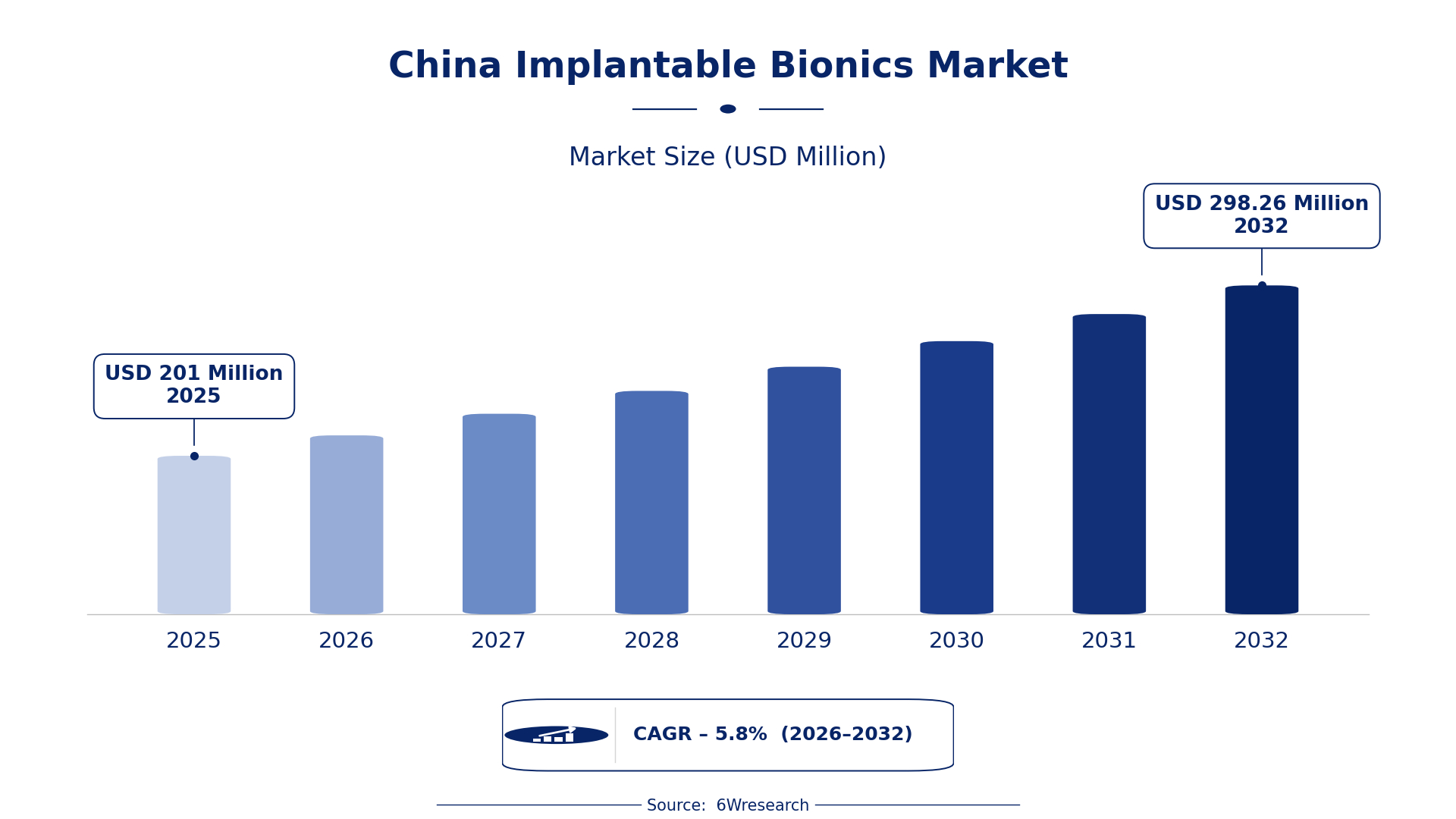
According to 6Wresearch internal database and industry insights, the China Implantable Bionics Market was valued at USD 201.0 million in 2025 and is projected to reach USD 298.26 million by 2032, growing at a CAGR of approximately 5.8% during 2026–2032.
China Implantable Bionics Market Highlights
| Report Metric | Details |
| Report Name | China Implantable Bionics Market |
| Market Size 2025 | USD 201.0 million |
| Market Size 2032 | USD 298.26 million |
| Absolute Growth 2025–2032 | USD 97.26 million |
| CAGR 2026–2032 | 5.8% |
| Peak Annual Growth | 7.5% in 2031 |
| Forecast Period | 2026–2032 |
| Historical Data | 2022–2025 |
| Base Year | 2025 |
| Leading Device Type, 2025 | Cochlear Implants (46% share) |
| Leading Assistive Function, 2025 | Hearing Enhancement (42% share) |
| Leading Integration Mode, 2025 | Neural Interface (35% share) |
| Leading End User, 2025 | Ophthalmic Hospitals (41% share) |
| Fastest-Growing Device Type | Neuromuscular Implants (6.9% CAGR) |
| Fastest-Growing Assistive Function | Cognitive/Augmented Function (7.2% CAGR) |
| Fastest-Growing Integration Mode | Sensor + Signal Unit (8.4% CAGR) |
| Fastest-Growing End User | Neuroprosthetic Labs (7.5% CAGR) |
| Growing Sector | Ophthalmic care |
| Key End Users | Ophthalmic Hospitals, ENT Clinics, Neuroprosthetic Labs, Neuroscience R&D Centers |
China Implantable Bionics Market Year-wise Growth Rate and Key Drivers (2022–2032)
This graph illustrates the annual growth rates of the market from 2022 to 2032, highlighting a steady upward trajectory and projected market expansion over the forecast period.
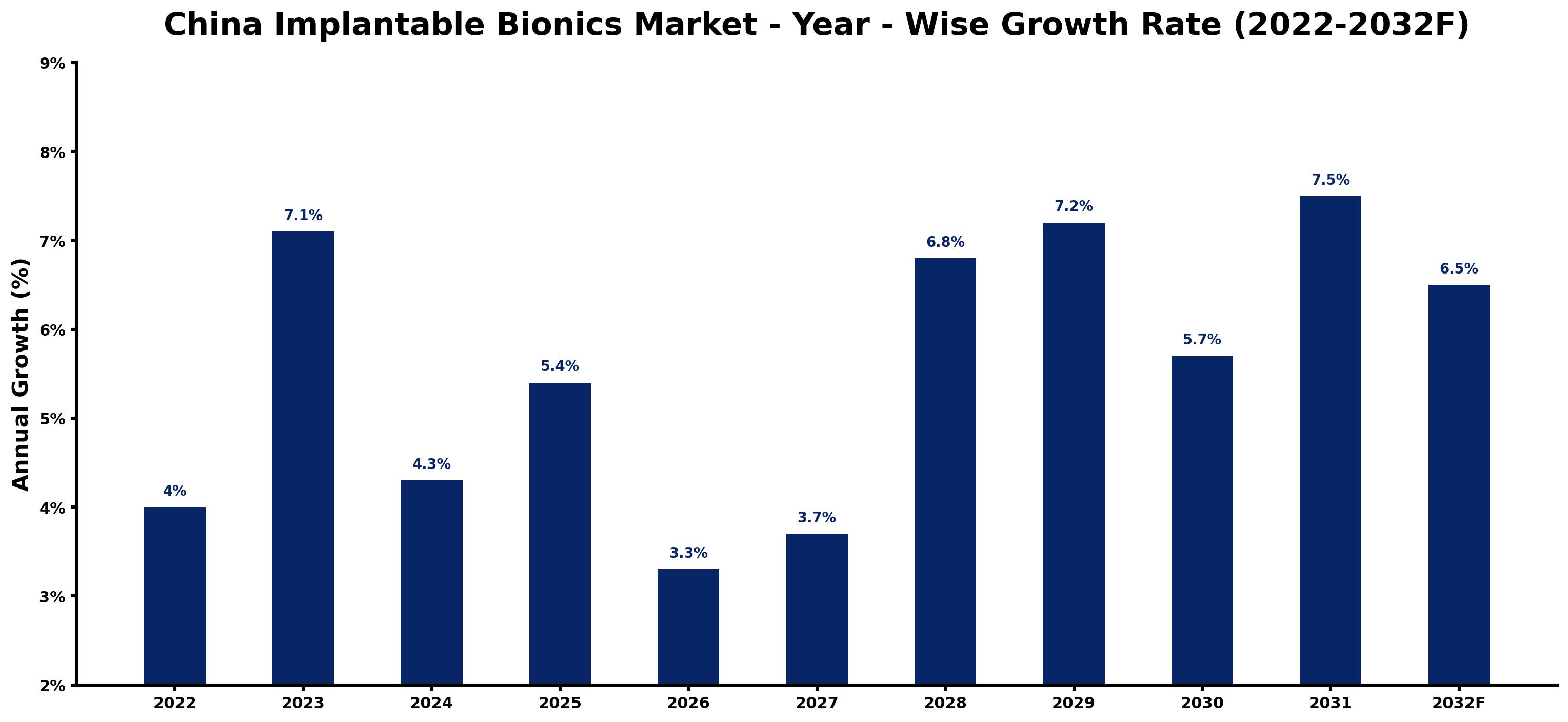
The table below sets out the estimated growth rate for each year and the main factor behind it.
| Year | Estimated Annual Growth (%) | Market Rationale |
| 2022 | 4.0 | The market experienced steady growth due to increasing healthcare needs driven by the National Health Commission's 2021-2025 Health Technology Development Plan. |
| 2023 | 7.1 | Demand surged as technological advancements in bionics gained traction, particularly in retinal implants being developed under the guidance of the Chinese Academy of Sciences. |
| 2024 | 4.3 | Growth slowed as market adjustments took place following rapid expansion in cochlear implants, which reached around 200,000 units by 2023. |
| 2025 | 5.4 | The market saw renewed interest with increased investments in healthcare technology from the 14th Five-Year Plan. |
| 2026 | 3.3 | A slowdown occurred as the market is expected to stabilise after previous high growth rates. |
| 2027 | 3.7 | Growth picked up again as innovations in neural interfaces emerge from the Ministry of Science and Technology's funding for research. |
| 2028 | 6.8 | Demand rose due to advancements in neuroprosthetics technology supported by the National Key Research and Development Program. |
| 2029 | 7.2 | The market continued to grow as more patients sought bionic solutions, particularly in urban areas with over 20 million individuals with hearing loss. |
| 2030 | 5.7 | Growth moderated as the market adjusted to new regulatory frameworks under the updated National Standard for Medical Devices. |
| 2031 | 7.5 | A peak in growth was reached with heightened investment in research and development initiatives. |
| 2032 | 6.5 | The market is projected to stabilise as demand remains strong for advanced bionic devices. |
Note: Market size estimations and growth projections presented in this report are based on 6Wresearch's proprietary forecasting methodology, utilizing the latest available industry data, government publications, and primary research inputs.
China Implantable Bionics Market Synopsis
The China Implantable Bionics Market includes advanced medical devices that replace or restore biological functions using technology. These devices feature retinal implants for vision restoration and cochlear implants for hearing restoration. The market is expanding due to rising healthcare demands and significant investments in medical technology, highlighted by the 14th Five-Year Plan for Health. With a population exceeding 1.4 billion, the need for implantable bionics is substantial, propelled by advancements in treatment options and patient care.
Market Dynamics Impact Analysis (2026–2032)
| Factor | Type | Impact | Primary Segment Affected |
| Rising healthcare investments are driving demand for advanced medical devices. | Driver | High | Cochlear Implants |
| Increasing patient population with disabilities creates a growing market. | Driver | High | Retinal Implants |
| The growing elderly population in urban areas requires more implantable solutions. | Opportunity | High | Neuromuscular Implants |
| Innovations in neural interface technology present new market avenues. | Opportunity | Medium | Brain-Machine Interfaces |
| High costs associated with advanced bionic devices limit accessibility. | Restraint | High | Cochlear Implants |
| Complex regulatory processes can delay product approvals. | Restraint | Medium | Retinal Implants |
| The Implantable Bionics market in China faces a few practical problems, including high costs. | Challenge | High | Neuromuscular Implants |
| Limited awareness among patients about available bionic solutions poses challenges. | Challenge | Medium | Brain-Machine Interfaces |
Evaluation of Drivers in China Implantable Bionics Market (2026–2032)
The table below links each growth driver to the segment it affects and the evidence for it.
| Drivers | Primary Segment Affected | Why It Matters (Evidence) |
| Increased healthcare spending is driving demand for advanced bionic devices. | Cochlear Implants | The installed base of cochlear implants reached around 200,000 units by 2023, indicating strong demand. |
| Growing prevalence of disabilities among the population fuels market growth. | Retinal Implants | China has over 20 million individuals with hearing loss, creating a market for bionic solutions. |
| Technological advancements in neural interfaces improve product offerings. | Neuromuscular Implants | Research funding in neural interface technology is enhancing product capabilities and applications. |
| Rising awareness of the benefits of bionic implants boosts demand. | Brain-Machine Interfaces | Research shows that over 90% of patients report improved quality of life after receiving bionic implants. |
| Government initiatives promote the development of advanced medical devices. | Neural Interface | The 14th Five-Year Plan for Health (2021-2025) emphasises advanced medical devices to improve healthcare outcomes. |
The Implantable Bionics market in China is expanding due to increased healthcare spending, technological progress, and heightened patient awareness. In 2023, the installed base of cochlear implants reached approximately 200,000 units, reflecting strong demand. The population includes many individuals with disabilities who require bionic solutions, further propelling market growth. Neuroscience R&D centres in Beijing are driving innovations in brain-computer interfaces, broadening product offerings. Research indicates that over 90% of patients report improved quality of life after receiving bionic implants, underscoring the value of these technologies.
Evaluation of Restraints in China Implantable Bionics Market
Below mentioned are some major restraints and their influence on market dynamics.
| Market Restraint | Primary Segment Affected | Why It Matters (Evidence) |
| High costs associated with advanced bionic devices limit accessibility. | Cochlear Implants | The average age of patients receiving cochlear implants is around 5 years old, highlighting affordability issues. |
| Complex regulatory processes can delay product approvals. | Retinal Implants | The National Standard for Medical Devices regulates implantable devices, affecting approval timelines and market entry. |
| Limited availability of trained professionals impacts service delivery. | Neuromuscular Implants | The need for specialized training in bionic technologies is essential for effective implementation and patient care. |
| Insurance coverage for bionic devices remains inadequate. | Brain-Machine Interfaces | Patients often face high out-of-pocket costs due to limited insurance support for advanced devices. |
| Market fragmentation complicates distribution channels. | Cochlear Implants | Numerous small players create challenges in reaching end users effectively and maintaining quality. |
China Implantable Bionics Market Challenges
The China Implantable Bionics Market encounters several practical issues, with technology adoption being a primary concern. Many hospitals lack the infrastructure necessary to support advanced implantable bionics, delaying access for around 200,000 patients needing cochlear implants. Intense competition among suppliers results in price wars, which can compromise quality and ultimately affect outcomes for buyers seeking reliable devices. Supply chain disruptions arise from reliance on imported components, leading to longer lead times for hospitals needing to procure essential devices. Limited specialised training for medical staff hampers effective implementation, impacting care for individuals with disabilities requiring bionic solutions.
Trends in the China Implantable Bionics Market
Several trends are reshaping the China Implantable Bionics Market; the most important are set out below.
- Shift from Traditional to Advanced Bionic Solutions: Since 2021, there has been a notable shift towards advanced bionic solutions, with the National Key Research and Development Program allocating 500 million CNY to support innovations in neural interface technology.
- Emergence of Neural Interface Technologies: The focus on neural interface technologies began in 2023, with funding from the Ministry of Science and Technology expected to drive advancements in brain-machine interfaces for better patient communication.
- Increased Demand from Ophthalmic Hospitals: Ophthalmic hospitals are increasingly adopting bionic solutions, with over 1,000 specialised facilities in China, driven by the rising prevalence of vision-related disorders requiring new treatment options.
- Expansion of Neuroprosthetic Labs: Neuroprosthetic labs are becoming more prominent, particularly in Beijing, where research is focused on developing new bionic technologies, with the market for neuroprosthetics projected to see substantial investment through 2025.
Investment Opportunities in the China Implantable Bionics Market
The following opportunities in the China Implantable Bionics Market pair current demand with a clear way in.
- Ophthalmic Hospitals Seeking Advanced Solutions: Ophthalmic hospitals are increasingly in need of advanced bionic solutions, particularly retinal implants, as the patient population grows. With over 1,000 hospitals, the market potential is substantial, driven by the rising number of patients requiring vision restoration.
- Supply of Neural Interface Technologies: There is a growing opportunity to supply neural interface technologies, particularly as research funding increases. The National Key Research and Development Program's budget of 500 million CNY supports innovations in this area, creating demand from various healthcare facilities.
- Timing for Investment in a leading supplier: Now is an opportune time to invest in neuroprosthetics, with substantial funding expected through 2025. The increasing prevalence of disabilities in China presents a strong market for new solutions, particularly in urban areas.
- Growth in Neuroprosthetic Labs: Neuroprosthetic labs are expanding, particularly in Beijing, where advanced research is being conducted. This growth is supported by the increasing demand for new bionic technologies, creating opportunities for suppliers.
Government Initiatives in the China Implantable Bionics Market
In 2023, the National Medical Products Administration introduced a fast-track approval pathway for bionic devices, enhancing patient access to new technologies. This measure builds on the 2021 updates to the Regulations on the Supervision and Administration of Medical Devices, which streamlined approval processes for implantable devices, ensuring quicker market entry for new products. The emphasis on efficiency in the approval process benefits both producers and patients, facilitating timely access to advanced medical solutions.
The Ministry of Science and Technology plays a key role in funding and approving research initiatives related to implantable bionics. The National Key Research and Development Program, launched in 2022, allocates substantial funding to support innovations in neural interface technology. This funding aims to enhance the development of advanced medical devices, ensuring that producers have the resources needed to innovate and improve patient care.
Future Insight of the China Implantable Bionics Market
By 2032, buyers and suppliers in the China Implantable Bionics Market can expect transformative changes driven by government initiatives and increased funding for research. The National Health Commission's 2021-2025 Health Technology Development Plan will facilitate better integration of bionic devices into healthcare systems. With approximately 20 million individuals with hearing loss, demand will spur innovations in device design and functionality. Investment in neuroprosthetics is projected to grow, creating a more supportive environment for the development of implantable bionics.
Market Segmentation Analysis
The analysis below covers each segmentation, its leading category in 2025 and its fastest-growing category through 2032.
By Device Type – Cochlear Implants Dominated, Neuromuscular Implants Expected to Grow Fastest
According to Sachin Kumar Rai, Senior Research Analyst at 6Wresearch, with a 46% revenue share in 2025, Cochlear Implants was the largest device type category. These devices are crucial in specialised facilities that provide auditory rehabilitation, ensuring a steady demand. Over 2026–2032, Neuromuscular Implants are expected to post the fastest growth, at a CAGR of 6.9%. Neuromuscular implants are rapidly gaining traction, propelled by advancements in technology that improve limb control for patients with motor impairments. The increasing focus on research and development in this area suggests that this segment will continue to expand significantly. Suppliers should prioritise innovations in neuromuscular implants to meet the surging demand and maintain competitive advantage.
By Assistive Function – Hearing Enhancement Dominated, Cognitive/Augmented Function Expected to Grow Fastest
Hearing Enhancement took a 42% share of assistive function in 2025, more than any other category. Hearing enhancement leads the market share as it effectively meets the needs of a vast population, significantly improving the quality of life for individuals with hearing impairments. The high success rate of these devices in restoring auditory capabilities reinforces their importance in healthcare. Cognitive/Augmented Function is set to record the highest CAGR in this split, 7.2% over 2026–2032. Cognitive or augmented function products are experiencing the fastest growth, driven by heightened interest in enhancing cognitive abilities and addressing neurological disorders. As research in this domain progresses, the demand for these solutions is expected to escalate rapidly. Buyers can expect a broader range of cognitive enhancement products as market interest continues to rise.
By Integration Mode – Neural Interface Dominated, Sensor + Signal Unit Expected to Grow Fastest
Neural Interface held a 35% share of the China Implantable Bionics Market by integration mode in 2025. Neural interfaces dominate the market share as they are essential for connecting implantable devices to the nervous system, ensuring effective functionality. Their critical role is highlighted by the ongoing development of advanced implant technologies that depend on these connections. Sensor + Signal Unit is projected to grow fastest, at a CAGR of 8.4% during 2026–2032. The segment for data collection and processing units is growing quickly, driven by the need for efficient integration in modern implantable devices. This growth reflects the increasing complexity and capability of bionic technologies. Suppliers must invest in advanced integration technologies to meet the rising demand for sophisticated implant solutions.
By End User – Ophthalmic Hospitals Dominated, Neuroprosthetic Labs Expected to Grow Fastest
In 2025, Ophthalmic Hospitals led the end user split with a 41% share. Ophthalmic hospitals hold the largest market share as they are the primary providers of vision-related implant surgeries, ensuring consistent demand for implantable bionic solutions. Their established role in the healthcare system underscores their importance in delivering these technologies. The quickest growth will come from Neuroprosthetic Labs, forecast to expand at a CAGR of 7.5% between 2026 and 2032. Neuroprosthetic labs are witnessing the fastest growth, focusing on the development of advanced bionic technologies and attracting significant investment. This trend indicates a shift towards more specialised research and development in the implantable bionics sector. Suppliers should explore collaborations with neuroprosthetic labs to stay at the forefront of technological advancements.
Key Attractiveness of the Report
- 10 Years of Market Numbers
- Historical Data Starting from 2022 to 2025
- Base Year 2025
- Forecast Data until 2032
- Key Performance Indicators Impacting the Market
- Major Upcoming Developments and Projects
Key Highlights of the Report:
- China Implantable Bionics Market Outlook
- Market Size of China Implantable Bionics Market, 2025
- Forecast of China Implantable Bionics Market, 2032
- Historical Data and Forecast of China Implantable Bionics Revenues & Volume for the Period 2022 - 2032F
- China Implantable Bionics Market Trend Evolution
- China Implantable Bionics Market Drivers and Challenges
- China Implantable Bionics Price Trends
- China Implantable Bionics Porter's Five Forces
- China Implantable Bionics Industry Life Cycle
- Historical Data and Forecast of China Implantable Bionics Market Revenues & Volume By Device Type for the Period 2022 - 2032F
- Historical Data and Forecast of China Implantable Bionics Market Revenues & Volume By Retinal Implants for the Period 2022 - 2032F
- Historical Data and Forecast of China Implantable Bionics Market Revenues & Volume By Cochlear Implants for the Period 2022 - 2032F
- Historical Data and Forecast of China Implantable Bionics Market Revenues & Volume By Neuromuscular Implants for the Period 2022 - 2032F
- Historical Data and Forecast of China Implantable Bionics Market Revenues & Volume By Brain-Machine Interfaces for the Period 2022 - 2032F
- Historical Data and Forecast of China Implantable Bionics Market Revenues & Volume By Assistive Function for the Period 2022 - 2032F
- Historical Data and Forecast of China Implantable Bionics Market Revenues & Volume By Vision Restoration for the Period 2022 - 2032F
- Historical Data and Forecast of China Implantable Bionics Market Revenues & Volume By Hearing Enhancement for the Period 2022 - 2032F
- Historical Data and Forecast of China Implantable Bionics Market Revenues & Volume By Limb Control/Support for the Period 2022 - 2032F
- Historical Data and Forecast of China Implantable Bionics Market Revenues & Volume By Cognitive/Augmented Function for the Period 2022 - 2032F
- Historical Data and Forecast of China Implantable Bionics Market Revenues & Volume By Integration Mode for the Period 2022 - 2032F
- Historical Data and Forecast of China Implantable Bionics Market Revenues & Volume By Neural Interface for the Period 2022 - 2032F
- Historical Data and Forecast of China Implantable Bionics Market Revenues & Volume By Electrode + Receiver for the Period 2022 - 2032F
- Historical Data and Forecast of China Implantable Bionics Market Revenues & Volume By Sensor + Signal Unit for the Period 2022 - 2032F
- Historical Data and Forecast of China Implantable Bionics Market Revenues & Volume By Direct Brain Stimulation for the Period 2022 - 2032F
- Historical Data and Forecast of China Implantable Bionics Market Revenues & Volume By End User for the Period 2022 - 2032F
- Historical Data and Forecast of China Implantable Bionics Market Revenues & Volume By Ophthalmic Hospitals for the Period 2022 - 2032F
- Historical Data and Forecast of China Implantable Bionics Market Revenues & Volume By ENT Clinics for the Period 2022 - 2032F
- Historical Data and Forecast of China Implantable Bionics Market Revenues & Volume By Neuroprosthetic Labs for the Period 2022 - 2032F
- Historical Data and Forecast of China Implantable Bionics Market Revenues & Volume By Neuroscience R&D Centers for the Period 2022 - 2032F
- China Implantable Bionics Import Export Trade Statistics
- Market Opportunity Assessment By Device Type
- Market Opportunity Assessment By Assistive Function
- Market Opportunity Assessment By Integration Mode
- Market Opportunity Assessment By End User
- China Implantable Bionics Top Companies Market Share
- China Implantable Bionics Competitive Benchmarking By Technical and Operational Parameters
- China Implantable Bionics Company Profiles
- China Implantable Bionics Key Strategic Recommendations
Market Covered
Segments analysed in this report are listed below.
By Device Type
- Retinal Implants
- Cochlear Implants
- Neuromuscular Implants
- Brain-Machine Interfaces
By Assistive Function
- Vision Restoration
- Hearing Enhancement
- Limb Control/Support
- Cognitive/Augmented Function
By Integration Mode
- Neural Interface
- Electrode + Receiver
- Sensor + Signal Unit
- Direct Brain Stimulation
By End User
- Ophthalmic Hospitals
- ENT Clinics
- Neuroprosthetic Labs
- Neuroscience R&D Centers































