China IMU Module Market Size & Growth Rate

According to 6Wresearch internal database and industry insights, the China IMU Module Market was valued at USD 908.0 million in 2025 and is projected to reach USD 1,486.91 million by 2032, growing at a CAGR of approximately 7.3% during 2026–2032.
China IMU Module Market Highlights
| Report Metric | Details |
| Report Name | China IMU Module Market (2026-2032) |
| Market Size 2025 | USD 908.0 million |
| Market Size 2032 | USD 1,486.91 million |
| Absolute Growth 2025–2032 | USD 578.91 million |
| CAGR 2026–2032 | 7.3% |
| Peak Annual Growth | 8.1% in 2028 |
| Forecast Period | 2026–2032 |
| Historical Data | 2022–2025 |
| Base Year | 2025 |
| Leading Module Type, 2025 | 6-Axis IMU (34% share) |
| Fastest-Growing Module Type | Automotive IMU Module (8.9% CAGR) |
| Leading Axis Count, 2025 | Accelerometer + Gyroscope (52% share) |
| Fastest-Growing Axis Count | Rugged/Precision (7.9% CAGR) |
| Leading Integration Level, 2025 | Medium (31% share) |
| Fastest-Growing Integration Level | Advanced (8.1% CAGR) |
| Leading End User, 2025 | Wearable Device Makers (29% share) |
| Fastest-Growing End User | UAV/Drone Manufacturers (8.6% CAGR) |
| Growing Sector | Automotive electronics and intelligent robotics |
| Key End Users | Consumer electronics brands, vehicle makers and Tier-1 suppliers, drone manufacturers, robotics and industrial automation integrators |
China IMU Module Market Year-wise Growth Rate and Key Drivers (2022–2032)
This graph illustrates the annual growth rates of the market from 2022 to 2032, highlighting a steady upward trajectory and projected market expansion over the forecast period.
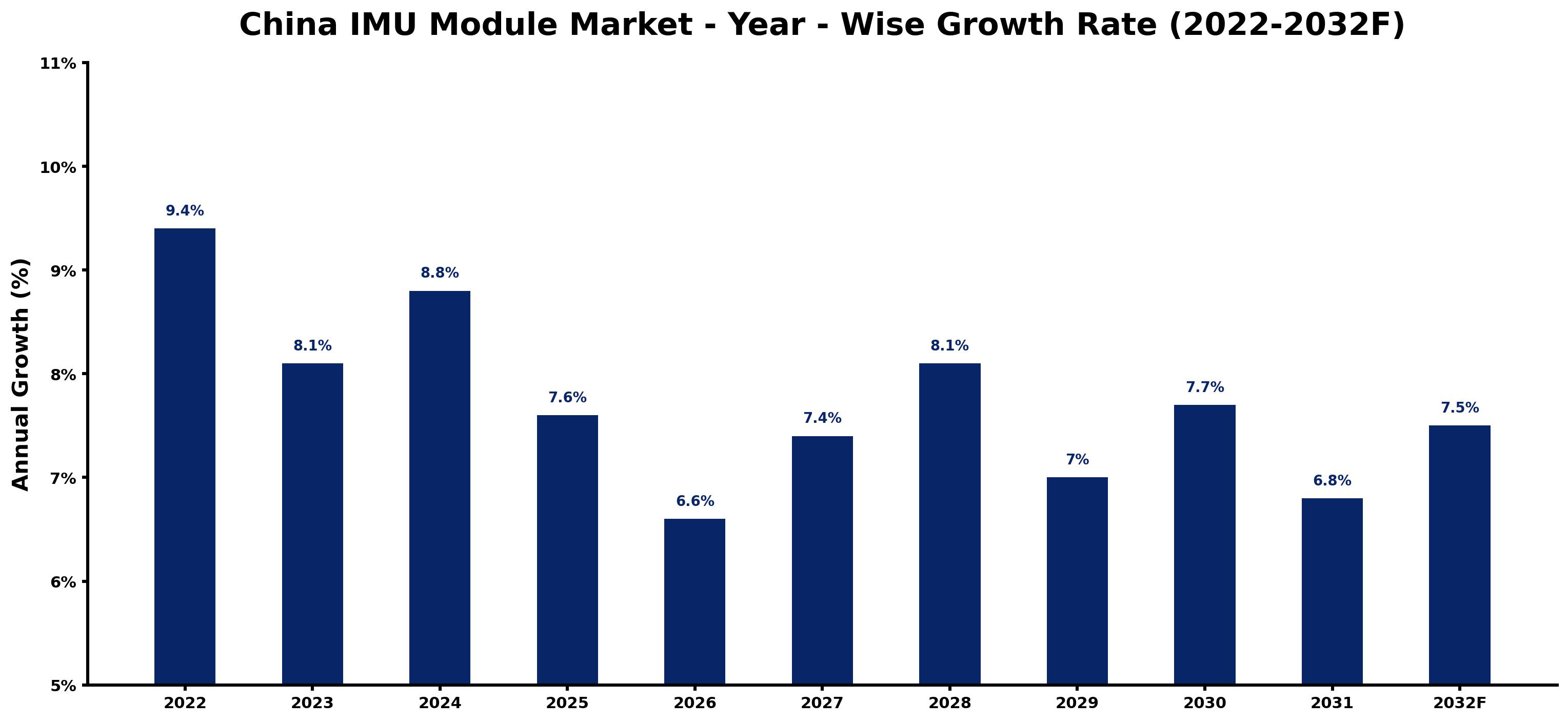
The following table presents the estimated annual growth rate for each year together with the principal factor influencing market performance.
| Year | Estimated Annual Growth (%) | Market Rationale |
| 2022 | 9.4 | Rising electric vehicle output and wearable shipments lifted demand, even as spring lockdowns in Shanghai disrupted component logistics. |
| 2023 | 8.1 | Growth normalised as consumer electronics inventories were corrected after reopening, although new energy vehicle sales rose to 9.5 million units. |
| 2024 | 8.8 | The equipment renewal and consumer goods trade-in programme launched in 2024 stimulated demand for robots, vehicles and smart devices. |
| 2025 | 7.6 | Price competition among vehicle makers compressed component budgets, moderating growth despite expanding humanoid robot and low-altitude drone pilot programmes. |
| 2026 | 6.6 | Slower vehicle sales growth after purchase-tax incentive tapering is expected to hold growth at its lowest forecast level. |
| 2027 | 7.4 | Scaling of humanoid and industrial robot production lines is expected to lift demand for precision motion sensing modules. |
| 2028 | 8.1 | Wider approval of conditional autonomous driving functions is expected to raise inertial sensor content per vehicle significantly. |
| 2029 | 7.0 | Maturing vehicle platforms and domestic sourcing are expected to compress module prices, normalising growth after the 2028 peak. |
| 2030 | 7.7 | Commercial low-altitude operations and cargo drone networks are expected to expand, increasing demand for navigation-grade inertial units. |
| 2031 | 6.8 | Wearable device penetration is expected to approach saturation among urban consumers, moderating unit growth despite continued upgrades. |
| 2032 | 7.5 | Next-generation MEMS gyroscope adoption and export expansion are expected to lift growth as higher-performance modules gain share. |
Note: Market size estimations and growth projections presented in this report are based on 6Wresearch's proprietary forecasting methodology, utilizing the latest available industry data, government publications, and primary research inputs.
China IMU Module Market Synopsis
The China IMU Module Market comprises inertial measurement units that combine accelerometers, gyroscopes and magnetometers into packaged modules for motion, orientation and navigation sensing across vehicles, robots and drones. Growth is supported by the world's largest new energy vehicle output, rising industrial robot installations, expanding consumer drone manufacturing led by Shenzhen, and large-scale wearable production. Domestic MEMS capacity at firms such as MEMSIC and Goertek is also deepening local supply. However, dependence on imported high-performance gyroscopes and calibration expertise limits penetration in navigation-grade applications.
Market Dynamics Impact Analysis (2026–2032)
| Factor | Type | Impact | Primary Segment Affected |
| Rising assisted-driving content per vehicle | Driver | High | Automotive IMU Module |
| Expanding robot and drone production | Driver | High | 9-Axis IMU |
| Import substitution in navigation-grade modules | Opportunity | High | Rugged/Precision |
| Pre-integrated sensor-fusion module offerings | Opportunity | Medium | Advanced |
| Dependence on imported high-end gyroscopes | Restraint | High | Rugged/Precision |
| Limited access to specialised MEMS process equipment | Restraint | Medium | 9-Axis IMU |
| Scarcity of calibration and fusion engineers | Challenge | Medium | Industrial-Grade IMU |
| Short platform design cycles and rising engineering cost | Challenge | Medium | Embedded in ECU |
Evaluation of Drivers in China IMU Module Market (2026–2032)
Below mentioned are some major drivers and their influence on market dynamics.
| Drivers | Primary Segment Affected | Why It Matters (Evidence) |
| New energy vehicle scale | Automotive IMU Module | Vehicles with driver assistance and stability control need inertial sensing for dead reckoning and chassis control, so higher output multiplies unit demand. China produced more than 30 million vehicles in 2024. |
| Industrial robot deployment | Industrial-Grade IMU | Robot arms, mobile robots and humanoids use inertial modules for vibration compensation and balance, so each installation creates recurring orders. China installed around 276,000 industrial robots in 2023, more than half of the global total. |
| Consumer drone manufacturing | 9-Axis IMU | Flight controllers rely on inertial data and heading references for attitude stabilisation, so every drone shipped carries at least one module. DJI, headquartered in Shenzhen, supplies a leading share of global consumer drones. |
| Wearable production scale | 6-Axis IMU | Smartwatches, bands and earbuds use low-power motion sensors for activity tracking and gesture control, so production volumes translate directly into module demand. Huawei and Xiaomi rank among the world's largest wearable brands by shipments. |
| Satellite navigation integration | Rugged/Precision | Inertial modules bridge GNSS outages in tunnels and urban canyons, so positioning products pair them with satellite receivers for continuous output. The BeiDou-3 constellation was completed in 2020 and provides global coverage. |
Market growth is supported by the depth of China's electronics manufacturing base, where clustered component suppliers in the Pearl River Delta and Yangtze River Delta shorten development cycles and keep module costs competitive. Total research and development spending reached about 3.6 trillion yuan in 2024, funding sensor design, calibration algorithms and packaging know-how that raise domestic module quality. Growing use of on-device artificial intelligence increases the need for accurate motion data to feed sensor-fusion software, and expanding domestic MEMS wafer capacity adds local supply of sensing dies. Rising private capital in semiconductor start-ups and falling unit costs are broadening the range of products that can economically embed inertial sensing.
Evaluation of Restraints in China IMU Module Market
Below mentioned are some major restraints and their influence on market dynamics.
| Market Restraint | Primary Segment Affected | Why It Matters (Evidence) |
| Dependence on imported high-end gyroscopes | Rugged/Precision | Navigation-grade designs still rely partly on foreign sensors, so buyers face licence and lead-time risk on strategic programmes. Bosch Sensortec, STMicroelectronics, TDK InvenSense and Analog Devices still supply many vehicle-qualified and precision modules. |
| Limited access to specialised MEMS process equipment | 9-Axis IMU | Deep reactive ion etching and wafer-level vacuum packaging tools are mainly sourced overseas, so capacity expansion is exposed to export-control risk. This slows the scaling of domestic gyroscope and magnetometer output. |
| Long automotive qualification cycles | Automotive IMU Module | AEC-Q100 qualification and functional-safety validation delay revenue for new entrants because vehicle makers will not approve unproven parts. Winning a vehicle programme often takes two to three years from first sample. |
| Calibration and temperature compensation complexity | Industrial-Grade IMU | Bias drift and temperature sensitivity require costly per-unit calibration, which raises production cost and reduces yield. Tactical-grade targets below 1 degree per hour need multi-point thermal calibration that many small makers cannot support. |
| Trade and export-control friction | UAV/Drone Manufacturers | Tighter rules on certain drone components from September 2023 and tariff measures on electronic goods raise compliance cost for exporters. Overseas buyers may diversify suppliers, which reduces order visibility for module makers. |
China IMU Module Market Challenges
Experienced calibration and sensor-fusion engineers are scarce because few universities teach inertial MEMS design, so Shanghai and Shenzhen firms compete for a small pool and delay launches. Large buyers negotiate annual price reductions of 3% to 5%, which erodes margins even as shipment volumes rise. Rapid iteration of vehicle and robot platforms shortens design cycles to roughly two years, leaving suppliers little time to recover development costs. Data security rules enforced from 2021 require vehicle makers to localise motion and location data, complicating common global designs. Smartphone and wearable chipset makers increasingly embed motion sensing directly in system-on-chip designs, which narrows the addressable market for standalone modules.
Trends in the China IMU Module Market
Below mentioned are some of the trends shaping the China IMU Module Market growth.
- Shift from Discrete Sensors to Integrated Sensor-Fusion Modules: Chinese vehicle and robot makers increasingly specify modules that bundle accelerometers, gyroscopes, magnetometers and onboard processing rather than buying separate parts. Suppliers such as MEMSIC now offer pre-calibrated units with fusion firmware. The trend favours vendors able to deliver tested algorithms and shortens design time for buyers.
- Transition from Consumer-Grade to Automotive-Grade Quality Standards: As domestic electric vehicle makers add assisted-driving features, they are moving from consumer-grade parts to modules qualified to AEC-Q100 and functional-safety requirements. Local suppliers are investing in automotive production lines and testing to win these programmes. The shift raises entry barriers but rewards qualified suppliers with longer contracts and higher margins.
- MEMS Gyroscopes Emerging as Substitutes for Fibre-Optic Units in Mid-Range Navigation: Improvements in bias stability are allowing high-performance MEMS gyroscopes to replace costlier fibre-optic gyroscopes in survey equipment, agricultural machinery and unmanned ground vehicles. Domestic suppliers are extending product ranges into tactical-grade performance. Buyers gain lower cost and smaller size, while suppliers must meet tougher accuracy testing.
- Humanoid and Service Robots Emerging as a New Volume Category: Companies such as Unitree and UBTech scaled production of humanoid and quadruped robots during 2025, and each machine carries multiple inertial modules for balance and joint feedback. Demand is shifting toward compact, low-latency modules with strong vibration tolerance. Suppliers able to customise form factors gain early design wins.
Investment Opportunities in the China IMU Module Market
Some of the investment opportunities in the China IMU Module Market are mentioned below.
- Automotive-Grade IMU Production: Rising assisted-driving content creates demand for AEC-Q100 qualified modules, yet few domestic suppliers hold full qualification. Investors can build automotive-grade MEMS packaging and test lines or acquire qualified module makers, ideally through joint ventures with Tier-1 suppliers near the Yangtze River Delta vehicle cluster, to secure design-ins early.
- Navigation-Grade MEMS Gyroscopes: Domestic buyers of survey, unmanned vehicle and industrial navigation systems still import high-end gyroscopes. Capital can fund tactical-grade MEMS gyroscope development, vacuum packaging and multi-point temperature calibration facilities. Entry is best through partnerships with universities such as Tsinghua or research institutes, or by acquiring specialist calibration firms, to shorten the accuracy learning curve.
- Robot and Drone Module Customisation: Humanoid, logistics and agricultural robot makers in Shenzhen, Hangzhou and Suzhou need compact modules with tailored interfaces and firmware. Investors can set up application-engineering centres that offer customised 9-axis modules, pre-integrated fusion software and rapid sampling. Supplying through distributors or direct design partnerships with leading drone and robot builders offers early volume access.
- Testing, Calibration and Reliability Services: Many small module makers lack equipment for temperature, vibration and shock testing, creating a service gap. Investors can establish shared calibration laboratories with thermal chambers, rate tables and automated test benches in Wuxi, Suzhou or Shenzhen, and obtain CNAS accreditation to serve both automotive and industrial clients on a contract basis.
Government Initiatives in the China IMU Module Market
China's 14th Five-Year Plan (2021–2025) identified sensors, intelligent robots and new energy vehicles among priority sectors, and the 2025 Government Work Report added embodied intelligence and low-altitude economy to the list of emerging industries. The 15th Five-Year Plan period begins in 2026. The Robot+ Application Action Plan issued in January 2023 targets doubling the robot density of the manufacturing sector by 2025.
The Ministry of Industry and Information Technology coordinates implementation across robotics, intelligent vehicle and sensor programmes, while the Civil Aviation Administration of China manages drone regulation. The Interim Regulations on Unmanned Aircraft Flight Management took effect on 1 January 2024, and Shenzhen's low-altitude economy regulation followed on 1 February 2024, creating clearer rules for commercial drone operators and their component suppliers.
Future Insight of the China IMU Module Market
Advances in wafer-level packaging and on-chip compensation will raise accuracy while lowering unit cost, widening the range of products that can adopt inertial sensing. New safety and data regulation for intelligent systems will create demand for certified, traceable sensors. Public programmes for intelligent manufacturing and digital infrastructure will extend connected networks that depend on precise motion data. China had more than 4 million 5G base stations by the end of 2024, and its 2035 digital development goals place intelligent infrastructure at the centre of national planning.
Market Segmentation Analysis
The report offers a comprehensive study of the following market segments and their leading categories in the market.
By Module Type – 6-Axis IMU Leads, Automotive IMU Module Expected to Grow Fastest
According to Sachin Kumar Rai, Senior Research Analyst at 6Wresearch, 6-Axis IMU led the market with a 34% share in 2025, supported by very high volumes in smartwatches, earbuds, consumer drones and entry-level robots produced by Chinese electronics clusters. Automotive IMU Module is expected to record the fastest CAGR of 8.9% during 2026–2032, as domestic electric vehicle makers add assisted-driving, stability control and dead-reckoning functions across a growing share of models.
By Axis Count – Accelerometer + Gyroscope Leads, Rugged/Precision Expected to Grow Fastest
Holding 52% of 2025 revenue, Accelerometer + Gyroscope configurations dominate because they meet the motion-sensing needs of mass-market electronics and basic vehicle functions at low cost and low power. Rugged/Precision modules are projected to grow at 7.9% over 2026–2032, driven by demand from survey, unmanned vehicle and industrial navigation systems that must keep accuracy in vibration and temperature extremes.
By Integration Level – Medium Leads, Advanced Expected to Grow Fastest
Medium integration accounted for 31% of the 2025 market, as most Chinese buyers still add their own fusion software to partly processed sensor outputs to control cost. Advanced integration is expected to grow at 8.1% through 2032 because vehicle and robot developers want pre-calibrated modules with onboard fusion that shorten development time in fast-iterating product programmes.
By End User – Wearable Device Makers Leads, UAV/Drone Manufacturers Expected to Grow Fastest
The largest end-user group in 2025 was Wearable Device Makers at 29%, reflecting the scale of Huawei, Xiaomi and numerous smaller brands manufacturing watches, bands and earbuds in Shenzhen and Dongguan. UAV/Drone Manufacturers are forecast to expand at 8.6% during 2026–2032, as commercial drone fleets for logistics, inspection and agriculture grow around the country's low-altitude economy.
Key Attractiveness of the Report
- 10 Years of Market Numbers
- Historical Data Starting from 2022 to 2025
- Base Year 2025
- Forecast Data until 2032
- Key Performance Indicators Impacting the Market
- Major Upcoming Developments and Projects
Key Highlights of the Report:
- China IMU Module Market Outlook
- Market Size of China IMU Module Market, 2025
- Forecast of China IMU Module Market, 2032
- Historical Data and Forecast of China IMU Module Revenues & Volume for the Period 2022 - 2032F
- China IMU Module Market Trend Evolution
- China IMU Module Market Drivers and Challenges
- China IMU Module Price Trends
- China IMU Module Porter's Five Forces
- China IMU Module Industry Life Cycle
- Historical Data and Forecast of China IMU Module Market Revenues & Volume By Module Type for the Period 2022 - 2032F
- Historical Data and Forecast of China IMU Module Market Revenues & Volume By 6-Axis IMU for the Period 2022 - 2032F
- Historical Data and Forecast of China IMU Module Market Revenues & Volume By 9-Axis IMU for the Period 2022 - 2032F
- Historical Data and Forecast of China IMU Module Market Revenues & Volume By Industrial-Grade IMU for the Period 2022 - 2032F
- Historical Data and Forecast of China IMU Module Market Revenues & Volume By Automotive IMU Module for the Period 2022 - 2032F
- Historical Data and Forecast of China IMU Module Market Revenues & Volume By Axis Count for the Period 2022 - 2032F
- Historical Data and Forecast of China IMU Module Market Revenues & Volume By Accelerometer + Gyroscope for the Period 2022 - 2032F
- Historical Data and Forecast of China IMU Module Market Revenues & Volume By Rugged/Precision for the Period 2022 - 2032F
- Historical Data and Forecast of China IMU Module Market Revenues & Volume By Stability/Navigation for the Period 2022 - 2032F
- Historical Data and Forecast of China IMU Module Market Revenues & Volume By Integration Level for the Period 2022 - 2032F
- Historical Data and Forecast of China IMU Module Market Revenues & Volume By Medium for the Period 2022 - 2032F
- Historical Data and Forecast of China IMU Module Market Revenues & Volume By Advanced for the Period 2022 - 2032F
- Historical Data and Forecast of China IMU Module Market Revenues & Volume By High for the Period 2022 - 2032F
- Historical Data and Forecast of China IMU Module Market Revenues & Volume By Embedded in ECU for the Period 2022 - 2032F
- Historical Data and Forecast of China IMU Module Market Revenues & Volume By End User for the Period 2022 - 2032F
- Historical Data and Forecast of China IMU Module Market Revenues & Volume By Wearable Device Makers for the Period 2022 - 2032F
- Historical Data and Forecast of China IMU Module Market Revenues & Volume By UAV/Drone Manufacturers for the Period 2022 - 2032F
- Historical Data and Forecast of China IMU Module Market Revenues & Volume By Robotics & Automation Firms for the Period 2022 - 2032F
- Historical Data and Forecast of China IMU Module Market Revenues & Volume By Tier-1 Automotive Suppliers for the Period 2022 - 2032F
- China IMU Module Import Export Trade Statistics
- Market Opportunity Assessment By Module Type
- Market Opportunity Assessment By Axis Count
- Market Opportunity Assessment By Integration Level
- Market Opportunity Assessment By End User
- China IMU Module Top Companies Market Share
- China IMU Module Competitive Benchmarking By Technical and Operational Parameters
- China IMU Module Company Profiles
- China IMU Module Key Strategic Recommendations
Market Covered
The report offers an extensive study of the following market segments.
By Module Type
- 6-Axis IMU
- 9-Axis IMU
- Industrial-Grade IMU
- Automotive IMU Module
By Axis Count
- Accelerometer + Gyroscope
- Rugged/Precision
- Stability/Navigation
By Integration Level
- Medium
- Advanced
- High
- Embedded in ECU
By End User
- Wearable Device Makers
- UAV/Drone Manufacturers
- Robotics & Automation Firms
- Tier-1 Automotive Suppliers































