India IMU Module Market Size & Growth Rate

According to 6Wresearch internal database and industry insights, the India IMU Module Market was valued at USD 457.0 million in 2025 and is projected to reach USD 738.66 million by 2032, growing at a CAGR of approximately 7.1% during 2026–2032.
India IMU Module Market Highlights
| Report Metric | Details |
| Report Name | India IMU Module Market (2026-2032) |
| Market Size 2025 | USD 457.0 million |
| Market Size 2032 | USD 738.66 million |
| Absolute Growth 2025–2032 | USD 281.66 million |
| CAGR 2026–2032 | 7.1% |
| Peak Annual Growth | 7.9% in 2028 |
| Forecast Period | 2026–2032 |
| Historical Data | 2022–2025 |
| Base Year | 2025 |
| Leading Module Type, 2025 | 6-Axis IMU (31% share) |
| Fastest-Growing Module Type | 9-Axis IMU (8.2% CAGR) |
| Leading Axis Count, 2025 | Accelerometer + Gyroscope (49% share) |
| Fastest-Growing Axis Count | Rugged/Precision (8.0% CAGR) |
| Leading Integration Level, 2025 | Medium (34% share) |
| Fastest-Growing Integration Level | Embedded in ECU (8.3% CAGR) |
| Leading End User, 2025 | Robotics & Automation Firms (28% share) |
| Fastest-Growing End User | Wearable Device Makers (9.0% CAGR) |
| Growing Sector | Consumer wearables and automotive electronics |
| Key End Users | Smartwatch and wearable brands, vehicle makers and Tier-1 suppliers, drone manufacturers, robotics and warehouse automation firms, defence electronics integrators |
India IMU Module Market Year-wise Growth Rate and Key Drivers (2022–2032)
This graph illustrates the annual growth rates of the market from 2022 to 2032, highlighting a steady upward trajectory and projected market expansion over the forecast period.
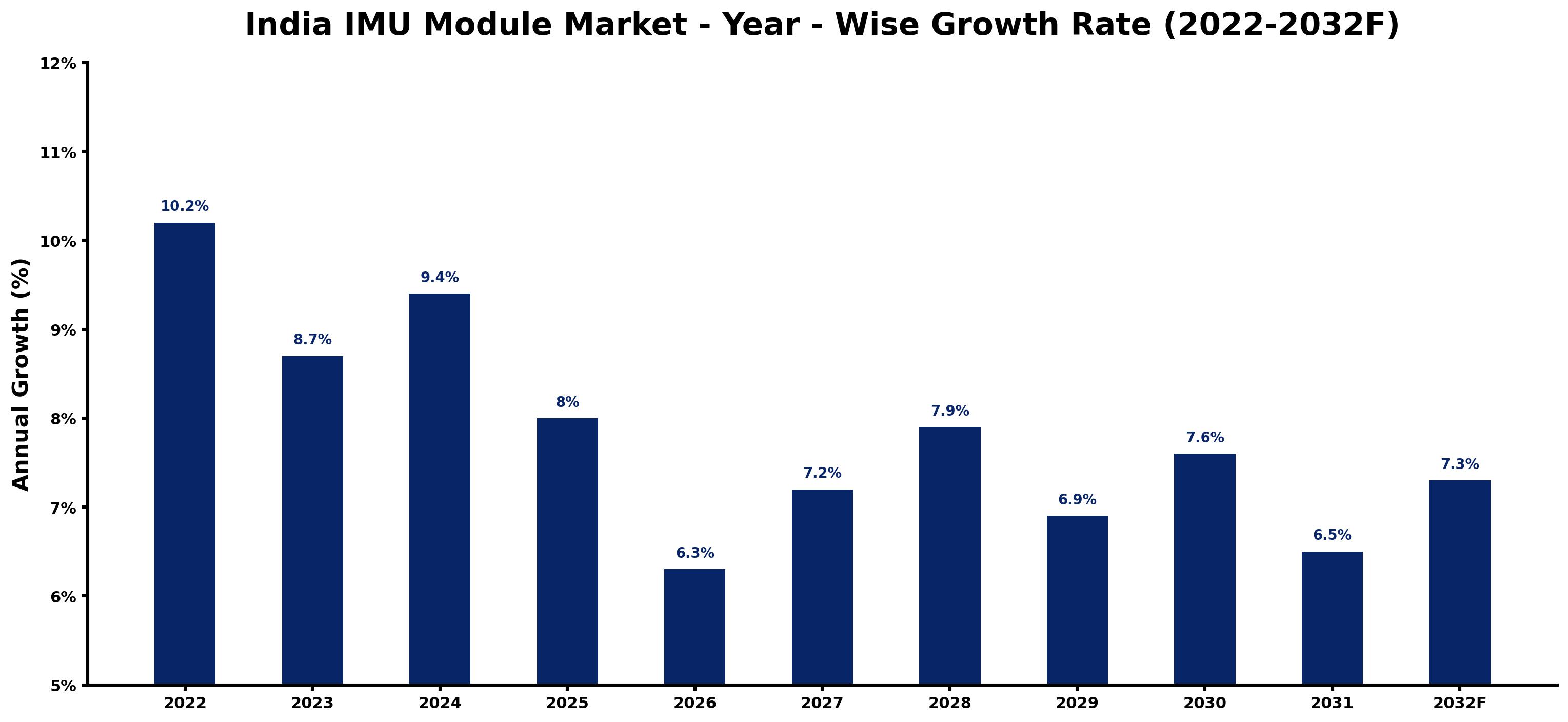
The following table presents the estimated annual growth rate for each year together with the principal factor influencing market performance.
| Year | Estimated Annual Growth (%) | Market Rationale |
| 2022 | 10.2 | Post-pandemic recovery in electronics demand and the production-linked incentive scheme for electronics lifted domestic assembly and module orders. |
| 2023 | 8.7 | Smartwatch shipments contracted after the 2022 surge and global component inventories were corrected, moderating growth. |
| 2024 | 9.4 | Rising electric two-wheeler registrations and emergency drone procurement by the armed forces lifted inertial module orders sharply. |
| 2025 | 8.0 | Higher United States tariffs on Indian exports and delayed capital spending tempered growth despite continued vehicle electronics demand. |
| 2026 | 6.3 | Slower factory investment and cautious industrial purchasing are expected to hold growth at the lowest level of the forecast period. |
| 2027 | 7.2 | Commissioning of domestic semiconductor assembly and packaging plants is expected to improve local sensor supply and lift module demand. |
| 2028 | 7.9 | Scale-up of drone manufacturing for defence and agriculture is expected to raise demand for navigation-grade inertial units. |
| 2029 | 6.9 | Price competition among local module assemblers and a mature vehicle electronics cycle are expected to temper growth after the peak. |
| 2030 | 7.6 | Wider adoption of advanced driver assistance in mass-market passenger vehicles is expected to increase inertial sensors per vehicle. |
| 2031 | 6.5 | Saturation of smartwatch ownership among urban consumers and normalising replacement cycles are expected to moderate growth after strong gains. |
| 2032 | 7.3 | Growth in robotics adoption across factories and warehouses is expected to lift demand for compact, high-stability inertial modules. |
Note: Market size estimations and growth projections presented in this report are based on 6Wresearch's proprietary forecasting methodology, utilizing the latest available industry data, government publications, and primary research inputs.
India IMU Module Market Synopsis
The India IMU Module Market comprises packaged inertial measurement units that combine accelerometers, gyroscopes and magnetometers for motion, orientation and navigation sensing across vehicles, robots, drones and wearables. Growth is supported by rising electric two-wheeler and passenger vehicle electronics content, expanding drone manufacturing for defence and agriculture, a large smartwatch user base served by boAt and Noise, and domestic electronics assembly incentives such as the production-linked schemes. However, dependence on imported MEMS sensors and limited local calibration capability constrain high-precision adoption.
Market Dynamics Impact Analysis (2026–2032)
| Factor | Type | Impact | Primary Segment Affected |
| Rising vehicle electronics content | Driver | High | Automotive IMU Module |
| Drone and robotics manufacturing scale-up | Driver | High | UAV/Drone Manufacturers |
| Indigenous navigation-grade modules for defence | Opportunity | High | Rugged/Precision |
| Inertial sensing embedded in vehicle control units | Opportunity | Medium | Embedded in ECU |
| Import dependence for MEMS sensor dies | Restraint | High | 9-Axis IMU |
| Absence of volume MEMS foundry capacity | Restraint | Medium | 6-Axis IMU |
| Scarcity of calibration and fusion expertise | Challenge | Medium | Industrial-Grade IMU |
| Price-sensitive wearable buyers and currency weakness | Challenge | Medium | Wearable Device Makers |
Evaluation of Drivers in India IMU Module Market (2026–2032)
Below mentioned are some major drivers and their influence on market dynamics.
| Drivers | Primary Segment Affected | Why It Matters (Evidence) |
| Vehicle electronics content growth | Automotive IMU Module | Stability control, driver assistance and telematics use inertial sensing for orientation and dead reckoning, so higher feature fitment lifts module demand per vehicle. India sold about 4.3 million passenger vehicles in fiscal 2024-25, a record. |
| Drone manufacturing scale-up | UAV/Drone Manufacturers | Flight controllers depend on inertial data for stabilisation, so each drone built adds module demand. ideaForge, listed in 2023, supplies surveillance drones to defence and police forces. |
| Smartwatch and wearable adoption | 6-Axis IMU | Fitness tracking and gesture functions require low-power motion sensing, which converts device shipments into module orders. boAt, Noise and Fire-Boltt rank among the largest smartwatch brands in India by volume. |
| Robotics and factory automation | Industrial-Grade IMU | Mobile robots and automated guided vehicles use inertial data for navigation and tilt compensation, so warehouse and factory automation expands orders. India installed more than 8,000 industrial robots in 2023. |
| Defence navigation requirements | Rugged/Precision | Missiles, unmanned aircraft and armoured vehicles need inertial navigation where satellite signals are denied, which creates demand for rugged parts. Bharat Electronics Limited designs inertial navigation systems for several platforms, creating pull for locally qualified modules. |
Growth is supported by the rapid deepening of India's electronics manufacturing ecosystem, where contract manufacturers such as Dixon Technologies and Kaynes Technology are adding board-level assembly and testing capability close to demand centres. A large engineering workforce, including more than 1.5 million engineering graduates a year, supplies firmware and sensor-fusion talent at competitive cost. Rising household incomes are widening the market for sensor-rich connected devices, and venture funding for deep-technology start-ups is financing indigenous hardware design. Growing use of on-device machine learning increases the value of clean motion data, and expanding logistics and mobility networks are raising the number of systems that require precise orientation sensing.
Evaluation of Restraints in India IMU Module Market
Below mentioned are some major restraints and their influence on market dynamics.
| Market Restraint | Primary Segment Affected | Why It Matters (Evidence) |
| Import dependence for MEMS sensor dies | 9-Axis IMU | Most MEMS inertial dies are fabricated overseas, so Indian assemblers face long supply lead times and allocation risk in shortages. Bosch, STMicroelectronics and TDK InvenSense supply a large share of sensors used in domestic devices. |
| Absence of volume MEMS foundry capacity | 6-Axis IMU | India has no volume MEMS wafer fabrication yet, so local module makers cannot control sensor cost or customise processes. The semiconductor projects approved so far focus mainly on logic, memory and packaging rather than MEMS. |
| Fragmented demand and small order volumes | Industrial-Grade IMU | Many industrial and robotics buyers place small batch orders, so suppliers cannot reach scale economies. India's annual robot installations are less than one-tenth of China's, which limits volume visibility. |
| Price sensitivity in domestic markets | Medium | Buyers of budget wearables and two-wheelers prioritise cost, so suppliers cannot easily recover the higher cost of advanced integration. Entry-level smartwatches in India often retail below INR 2,000. |
| Long automotive validation cycles | Embedded in ECU | Vehicle makers and Tier-1 suppliers require extensive validation to AIS and AEC-Q standards, so new modules take long to win programmes. Approval for a new inertial part often takes 18 to 24 months. |
India IMU Module Market Challenges
Calibration, MEMS packaging and sensor-fusion expertise sits with a few firms in Bengaluru and Hyderabad, so start-ups struggle to hire and delay product designs. Mandatory BIS registration for many consumer electronics adds testing steps that can extend launches by up to three months. Rupee weakness of about 3% a year raises the rupee cost of imported components, squeezing margins on fixed-price contracts. Fusion software and interface protocols differ across vehicle and drone platforms, forcing suppliers to maintain several firmware versions and raising support costs. Investment restrictions on Chinese firms introduced in 2020 limit access to low-cost technology partners, making cost parity with imported modules difficult.
Trends in the India IMU Module Market
Below mentioned are some of the trends shaping the India IMU Module Market growth.
- Shift from Imported to Locally Assembled Module Supply: Indian device and vehicle makers are moving from fully imported modules to locally assembled units as incentive schemes make board-level assembly attractive. Contract manufacturers are adding sensor mounting and calibration lines. The trend lowers lead times for buyers and gives suppliers that offer local testing a clear advantage in winning design-ins.
- Drones Emerging as a Mainstream Industrial Tool: Drones are moving from experimental use to routine work in surveying, crop spraying and infrastructure inspection, supported by the Drone Rules 2021 that eased flight approvals. Agricultural drone deployments are growing under subsidy-backed programmes. This raises demand for stable, low-cost inertial modules with reliable calibration across temperature ranges.
- Transition from Basic Two-Wheelers to Feature-Rich Connected Vehicles: Electric two-wheeler makers such as Ola Electric and Ather Energy are offering ride modes, hill hold and navigation features that benefit from inertial sensing. This shifts demand from simple motion sensors to higher-grade modules and gives suppliers new volume in a vehicle category that previously used few inertial components.
- Indigenous Navigation Modules Prioritised over Imports in Defence: Defence procurement increasingly favours indigenously designed inertial and navigation systems, with iDEX funding start-ups to develop them. Public sector firms such as Bharat Electronics Limited are qualifying local suppliers for rugged modules. This favours Indian firms able to meet military environmental standards and offers import-substitution volumes to those that qualify.
Investment Opportunities in the India IMU Module Market
Some of the investment opportunities in the India IMU Module Market are mentioned below.
- Embedded Automotive and Two-Wheeler Modules: Rising feature content in vehicles built in Pune, Chennai and Gurugram creates demand for locally supported modules. Investors can set up AEC-Q100 aligned module assembly and test lines or license designs from global MEMS firms, partnering with Tier-1 suppliers such as Bosch India or Minda to secure early design-ins.
- Defence and Aerospace Navigation Modules: Indigenisation preference and a growing drone and missile programme need rugged, high-stability modules that are currently imported. Investors can build precision calibration and environmental screening facilities in the Uttar Pradesh or Tamil Nadu defence corridors and partner with defence public sector firms or DRDO laboratories to supply qualified modules.
- Drone and Robotics Module Customisation: Agricultural drone makers and warehouse automation firms need compact modules with tailored firmware at low cost. Investors can establish design and application-engineering teams in Bengaluru or Hyderabad that supply customised nine-axis modules with fusion software, using distributor channels and joint development with start-ups to reach early volumes.
- Calibration and Testing Services: Few Indian laboratories offer traceable temperature, vibration and rate-table calibration, forcing module makers to test overseas. Investors can build shared calibration centres in electronics manufacturing clusters such as Noida, Chennai or Bengaluru, seek NABL accreditation and serve automotive, drone and industrial clients on a contract basis, shortening qualification timelines for local brands.
Government Initiatives in the India IMU Module Market
The India Semiconductor Mission, launched in December 2021 with an outlay of INR 76,000 crore, supports fabrication, packaging and design investments, while the Electronics Component Manufacturing Scheme notified in 2025 provides INR 22,919 crore for component and sub-assembly production. The Drone Rules 2021 liberalised flight approvals, and the drone production-linked incentive scheme committed INR 120 crore from 2021.
The Ministry of Electronics and Information Technology and the Directorate General of Civil Aviation oversee implementation. Tata Electronics' Dholera fab, approved in 2024 with an investment of INR 91,000 crore, and several approved assembly and test plants are expected to deepen domestic component supply. The Ministry of Defence's iDEX platform launched in 2018 funds start-ups developing defence technologies.
Future Insight of the India IMU Module Market
Domestic semiconductor assembly and packaging capacity will shorten supply chains and make local module production more cost competitive. Advances in sensor-fusion algorithms and low-power MEMS design will extend inertial sensing into new product categories. Expanding connected infrastructure and satellite navigation services will raise the number of systems needing precise motion data. India aims to become a USD 500 billion electronics manufacturing economy by 2030 and has approved 10 semiconductor projects under its national mission. Continued public and private investment in testing and certification facilities will strengthen the local supply base.
Market Segmentation Analysis
The report offers a comprehensive study of the following market segments and their leading categories in the market.
By Module Type – 6-Axis IMU Leads, 9-Axis IMU Expected to Grow Fastest
According to Sachin Kumar Rai, Senior Research Analyst at 6Wresearch, 6-Axis IMU held the largest share at 31% in 2025, as India's large smartwatch, fitness band and two-wheeler telematics volumes rely on low-cost accelerometer and gyroscope pairs. 9-Axis IMU is projected to grow fastest at a CAGR of 8.2% during 2026–2032, driven by drone flight controllers and robotic navigation systems that need magnetometer-based heading accuracy.
By Axis Count – Accelerometer + Gyroscope Leads, Rugged/Precision Expected to Grow Fastest
Accelerometer + Gyroscope modules accounted for 49% of 2025 revenue because Indian consumer electronics and mobility products favour simple, low-cost motion sensing. Rugged/Precision modules are forecast to rise at 8.0% over 2026–2032 as defence electronics and survey and agricultural machinery require stable performance under heat, dust and vibration.
By Integration Level – Medium Leads, Embedded in ECU Expected to Grow Fastest
Medium integration led with 34% of the 2025 market, since most Indian buyers add their own filtering and fusion software to cut cost. Embedded in ECU is expected to grow fastest at 8.3% through 2032 as vehicle makers integrate inertial sensing directly into electronic control units for stability and driver-assistance functions.
By End User – Robotics & Automation Firms Leads, Wearable Device Makers Expected to Grow Fastest
Robotics & Automation Firms led in 2025 with a 28% share, supported by warehouse automation, automated guided vehicles and factory robot deployment concentrated in Maharashtra, Tamil Nadu and Gujarat. Wearable Device Makers are projected to expand at 9.0% over 2026–2032, backed by smartwatch and earbuds production from boAt, Noise and other brands scaling local assembly.
Key Attractiveness of the Report
- 10 Years of Market Numbers
- Historical Data Starting from 2022 to 2025
- Base Year 2025
- Forecast Data until 2032
- Key Performance Indicators Impacting the Market
- Major Upcoming Developments and Projects
Key Highlights of the Report:
- India IMU Module Market Outlook
- Market Size of India IMU Module Market, 2025
- Forecast of India IMU Module Market, 2032
- Historical Data and Forecast of India IMU Module Revenues & Volume for the Period 2022 - 2032F
- India IMU Module Market Trend Evolution
- India IMU Module Market Drivers and Challenges
- India IMU Module Price Trends
- India IMU Module Porter's Five Forces
- India IMU Module Industry Life Cycle
- Historical Data and Forecast of India IMU Module Market Revenues & Volume By Module Type for the Period 2022 - 2032F
- Historical Data and Forecast of India IMU Module Market Revenues & Volume By 6-Axis IMU for the Period 2022 - 2032F
- Historical Data and Forecast of India IMU Module Market Revenues & Volume By 9-Axis IMU for the Period 2022 - 2032F
- Historical Data and Forecast of India IMU Module Market Revenues & Volume By Industrial-Grade IMU for the Period 2022 - 2032F
- Historical Data and Forecast of India IMU Module Market Revenues & Volume By Automotive IMU Module for the Period 2022 - 2032F
- Historical Data and Forecast of India IMU Module Market Revenues & Volume By Axis Count for the Period 2022 - 2032F
- Historical Data and Forecast of India IMU Module Market Revenues & Volume By Accelerometer + Gyroscope for the Period 2022 - 2032F
- Historical Data and Forecast of India IMU Module Market Revenues & Volume By Rugged/Precision for the Period 2022 - 2032F
- Historical Data and Forecast of India IMU Module Market Revenues & Volume By Stability/Navigation for the Period 2022 - 2032F
- Historical Data and Forecast of India IMU Module Market Revenues & Volume By Integration Level for the Period 2022 - 2032F
- Historical Data and Forecast of India IMU Module Market Revenues & Volume By Medium for the Period 2022 - 2032F
- Historical Data and Forecast of India IMU Module Market Revenues & Volume By Advanced for the Period 2022 - 2032F
- Historical Data and Forecast of India IMU Module Market Revenues & Volume By High for the Period 2022 - 2032F
- Historical Data and Forecast of India IMU Module Market Revenues & Volume By Embedded in ECU for the Period 2022 - 2032F
- Historical Data and Forecast of India IMU Module Market Revenues & Volume By End User for the Period 2022 - 2032F
- Historical Data and Forecast of India IMU Module Market Revenues & Volume By Wearable Device Makers for the Period 2022 - 2032F
- Historical Data and Forecast of India IMU Module Market Revenues & Volume By UAV/Drone Manufacturers for the Period 2022 - 2032F
- Historical Data and Forecast of India IMU Module Market Revenues & Volume By Robotics & Automation Firms for the Period 2022 - 2032F
- Historical Data and Forecast of India IMU Module Market Revenues & Volume By Tier-1 Automotive Suppliers for the Period 2022 - 2032F
- India IMU Module Import Export Trade Statistics
- Market Opportunity Assessment By Module Type
- Market Opportunity Assessment By Axis Count
- Market Opportunity Assessment By Integration Level
- Market Opportunity Assessment By End User
- India IMU Module Top Companies Market Share
- India IMU Module Competitive Benchmarking By Technical and Operational Parameters
- India IMU Module Company Profiles
- India IMU Module Key Strategic Recommendations
Market Covered
The report offers an extensive study of the following market segments.
By Module Type
- 6-Axis IMU
- 9-Axis IMU
- Industrial-Grade IMU
- Automotive IMU Module
By Axis Count
- Accelerometer + Gyroscope
- Rugged/Precision
- Stability/Navigation
By Integration Level
- Medium
- Advanced
- High
- Embedded in ECU
By End User
- Wearable Device Makers
- UAV/Drone Manufacturers
- Robotics & Automation Firms
- Tier-1 Automotive Suppliers































