China In-Cabin Sensing Market Size & Growth Rate
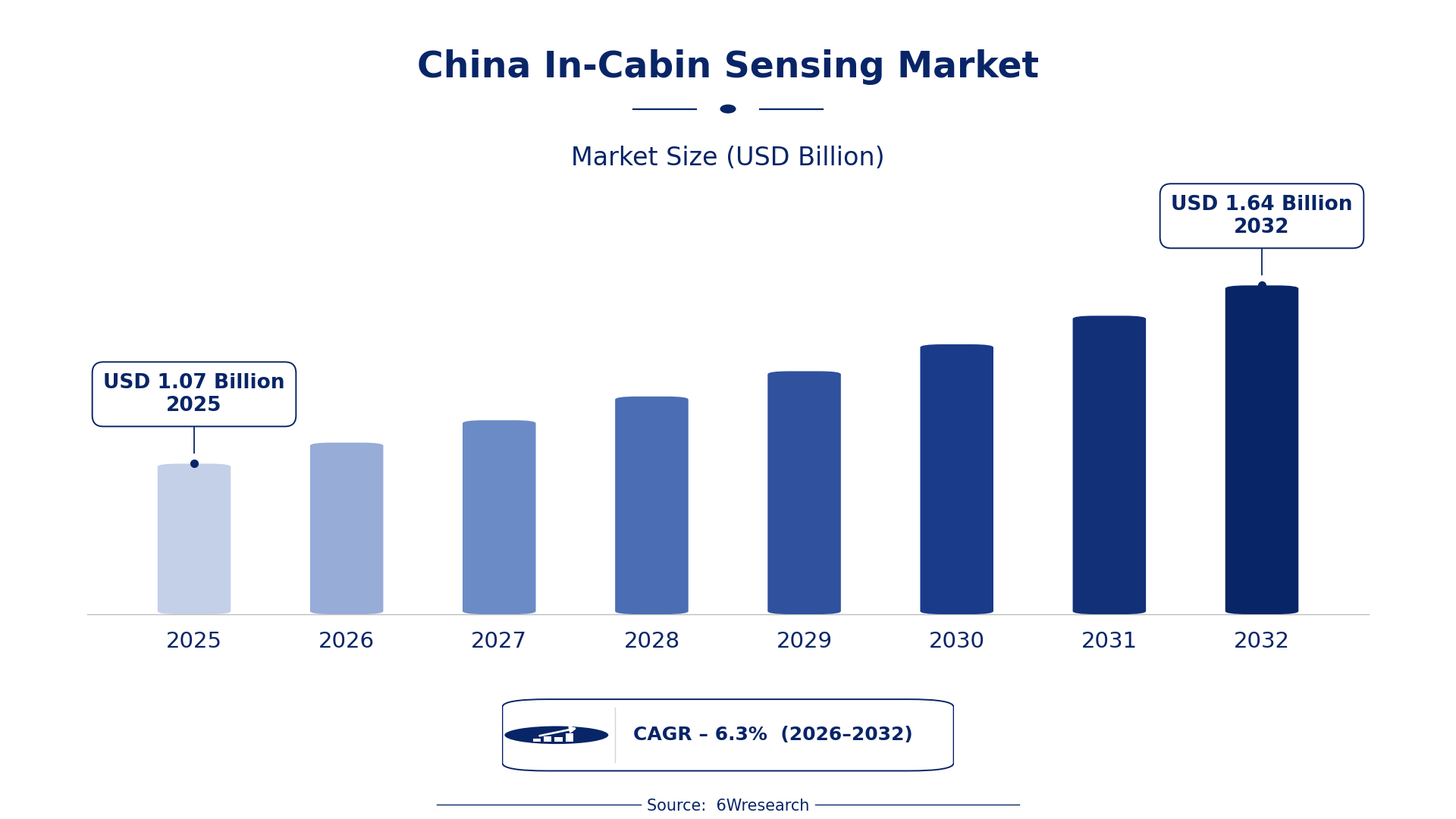
According to 6Wresearch internal database and industry insights, the China In-Cabin Sensing Market was valued at USD 1.07 billion in 2025 and is projected to reach USD 1.64 billion by 2032, growing at a CAGR of approximately 6.3% during 2026–2032.
China In-Cabin Sensing Market Highlights
| Report Metric | Details |
| Report Name | China In-Cabin Sensing Market |
| Market Size 2025 | USD 1.07 billion |
| Market Size 2032 | USD 1.64 billion |
| Absolute Growth 2025–2032 | USD 0.57 billion |
| CAGR 2026–2032 | 6.3% |
| Peak Annual Growth | 8.8% in 2030 |
| Forecast Period | 2026–2032 |
| Historical Data | 2022–2025 |
| Base Year | 2025 |
| Leading Sensing Type, 2025 | Visual Sensing (37% share) |
| Leading Component Used, 2025 | Camera (35% share) |
| Leading Application Area, 2025 | Face/Eye Tracking (42% share) |
| Leading End User, 2025 | Smart Cabin Developers (51% share) |
| Fastest-Growing Sensing Type | Thermal/Radar (8.2% CAGR) |
| Fastest-Growing Component Used | Microphone Array (8.3% CAGR) |
| Fastest-Growing Application Area | Health & Occupancy (7.9% CAGR) |
| Growing Sector | automotive |
| Key End Users | Smart Cabin Developers, Infotainment Integrators, HVAC & Comfort Solutions, Driver Monitoring Systems |
China In-Cabin Sensing Market Year-wise Growth Rate and Key Drivers (2022–2032)
This graph illustrates the annual growth rates of the market from 2022 to 2032, highlighting a steady upward trajectory and projected market expansion over the forecast period.
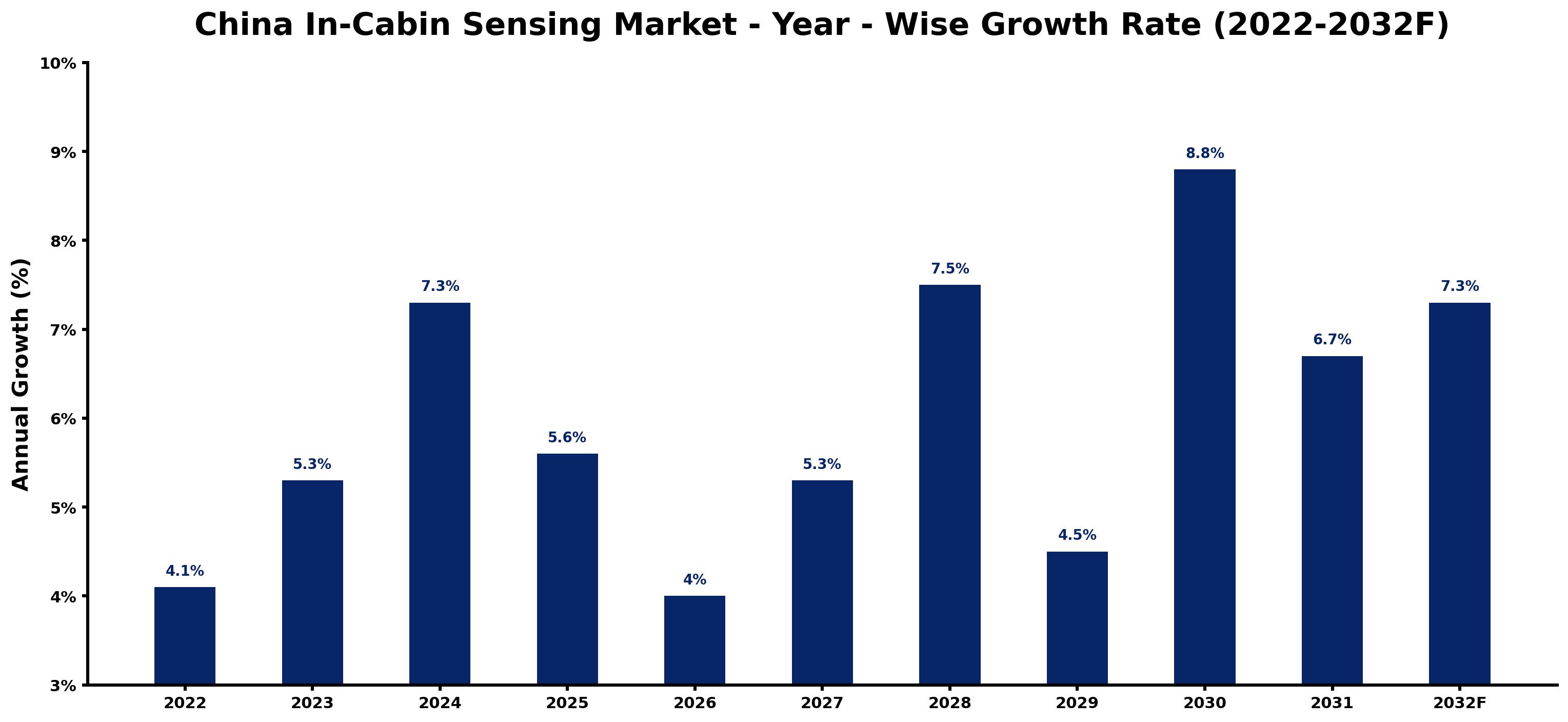
Below, each year's estimated growth is shown next to the factor that most influenced it.
| Year | Estimated Annual Growth (%) | Market Rationale |
| 2022 | 4.1 | The automotive sector saw steady demand for in-cabin sensing technologies as vehicle production remained high. |
| 2023 | 5.3 | Increased urban population spurred the need for smart cabin solutions, driving demand for advanced sensing technologies. |
| 2024 | 7.3 | The adoption of driver monitoring systems accelerated as safety regulations became more stringent in the automotive industry. |
| 2025 | 5.6 | Growth slowed as manufacturers adjusted to evolving technology standards and consumer preferences. |
| 2026 | 4.0 | Market expansion is expected to continue but at a slower pace due to the 'Smart Vehicle Innovation and Development Strategy' promoting advanced technologies. |
| 2027 | 5.3 | Demand for health and occupancy monitoring systems is projected to grow as consumer awareness of vehicle safety increases. |
| 2028 | 7.5 | The market is expected to rebound with rising investments in smart cabin technologies by domestic manufacturers. |
| 2029 | 4.5 | Growth is expected to slow again as market saturation begins to impact new technology adoption rates. |
| 2030 | 8.8 | A surge in demand is projected as innovative sensing solutions gain traction in the automotive sector. |
| 2031 | 6.7 | The market is expected to experience a slowdown as established players consolidate their positions in the industry. |
| 2032 | 7.3 | Growth is projected to accelerate again as emerging technologies and standards revitalise interest in in-cabin sensing. |
Note: Market size estimations and growth projections presented in this report are based on 6Wresearch's proprietary forecasting methodology, utilizing the latest available industry data, government publications, and primary research inputs.
China In-Cabin Sensing Market Synopsis
In-Cabin Sensing in China includes technologies that monitor and analyse vehicle environments. This encompasses sensors such as cameras and thermal devices for applications like driver monitoring and health tracking. The China In-Cabin Sensing Market is growing due to increasing urbanisation and the automotive sector's emphasis on smart technologies. By 2025, the installed base of driver monitoring systems is expected to surpass 10 million units, reflecting the rising demand for improved passenger safety and comfort. Initiatives like the 'Smart Vehicle Innovation and Development Strategy' further facilitate this expansion.
Market Dynamics Impact Analysis (2026–2032)
| Factor | Type | Impact | Primary Segment Affected |
| Growing urban population increases demand for smart cabin solutions. | Driver | High | Driver Monitoring Systems |
| Rising investments in automotive technology create opportunities for new entrants. | Opportunity | High | Smart Cabin Developers |
| Stringent vehicle safety regulations necessitate advanced sensing technologies. | Driver | High | Face/Eye Tracking |
| Health monitoring systems are increasingly integrated into vehicles to enhance passenger safety. | Opportunity | Medium | Health & Occupancy |
| Intense competition among technology developers can limit profit margins. | Restraint | High | Audio-Based Sensing |
| Market saturation in urban areas may slow down new technology adoption. | Restraint | Medium | Environmental Sensors |
| High development costs can deter smaller firms from entering the market. | Challenge | High | Thermal/Radar |
| Regulatory compliance can delay product launches for new technologies. | Challenge | Medium | Voice Command Detection |
Evaluation of Drivers in China In-Cabin Sensing Market (2026–2032)
The main growth drivers and the segments they affect most are set out below.
| Drivers | Primary Segment Affected | Why It Matters (Evidence) |
| Increased vehicle production drives demand for in-cabin sensing technologies. | Driver Monitoring Systems | In 2022, China's automotive market produced over 25 million vehicles, increasing the need for safety systems. |
| Urbanisation leads to higher demand for smart cabin solutions. | Health & Occupancy | China's urban population reached 900 million in 2022, prompting investments in smart technologies. |
| Rising safety regulations necessitate advanced driver monitoring systems. | Face/Eye Tracking | The installed base of driver monitoring systems is expected to exceed 10 million units by 2025. |
| Growing consumer awareness of health and safety enhances demand for monitoring technologies. | Audio-Based Sensing | The adoption rate of voice command systems in vehicles is around 30% in urban areas. |
| Investment in automotive technology innovation supports the development of in-cabin systems. | Smart Cabin Developers | In 2023, a budget of 50 billion CNY was announced for automotive technology innovation. |
In 2022, the automotive sector produced over 25 million vehicles, creating a need for driver monitoring systems. The installed base of these systems is projected to exceed 10 million units by 2025, reflecting a strong push for improved safety features. The urban population reached 900 million in 2022, further driving demand for smart cabin solutions. Investment in automotive technology innovation, with a budget of 50 billion CNY announced in 2023, supports the development of advanced in-cabin technologies.
Evaluation of Restraints in China In-Cabin Sensing Market
The main factors holding the market back are set out below.
| Market Restraint | Primary Segment Affected | Why It Matters (Evidence) |
| High development costs can limit market entry for smaller firms. | Thermal/Radar | The average investment required for new technology development can exceed several million CNY. |
| Market saturation in urban areas may slow down new technology adoption. | Environmental Sensors | As urban areas become saturated, growth in new installations is likely to decline. |
| Intense competition among technology developers can limit profit margins. | Audio-Based Sensing | With over 1,000 research institutions in China, competition is fierce, impacting pricing strategies. |
| Regulatory compliance can delay product launches for new technologies. | Voice Command Detection | New standards require extensive testing and certification, extending time to market. |
| Consumer reluctance to adopt new technologies can hinder growth. | Driver Monitoring Systems | Despite advancements, some consumers remain hesitant to embrace new safety technologies. |
China In-Cabin Sensing Market Challenges
The China In-Cabin Sensing Market encounters high production costs, primarily due to the expensive components required for advanced sensing technology. Manufacturers often depend on imported materials, which can inflate prices by up to 20% for producers. Supply chain disruptions complicate matters, as delays in component delivery can postpone product launches, costing producers up to 15% in potential revenue. Intense competition among local manufacturers leads to price reductions, forcing suppliers to lower margins and potentially compromising product quality. Regulatory challenges also hinder progress, as compliance with updated standards can extend development timelines by six months for new entrants.
Trends in the China In-Cabin Sensing Market
Four trends stand out in the China In-Cabin Sensing Market.
- Shift from Basic to Advanced Driver Monitoring Systems: Since 2021, there has been a notable shift towards advanced driver monitoring systems in vehicles. The 'Smart Vehicle Innovation and Development Strategy' promotes these technologies, with the installed base expected to exceed 10 million units by 2025.
- Transition from Traditional to Smart Cabin Solutions: The automotive industry is increasingly integrating smart cabin solutions, influenced by urbanisation. In 2022, China's urban population reached 900 million, creating a demand for advanced in-cabin technologies.
- Emergence of Health Monitoring Features in Vehicles: Health monitoring systems are becoming essential in modern vehicles, especially since the update of the National Standard GB/T 34590-2020 in 2023. This standard improves air quality monitoring, reflecting growing consumer health awareness.
- Prioritisation of Voice Command Technologies: The adoption of voice command systems has increased, with around 30% usage in urban vehicles. This trend is supported by consumer demand for improved user interaction in smart cabins.
Investment Opportunities in the China In-Cabin Sensing Market
Below are the investment opportunities with the strongest case in the China In-Cabin Sensing Market.
- Investment Gap in Advanced Sensing Technologies: With the automotive electronics market valued at 300 billion CNY in 2022, there is an opportunity for investment in advanced sensing technologies. Smart Cabin Developers are particularly positioned to benefit from this trend.
- Supply of Health Monitoring Systems: The demand for health monitoring systems is rising, driven by consumer safety concerns. Smart Cabin Developers can capitalise on this trend by integrating advanced health tracking features into their offerings.
- Timing for Smart Cabin Solutions: As urbanisation continues, the need for smart cabin solutions is pressing. The automotive sector's focus on integrating smart technologies presents a timely opportunity for investment.
- Growing Demand from Infotainment Integrators: Infotainment Integrators are increasingly seeking advanced in-cabin technologies to improve user experience. This demand is supported by the projected growth in the automotive electronics market.
Government Initiatives in the China In-Cabin Sensing Market
The 'Smart Vehicle Innovation and Development Strategy' was launched by the Ministry of Industry and Information Technology in 2021 to promote advanced in-cabin technologies. This strategy aims to improve the integration of smart technologies in vehicles, ensuring compliance with international standards. The 'Automotive Industry Development Plan' approved in 2022 by the National Development and Reform Commission supports the growth of in-cabin sensing technologies, providing a framework for innovation and development in this sector. The updated 'Vehicle Air Quality Standards' in 2023 also improve air quality monitoring in vehicles, reflecting the government's commitment to improving passenger safety and comfort.
The National Development and Reform Commission plays a key role in approving funding for automotive technology innovation. In 2023, it announced a budget of 50 billion CNY specifically for this purpose, which will support research and development in in-cabin sensing technologies. The Ministry of Ecology and Environment oversees the implementation of the updated 'Vehicle Air Quality Standards', ensuring that manufacturers comply with air quality monitoring requirements. This regulatory framework is essential for improving the safety and comfort of vehicle occupants.
Future Insight of the China In-Cabin Sensing Market
By 2032, buyers and suppliers in the China In-Cabin Sensing Market can anticipate substantial advancements driven by government initiatives and technological progress. The 'Smart Vehicle Innovation and Development Strategy' will enhance the integration of in-cabin sensing solutions, while the automotive electronics market was valued at 300 billion CNY in 2022, indicating strong investment in technology. The installed base of driver monitoring systems is set to exceed 10 million units by 2025, improving safety and passenger comfort. Urban population growth will continue to elevate demand for smart cabin solutions, creating new opportunities for suppliers.
Market Segmentation Analysis
The report offers a comprehensive study of the following market segments and their leading categories in the market.
By Sensing Type – Visual Sensing Dominated, Thermal/Radar Expected to Grow Fastest
According to Sachin Kumar Rai, Senior Research Analyst at 6Wresearch, the largest sensing type category in 2025 was Visual Sensing, with a 37% share of total revenue. Visual sensing captures the largest share in China's in-cabin sensing market due to its essential role in applications like face and eye tracking, which significantly enhance driver safety. The strong demand for visual sensing technology is underscored by the installed base of over 10 million driver monitoring systems expected by 2025. Over 2026–2032, Thermal/Radar is expected to post the fastest growth, at a CAGR of 8.2%. Thermal and radar sensing is experiencing rapid growth as it effectively monitors driver attentiveness and health conditions, which are increasingly vital in modern vehicles. This segment's expansion is driven by the automotive industry's commitment to improving safety features and overall vehicle performance. Suppliers must prioritise the development of thermal and radar sensing technologies to meet the rising demand for safety and health monitoring solutions in vehicles.
By Component Used – Camera Dominated, Microphone Array Expected to Grow Fastest
In 2025, Camera led the component used split with a 35% share. Cameras dominate the market share for in-cabin sensing components in China, as they are essential for visual sensing applications, particularly in driver monitoring systems. The increasing production of vehicles, exceeding 25 million in 2022, further solidifies the demand for camera technology. Microphone Array is set to record the highest CAGR in this split, 8.3% over 2026–2032. Microphone arrays are growing rapidly due to their necessity for accurately capturing voice commands, which are becoming more prevalent in smart vehicles. The adoption rate of voice command systems, around 30% in urban areas, highlights the increasing reliance on this technology. Manufacturers should invest in microphone array technologies to capitalise on the growing trend of voice command integration in vehicles.
By Application Area – Face/Eye Tracking Dominated, Health & Occupancy Expected to Grow Fastest
Face/Eye Tracking took a 42% share of application area in 2025, more than any other category. Face and eye tracking applications hold the largest share in the in-cabin sensing market as they are crucial for ensuring driver safety and preventing accidents. The automotive sector's emphasis on safety drives the demand for these technologies, making them a top priority for developers. Health & Occupancy is projected to grow fastest, at a CAGR of 7.9% during 2026–2032. Health and occupancy monitoring is experiencing rapid growth as it is essential for assessing passenger well-being, particularly in smart cabin environments. The increasing focus on passenger comfort and safety in vehicle design propels this segment forward, ensuring its prominence in the market. Developers should focus on health and occupancy monitoring technologies to align with the growing consumer demand for enhanced passenger safety and comfort.
By End User – Smart Cabin Developers Dominated and Is Expected to Record the Fastest Growth
With a 51% revenue share in 2025, Smart Cabin Developers was the largest end user category. Smart cabin developers command the largest share in the in-cabin sensing market as they are responsible for creating integrated solutions that enhance the driving experience. With the automotive sector employing approximately 5 million people in China, the focus on smart cabin solutions is paramount for future growth. Its lead should widen, with a projected CAGR of 8.3% during 2026–2032, the highest in this split. Smart cabin developers are also the fastest-growing segment, as they continuously innovate to meet the increasing demand for advanced cabin technologies. The push for smarter, more integrated vehicle solutions ensures that this segment will maintain its growth trajectory, reinforcing its market position. Suppliers should collaborate with smart cabin developers to leverage the expanding market for integrated in-cabin sensing technologies.
Key Attractiveness of the Report
- 10 Years of Market Numbers
- Historical Data Starting from 2022 to 2025
- Base Year 2025
- Forecast Data until 2032
- Key Performance Indicators Impacting the Market
- Major Upcoming Developments and Projects
Key Highlights of the Report:
- China In-Cabin Sensing Market Outlook
- Market Size of China In-Cabin Sensing Market, 2025
- Forecast of China In-Cabin Sensing Market, 2032
- Historical Data and Forecast of China In-Cabin Sensing Revenues & Volume for the Period 2022 - 2032F
- China In-Cabin Sensing Market Trend Evolution
- China In-Cabin Sensing Market Drivers and Challenges
- China In-Cabin Sensing Price Trends
- China In-Cabin Sensing Porter's Five Forces
- China In-Cabin Sensing Industry Life Cycle
- Historical Data and Forecast of China In-Cabin Sensing Market Revenues & Volume By Sensing Type for the Period 2022 - 2032F
- Historical Data and Forecast of China In-Cabin Sensing Market Revenues & Volume By Visual Sensing for the Period 2022 - 2032F
- Historical Data and Forecast of China In-Cabin Sensing Market Revenues & Volume By Thermal/Radar for the Period 2022 - 2032F
- Historical Data and Forecast of China In-Cabin Sensing Market Revenues & Volume By Audio-Based Sensing for the Period 2022 - 2032F
- Historical Data and Forecast of China In-Cabin Sensing Market Revenues & Volume By Environmental Sensors for the Period 2022 - 2032F
- Historical Data and Forecast of China In-Cabin Sensing Market Revenues & Volume By Component Used for the Period 2022 - 2032F
- Historical Data and Forecast of China In-Cabin Sensing Market Revenues & Volume By Camera, ToF, IR for the Period 2022 - 2032F
- Historical Data and Forecast of China In-Cabin Sensing Market Revenues & Volume By Body Temperature, Movement for the Period 2022 - 2032F
- Historical Data and Forecast of China In-Cabin Sensing Market Revenues & Volume By Microphone Array for the Period 2022 - 2032F
- Historical Data and Forecast of China In-Cabin Sensing Market Revenues & Volume By VOC, CO , PM for the Period 2022 - 2032F
- Historical Data and Forecast of China In-Cabin Sensing Market Revenues & Volume By Application Area for the Period 2022 - 2032F
- Historical Data and Forecast of China In-Cabin Sensing Market Revenues & Volume By Face/Eye Tracking for the Period 2022 - 2032F
- Historical Data and Forecast of China In-Cabin Sensing Market Revenues & Volume By Health & Occupancy for the Period 2022 - 2032F
- Historical Data and Forecast of China In-Cabin Sensing Market Revenues & Volume By Voice Command Detection for the Period 2022 - 2032F
- Historical Data and Forecast of China In-Cabin Sensing Market Revenues & Volume By Air Quality Control for the Period 2022 - 2032F
- Historical Data and Forecast of China In-Cabin Sensing Market Revenues & Volume By End User for the Period 2022 - 2032F
- Historical Data and Forecast of China In-Cabin Sensing Market Revenues & Volume By Driver Monitoring Systems for the Period 2022 - 2032F
- Historical Data and Forecast of China In-Cabin Sensing Market Revenues & Volume By Smart Cabin Developers for the Period 2022 - 2032F
- Historical Data and Forecast of China In-Cabin Sensing Market Revenues & Volume By Infotainment Integrators for the Period 2022 - 2032F
- Historical Data and Forecast of China In-Cabin Sensing Market Revenues & Volume By HVAC & Comfort Solutions for the Period 2022 - 2032F
- China In-Cabin Sensing Import Export Trade Statistics
- Market Opportunity Assessment By Sensing Type
- Market Opportunity Assessment By Component Used
- Market Opportunity Assessment By Application Area
- Market Opportunity Assessment By End User
- China In-Cabin Sensing Top Companies Market Share
- China In-Cabin Sensing Competitive Benchmarking By Technical and Operational Parameters
- China In-Cabin Sensing Company Profiles
- China In-Cabin Sensing Key Strategic Recommendations
Market Covered
Segments analysed in this report are listed below.
By Sensing Type
- Visual Sensing
- Thermal/Radar
- Audio-Based Sensing
- Environmental Sensors
By Component Used
- Camera
- ToF
- IR
- Body Temperature
- Movement
- Microphone Array
- VOC
- CO₂
- PM
By Application Area
- Face/Eye Tracking
- Health & Occupancy
- Voice Command Detection
- Air Quality Control
By End User
- Driver Monitoring Systems
- Smart Cabin Developers
- Infotainment Integrators
- HVAC & Comfort Solutions































