India In-Cabin Sensing Market Size & Growth Rate
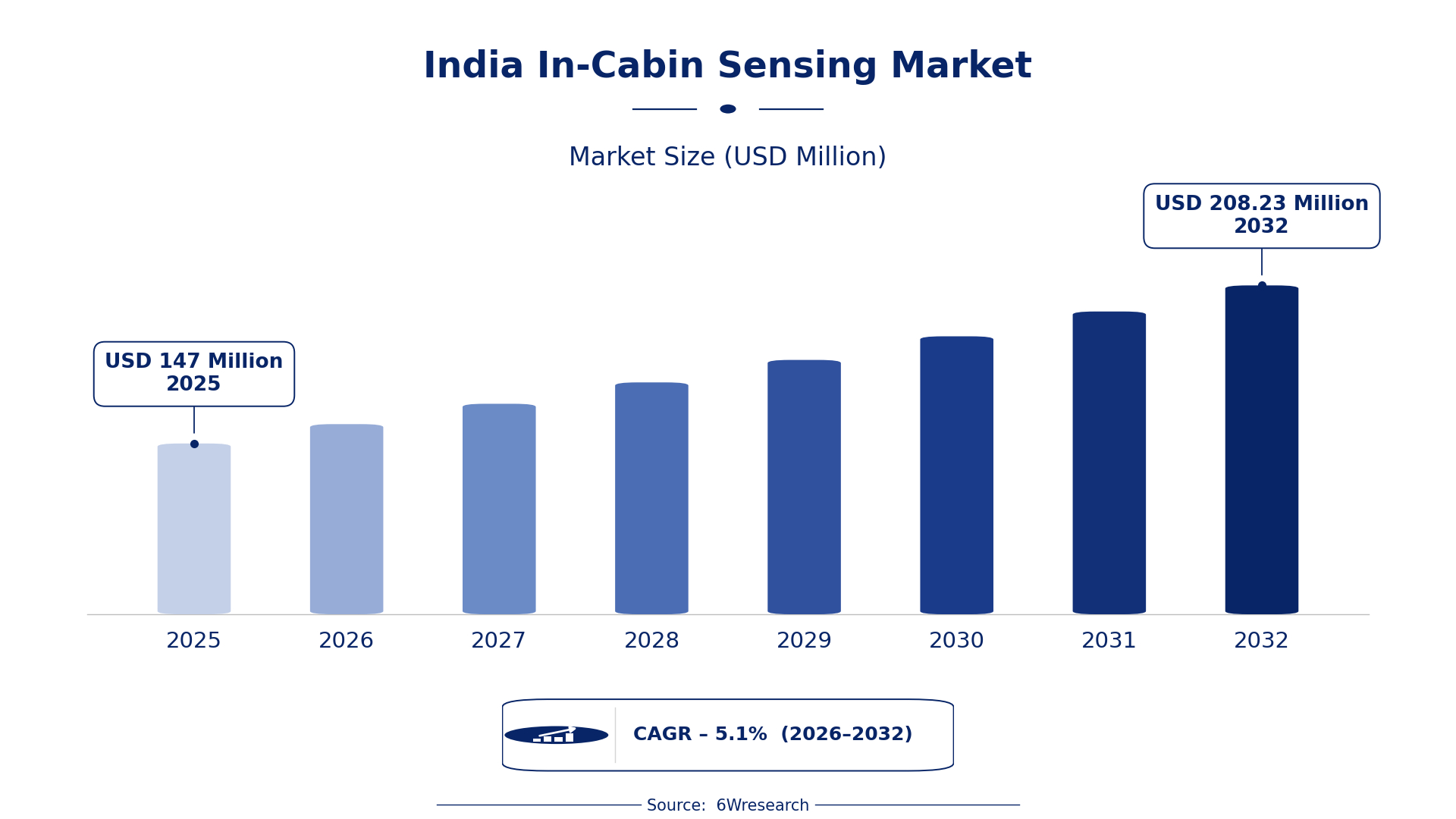
According to 6Wresearch internal database and industry insights, the India In-Cabin Sensing Market was valued at USD 147.0 million in 2025 and is projected to reach USD 208.23 million by 2032, growing at a CAGR of approximately 5.1% during 2026–2032.
India In-Cabin Sensing Market Highlights
| Report Metric | Details |
| Report Name | India In-Cabin Sensing Market |
| Market Size 2025 | USD 147.0 million |
| Market Size 2032 | USD 208.23 million |
| Absolute Growth 2025–2032 | USD 61.23 million |
| CAGR 2026–2032 | 5.1% |
| Peak Annual Growth | 6.8% in 2031 |
| Forecast Period | 2026–2032 |
| Historical Data | 2022–2025 |
| Base Year | 2025 |
| Leading Sensing Type, 2025 | Visual Sensing (46% share) |
| Leading Component Used, 2025 | Camera (34% share) |
| Leading Application Area, 2025 | Face/Eye Tracking (51% share) |
| Leading End User, 2025 | Driver Monitoring Systems (52% share) |
| Fastest-Growing Sensing Type | Thermal/Radar (6.5% CAGR) |
| Fastest-Growing Component Used | ToF (7.2% CAGR) |
| Fastest-Growing Application Area | Health & Occupancy (7.5% CAGR) |
| Fastest-Growing End User | Smart Cabin Developers (7.0% CAGR) |
| Growing Sector | Health & Occupancy |
| Key End Users | Face/Eye Tracking, Health & Occupancy, Voice Command Detection, Air Quality Control |
India In-Cabin Sensing Market Year-wise Growth Rate and Key Drivers (2022–2032)
This graph illustrates the annual growth rates of the market from 2022 to 2032, highlighting a steady upward trajectory and projected market expansion over the forecast period.
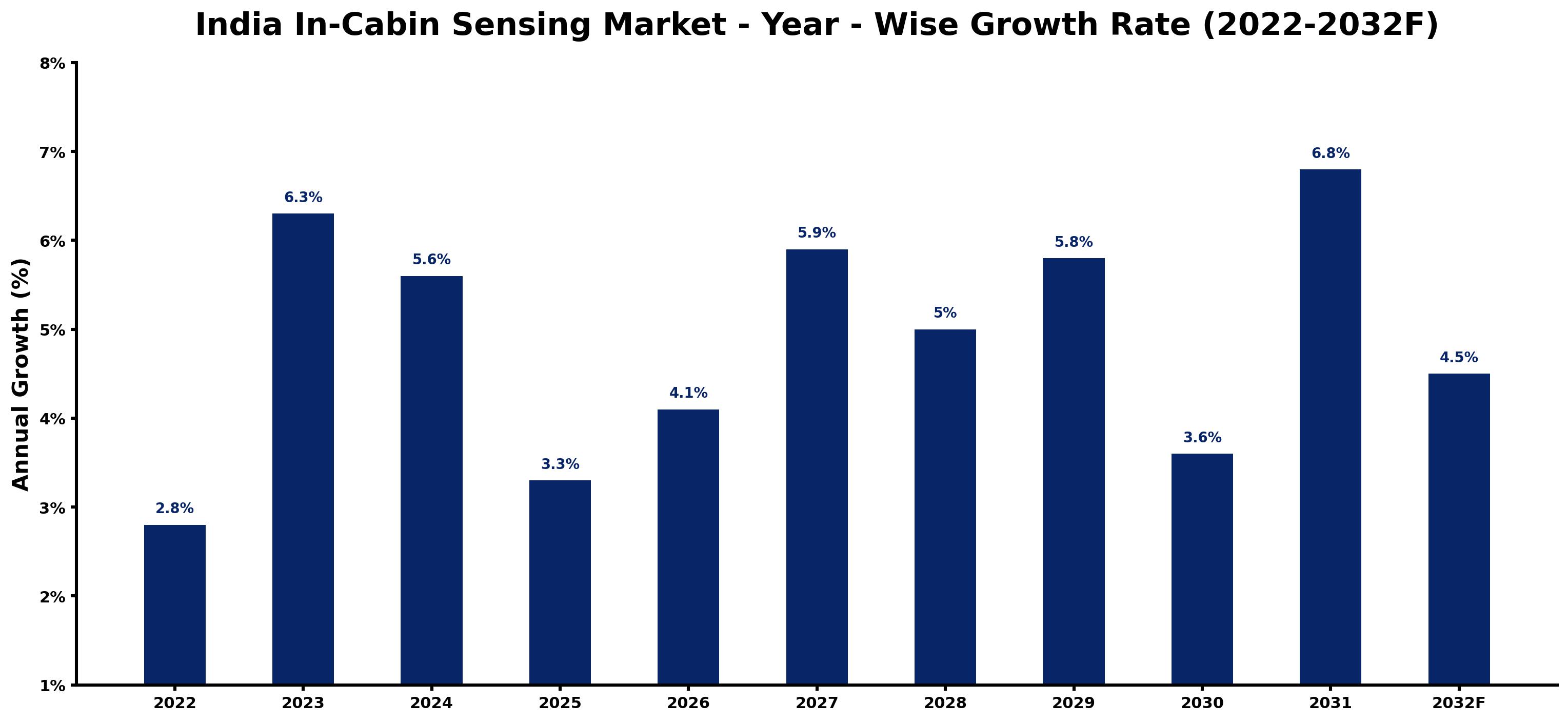
Below, each year's estimated growth is shown next to the factor that most influenced it.
| Year | Estimated Annual Growth (%) | Market Rationale |
| 2022 | 2.8 | The market experienced steady growth, driven by ongoing advancements in automotive technologies. |
| 2023 | 6.3 | Growth accelerated due to increased adoption of driver monitoring systems for enhanced safety. |
| 2024 | 5.6 | The market growth slowed as demand stabilised following the previous year's surge. |
| 2025 | 3.3 | A further slowdown occurred as the market adjusted to earlier growth peaks. |
| 2026 | 4.1 | Growth picked up again, supported by the rising focus on smart vehicle technologies. |
| 2027 | 5.9 | Demand increased as regulatory pressures for safety features became more pronounced. |
| 2028 | 5.0 | The market saw a slight slowdown as new technologies took time to integrate. |
| 2029 | 5.8 | Growth resumed as consumer interest in smart cabin features intensified. |
| 2030 | 3.6 | A slowdown was noted as the market faced maturity in certain segments. |
| 2031 | 6.8 | The market peaked with heightened demand for advanced in-cabin sensing solutions. |
| 2032 | 4.5 | Growth decelerated as the market began to stabilise after reaching peak demand. |
Note: Market size estimations and growth projections presented in this report are based on 6Wresearch's proprietary forecasting methodology, utilizing the latest available industry data, government publications, and primary research inputs.
India In-Cabin Sensing Market Synopsis
In-Cabin Sensing Market in India includes technologies that monitor the vehicle's interior environment using various sensors. This technology is crucial for improving driver safety, enhancing passenger comfort, and enabling smart cabin features. The market is expanding due to rising demand from domestic users and initiatives like the National Electric Mobility Mission Plan. The adoption of ISO 26262 standards is driving advancements in automotive electronics, further increasing purchases.
Market Dynamics Impact Analysis (2026–2032)
| Factor | Type | Impact | Primary Segment Affected |
| Increasing focus on driver safety regulations is boosting demand for driver monitoring systems. | Driver | High | Driver Monitoring Systems |
| The rise in urban vehicle occupancy rates necessitates advanced occupancy sensors. | Driver | Medium | Visual Sensing |
| The growing need for air quality monitoring solutions presents a significant opportunity. | Opportunity | High | Environmental Sensors |
| Investment in smart cabin technologies is rapidly increasing, creating new market avenues. | Opportunity | Medium | Smart Cabin Developers |
| High costs of advanced sensor technologies can limit widespread adoption. | Restraint | High | Visual Sensing |
| Limited consumer awareness about in-cabin sensing benefits restrains market growth. | Restraint | Medium | Driver Monitoring Systems |
| Integration challenges with existing vehicle systems can delay implementation. | Challenge | High | Thermal/Radar |
| Competition from alternative safety systems poses a threat to market growth. | Challenge | Medium | Audio-Based Sensing |
Evaluation of Drivers in India In-Cabin Sensing Market (2026–2032)
Below mentioned are some major drivers and their influence on market dynamics.
| Drivers | Primary Segment Affected | Why It Matters (Evidence) |
| Increased regulatory requirements for driver monitoring systems drive demand. | Driver Monitoring Systems | The growing emphasis on road safety regulations pushes manufacturers to integrate these systems into vehicles, enhancing compliance. |
| Urbanisation is leading to higher vehicle occupancy rates, increasing demand for occupancy sensors. | Visual Sensing | With an average vehicle occupancy of 1.5 persons in urban areas, the need for effective monitoring solutions is rising significantly. |
| The push for air quality monitoring in vehicles is driving demand for environmental sensors. | Environmental Sensors | India's poor air quality index highlights the urgent need for solutions that ensure a healthy cabin environment, prompting purchases. |
| Investment in smart cabin technologies is expanding, creating new opportunities in the market. | Smart Cabin Developers | The National Electric Mobility Mission Plan promotes the development of advanced automotive technologies, encouraging investment in smart solutions. |
| The adoption of ISO 26262 standards is enhancing safety in automotive electronics, boosting demand. | Visual Sensing | These standards ensure functional safety in automotive systems, prompting manufacturers to invest in advanced sensing technologies. |
Urbanisation is resulting in higher vehicle occupancy rates, increasing the demand for occupancy sensors as urban areas average 1.5 persons per vehicle. With India's air quality index reflecting severe pollution levels, there is a pressing need for environmental sensors to monitor cabin air quality effectively. The adoption of ISO 26262 standards is becoming common among manufacturers, ensuring functional safety and reliability in automotive electronics, further boosting demand for in-cabin sensing technologies.
Evaluation of Restraints in India In-Cabin Sensing Market
Below mentioned are some major restraints and their influence on market dynamics.
| Market Restraint | Primary Segment Affected | Why It Matters (Evidence) |
| High costs of advanced sensor technologies can limit widespread adoption. | Visual Sensing | The initial investment required for advanced sensors can deter potential buyers, impacting market penetration significantly. |
| Limited consumer awareness about in-cabin sensing benefits restrains market growth. | Driver Monitoring Systems | Many consumers are unaware of the advantages of in-cabin sensing technologies, which leads to lower demand and adoption rates. |
| Integration challenges with existing vehicle systems can delay implementation. | Thermal/Radar | The complexity of integrating new technologies with legacy systems can slow down adoption rates, affecting overall market growth. |
| Competition from alternative safety systems poses a threat to market growth. | Audio-Based Sensing | As alternatives emerge, they may divert investment and attention away from in-cabin sensing technologies, limiting market expansion. |
| Regulatory compliance costs can burden manufacturers, affecting pricing strategies. | Environmental Sensors | Manufacturers may face increased costs to meet safety and environmental standards, impacting their pricing and market competitiveness. |
India In-Cabin Sensing Market Challenges
The India In-Cabin Sensing Market still faces several challenges, starting with high costs for buyers linked to sensor integration. Many buyers encounter expenses that can exceed 20% of their vehicle's total cost due to the complexities of incorporating advanced technologies. Suppliers are experiencing a skills gap, as only 30% of the workforce is trained in the latest automotive electronics, causing delays in product development and impacting timely delivery. Regulatory challenges persist, as compliance with ISO 26262 standards demands substantial investment, which can postpone projects for manufacturers by up to six months.
Trends in the India In-Cabin Sensing Market
Four trends stand out in the India In-Cabin Sensing Market.
- Shift towards Enhanced Driver Monitoring Systems: Driver Monitoring Systems are increasingly being integrated into vehicles to meet safety regulations. The growing emphasis on road safety has led to a projected market growth of 6.3% in 2023.
- Transition to Smart Cabin Technologies: There is a notable shift towards smart cabin technologies that enhance passenger experience and safety. The National Electric Mobility Mission Plan has significantly influenced this trend, promoting advanced automotive solutions.
- Emergence of Advanced Air Quality Monitoring: The demand for air quality monitoring systems within vehicles is rising due to deteriorating urban air quality. The average air quality index in major cities highlights the need for effective monitoring solutions.
- Focus on ISO 26262 Compliance: The adoption of ISO 26262 standards is becoming common among automotive manufacturers to ensure safety. This trend reflects a commitment to improving the reliability of automotive electronics.
Investment Opportunities in the India In-Cabin Sensing Market
Several openings in the India In-Cabin Sensing Market merit attention from investors.
- Investment in Advanced Environmental Sensors: With India's air quality index indicating high pollution levels, there is a growing opportunity for environmental sensors. The market for these sensors is expected to expand significantly, driven by urban demand.
- Supply of Driver Monitoring Systems: The increasing focus on road safety regulations presents a strong opportunity for driver monitoring systems. Manufacturers can target automotive suppliers looking to improve safety features.
- Development of Smart Cabin Features: The push for smart cabin technologies is creating opportunities for developers and integrators. The National Electric Mobility Mission Plan supports initiatives that enhance passenger comfort and safety.
- Expansion of Occupancy Sensors: The average vehicle occupancy in urban areas highlights the need for effective occupancy sensors. Suppliers can capitalise on this demand by focusing on advanced sensing solutions.
Government Initiatives in the India In-Cabin Sensing Market
The 'Automotive Mission Plan 2026' outlines strategies for the automotive sector, including smart technologies, initiated by the Ministry of Heavy Industries in 2021. This initiative promotes the integration of advanced sensing solutions in vehicles, aligning with environmental goals. Additionally, the 'National Policy on Electronics 2019' encourages local manufacturing of automotive electronics, impacting in-cabin sensing production and ensuring compliance with safety standards. These measures support the growth of in-cabin sensing technologies, driving innovation and investment in the sector.
The Automotive Research Association of India plays a crucial role in developing testing standards for in-cabin sensing technologies. This agency funds various projects aimed at improving the reliability and performance of automotive electronics, ensuring that manufacturers meet the necessary safety requirements. The Smart Cities Mission also promotes smart transportation solutions, indirectly boosting demand for in-cabin sensing technologies through urban development initiatives.
Future Insight of the India In-Cabin Sensing Market
By 2032, buyers and suppliers in the India In-Cabin Sensing Market can expect substantial advancements driven by government initiatives like the National Electric Mobility Mission Plan, which will enhance demand for smart cabin features. The growing need for air quality monitoring solutions will emerge as urban air quality issues intensify. Stricter road safety regulations will elevate the focus on driver monitoring systems, thereby improving vehicle safety. The Automotive Research Association of India will play a crucial role in establishing testing standards, ensuring product reliability and boosting market confidence.
Market Segmentation Analysis
The analysis below covers each segmentation, its leading category in 2025 and its fastest-growing category through 2032.
By Sensing Type – Visual Sensing Dominated, Thermal/Radar Expected to Grow Fastest
According to Sachin Kumar Rai, Senior Research Analyst at 6Wresearch, in 2025, Visual Sensing led the sensing type split with a 46% share. Visual sensing holds the largest market share due to its critical role in monitoring driver attention and behaviour, which are essential for enhancing road safety. The integration of these systems aligns with the Ministry of Road Transport and Highways' push for smart vehicle technologies. Thermal/Radar is projected to grow fastest, at a CAGR of 6.5% during 2026–2032. Thermal/radar sensing is experiencing rapid growth as it plays a vital role in detecting passenger presence and monitoring temperature, both of which are increasingly important in modern vehicles. The rising consumer demand for enhanced passenger comfort and safety features is propelling this segment's expansion. Suppliers should focus on developing advanced thermal/radar solutions to meet the growing requirements of smart vehicle technologies.
By Component Used – Camera Dominated, ToF Expected to Grow Fastest
Camera accounted for a 34% market share by component used in 2025. Cameras dominate the market share as they are fundamental for visual monitoring and driver assistance systems, making them indispensable in today's vehicles. Their integration into driver monitoring systems is crucial for improving safety and complying with regulatory standards. Over 2026–2032, ToF is expected to post the fastest growth, at a CAGR of 7.2%. Time-of-Flight (ToF) technology is rapidly gaining traction due to its application in accurate distance measurement and occupancy detection, which are increasingly vital in smart cabin environments. The heightened focus on safety and comfort in vehicles is driving this segment's growth. Buyers should consider investing in ToF technology to leverage its benefits in enhancing vehicle safety and user experience.
By Application Area – Face/Eye Tracking Dominated, Health & Occupancy Expected to Grow Fastest
Face/Eye Tracking held a 51% share of the India In-Cabin Sensing Market by application area in 2025. Face/eye tracking holds the largest market share as it is vital for driver monitoring, helping to avert accidents by ensuring drivers stay attentive. This application is becoming standard in numerous new vehicle models, highlighting its critical role in safety measures. Health & Occupancy is set to record the highest CAGR in this split, 7.5% over 2026–2032. Health and occupancy monitoring is the fastest-growing application area due to its direct impact on ensuring passenger safety and comfort, which are increasingly prioritised in vehicle designs. The average vehicle occupancy in urban areas underscores the necessity for these solutions. Suppliers must focus on advancing health and occupancy technologies to meet the growing demand for improved passenger experiences.
By End User – Driver Monitoring Systems Dominated, Smart Cabin Developers Expected to Grow Fastest
With a 52% revenue share in 2025, Driver Monitoring Systems was the largest end user category. Driver monitoring systems capture the largest market share as they are essential for improving safety through real-time monitoring of driver behaviour. The significance of this segment is underscored by the increasing road safety regulations that mandate such systems in vehicles. The quickest growth will come from Smart Cabin Developers, forecast to expand at a CAGR of 7.0% between 2026 and 2032. Smart cabin developers are the fastest-growing end user segment, as they are directly involved in creating advanced cabin technologies that enhance user experience. The ongoing advancements in smart vehicle features are driving this growth. Companies should align their strategies with smart cabin developers to stay competitive in the evolving in-cabin sensing market.
Key Attractiveness of the Report
- 10 Years of Market Numbers
- Historical Data Starting from 2022 to 2025
- Base Year 2025
- Forecast Data until 2032
- Key Performance Indicators Impacting the Market
- Major Upcoming Developments and Projects
Key Highlights of the Report:
- India In-Cabin Sensing Market Outlook
- Market Size of India In-Cabin Sensing Market, 2025
- Forecast of India In-Cabin Sensing Market, 2032
- Historical Data and Forecast of India In-Cabin Sensing Revenues & Volume for the Period 2022 - 2032F
- India In-Cabin Sensing Market Trend Evolution
- India In-Cabin Sensing Market Drivers and Challenges
- India In-Cabin Sensing Price Trends
- India In-Cabin Sensing Porter's Five Forces
- India In-Cabin Sensing Industry Life Cycle
- Historical Data and Forecast of India In-Cabin Sensing Market Revenues & Volume By Sensing Type for the Period 2022 - 2032F
- Historical Data and Forecast of India In-Cabin Sensing Market Revenues & Volume By Visual Sensing for the Period 2022 - 2032F
- Historical Data and Forecast of India In-Cabin Sensing Market Revenues & Volume By Thermal/Radar for the Period 2022 - 2032F
- Historical Data and Forecast of India In-Cabin Sensing Market Revenues & Volume By Audio-Based Sensing for the Period 2022 - 2032F
- Historical Data and Forecast of India In-Cabin Sensing Market Revenues & Volume By Environmental Sensors for the Period 2022 - 2032F
- Historical Data and Forecast of India In-Cabin Sensing Market Revenues & Volume By Component Used for the Period 2022 - 2032F
- Historical Data and Forecast of India In-Cabin Sensing Market Revenues & Volume By Camera, ToF, IR for the Period 2022 - 2032F
- Historical Data and Forecast of India In-Cabin Sensing Market Revenues & Volume By Body Temperature, Movement for the Period 2022 - 2032F
- Historical Data and Forecast of India In-Cabin Sensing Market Revenues & Volume By Microphone Array for the Period 2022 - 2032F
- Historical Data and Forecast of India In-Cabin Sensing Market Revenues & Volume By VOC, CO , PM for the Period 2022 - 2032F
- Historical Data and Forecast of India In-Cabin Sensing Market Revenues & Volume By Application Area for the Period 2022 - 2032F
- Historical Data and Forecast of India In-Cabin Sensing Market Revenues & Volume By Face/Eye Tracking for the Period 2022 - 2032F
- Historical Data and Forecast of India In-Cabin Sensing Market Revenues & Volume By Health & Occupancy for the Period 2022 - 2032F
- Historical Data and Forecast of India In-Cabin Sensing Market Revenues & Volume By Voice Command Detection for the Period 2022 - 2032F
- Historical Data and Forecast of India In-Cabin Sensing Market Revenues & Volume By Air Quality Control for the Period 2022 - 2032F
- Historical Data and Forecast of India In-Cabin Sensing Market Revenues & Volume By End User for the Period 2022 - 2032F
- Historical Data and Forecast of India In-Cabin Sensing Market Revenues & Volume By Driver Monitoring Systems for the Period 2022 - 2032F
- Historical Data and Forecast of India In-Cabin Sensing Market Revenues & Volume By Smart Cabin Developers for the Period 2022 - 2032F
- Historical Data and Forecast of India In-Cabin Sensing Market Revenues & Volume By Infotainment Integrators for the Period 2022 - 2032F
- Historical Data and Forecast of India In-Cabin Sensing Market Revenues & Volume By HVAC & Comfort Solutions for the Period 2022 - 2032F
- India In-Cabin Sensing Import Export Trade Statistics
- Market Opportunity Assessment By Sensing Type
- Market Opportunity Assessment By Component Used
- Market Opportunity Assessment By Application Area
- Market Opportunity Assessment By End User
- India In-Cabin Sensing Top Companies Market Share
- India In-Cabin Sensing Competitive Benchmarking By Technical and Operational Parameters
- India In-Cabin Sensing Company Profiles
- India In-Cabin Sensing Key Strategic Recommendations
Market Covered
This report examines the market across the segments below.
By Sensing Type
- Visual Sensing
- Thermal/Radar
- Audio-Based Sensing
- Environmental Sensors
By Component Used
- Camera
- ToF
- IR
- Body Temperature
- Movement
- Microphone Array
- VOC
- CO₂
- PM
By Application Area
- Face/Eye Tracking
- Health & Occupancy
- Voice Command Detection
- Air Quality Control
By End User
- Driver Monitoring Systems
- Smart Cabin Developers
- Infotainment Integrators
- HVAC & Comfort Solutions































