China in-car air purification systems Market Size & Growth Rate
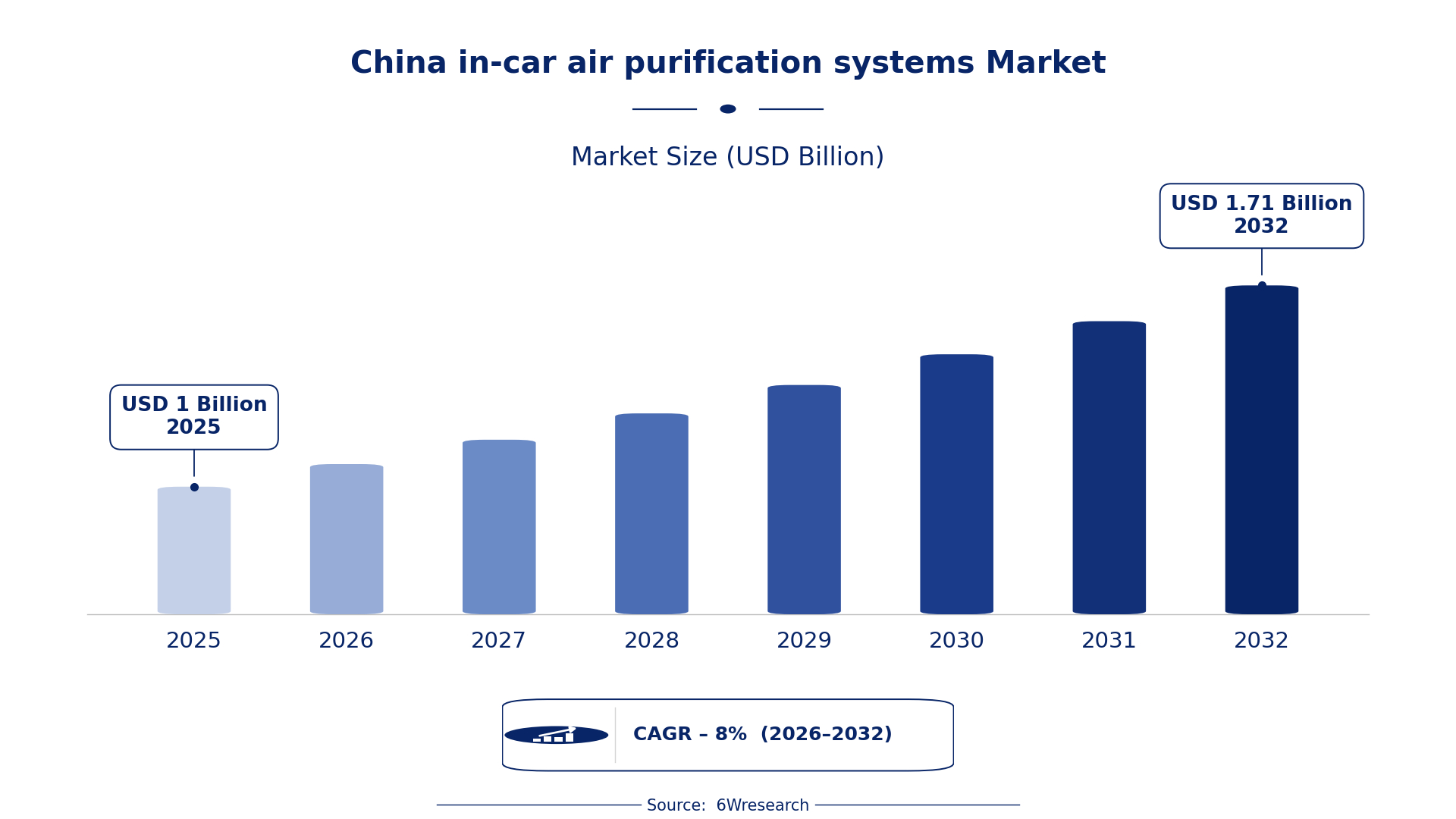
According to 6Wresearch internal database and industry insights, the China in-car air purification systems Market was valued at USD 1.00 billion in 2025 and is projected to reach USD 1.71 billion by 2032, growing at a CAGR of approximately 8% during 2026–2032.
China in-car air purification systems Market Highlights
| Report Metric | Details |
| Report Name | China in-car air purification systems Market |
| Market Size 2025 | USD 1.00 billion |
| Market Size 2032 | USD 1.71 billion |
| Absolute Growth 2025–2032 | USD 0.71 billion |
| CAGR 2026–2032 | 8% |
| Peak Annual Growth | 10.2% in 2027 |
| Forecast Period | 2026–2032 |
| Historical Data | 2022–2025 |
| Base Year | 2025 |
| Leading System Type, 2025 | HEPA Filters (37% share) |
| Leading Filtration Method, 2025 | Particle Removal (46% share) |
| Leading Vehicle Segment, 2025 | Mid to Premium Cars (53% share) |
| Leading End User, 2025 | OEM Cabin Air Suppliers (46% share) |
| Fastest-Growing System Type | Hybrid Systems (9.4% CAGR) |
| Fastest-Growing Filtration Method | HEPA + Ionizer Combo (10.7% CAGR) |
| Fastest-Growing Vehicle Segment | SUVs & EVs (10.3% CAGR) |
| Fastest-Growing End User | Air Quality Device Makers (9.5% CAGR) |
| Growing Sector | automotive |
| Key End Users | OEM suppliers, aftermarket suppliers, vehicle manufacturers, fleet operators |
China in-car air purification systems Market Year-wise Growth Rate and Key Drivers (2022–2032)
This graph illustrates the annual growth rates of the market from 2022 to 2032, highlighting a steady upward trajectory and projected market expansion over the forecast period.
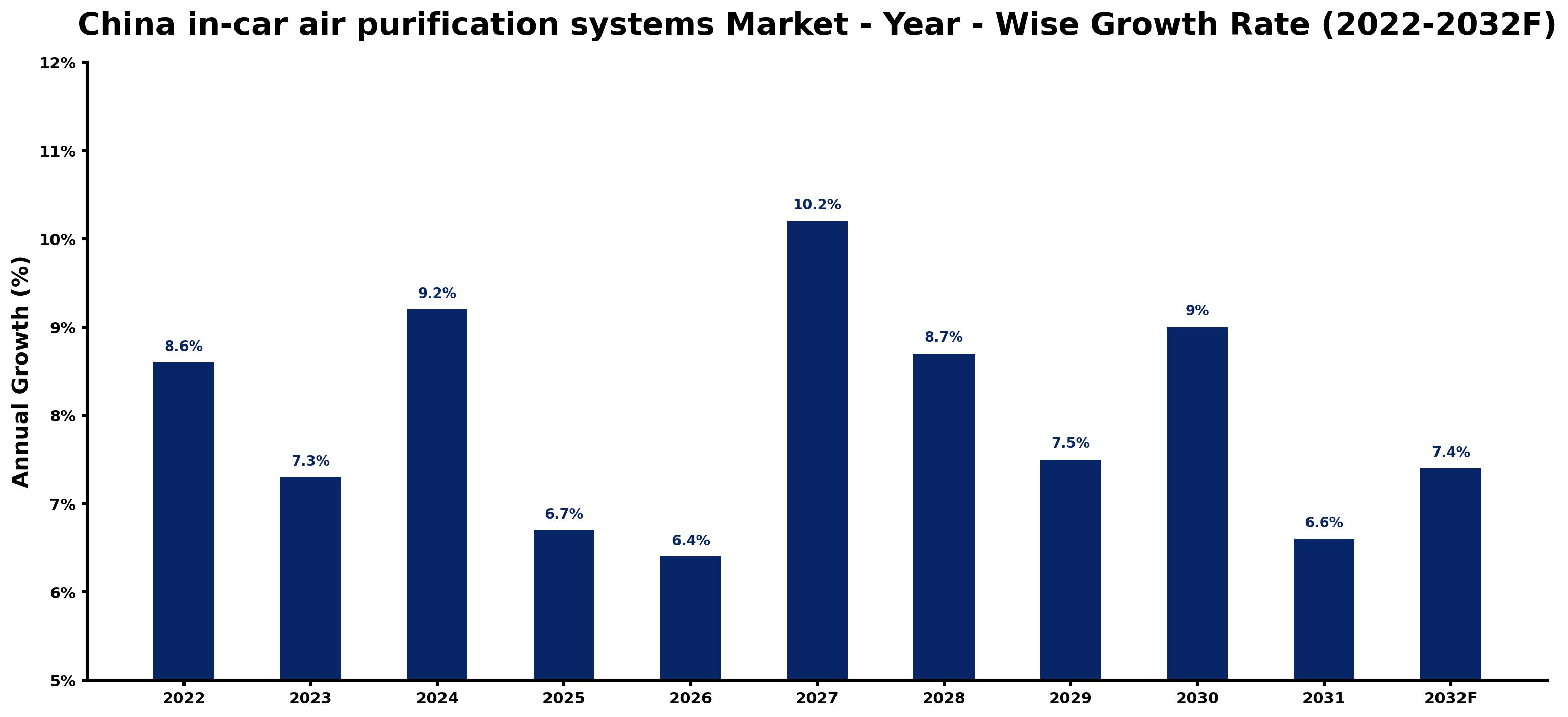
Each row of the following table gives one year's estimated growth and the event or demand shift that explains it.
| Year | Estimated Annual Growth (%) | Market Rationale |
| 2022 | 8.6 | Demand for in-car air purification systems grew as urban consumers became more aware of air quality issues. |
| 2023 | 7.3 | The market experienced a slowdown in growth due to evolving vehicle emissions regulations impacting purchasing decisions. |
| 2024 | 9.2 | Increased vehicle production rates contributed to a faster growth rate as manufacturers integrated more purification systems. |
| 2025 | 6.7 | Growth slowed again as consumers faced high costs for advanced air purification technologies in vehicles. |
| 2026 | 6.4 | Demand continued to rise but at a slower pace as manufacturers adjusted to stricter air quality standards. |
| 2027 | 10.2 | The market is expected to see a surge in growth driven by the introduction of new vehicle models with enhanced air purification features. |
| 2028 | 8.7 | Growth is projected to slow as market saturation begins to affect new purchases of in-car air purification systems. |
| 2029 | 7.5 | Continued consumer concerns about air quality will keep demand steady, but growth rates are expected to decline slightly. |
| 2030 | 9.0 | A resurgence in growth is anticipated as electric vehicle adoption increases, necessitating advanced air purification solutions. |
| 2031 | 6.6 | The market is expected to slow again as competition increases among suppliers of in-car air purification technologies. |
| 2032 | 7.4 | A renewed focus on urban air quality initiatives will drive growth as consumers seek cleaner air in their vehicles. |
Note: Market size estimations and growth projections presented in this report are based on 6Wresearch's proprietary forecasting methodology, utilizing the latest available industry data, government publications, and primary research inputs.
China in-car air purification systems Market Synopsis
In-car air purification systems in China are designed to remove pollutants and allergens from vehicles, utilising technologies such as HEPA filters and ionizers. The China in-car air purification systems Market is expanding due to rising consumer concerns about urban air quality and increasing vehicle production. With over 26 million vehicles produced in 2022, demand for these systems is expected to grow significantly, particularly in mid to premium cars and electric vehicles.
Market Dynamics Impact Analysis (2026–2032)
| Factor | Type | Impact | Primary Segment Affected |
| Rising consumer awareness of air quality issues | Driver | High | OEM Cabin Air Suppliers |
| Increased vehicle production rates | Driver | High | Mid to Premium Cars |
| Growing urban pollution levels | Opportunity | High | SUVs & EVs |
| Expansion of electric vehicle market | Opportunity | High | Luxury Vehicles |
| High replacement costs of advanced systems | Restraint | Medium | Hybrid Systems |
| Regulatory compliance costs for manufacturers | Restraint | Medium | HEPA Filters |
| Supply chain disruptions affecting production timelines | Challenge | High | Air Quality Device Makers |
| Intense competition leading to price wars | Challenge | High | Vehicle HVAC Manufacturers |
Evaluation of Drivers in China in-car air purification systems Market (2026–2032)
Key forces behind demand, with the segment each one moves most, are listed below.
| Drivers | Primary Segment Affected | Why It Matters (Evidence) |
| Increased consumer awareness of air quality | OEM Cabin Air Suppliers | Over 60% of urban consumers express concerns about in-car air quality, driving demand for advanced purification systems. |
| Rising vehicle production rates | Mid to Premium Cars | China's automotive market produced over 26 million vehicles in 2022, boosting the need for in-car air purification systems. |
| Urban pollution levels | SUVs & EVs | The 'Clean Air Action Plan' launched in 2023 aims to improve urban air quality, increasing demand for purification systems in vehicles. |
| Expansion of electric vehicle market | Luxury Vehicles | The market for electric vehicles is projected to grow to 20 million units by 2025, enhancing the need for air purification systems. |
| Integration of advanced technologies | Hybrid Systems | The 'Green Vehicle Development Plan' promotes the integration of air purification technologies in new vehicle designs. |
The in-car air purification systems market in China is expanding as rising consumer awareness of air quality issues, increased vehicle production rates, and urban pollution levels drive demand. Over 60% of urban consumers express concerns about in-car air quality, which boosts the need for advanced purification systems. In 2022, China produced over 26 million vehicles, further increasing demand for these systems. The 'Clean Air Action Plan' initiated in 2023 aims to improve urban air quality, influencing the adoption of purification technologies. The electric vehicle market is set to grow to 20 million units by 2025, creating further opportunities for suppliers.
Evaluation of Restraints in China in-car air purification systems Market
The main factors holding the market back are set out below.
| Market Restraint | Primary Segment Affected | Why It Matters (Evidence) |
| High replacement costs of advanced systems | Hybrid Systems | The average price of in-car air purification systems ranges from 500 to 2000 CNY, which can deter some consumers. |
| Regulatory compliance costs for manufacturers | HEPA Filters | Stricter regulations under the 'Vehicle Emission Standards' increase production costs for manufacturers. |
| Supply chain disruptions affecting production timelines | Air Quality Device Makers | Global supply chain issues have delayed the availability of key components, impacting production schedules. |
| Intense competition leading to price wars | Vehicle HVAC Manufacturers | Increased competition among suppliers has led to aggressive pricing strategies, affecting profit margins. |
| Limited consumer understanding of technology benefits | OEM Cabin Air Suppliers | Many consumers remain unaware of the advantages of advanced air purification technologies, limiting market growth. |
China in-car air purification systems Market Challenges
Buyers in the China in-car air purification systems market face high costs, with average prices ranging from 500 to 2000 CNY, which can deter potential customers. Suppliers encounter fluctuating demand due to evolving regulations, such as the stricter vehicle emissions standards from the Beijing Municipal Government, leading to unpredictable sales cycles. Manufacturers struggle with production delays caused by a shortage of advanced filtration materials, which raises operational costs and extends lead times for suppliers. Skills gaps within the automotive sector, affecting around 4 million employees, hinder the development of effective air purification technologies, ultimately slowing market progress for producers.
Trends in the China in-car air purification systems Market
Four trends stand out in the China in-car air purification systems Market.
- Shift towards Multi-Technology Systems: There is a notable shift towards hybrid systems that combine HEPA filters and ionizers, appealing to health-conscious consumers. In 2022, over 70% of mid to premium cars sold in China featured HEPA filters, reflecting this trend.
- Increased Adoption in Electric Vehicles: Electric vehicles are increasingly integrating advanced air purification systems, driven by consumer demand for cleaner air. The market for electric vehicles is expected to grow to 20 million units by 2025, increasing the need for purification technologies.
- Focus on Urban Air Quality Initiatives: Urban areas are prioritising air quality improvement initiatives, influencing vehicle design and technology integration. The 'Clean Air Action Plan' launched in 2023 aims to improve urban air quality, impacting automotive regulations.
- Growing Popularity of UV-Based Purifiers: UV-based purifiers are gaining traction in commercial fleets due to their effectiveness in germicidal cleaning. This segment is projected to see increased adoption as urban pollution levels rise and health concerns grow.
Investment Opportunities in the China in-car air purification systems Market
Investors looking at the China in-car air purification systems Market should consider the following areas.
- Market gap in advanced purification technologies: With the air quality device market set to reach 15 billion CNY by 2025, there is a gap for advanced purification technologies. OEM cabin air suppliers can invest in effective solutions to meet this demand.
- Integration of purification systems in new vehicles: The 'Green Vehicle Development Plan' promotes the integration of air purification technologies in electric vehicles, creating opportunities for suppliers. Collaboration with vehicle manufacturers can facilitate market entry.
- Focus on health-conscious consumers: As over 60% of urban consumers express concerns about in-car air quality, there is a growing opportunity to supply advanced purification systems. Targeting health-conscious buyers in urban areas can drive sales.
- Partnerships with local manufacturers: Forming joint ventures with local manufacturers can help navigate regulatory challenges and enhance market presence. This approach can facilitate compliance with the 'Vehicle Emission Standards' and other regulations.
Government Initiatives in the China in-car air purification systems Market
In 2023, the National Development and Reform Commission approved the 'Automotive Industry Development Plan' focusing on air quality improvements in new vehicle designs. This measure builds on the 'Clean Air Action Plan' launched in 2021, which set the groundwork for stricter regulations on vehicle emissions and air purification system requirements. The updated plan aims to improve air quality in urban areas, impacting the design and integration of purification technologies in vehicles. The 'Vehicle Emission Standards' introduced in 2022 mandate stricter air quality measures, requiring manufacturers to adapt their systems accordingly.
The 'Clean Air Action Plan' has led to increased scrutiny of vehicle emissions, prompting manufacturers to invest in advanced air purification technologies. Agencies such as the Ministry of Ecology and Environment oversee compliance with these regulations, ensuring that vehicle manufacturers meet air quality standards. The National Standard GB/T 18801-2015 regulates air purification efficiency in vehicles, which has resulted in a growing demand for in-car air purification systems, as manufacturers strive to align with the new standards.
Future Insight of the China in-car air purification systems Market
Several forward-looking factors should support the in-car air purification systems market in China over the coming years. The 'Clean Air Action Plan' launched in 2023 will drive demand for these systems as urban air quality improves. By 2025, the market for air quality devices in vehicles is projected to reach 15 billion CNY, indicating robust growth potential. The 'Green Vehicle Development Plan' will enhance air quality in electric vehicles, increasing the need for advanced purification solutions. The integration of UV purifiers in various vehicle types will create new opportunities for suppliers.
Market Segmentation Analysis
The analysis below covers each segmentation, its leading category in 2025 and its fastest-growing category through 2032.
By System Type – HEPA Filters Dominated, Hybrid Systems Expected to Grow Fastest
According to Sachin Kumar Rai, Senior Research Analyst at 6Wresearch, in 2025, HEPA Filters led the system type split with a 37% share. HEPA filters dominate the market share because they are critical for removing particulate matter, essential for improving air quality within vehicles. Their prevalence in over 70% of mid to premium cars sold in China underscores their significance in the automotive industry. The quickest growth will come from Hybrid Systems, forecast to expand at a CAGR of 9.4% between 2026 and 2032. Hybrid systems are witnessing rapid growth as they integrate multiple technologies, appealing to consumers who prioritise enhanced air purification. The increasing focus on urban air quality issues is driving demand for these advanced systems, ensuring their continued expansion. Suppliers should focus on developing hybrid systems to meet the rising consumer demand for comprehensive air purification solutions.
By Filtration Method – Particle Removal Dominated, HEPA + Ionizer Combo Expected to Grow Fastest
With a 46% revenue share in 2025, Particle Removal was the largest filtration method category. Particle removal is the primary function of many in-car air purification systems, making it a vital aspect for consumers concerned about air quality. This method is well-recognised for its effectiveness in eliminating harmful particles, crucial for passenger health. HEPA + Ionizer Combo is projected to grow fastest, at a CAGR of 10.7% during 2026–2032. The HEPA and ionizer combo is gaining traction quickly, providing a comprehensive solution that addresses both particles and allergens. This combination is increasingly favoured by consumers seeking advanced solutions for cleaner air in their vehicles. Manufacturers should concentrate on developing HEPA and ionizer combo systems to align with the growing market interest in effective air purification methods.
By Vehicle Segment – Mid to Premium Cars Dominated, SUVs & EVs Expected to Grow Fastest
Mid to Premium Cars took a 53% share of vehicle segment in 2025, more than any other category. Mid to premium cars lead the market due to the high consumer demand for air quality features in these segments. The production of over 26 million vehicles in 2022 establishes a strong foundation for the adoption of these systems. Over 2026–2032, SUVs & EVs are expected to post the fastest growth, at a CAGR of 10.3%. SUVs and electric vehicles are emerging as the fastest-growing segments, reflecting a shift in consumer preferences towards larger vehicles that prioritise air quality. The expected growth of electric vehicles to 20 million units by 2025 further drives this trend. Suppliers should target the SUV and EV segments to align with the market's increasing focus on air quality in larger vehicles.
By End User – OEM Cabin Air Suppliers Dominated, Air Quality Device Makers Expected to Grow Fastest
OEM Cabin Air Suppliers held a 46% share of the China in-car air purification systems Market by end user in 2025. OEM cabin air suppliers hold the largest market share as they integrate air purification systems directly into vehicle manufacturing processes. This integration is essential for ensuring compliance with air quality standards and meeting consumer expectations for cleaner air. Air Quality Device Makers are set to record the highest CAGR in this split, 9.5% over 2026–2032. Air quality device makers are experiencing rapid growth as they create specialised technologies aimed at enhancing in-car air quality. The rising consumer awareness of air pollution significantly propels the expansion of this segment. Suppliers should collaborate with air quality device makers to innovate and improve the effectiveness of in-car air purification technologies.
Key Attractiveness of the Report
- 10 Years of Market Numbers
- Historical Data Starting from 2022 to 2025
- Base Year 2025
- Forecast Data until 2032
- Key Performance Indicators Impacting the Market
- Major Upcoming Developments and Projects
Key Highlights of the Report:
- China in-car air purification systems Market Outlook
- Market Size of China in-car air purification systems Market, 2025
- Forecast of China in-car air purification systems Market, 2032
- Historical Data and Forecast of China in-car air purification systems Revenues & Volume for the Period 2022 - 2032F
- China in-car air purification systems Market Trend Evolution
- China in-car air purification systems Market Drivers and Challenges
- China in-car air purification systems Price Trends
- China in-car air purification systems Porter's Five Forces
- China in-car air purification systems Industry Life Cycle
- Historical Data and Forecast of China in-car air purification systems Market Revenues & Volume By System Type for the Period 2022 - 2032F
- Historical Data and Forecast of China in-car air purification systems Market Revenues & Volume By HEPA Filters for the Period 2022 - 2032F
- Historical Data and Forecast of China in-car air purification systems Market Revenues & Volume By Ionizers for the Period 2022 - 2032F
- Historical Data and Forecast of China in-car air purification systems Market Revenues & Volume By UV-Based Purifiers for the Period 2022 - 2032F
- Historical Data and Forecast of China in-car air purification systems Market Revenues & Volume By Hybrid Systems for the Period 2022 - 2032F
- Historical Data and Forecast of China in-car air purification systems Market Revenues & Volume By Filtration Method for the Period 2022 - 2032F
- Historical Data and Forecast of China in-car air purification systems Market Revenues & Volume By Particle Removal for the Period 2022 - 2032F
- Historical Data and Forecast of China in-car air purification systems Market Revenues & Volume By Electrostatic Purification for the Period 2022 - 2032F
- Historical Data and Forecast of China in-car air purification systems Market Revenues & Volume By Germicidal Cleaning for the Period 2022 - 2032F
- Historical Data and Forecast of China in-car air purification systems Market Revenues & Volume By HEPA + Ionizer Combo for the Period 2022 - 2032F
- Historical Data and Forecast of China in-car air purification systems Market Revenues & Volume By Vehicle Segment for the Period 2022 - 2032F
- Historical Data and Forecast of China in-car air purification systems Market Revenues & Volume By Mid to Premium Cars for the Period 2022 - 2032F
- Historical Data and Forecast of China in-car air purification systems Market Revenues & Volume By SUVs & EVs for the Period 2022 - 2032F
- Historical Data and Forecast of China in-car air purification systems Market Revenues & Volume By Luxury Vehicles for the Period 2022 - 2032F
- Historical Data and Forecast of China in-car air purification systems Market Revenues & Volume By Commercial Fleets for the Period 2022 - 2032F
- Historical Data and Forecast of China in-car air purification systems Market Revenues & Volume By End User for the Period 2022 - 2032F
- Historical Data and Forecast of China in-car air purification systems Market Revenues & Volume By OEM Cabin Air Suppliers for the Period 2022 - 2032F
- Historical Data and Forecast of China in-car air purification systems Market Revenues & Volume By Air Quality Device Makers for the Period 2022 - 2032F
- Historical Data and Forecast of China in-car air purification systems Market Revenues & Volume By Vehicle HVAC Manufacturers for the Period 2022 - 2032F
- Historical Data and Forecast of China in-car air purification systems Market Revenues & Volume By Fleet HVAC Integrators for the Period 2022 - 2032F
- China in-car air purification systems Import Export Trade Statistics
- Market Opportunity Assessment By System Type
- Market Opportunity Assessment By Filtration Method
- Market Opportunity Assessment By Vehicle Segment
- Market Opportunity Assessment By End User
- China in-car air purification systems Top Companies Market Share
- China in-car air purification systems Competitive Benchmarking By Technical and Operational Parameters
- China in-car air purification systems Company Profiles
- China in-car air purification systems Key Strategic Recommendations
Market Covered
This report examines the market across the segments below.
By System Type
- HEPA Filters
- Ionizers
- UV-Based Purifiers
- Hybrid Systems
By Filtration Method
- Particle Removal
- Electrostatic Purification
- Germicidal Cleaning
- HEPA + Ionizer Combo
By Vehicle Segment
- Mid to Premium Cars
- SUVs & EVs
- Luxury Vehicles
- Commercial Fleets
By End User
- OEM Cabin Air Suppliers
- Air Quality Device Makers
- Vehicle HVAC Manufacturers
- Fleet HVAC Integrators































