China In-Flight Connectivity Antenna Market Size & Growth Rate
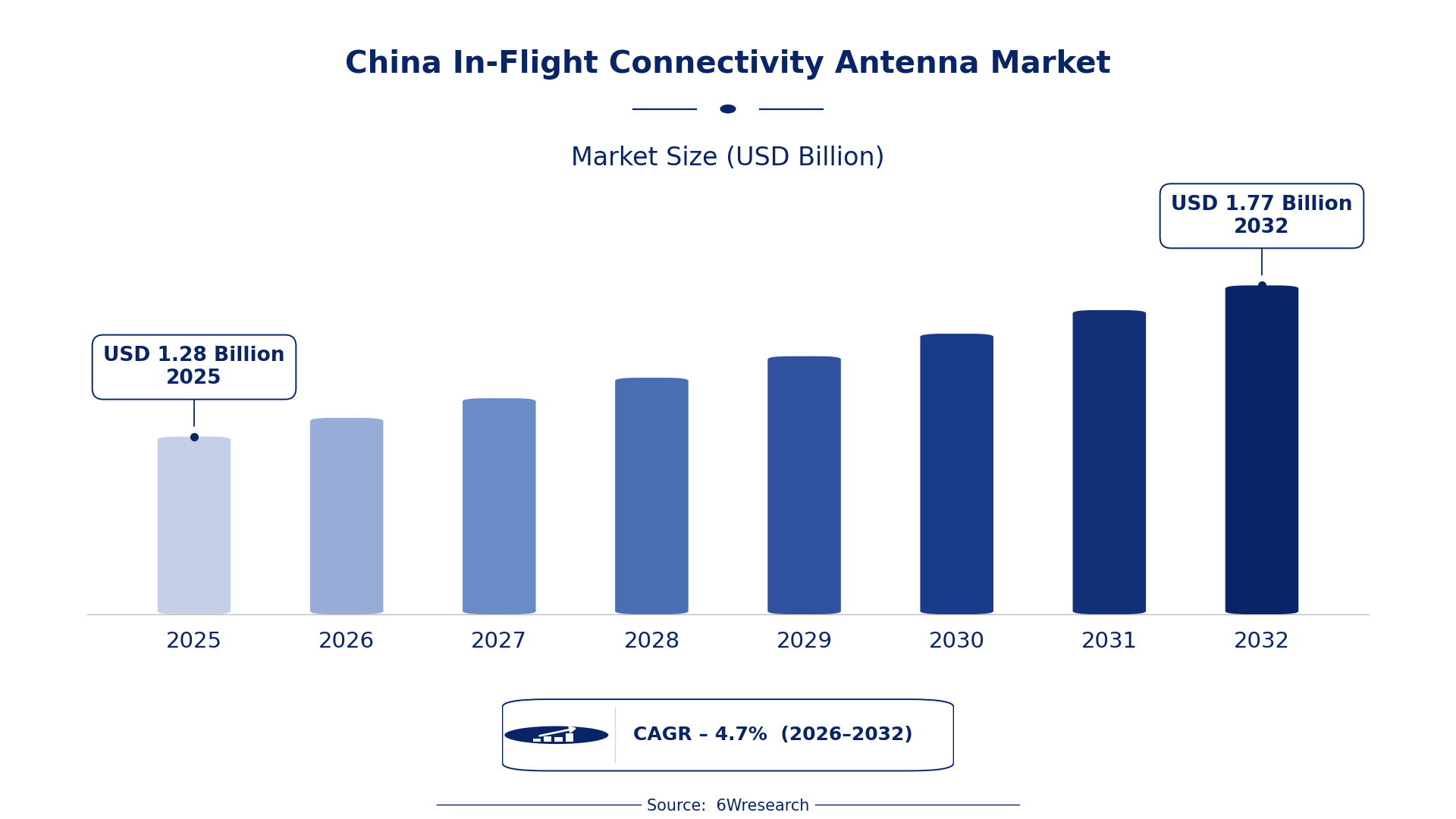
According to 6Wresearch internal database and industry insights, the China In-Flight Connectivity Antenna Market was valued at USD 1.28 billion in 2025 and is projected to reach USD 1.77 billion by 2032, growing at a CAGR of approximately 4.7% during 2026–2032.
China In-Flight Connectivity Antenna Market Highlights
| Report Metric | Details |
| Report Name | China In-Flight Connectivity Antenna Market |
| Market Size 2025 | USD 1.28 billion |
| Market Size 2032 | USD 1.77 billion |
| Absolute Growth 2025–2032 | USD 0.49 billion |
| CAGR 2026–2032 | 4.7% |
| Peak Annual Growth | 7.2% in 2029 |
| Forecast Period | 2026–2032 |
| Historical Data | 2022–2025 |
| Base Year | 2025 |
| Leading Antenna Type, 2025 | Electronically Steered (43% share) |
| Leading Frequency Band, 2025 | Ka-Band (39% share) |
| Leading Aircraft Type, 2025 | Commercial Jets (42% share) |
| Leading Distribution Channel, 2025 | OEM Supply Chains (46% share) |
| Fastest-Growing Antenna Type | Phased Array Antennas (7.3% CAGR) |
| Fastest-Growing Aircraft Type | Business Jets (6.0% CAGR) |
| Fastest-Growing Distribution Channel | In-Flight System Vendors (6.7% CAGR) |
| Growing Sector | Commercial Aviation |
| Key End Users | Airlines, Aircraft Manufacturers, In-Flight System Vendors, Aviation Regulatory Bodies |
China In-Flight Connectivity Antenna Market Year-wise Growth Rate and Key Drivers (2022–2032)
This graph illustrates the annual growth rates of the market from 2022 to 2032, highlighting a steady upward trajectory and projected market expansion over the forecast period.
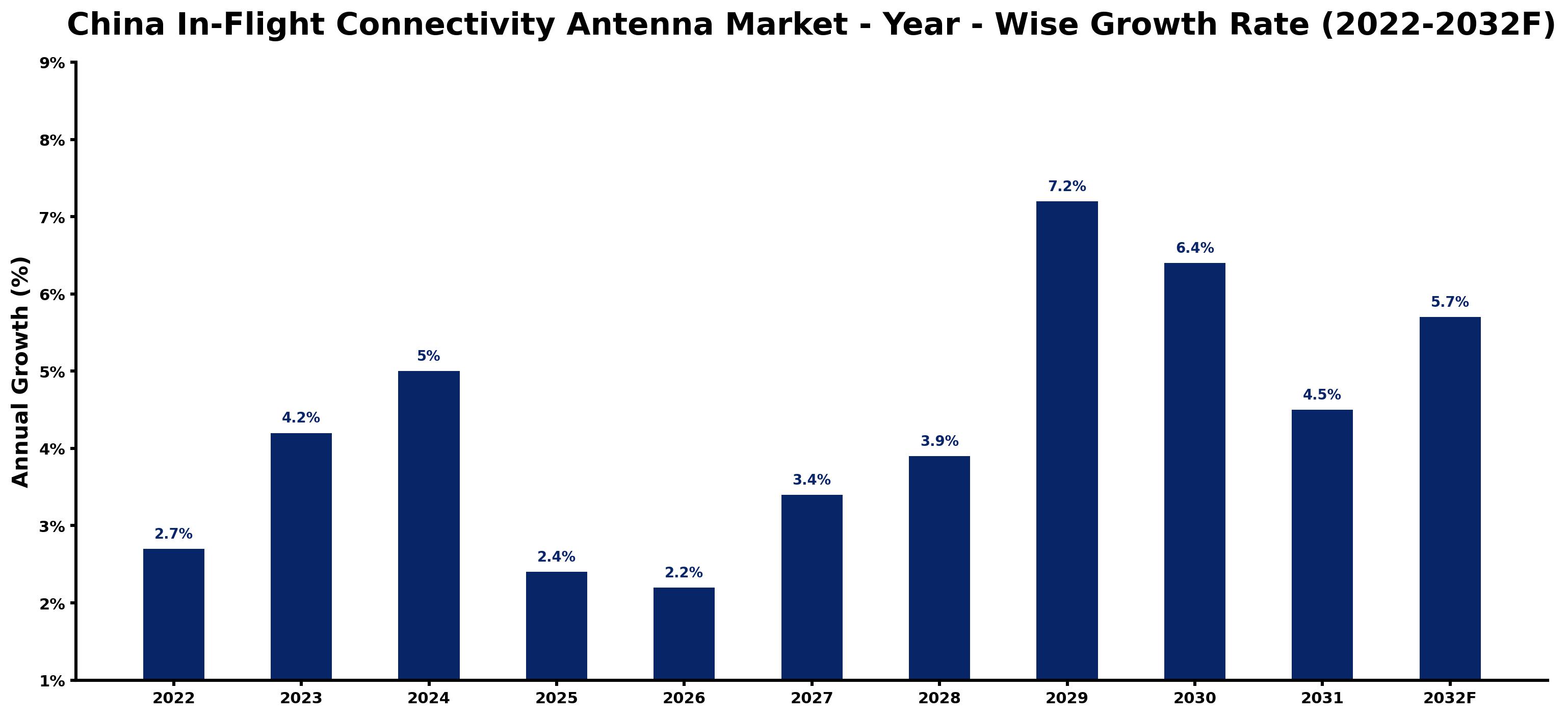
Each row of the following table gives one year's estimated growth and the event or demand shift that explains it.
| Year | Estimated Annual Growth (%) | Market Rationale |
| 2022 | 2.7 | The market experienced moderate growth due to increasing passenger numbers in domestic flights. |
| 2023 | 4.2 | Growth accelerated as airlines expanded their in-flight services to meet rising demand. |
| 2024 | 5.0 | The market reached its historical peak, driven by investments in connectivity technologies. |
| 2025 | 2.4 | Growth slowed as the market adjusted to previous rapid expansions and technological upgrades. |
| 2026 | 2.2 | A further slowdown occurred as airlines focused on operational efficiency rather than expansion. |
| 2027 | 3.4 | Demand picked up again with increased interest in advanced connectivity solutions from airlines. |
| 2028 | 3.9 | Growth continued as more airlines adopted high-speed internet services for passengers. |
| 2029 | 7.2 | The market peaked due to a surge in demand for high-performance antennas and connectivity solutions. |
| 2030 | 6.4 | Growth slowed as the Aviation Connectivity Enhancement Program aimed for a 50% increase in coverage by 2025. |
| 2031 | 4.5 | A further slowdown was noted as the market adjusted to new technological standards. |
| 2032 | 5.7 | Growth rebounded as airlines invested in modernising their fleets with advanced connectivity options. |
Note: Market size estimations and growth projections presented in this report are based on 6Wresearch's proprietary forecasting methodology, utilizing the latest available industry data, government publications, and primary research inputs.
China In-Flight Connectivity Antenna Market Synopsis
The In-Flight Connectivity Antenna Market in China encompasses advanced communication devices that facilitate internet access during flights. These antennas are crafted using high-frequency materials and are essential for providing reliable connectivity for passengers and crew. The market is growing due to increasing demand from domestic airlines and international partnerships in aircraft manufacturing. By 2030, China's aviation sector is projected to reach 1.6 billion passengers, driving further investments in connectivity solutions. The adoption of Ka-Band antennas is also contributing to higher data rates and improved passenger experiences.
Market Dynamics Impact Analysis (2026–2032)
| Factor | Type | Impact | Primary Segment Affected |
| Increasing passenger numbers drive demand for connectivity solutions in commercial jets. | Driver | High | Commercial Jets |
| Growing middle class in urban areas fuels demand for in-flight internet services. | Driver | High | Commercial Jets |
| High demand for advanced connectivity solutions presents opportunities for suppliers. | Opportunity | High | In-Flight System Vendors |
| Investment in aircraft manufacturing in the Shanghai region opens new markets. | Opportunity | Medium | OEM Supply Chains |
| High costs associated with upgrading existing aircraft to new standards limit adoption. | Restraint | High | Commercial Jets |
| Regulatory compliance requirements for new technologies can delay implementation. | Restraint | Medium | In-Flight System Vendors |
| Limited availability of skilled technicians hinders installation and maintenance. | Challenge | High | OEM Supply Chains |
| Technological advancements require constant updates, increasing operational costs. | Challenge | Medium | In-Flight System Vendors |
Evaluation of Drivers in China In-Flight Connectivity Antenna Market (2026–2032)
Key forces behind demand, with the segment each one moves most, are listed below.
| Drivers | Primary Segment Affected | Why It Matters (Evidence) |
| Rising passenger numbers in domestic flights increase demand for connectivity solutions. | Commercial Jets | China's aviation sector is projected to reach 1.6 billion passengers by 2030, prompting airlines to invest in in-flight services. |
| The adoption of Ka-Band antennas offers higher data rates for passengers. | Ka-Band | Ka-Band antennas are increasingly adopted due to their higher data rates, improving the overall passenger experience. |
| Investment in aircraft manufacturing improves the supply chain for connectivity solutions. | OEM Supply Chains | The Shanghai region is a hub for aircraft manufacturing, leading to increased demand for connectivity solutions. |
| The growing middle class in urban areas drives demand for in-flight internet services. | Commercial Jets | As the middle class expands, more passengers expect reliable internet access during flights. |
| Technological advancements in antennas improve performance and reliability. | Electronically Steered | Electronically Steered antennas are preferred for their precise signal tracking and improved performance. |
Growth in the In-Flight Connectivity Antenna market in China comes from rising passenger numbers, increasing investments in aircraft manufacturing and the adoption of advanced technologies. The aviation sector is projected to reach 1.6 billion passengers by 2030, prompting airlines to invest in their in-flight services. The adoption of Ka-Band antennas is on the rise, offering higher data rates and improving passenger experiences. As the middle class grows, more passengers expect reliable internet access during flights, further boosting market growth. Investment in the aircraft manufacturing sector in the Shanghai region is driving demand for connectivity solutions.
Evaluation of Restraints in China In-Flight Connectivity Antenna Market
The following restraints limit how fast demand can grow.
| Market Restraint | Primary Segment Affected | Why It Matters (Evidence) |
| High costs associated with upgrading existing aircraft to new standards limit adoption. | Commercial Jets | Upgrading to advanced connectivity solutions can be expensive, deterring some airlines from making the transition. |
| Regulatory compliance requirements for new technologies can delay implementation. | In-Flight System Vendors | Compliance with the updated Civil Aviation Safety Regulations can prolong the approval process for new systems. |
| Limited availability of skilled technicians hinders installation and maintenance. | OEM Supply Chains | A shortage of qualified technicians for installing and maintaining advanced antennas can slow down deployment. |
| Technological complexity of new antennas can deter smaller operators. | Business Jets | Smaller operators may find it challenging to adopt advanced technologies due to their complexity and cost. |
| Market saturation in urban areas limits growth potential. | Commercial Jets | As major airlines saturate urban routes, finding new growth opportunities becomes increasingly difficult. |
China In-Flight Connectivity Antenna Market Challenges
The China In-Flight Connectivity Antenna market encounters several practical challenges, starting with a skills shortage that hampers production efficiency. Many manufacturers struggle to recruit qualified engineers, which delays product development and increases costs for producers. Supply chain disruptions exacerbate this issue, as they hinder timely delivery of essential components, resulting in longer lead times for buyers and impacting service quality. Additionally, the high cost of advanced materials can inflate production expenses by up to 20%, making it challenging for airlines to offer competitive in-flight connectivity options for passengers.
Trends in the China In-Flight Connectivity Antenna Market
Buyers and suppliers in the China In-Flight Connectivity Antenna Market are adjusting to the following trends.
- Shift from Mechanically Steered to Electronically Steered Antennas: China is transitioning from mechanically steered antennas to electronically steered models, improving performance and reliability. This shift began around 2021, aligning with advancements in connectivity technology.
- Increased Adoption of Ka-Band Antennas: The aviation sector is increasingly adopting Ka-Band antennas, which offer superior data rates. By 2023, Ka-Band antennas accounted for 39% of the market share, reflecting a growing preference for high-speed connectivity.
- Focus on Sustainability in Aviation: The Chinese government is prioritising sustainable aviation practices, integrating advanced connectivity solutions to support eco-friendly initiatives. The Green Aviation Development Strategy aims for a 30% reduction in carbon emissions by 2035.
- Emergence of In-Flight System Vendors: In-Flight System Vendors are gaining prominence as key players in the market, providing comprehensive connectivity solutions. By 2026, this segment is expected to grow at a CAGR of 6.7%, indicating increasing reliance on specialised vendors.
Investment Opportunities in the China In-Flight Connectivity Antenna Market
Several openings in the China In-Flight Connectivity Antenna Market merit attention from investors.
- Gap in High-Speed Connectivity Solutions: With the aviation sector expected to reach 1.6 billion passengers by 2030, there is a gap in high-speed connectivity solutions. Airlines are seeking partnerships with In-Flight System Vendors to improve passenger experiences.
- Growing Demand from Business Jets: Business jets are increasingly demanding high-end connectivity solutions, creating opportunities for suppliers. The market for business jets is anticipated to grow at a CAGR of 6.0% from 2026 to 2032, indicating strong demand.
- Entry through Local Partnerships: Local partnerships are crucial for entering the Chinese market, particularly for foreign suppliers. Collaborating with established OEM Supply Chains can streamline the integration of connectivity solutions.
- Timing with Regulatory Changes: Now presents an ideal opportunity to invest in connectivity solutions, as recent regulatory changes support advancements. The Aviation Connectivity Enhancement Program aims for a 50% increase in coverage by 2025.
Government Initiatives in the China In-Flight Connectivity Antenna Market
In 2021, the Ministry of Transport launched the 'Aviation Connectivity Enhancement Program', aiming to improve in-flight internet services and targeting a 50% increase in coverage by 2025. This initiative builds on the 'National Medium- and Long-Term Program for the Development of Civil Aviation' released in 2020, which emphasised technological advancements in connectivity. These measures collectively enhance the regulatory framework for in-flight connectivity, ensuring better service delivery for passengers and airlines alike.
The 'Aviation Connectivity Enhancement Program' allows airlines to apply for funding to upgrade their in-flight connectivity systems. The program is administered by the Civil Aviation Administration of China (CAAC), which oversees all aviation regulations. By providing financial support, the CAAC encourages airlines to adopt advanced technologies, improving overall passenger experience and operational efficiency.
Future Insight of the China In-Flight Connectivity Antenna Market
Several forward-looking factors should drive growth in the China In-Flight Connectivity Antenna market over the coming years. The aviation sector is projected to support 1.6 billion passengers by 2030, creating a robust demand for reliable connectivity solutions. The implementation of the 13th Five-Year Plan will facilitate advancements in aviation technology, while the government's commitment to reducing carbon emissions in aviation by 30% by 2035 will promote the adoption of more efficient antenna systems. These developments will present new opportunities for buyers and suppliers to enhance their offerings and meet evolving passenger expectations.
Market Segmentation Analysis
The report offers a comprehensive study of the following market segments and their leading categories in the market.
By Antenna Type – Electronically Steered Dominated, Phased Array Antennas Expected to Grow Fastest
According to Shubham Deep, Research Manager at 6Wresearch, with a 43% revenue share in 2025, Electronically Steered was the largest antenna type category. Electronically Steered antennas dominate the market due to their precise signal tracking capabilities, essential for maintaining reliable connectivity during flights. Their widespread application in major airlines, especially in the Shanghai region, solidifies their leading market share. Over 2026–2032, Phased Array Antennas are expected to post the fastest growth, at a CAGR of 7.3%. Phased Array Antennas are gaining momentum as they enable electronic beam steering without moving parts, aligning with the industry's efficiency goals. This technology's rapid adoption is driven by the increasing demand for high-speed internet access in-flight, which enhances its growth potential. Suppliers should focus on advancing antenna technologies to meet the rising demand for dependable in-flight connectivity.
By Frequency Band – Ka-Band Dominated and Is Expected to Record the Fastest Growth
In 2025, Ka-Band led the frequency band split with a 39% share. Ka-Band antennas hold a significant market share because they provide higher bandwidth, allowing for faster in-flight internet services. Their growing use reflects airlines' efforts to improve passenger experiences through enhanced connectivity options. The same category is also set to grow fastest, at a CAGR of 6.8% during 2026–2032. Ka-Band is also the fastest-growing segment, as its superior bandwidth capabilities are increasingly valued by airlines aiming to satisfy customer expectations for high-speed internet. The continuous improvements in average internet speeds on flights further support this growth trajectory. Suppliers should concentrate on Ka-Band technology to take advantage of the surging demand for high-speed in-flight connectivity.
By Aircraft Type – Commercial Jets Dominated, Business Jets Expected to Grow Fastest
Commercial Jets took a 42% share of aircraft type in 2025, more than any other category. Commercial Jets represent the largest segment in the market, extensively utilising in-flight connectivity solutions to enhance passenger services. The over 3,000 commercial aircraft registered in China highlight the strong demand for these connectivity solutions. Business Jets are projected to grow fastest, at a CAGR of 6.0% during 2026–2032. Business Jets are witnessing the fastest growth due to rising demand for premium connectivity solutions among corporate travellers. This segment's expansion is fuelled by an increasing number of affluent individuals seeking reliable in-flight internet for business purposes. Suppliers should customise their offerings to address the specific connectivity needs of both commercial and business aircraft.
By Distribution Channel – OEM Supply Chains Dominated, In-Flight System Vendors Expected to Grow Fastest
OEM Supply Chains accounted for a 46% market share by distribution channel in 2025. OEM Supply Chains lead the market as they are crucial for integrating connectivity antennas into new aircraft designs, ensuring optimal installation and performance. Their established relationships with aircraft manufacturers guarantee a consistent supply of antennas to the aviation sector. In-Flight System Vendors are set to record the highest CAGR in this split, 6.7% over 2026–2032. In-Flight System Vendors are the fastest-growing distribution channel, providing comprehensive connectivity solutions that include antennas, meeting the rising demand for in-flight internet services. Their capacity to offer complete systems positions them advantageously in a competitive landscape. This trend indicates that suppliers need to strengthen partnerships with in-flight system vendors to broaden market reach and enhance service offerings.
Key Attractiveness of the Report
- 10 Years of Market Numbers
- Historical Data Starting from 2022 to 2025
- Base Year 2025
- Forecast Data until 2032
- Key Performance Indicators Impacting the Market
- Major Upcoming Developments and Projects
Key Highlights of the Report:
- China In-Flight Connectivity Antenna Market Outlook
- Market Size of China In-Flight Connectivity Antenna Market, 2025
- Forecast of China In-Flight Connectivity Antenna Market, 2032
- Historical Data and Forecast of China In-Flight Connectivity Antenna Revenues & Volume for the Period 2022 - 2032F
- China In-Flight Connectivity Antenna Market Trend Evolution
- China In-Flight Connectivity Antenna Market Drivers and Challenges
- China In-Flight Connectivity Antenna Price Trends
- China In-Flight Connectivity Antenna Porter's Five Forces
- China In-Flight Connectivity Antenna Industry Life Cycle
- Historical Data and Forecast of China In-Flight Connectivity Antenna Market Revenues & Volume By Antenna Type for the Period 2022 - 2032F
- Historical Data and Forecast of China In-Flight Connectivity Antenna Market Revenues & Volume By Electronically Steered for the Period 2022 - 2032F
- Historical Data and Forecast of China In-Flight Connectivity Antenna Market Revenues & Volume By Mechanically Steered for the Period 2022 - 2032F
- Historical Data and Forecast of China In-Flight Connectivity Antenna Market Revenues & Volume By Flat Panel Antennas for the Period 2022 - 2032F
- Historical Data and Forecast of China In-Flight Connectivity Antenna Market Revenues & Volume By Phased Array Antennas for the Period 2022 - 2032F
- Historical Data and Forecast of China In-Flight Connectivity Antenna Market Revenues & Volume By Frequency Band for the Period 2022 - 2032F
- Historical Data and Forecast of China In-Flight Connectivity Antenna Market Revenues & Volume By Ku-Band for the Period 2022 - 2032F
- Historical Data and Forecast of China In-Flight Connectivity Antenna Market Revenues & Volume By Ka-Band for the Period 2022 - 2032F
- Historical Data and Forecast of China In-Flight Connectivity Antenna Market Revenues & Volume By Dual-Band for the Period 2022 - 2032F
- Historical Data and Forecast of China In-Flight Connectivity Antenna Market Revenues & Volume By L-Band for the Period 2022 - 2032F
- Historical Data and Forecast of China In-Flight Connectivity Antenna Market Revenues & Volume By Aircraft Type for the Period 2022 - 2032F
- Historical Data and Forecast of China In-Flight Connectivity Antenna Market Revenues & Volume By Commercial Jets for the Period 2022 - 2032F
- Historical Data and Forecast of China In-Flight Connectivity Antenna Market Revenues & Volume By Business Jets for the Period 2022 - 2032F
- Historical Data and Forecast of China In-Flight Connectivity Antenna Market Revenues & Volume By Regional Aircraft for the Period 2022 - 2032F
- Historical Data and Forecast of China In-Flight Connectivity Antenna Market Revenues & Volume By Military Aircraft for the Period 2022 - 2032F
- Historical Data and Forecast of China In-Flight Connectivity Antenna Market Revenues & Volume By Distribution Channel for the Period 2022 - 2032F
- Historical Data and Forecast of China In-Flight Connectivity Antenna Market Revenues & Volume By OEM Supply Chains for the Period 2022 - 2032F
- Historical Data and Forecast of China In-Flight Connectivity Antenna Market Revenues & Volume By In-Flight System Vendors for the Period 2022 - 2032F
- Historical Data and Forecast of China In-Flight Connectivity Antenna Market Revenues & Volume By Direct Sales for the Period 2022 - 2032F
- Historical Data and Forecast of China In-Flight Connectivity Antenna Market Revenues & Volume By Defense Contractors for the Period 2022 - 2032F
- China In-Flight Connectivity Antenna Import Export Trade Statistics
- Market Opportunity Assessment By Antenna Type
- Market Opportunity Assessment By Frequency Band
- Market Opportunity Assessment By Aircraft Type
- Market Opportunity Assessment By Distribution Channel
- China In-Flight Connectivity Antenna Top Companies Market Share
- China In-Flight Connectivity Antenna Competitive Benchmarking By Technical and Operational Parameters
- China In-Flight Connectivity Antenna Company Profiles
- China In-Flight Connectivity Antenna Key Strategic Recommendations
Market Covered
The report offers an extensive study of the following market segments.
By Antenna Type
- Electronically Steered
- Mechanically Steered
- Flat Panel Antennas
- Phased Array Antennas
By Frequency Band
- Ku-Band
- Ka-Band
- Dual-Band
- L-Band
By Aircraft Type
- Commercial Jets
- Business Jets
- Regional Aircraft
- Military Aircraft
By Distribution Channel
- OEM Supply Chains
- In-Flight System Vendors
- Direct Sales
- Defense Contractors































