China In-Flight Kitchen Module Market Size & Growth Rate
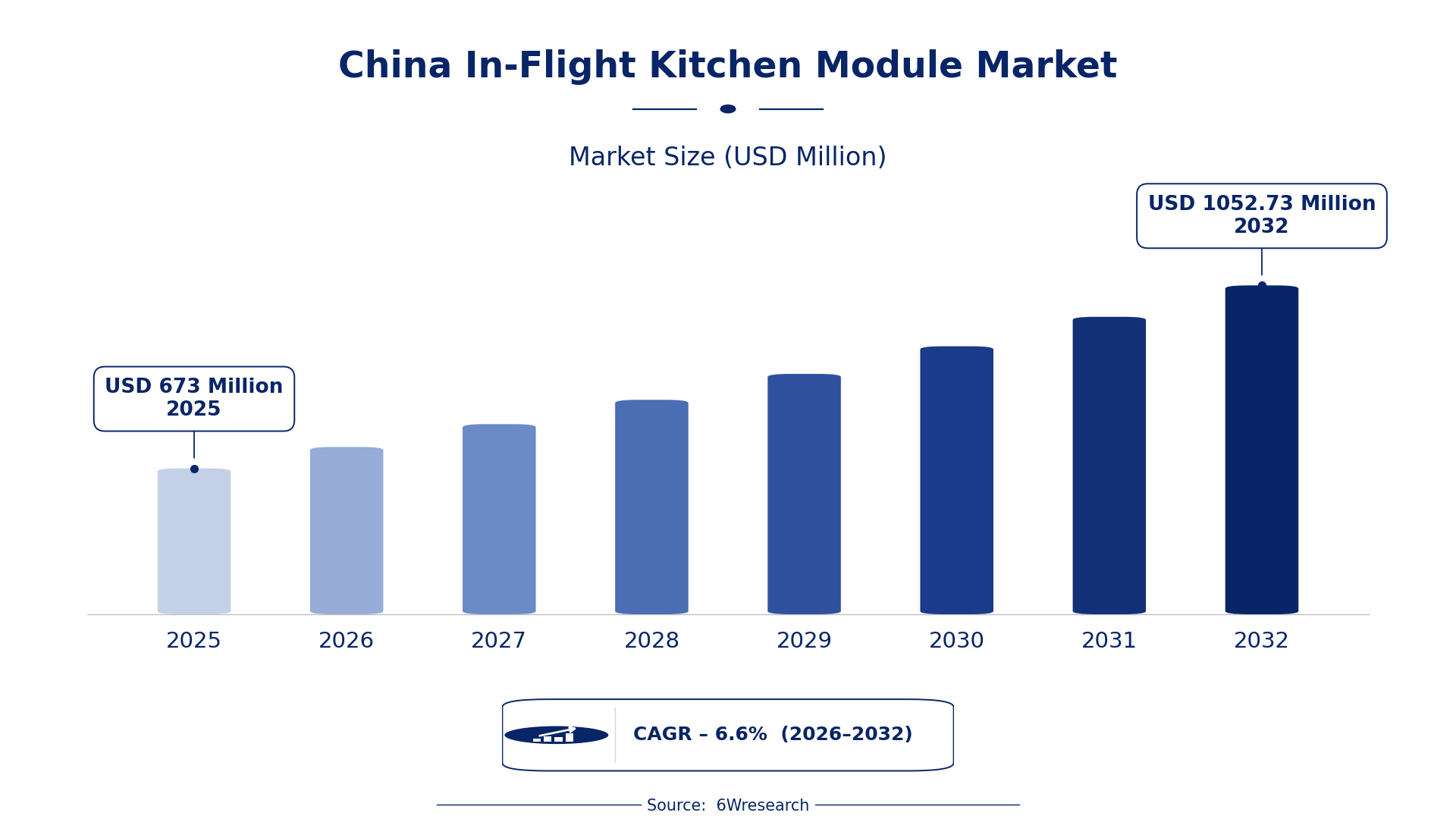
According to 6Wresearch internal database and industry insights, the China In-Flight Kitchen Module Market was valued at USD 673.0 million in 2025 and is projected to reach USD 1,052.73 million by 2032, growing at a CAGR of approximately 6.6% during 2026–2032.
China In-Flight Kitchen Module Market Highlights
| Report Metric | Details |
| Report Name | China In-Flight Kitchen Module Market |
| Market Size 2025 | USD 673.0 million |
| Market Size 2032 | USD 1,052.73 million |
| Absolute Growth 2025–2032 | USD 379.73 million |
| CAGR 2026–2032 | 6.6% |
| Peak Annual Growth | 8.8% in 2030 |
| Forecast Period | 2026–2032 |
| Historical Data | 2022–2025 |
| Base Year | 2025 |
| Leading Module Type, 2025 | Galley Inserts (35% share) |
| Leading Material Type, 2025 | Aluminum / Composites (39% share) |
| Leading Placement Zone, 2025 | Aft / Front Section (43% share) |
| Leading Distribution Channel, 2025 | Galley Equipment Suppliers (45% share) |
| Fastest-Growing Module Type | Ovens and Warmers (8.6% CAGR) |
| Fastest-Growing Material Type | Electric / Convection (7.8% CAGR) |
| Fastest-Growing Placement Zone | Business Class Kitchens (7.6% CAGR) |
| Fastest-Growing Distribution Channel | OEM Catering Integrators (8.1% CAGR) |
| Growing Sector | Aviation Catering |
| Key End Users | Airlines, Catering Services, Aviation Equipment Manufacturers, Regulatory Bodies |
China In-Flight Kitchen Module Market Year-wise Growth Rate and Key Drivers (2022–2032)
This graph illustrates the annual growth rates of the market from 2022 to 2032, highlighting a steady upward trajectory and projected market expansion over the forecast period.
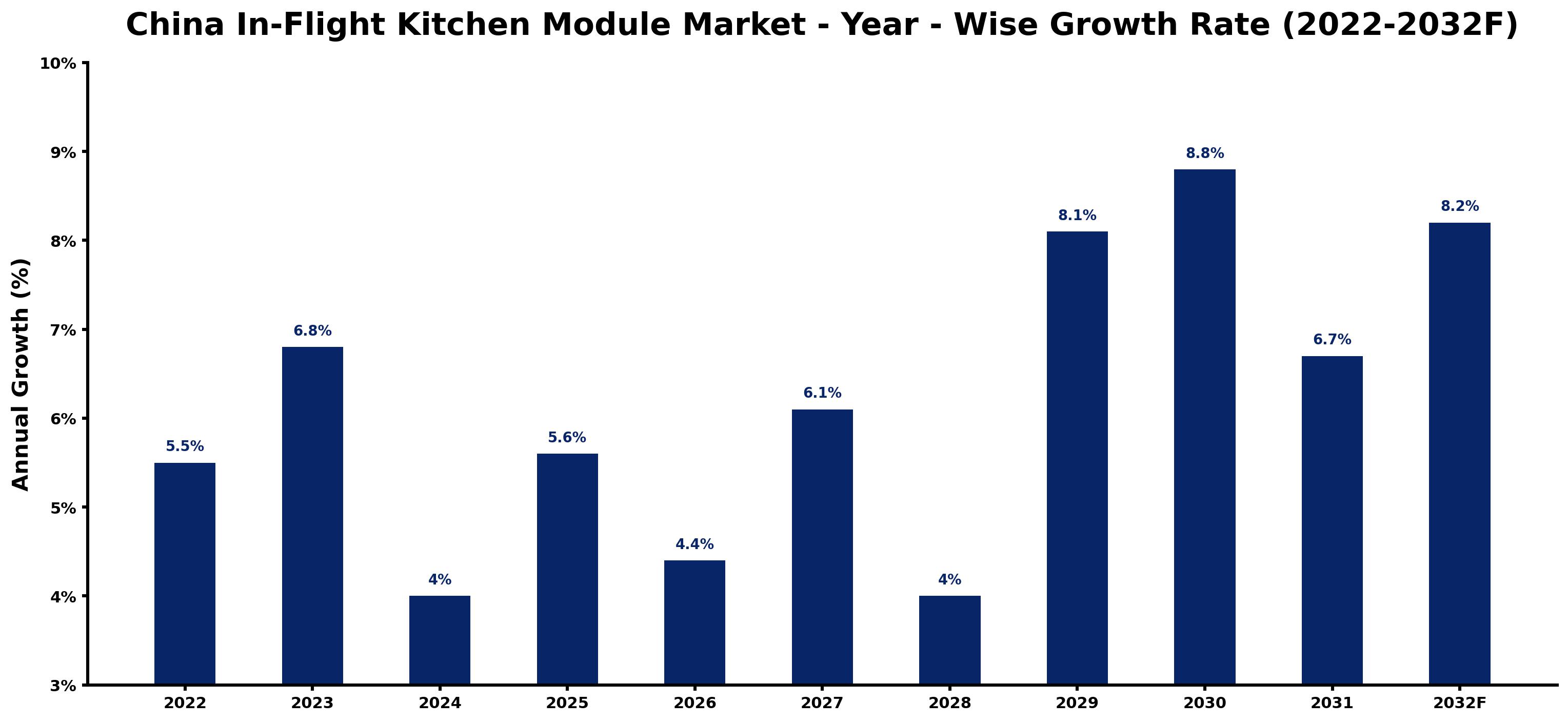
Below, each year's estimated growth is shown next to the factor that most influenced it.
| Year | Estimated Annual Growth (%) | Market Rationale |
| 2022 | 5.5 | The market experienced steady growth due to rising domestic air travel and increased passenger numbers. |
| 2023 | 6.8 | Demand surged as the aviation sector served over 660 million passengers, boosting the need for kitchen modules. |
| 2024 | 4.0 | Growth slowed as airlines adjusted to new catering standards and focused on operational efficiency. |
| 2025 | 5.6 | An increase in domestic flights led to higher demand for in-flight kitchen modules and catering services. |
| 2026 | 4.4 | The market growth rate decreased as suppliers faced challenges in sourcing materials like aluminum. |
| 2027 | 6.1 | Demand increased as airlines invested in modern kitchen technologies to enhance passenger experiences. |
| 2028 | 4.0 | Growth slowed again as competition intensified, leading to price pressures among manufacturers. |
| 2029 | 8.1 | The market rebounded with rising passenger expectations for meal quality and service efficiency. |
| 2030 | 8.8 | Demand peaked due to significant investments in upgrading in-flight catering equipment and facilities. |
| 2031 | 6.7 | Growth moderated as airlines focused on optimising operations and meeting regulatory requirements. |
| 2032 | 8.2 | The market is expected to grow as new catering technologies and infrastructure improvements are implemented. |
Note: Market size estimations and growth projections presented in this report are based on 6Wresearch's proprietary forecasting methodology, utilizing the latest available industry data, government publications, and primary research inputs.
China In-Flight Kitchen Module Market Synopsis
The In-Flight Kitchen Module Market in China includes specialised assemblies used in aircraft for food preparation and service. These modules are primarily made from lightweight materials such as aluminium and composites, ensuring durability and efficiency. The market is expanding due to a rise in domestic air travel and the growing demand for improved catering services. With over 200 commercial airports facilitating operations, domestic airlines and catering services drive this demand. The government's commitment to aviation infrastructure further supports this growth.
Market Dynamics Impact Analysis (2026–2032)
| Factor | Type | Impact | Primary Segment Affected |
| Rising domestic air travel increases the need for in-flight kitchen modules. | Driver | High | Galley Inserts |
| Investment in airport facilities enhances catering capabilities. | Driver | High | Refrigeration Units |
| The Civil Aviation Development Plan aims to upgrade aviation infrastructure, creating demand. | Opportunity | High | Ovens and Warmers |
| Growing passenger expectations for meal quality presents a market entry opportunity. | Opportunity | High | Coffee Makers |
| Regulatory compliance costs can burden smaller suppliers in the market. | Restraint | High | Galley Equipment Suppliers |
| Limited access to advanced materials may hinder production efficiency. | Restraint | Medium | OEM Catering Integrators |
| Supply chain disruptions can delay module deliveries to airlines. | Challenge | High | Airline Catering OEMs |
| Technological advancements require constant upgrades to remain competitive. | Challenge | Medium | Avionics Retail Chains |
Evaluation of Drivers in China In-Flight Kitchen Module Market (2026–2032)
Key forces behind demand, with the segment each one moves most, are listed below.
| Drivers | Primary Segment Affected | Why It Matters (Evidence) |
| Increased passenger numbers drive demand for efficient food service solutions. | Galley Inserts | The aviation sector served over 660 million passengers in 2019, boosting the need for kitchen modules. |
| Investment in airport infrastructure improves catering service capabilities. | Refrigeration Units | In 2022, the government allocated funds for upgrading airport facilities, increasing demand for refrigeration solutions. |
| Rising consumer expectations for meal quality prompt airlines to upgrade catering equipment. | Ovens and Warmers | The average flight in China serves 150 meals, necessitating efficient food preparation technologies. |
| The 'Civil Aviation Development Plan' supports advancements in catering technology. | Coffee Makers | This plan aims to improve aviation services, leading to increased demand for modern kitchen equipment. |
| Growing focus on food safety regulations encourages upgrades in kitchen modules. | Galley Equipment Suppliers | The National Food Safety Standard for Catering Services mandates stricter hygiene practices. |
Growth across the In-Flight Kitchen Module market in China is anchored in rising domestic air travel, increased passenger numbers and investments in airport infrastructure. The aviation sector served over 660 million passengers in 2019, which boosted demand for kitchen modules. The average flight in China serves 150 meals per trip, necessitating efficient food preparation technologies. Growing consumer expectations for meal quality prompt airlines to upgrade catering equipment, which is expected to increase demand for modern kitchen solutions.
Evaluation of Restraints in China In-Flight Kitchen Module Market
The main factors holding the market back are set out below.
| Market Restraint | Primary Segment Affected | Why It Matters (Evidence) |
| Regulatory compliance costs can burden smaller suppliers in the market. | Galley Equipment Suppliers | Stricter hygiene practices mandated by the National Food Safety Standard increase operational costs. |
| Limited access to advanced materials may hinder production efficiency. | OEM Catering Integrators | The reliance on aluminum, which constitutes 70% of kitchen modules, can restrict material sourcing. |
| Supply chain disruptions can delay module deliveries to airlines. | Airline Catering OEMs | Global supply chain issues have affected the timely procurement of essential components. |
| High initial investment costs for modern kitchen equipment can deter new entrants. | Avionics Retail Chains | The need for ISO 9001 certification adds to the financial burden on smaller producers. |
| Market fluctuations can impact long-term contracts with airlines. | Galley Inserts | Economic uncertainties may lead airlines to reassess their catering service agreements. |
China In-Flight Kitchen Module Market Challenges
The China In-Flight Kitchen Module market still has to address several pressing challenges, beginning with stringent regulations from the Civil Aviation Administration that can delay product approvals for suppliers by up to six months. Intense competition among local manufacturers drives prices down, forcing producers to compromise on quality, which ultimately affects the reliability of kitchen modules for airlines. Supply chain disruptions, particularly in sourcing aluminum, can lead to increased costs for manufacturers, raising module prices by approximately 15% for buyers. A shortage of skilled workers in the aviation sector can further delay production timelines, impacting delivery schedules for catering services.
Trends in the China In-Flight Kitchen Module Market
Several trends are reshaping the China In-Flight Kitchen Module Market; the most important are set out below.
- Shift towards Sustainable Catering Practices: The Green Airport Initiative, introduced in 2023, promotes sustainable practices in airport operations, including in-flight catering. This initiative encourages airlines to adopt eco-friendly kitchen modules, aligning with global sustainability trends.
- Growing Focus on Premium In-Flight Services: Domestic airlines are increasingly prioritising passenger experience, especially in business class kitchens. The demand for specialised equipment in these kitchens has risen, reflecting a 7.6% growth rate in this segment.
- Expansion of Modular Kitchen Units: The use of modular units is increasing in business class kitchens for efficiency. This trend is supported by the growing preference for adaptable kitchen solutions, with a notable rise in installations across major airports.
- Focus on Food Safety Standards Compliance: The National Food Safety Standard for Catering Services, updated in 2022, mandates stricter hygiene practices. This regulation is driving airlines to invest in upgraded kitchen modules to ensure compliance.
Investment Opportunities in the China In-Flight Kitchen Module Market
Investors looking at the China In-Flight Kitchen Module Market should consider the following areas.
- Partnerships with Local Suppliers: Now is an opportune time to partner with local suppliers in the Guangdong province, which is a significant manufacturing base for aviation equipment. Collaborating with local entities can streamline supply chains and enhance market entry.
- Investment in High-Quality Kitchen Modules: With the rising focus on premium in-flight services, investing in high-quality kitchen modules is timely. Airlines are seeking advanced solutions to meet passenger expectations, particularly in the Beijing-Tianjin-Hebei region.
- Expansion into Emerging Markets: The Sichuan region is known for its unique in-flight meal offerings, presenting an opportunity for suppliers to expand their product lines. Investing in tailored kitchen solutions can cater to this growing market segment.
- Focus on Compliance with Food Safety Standards: Investing in equipment that meets the updated National Food Safety Standard can position suppliers advantageously. Airlines are prioritising compliance, creating demand for certified kitchen modules.
Government Initiatives in the China In-Flight Kitchen Module Market
In 2023, the Civil Aviation Administration of China initiated a subsidy program for airlines to upgrade their in-flight catering equipment, aiming to improve passenger experience. This program provides financial support to airlines, enabling them to invest in modern kitchen modules that comply with new regulations. The initiative encourages airlines to enhance their catering services, ultimately benefiting passengers. Additionally, the National Health Commission oversees the implementation of the updated National Food Safety Standard for Catering Services, ensuring that in-flight meals meet stringent hygiene requirements. This oversight promotes accountability among suppliers and improves the overall quality of in-flight catering.
The 'Civil Aviation Development Plan', launched in 2021 by the Civil Aviation Administration of China, aims to improve aviation infrastructure and services, including in-flight catering systems. This plan enhances the operational capabilities of airlines and encourages investment in modern kitchen technologies. The initiative is projected to drive growth in the market, as it aligns with the increasing need for efficient catering solutions.
Future Insight of the China In-Flight Kitchen Module Market
The China In-Flight Kitchen Module market is set to evolve significantly by 2032, influenced by enhancements in aviation infrastructure and catering technology. The Civil Aviation Development Plan will upgrade airport facilities, leading to improved kitchen module designs and operational efficiency. Increased domestic air travel will elevate demand for in-flight kitchen modules, with the average flight serving 150 meals per trip. Upgrades in catering services will modernise equipment, improving passenger experiences and prompting airlines to invest in high-quality kitchen modules.
Market Segmentation Analysis
The report offers a comprehensive study of the following market segments and their leading categories in the market.
By Module Type – Galley Inserts Dominated, Ovens and Warmers Expected to Grow Fastest
According to Shubham Deep, Research Manager at 6Wresearch, in 2025, Galley Inserts led the module type split with a 35% share. Galley Inserts hold the largest share in the market as they are vital for food storage and serving, essential for efficient in-flight operations. Their widespread adoption across various airlines, particularly in busy hubs like Shanghai, contributes to a robust installed base. Ovens and Warmers are projected to grow fastest, at a CAGR of 8.6% during 2026–2032. Ovens and Warmers are experiencing rapid growth as airlines upgrade their equipment to meet rising passenger expectations for meal quality. The average of 150 meals served per flight in China highlights the increasing demand for effective heating solutions. Suppliers should prioritise the development of advanced ovens and warmers to address the growing need for high-quality in-flight meal preparation.
By Material Type – Aluminum / Composites Dominated, Electric / Convection Expected to Grow Fastest
The largest material type category in 2025 was Aluminum / Composites, with a 39% share of total revenue. Aluminum and Composites dominate the market due to their lightweight properties, which are crucial for fuel efficiency in aviation. This material is extensively used across airline catering operations, ensuring reliability and performance in kitchen modules. Electric / Convection is set to record the highest CAGR in this split, 7.8% over 2026–2032. Electric and Convection materials are gaining traction as they improve meal preparation efficiency, aligning with the trend of modernising in-flight services. Airlines are increasingly investing in these materials to enhance service speed and quality. Buyers should focus on sourcing electric and convection materials to improve kitchen module efficiency and meet modern service standards.
By Placement Zone – Aft / Front Section Dominated, Business Class Kitchens Expected to Grow Fastest
Aft / Front Section took a 43% share of placement zone in 2025, more than any other category. The Aft and Front Section placement of kitchen modules is essential for service efficiency, allowing quick access during meal service. This strategic positioning is standard in many aircraft designs, particularly in regions with high passenger volumes. Over 2026–2032, Business Class Kitchens are expected to post the fastest growth, at a CAGR of 7.6%. Business Class Kitchens are rapidly expanding as airlines enhance their premium in-flight experiences, requiring specialised equipment. The increasing demand for superior service in this segment is driving significant growth in related kitchen module placements. Suppliers should innovate solutions tailored for business class kitchens to meet the rising demand for premium in-flight services.
By Distribution Channel – Galley Equipment Suppliers Dominated, OEM Catering Integrators Expected to Grow Fastest
With a 45% revenue share in 2025, Galley Equipment Suppliers was the largest distribution channel category. Galley Equipment Suppliers lead the market by providing essential components that cater to the needs of airlines, ensuring operational efficiency. Their established relationships with airlines make them a preferred choice for sourcing kitchen modules. The quickest growth will come from OEM Catering Integrators, forecast to expand at a CAGR of 8.1% between 2026 and 2032. OEM Catering Integrators are experiencing swift growth as they offer tailored kitchen solutions that meet specific airline requirements. The increasing complexity of in-flight services necessitates these integrators to streamline kitchen operations, driving their market expansion. Suppliers should strengthen partnerships with OEM Catering Integrators to tap into the growing demand for customised kitchen solutions.
Key Attractiveness of the Report
- 10 Years of Market Numbers
- Historical Data Starting from 2022 to 2025
- Base Year 2025
- Forecast Data until 2032
- Key Performance Indicators Impacting the Market
- Major Upcoming Developments and Projects
Key Highlights of the Report:
- China In-Flight Kitchen Module Market Outlook
- Market Size of China In-Flight Kitchen Module Market, 2025
- Forecast of China In-Flight Kitchen Module Market, 2032
- Historical Data and Forecast of China In-Flight Kitchen Module Revenues & Volume for the Period 2022 - 2032F
- China In-Flight Kitchen Module Market Trend Evolution
- China In-Flight Kitchen Module Market Drivers and Challenges
- China In-Flight Kitchen Module Price Trends
- China In-Flight Kitchen Module Porter's Five Forces
- China In-Flight Kitchen Module Industry Life Cycle
- Historical Data and Forecast of China In-Flight Kitchen Module Market Revenues & Volume By Module Type for the Period 2022 - 2032F
- Historical Data and Forecast of China In-Flight Kitchen Module Market Revenues & Volume By Galley Inserts for the Period 2022 - 2032F
- Historical Data and Forecast of China In-Flight Kitchen Module Market Revenues & Volume By Refrigeration Units for the Period 2022 - 2032F
- Historical Data and Forecast of China In-Flight Kitchen Module Market Revenues & Volume By Ovens and Warmers for the Period 2022 - 2032F
- Historical Data and Forecast of China In-Flight Kitchen Module Market Revenues & Volume By Coffee Makers for the Period 2022 - 2032F
- Historical Data and Forecast of China In-Flight Kitchen Module Market Revenues & Volume By Material Type for the Period 2022 - 2032F
- Historical Data and Forecast of China In-Flight Kitchen Module Market Revenues & Volume By Aluminum / Composites for the Period 2022 - 2032F
- Historical Data and Forecast of China In-Flight Kitchen Module Market Revenues & Volume By Steel / Composite for the Period 2022 - 2032F
- Historical Data and Forecast of China In-Flight Kitchen Module Market Revenues & Volume By Electric / Convection for the Period 2022 - 2032F
- Historical Data and Forecast of China In-Flight Kitchen Module Market Revenues & Volume By Modular Units for the Period 2022 - 2032F
- Historical Data and Forecast of China In-Flight Kitchen Module Market Revenues & Volume By Placement Zone for the Period 2022 - 2032F
- Historical Data and Forecast of China In-Flight Kitchen Module Market Revenues & Volume By Aft / Front Section for the Period 2022 - 2032F
- Historical Data and Forecast of China In-Flight Kitchen Module Market Revenues & Volume By Galley Systems for the Period 2022 - 2032F
- Historical Data and Forecast of China In-Flight Kitchen Module Market Revenues & Volume By Business Class Kitchens for the Period 2022 - 2032F
- Historical Data and Forecast of China In-Flight Kitchen Module Market Revenues & Volume By Beverage Service for the Period 2022 - 2032F
- Historical Data and Forecast of China In-Flight Kitchen Module Market Revenues & Volume By Distribution Channel for the Period 2022 - 2032F
- Historical Data and Forecast of China In-Flight Kitchen Module Market Revenues & Volume By Galley Equipment Suppliers for the Period 2022 - 2032F
- Historical Data and Forecast of China In-Flight Kitchen Module Market Revenues & Volume By OEM Catering Integrators for the Period 2022 - 2032F
- Historical Data and Forecast of China In-Flight Kitchen Module Market Revenues & Volume By Airline Catering OEMs for the Period 2022 - 2032F
- Historical Data and Forecast of China In-Flight Kitchen Module Market Revenues & Volume By Avionics Retail Chains for the Period 2022 - 2032F
- China In-Flight Kitchen Module Import Export Trade Statistics
- Market Opportunity Assessment By Module Type
- Market Opportunity Assessment By Material Type
- Market Opportunity Assessment By Placement Zone
- Market Opportunity Assessment By Distribution Channel
- China In-Flight Kitchen Module Top Companies Market Share
- China In-Flight Kitchen Module Competitive Benchmarking By Technical and Operational Parameters
- China In-Flight Kitchen Module Company Profiles
- China In-Flight Kitchen Module Key Strategic Recommendations
Market Covered
Segments analysed in this report are listed below.
By Module Type
- Galley Inserts
- Refrigeration Units
- Ovens and Warmers
- Coffee Makers
By Material Type
- Aluminum / Composites
- Steel / Composite
- Electric / Convection
- Modular Units
By Placement Zone
- Aft / Front Section
- Galley Systems
- Business Class Kitchens
- Beverage Service
By Distribution Channel
- Galley Equipment Suppliers
- OEM Catering Integrators
- Airline Catering OEMs
- Avionics Retail Chains































