China In-Line Fuel Filter Market Size & Growth Rate
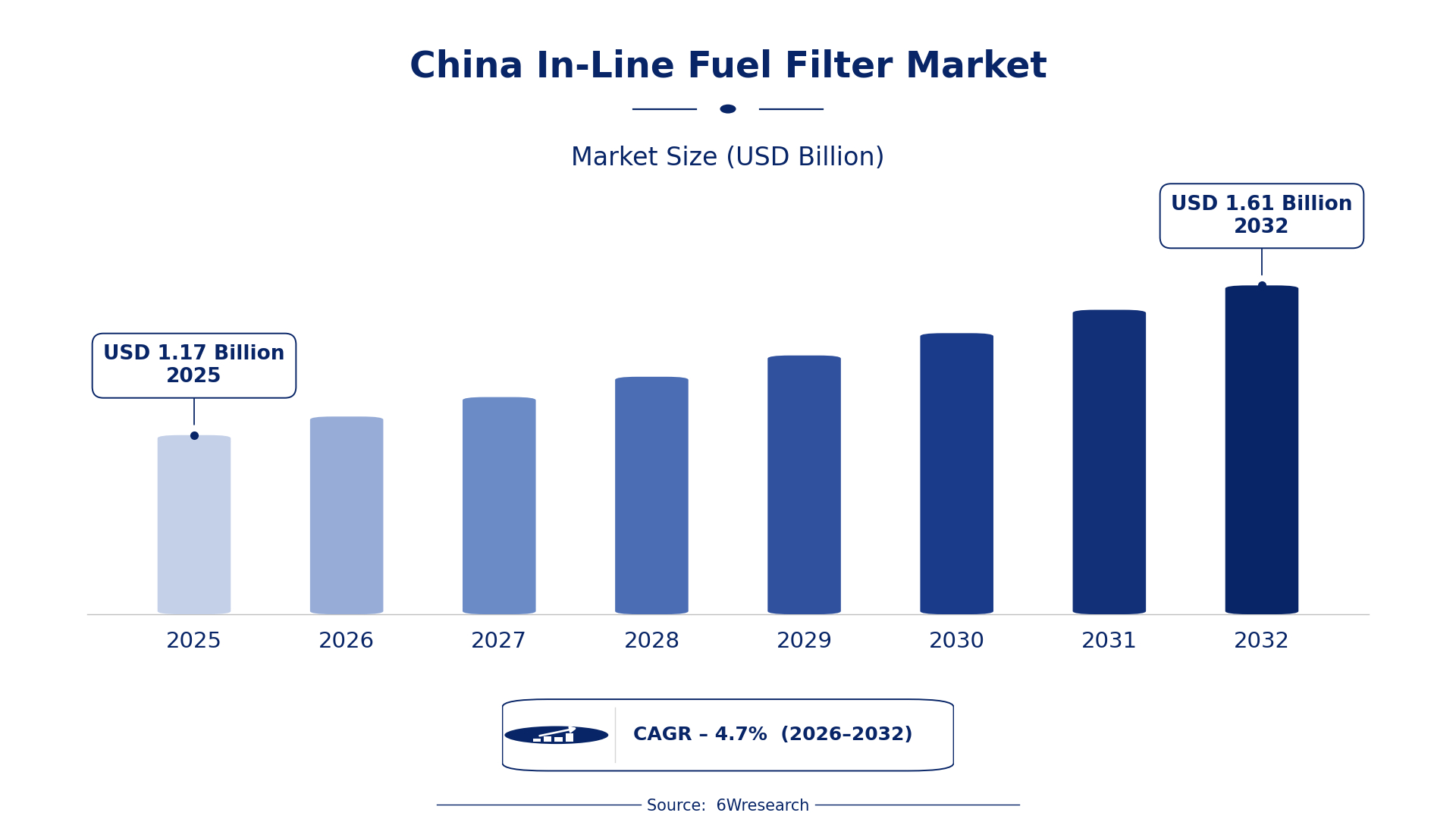
According to 6Wresearch internal database and industry insights, the China In-Line Fuel Filter Market was valued at USD 1.17 billion in 2025 and is projected to reach USD 1.61 billion by 2032, growing at a CAGR of approximately 4.7% during 2026–2032.
China In-Line Fuel Filter Market Highlights
| Report Metric | Details |
| Report Name | China In-Line Fuel Filter Market |
| Market Size 2025 | USD 1.17 billion |
| Market Size 2032 | USD 1.61 billion |
| Absolute Growth 2025–2032 | USD 0.44 billion |
| CAGR 2026–2032 | 4.7% |
| Peak Annual Growth | 7.0% in 2029 |
| Forecast Period | 2026–2032 |
| Historical Data | 2022–2025 |
| Base Year | 2025 |
| Leading Filter Type, 2025 | Primary Fuel Filters (37% share) |
| Leading Filtration Material, 2025 | Cellulose Media (49% share) |
| Leading Fuel Type, 2025 | Diesel (39% share) |
| Leading Vehicle Type, 2025 | Passenger Vehicles (35% share) |
| Leading Replacement Interval, 2025 | Seasonal Maintenance (35% share) |
| Fastest-Growing Filter Type | Performance Filters (6.1% CAGR) |
| Fastest-Growing Filtration Material | Synthetic Mesh (6.2% CAGR) |
| Fastest-Growing Fuel Type | Biofuels (6.9% CAGR) |
| Fastest-Growing Vehicle Type | Agricultural Vehicles (6.8% CAGR) |
| Growing Sector | Seasonal Maintenance |
| Key End Users | Seasonal Maintenance, 20, 000–30, 000 km |
China In-Line Fuel Filter Market Year-wise Growth Rate and Key Drivers (2022–2032)
This graph illustrates the annual growth rates of the market from 2022 to 2032, highlighting a steady upward trajectory and projected market expansion over the forecast period.
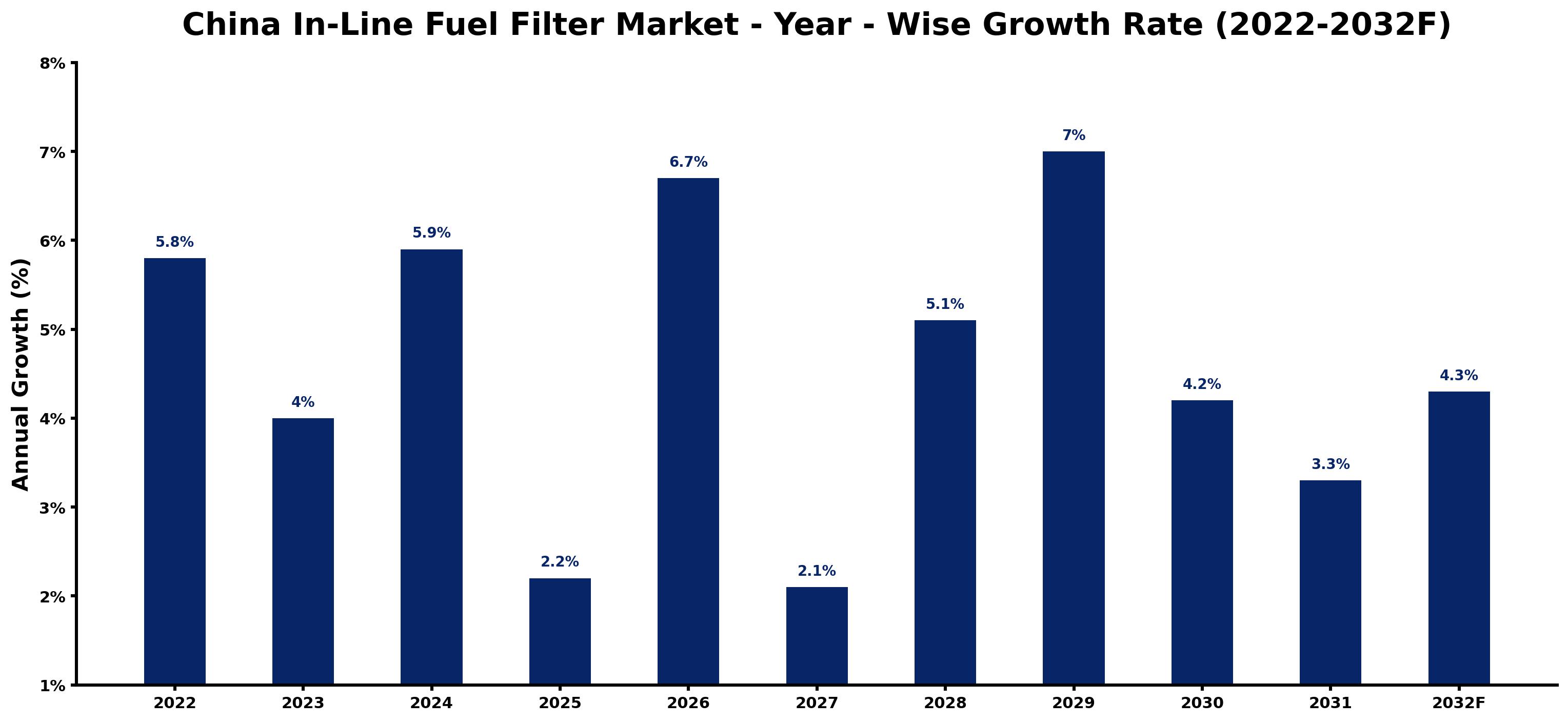
Below, each year's estimated growth is shown next to the factor that most influenced it.
| Year | Estimated Annual Growth (%) | Market Rationale |
| 2022 | 5.8 | The automotive sector showed strong activity, driving filter demand from various vehicle types. |
| 2023 | 4.0 | Growth slowed due to supply chain disruptions affecting filter availability. |
| 2024 | 5.9 | Increased production in the automotive sector led to higher filter demand across all vehicle types. |
| 2025 | 2.2 | Demand growth slowed as market saturation began to affect filter replacements. |
| 2026 | 6.7 | Rising investments in fuel efficiency technologies boosted filter demand. |
| 2027 | 2.1 | The market is expected to slow as competition intensifies among manufacturers. |
| 2028 | 5.1 | Growing awareness of environmental standards is increasing the need for high-efficiency filters. |
| 2029 | 7.0 | The introduction of stricter emissions regulations is expected to spur demand for advanced filtration solutions. |
| 2030 | 4.2 | The market growth rate is projected to slow due to ongoing supply chain challenges affecting production. |
| 2031 | 3.3 | Demand for filters will slow as the market adjusts to new regulatory standards. |
| 2032 | 4.3 | A resurgence in automotive production is expected to drive filter demand upward. |
Note: Market size estimations and growth projections presented in this report are based on 6Wresearch's proprietary forecasting methodology, utilizing the latest available industry data, government publications, and primary research inputs.
China In-Line Fuel Filter Market Synopsis
In-Line Fuel Filters in China are essential devices that remove contaminants from fuel before it reaches the engine. These filters are made from various materials, including cellulose and synthetic mesh, and are vital for maintaining engine performance. The China In-Line Fuel Filter Market is expanding due to strong demand from the automotive sector, valued at over 30 trillion yuan. The push for cleaner fuels and improved filtration standards is driving growth, with various buyer groups seeking reliable filtration solutions. As the market evolves, advancements in technology and regulatory support will further promote filter adoption.
Market Dynamics Impact Analysis (2026–2032)
| Factor | Type | Impact | Primary Segment Affected |
| Rising demand for cleaner fuels and efficient filtration systems | Driver | High | Primary Fuel Filters |
| Increasing automotive production and vehicle registrations | Driver | High | Passenger Vehicles |
| Growing agricultural modernization efforts | Opportunity | Medium | Agricultural Vehicles |
| Expansion of the automotive aftermarket for filter replacements | Opportunity | High | Primary Fuel Filters |
| Competition among filter manufacturers leading to price pressures | Restraint | Medium | Primary Fuel Filters |
| Supply chain disruptions affecting filter availability | Restraint | High | Primary Fuel Filters |
| Technological gaps in filter efficiency and performance | Challenge | High | Performance Filters |
| Regulatory compliance costs for new filtration standards | Challenge | Medium | Primary Fuel Filters |
Evaluation of Drivers in China In-Line Fuel Filter Market (2026–2032)
The factors lifting demand, and the evidence behind each, are summarised below.
| Drivers | Primary Segment Affected | Why It Matters (Evidence) |
| Increased vehicle registrations and production | Passenger Vehicles | In 2023, over 200 million registered passenger vehicles in China drive filter demand. |
| Rising focus on fuel efficiency and emissions reduction | Primary Fuel Filters | The Green Vehicle Promotion Program encourages the use of efficient fuel filters. |
| Modernization of agricultural vehicles | Agricultural Vehicles | The Agricultural Vehicle market is expected to use more in-line filters due to modernization efforts. |
| Growth in the automotive aftermarket | 20 | In 2023, the automotive aftermarket is projected to grow by 10% in filter replacements. |
| Technological advancements in filtration materials | Synthetic Mesh | Synthetic mesh filters are increasingly favoured for their durability in urban vehicles. |
Market growth in China for In-Line Fuel Filter hinges on increasing demand from the automotive sector, spurred by rising vehicle registrations and production. In 2023, over 200 million registered passenger vehicles are anticipated to drive filter demand across all categories. The emphasis on cleaner fuels and improved filtration standards is fuelling this growth, as diverse buyer groups look for reliable filtration solutions. Modernisation efforts in agricultural vehicles will also heighten the need for in-line filters, while advancements in filtration materials will boost demand for high-quality filters.
Evaluation of Restraints in China In-Line Fuel Filter Market
The table below lists the restraints and the evidence behind each.
| Market Restraint | Primary Segment Affected | Why It Matters (Evidence) |
| Price pressures from competition among manufacturers | Primary Fuel Filters | Intense competition has led to reduced profit margins, affecting manufacturers' ability to invest in innovation. |
| Supply chain disruptions impacting filter availability | Primary Fuel Filters | Ongoing supply chain issues have delayed filter production, leading to shortages in the market. |
| Technological gaps in filter efficiency | Performance Filters | Some manufacturers struggle to meet the latest efficiency standards, limiting their market appeal. |
| Regulatory compliance costs for new standards | Primary Fuel Filters | Compliance with updated filtration standards increases operational costs for manufacturers. |
| Limited awareness of advanced filtration technologies | Primary Fuel Filters | Many buyers remain unaware of the benefits of high-efficiency filters, hindering market growth. |
China In-Line Fuel Filter Market Challenges
The China In-Line Fuel Filter market still has to solve a few problems, starting with intense competition among local manufacturers. This competition drives down prices, which pressures suppliers to cut costs, potentially compromising filter quality. Buyers face challenges with inconsistent filter performance, as approximately 25% of passenger vehicles use performance filters that may not meet required standards, risking engine efficiency. Regulatory hurdles arise from the updated National Standard GB/T 18613-2020, which many smaller producers struggle to comply with, delaying product availability. Supply chain disruptions due to raw material shortages can extend lead times for manufacturers, affecting timely delivery to automotive clients.
Trends in the China In-Line Fuel Filter Market
Buyers and suppliers in the China In-Line Fuel Filter Market are adjusting to the following trends.
- Shift from Traditional to Synthetic Mesh Filters: Since 2022, the automotive sector has increasingly adopted synthetic mesh filters due to their durability. In 2023, these filters are expected to account for a growing share of the market, improving vehicle performance.
- Growing Adoption of Biofuels in Vehicles: Beginning in 2023, the use of biofuels in vehicles is gaining traction under the National Biofuel Development Plan. This shift is projected to increase demand for compatible filtration systems, with a growth rate of 6.9%.
- Increased Focus on Seasonal Maintenance: In 2023, the trend towards seasonal maintenance has led to a rise in filter replacements, with 35% of filters being replaced during routine checks. This trend highlights the importance of regular maintenance in vehicle performance.
- Expansion of the Automotive Aftermarket: Since 2023, the automotive aftermarket has been expanding, with a projected 10% growth in filter replacements. This growth presents opportunities for suppliers to meet the rising demand for quality filters.
Investment Opportunities in the China In-Line Fuel Filter Market
The following opportunities in the China In-Line Fuel Filter Market pair current demand with a clear way in.
- Growing Demand for High-Efficiency Filters: In 2023, the market gap for high-efficiency filters is set to widen, with demand anticipated to rise. Suppliers can focus on the automotive aftermarket, particularly targeting urban vehicle segments.
- Investment in Advanced Filtration Technologies: With a projected 10% growth in the automotive aftermarket, there lies a substantial opportunity for investment in advanced filtration technologies. Targeting manufacturers in urban areas can improve market penetration.
- Expansion in Agricultural Vehicle Filtration: The modernisation of agricultural vehicles is expected to boost filter demand. Suppliers should concentrate on providing in-line filters tailored to this sector, especially in rural areas.
- Focus on Compliance with New Standards: As adherence to updated filtration standards becomes increasingly important, there is an opportunity to supply advanced filters that meet these requirements. Engaging with manufacturers in the automotive sector will be essential.
Government Initiatives in the China In-Line Fuel Filter Market
The National Development and Reform Commission launched the 'Green Vehicle Promotion Program' in 2021 to improve fuel efficiency and reduce emissions in the automotive sector. This initiative encourages the adoption of advanced filtration technologies, ensuring compliance with environmental standards. The program aims to support manufacturers in developing high-efficiency filters, thereby improving market competitiveness. Additionally, the Ministry of Industry and Information Technology updated the 'Automotive Industry Development Policy' in 2022, focusing on improving fuel filtration standards and technologies, which benefits both producers and consumers.
In 2023, the Ministry of Ecology and Environment initiated the 'Clean Fuel Strategy', promoting the use of high-efficiency filters in vehicles to reduce pollution. This strategy encourages manufacturers to invest in innovative filtration solutions and provides guidelines for compliance. The China Automotive Technology and Research Center plays a vital role in supporting these initiatives, facilitating research and development in filtration technologies. Furthermore, funding from the Ministry of Finance has been allocated to support the development of advanced filtration technologies in the automotive industry, enhancing the overall quality of products available in the market.
Future Insight of the China In-Line Fuel Filter Market
The China In-Line Fuel Filter market is expected to evolve by 2032, driven by advancements in filtration technology and stricter emissions regulations. The government's Green Vehicle Promotion Program will promote the adoption of cleaner fuels, while the agricultural vehicle sector will increasingly modernise, boosting filter usage. The automotive aftermarket for filter replacements will experience a growth rate of 10%, offering suppliers opportunities to innovate. The rising demand for synthetic mesh filters will further enhance durability and performance in urban vehicles.
Market Segmentation Analysis
The report offers a comprehensive study of the following market segments and their leading categories in the market.
By Filter Type – Primary Fuel Filters Dominated, Performance Filters Expected to Grow Fastest
According to Shubham Deep, Research Manager at 6Wresearch, Primary Fuel Filters held a 37% share of the China In-Line Fuel Filter Market by filter type in 2025. Primary fuel filters dominate the market share due to their essential role in filtering fuel before it reaches the engine, particularly in heavy-duty trucks that are common in northern provinces. Their critical function in ensuring engine reliability and performance solidifies their position in the automotive sector. Over 2026–2032, Performance Filters are expected to post the fastest growth, at a CAGR of 6.1%. Performance filters are experiencing rapid growth driven by their increasing use in passenger vehicles, where consumers seek improved fuel flow and engine performance. This trend is particularly evident among urban vehicle owners prioritising efficiency, suggesting a widening lead for primary filters as they remain essential. For suppliers, focusing on performance filter development is crucial to meet the rising consumer demand for enhanced engine efficiency.
By Filtration Material – Cellulose Media Dominated, Synthetic Mesh Expected to Grow Fastest
Cellulose Media took a 49% share of filtration material in 2025, more than any other category. Cellulose media holds the largest share in the market due to its cost-effectiveness and widespread adoption in various filter types. This material is particularly favoured for its reliability in filtering diesel and petrol in passenger vehicles. The quickest growth will come from Synthetic Mesh, forecast to expand at a CAGR of 6.2% between 2026 and 2032. Synthetic mesh is gaining traction for its durability and resistance to clogging, making it an attractive option for urban vehicles. As the automotive sector modernises, the shift towards synthetic materials is expected to accelerate. Buyers may benefit from investing in synthetic mesh filters to ensure longevity and performance in their vehicles.
By Fuel Type – Diesel Dominated, Biofuels Expected to Grow Fastest
With a 39% revenue share in 2025, Diesel was the largest fuel type category. Diesel holds the largest market share as it is the primary fuel type filtered by in-line fuel filters, with a significant portion of China's automotive fleet comprising diesel vehicles, especially in commercial applications. The high number of registered diesel vehicles ensures a steady demand for diesel fuel filters. Biofuels are projected to grow fastest, at a CAGR of 6.9% during 2026–2032. Biofuels are rapidly gaining traction, driven by government initiatives that promote cleaner fuel alternatives in the automotive sector. This aligns with the National Biofuel Development Plan, indicating a substantial market opportunity for suppliers looking to innovate in this area. Suppliers should explore expanding their product lines to include biofuel filtration solutions to cater to this emerging market segment.
By Vehicle Type – Passenger Vehicles Dominated, Agricultural Vehicles Expected to Grow Fastest
Passenger Vehicles accounted for a 35% market share by vehicle type in 2025. Passenger vehicles represent the largest segment for in-line fuel filters, with over 200 million registered vehicles in China. This extensive base creates a substantial demand for reliable filtration solutions to maintain engine performance. Agricultural Vehicles are set to record the highest CAGR in this split, 6.8% over 2026–2032. Agricultural vehicles are increasingly adopting in-line filters as modernization efforts take hold in the agricultural sector. This trend is likely to accelerate as farmers seek to ensure fuel quality for their machinery. Suppliers should target agricultural vehicle manufacturers to tap into this growing market segment.
By Replacement Interval – Seasonal Maintenance Dominated and Is Expected to Record the Fastest Growth
The largest replacement interval category in 2025 was Seasonal Maintenance, with a 35% share of total revenue. Seasonal maintenance is the leading replacement interval as vehicle owners typically replace filters during routine servicing, ensuring optimal engine performance. This practice is common across various vehicle types in China, reinforcing its market share. The same category is also set to grow fastest, at a CAGR of 6.9% during 2026–2032. As seasonal maintenance is both the leader and fastest-growing interval, the consistent demand for filter replacements during this time will likely increase. The automotive aftermarket is projected to grow by 10% in filter replacements, supporting this trend. Suppliers should align their inventory and marketing strategies with seasonal maintenance schedules to maximise sales opportunities.
Key Attractiveness of the Report
- 10 Years of Market Numbers
- Historical Data Starting from 2022 to 2025
- Base Year 2025
- Forecast Data until 2032
- Key Performance Indicators Impacting the Market
- Major Upcoming Developments and Projects
Key Highlights of the Report:
- China In-Line Fuel Filter Market Outlook
- Market Size of China In-Line Fuel Filter Market, 2025
- Forecast of China In-Line Fuel Filter Market, 2032
- Historical Data and Forecast of China In-Line Fuel Filter Revenues & Volume for the Period 2022 - 2032F
- China In-Line Fuel Filter Market Trend Evolution
- China In-Line Fuel Filter Market Drivers and Challenges
- China In-Line Fuel Filter Price Trends
- China In-Line Fuel Filter Porter's Five Forces
- China In-Line Fuel Filter Industry Life Cycle
- Historical Data and Forecast of China In-Line Fuel Filter Market Revenues & Volume By Filter Type for the Period 2022 - 2032F
- Historical Data and Forecast of China In-Line Fuel Filter Market Revenues & Volume By Primary Fuel Filters for the Period 2022 - 2032F
- Historical Data and Forecast of China In-Line Fuel Filter Market Revenues & Volume By Secondary Filters for the Period 2022 - 2032F
- Historical Data and Forecast of China In-Line Fuel Filter Market Revenues & Volume By Performance Filters for the Period 2022 - 2032F
- Historical Data and Forecast of China In-Line Fuel Filter Market Revenues & Volume By Inline Cartridge for the Period 2022 - 2032F
- Historical Data and Forecast of China In-Line Fuel Filter Market Revenues & Volume By Filtration Material for the Period 2022 - 2032F
- Historical Data and Forecast of China In-Line Fuel Filter Market Revenues & Volume By Cellulose Media for the Period 2022 - 2032F
- Historical Data and Forecast of China In-Line Fuel Filter Market Revenues & Volume By Synthetic Mesh for the Period 2022 - 2032F
- Historical Data and Forecast of China In-Line Fuel Filter Market Revenues & Volume By Glass Fiber Composite for the Period 2022 - 2032F
- Historical Data and Forecast of China In-Line Fuel Filter Market Revenues & Volume By Micron-Rated for the Period 2022 - 2032F
- Historical Data and Forecast of China In-Line Fuel Filter Market Revenues & Volume By Fuel Type for the Period 2022 - 2032F
- Historical Data and Forecast of China In-Line Fuel Filter Market Revenues & Volume By Diesel for the Period 2022 - 2032F
- Historical Data and Forecast of China In-Line Fuel Filter Market Revenues & Volume By Petrol for the Period 2022 - 2032F
- Historical Data and Forecast of China In-Line Fuel Filter Market Revenues & Volume By Performance Fuel for the Period 2022 - 2032F
- Historical Data and Forecast of China In-Line Fuel Filter Market Revenues & Volume By Biofuels for the Period 2022 - 2032F
- Historical Data and Forecast of China In-Line Fuel Filter Market Revenues & Volume By Vehicle Type for the Period 2022 - 2032F
- Historical Data and Forecast of China In-Line Fuel Filter Market Revenues & Volume By Heavy-Duty Trucks for the Period 2022 - 2032F
- Historical Data and Forecast of China In-Line Fuel Filter Market Revenues & Volume By Passenger Vehicles for the Period 2022 - 2032F
- Historical Data and Forecast of China In-Line Fuel Filter Market Revenues & Volume By Sports Cars for the Period 2022 - 2032F
- Historical Data and Forecast of China In-Line Fuel Filter Market Revenues & Volume By Agricultural Vehicles for the Period 2022 - 2032F
- Historical Data and Forecast of China In-Line Fuel Filter Market Revenues & Volume By Replacement Interval for the Period 2022 - 2032F
- Historical Data and Forecast of China In-Line Fuel Filter Market Revenues & Volume By 20,000 30,000 km for the Period 2022 - 2032F
- Historical Data and Forecast of China In-Line Fuel Filter Market Revenues & Volume By 15,000 25,000 km for the Period 2022 - 2032F
- Historical Data and Forecast of China In-Line Fuel Filter Market Revenues & Volume By 10,000 20,000 km for the Period 2022 - 2032F
- Historical Data and Forecast of China In-Line Fuel Filter Market Revenues & Volume By Seasonal Maintenance for the Period 2022 - 2032F
- China In-Line Fuel Filter Import Export Trade Statistics
- Market Opportunity Assessment By Filter Type
- Market Opportunity Assessment By Filtration Material
- Market Opportunity Assessment By Fuel Type
- Market Opportunity Assessment By Vehicle Type
- Market Opportunity Assessment By Replacement Interval
- China In-Line Fuel Filter Top Companies Market Share
- China In-Line Fuel Filter Competitive Benchmarking By Technical and Operational Parameters
- China In-Line Fuel Filter Company Profiles
- China In-Line Fuel Filter Key Strategic Recommendations
Market Covered
The report offers an extensive study of the following market segments.
By Filter Type
- Primary Fuel Filters
- Secondary Filters
- Performance Filters
- Inline Cartridge
By Filtration Material
- Cellulose Media
- Synthetic Mesh
- Glass Fiber Composite
- Micron-Rated
By Fuel Type
- Diesel
- Petrol
- Performance Fuel
- Biofuels
By Vehicle Type
- Heavy-Duty Trucks
- Passenger Vehicles
- Sports Cars
- Agricultural Vehicles
By Replacement Interval
- 20
- 000–30
- 000 km
- 15
- 000–25
- 10
- 000–20
- Seasonal Maintenance































