China In-Wheel Motor System Market Size & Growth Rate
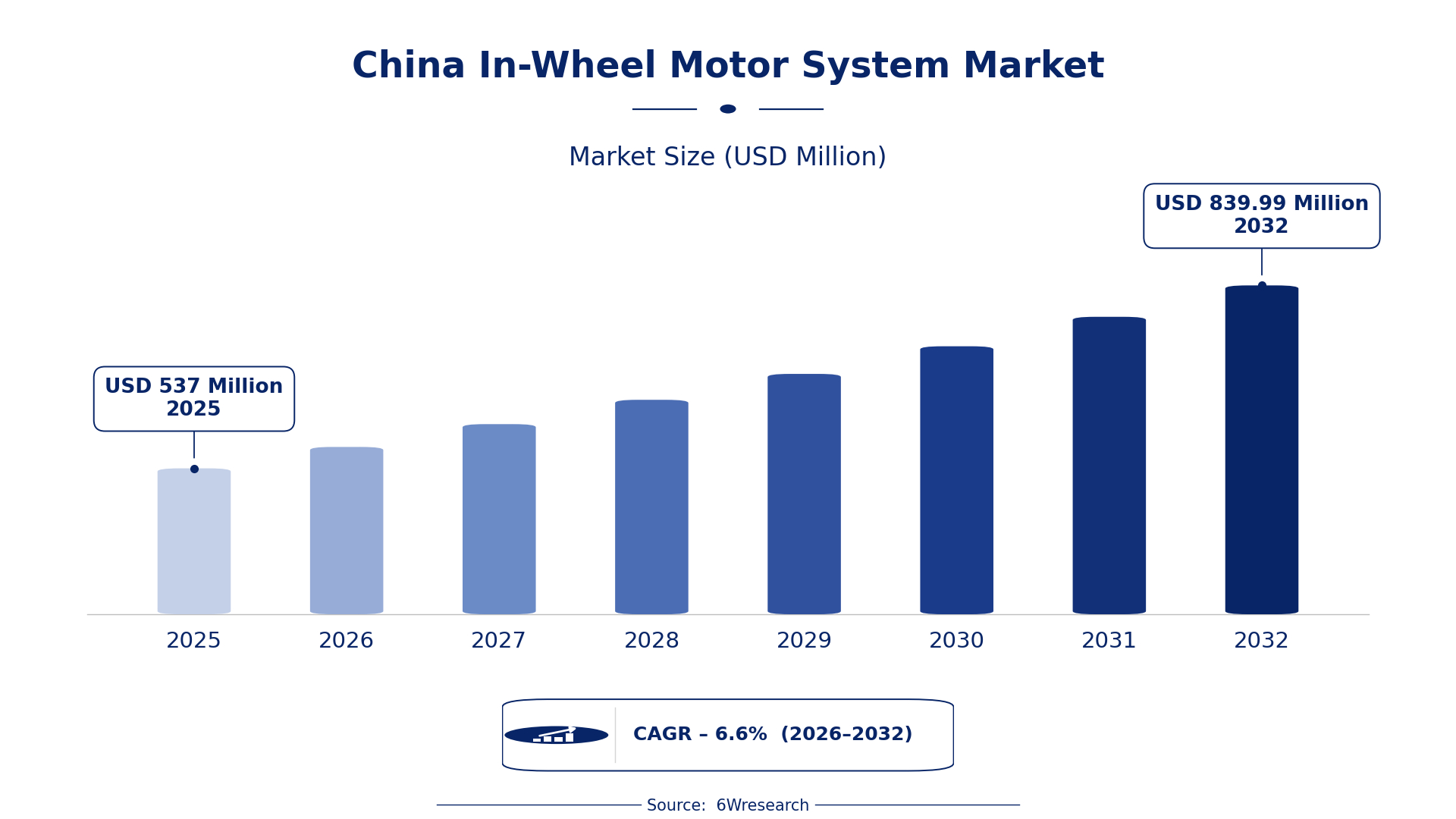
According to 6Wresearch internal database and industry insights, the China In-Wheel Motor System Market was valued at USD 537.0 million in 2025 and is projected to reach USD 839.99 million by 2032, growing at a CAGR of approximately 6.6% during 2026–2032.
China In-Wheel Motor System Market Highlights
| Report Metric | Details |
| Report Name | China In-Wheel Motor System Market |
| Market Size 2025 | USD 537.0 million |
| Market Size 2032 | USD 839.99 million |
| Absolute Growth 2025–2032 | USD 302.99 million |
| CAGR 2026–2032 | 6.6% |
| Peak Annual Growth | 8.7% in 2029 |
| Forecast Period | 2026–2032 |
| Historical Data | 2022–2025 |
| Base Year | 2025 |
| Leading Motor Type, 2025 | Permanent Magnet (53% share) |
| Leading Vehicle Type, 2025 | Electric Passenger Cars (49% share) |
| Leading Power Rating, 2025 | 50–100 kW (49% share) |
| Leading Distribution Channel, 2025 | OEMs (45% share) |
| Leading End User, 2025 | EV Manufacturers (52% share) |
| Fastest-Growing Motor Type | Brushless DC Motor (9.3% CAGR) |
| Fastest-Growing Vehicle Type | Commercial EVs (8.2% CAGR) |
| Fastest-Growing Distribution Channel | Online Platforms (8.6% CAGR) |
| Fastest-Growing End User | Fleet Operators (8.7% CAGR) |
| Growing Sector | Electric Vehicles |
| Key End Users | EV Manufacturers, Fleet Operators, Commercial Vehicle Producers |
China In-Wheel Motor System Market Year-wise Growth Rate and Key Drivers (2022–2032)
This graph illustrates the annual growth rates of the market from 2022 to 2032, highlighting a steady upward trajectory and projected market expansion over the forecast period.
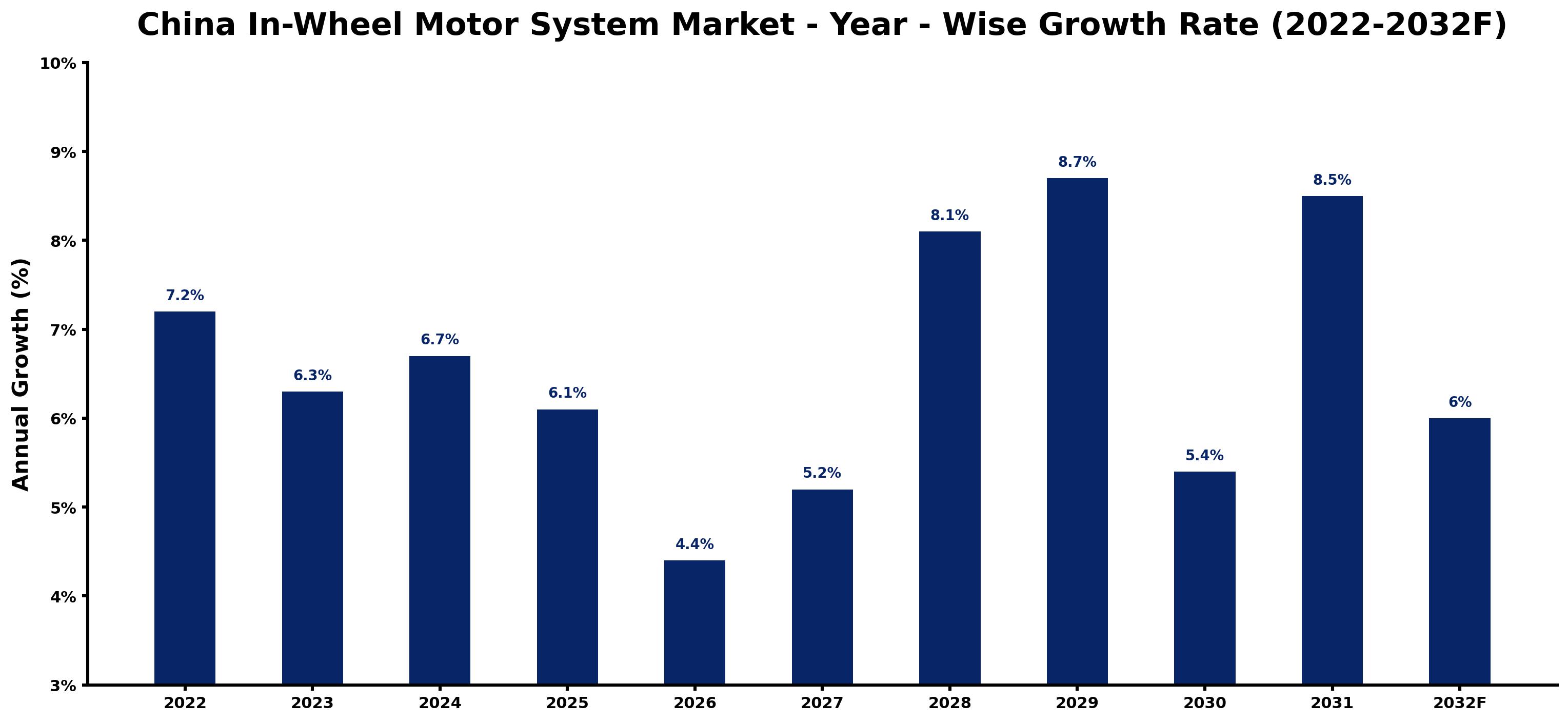
The following table presents the estimated annual growth rate for each year together with the principal factor influencing market performance.
| Year | Estimated Annual Growth (%) | Market Rationale |
| 2022 | 7.2 | The market experienced strong demand due to increased electric vehicle production, with over 1 million units manufactured. |
| 2023 | 6.3 | Growth slowed as the market adjusted to supply chain challenges in the EV sector, impacting component availability. |
| 2024 | 6.7 | Demand picked up as the Electric Vehicle Charging Infrastructure Construction Plan began supporting electric vehicle adoption. |
| 2025 | 6.1 | A slight slowdown occurred as the New Energy Vehicle Industry Development Plan aimed for 20% market share by 2025. |
| 2026 | 4.4 | Growth is expected to decelerate as manufacturers face challenges in sourcing materials and skilled labour. |
| 2027 | 5.2 | Demand is projected to rise again as fleet operators expand their electric vehicle adoption, driven by efficiency needs. |
| 2028 | 8.1 | The market will accelerate due to heightened investments in electric mobility infrastructure, particularly in key regions. |
| 2029 | 8.7 | Peak growth is expected as consumer interest in electric vehicles surges, supported by government initiatives. |
| 2030 | 5.4 | The market will face a slowdown as manufacturers adjust to changing consumer preferences and market dynamics. |
| 2031 | 8.5 | Demand is projected to rebound as technological advancements improve vehicle performance and efficiency. |
| 2032 | 6.0 | Growth is expected to decelerate slightly as the market stabilises after rapid expansion and increased competition. |
Note: Market size estimations and growth projections presented in this report are based on 6Wresearch's proprietary forecasting methodology, utilizing the latest available industry data, government publications, and primary research inputs.
China In-Wheel Motor System Market Synopsis
The In-Wheel Motor System in China is an advanced electric motor technology integrated into vehicle wheels, designed to improve efficiency and performance. This system is primarily used in electric vehicles and autonomous vehicles, with applications in passenger cars and commercial transport. The market is expanding due to rising domestic demand, with over 1 million electric vehicles produced in 2022 and government initiatives supporting electric mobility. The government aims for 20% of vehicles to be electric by 2025, driving further investments in this sector.
Market Dynamics Impact Analysis (2026–2032)
| Factor | Type | Impact | Primary Segment Affected |
| Growing electric vehicle production and adoption | Driver | High | Electric Passenger Cars |
| Investment in EV infrastructure development | Driver | High | Commercial EVs |
| Increasing demand for electric mobility solutions | Opportunity | High | Electric Passenger Cars |
| Expansion of charging infrastructure | Opportunity | Medium | Commercial EVs |
| Supply chain disruptions affecting component availability | Restraint | High | Permanent Magnet |
| Intense competition among manufacturers leading to price pressures | Restraint | Medium | Permanent Magnet |
| Challenges in securing skilled workforce for production | Challenge | High | Permanent Magnet |
| Technological hurdles in achieving higher efficiency | Challenge | Medium | Permanent Magnet |
Evaluation of Drivers in China In-Wheel Motor System Market (2026–2032)
The main growth drivers and the segments they affect most are set out below.
| Drivers | Primary Segment Affected | Why It Matters (Evidence) |
| Increased electric vehicle production | Electric Passenger Cars | China produced over 1 million electric vehicles in 2022, boosting demand for in-wheel motors. |
| Government investment in EV technology | Commercial EVs | The government invested 100 billion CNY in EV technology development, increasing demand for advanced systems. |
| Growing consumer preference for electric vehicles | Electric Passenger Cars | The installed base of electric vehicles reached 10 million in 2023, driving demand for in-wheel motors. |
| Development of charging infrastructure | Commercial EVs | The Electric Vehicle Charging Infrastructure Construction Plan targets 1 million charging stations by 2025, enhancing EV adoption. |
| Technological advancements in motor efficiency | Brushless DC Motor | The average range of electric passenger cars is increasing to 600 km, necessitating improved motor systems. |
The In-Wheel Motor System market in China is growing on the back of rising electric vehicle production, expanding infrastructure, and increasing consumer interest in electric mobility. In 2022, over 1 million electric vehicles were produced, boosting demand for in-wheel motors. The installed base of electric vehicles reached 10 million in 2023, indicating strong market potential.
Evaluation of Restraints in China In-Wheel Motor System Market
The following restraints limit how fast demand can grow.
| Market Restraint | Primary Segment Affected | Why It Matters (Evidence) |
| Supply chain disruptions affecting component availability | Permanent Magnet | Manufacturers face delays in sourcing materials, impacting production schedules and delivery timelines, leading to a 15% increase in costs. |
| Intense competition among manufacturers leading to price pressures | Permanent Magnet | Increased competition results in lower profit margins, making it challenging for suppliers to sustain operations and maintain quality. |
| Challenges in securing skilled workforce for production | Permanent Magnet | A shortage of skilled labour in the manufacturing sector hampers production efficiency and innovation, delaying product launches by several months. |
| Technological hurdles in achieving higher efficiency | Brushless DC Motor | Developing more efficient motors requires significant investment in R&D, which can delay product launches and increase costs for manufacturers. |
| Regulatory compliance costs for manufacturers | Permanent Magnet | Meeting national standards increases operational costs for producers, affecting overall profitability and market competitiveness. |
China In-Wheel Motor System Market Challenges
China's regulatory framework presents challenges for the In-Wheel Motor System market, as compliance with standards like GB/T 32960-2016 can postpone product launches by up to six months for manufacturers. Fierce competition among producers results in price wars, squeezing profit margins and compelling suppliers to reduce costs, which can compromise quality for buyers. Buyers also struggle with securing stable supply chains, as fluctuating demand for electric vehicles may lead to shortages, disrupting production schedules. Sourcing advanced materials for In-Wheel Motor Systems is becoming increasingly challenging, with costs rising by approximately 15%, impacting suppliers and elevating prices for end users.
Trends in the China In-Wheel Motor System Market
The trends below show where the China In-Wheel Motor System Market is heading.
- Shift towards Autonomous Vehicles: In 2023, the focus on autonomous vehicles intensified, with investments in technology development. The government aims for 20% of vehicles to be electric by 2025, promoting advancements in in-wheel motor systems.
- Transition from Traditional Motors to In-Wheel Systems: The adoption of in-wheel motor systems is rising as manufacturers seek to improve vehicle efficiency. In 2023, the average range of electric passenger cars increased to 600 km, highlighting the need for advanced motor technologies.
- Emergence of Online Sales Channels: The rise of online platforms for vehicle sales is changing distribution methods. In 2023, online platforms saw an increase of 8.6% in market share, reflecting shifting consumer purchasing behaviours.
- Growth in Electric Two-Wheeler Market: The electric two-wheeler market is rapidly expanding, with 30 million units sold annually. This surge indicates a growing demand for compact and efficient in-wheel motor systems.
Investment Opportunities in the China In-Wheel Motor System Market
The following opportunities in the China In-Wheel Motor System Market pair current demand with a clear way in.
- Electric Vehicle Manufacturers: With over 1 million electric vehicles produced in 2022, EV manufacturers are in search of advanced in-wheel motor systems to boost performance and efficiency. Partnering with local suppliers can ease market entry and improve production capabilities.
- Commercial Fleet Operators: The demand for electric commercial vehicles is on the rise, with a projected growth rate of 8.2% for commercial EVs. Investing in in-wheel motor systems can address the needs of fleet operators aiming to enhance operational efficiency.
- Charging Infrastructure Development: The government aims for 1 million charging stations by 2025, presenting opportunities for suppliers of in-wheel motor systems to collaborate with infrastructure developers. Forming partnerships can facilitate market penetration and improve service offerings.
- Electric Two-Wheeler Manufacturers: The electric two-wheeler market is growing swiftly, with 30 million units sold annually, creating opportunities for in-wheel motor system suppliers. Engaging with manufacturers in key regions like Guangdong can boost sales and extend market reach.
Government Initiatives in the China In-Wheel Motor System Market
The Green Transportation Development Strategy initiated by the State Council in 2021 seeks to promote electric vehicle adoption and infrastructure. This strategy encourages investments in sustainable transport solutions, benefiting producers of in-wheel motor systems. The New Energy Vehicle Industry Development Plan (2023-2035) launched by the Ministry of Industry and Information Technology in 2023 targets a 20% market share of electric vehicles by 2025, supporting further growth in this sector.
The Ministry of Industry and Information Technology manages the approval of electric vehicle regulations and standards. It finances initiatives to improve charging infrastructure and backs projects that align with the national EV strategy. The National Development and Reform Commission approved the Electric Vehicle Charging Infrastructure Construction Plan in 2022, aiming for 1 million charging stations by 2025, thus facilitating the growth of electric mobility.
Future Insight of the China In-Wheel Motor System Market
Several promising factors are expected to support the In-Wheel Motor System market in China in the coming years. The government's investment of 100 billion CNY in EV technology will drive improvements in efficiency and performance. By 2025, electric vehicles are anticipated to account for 35% of total vehicle sales, creating a larger market for In-Wheel Motor Systems. Infrastructure enhancements, such as the EV support programs launched in Beijing, will bolster consumer confidence and adoption rates. Innovations in battery technology and renewable energy integration will further increase the appeal of electric vehicles.
Market Segmentation Analysis
Each segment group is reviewed below, with the leader by share and the fastest grower by CAGR.
By Motor Type – Permanent Magnet Dominated, Brushless DC Motor Expected to Grow Fastest
According to Shubham Deep, Research Manager at 6Wresearch, Permanent Magnet held a 53% share of the China In-Wheel Motor System Market by motor type in 2025. Permanent Magnet motors command the largest market share due to their high efficiency and compact design, making them particularly suitable for electric vehicles. Their widespread use in the Yangtze River Delta, a crucial hub for EV manufacturing, reflects the strong demand for this technology. The quickest growth will come from Brushless DC Motor, forecast to expand at a CAGR of 9.3% between 2026 and 2032. Brushless DC Motors are experiencing rapid growth, primarily because they provide smooth operation in electric vehicles. The production of over 1 million electric vehicles in 2022 has significantly accelerated their adoption, indicating a robust trend in this segment. Suppliers should focus on enhancing the efficiency of Permanent Magnet motors while exploring opportunities in Brushless DC Motors to align with market trends.
By Vehicle Type – Electric Passenger Cars Dominated, Commercial EVs Expected to Grow Fastest
In 2025, Electric Passenger Cars led the vehicle type split with a 49% share. Electric Passenger Cars lead the market as they are the preferred choice for personal transport, highlighting the shift towards electric mobility. With an installed base of electric vehicles reaching 10 million in 2023, the demand for passenger vehicles remains strong. Commercial EVs are projected to grow fastest, at a CAGR of 8.2% during 2026–2032. Commercial EVs represent the fastest-growing segment, driven by increasing demand for logistics and delivery services. A reported 25% rise in EV sales in 2023 underscores the expanding market for commercial applications, indicating a significant opportunity for growth. Manufacturers should prioritise the development of electric passenger cars while addressing the surging demand for commercial EVs to capitalise on market growth.
By Power Rating – 50–100 kW Dominated and Is Expected to Record the Fastest Growth
With a 49% revenue share in 2025, 50–100 kW was the largest power rating category. The 50–100 kW power rating segment leads the market as it is well-suited for mid-range electric vehicles, aligning with consumer preferences for efficiency. Its established presence in the expanding electric vehicle market contributes to its substantial share. The same category is also set to grow fastest, at a CAGR of 8.6% during 2026–2032. The 50–100 kW segment is also the fastest-growing, catering to the rising production of mid-range electric vehicles. With government investment of 100 billion CNY in EV technology development, this growth trajectory is expected to continue. Suppliers should optimise their offerings within the 50–100 kW range to meet the increasing demand for mid-range electric vehicles.
By Distribution Channel – OEMs Dominated, Online Platforms Expected to Grow Fastest
OEMs took a 45% share of distribution channel in 2025, more than any other category. OEMs dominate the distribution channel segment as they are the primary manufacturers of vehicles, directly impacting the in-wheel motor system market. Their established relationships with vehicle manufacturers ensure a steady demand for integrated motor systems. Online Platforms are set to record the highest CAGR in this split, 8.6% over 2026–2032. Online Platforms are emerging as the fastest-growing distribution channel, offering a convenient sales avenue for aftermarket products. The increasing digitalisation of sales processes is driving this trend, enabling wider market reach and accessibility. Suppliers should enhance their online presence to capture the growing market share through digital sales channels.
By End User – EV Manufacturers Dominated, Fleet Operators Expected to Grow Fastest
EV Manufacturers accounted for a 52% market share by end user in 2025. EV Manufacturers hold the leading position in the end user segment as they are the primary users of in-wheel motor systems, crucial for electric vehicle production. The anticipated growth in electric vehicles, with 35% of total vehicle sales projected by 2025, reinforces their dominance. The quickest growth will come from Fleet Operators, forecast to expand at a CAGR of 8.7% between 2026 and 2032. Fleet Operators are the fastest-growing end user group, increasingly adopting EVs to improve operational efficiency. Government initiatives promoting electric mobility are encouraging fleet operators to transition to electric solutions, indicating a significant shift in the market. Suppliers should target EV manufacturers while also addressing the evolving needs of fleet operators to maximise market opportunities.
Key Attractiveness of the Report
- 10 Years of Market Numbers
- Historical Data Starting from 2022 to 2025
- Base Year 2025
- Forecast Data until 2032
- Key Performance Indicators Impacting the Market
- Major Upcoming Developments and Projects
Key Highlights of the Report:
- China In-Wheel Motor System Market Outlook
- Market Size of China In-Wheel Motor System Market, 2025
- Forecast of China In-Wheel Motor System Market, 2032
- Historical Data and Forecast of China In-Wheel Motor System Revenues & Volume for the Period 2022 - 2032F
- China In-Wheel Motor System Market Trend Evolution
- China In-Wheel Motor System Market Drivers and Challenges
- China In-Wheel Motor System Price Trends
- China In-Wheel Motor System Porter's Five Forces
- China In-Wheel Motor System Industry Life Cycle
- Historical Data and Forecast of China In-Wheel Motor System Market Revenues & Volume By Motor Type for the Period 2022 - 2032F
- Historical Data and Forecast of China In-Wheel Motor System Market Revenues & Volume By Permanent Magnet for the Period 2022 - 2032F
- Historical Data and Forecast of China In-Wheel Motor System Market Revenues & Volume By Induction Motor for the Period 2022 - 2032F
- Historical Data and Forecast of China In-Wheel Motor System Market Revenues & Volume By Brushless DC Motor for the Period 2022 - 2032F
- Historical Data and Forecast of China In-Wheel Motor System Market Revenues & Volume By Hub Motor for the Period 2022 - 2032F
- Historical Data and Forecast of China In-Wheel Motor System Market Revenues & Volume By Vehicle Type for the Period 2022 - 2032F
- Historical Data and Forecast of China In-Wheel Motor System Market Revenues & Volume By Electric Passenger Cars for the Period 2022 - 2032F
- Historical Data and Forecast of China In-Wheel Motor System Market Revenues & Volume By Commercial EVs for the Period 2022 - 2032F
- Historical Data and Forecast of China In-Wheel Motor System Market Revenues & Volume By Two-Wheelers for the Period 2022 - 2032F
- Historical Data and Forecast of China In-Wheel Motor System Market Revenues & Volume By Autonomous Vehicles for the Period 2022 - 2032F
- Historical Data and Forecast of China In-Wheel Motor System Market Revenues & Volume By Power Rating for the Period 2022 - 2032F
- Historical Data and Forecast of China In-Wheel Motor System Market Revenues & Volume By 50 kW for the Period 2022 - 2032F
- Historical Data and Forecast of China In-Wheel Motor System Market Revenues & Volume By 50 100 kW for the Period 2022 - 2032F
- Historical Data and Forecast of China In-Wheel Motor System Market Revenues & Volume By 10 kW for the Period 2022 - 2032F
- Historical Data and Forecast of China In-Wheel Motor System Market Revenues & Volume By 100 150 kW for the Period 2022 - 2032F
- Historical Data and Forecast of China In-Wheel Motor System Market Revenues & Volume By Distribution Channel for the Period 2022 - 2032F
- Historical Data and Forecast of China In-Wheel Motor System Market Revenues & Volume By OEMs for the Period 2022 - 2032F
- Historical Data and Forecast of China In-Wheel Motor System Market Revenues & Volume By Tier-1 Suppliers for the Period 2022 - 2032F
- Historical Data and Forecast of China In-Wheel Motor System Market Revenues & Volume By Online Platforms for the Period 2022 - 2032F
- Historical Data and Forecast of China In-Wheel Motor System Market Revenues & Volume By Direct Sales for the Period 2022 - 2032F
- Historical Data and Forecast of China In-Wheel Motor System Market Revenues & Volume By End User for the Period 2022 - 2032F
- Historical Data and Forecast of China In-Wheel Motor System Market Revenues & Volume By EV Manufacturers for the Period 2022 - 2032F
- Historical Data and Forecast of China In-Wheel Motor System Market Revenues & Volume By Fleet Operators for the Period 2022 - 2032F
- Historical Data and Forecast of China In-Wheel Motor System Market Revenues & Volume By Aftermarket Retrofitters for the Period 2022 - 2032F
- Historical Data and Forecast of China In-Wheel Motor System Market Revenues & Volume By Robotics Integrators for the Period 2022 - 2032F
- China In-Wheel Motor System Import Export Trade Statistics
- Market Opportunity Assessment By Motor Type
- Market Opportunity Assessment By Vehicle Type
- Market Opportunity Assessment By Power Rating
- Market Opportunity Assessment By Distribution Channel
- Market Opportunity Assessment By End User
- China In-Wheel Motor System Top Companies Market Share
- China In-Wheel Motor System Competitive Benchmarking By Technical and Operational Parameters
- China In-Wheel Motor System Company Profiles
- China In-Wheel Motor System Key Strategic Recommendations
Market Covered
Segments analysed in this report are listed below.
By Motor Type
- Permanent Magnet
- Induction Motor
- Brushless DC Motor
- Hub Motor
By Vehicle Type
- Electric Passenger Cars
- Commercial EVs
- Two-Wheelers
- Autonomous Vehicles
By Power Rating
- <50 kW
- 50–100 kW
- <10 kW
- 100–150 kW
By Distribution Channel
- OEMs
- Tier-1 Suppliers
- Online Platforms
- Direct Sales
By End User
- EV Manufacturers
- Fleet Operators
- Aftermarket Retrofitters
- Robotics Integrators































