China In-Wheel Propulsion System Market Size & Growth Rate
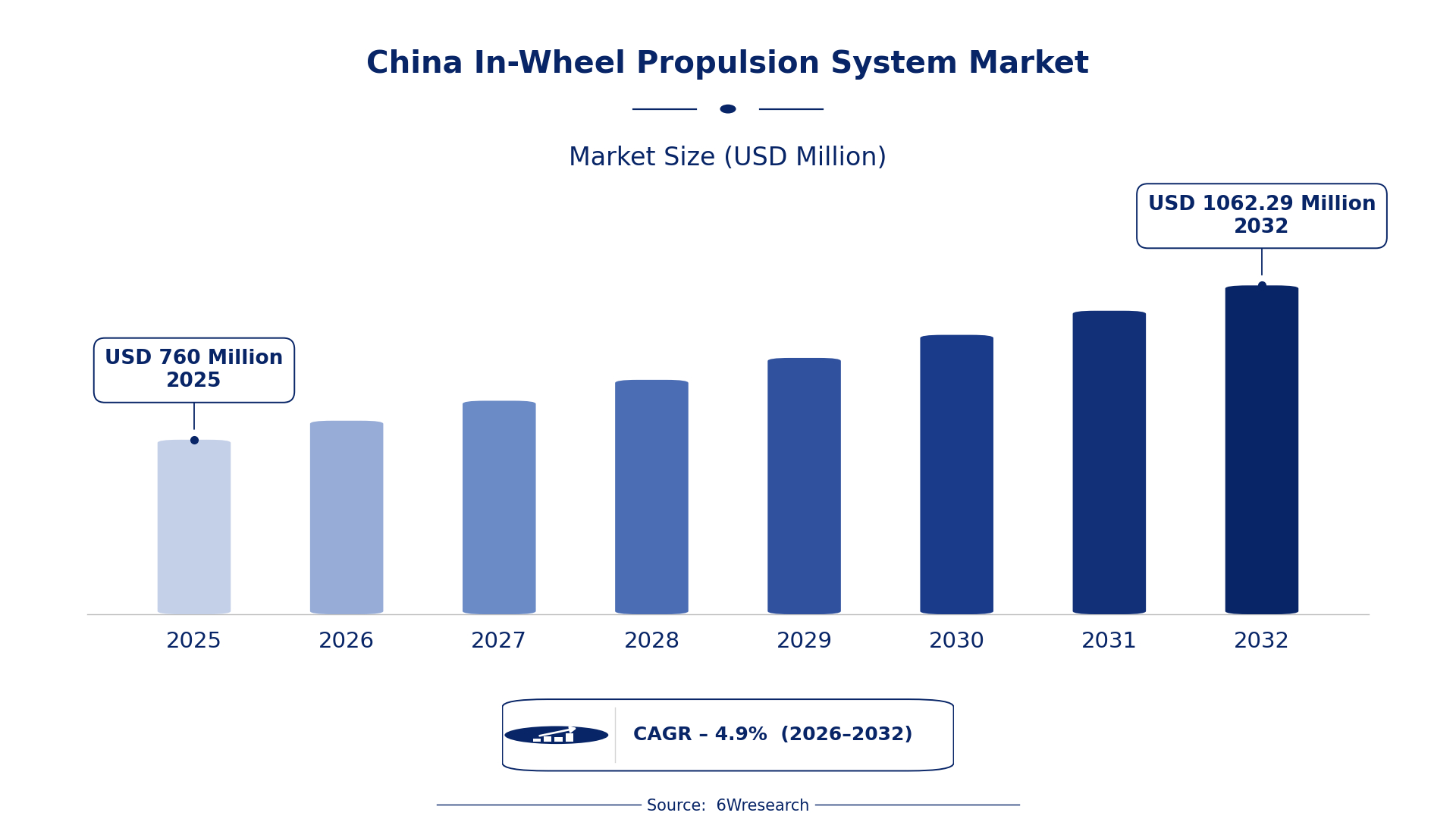
According to 6Wresearch internal database and industry insights, the China In-Wheel Propulsion System Market was valued at USD 760.0 million in 2025 and is projected to reach USD 1,062.29 million by 2032, growing at a CAGR of approximately 4.9% during 2026–2032.
China In-Wheel Propulsion System Market Highlights
| Report Metric | Details |
| Report Name | China In-Wheel Propulsion System Market |
| Market Size 2025 | USD 760.0 million |
| Market Size 2032 | USD 1,062.29 million |
| Absolute Growth 2025–2032 | USD 302.29 million |
| CAGR 2026–2032 | 4.9% |
| Peak Annual Growth | 6.5% in 2032 |
| Forecast Period | 2026–2032 |
| Historical Data | 2022–2025 |
| Base Year | 2025 |
| Leading Propulsion Type, 2025 | Electric Drive Unit (38% share) |
| Leading Power Source, 2025 | Battery Electric Vehicle (37% share) |
| Leading Vehicle Segment, 2025 | SUVs (50% share) |
| Leading Control Architecture, 2025 | Distributed (39% share) |
| Leading End User, 2025 | Vehicle OEMs (42% share) |
| Fastest-Growing Propulsion Type | Dual-Motor System (6.8% CAGR) |
| Fastest-Growing Vehicle Segment | Performance Cars (6.3% CAGR) |
| Fastest-Growing Control Architecture | Torque Vectoring (6.9% CAGR) |
| Fastest-Growing End User | EV Startups (7.4% CAGR) |
| Growing Sector | EV Startups |
| Key End Users | Vehicle OEMs, EV Startups, Performance Brands, Micro Mobility Firms |
China In-Wheel Propulsion System Market Year-wise Growth Rate and Key Drivers (2022–2032)
This graph illustrates the annual growth rates of the market from 2022 to 2032, highlighting a steady upward trajectory and projected market expansion over the forecast period.
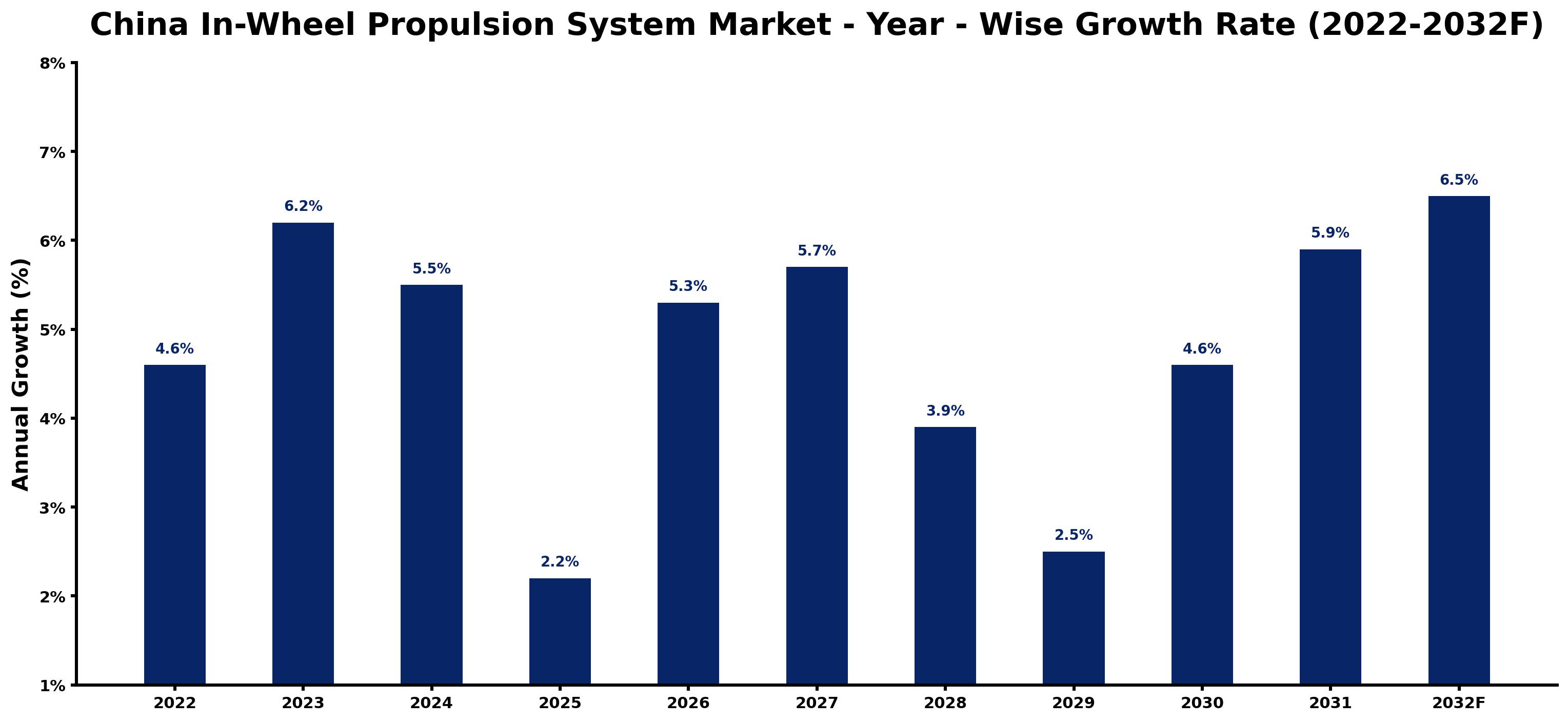
Year by year, the estimates below pair each growth rate with the development that shaped it.
| Year | Estimated Annual Growth (%) | Market Rationale |
| 2022 | 4.6 | The market experienced steady growth due to rising electric vehicle adoption driven by consumer interest. |
| 2023 | 6.2 | Growth accelerated as consumer interest in electric mobility increased, supported by the National Development and Reform Commission's initiatives. |
| 2024 | 5.5 | A slowdown occurred as the market adjusted to previous rapid growth rates, influenced by the integration of new technologies. |
| 2025 | 2.2 | Growth continued to decelerate as market saturation began to influence demand, particularly in the battery electric vehicle segment. |
| 2026 | 5.3 | An uptick in growth was driven by renewed investments in electric vehicle technology, particularly in the Guangdong province. |
| 2027 | 5.7 | Further growth was spurred by increasing consumer acceptance of electric vehicles, as seen in the 2022 sales figures. |
| 2028 | 3.9 | The market saw a slowdown as competition intensified among manufacturers, particularly in the performance car segment. |
| 2029 | 2.5 | Growth slowed again as the market faced challenges in infrastructure development, impacting EV adoption rates. |
| 2030 | 4.6 | An increase in growth was supported by new government initiatives for electric vehicles, including the Charging Infrastructure Construction Action Plan. |
| 2031 | 5.9 | Demand rose as technological advancements improved vehicle performance and efficiency, particularly in dual-motor systems. |
| 2032 | 6.5 | The market peaked with strong consumer demand and innovation in electric mobility, expected to reach USD 1,062.29 million. |
Note: Market size estimations and growth projections presented in this report are based on 6Wresearch's proprietary forecasting methodology, utilizing the latest available industry data, government publications, and primary research inputs.
China In-Wheel Propulsion System Market Synopsis
The In-Wheel Propulsion System Market in China encompasses advanced electric drive technologies integrated into vehicle wheels. These systems improve electric vehicle performance, optimise space efficiency, and enable regenerative braking. The market is expanding due to strong domestic demand, substantial investments in electric mobility, and government initiatives. By 2025, in-wheel propulsion systems are expected to be integrated into 30% of new electric vehicles, reflecting a shift towards advanced automotive solutions. The automotive sector is projected to invest over $100 billion in EV technology by 2025, driving further growth.
Market Dynamics Impact Analysis (2026–2032)
| Factor | Type | Impact | Primary Segment Affected |
| Rising investments in electric vehicle technology | Driver | High | Electric Drive Unit |
| Increasing consumer demand for electric vehicles | Driver | High | Battery Electric Vehicle |
| Growing demand for high-performance vehicles | Opportunity | Medium | Performance Cars |
| Expansion of electric vehicle infrastructure | Opportunity | High | EV Startups |
| High production costs for advanced technologies | Restraint | High | Dual-Motor System |
| Limited charging infrastructure in rural areas | Restraint | Medium | Battery Electric Vehicle |
| Challenges in scaling production efficiently | Challenge | High | Electric Drive Unit |
| Regulatory compliance burdens for manufacturers | Challenge | Medium | Vehicle OEMs |
Evaluation of Drivers in China In-Wheel Propulsion System Market (2026–2032)
Key forces behind demand, with the segment each one moves most, are listed below.
| Drivers | Primary Segment Affected | Why It Matters (Evidence) |
| Substantial investments in electric vehicle technology | Battery Electric Vehicle | China's automotive industry is set to invest over $100 billion in EV technology by 2025, driving demand for in-wheel systems. |
| Growing consumer adoption of electric vehicles | Electric Drive Unit | China's electric vehicle market reached 6.89 million units in 2022, boosting the need for efficient propulsion systems. |
| Demand for improved vehicle performance | Dual-Motor System | Performance Cars are increasingly integrating in-wheel propulsion systems to achieve higher torque and efficiency, projected to grow at 6.3% by 2032. |
| Government support for electric mobility | EV Startups | The Beijing Electric Vehicle Promotion Program provides subsidies, encouraging startups to adopt advanced technologies and improve their offerings. |
| Focus on regenerative braking technologies | Regenerative Propulsion | In-wheel systems facilitate energy recovery, appealing to manufacturers aiming to improve EV efficiency and performance. |
Market growth in China for In-Wheel Propulsion System rests on substantial investments in electric vehicle technology and growing consumer adoption. The automotive sector is projected to invest over $100 billion in EV technology by 2025, leading to increased demand for in-wheel systems. In 2022, the electric vehicle market reached 6.89 million units, indicating a strong consumer shift towards electric mobility. The performance car segment is integrating in-wheel propulsion systems to improve torque and efficiency, reflecting a broader trend towards advanced vehicle technologies.
Evaluation of Restraints in China In-Wheel Propulsion System Market
The key brakes on demand, and where they bite hardest, are shown below.
| Market Restraint | Primary Segment Affected | Why It Matters (Evidence) |
| Regulatory compliance challenges | Electric Drive Unit | The National Standard for Electric Vehicle Safety imposes strict compliance requirements, delaying product launches for producers by up to six months. |
| High production costs | Dual-Motor System | The high production costs associated with advanced materials can inflate prices for buyers, with estimates suggesting a 15% rise in vehicle prices. |
| Technology integration difficulties | Regenerative Propulsion | Many manufacturers struggle to incorporate in-wheel systems into existing vehicle designs, leading to increased development costs for importers. |
| Intense competition among manufacturers | Battery Electric Vehicle | Numerous players vie for market share, pressuring suppliers to lower prices, which can erode profit margins. |
| Infrastructure development challenges | EV Startups | The market faces challenges in infrastructure development, impacting EV adoption rates and limiting consumer accessibility. |
China In-Wheel Propulsion System Market Challenges
The China In-Wheel Propulsion System market still has to solve a few problems, starting with regulatory hurdles. The National Standard for Electric Vehicle Safety imposes strict compliance requirements, which can delay product launches for producers by up to six months. Next, technology integration remains a challenge; many manufacturers struggle to incorporate in-wheel systems into existing vehicle designs, resulting in increased development costs for importers. High production costs associated with advanced materials can inflate prices for buyers, with estimates suggesting a 15% rise in vehicle costs. Fierce competition in the electric vehicle sector pressures suppliers to reduce prices, which can erode profit margins significantly.
Trends in the China In-Wheel Propulsion System Market
The trends below show where the China In-Wheel Propulsion System Market is heading.
- Shift Towards Regenerative Braking: The adoption of regenerative braking technologies is increasing, with in-wheel propulsion systems facilitating energy recovery in electric vehicles. By 2025, these systems are expected to be integrated into 30% of new EVs, improving overall efficiency.
- Growing Demand for Performance Cars: Performance Cars are increasingly adopting in-wheel propulsion systems to achieve higher torque and efficiency. This shift is evident as the segment is projected to grow at a rate of 6.3% through 2032.
- Expansion of Electric Vehicle Infrastructure: The government is actively promoting electric vehicle infrastructure development, with the Charging Infrastructure Construction Action Plan targeting 1 million charging stations by 2025, enhancing accessibility for consumers.
- Increased Investment in Electric Mobility: The automotive sector is set to invest over $100 billion in EV technology by 2025, driving innovation and adoption of in-wheel propulsion systems across various vehicle segments.
Investment Opportunities in the China In-Wheel Propulsion System Market
The following opportunities in the China In-Wheel Propulsion System Market pair current demand with a clear way in.
- Investment in EV Startups: The growing interest in electric vehicles presents opportunities for investment in EV startups, particularly in regions like Guangdong. With a projected market size of USD 1,062.29 million by 2032, partnerships with local firms can facilitate market entry.
- Collaboration with Vehicle OEMs: Collaborating with vehicle OEMs offers opportunities to integrate in-wheel propulsion systems into new electric vehicle models. The expected integration of these systems into 30% of new EVs by 2025 creates a timely entry point.
- Focus on Performance Car Segment: The performance car segment is rapidly adopting in-wheel propulsion systems, projected to grow at 6.3%. Suppliers can capitalise on this trend by targeting high-performance vehicle manufacturers.
- Enhancing Charging Infrastructure: The ongoing expansion of charging infrastructure presents opportunities for suppliers to invest in related technologies. The government's target of 1 million charging stations by 2025 indicates a growing market for charging solutions.
Government Initiatives in the China In-Wheel Propulsion System Market
The National Development and Reform Commission launched the '14th Five-Year Plan for Energy Development' in 2021, emphasising electric vehicle infrastructure expansion and renewable energy integration. This plan aims to improve the overall electric vehicle ecosystem, benefiting producers and buyers alike. The plan targets significant investments in infrastructure, aiming for a network that supports electric vehicle adoption and usage across the country.
The Ministry of Finance initiated the 'Electric Vehicle Purchase Subsidy Program' in 2021, providing financial incentives for consumers purchasing electric vehicles. This program aims to increase consumer uptake of electric vehicles, thereby boosting demand for in-wheel propulsion systems. The program has allocated substantial funding to support the purchase of electric vehicles, encouraging manufacturers to innovate and improve their offerings.
Future Insight of the China In-Wheel Propulsion System Market
The China In-Wheel Propulsion System market is set to transform by 2032, primarily driven by a significant increase in electric vehicle adoption. By 2025, in-wheel propulsion systems are expected to be integrated into 30% of new EVs, supported by government initiatives and substantial industry investment. The automotive sector plans to invest over $100 billion in EV technology, which will improve vehicle performance and efficiency. The ongoing Electric Vehicle Charging Infrastructure Promotion Program will also enhance charging accessibility, providing clear advantages for both buyers and suppliers.
Market Segmentation Analysis
Each segment group is reviewed below, with the leader by share and the fastest grower by CAGR.
By Propulsion Type – Electric Drive Unit Dominated, Dual-Motor System Expected to Grow Fastest
According to Shubham Deep, Research Manager at 6Wresearch, Electric Drive Unit accounted for a 38% market share by propulsion type in 2025. The Electric Drive Unit holds the largest market share as it is crucial for the functionality of in-wheel propulsion systems, enhancing the performance of electric vehicles. Its expected integration into 30% of new EVs by 2025 underscores its importance in the automotive sector. Dual-Motor System is projected to grow fastest, at a CAGR of 6.8% during 2026–2032. The Dual-Motor System is experiencing rapid growth due to its ability to provide enhanced torque and performance, making it highly attractive to electric vehicle manufacturers. This trend is reflected in the remarkable 120% increase in battery electric vehicle sales in 2021, indicating a strong market shift. Suppliers should focus on advancing Electric Drive Units to meet the rising demand in the electric vehicle market.
By Power Source – Battery Electric Vehicle Dominated and Is Expected to Record the Fastest Growth
Battery Electric Vehicle held a 37% share of the China In-Wheel Propulsion System Market by power source in 2025. Battery Electric Vehicles dominate the market share as they serve as the primary application for in-wheel propulsion systems, aligning with the government’s goal of having 20% of vehicles be electric by 2025. The installed base exceeding 10 million electric vehicles in China further solidifies this segment's leading position. Its lead should widen, with a projected CAGR of 5.9% during 2026–2032, the highest in this split. Battery Electric Vehicles are also the fastest-growing segment, driven by substantial government backing and a growing consumer preference for electric mobility. With projections of over $100 billion in investments for EV technology by 2025, this segment is set for accelerated growth. Buyers should prioritise Battery Electric Vehicles to take advantage of advancements in in-wheel propulsion technology.
By Vehicle Segment – SUVs Dominated, Performance Cars Expected to Grow Fastest
SUVs took a 50% share of vehicle segment in 2025, more than any other category. SUVs lead the market share as they are a rapidly growing segment for in-wheel propulsion adoption, appealing to consumers who prioritise space and performance. The increasing popularity of SUVs in urban areas further strengthens their market position. Performance Cars are set to record the highest CAGR in this split, 6.3% over 2026–2032. Performance Cars are the fastest-growing segment, benefitting significantly from in-wheel propulsion technology that enhances speed and handling. The rising consumer demand for high-performance vehicles is a key factor driving this segment's rapid expansion. Suppliers should target the Performance Cars segment to capitalise on the increasing interest in high-performance electric vehicles.
By Control Architecture – Distributed Dominated, Torque Vectoring Expected to Grow Fastest
In 2025, Distributed led the control architecture split with a 39% share. The Distributed control architecture is the leading choice due to its effectiveness in optimising the performance of in-wheel systems, making it a standard in the industry. Its widespread adoption among manufacturers reinforces its strong market share. Over 2026–2032, Torque Vectoring is expected to post the fastest growth, at a CAGR of 6.9%. Torque Vectoring is the fastest-growing architecture, significantly improving vehicle handling and stability, which is essential for performance-oriented electric vehicles. As consumers increasingly seek enhanced driving experiences, the demand for this technology is on the rise. Manufacturers should invest in Torque Vectoring technologies to remain competitive in the electric vehicle market.
By End User – Vehicle OEMs Dominated, EV Startups Expected to Grow Fastest
With a 42% revenue share in 2025, Vehicle OEMs was the largest end user category. Vehicle OEMs command the largest market share as they are the primary integrators of in-wheel propulsion systems into their electric vehicle offerings, addressing the growing demand for EVs. Their established consumer relationships and extensive distribution networks further bolster their market position. EV Startups are projected to grow fastest, at a CAGR of 7.4% during 2026–2032. EV Startups are the fastest-growing end users, rapidly adopting in-wheel propulsion technology to differentiate their offerings in a competitive landscape. This trend is fuelled by the influx of startups entering the electric vehicle sector, eager to innovate and capture market share. Suppliers should engage with EV Startups to explore new opportunities and partnerships in the electric vehicle market.
Key Attractiveness of the Report
- 10 Years of Market Numbers
- Historical Data Starting from 2022 to 2025
- Base Year 2025
- Forecast Data until 2032
- Key Performance Indicators Impacting the Market
- Major Upcoming Developments and Projects
Key Highlights of the Report:
- China In-Wheel Propulsion System Market Outlook
- Market Size of China In-Wheel Propulsion System Market, 2025
- Forecast of China In-Wheel Propulsion System Market, 2032
- Historical Data and Forecast of China In-Wheel Propulsion System Revenues & Volume for the Period 2022 - 2032F
- China In-Wheel Propulsion System Market Trend Evolution
- China In-Wheel Propulsion System Market Drivers and Challenges
- China In-Wheel Propulsion System Price Trends
- China In-Wheel Propulsion System Porter's Five Forces
- China In-Wheel Propulsion System Industry Life Cycle
- Historical Data and Forecast of China In-Wheel Propulsion System Market Revenues & Volume By Propulsion Type for the Period 2022 - 2032F
- Historical Data and Forecast of China In-Wheel Propulsion System Market Revenues & Volume By Electric Drive Unit for the Period 2022 - 2032F
- Historical Data and Forecast of China In-Wheel Propulsion System Market Revenues & Volume By Hybrid Propulsion for the Period 2022 - 2032F
- Historical Data and Forecast of China In-Wheel Propulsion System Market Revenues & Volume By Dual-Motor System for the Period 2022 - 2032F
- Historical Data and Forecast of China In-Wheel Propulsion System Market Revenues & Volume By Regenerative Propulsion for the Period 2022 - 2032F
- Historical Data and Forecast of China In-Wheel Propulsion System Market Revenues & Volume By Power Source for the Period 2022 - 2032F
- Historical Data and Forecast of China In-Wheel Propulsion System Market Revenues & Volume By Battery Electric Vehicle for the Period 2022 - 2032F
- Historical Data and Forecast of China In-Wheel Propulsion System Market Revenues & Volume By Plug-in Hybrid for the Period 2022 - 2032F
- Historical Data and Forecast of China In-Wheel Propulsion System Market Revenues & Volume By Fuel Cell Electric for the Period 2022 - 2032F
- Historical Data and Forecast of China In-Wheel Propulsion System Market Revenues & Volume By BEV for the Period 2022 - 2032F
- Historical Data and Forecast of China In-Wheel Propulsion System Market Revenues & Volume By Vehicle Segment for the Period 2022 - 2032F
- Historical Data and Forecast of China In-Wheel Propulsion System Market Revenues & Volume By Mid-Size Cars for the Period 2022 - 2032F
- Historical Data and Forecast of China In-Wheel Propulsion System Market Revenues & Volume By SUVs for the Period 2022 - 2032F
- Historical Data and Forecast of China In-Wheel Propulsion System Market Revenues & Volume By Performance Cars for the Period 2022 - 2032F
- Historical Data and Forecast of China In-Wheel Propulsion System Market Revenues & Volume By Two-Wheelers for the Period 2022 - 2032F
- Historical Data and Forecast of China In-Wheel Propulsion System Market Revenues & Volume By Control Architecture for the Period 2022 - 2032F
- Historical Data and Forecast of China In-Wheel Propulsion System Market Revenues & Volume By Centralized for the Period 2022 - 2032F
- Historical Data and Forecast of China In-Wheel Propulsion System Market Revenues & Volume By Distributed for the Period 2022 - 2032F
- Historical Data and Forecast of China In-Wheel Propulsion System Market Revenues & Volume By Torque Vectoring for the Period 2022 - 2032F
- Historical Data and Forecast of China In-Wheel Propulsion System Market Revenues & Volume By Sensor-Based Control for the Period 2022 - 2032F
- Historical Data and Forecast of China In-Wheel Propulsion System Market Revenues & Volume By End User for the Period 2022 - 2032F
- Historical Data and Forecast of China In-Wheel Propulsion System Market Revenues & Volume By EV Startups for the Period 2022 - 2032F
- Historical Data and Forecast of China In-Wheel Propulsion System Market Revenues & Volume By Vehicle OEMs for the Period 2022 - 2032F
- Historical Data and Forecast of China In-Wheel Propulsion System Market Revenues & Volume By Performance Brands for the Period 2022 - 2032F
- Historical Data and Forecast of China In-Wheel Propulsion System Market Revenues & Volume By Micro Mobility Firms for the Period 2022 - 2032F
- China In-Wheel Propulsion System Import Export Trade Statistics
- Market Opportunity Assessment By Propulsion Type
- Market Opportunity Assessment By Power Source
- Market Opportunity Assessment By Vehicle Segment
- Market Opportunity Assessment By Control Architecture
- Market Opportunity Assessment By End User
- China In-Wheel Propulsion System Top Companies Market Share
- China In-Wheel Propulsion System Competitive Benchmarking By Technical and Operational Parameters
- China In-Wheel Propulsion System Company Profiles
- China In-Wheel Propulsion System Key Strategic Recommendations
Market Covered
This report examines the market across the segments below.
By Propulsion Type
- Electric Drive Unit
- Hybrid Propulsion
- Dual-Motor System
- Regenerative Propulsion
By Power Source
- Battery Electric Vehicle
- Plug-in Hybrid
- Fuel Cell Electric
- BEV
By Vehicle Segment
- Mid-Size Cars
- SUVs
- Performance Cars
- Two-Wheelers
By Control Architecture
- Centralized
- Distributed
- Torque Vectoring
- Sensor-Based Control
By End User
- EV Startups
- Vehicle OEMs
- Performance Brands
- Micro Mobility Firms































