China In‑Cabin Air Quality Sensor Market Size & Growth Rate
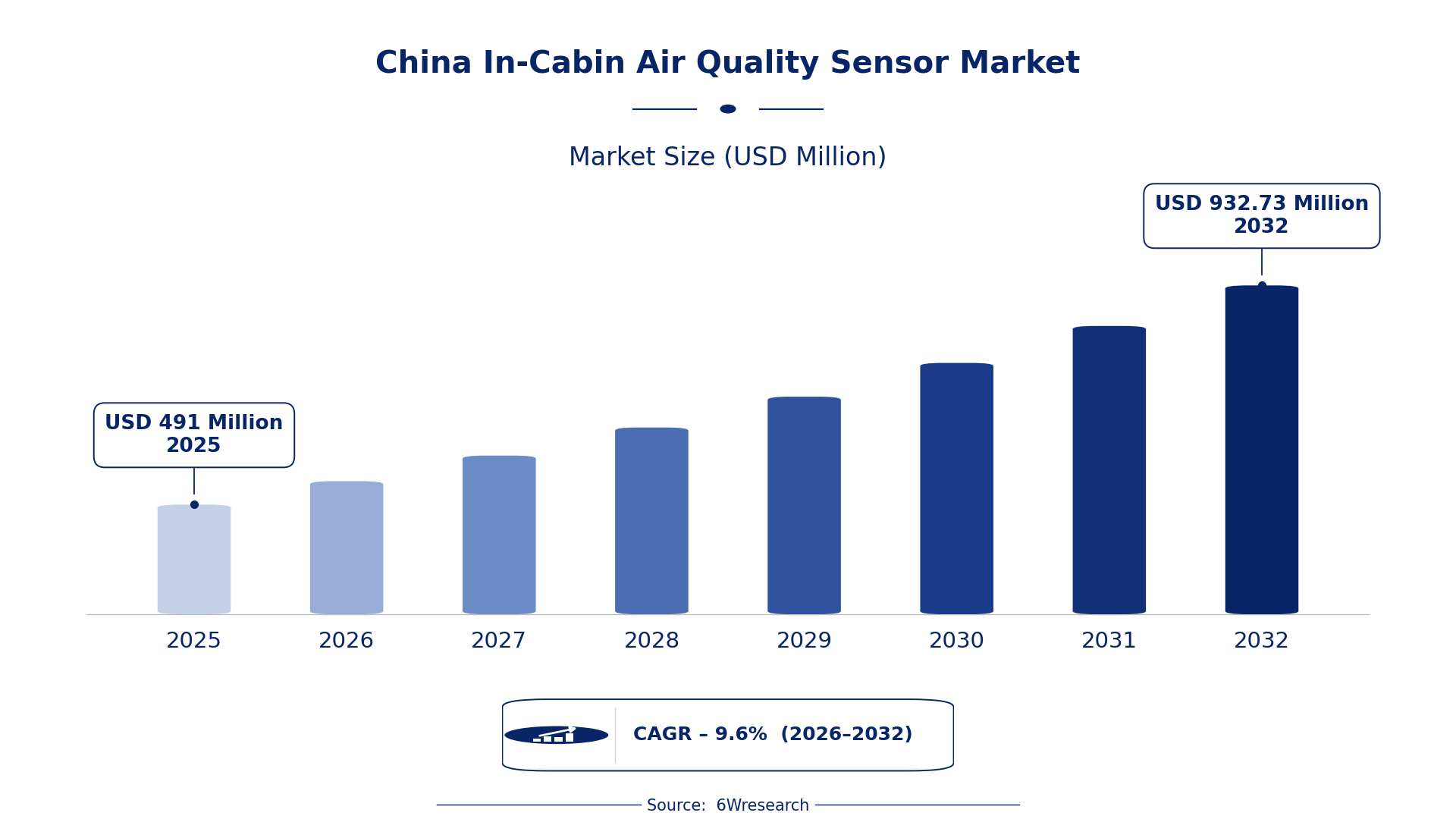
According to 6Wresearch internal database and industry insights, the China In‑Cabin Air Quality Sensor Market was valued at USD 491.0 million in 2025 and is projected to reach USD 932.73 million by 2032, growing at a CAGR of approximately 9.6% during 2026–2032.
China In‑Cabin Air Quality Sensor Market Highlights
| Report Metric | Details |
| Report Name | China In‑Cabin Air Quality Sensor Market |
| Market Size 2025 | USD 491.0 million |
| Market Size 2032 | USD 932.73 million |
| Absolute Growth 2025–2032 | USD 441.73 million |
| CAGR 2026–2032 | 9.6% |
| Peak Annual Growth | 11.4% in 2030 |
| Forecast Period | 2026–2032 |
| Historical Data | 2022–2025 |
| Base Year | 2025 |
| Leading Sensor Type, 2025 | Gas Sensors (36% share) |
| Leading Detection Capability, 2025 | CO₂ (39% share) |
| Leading Vehicle Type, 2025 | Passenger Cars (48% share) |
| Leading End User, 2025 | OEMs (41% share) |
| Fastest-Growing Sensor Type | Combined Air Quality (10.9% CAGR) |
| Fastest-Growing Detection Capability | VOC Detection (12.4% CAGR) |
| Fastest-Growing Vehicle Type | EVs & Luxury Vehicles (12.1% CAGR) |
| Fastest-Growing End User | Automotive Integrators (11.4% CAGR) |
| Growing Sector | automotive industry |
| Key End Users | OEMs, Tier-1 Suppliers, Automotive Integrators, In-Cabin System Developers |
China In‑Cabin Air Quality Sensor Market Year-wise Growth Rate and Key Drivers (2022–2032)
This graph illustrates the annual growth rates of the market from 2022 to 2032, highlighting a steady upward trajectory and projected market expansion over the forecast period.
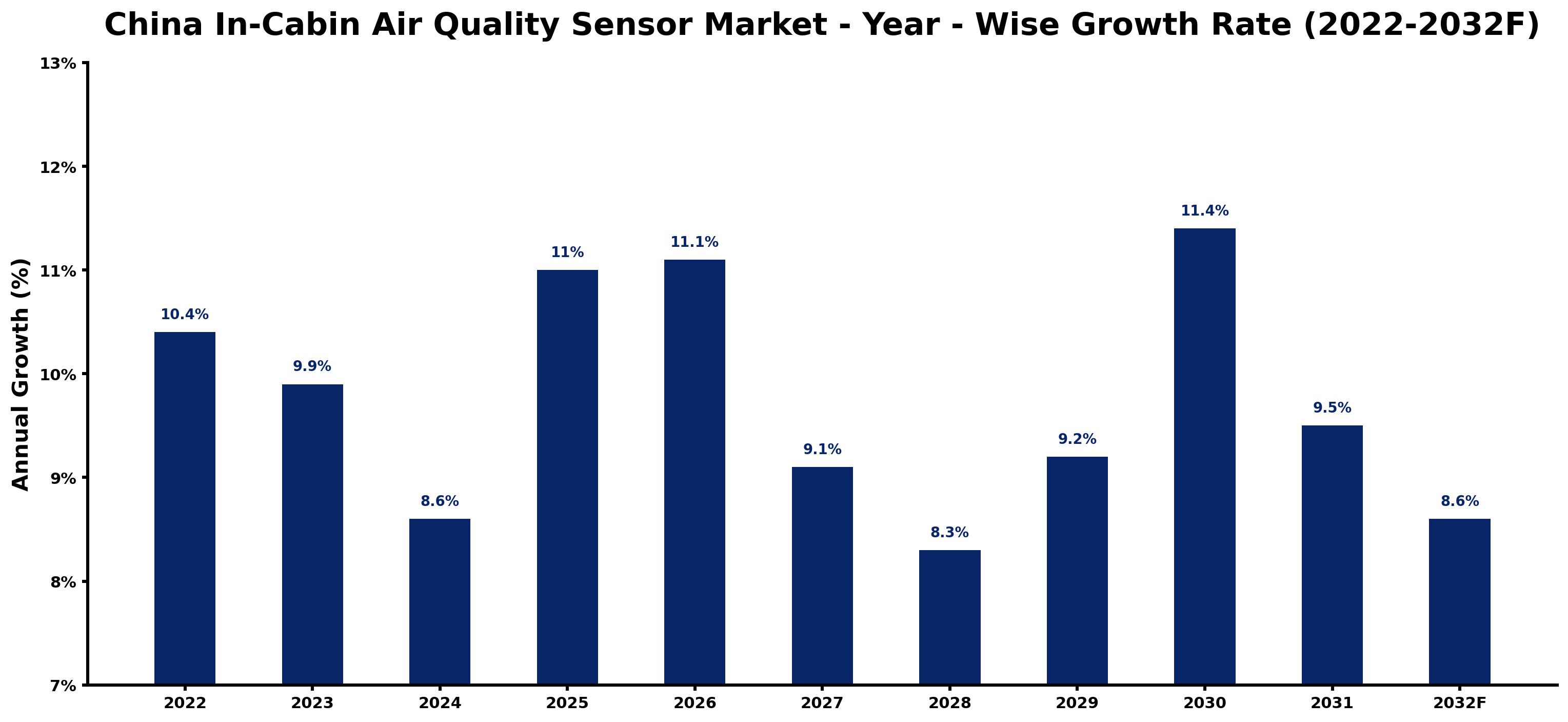
Year by year, the estimates below pair each growth rate with the development that shaped it.
| Year | Estimated Annual Growth (%) | Market Rationale |
| 2022 | 10.4 | The market experienced steady growth, driven by the demand for improved air quality in vehicles, particularly from domestic manufacturers. |
| 2023 | 9.9 | Growth slowed slightly as manufacturers adjusted to the updated 'Air Quality Standards for Motor Vehicles' and other regulations. |
| 2024 | 8.6 | Demand continued to rise, supported by the increasing vehicle population and health awareness among consumers. |
| 2025 | 11.0 | The market saw a surge as domestic manufacturers ramped up production of air quality sensors in response to rising standards. |
| 2026 | 11.1 | Growth is expected to accelerate due to the implementation of the 'Green Vehicle Development Plan' promoting cleaner technologies in vehicles. |
| 2027 | 9.1 | The market is projected to experience a slowdown as competition intensifies among sensor manufacturers, impacting pricing strategies. |
| 2028 | 8.3 | Demand is expected to remain steady, influenced by ongoing regulatory requirements for air quality monitoring in vehicles. |
| 2029 | 9.2 | Growth will pick up again as electric vehicle adoption increases, driving sensor demand among OEMs and integrators. |
| 2030 | 11.4 | The market is projected to peak with strong demand for advanced air quality monitoring solutions, particularly in the EV sector. |
| 2031 | 9.5 | Growth is expected to slow as the market begins to stabilise after rapid expansion in previous years, particularly in sensor integration. |
| 2032 | 8.6 | The market will continue to grow, driven by ongoing technological advancements and regulatory pressures for cleaner air. |
Note: Market size estimations and growth projections presented in this report are based on 6Wresearch's proprietary forecasting methodology, utilizing the latest available industry data, government publications, and primary research inputs.
China In‑Cabin Air Quality Sensor Market Synopsis
The China In-Cabin Air Quality Sensor Market includes sophisticated devices that monitor air quality inside vehicles. These sensors improve passenger comfort and ensure adherence to health standards. The market is growing alongside the vehicle population, which surpasses 1.4 billion units. Demand is fuelled by domestic manufacturers and the automotive sector, which produced over 25 million vehicles in 2022. The 'Green Vehicle Development Plan' encourages the adoption of cleaner technologies, further driving sensor uptake.
Market Dynamics Impact Analysis (2026–2032)
| Factor | Type | Impact | Primary Segment Affected |
| Increasing vehicle population drives demand for air quality sensors in passenger vehicles. | Driver | High | Passenger Cars |
| Stricter environmental regulations push manufacturers to integrate air quality sensors. | Driver | High | OEMs |
| Growing focus on electric vehicles creates opportunities for advanced air quality solutions. | Opportunity | High | EVs & Luxury Vehicles |
| Rising health awareness among consumers leads to a demand for better air quality monitoring. | Opportunity | High | All Vehicle Types |
| High competition among manufacturers may lead to price pressures. | Restraint | Medium | Gas Sensors |
| Limited consumer awareness of air quality sensors can hinder market growth. | Restraint | Medium | PM Sensors |
| The In-Cabin Air Quality Sensor Market in China faces challenges from fluctuating raw material costs. | Challenge | High | Combined Air Quality |
| Technological integration challenges may delay sensor adoption in new vehicle models. | Challenge | Medium | Commercial Vehicles |
Evaluation of Drivers in China In‑Cabin Air Quality Sensor Market (2026–2032)
The table below links each growth driver to the segment it affects and the evidence for it.
| Drivers | Primary Segment Affected | Why It Matters (Evidence) |
| Rising vehicle production increases the need for air quality sensors. | Passenger Cars | China's automotive market produced over 25 million vehicles in 2022, boosting sensor demand. |
| Stricter emission standards require compliance through air quality monitoring. | OEMs | National air quality standards mandate the integration of air quality sensors in new vehicles. |
| Electric vehicle growth drives demand for advanced air quality solutions. | EVs & Luxury Vehicles | Government funding for electric vehicle infrastructure development in 2023 supports sensor adoption. |
| Health awareness among consumers drives demand for cleaner air in vehicles. | All Vehicle Types | The average passenger car in China is equipped with at least one air quality sensor, reflecting consumer focus on health. |
| Technological advancements in sensor integration improve market offerings. | Combined Air Quality | The China Automotive Technology and Research Center oversees standards for automotive components, enhancing sensor integration. |
Market growth in China for In-Cabin Air Quality Sensor relies on increased vehicle production, stricter emission standards, and heightened health awareness. The automotive market produced over 25 million vehicles in 2022, creating a surge in sensor demand. Updated national air quality standards require manufacturers to incorporate these sensors into their vehicles. Investment in electric vehicle infrastructure is also propelling the need for advanced air quality solutions, ensuring a cleaner driving experience. The average passenger car in China is now equipped with at least one air quality sensor, reflecting the growing consumer emphasis on health.
Evaluation of Restraints in China In‑Cabin Air Quality Sensor Market
The key brakes on demand, and where they bite hardest, are shown below.
| Market Restraint | Primary Segment Affected | Why It Matters (Evidence) |
| High competition may lead to price pressures on sensor manufacturers. | Gas Sensors | Intense competition among manufacturers can reduce profit margins, affecting sustainability. |
| Limited consumer awareness can hinder the adoption of air quality sensors. | PM Sensors | Many consumers remain unaware of the benefits of air quality monitoring in vehicles. |
| Fluctuating raw material costs can impact sensor production. | Combined Air Quality | Rising costs of semiconductor materials may delay production schedules and increase prices. |
| Technological integration challenges may slow sensor adoption in vehicles. | Commercial Vehicles | Complexities in integrating sensors with existing vehicle systems can cause delays. |
| Regulatory compliance costs can burden manufacturers. | OEMs | Meeting stringent air quality standards requires significant investment in technology and processes. |
China In‑Cabin Air Quality Sensor Market Challenges
The China In-Cabin Air Quality Sensor Market faces a notable skills shortage, as producers find it difficult to recruit qualified professionals for sensor integration and development. This challenge arises from the rapid pace of technological advancements in the automotive sector, leading to delays in product launches and a diminished competitive edge for manufacturers. Additionally, outdated technology in production facilities restricts the efficiency of air quality sensor manufacturing, resulting in longer lead times to satisfy the needs of a vehicle population exceeding 1.4 billion. Intense competition among domestic producers triggers price wars, eroding profit margins for suppliers and limiting their capacity for innovation.
Trends in the China In‑Cabin Air Quality Sensor Market
Several trends are reshaping the China In‑Cabin Air Quality Sensor Market; the most important are set out below.
- Shift towards Comprehensive Air Quality Monitoring: In 2023, stricter regulations have prompted a focus on comprehensive air quality monitoring in vehicles. The 'Green Transport Development Strategy' aims to enhance air quality in transportation, motivating manufacturers to adopt advanced sensors.
- Emergence of VOC Detection Technologies: Since 2022, VOC detection technologies have gained popularity in the automotive sector. Growing awareness of volatile organic compounds has led to increased demand for sensors that monitor these pollutants.
- Growth of Electric Vehicle Integration: The automotive industry in Guangdong province is experiencing a surge in electric vehicle integration. With over 25 million vehicles produced in 2022, the demand for air quality sensors in EVs is projected to rise significantly.
- Focus on Health and Safety Standards: The year 2022 marked an intensified focus on health and safety standards in vehicles. The updated 'Air Quality Standards for Motor Vehicles' has urged manufacturers to enhance their air quality monitoring solutions.
Investment Opportunities in the China In‑Cabin Air Quality Sensor Market
Investors looking at the China In‑Cabin Air Quality Sensor Market should consider the following areas.
- Increasing Demand for Advanced Sensors: With over 1.4 billion vehicles in China, there is a gap in advanced air quality monitoring solutions. Investing in VOC detection technologies can meet the demand from OEMs and automotive integrators.
- Electric Vehicle Market Expansion: The electric vehicle market is projected to grow, with government support for infrastructure. Suppliers can enter this market by partnering with automotive integrators to provide tailored air quality solutions.
- Regulatory Compliance Solutions: As regulations tighten, manufacturers need to invest in compliant air quality sensors. Collaborating with local Tier-1 suppliers can facilitate access to the necessary technology and standards.
- Integration of Smart Technologies: The push for smart vehicles opens opportunities for advanced air quality sensors. Focusing on HVAC integration can attract OEMs looking to improve passenger comfort and safety.
Government Initiatives in the China In‑Cabin Air Quality Sensor Market
In 2023, the Ministry of Transport launched the 'Green Transport Development Strategy', concentrating on improving air quality in transportation. This strategy builds on previous measures like the 'Automotive Industry Development Plan' from 2021, which sought to advance air quality technologies in vehicles. These initiatives encourage manufacturers to adopt improved air quality monitoring solutions, ensuring compliance with health standards and enhancing passenger comfort. The updated 'Air Quality Standards for Motor Vehicles' from 2022 further reinforces these requirements, compelling manufacturers to upgrade their systems.
The National Development and Reform Commission approved the 'New Energy Vehicle Industry Development Plan' in 2020, promoting air quality enhancements in electric vehicles. This plan allocated substantial funding for developing infrastructure and technologies that improve air quality. Agencies like the Ministry of Ecology and Environment oversee the implementation of these standards, ensuring that automotive manufacturers comply with the latest regulations. The funding amount for the plan was considerable, supporting advancements in air quality monitoring technologies.
Future Insight of the China In‑Cabin Air Quality Sensor Market
The China In-Cabin Air Quality Sensor Market is poised for considerable evolution by 2032, driven by the implementation of the 'Green Vehicle Development Plan' and increased environmental regulations. These elements will encourage the integration of advanced monitoring technologies in vehicles, improving air quality management. Government funding for electric vehicle infrastructure will elevate demand for in-cabin air quality solutions, as adherence to health standards becomes increasingly crucial. By 2025, the automotive sector in Guangdong province is expected to lead in sensor integration, positioning local manufacturers as frontrunners in technological advancement.
Market Segmentation Analysis
The analysis below covers each segmentation, its leading category in 2025 and its fastest-growing category through 2032.
By Sensor Type – Gas Sensors Dominated, Combined Air Quality Expected to Grow Fastest
According to Sachin Kumar Rai, Senior Research Analyst at 6Wresearch, Gas Sensors held a 36% share of the China In‑Cabin Air Quality Sensor Market by sensor type in 2025. Gas Sensors hold the largest share in the China In-Cabin Air Quality Sensor Market due to their essential role in identifying harmful gases within vehicles. Their importance is highlighted by the extensive vehicle production, exceeding 25 million units in 2022, which drives demand from manufacturers. Combined Air Quality is set to record the highest CAGR in this split, 10.9% over 2026–2032. The Combined Air Quality segment is experiencing rapid growth as it provides a comprehensive assessment of air quality, crucial for meeting stringent environmental regulations. The implementation of the 'Green Vehicle Development Plan' in 2023 is a key factor accelerating the demand for these advanced sensors. Suppliers should focus on developing advanced Combined Air Quality sensors to capture the growing market share driven by regulatory compliance.
By Detection Capability – CO₂ Dominated, VOC Detection Expected to Grow Fastest
In 2025, CO₂ led the detection capability split with a 39% share. CO₂ detection technology leads the market as it is critical for assessing air quality and ensuring passenger safety in vehicles. With a vehicle population exceeding 1.4 billion, the reliance on CO₂ sensors is paramount for manufacturers aiming to meet health standards. VOC Detection is projected to grow fastest, at a CAGR of 12.4% during 2026–2032. VOC Detection is the fastest-growing segment, driven by the increasing awareness of the health impacts of volatile organic compounds in vehicles. As consumer demand for cleaner air rises, manufacturers are prioritising VOC detection capabilities in their offerings. Buyers should prioritise vehicles equipped with advanced VOC Detection capabilities to ensure a healthier driving environment.
By Vehicle Type – Passenger Cars Dominated, EVs & Luxury Vehicles Expected to Grow Fastest
The largest vehicle type category in 2025 was Passenger Cars, with a 48% share of total revenue. Passenger Cars dominate the market, accounting for the largest segment utilising In-Cabin Air Quality Sensors, reflecting the high volume of personal vehicles in China. The average passenger car's standard inclusion of at least one air quality sensor demonstrates their widespread adoption across this segment. Over 2026–2032, EVs & Luxury Vehicles are expected to post the fastest growth, at a CAGR of 12.1%. EVs & Luxury Vehicles represent the fastest-growing segment, driven by increasing consumer demand for advanced features that enhance passenger comfort and safety. As the automotive market transitions towards electric vehicles, the need for sophisticated air quality sensors is becoming more pronounced. Suppliers should tailor their products to meet the specific needs of the EV and luxury vehicle segments to seize emerging market opportunities.
By End User – OEMs Dominated, Automotive Integrators Expected to Grow Fastest
With a 41% revenue share in 2025, OEMs was the largest end user category. OEMs are the primary end users of In-Cabin Air Quality Sensors, as they are the main manufacturers integrating these technologies into vehicles. With over 5 million people employed in the automotive sector, OEMs play a crucial role in driving sensor adoption and market growth. The quickest growth will come from Automotive Integrators, forecast to expand at a CAGR of 11.4% between 2026 and 2032. Automotive Integrators are experiencing the fastest growth as they focus on the seamless integration of air quality sensors into vehicle systems. The increasing emphasis on smart vehicle initiatives is significantly boosting the demand for these integrators to enhance overall vehicle functionality. Suppliers should strengthen partnerships with automotive integrators to capitalise on the rising trend of sensor integration in modern vehicles.
Key Attractiveness of the Report
- 10 Years of Market Numbers
- Historical Data Starting from 2022 to 2025
- Base Year 2025
- Forecast Data until 2032
- Key Performance Indicators Impacting the Market
- Major Upcoming Developments and Projects
Key Highlights of the Report:
- China In Cabin Air Quality Sensor Market Outlook
- Market Size of China In Cabin Air Quality Sensor Market, 2025
- Forecast of China In Cabin Air Quality Sensor Market, 2032
- Historical Data and Forecast of China In Cabin Air Quality Sensor Revenues & Volume for the Period 2022 - 2032F
- China In Cabin Air Quality Sensor Market Trend Evolution
- China In Cabin Air Quality Sensor Market Drivers and Challenges
- China In Cabin Air Quality Sensor Price Trends
- China In Cabin Air Quality Sensor Porter's Five Forces
- China In Cabin Air Quality Sensor Industry Life Cycle
- Historical Data and Forecast of China In Cabin Air Quality Sensor Market Revenues & Volume By Sensor Type for the Period 2022 - 2032F
- Historical Data and Forecast of China In Cabin Air Quality Sensor Market Revenues & Volume By Gas Sensors for the Period 2022 - 2032F
- Historical Data and Forecast of China In Cabin Air Quality Sensor Market Revenues & Volume By PM Sensors for the Period 2022 - 2032F
- Historical Data and Forecast of China In Cabin Air Quality Sensor Market Revenues & Volume By Combined Air Quality for the Period 2022 - 2032F
- Historical Data and Forecast of China In Cabin Air Quality Sensor Market Revenues & Volume By Temperature/Humidity for the Period 2022 - 2032F
- Historical Data and Forecast of China In Cabin Air Quality Sensor Market Revenues & Volume By Detection Capability for the Period 2022 - 2032F
- Historical Data and Forecast of China In Cabin Air Quality Sensor Market Revenues & Volume By CO , VOC Detection for the Period 2022 - 2032F
- Historical Data and Forecast of China In Cabin Air Quality Sensor Market Revenues & Volume By Particulate Monitoring for the Period 2022 - 2032F
- Historical Data and Forecast of China In Cabin Air Quality Sensor Market Revenues & Volume By PM VOC CO for the Period 2022 - 2032F
- Historical Data and Forecast of China In Cabin Air Quality Sensor Market Revenues & Volume By HVAC Integration for the Period 2022 - 2032F
- Historical Data and Forecast of China In Cabin Air Quality Sensor Market Revenues & Volume By Vehicle Type for the Period 2022 - 2032F
- Historical Data and Forecast of China In Cabin Air Quality Sensor Market Revenues & Volume By Passenger Cars for the Period 2022 - 2032F
- Historical Data and Forecast of China In Cabin Air Quality Sensor Market Revenues & Volume By Commercial Vehicles for the Period 2022 - 2032F
- Historical Data and Forecast of China In Cabin Air Quality Sensor Market Revenues & Volume By EVs & Luxury Vehicles for the Period 2022 - 2032F
- Historical Data and Forecast of China In Cabin Air Quality Sensor Market Revenues & Volume By All Vehicle Types for the Period 2022 - 2032F
- Historical Data and Forecast of China In Cabin Air Quality Sensor Market Revenues & Volume By End User for the Period 2022 - 2032F
- Historical Data and Forecast of China In Cabin Air Quality Sensor Market Revenues & Volume By OEMs for the Period 2022 - 2032F
- Historical Data and Forecast of China In Cabin Air Quality Sensor Market Revenues & Volume By Tier-1 Suppliers for the Period 2022 - 2032F
- Historical Data and Forecast of China In Cabin Air Quality Sensor Market Revenues & Volume By Automotive Integrators for the Period 2022 - 2032F
- Historical Data and Forecast of China In Cabin Air Quality Sensor Market Revenues & Volume By In-Cabin System Developers for the Period 2022 - 2032F
- China In Cabin Air Quality Sensor Import Export Trade Statistics
- Market Opportunity Assessment By Sensor Type
- Market Opportunity Assessment By Detection Capability
- Market Opportunity Assessment By Vehicle Type
- Market Opportunity Assessment By End User
- China In Cabin Air Quality Sensor Top Companies Market Share
- China In Cabin Air Quality Sensor Competitive Benchmarking By Technical and Operational Parameters
- China In Cabin Air Quality Sensor Company Profiles
- China In Cabin Air Quality Sensor Key Strategic Recommendations
Market Covered
Segments analysed in this report are listed below.
By Sensor Type
- Gas Sensors
- PM Sensors
- Combined Air Quality
- Temperature/Humidity
By Detection Capability
- CO₂
- VOC Detection
- Particulate Monitoring
- PM + VOC + CO₂
- HVAC Integration
By Vehicle Type
- Passenger Cars
- Commercial Vehicles
- EVs & Luxury Vehicles
- All Vehicle Types
By End User
- OEMs
- Tier-1 Suppliers
- Automotive Integrators
- In-Cabin System Developers































