India In‑Cabin Air Quality Sensor Market Size & Growth Rate
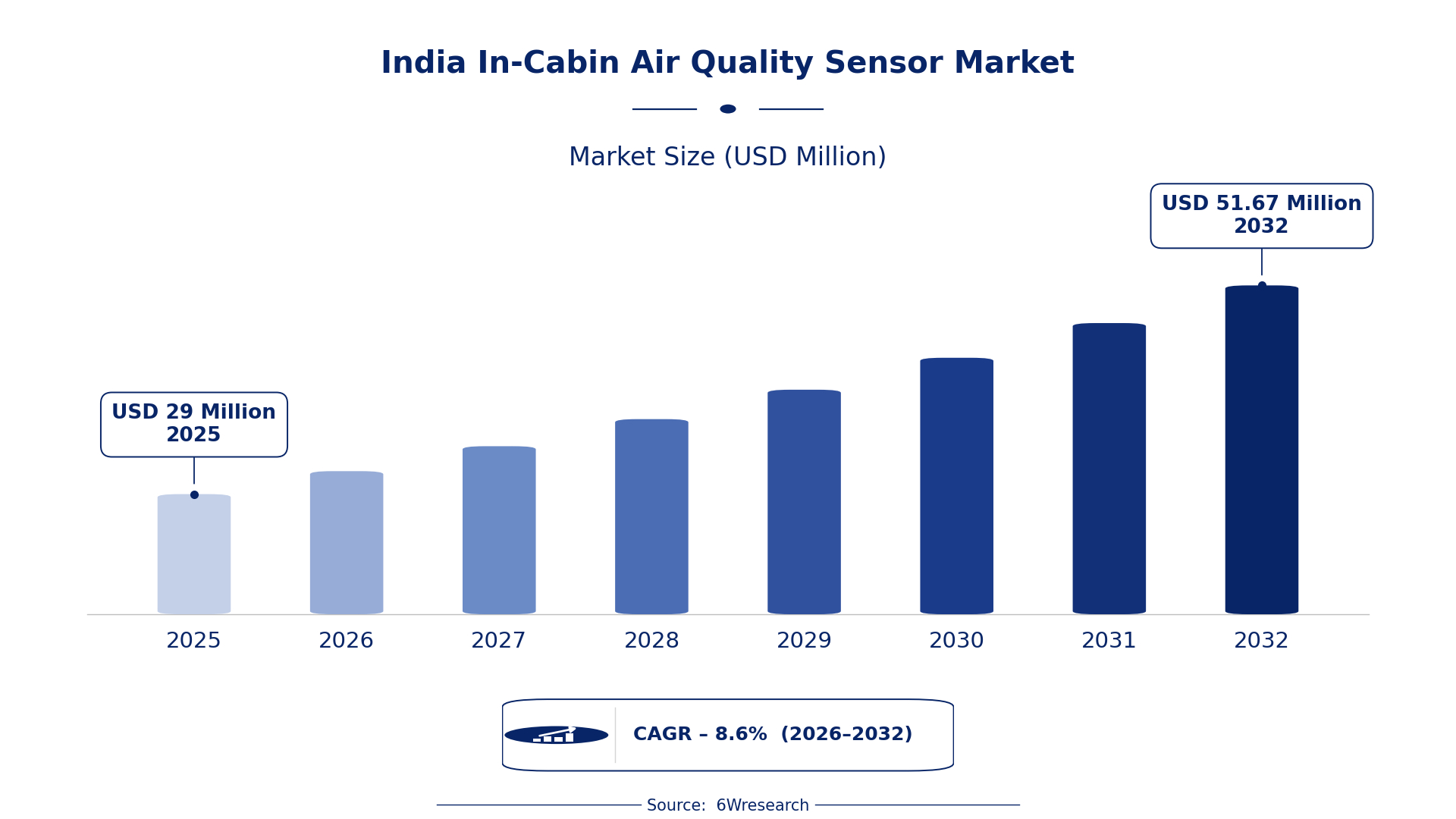
According to 6Wresearch internal database and industry insights, the India In‑Cabin Air Quality Sensor Market was valued at USD 29.0 million in 2025 and is projected to reach USD 51.67 million by 2032, growing at a CAGR of approximately 8.6% during 2026–2032.
India In‑Cabin Air Quality Sensor Market Highlights
| Report Metric | Details |
| Report Name | India In‑Cabin Air Quality Sensor Market |
| Market Size 2025 | USD 29.0 million |
| Market Size 2032 | USD 51.67 million |
| Absolute Growth 2025–2032 | USD 22.67 million |
| CAGR 2026–2032 | 8.6% |
| Peak Annual Growth | 10.0% in 2026 |
| Forecast Period | 2026–2032 |
| Historical Data | 2022–2025 |
| Base Year | 2025 |
| Leading Sensor Type, 2025 | Gas Sensors (47% share) |
| Leading Detection Capability, 2025 | CO₂ (43% share) |
| Leading Vehicle Type, 2025 | Passenger Cars (48% share) |
| Leading End User, 2025 | OEMs (42% share) |
| Fastest-Growing Sensor Type | Combined Air Quality (11.2% CAGR) |
| Fastest-Growing Detection Capability | VOC Detection (10.0% CAGR) |
| Fastest-Growing Vehicle Type | EVs & Luxury Vehicles (10.9% CAGR) |
| Fastest-Growing End User | Automotive Integrators (10.5% CAGR) |
| Growing Sector | Electric Vehicles |
| Key End Users | OEMs, Tier-1 Suppliers, Automotive Integrators, In-Cabin System Developers |
India In‑Cabin Air Quality Sensor Market Year-wise Growth Rate and Key Drivers (2022–2032)
This graph illustrates the annual growth rates of the market from 2022 to 2032, highlighting a steady upward trajectory and projected market expansion over the forecast period.
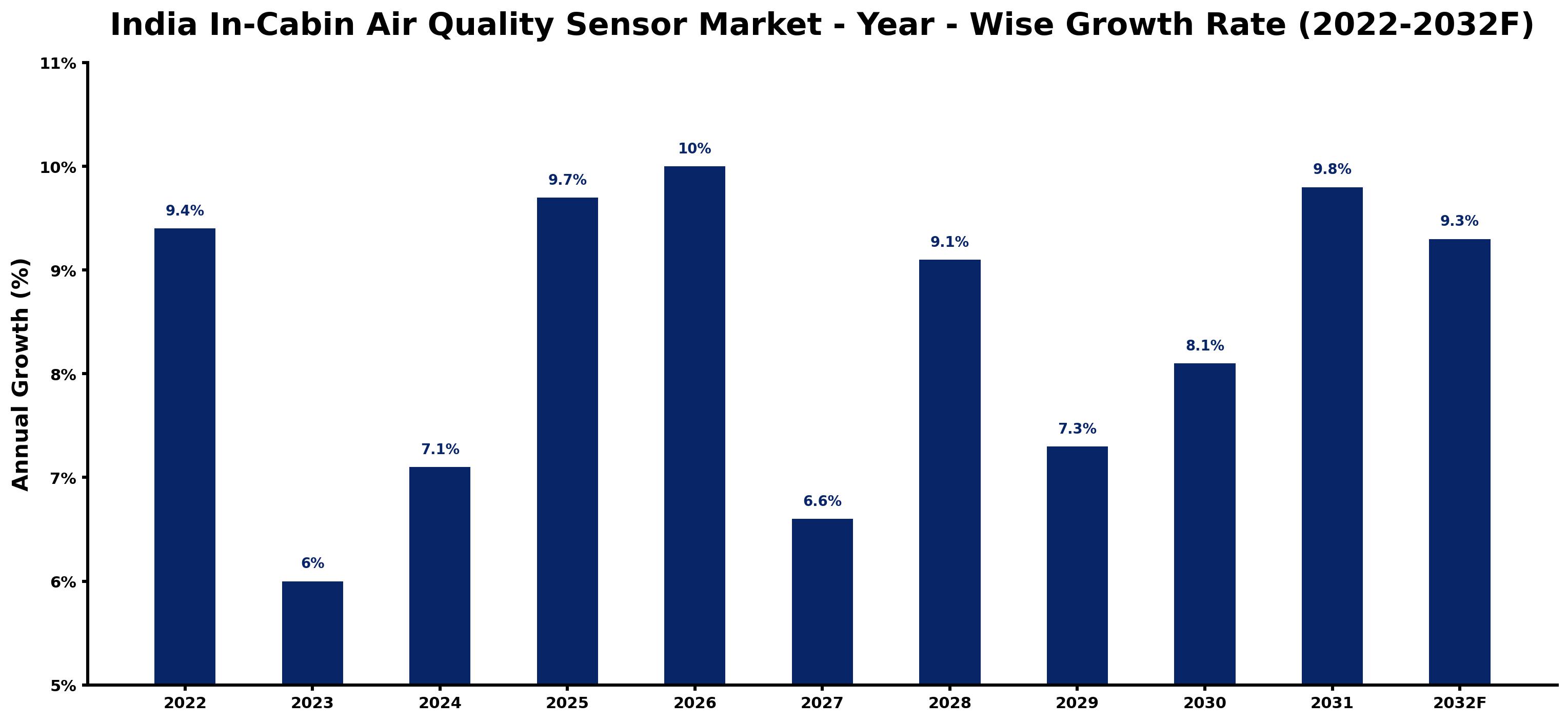
The table below sets out the estimated growth rate for each year and the main factor behind it.
| Year | Estimated Annual Growth (%) | Market Rationale |
| 2022 | 9.4 | The market showed strong demand with 3.1 million passenger vehicles sold, driving sensor adoption. |
| 2023 | 6.0 | Growth slowed as manufacturers adjusted to new standards set by the Bureau of Indian Standards. |
| 2024 | 7.1 | An increase in vehicle sales and improved air quality regulations boosted sensor demand. |
| 2025 | 9.7 | The market accelerated due to heightened awareness of air quality in vehicles among consumers. |
| 2026 | 10.0 | Peak growth will be driven by the rising adoption of electric vehicles requiring advanced air quality sensors. |
| 2027 | 6.6 | Demand will moderate as manufacturers face challenges integrating new technologies into existing systems. |
| 2028 | 9.1 | A renewed focus on passenger comfort will drive demand as OEMs enhance features. |
| 2029 | 7.3 | The market will experience a slowdown as competition intensifies among sensor manufacturers. |
| 2030 | 8.1 | Growth will pick up as the electric vehicle market expands, increasing demand for air quality monitoring. |
| 2031 | 9.8 | Demand will surge as new regulations mandate higher air quality standards in vehicles. |
| 2032 | 9.3 | Growth will slow as the market matures, but demand remains strong due to ongoing technological advancements. |
Note: Market size estimations and growth projections presented in this report are based on 6Wresearch's proprietary forecasting methodology, utilizing the latest available industry data, government publications, and primary research inputs.
India In‑Cabin Air Quality Sensor Market Synopsis
The India In‑Cabin Air Quality Sensor Market encompasses advanced devices that monitor air quality within vehicles, detecting pollutants to ensure a healthier environment for passengers. These sensors are essential for improving passenger comfort and ensuring compliance with health regulations. The market is growing due to rising vehicle sales, with 3.1 million passenger vehicles sold in 2022, and increasing demand from domestic manufacturers. The electric vehicle market is projected to reach 30% of total vehicle sales by 2030, further boosting sensor adoption. Government initiatives and standards are driving the need for improved air quality monitoring in vehicles.
Market Dynamics Impact Analysis (2026–2032)
| Factor | Type | Impact | Primary Segment Affected |
| Rising vehicle sales and increased consumer awareness drive demand for air quality sensors. | Driver | High | Gas Sensors |
| The growing electric vehicle market necessitates advanced air quality monitoring technologies. | Driver | High | EVs & Luxury Vehicles |
| The push for compliance with new air quality standards creates opportunities for sensor manufacturers. | Opportunity | High | Combined Air Quality |
| Investment in automotive technologies, including air quality systems, presents significant market potential. | Opportunity | High | OEMs |
| Challenges in integrating new technologies into existing vehicle systems can hinder growth. | Restraint | Medium | PM Sensors |
| The cost of advanced sensors may limit adoption among smaller manufacturers. | Restraint | Medium | Temperature/Humidity |
| Supply chain disruptions can delay sensor production and delivery timelines. | Challenge | High | All Vehicle Types |
| Competition among sensor manufacturers may lead to pricing pressures and reduced margins. | Challenge | Medium | Commercial Vehicles |
Evaluation of Drivers in India In‑Cabin Air Quality Sensor Market (2026–2032)
The main growth drivers and the segments they affect most are set out below.
| Drivers | Primary Segment Affected | Why It Matters (Evidence) |
| Increased consumer awareness of air quality impacts passenger health and comfort. | Gas Sensors | With 3.1 million passenger vehicles sold in 2022, demand for sensors has surged. |
| The rise of electric vehicles necessitates advanced air quality monitoring technologies. | EVs & Luxury Vehicles | India's electric vehicle market is expected to grow to 30% of total vehicle sales by 2030. |
| Government initiatives promoting air quality standards drive sensor adoption. | Combined Air Quality | The Bureau of Indian Standards established new benchmarks under IS 16833:2018. |
| Investment in automotive technologies boosts demand for air quality sensors. | OEMs | The Indian automotive industry is expected to invest $8 billion in new technologies by 2025. |
| Growing focus on passenger safety and comfort increases demand for air quality sensors. | Commercial Vehicles | The Automotive Research Association of India is working on improving air quality standards in vehicles. |
Growth across the In‑Cabin Air Quality Sensor market in India is anchored in rising vehicle sales, increasing consumer awareness of air quality, and the expansion of the electric vehicle market. In 2022, 3.1 million passenger vehicles were sold, which boosted demand for sensors. The electric vehicle market is set to reach 30% of total vehicle sales by 2030, necessitating advanced air quality monitoring technologies. The Indian automotive industry is projected to invest $8 billion in new technologies by 2025, including air quality sensors.
Evaluation of Restraints in India In‑Cabin Air Quality Sensor Market
The following restraints limit how fast demand can grow.
| Market Restraint | Primary Segment Affected | Why It Matters (Evidence) |
| Integration challenges with existing vehicle systems can limit sensor effectiveness. | PM Sensors | Manufacturers face difficulties in adapting new technologies to established designs, delaying implementation. |
| High costs of advanced sensors may deter smaller manufacturers from adoption. | Temperature/Humidity | Smaller firms may struggle to invest in the latest sensor technologies, limiting market growth. |
| Supply chain disruptions can impact sensor availability and production timelines. | All Vehicle Types | Global supply chain issues have led to delays in component delivery, affecting production schedules. |
| Intense competition among manufacturers may lead to price wars, reducing profit margins. | Commercial Vehicles | As more players enter the market, pricing pressures can affect profitability for existing manufacturers. |
| Regulatory compliance costs can burden manufacturers, impacting pricing strategies. | Gas Sensors | Meeting new standards requires investment in testing and certification, increasing operational costs. |
India In‑Cabin Air Quality Sensor Market Challenges
Producers in the India In-Cabin Air Quality Sensor market face intense competition, which drives down profit margins and compels them to reduce prices. Regulatory compliance poses another hurdle, as meeting IS 16833:2018 standards incurs substantial costs that can delay product launches for manufacturers. A lack of skilled professionals in the automotive sector restricts innovation, leaving suppliers unable to find qualified talent to enhance sensor technology, which can extend development timelines. Increasing input costs, driven by the automotive industry's projected $8 billion investment in new technologies by 2025, further pressure budgets, potentially raising prices for buyers.
Trends in the India In‑Cabin Air Quality Sensor Market
Four trends stand out in the India In‑Cabin Air Quality Sensor Market.
- Shift towards Integrated Air Quality Monitoring Systems: OEMs are increasingly adopting integrated air quality monitoring systems in vehicles, improving passenger comfort. The Automotive Research Association of India is focusing on this trend as part of its 2023 initiatives, which aim to improve air quality standards.
- Transition from Basic to Advanced Sensors: The demand for advanced in-cabin air quality sensors is growing, particularly in electric vehicles. The updated IS 16833:2018 standard reflects this shift, establishing new benchmarks for sensor performance.
- Emergence of VOC Detection Technologies: VOC detection technologies are gaining traction in the market, driven by rising health concerns. The fastest-growing segment is expected to see a CAGR of 10.0% from 2026 to 2032, indicating strong demand.
- Increased Focus on Passenger Safety: The automotive industry is prioritising passenger safety, leading to higher demand for air quality sensors. Regulations from the Ministry of Road Transport and Highways are pushing manufacturers to improve air quality monitoring.
Investment Opportunities in the India In‑Cabin Air Quality Sensor Market
Some of the investment opportunities in the India In‑Cabin Air Quality Sensor Market are mentioned below.
- OEMs seeking advanced air quality solutions: With market growth on the horizon, OEMs are pursuing advanced air quality sensor technologies. The Indian automotive industry is projected to invest $8 billion in new technologies by 2025.
- Growing electric vehicle segment presents opportunities: As electric vehicles are expected to reach 30% of total vehicle sales by 2030, there is a pressing need for advanced air quality monitoring. Suppliers can penetrate this market through partnerships with OEMs.
- Demand for compliance with new standards: The updated IS 16833:2018 standard presents opportunities for manufacturers to create compliant air quality sensors. Collaborating with automotive integrators can facilitate market entry.
- Investment in air quality technologies by automotive manufacturers: With substantial investments in automotive technologies, there exists a gap for advanced air quality solutions. Partnering with Tier-1 suppliers can help address this demand.
Government Initiatives in the India In‑Cabin Air Quality Sensor Market
The Bureau of Indian Standards updated IS 16833:2018 in 2022, establishing new benchmarks for in-cabin air quality sensors in vehicles. This update builds on previous regulations aimed at improving vehicle safety and emissions. Manufacturers must now ensure compliance with these standards to remain competitive in the market. Additionally, the National Electric Mobility Mission Plan 2020 necessitates advanced monitoring technologies for electric vehicles, further influencing sensor requirements.
The Ministry of Heavy Industries announced a $1.5 billion budget in 2023 for research and development in automotive technologies, including air quality sensors. This funding supports initiatives aimed at improving vehicle safety and emissions standards. The Automotive Research Association of India is also working on developing standards for air quality monitoring in commercial vehicles, ensuring compliance with new regulations. These measures collectively boost the market for in-cabin air quality sensors.
Future Insight of the India In‑Cabin Air Quality Sensor Market
By 2032, buyers and suppliers in the India In-Cabin Air Quality Sensor market can expect a notable shift towards electric vehicles, driven by government initiatives like the FAME India Scheme. This transition will elevate the demand for advanced air quality monitoring systems as manufacturers align with new standards from the Automotive Research Association of India. Innovations in sensor technology will be essential, as evolving air quality standards from the Central Pollution Control Board will require better integration in vehicles. The emphasis on health regulations will push producers to create more effective solutions for passenger safety.
Market Segmentation Analysis
The report offers a comprehensive study of the following market segments and their leading categories in the market.
By Sensor Type – Gas Sensors Dominated, Combined Air Quality Expected to Grow Fastest
According to Sachin Kumar Rai, Senior Research Analyst at 6Wresearch, Gas Sensors held a 47% share of the India In‑Cabin Air Quality Sensor Market by sensor type in 2025. Gas Sensors command a significant market share as they are crucial for detecting harmful gases within vehicle cabins, ensuring the safety of passengers. The sale of 3.1 million passenger vehicles in 2022 underscores the robust demand for these sensors among local manufacturers. The quickest growth will come from Combined Air Quality, forecast to expand at a CAGR of 11.2% between 2026 and 2032. Combined Air Quality sensors are experiencing rapid growth due to their ability to provide a thorough assessment of air quality, effectively addressing multiple pollutants. Initiatives from the Automotive Research Association of India aimed at enhancing air quality standards will further drive the demand for this technology. Suppliers should focus on developing advanced combined air quality solutions to meet the growing needs of manufacturers.
By Detection Capability – CO₂ Dominated, VOC Detection Expected to Grow Fastest
In 2025, CO₂ led the detection capability split with a 43% share. CO₂ detection leads the market due to its importance in assessing air freshness and ensuring passenger comfort within vehicles. Compliance with health regulations set by the Bureau of Indian Standards reinforces the demand for CO₂ sensors in the automotive sector. VOC Detection is set to record the highest CAGR in this split, 10.0% over 2026–2032. VOC Detection is expanding quickly as awareness of indoor air quality and its health implications grows, prompting manufacturers to focus on this technology. The standards established by the Central Pollution Control Board will likely accelerate the adoption of VOC detection capabilities in vehicles. Buyers should consider investing in vehicles equipped with advanced VOC detection systems to align with emerging regulations.
By Vehicle Type – Passenger Cars Dominated, EVs & Luxury Vehicles Expected to Grow Fastest
Passenger Cars accounted for a 48% market share by vehicle type in 2025. Passenger Cars hold the largest market share as they are the primary segment for in-cabin air quality sensors, reflecting consumer demand for enhanced comfort and safety features. The expected rise of the electric vehicle market to 30% by 2030 will further solidify this segment's leading position. Over 2026–2032, EVs & Luxury Vehicles are expected to post the fastest growth, at a CAGR of 10.9%. EVs & Luxury Vehicles are the fastest-growing segment, indicating a shift towards premium features and sustainability in automotive design. Government initiatives that promote electric vehicles will significantly boost the demand for advanced air quality monitoring systems in this category. Suppliers should tailor their offerings to meet the specific requirements of the EV and luxury vehicle market.
By End User – OEMs Dominated, Automotive Integrators Expected to Grow Fastest
The largest end user category in 2025 was OEMs, with a 42% share of total revenue. OEMs represent the leading end users as they are the primary producers of in-cabin air quality sensors, integrating them into new vehicle models. The projected investment of $8 billion by the automotive industry in new technologies by 2025 highlights the essential role of OEMs in this market. Automotive Integrators are projected to grow fastest, at a CAGR of 10.5% during 2026–2032. Automotive Integrators are witnessing rapid growth as they play a vital role in embedding air quality sensors into vehicle systems, driven by the increasing demand for integrated solutions. Their emphasis on enhancing vehicle safety and comfort will further propel growth in this segment. Suppliers should collaborate closely with automotive integrators to ensure their products align with specific integration requirements.
Key Attractiveness of the Report
- 10 Years of Market Numbers
- Historical Data Starting from 2022 to 2025
- Base Year 2025
- Forecast Data until 2032
- Key Performance Indicators Impacting the Market
- Major Upcoming Developments and Projects
Key Highlights of the Report:
- India In Cabin Air Quality Sensor Market Outlook
- Market Size of India In Cabin Air Quality Sensor Market, 2025
- Forecast of India In Cabin Air Quality Sensor Market, 2032
- Historical Data and Forecast of India In Cabin Air Quality Sensor Revenues & Volume for the Period 2022 - 2032F
- India In Cabin Air Quality Sensor Market Trend Evolution
- India In Cabin Air Quality Sensor Market Drivers and Challenges
- India In Cabin Air Quality Sensor Price Trends
- India In Cabin Air Quality Sensor Porter's Five Forces
- India In Cabin Air Quality Sensor Industry Life Cycle
- Historical Data and Forecast of India In Cabin Air Quality Sensor Market Revenues & Volume By Sensor Type for the Period 2022 - 2032F
- Historical Data and Forecast of India In Cabin Air Quality Sensor Market Revenues & Volume By Gas Sensors for the Period 2022 - 2032F
- Historical Data and Forecast of India In Cabin Air Quality Sensor Market Revenues & Volume By PM Sensors for the Period 2022 - 2032F
- Historical Data and Forecast of India In Cabin Air Quality Sensor Market Revenues & Volume By Combined Air Quality for the Period 2022 - 2032F
- Historical Data and Forecast of India In Cabin Air Quality Sensor Market Revenues & Volume By Temperature/Humidity for the Period 2022 - 2032F
- Historical Data and Forecast of India In Cabin Air Quality Sensor Market Revenues & Volume By Detection Capability for the Period 2022 - 2032F
- Historical Data and Forecast of India In Cabin Air Quality Sensor Market Revenues & Volume By CO , VOC Detection for the Period 2022 - 2032F
- Historical Data and Forecast of India In Cabin Air Quality Sensor Market Revenues & Volume By Particulate Monitoring for the Period 2022 - 2032F
- Historical Data and Forecast of India In Cabin Air Quality Sensor Market Revenues & Volume By PM VOC CO for the Period 2022 - 2032F
- Historical Data and Forecast of India In Cabin Air Quality Sensor Market Revenues & Volume By HVAC Integration for the Period 2022 - 2032F
- Historical Data and Forecast of India In Cabin Air Quality Sensor Market Revenues & Volume By Vehicle Type for the Period 2022 - 2032F
- Historical Data and Forecast of India In Cabin Air Quality Sensor Market Revenues & Volume By Passenger Cars for the Period 2022 - 2032F
- Historical Data and Forecast of India In Cabin Air Quality Sensor Market Revenues & Volume By Commercial Vehicles for the Period 2022 - 2032F
- Historical Data and Forecast of India In Cabin Air Quality Sensor Market Revenues & Volume By EVs & Luxury Vehicles for the Period 2022 - 2032F
- Historical Data and Forecast of India In Cabin Air Quality Sensor Market Revenues & Volume By All Vehicle Types for the Period 2022 - 2032F
- Historical Data and Forecast of India In Cabin Air Quality Sensor Market Revenues & Volume By End User for the Period 2022 - 2032F
- Historical Data and Forecast of India In Cabin Air Quality Sensor Market Revenues & Volume By OEMs for the Period 2022 - 2032F
- Historical Data and Forecast of India In Cabin Air Quality Sensor Market Revenues & Volume By Tier-1 Suppliers for the Period 2022 - 2032F
- Historical Data and Forecast of India In Cabin Air Quality Sensor Market Revenues & Volume By Automotive Integrators for the Period 2022 - 2032F
- Historical Data and Forecast of India In Cabin Air Quality Sensor Market Revenues & Volume By In-Cabin System Developers for the Period 2022 - 2032F
- India In Cabin Air Quality Sensor Import Export Trade Statistics
- Market Opportunity Assessment By Sensor Type
- Market Opportunity Assessment By Detection Capability
- Market Opportunity Assessment By Vehicle Type
- Market Opportunity Assessment By End User
- India In Cabin Air Quality Sensor Top Companies Market Share
- India In Cabin Air Quality Sensor Competitive Benchmarking By Technical and Operational Parameters
- India In Cabin Air Quality Sensor Company Profiles
- India In Cabin Air Quality Sensor Key Strategic Recommendations
Market Covered
The report offers an extensive study of the following market segments.
By Sensor Type
- Gas Sensors
- PM Sensors
- Combined Air Quality
- Temperature/Humidity
By Detection Capability
- CO₂
- VOC Detection
- Particulate Monitoring
- PM + VOC + CO₂
- HVAC Integration
By Vehicle Type
- Passenger Cars
- Commercial Vehicles
- EVs & Luxury Vehicles
- All Vehicle Types
By End User
- OEMs
- Tier-1 Suppliers
- Automotive Integrators
- In-Cabin System Developers































