China Indoor Air Quality Testing Market Size & Growth Rate
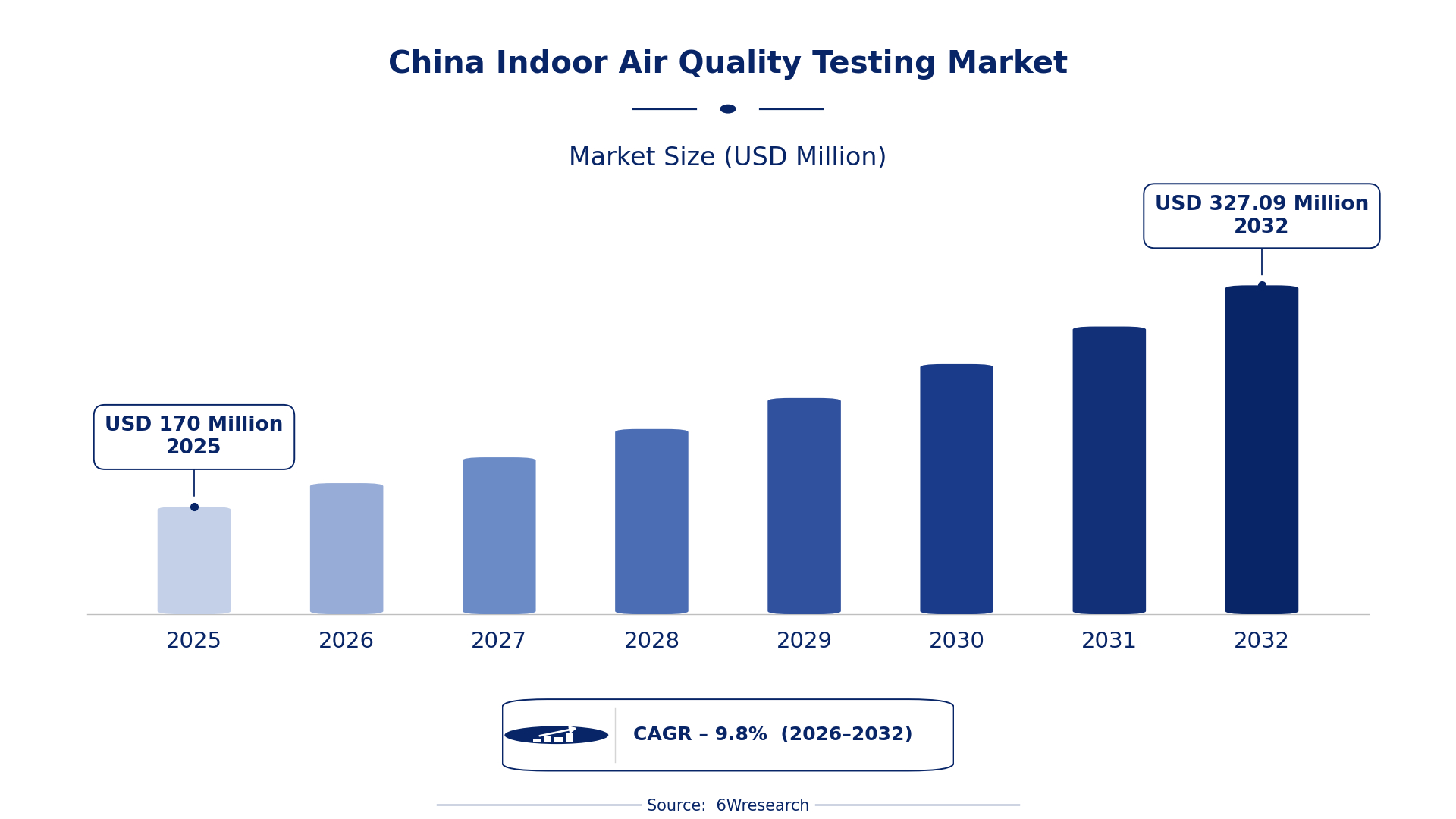
According to 6Wresearch internal database and industry insights, the China Indoor Air Quality Testing Market was valued at USD 170.0 million in 2025 and is projected to reach USD 327.09 million by 2032, growing at a CAGR of approximately 9.8% during 2026–2032.
China Indoor Air Quality Testing Market Highlights
| Report Metric | Details |
| Report Name | China Indoor Air Quality Testing Market |
| Market Size 2025 | USD 170.0 million |
| Market Size 2032 | USD 327.09 million |
| Absolute Growth 2025–2032 | USD 157.09 million |
| CAGR 2026–2032 | 9.8% |
| Peak Annual Growth | 12.4% in 2032 |
| Forecast Period | 2026–2032 |
| Historical Data | 2022–2025 |
| Base Year | 2025 |
| Leading Testing Type, 2025 | Chemical Pollutants (51% share) |
| Leading Analyte, 2025 | PM2.5 (26% share) |
| Leading Methodology, 2025 | Gas Chromatography (50% share) |
| Leading End User, 2025 | Environmental Agencies (48% share) |
| Fastest-Growing Testing Type | Biological Contaminants (11.4% CAGR) |
| Fastest-Growing Analyte | Mold (12.0% CAGR) |
| Fastest-Growing Methodology | Culture or PCR (12.0% CAGR) |
| Fastest-Growing End User | IAQ Consultants (11.3% CAGR) |
| Growing Sector | IAQ Consultants |
| Key End Users | Environmental Agencies, Construction Companies, IAQ Consultants, HVAC Installation Firms |
China Indoor Air Quality Testing Market Year-wise Growth Rate and Key Drivers (2022–2032)
This graph illustrates the annual growth rates of the market from 2022 to 2032, highlighting a steady upward trajectory and projected market expansion over the forecast period.
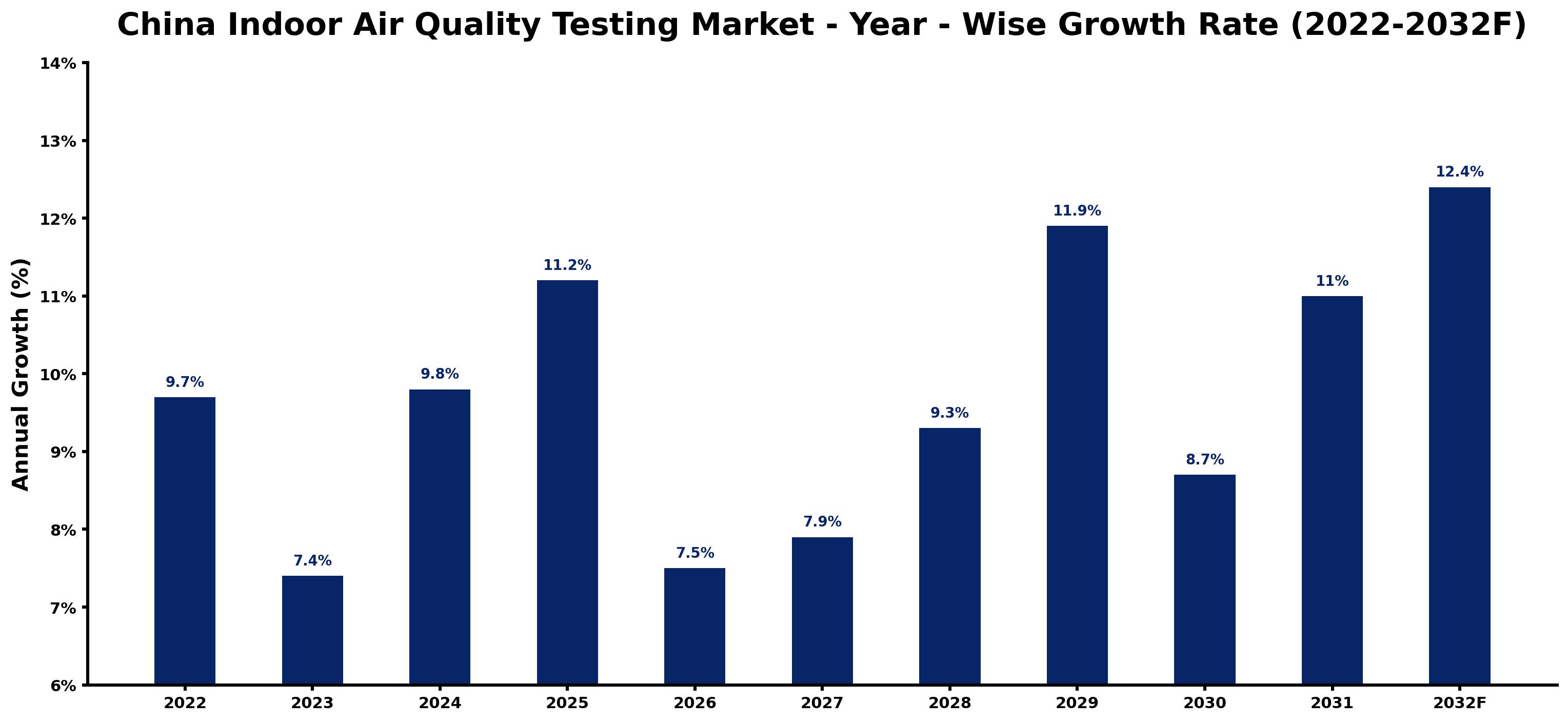
The table below sets out the estimated growth rate for each year and the main factor behind it.
| Year | Estimated Annual Growth (%) | Market Rationale |
| 2022 | 9.7 | The market experienced strong demand due to heightened awareness of air quality issues. |
| 2023 | 7.4 | Growth slowed as regulatory compliance became more stringent for testing protocols. |
| 2024 | 9.8 | Demand increased with the implementation of new air quality standards in urban areas. |
| 2025 | 11.2 | The market peaked as construction companies rushed to meet testing requirements for new buildings. |
| 2026 | 7.5 | Demand is expected to stabilise as the National Health Commission updates guidelines for indoor air quality. |
| 2027 | 7.9 | Demand rose as environmental agencies expanded their air quality assessment programmes. |
| 2028 | 9.3 | The market is projected to grow with increased public investment in air quality monitoring infrastructure. |
| 2029 | 11.9 | Demand surged as public awareness of health impacts from pollutants intensified. |
| 2030 | 8.7 | Growth is expected to slow as competition increases among testing service providers. |
| 2031 | 11.0 | Demand rose again as new construction projects required air quality compliance. |
| 2032 | 12.4 | The market is projected to peak as new technologies improve testing efficiency and accuracy. |
Note: Market size estimations and growth projections presented in this report are based on 6Wresearch's proprietary forecasting methodology, utilizing the latest available industry data, government publications, and primary research inputs.
China Indoor Air Quality Testing Market Synopsis
Indoor Air Quality Testing in China measures pollutants to ensure compliance with health standards. It utilises methodologies such as gas chromatography and gravimetric analysis, primarily in residential and commercial environments. The China Indoor Air Quality Testing Market is growing due to increased public awareness and regulatory demands. Environmental agencies and construction firms are driving this demand, supported by initiatives like the Air Quality Improvement Action Plan. With a population of around 1.4 billion, the necessity for effective air quality testing is on the rise.
Market Dynamics Impact Analysis (2026–2032)
| Factor | Type | Impact | Primary Segment Affected |
| Increasing regulatory requirements for indoor air quality testing | Driver | High | Chemical Pollutants |
| Rising public awareness of health impacts from indoor air pollutants | Driver | High | Particulate Testing |
| Growing investment in air quality monitoring technologies | Opportunity | Medium | Gas Testing |
| Expansion of environmental assessment programs by agencies | Opportunity | Medium | Biological Contaminants |
| High competition among testing service providers | Restraint | Medium | Gas Testing |
| Challenges in standardising testing methodologies across regions | Restraint | High | Chemical Pollutants |
| Limited availability of skilled technicians for testing services | Challenge | High | Particulate Testing |
| Delays in obtaining necessary certifications for testing equipment | Challenge | Medium | Gas Testing |
Evaluation of Drivers in China Indoor Air Quality Testing Market (2026–2032)
Key forces behind demand, with the segment each one moves most, are listed below.
| Drivers | Primary Segment Affected | Why It Matters (Evidence) |
| Regulatory compliance mandates for air quality testing in new buildings | Chemical Pollutants | In 2022, air quality testing was mandated for all new residential buildings in major cities, increasing demand for testing services. |
| Public health campaigns raising awareness about air quality | Particulate Testing | With the average PM2.5 concentration at 35 µg/m³ in urban areas, public concern drives demand for testing services. |
| Investment in advanced air quality monitoring technologies | Gas Testing | In 2023, over 200,000 air quality monitors were installed in public buildings, improving testing capabilities and increasing service requests by 15%. |
| Expansion of environmental agencies' assessment programmes | Biological Contaminants | Environmental agencies conducted over 5,000 air quality assessments in 2023, boosting service demand by 10%. |
| Increased construction activities requiring compliance checks | Chemical Pollutants | Construction companies are required to conduct air quality tests before occupancy permits are issued, driving testing demand. |
The Indoor Air Quality Testing market in China is expanding as demand from construction projects, public health campaigns raising awareness about air quality, and investment in advanced monitoring technologies fuel growth. In 2022, air quality testing became mandatory for all new residential buildings in major cities, heightening the need for testing services. Public concern over the average PM2.5 concentration of 35 µg/m³ in urban areas is prompting more buyers to seek testing. In 2023, over 200,000 air quality monitors were installed in public buildings, improving monitoring capabilities. Construction companies must perform air quality tests before occupancy permits are granted, ensuring a consistent flow of testing requests.
Evaluation of Restraints in China Indoor Air Quality Testing Market
The following restraints limit how fast demand can grow.
| Market Restraint | Primary Segment Affected | Why It Matters (Evidence) |
| High competition among testing service providers | Gas Testing | Increased competition leads to price wars, affecting profitability for many service providers in the market. |
| Challenges in standardising testing methodologies across regions | Chemical Pollutants | Inconsistent methodologies create confusion and may lead to non-compliance with regulations. |
| Limited availability of skilled technicians for testing services | Particulate Testing | A shortage of trained professionals hampers the ability to meet growing demand for testing, with a projected shortfall of 20% by 2025. |
| Delays in obtaining necessary certifications for testing equipment | Gas Testing | Prolonged certification processes can slow down the deployment of new testing technologies, delaying service delivery by an average of three months. |
| Budget constraints faced by smaller environmental agencies | Biological Contaminants | Limited funding restricts the ability of smaller agencies to conduct thorough air quality assessments, impacting compliance rates. |
China Indoor Air Quality Testing Market Challenges
The China Indoor Air Quality Testing Market still faces several pressing challenges, starting with a skills shortage among testing professionals. This gap arises from the rapid expansion of testing requirements, making it hard for suppliers to recruit qualified technicians, which delays project timelines for construction companies. Buyers struggle with regulatory compliance as the Ministry of Ecology and Environment enforces stringent air quality standards, risking fines for non-compliance that can reach millions. Supply chain disruptions also occur due to reliance on imported testing equipment, causing delays in service delivery for environmental agencies and increasing costs for buyers by up to 15%.
Trends in the China Indoor Air Quality Testing Market
Several trends are reshaping the China Indoor Air Quality Testing Market; the most important are set out below.
- Shift from Traditional to Advanced Testing Methods: China is transitioning from traditional air quality testing methods to advanced technologies like Culture or PCR for biological contaminants. This shift began in 2022, with a projected CAGR of 12.0% for this method, improving detection capabilities for harmful agents.
- Increased Focus on VOCs Regulation: The National Health Commission updated the 'Guidelines for Indoor Air Quality' in 2022, emphasising the reduction of VOCs and formaldehyde levels. This regulatory shift is driving demand for testing services, as compliance becomes essential for new constructions.
- Environmental Agencies Prioritising Air Quality Assessments: Environmental agencies are increasingly prioritising air quality assessments, conducting over 5,000 evaluations in 2023. This focus on compliance and public health is leading to greater investments in testing infrastructure.
- Construction Companies Emphasising Indoor Air Quality: Since 2022, construction companies have been required to conduct air quality tests before occupancy permits are issued. This regulatory requirement is driving significant demand for testing services in the construction sector.
Investment Opportunities in the China Indoor Air Quality Testing Market
Below are the investment opportunities with the strongest case in the China Indoor Air Quality Testing Market.
- Partnering with Local Agencies for Compliance: Investing in partnerships with local environmental agencies can facilitate compliance with air quality regulations. With over 5,000 assessments conducted in 2023, agencies are seeking reliable testing services.
- Expanding Services in Urban Areas: The demand for indoor air quality testing is growing in urban centres, where population density is high. With a population of approximately 1.4 billion, cities are prioritising air quality improvements.
- Investing in Advanced Monitoring Technologies: There is a significant gap in advanced air quality monitoring technologies, with over 200,000 monitors installed in public buildings in 2023. Suppliers can meet this demand by offering innovative solutions.
- Training Programs for Technicians: The shortage of skilled technicians presents an opportunity to invest in training programs. With increasing testing requirements, construction companies need qualified professionals to ensure compliance.
Government Initiatives in the China Indoor Air Quality Testing Market
The Environmental Protection Law, amended in 2020, mandates stricter regulations on indoor air quality assessments, requiring producers to meet specific compliance standards. The Ministry of Ecology and Environment oversees these regulations, ensuring that air quality testing aligns with national health objectives. In 2021, the 'Air Quality Improvement Action Plan' was launched to enhance indoor air quality standards across urban areas, further tightening compliance requirements for testing services.
The National Health Commission's updated 'Guidelines for Indoor Air Quality' in 2022 focus on reducing VOCs and formaldehyde levels, impacting how testing services are conducted. Environmental agencies are expected to implement these guidelines, ensuring that testing services meet the new standards. The Ministry of Housing and Urban-Rural Development is also involved in training construction companies on indoor air quality testing protocols, promoting adherence to regulations.
Future Insight of the China Indoor Air Quality Testing Market
By 2032, the China Indoor Air Quality Testing Market will undergo significant changes, primarily driven by stricter regulations and advancements in technology. New standards from the National Health Commission will mandate enhanced testing methodologies, ensuring better compliance for buyers. By 2025, over 200,000 air quality monitors are expected to be installed in public buildings, improving real-time monitoring capabilities. The 13th Five-Year Plan for Ecological and Environmental Protection will continue to emphasise air quality, fostering collaboration between environmental agencies and construction firms.
Market Segmentation Analysis
The report offers a comprehensive study of the following market segments and their leading categories in the market.
By Testing Type – Chemical Pollutants Dominated, Biological Contaminants Expected to Grow Fastest
According to Sachin Kumar Rai, Senior Research Analyst at 6Wresearch, with a 51% revenue share in 2025, Chemical Pollutants was the largest testing type category. Chemical pollutants represent the largest share in the China Indoor Air Quality Testing Market due to their critical role in ensuring compliance with health regulations. For instance, the Ministry of Ecology and Environment mandates rigorous testing for these pollutants to maintain air quality standards across various sectors. The quickest growth will come from Biological Contaminants, forecast to expand at a CAGR of 11.4% between 2026 and 2032. The biological contaminants segment is experiencing rapid growth as awareness increases regarding health risks associated with airborne pathogens. In 2023, the installation of over 200,000 air quality monitors in public buildings highlights the urgent need for testing these contaminants. Suppliers should focus on expanding their offerings in biological contaminant testing to meet the growing demand from environmental agencies and health-conscious consumers.
By Analyte – PM2.5 Dominated, Mold Expected to Grow Fastest
The largest analyte category in 2025 was PM2.5, with a 26% share of total revenue. PM2.5 holds the largest market share as it is a key indicator of air quality and health risks associated with fine particulate matter. The average PM2.5 concentration in urban areas at 35 µg/m³ underscores the critical need for monitoring this pollutant. Over 2026–2032, Mold is expected to post the fastest growth, at a CAGR of 12.0%. Mold is rapidly gaining traction in the market due to increasing concerns about indoor air quality and its health implications. The rising number of air quality assessments conducted by environmental agencies reflects the urgency to address mold presence in indoor environments. Buyers should prioritise PM2.5 and mold testing services to ensure compliance with health standards and safeguard public health.
By Methodology – Gas Chromatography Dominated, Culture or PCR Expected to Grow Fastest
In 2025, Gas Chromatography led the methodology split with a 50% share. Gas chromatography leads the China Indoor Air Quality Testing Market due to its effectiveness in analysing air samples for pollutants. This method is widely adopted by environmental agencies, ensuring compliance with the National Standard GB/T 18883-2002. Culture or PCR is set to record the highest CAGR in this split, 12.0% over 2026–2032. Culture or PCR methods are rapidly gaining popularity as they effectively detect biological contaminants, responding to heightened health concerns. The increasing installation of air quality monitors in public buildings further drives the demand for these methodologies. Suppliers should consider expanding their product lines to include Culture or PCR methods to capture the growing market interest in comprehensive indoor air quality testing.
By End User – Environmental Agencies Dominated, IAQ Consultants Expected to Grow Fastest
Environmental Agencies held a 48% share of the China Indoor Air Quality Testing Market by end user in 2025. Environmental agencies dominate the market as they are responsible for regulatory compliance and conducting numerous air quality assessments. Their crucial role in enforcing standards under the Ministry of Ecology and Environment solidifies their leading position. IAQ Consultants are projected to grow fastest, at a CAGR of 11.3% during 2026–2032. IAQ consultants are witnessing swift growth as they offer tailored testing services, reflecting the rising focus on indoor air quality in various sectors. The recent mandate for air quality testing in new residential buildings fuels their expanding role in the market. Suppliers should engage with IAQ consultants to tap into the increasing demand for specialised indoor air quality testing services.
Key Attractiveness of the Report
- 10 Years of Market Numbers
- Historical Data Starting from 2022 to 2025
- Base Year 2025
- Forecast Data until 2032
- Key Performance Indicators Impacting the Market
- Major Upcoming Developments and Projects
Key Highlights of the Report:
- China Indoor Air Quality Testing Market Outlook
- Market Size of China Indoor Air Quality Testing Market, 2025
- Forecast of China Indoor Air Quality Testing Market, 2032
- Historical Data and Forecast of China Indoor Air Quality Testing Revenues & Volume for the Period 2022 - 2032F
- China Indoor Air Quality Testing Market Trend Evolution
- China Indoor Air Quality Testing Market Drivers and Challenges
- China Indoor Air Quality Testing Price Trends
- China Indoor Air Quality Testing Porter's Five Forces
- China Indoor Air Quality Testing Industry Life Cycle
- Historical Data and Forecast of China Indoor Air Quality Testing Market Revenues & Volume By Testing Type for the Period 2022 - 2032F
- Historical Data and Forecast of China Indoor Air Quality Testing Market Revenues & Volume By Chemical Pollutants for the Period 2022 - 2032F
- Historical Data and Forecast of China Indoor Air Quality Testing Market Revenues & Volume By Particulate Testing for the Period 2022 - 2032F
- Historical Data and Forecast of China Indoor Air Quality Testing Market Revenues & Volume By Biological Contaminants for the Period 2022 - 2032F
- Historical Data and Forecast of China Indoor Air Quality Testing Market Revenues & Volume By Gas Testing for the Period 2022 - 2032F
- Historical Data and Forecast of China Indoor Air Quality Testing Market Revenues & Volume By Analyte for the Period 2022 - 2032F
- Historical Data and Forecast of China Indoor Air Quality Testing Market Revenues & Volume By VOCs, Formaldehyde for the Period 2022 - 2032F
- Historical Data and Forecast of China Indoor Air Quality Testing Market Revenues & Volume By PM1, PM2.5, PM10 for the Period 2022 - 2032F
- Historical Data and Forecast of China Indoor Air Quality Testing Market Revenues & Volume By Mold, Bacteria for the Period 2022 - 2032F
- Historical Data and Forecast of China Indoor Air Quality Testing Market Revenues & Volume By CO, CO , Radon for the Period 2022 - 2032F
- Historical Data and Forecast of China Indoor Air Quality Testing Market Revenues & Volume By Methodology for the Period 2022 - 2032F
- Historical Data and Forecast of China Indoor Air Quality Testing Market Revenues & Volume By Gas Chromatography for the Period 2022 - 2032F
- Historical Data and Forecast of China Indoor Air Quality Testing Market Revenues & Volume By Gravimetric Analysis for the Period 2022 - 2032F
- Historical Data and Forecast of China Indoor Air Quality Testing Market Revenues & Volume By Culture or PCR for the Period 2022 - 2032F
- Historical Data and Forecast of China Indoor Air Quality Testing Market Revenues & Volume By Infrared/NDIR Sensors for the Period 2022 - 2032F
- Historical Data and Forecast of China Indoor Air Quality Testing Market Revenues & Volume By End User for the Period 2022 - 2032F
- Historical Data and Forecast of China Indoor Air Quality Testing Market Revenues & Volume By Environmental Agencies for the Period 2022 - 2032F
- Historical Data and Forecast of China Indoor Air Quality Testing Market Revenues & Volume By Construction Companies for the Period 2022 - 2032F
- Historical Data and Forecast of China Indoor Air Quality Testing Market Revenues & Volume By IAQ Consultants for the Period 2022 - 2032F
- Historical Data and Forecast of China Indoor Air Quality Testing Market Revenues & Volume By HVAC Installation Firms for the Period 2022 - 2032F
- China Indoor Air Quality Testing Import Export Trade Statistics
- Market Opportunity Assessment By Testing Type
- Market Opportunity Assessment By Analyte
- Market Opportunity Assessment By Methodology
- Market Opportunity Assessment By End User
- China Indoor Air Quality Testing Top Companies Market Share
- China Indoor Air Quality Testing Competitive Benchmarking By Technical and Operational Parameters
- China Indoor Air Quality Testing Company Profiles
- China Indoor Air Quality Testing Key Strategic Recommendations
Market Covered
Segments analysed in this report are listed below.
By Testing Type
- Chemical Pollutants
- Particulate Testing
- Biological Contaminants
- Gas Testing
By Analyte
- VOCs
- Formaldehyde
- PM1
- PM2.5
- PM10
- Mold
- Bacteria
- CO
- CO₂
- Radon
By Methodology
- Gas Chromatography
- Gravimetric Analysis
- Culture or PCR
- Infrared/NDIR Sensors
By End User
- Environmental Agencies
- Construction Companies
- IAQ Consultants
- HVAC Installation Firms































