India Indoor Air Quality Testing Market Size & Growth Rate
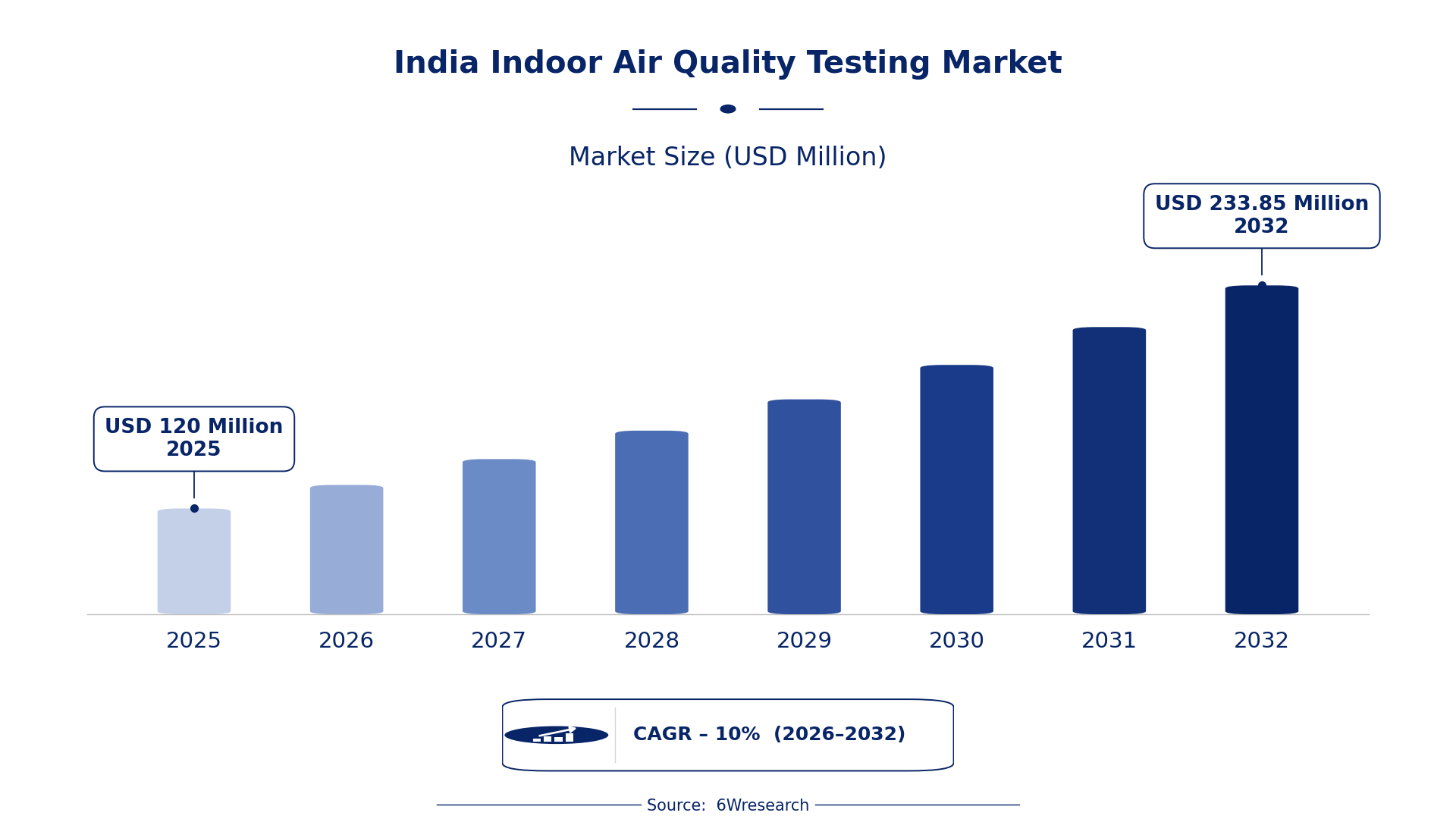
According to 6Wresearch internal database and industry insights, the India Indoor Air Quality Testing Market was valued at USD 120.0 million in 2025 and is projected to reach USD 233.85 million by 2032, growing at a CAGR of approximately 10% during 2026–2032.
India Indoor Air Quality Testing Market Highlights
| Report Metric | Details |
| Report Name | India Indoor Air Quality Testing Market |
| Market Size 2025 | USD 120.0 million |
| Market Size 2032 | USD 233.85 million |
| Absolute Growth 2025–2032 | USD 113.85 million |
| CAGR 2026–2032 | 10% |
| Peak Annual Growth | 12.4% in 2027 |
| Forecast Period | 2026–2032 |
| Historical Data | 2022–2025 |
| Base Year | 2025 |
| Leading Testing Type, 2025 | Gas Testing (48% share) |
| Leading Analyte, 2025 | PM2.5 (22% share) |
| Leading Methodology, 2025 | Gas Chromatography (48% share) |
| Leading End User, 2025 | Environmental Agencies (42% share) |
| Fastest-Growing Testing Type | Biological Contaminants (12.7% CAGR) |
| Fastest-Growing Analyte | VOCs (12.6% CAGR) |
| Fastest-Growing Methodology | Culture or PCR (11.2% CAGR) |
| Fastest-Growing End User | IAQ Consultants (12.3% CAGR) |
| Growing Sector | Construction |
| Key End Users | Environmental Agencies, Construction Companies, HVAC Installation Firms, IAQ Consultants |
India Indoor Air Quality Testing Market Year-wise Growth Rate and Key Drivers (2022–2032)
This graph illustrates the annual growth rates of the market from 2022 to 2032, highlighting a steady upward trajectory and projected market expansion over the forecast period.
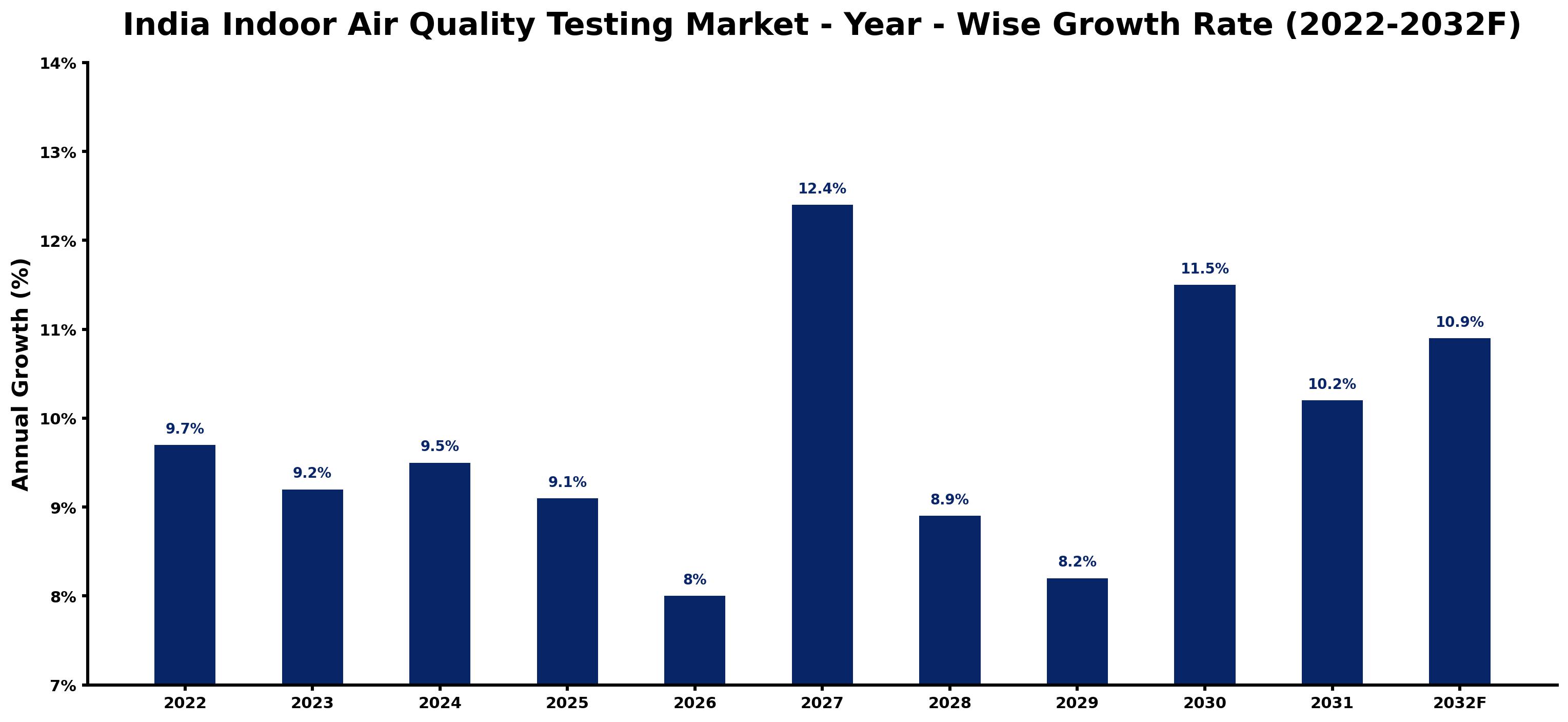
Year by year, the estimates below pair each growth rate with the development that shaped it.
| Year | Estimated Annual Growth (%) | Market Rationale |
| 2022 | 9.7 | Demand for indoor air quality testing was strong due to rising pollution levels in urban areas. |
| 2023 | 9.2 | Growth slowed as the market adjusted to the updated IS 16896:2018 standards for testing protocols. |
| 2024 | 9.5 | Testing demand increased as awareness of health impacts grew among consumers following the National Health Mission's initiatives. |
| 2025 | 9.1 | Market growth slowed slightly due to regulatory compliance challenges faced by testing laboratories. |
| 2026 | 8.0 | The market is expected to slow as testing protocols become more stringent under the National Clean Air Programme. |
| 2027 | 12.4 | Growth is projected to rise sharply with increased investment in HVAC systems and construction projects. |
| 2028 | 8.9 | Demand is expected to slow as market saturation begins in urban areas like Delhi NCR. |
| 2029 | 8.2 | Growth is anticipated to decelerate due to increased competition among service providers in major cities. |
| 2030 | 11.5 | A resurgence in demand is expected as new health initiatives are launched by the Ministry of Health and Family Welfare. |
| 2031 | 10.2 | Growth is projected to slow as the market stabilises post-2029 with established testing protocols. |
| 2032 | 10.9 | Demand is expected to rise again with new environmental regulations coming into effect from the Ministry of Environment. |
Note: Market size estimations and growth projections presented in this report are based on 6Wresearch's proprietary forecasting methodology, utilizing the latest available industry data, government publications, and primary research inputs.
India Indoor Air Quality Testing Market Synopsis
Indoor Air Quality Testing in India involves assessing air quality to identify pollutants and contaminants using methodologies such as gas chromatography and gravimetric analysis. The India Indoor Air Quality Testing Market is growing due to heightened awareness of health impacts from pollution and regulatory compliance needs. Major buyer groups include environmental agencies, construction companies, and HVAC firms. The National Clean Air Programme and increasing urbanisation are key factors driving this growth, with a population exceeding 1.4 billion creating substantial demand for testing services.
Market Dynamics Impact Analysis (2026–2032)
| Factor | Type | Impact | Primary Segment Affected |
| Rising urbanisation and pollution levels drive demand for testing services. | Driver | High | Gas Testing |
| Increased investment in HVAC systems boosts the need for air quality assessments. | Driver | High | HVAC Installation Firms |
| Growing need for compliance with health standards presents opportunities for testing firms. | Opportunity | High | Environmental Agencies |
| The rise of smart city initiatives creates demand for advanced air quality monitoring. | Opportunity | High | Construction Companies |
| High operational costs for testing laboratories limit market expansion. | Restraint | Medium | Biological Contaminants |
| Regulatory compliance challenges slow down market growth for testing services. | Restraint | Medium | Gas Testing |
| Limited awareness among consumers about indoor air quality testing hampers demand. | Challenge | High | Chemical Pollutants |
| Competition among testing service providers can lead to price wars, affecting profitability. | Challenge | Medium | Particulate Testing |
Evaluation of Drivers in India Indoor Air Quality Testing Market (2026–2032)
Below mentioned are some major drivers and their influence on market dynamics.
| Drivers | Primary Segment Affected | Why It Matters (Evidence) |
| Increased urbanisation | Environmental Agencies | The growing urban population, exceeding 1.4 billion, drives demand for regular air quality assessments to comply with health standards, leading to more testing contracts for environmental agencies. |
| Rising HVAC installations | HVAC Installation Firms | The projected growth of the HVAC industry necessitates comprehensive indoor air quality evaluations, prompting HVAC installation firms to invest in testing services to ensure compliance with health regulations. |
| Regulatory compliance needs | Construction Companies | The enforcement of the National Ambient Air Quality Standards compels construction companies to conduct air quality assessments, increasing their reliance on testing services to avoid fines and ensure project approvals. |
| Public health awareness | IAQ Consultants | Growing awareness of health impacts from indoor air pollution leads IAQ consultants to advocate for more rigorous testing in residential and commercial spaces, boosting demand for their services. |
| Technological advancements in testing methods | Gas Testing | Improvements in gas testing methodologies enhance accuracy and reliability, encouraging buyers to adopt these advanced solutions for better compliance with air quality standards. |
With an urban population surpassing 1.4 billion, regular air quality assessments are essential to meet health standards. Rising public health awareness is prompting greater demand for testing in residential areas. The construction sector's growth further fuels the need for air quality assessments in new buildings, while the National Ambient Air Quality Standards enforce compliance, urging buyers to invest in testing services. The surge in HVAC installations also reinforces the necessity for thorough indoor air quality evaluations.
Evaluation of Restraints in India Indoor Air Quality Testing Market
The table below lists the restraints and the evidence behind each.
| Market Restraint | Primary Segment Affected | Why It Matters (Evidence) |
| High operational costs for testing laboratories limit market expansion. | Biological Contaminants | Testing laboratories face costs exceeding 20% of their operational budgets, impacting profitability and service delivery. |
| Regulatory compliance challenges slow down market growth for testing services. | Gas Testing | Complex compliance requirements can delay testing processes, affecting service delivery and client satisfaction. |
| Limited awareness among consumers about indoor air quality testing hampers demand. | Chemical Pollutants | A large percentage of the population remains unaware of the health impacts of poor air quality, reducing testing uptake. |
| Competition among testing service providers can lead to price wars, affecting profitability. | Particulate Testing | With over 300 accredited laboratories, price competition can significantly reduce margins, impacting service quality. |
| Insufficient funding for air quality monitoring initiatives limits testing capabilities. | VOCs | Many local agencies struggle to secure funding, hindering their ability to conduct comprehensive testing and monitoring. |
India Indoor Air Quality Testing Market Challenges
High compliance costs for indoor air quality testing in India burden producers, as assessments can exceed ₹50,000 each. This financial strain discourages smaller construction firms from undertaking essential evaluations, resulting in potential fines and project delays. The complexity of testing technologies creates hurdles for producers lacking expertise, which can lead to inaccurate results that diminish buyer trust. Stringent regulations, such as the National Ambient Air Quality Standards, extend project approval timelines, affecting buyers who rely on timely completions for occupancy and revenue generation.
Trends in the India Indoor Air Quality Testing Market
Below mentioned are some of the trends shaping the India Indoor Air Quality Testing Market growth.
- Shift towards Smart City Air Quality Monitoring: Delhi NCR is implementing smart city air quality monitoring systems to improve data collection and management. This shift began in 2023, concentrating on real-time monitoring, which enhances compliance and public health outcomes.
- Transition from Manual to Automated Testing: The transition to automated indoor air quality testing is gaining momentum, especially in urban areas. In 2023, over 300 accredited laboratories adopted automated systems, boosting efficiency and accuracy in air quality assessments.
- Emergence of Stringent Testing Standards: The update of IS 16896:2018 in 2021 introduced stricter testing protocols for indoor air quality. This change ensures higher compliance levels among testing laboratories, building trust among buyers regarding the accuracy of results.
- Growing Focus on Health Impacts of Indoor Air Pollution: The Ministry of Health and Family Welfare's 2022 programme aimed at raising awareness about indoor air pollution impacts is shifting priorities for buyers. With increased public focus, demand for thorough air quality assessments is anticipated to grow.
Investment Opportunities in the India Indoor Air Quality Testing Market
The following opportunities in the India Indoor Air Quality Testing Market pair current demand with a clear way in.
- Partnerships with Local Agencies: Local partnerships can enhance service delivery in urban areas, particularly in Delhi NCR. With over 300 accredited laboratories, collaboration can streamline operations and improve testing efficiency for clients.
- Investment in Advanced Testing Technologies: There is a considerable gap in advanced testing technologies, with demand expected to increase. Environmental agencies are actively seeking innovative solutions to enhance compliance and monitoring capabilities.
- Expansion into Emerging Urban Areas: Emerging urban areas offer opportunities for testing services as pollution levels rise. The anticipated increase in urbanisation will drive demand for air quality assessments in new developments, particularly in tier-2 cities.
- Focus on Compliance Solutions: The need for compliance with health standards is increasing, especially among construction firms. Investing in compliance solutions can position firms as leaders in the indoor air quality testing market, ensuring adherence to regulations.
Government Initiatives in the India Indoor Air Quality Testing Market
The National Clean Air Programme, launched by the Ministry of Environment, Forest and Climate Change in 2019, aims to reduce PM2.5 levels by 20-30% by 2024. This programme strengthens existing regulations by providing a structured approach to air quality management, ensuring compliance across various sectors. Additionally, the Bureau of Indian Standards updated IS 16896:2018 in 2021 to improve indoor air quality testing standards, making compliance more stringent and thorough for testing laboratories.
In 2023, the Central Pollution Control Board initiated funding for air quality monitoring stations in major cities, enhancing data collection capabilities. This initiative supports environmental agencies in their efforts to monitor air quality effectively. The Ministry of Health and Family Welfare also launched a programme in 2022 focusing on the health impacts of indoor air pollution in urban areas, aiming to raise awareness and improve public health outcomes.
Future Insight of the India Indoor Air Quality Testing Market
The India Indoor Air Quality Testing Market will evolve by 2032, driven by the rollout of smart city air quality monitoring programmes. The National Clean Air Programme will strengthen regulatory frameworks, encouraging more rigorous testing protocols. Increased public awareness of health impacts will lead buyers to prioritise air quality assessments in residential and commercial spaces. With the Ministry of Housing and Urban Affairs' initiatives, the number of accredited laboratories is expected to rise, improving service delivery and response times for all stakeholders.
Market Segmentation Analysis
Each segment group is reviewed below, with the leader by share and the fastest grower by CAGR.
By Testing Type – Gas Testing Dominated, Biological Contaminants Expected to Grow Fastest
According to Sachin Kumar Rai, Senior Research Analyst at 6Wresearch, with a 48% revenue share in 2025, Gas Testing was the largest testing type category. Gas Testing holds the largest share in the India Indoor Air Quality Testing Market due to its critical role in detecting harmful gases, which is vital for health compliance. Environmental agencies extensively utilise gas testing to monitor air quality in densely populated urban regions like Delhi NCR. Biological Contaminants are set to record the highest CAGR in this split, 12.7% over 2026–2032. The segment for Biological Contaminants is experiencing rapid growth as awareness of health risks from airborne pathogens increases, particularly in light of recent public health challenges. This focus on biological threats is driving demand for testing solutions that can accurately identify such contaminants in indoor air. Suppliers must prioritise advancements in biological contaminant testing to cater to the growing health-conscious market.
By Analyte – PM2.5 Dominated, VOCs Expected to Grow Fastest
PM2.5 took a 22% share of analyte in 2025, more than any other category. PM2.5 leads the market share as it is vital for assessing the impacts of fine particulate matter on health, especially in urban regions with high pollution levels. The Central Pollution Control Board's findings underscore the urgent need for consistent PM2.5 monitoring in cities like Delhi. VOCs are projected to grow fastest, at a CAGR of 12.6% during 2026–2032. VOCs are gaining rapid traction due to growing awareness of their effects on indoor air quality. The increasing emphasis on maintaining cleaner indoor environments has accelerated the demand for VOC testing in both residential and commercial settings. Buyers should prioritise VOC testing to ensure healthier indoor air quality as regulations and consumer awareness continue to rise.
By Methodology – Gas Chromatography Dominated, Culture or PCR Expected to Grow Fastest
In 2025, Gas Chromatography led the methodology split with a 48% share. Gas Chromatography leads the methodology segment as it is the preferred choice for precise chemical analysis in air quality testing, ensuring accurate results for compliance. Its alignment with established standards, such as those set by the Central Pollution Control Board, reinforces its market dominance. The quickest growth will come from Culture or PCR, forecast to expand at a CAGR of 11.2% between 2026 and 2032. Culture or PCR is growing at the fastest rate because it is essential for identifying biological contaminants, a need that is becoming increasingly critical in health-focused indoor environments. The rising concern over air quality is making this methodology a key priority for testing laboratories. Suppliers should focus on integrating advanced methodologies like Culture or PCR to meet the escalating demand for thorough air quality evaluations.
By End User – Environmental Agencies Dominated, IAQ Consultants Expected to Grow Fastest
Environmental Agencies held a 42% share of the India Indoor Air Quality Testing Market by end user in 2025. Environmental Agencies hold the largest share as they are the primary users for regulatory compliance testing, ensuring air quality meets established standards. Their continuous monitoring efforts across various regions highlight their critical role in air quality management. Over 2026–2032, IAQ Consultants are expected to post the fastest growth, at a CAGR of 12.3%. IAQ Consultants are experiencing the fastest growth as their expertise in air quality assessments becomes increasingly sought after by both residential and commercial clients. The rising demand for professional guidance in achieving optimal indoor air quality is driving this segment's expansion. Suppliers should consider partnerships with IAQ Consultants to tap into the growing market for expert air quality assessment services.
Key Attractiveness of the Report
- 10 Years of Market Numbers
- Historical Data Starting from 2022 to 2025
- Base Year 2025
- Forecast Data until 2032
- Key Performance Indicators Impacting the Market
- Major Upcoming Developments and Projects
Key Highlights of the Report:
- India Indoor Air Quality Testing Market Outlook
- Market Size of India Indoor Air Quality Testing Market, 2025
- Forecast of India Indoor Air Quality Testing Market, 2032
- Historical Data and Forecast of India Indoor Air Quality Testing Revenues & Volume for the Period 2022 - 2032F
- India Indoor Air Quality Testing Market Trend Evolution
- India Indoor Air Quality Testing Market Drivers and Challenges
- India Indoor Air Quality Testing Price Trends
- India Indoor Air Quality Testing Porter's Five Forces
- India Indoor Air Quality Testing Industry Life Cycle
- Historical Data and Forecast of India Indoor Air Quality Testing Market Revenues & Volume By Testing Type for the Period 2022 - 2032F
- Historical Data and Forecast of India Indoor Air Quality Testing Market Revenues & Volume By Chemical Pollutants for the Period 2022 - 2032F
- Historical Data and Forecast of India Indoor Air Quality Testing Market Revenues & Volume By Particulate Testing for the Period 2022 - 2032F
- Historical Data and Forecast of India Indoor Air Quality Testing Market Revenues & Volume By Biological Contaminants for the Period 2022 - 2032F
- Historical Data and Forecast of India Indoor Air Quality Testing Market Revenues & Volume By Gas Testing for the Period 2022 - 2032F
- Historical Data and Forecast of India Indoor Air Quality Testing Market Revenues & Volume By Analyte for the Period 2022 - 2032F
- Historical Data and Forecast of India Indoor Air Quality Testing Market Revenues & Volume By VOCs, Formaldehyde for the Period 2022 - 2032F
- Historical Data and Forecast of India Indoor Air Quality Testing Market Revenues & Volume By PM1, PM2.5, PM10 for the Period 2022 - 2032F
- Historical Data and Forecast of India Indoor Air Quality Testing Market Revenues & Volume By Mold, Bacteria for the Period 2022 - 2032F
- Historical Data and Forecast of India Indoor Air Quality Testing Market Revenues & Volume By CO, CO , Radon for the Period 2022 - 2032F
- Historical Data and Forecast of India Indoor Air Quality Testing Market Revenues & Volume By Methodology for the Period 2022 - 2032F
- Historical Data and Forecast of India Indoor Air Quality Testing Market Revenues & Volume By Gas Chromatography for the Period 2022 - 2032F
- Historical Data and Forecast of India Indoor Air Quality Testing Market Revenues & Volume By Gravimetric Analysis for the Period 2022 - 2032F
- Historical Data and Forecast of India Indoor Air Quality Testing Market Revenues & Volume By Culture or PCR for the Period 2022 - 2032F
- Historical Data and Forecast of India Indoor Air Quality Testing Market Revenues & Volume By Infrared/NDIR Sensors for the Period 2022 - 2032F
- Historical Data and Forecast of India Indoor Air Quality Testing Market Revenues & Volume By End User for the Period 2022 - 2032F
- Historical Data and Forecast of India Indoor Air Quality Testing Market Revenues & Volume By Environmental Agencies for the Period 2022 - 2032F
- Historical Data and Forecast of India Indoor Air Quality Testing Market Revenues & Volume By Construction Companies for the Period 2022 - 2032F
- Historical Data and Forecast of India Indoor Air Quality Testing Market Revenues & Volume By IAQ Consultants for the Period 2022 - 2032F
- Historical Data and Forecast of India Indoor Air Quality Testing Market Revenues & Volume By HVAC Installation Firms for the Period 2022 - 2032F
- India Indoor Air Quality Testing Import Export Trade Statistics
- Market Opportunity Assessment By Testing Type
- Market Opportunity Assessment By Analyte
- Market Opportunity Assessment By Methodology
- Market Opportunity Assessment By End User
- India Indoor Air Quality Testing Top Companies Market Share
- India Indoor Air Quality Testing Competitive Benchmarking By Technical and Operational Parameters
- India Indoor Air Quality Testing Company Profiles
- India Indoor Air Quality Testing Key Strategic Recommendations
Market Covered
This report examines the market across the segments below.
By Testing Type
- Chemical Pollutants
- Particulate Testing
- Biological Contaminants
- Gas Testing
By Analyte
- VOCs
- Formaldehyde
- PM1
- PM2.5
- PM10
- Mold
- Bacteria
- CO
- CO₂
- Radon
By Methodology
- Gas Chromatography
- Gravimetric Analysis
- Culture or PCR
- Infrared/NDIR Sensors
By End User
- Environmental Agencies
- Construction Companies
- IAQ Consultants
- HVAC Installation Firms































