China Indoor Games Market Size & Growth Rate
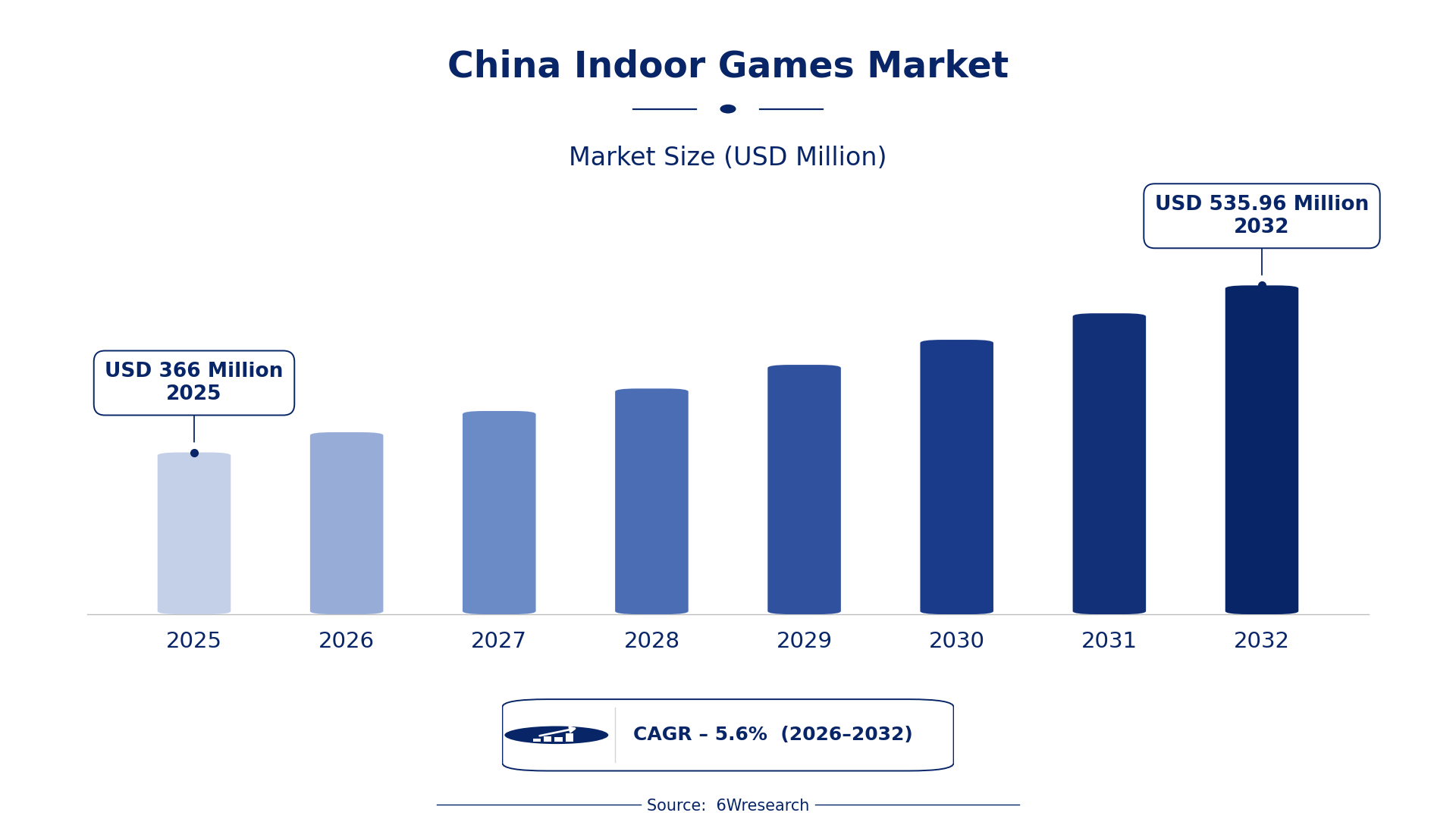
According to 6Wresearch internal database and industry insights, the China Indoor Games Market was valued at USD 366.0 million in 2025 and is projected to reach USD 535.96 million by 2032, growing at a CAGR of approximately 5.6% during 2026–2032.
China Indoor Games Market Highlights
| Report Metric | Details |
| Report Name | China Indoor Games Market |
| Market Size 2025 | USD 366.0 million |
| Market Size 2032 | USD 535.96 million |
| Absolute Growth 2025–2032 | USD 169.96 million |
| CAGR 2026–2032 | 5.6% |
| Peak Annual Growth | 8.0% in 2030 |
| Forecast Period | 2026–2032 |
| Historical Data | 2022–2025 |
| Base Year | 2025 |
| Leading Game Type, 2025 | Board Games (47% share) |
| Leading Age Group, 2025 | All Ages (38% share) |
| Leading Game Mode, 2025 | Offline/Multiplayer (42% share) |
| Leading End User, 2025 | Toy & Hobby Retailers (55% share) |
| Fastest-Growing Game Type | AR Indoor Games (7.7% CAGR) |
| Fastest-Growing Age Group | Teen to Adult (6.6% CAGR) |
| Fastest-Growing Game Mode | Educational (7.9% CAGR) |
| Fastest-Growing End User | Learning Centers (7.7% CAGR) |
| Growing Sector | Educational Games |
| Key End Users | Toy & Hobby Retailers, Learning Centres, Casual Gamers |
China Indoor Games Market Year-wise Growth Rate and Key Drivers (2022–2032)
This graph illustrates the annual growth rates of the market from 2022 to 2032, highlighting a steady upward trajectory and projected market expansion over the forecast period.
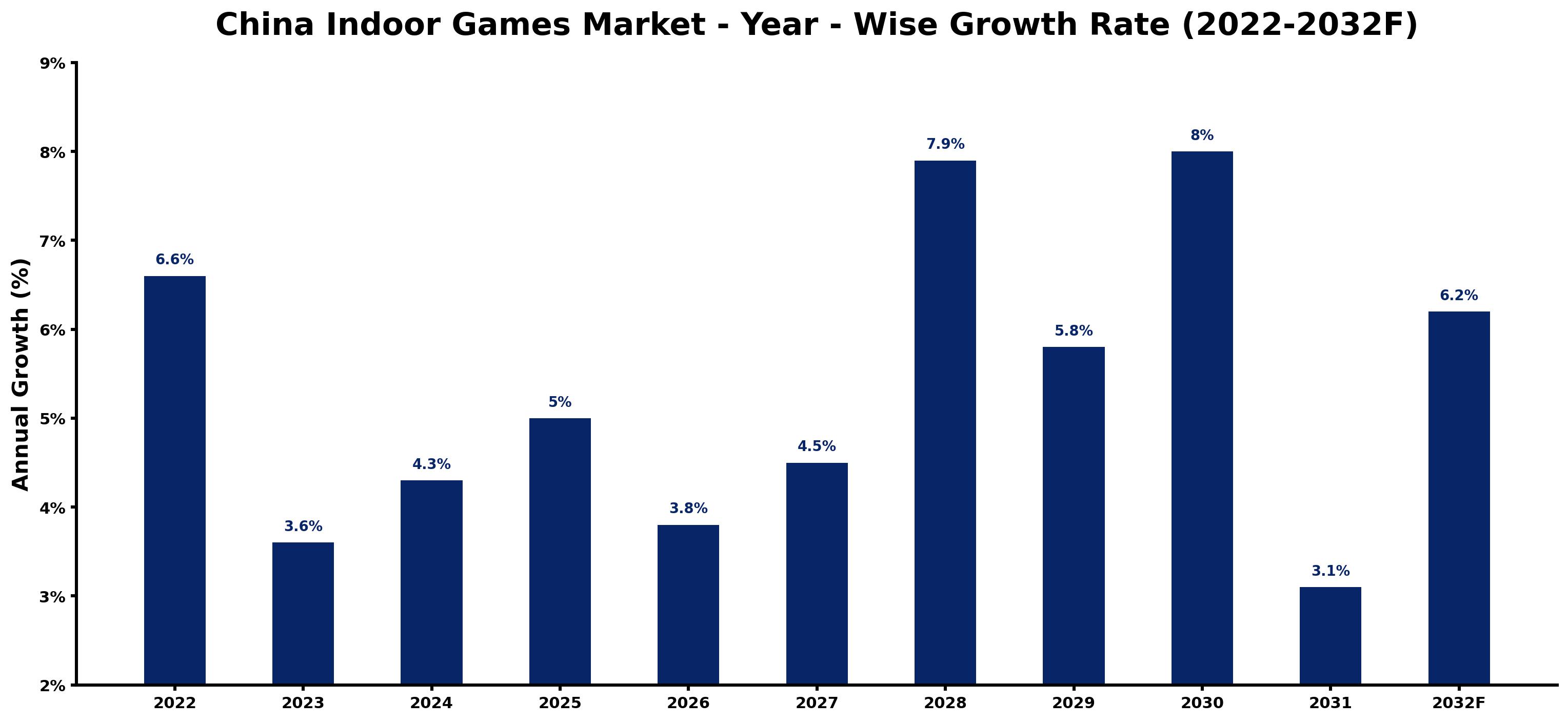
The following table presents the estimated annual growth rate for each year together with the principal factor influencing market performance.
| Year | Estimated Annual Growth (%) | Market Rationale |
| 2022 | 6.6 | The board games segment generated revenue, reflecting growing interest in tabletop gaming. |
| 2023 | 3.6 | Growth slowed as consumer spending adjusted, impacting indoor games purchases. |
| 2024 | 4.3 | Increased participation in family game nights drove demand for board games and puzzles. |
| 2025 | 5.0 | The rise in casual gaming among families contributed to a stronger market performance. |
| 2026 | 3.8 | Market growth is expected to slow as competition intensifies among various game types. |
| 2027 | 4.5 | Renewed interest in educational games will spur demand across learning centres and households. |
| 2028 | 7.9 | The popularity of AR indoor games among teenagers is expected to boost overall market growth. |
| 2029 | 5.8 | Growth is projected to slow as the National Youth Sports Plan begins to take effect. |
| 2030 | 8.0 | A surge in interest for offline multiplayer games will lead to peak annual growth. |
| 2031 | 3.1 | Market growth is expected to slow as economic factors influence consumer spending patterns. |
| 2032 | 6.2 | Increased investments in local game design talent are projected to drive further growth. |
Note: Market size estimations and growth projections presented in this report are based on 6Wresearch's proprietary forecasting methodology, utilizing the latest available industry data, government publications, and primary research inputs.
China Indoor Games Market Synopsis
Indoor Games in China includes a variety of recreational activities played indoors, such as board games, card games, and puzzles. These games are made from materials like cardboard, plastic, and wood, providing entertainment and encouraging social interaction. The China Indoor Games Market is flourishing, propelled by a rising middle class and more leisure time. With over 300 million casual gamers, demand continues to grow. The National Youth Sports Plan aims to increase participation in indoor games, further enhancing market potential.
Market Dynamics Impact Analysis (2026–2032)
| Factor | Type | Impact | Primary Segment Affected |
| Growing interest in tabletop gaming among families | Driver | High | Board Games |
| Increased participation in educational games in learning centres | Driver | High | Educational |
| Rising demand for AR indoor games among tech-savvy youth | Opportunity | Medium | AR Indoor Games |
| Expansion of online retail platforms for indoor games | Opportunity | Medium | Board Games |
| Competition from digital gaming alternatives | Restraint | High | Board Games |
| Economic fluctuations affecting discretionary spending | Restraint | Medium | Board Games |
| Indoor Games in China faces a few practical problems, including supply chain disruptions. | Challenge | High | Board Games |
| Manufacturers struggle to meet safety standards for new products. | Challenge | Medium | Board Games |
Evaluation of Drivers in China Indoor Games Market (2026–2032)
Below mentioned are some major drivers and their influence on market dynamics.
| Drivers | Primary Segment Affected | Why It Matters (Evidence) |
| Increased disposable income among families | Board Games | Families are spending more on entertainment, with the average household spending approximately 1,000 yuan annually on indoor games. |
| Growing popularity of educational games in schools | Educational | Over 10,000 learning centres in China are utilising educational games to engage students. |
| Rising interest in family bonding activities | Indoor Puzzle Games | Family game nights have become a cultural trend, with over 60% of families participating regularly. |
| Expansion of e-commerce platforms for game sales | Board Games | The rise of e-commerce has boosted sales of indoor games in rural areas. |
| Government initiatives promoting youth sports | AR Indoor Games | The National Youth Sports Plan aims to promote indoor games among children, increasing participation by 30% by 2025. |
Market growth for Indoor Games in China is underpinned by increased disposable income among families, rising interest in family bonding activities, and growing popularity of educational games in schools. The average household spends approximately 1,000 yuan annually on indoor games, reflecting a strong market. Over 10,000 learning centres are utilising educational games to engage students, driving demand. Family game nights have become a cultural trend, with over 60% of families participating regularly. The National Youth Sports Plan aims to promote indoor games among children, increasing participation by 30% by 2025.
Evaluation of Restraints in China Indoor Games Market
Below mentioned are some major restraints and their influence on market dynamics.
| Market Restraint | Primary Segment Affected | Why It Matters (Evidence) |
| Supply chain disruptions affecting product availability | Board Games | Manufacturers face delays in sourcing materials, impacting the timely delivery of indoor games. |
| Difficulty in meeting safety standards for new products | Board Games | Compliance with the National Standard for Toy Safety (GB 6675) poses challenges for manufacturers. |
| Competition from digital gaming alternatives | Board Games | Digital gaming options attract younger audiences, reducing interest in traditional board games. |
| Economic fluctuations affecting discretionary spending | Board Games | Economic uncertainties lead consumers to limit spending on non-essential items like indoor games. |
| Limited awareness of new game types among consumers | AR Indoor Games | Many consumers remain unaware of the benefits and features of AR indoor games. |
China Indoor Games Market Challenges
The China Indoor Games Market faces several practical issues, starting with intense competition among manufacturers that drives down prices, making it challenging for smaller players to remain profitable. This rivalry can reduce profit margins by up to 15% for some suppliers. Rapid technological advancements in gaming experiences compel traditional indoor game producers to innovate, risking obsolescence for those unable to adapt. Families, as buyers, often favour lower-priced options, which can compromise quality and lead to dissatisfaction, potentially decreasing repeat purchases. A skills gap in game design persists, as the industry struggles to attract and retain talent, delaying product development for producers.
Trends in the China Indoor Games Market
Below mentioned are some of the trends shaping the China Indoor Games Market growth.
- Shift towards Educational Games in Learning Centres: Learning centres across China are increasingly incorporating educational games into their curricula, engaging students. Over 10,000 centres are now using these games, marking a notable trend in education.
- Growing Popularity of Family Game Nights: Family game nights have gained popularity, with over 60% of families participating regularly. This cultural shift is driving demand for board games and puzzles in households.
- Emergence of AR Indoor Games among Teenagers: AR indoor games are becoming popular among teenagers, with over 40% of this demographic engaging in such activities. This trend reflects a shift towards tech-integrated gaming experiences.
- Expansion of E-commerce for Indoor Games: The rise of e-commerce platforms has increased sales of indoor games in rural areas, making them more accessible to a wider audience.
Investment Opportunities in the China Indoor Games Market
Several openings in the China Indoor Games Market merit attention from investors.
- Supply of Educational Games for Learning Centres: With over 10,000 learning centres using educational games, there is strong demand for products. Investing in this sector can enhance student engagement and learning outcomes.
- Distribution of Board Games through E-commerce Platforms: The growth of e-commerce presents a unique opportunity to reach rural consumers. Partnering with local distributors can facilitate market entry and expand reach.
- Development of AR Indoor Games for Tech-Savvy Youth: As AR indoor games gain traction among teenagers, there is a need for creative products. Collaborating with tech firms can improve game development and appeal to this demographic.
- Investment in Family Entertainment Centres: Family entertainment centres are increasingly featuring board games, presenting a promising opportunity. Investing in this sector can tap into the growing demand for social gaming experiences.
Government Initiatives in the China Indoor Games Market
The National Youth Sports Plan, launched by the Ministry of Education in 2021, aims to promote indoor games in schools, targeting a 30% increase in participation by 2025. This initiative encourages schools to incorporate indoor games into their physical education programs, boosting engagement among students. Additionally, the updated National Standard for Toy Safety in 2022 ensures that all indoor games meet safety requirements, protecting consumers and improving product quality.
In 2023, the National Development and Reform Commission approved funding for the Youth Sports Development Program, which aims to improve access to indoor games in underserved areas. This initiative targets increased participation among children and youth, ensuring that more individuals can enjoy indoor games. The Ministry of Culture and Tourism also supports the growth of indoor games through the Cultural and Creative Industry Development Plan, which promotes local production and innovation.
Future Insight of the China Indoor Games Market
Several forward-looking factors should support the China Indoor Games Market in the coming years. The government's 'National Youth Sports Plan' aims to increase participation in indoor games, promoting family bonding and leisure activities. Educational institutions are increasingly incorporating indoor games into their curricula, improving student engagement. By 2025, urban households are expected to spend around 1,000 yuan annually on indoor games and toys, reflecting rising consumer interest. The growth of e-commerce platforms will further broaden market access, making indoor games more available to a wider audience.
Market Segmentation Analysis
Each segment group is reviewed below, with the leader by share and the fastest grower by CAGR.
By Game Type – Board Games Dominated, AR Indoor Games Expected to Grow Fastest
According to Sachin Kumar Rai, Senior Research Analyst at 6Wresearch, in 2025, Board Games led the game type split with a 47% share. The board games segment commands the largest share due to its widespread popularity for family and social gatherings, with millions of households engaging in game nights. This segment's appeal is underscored by the annual China Board Game Convention, which attracts thousands of attendees, highlighting its significance in the market. AR Indoor Games are set to record the highest CAGR in this split, 7.7% over 2026–2032. AR indoor games are rapidly gaining traction among teenagers, with over 40% of this demographic actively participating in such activities. This trend towards tech integration in gaming is expected to continue driving growth as more young players are drawn to these interactive experiences. Suppliers should prioritise the development of AR indoor games to align with the increasing interest from younger audiences.
By Age Group – All Ages Dominated, Teen to Adult Expected to Grow Fastest
With a 38% revenue share in 2025, All Ages was the largest age group category. The all ages segment commands the largest share as it is designed to appeal to a broad demographic, including families and casual gamers. This wide-ranging appeal is reflected in the average household spending of approximately 1,000 yuan annually on indoor games and toys. Over 2026–2032, Teen to Adult is expected to post the fastest growth, at a CAGR of 6.6%. The teen to adult segment is growing rapidly as these age groups seek more strategic gameplay experiences. This shift is supported by the increasing number of board games being featured in family entertainment centers, promoting social interaction. Suppliers should tailor their marketing strategies to engage older audiences seeking more complex gaming experiences.
By Game Mode – Offline/Multiplayer Dominated, Educational Expected to Grow Fastest
Offline/Multiplayer accounted for a 42% market share by game mode in 2025. The offline/multiplayer mode commands the largest market share due to its emphasis on social interaction and group play, making it a popular choice for family gatherings. This is evident in the cultural trend of family game nights, with over 60% of families engaging regularly, solidifying its appeal. The quickest growth will come from Educational, forecast to expand at a CAGR of 7.9% between 2026 and 2032. Educational games are experiencing rapid growth as they are increasingly adopted in learning environments, particularly in over 10,000 learning centres across China. This trend reflects a broader movement towards incorporating enjoyable activities into educational practices, which enhances student engagement. Suppliers should prioritise the development of educational games to meet the rising demand from educational institutions.
By End User – Toy & Hobby Retailers Dominated, Learning Centers Expected to Grow Fastest
Toy & Hobby Retailers took a 55% share of end user in 2025, more than any other category. Toy and hobby retailers dominate the market share as the main distribution channel for indoor games, catering to a wide range of consumers. Their significance is underscored by the average household expenditure on indoor games, which reinforces their pivotal role in the industry. Learning Centers are projected to grow fastest, at a CAGR of 7.7% during 2026–2032. Learning centres are swiftly embracing indoor games for educational purposes, indicating a shift towards more interactive learning methods. This trend is further supported by government initiatives that advocate for the inclusion of educational games in school curricula. Suppliers should enhance partnerships with learning centres to capitalise on the growing interest in educational indoor games.
Key Attractiveness of the Report
- 10 Years of Market Numbers
- Historical Data Starting from 2022 to 2025
- Base Year 2025
- Forecast Data until 2032
- Key Performance Indicators Impacting the Market
- Major Upcoming Developments and Projects
Key Highlights of the Report:
- China Indoor Games Market Outlook
- Market Size of China Indoor Games Market, 2025
- Forecast of China Indoor Games Market, 2032
- Historical Data and Forecast of China Indoor Games Revenues & Volume for the Period 2022 - 2032F
- China Indoor Games Market Trend Evolution
- China Indoor Games Market Drivers and Challenges
- China Indoor Games Price Trends
- China Indoor Games Porter's Five Forces
- China Indoor Games Industry Life Cycle
- Historical Data and Forecast of China Indoor Games Market Revenues & Volume By Game Type for the Period 2022 - 2032F
- Historical Data and Forecast of China Indoor Games Market Revenues & Volume By Board Games for the Period 2022 - 2032F
- Historical Data and Forecast of China Indoor Games Market Revenues & Volume By Card Games for the Period 2022 - 2032F
- Historical Data and Forecast of China Indoor Games Market Revenues & Volume By AR Indoor Games for the Period 2022 - 2032F
- Historical Data and Forecast of China Indoor Games Market Revenues & Volume By Indoor Puzzle Games for the Period 2022 - 2032F
- Historical Data and Forecast of China Indoor Games Market Revenues & Volume By Age Group for the Period 2022 - 2032F
- Historical Data and Forecast of China Indoor Games Market Revenues & Volume By All Ages for the Period 2022 - 2032F
- Historical Data and Forecast of China Indoor Games Market Revenues & Volume By Teen to Adult for the Period 2022 - 2032F
- Historical Data and Forecast of China Indoor Games Market Revenues & Volume By Kids + Teen for the Period 2022 - 2032F
- Historical Data and Forecast of China Indoor Games Market Revenues & Volume By Children for the Period 2022 - 2032F
- Historical Data and Forecast of China Indoor Games Market Revenues & Volume By Game Mode for the Period 2022 - 2032F
- Historical Data and Forecast of China Indoor Games Market Revenues & Volume By Offline/Multiplayer for the Period 2022 - 2032F
- Historical Data and Forecast of China Indoor Games Market Revenues & Volume By Solo/Party for the Period 2022 - 2032F
- Historical Data and Forecast of China Indoor Games Market Revenues & Volume By Mobile-based AR for the Period 2022 - 2032F
- Historical Data and Forecast of China Indoor Games Market Revenues & Volume By Educational for the Period 2022 - 2032F
- Historical Data and Forecast of China Indoor Games Market Revenues & Volume By End User for the Period 2022 - 2032F
- Historical Data and Forecast of China Indoor Games Market Revenues & Volume By Toy & Hobby Retailers for the Period 2022 - 2032F
- Historical Data and Forecast of China Indoor Games Market Revenues & Volume By Casual Gamers for the Period 2022 - 2032F
- Historical Data and Forecast of China Indoor Games Market Revenues & Volume By Gaming App Developers for the Period 2022 - 2032F
- Historical Data and Forecast of China Indoor Games Market Revenues & Volume By Learning Centers for the Period 2022 - 2032F
- China Indoor Games Import Export Trade Statistics
- Market Opportunity Assessment By Game Type
- Market Opportunity Assessment By Age Group
- Market Opportunity Assessment By Game Mode
- Market Opportunity Assessment By End User
- China Indoor Games Top Companies Market Share
- China Indoor Games Competitive Benchmarking By Technical and Operational Parameters
- China Indoor Games Company Profiles
- China Indoor Games Key Strategic Recommendations
Market Covered
The report offers an extensive study of the following market segments.
By Game Type
- Board Games
- Card Games
- AR Indoor Games
- Indoor Puzzle Games
By Age Group
- All Ages
- Teen to Adult
- Kids + Teen
- Children
By Game Mode
- Offline/Multiplayer
- Solo/Party
- Mobile-based AR
- Educational
By End User
- Toy & Hobby Retailers
- Casual Gamers
- Gaming App Developers
- Learning Centers































