China Indoor Positioning Systems Market Size & Growth Rate
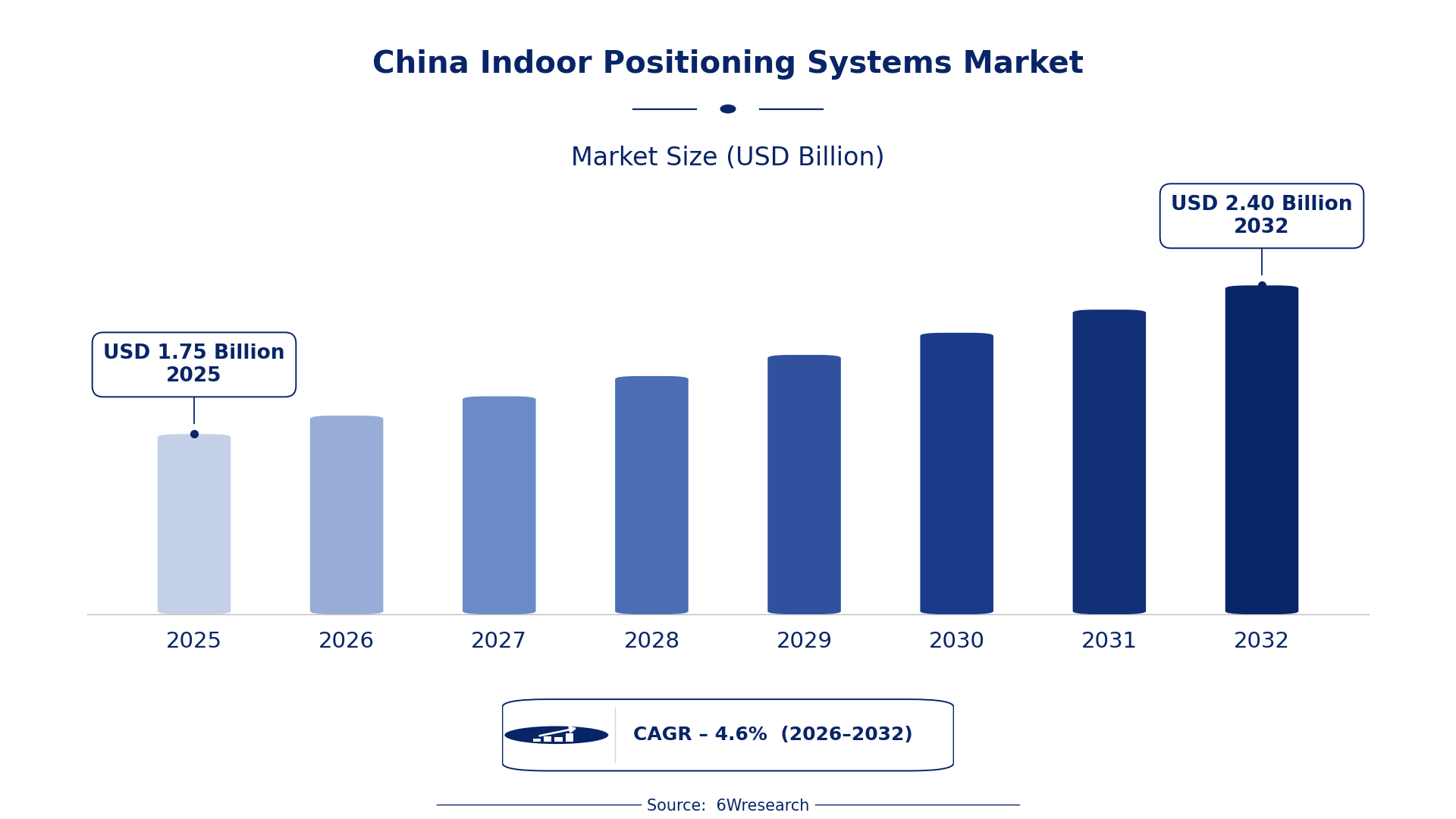
According to 6Wresearch internal database and industry insights, the China Indoor Positioning Systems Market was valued at USD 1.75 billion in 2025 and is projected to reach USD 2.40 billion by 2032, growing at a CAGR of approximately 4.6% during 2026–2032.
China Indoor Positioning Systems Market Highlights
| Report Metric | Details |
| Report Name | China Indoor Positioning Systems Market |
| Market Size 2025 | USD 1.75 billion |
| Market Size 2032 | USD 2.40 billion |
| Absolute Growth 2025–2032 | USD 0.65 billion |
| CAGR 2026–2032 | 4.6% |
| Peak Annual Growth | 7.5% in 2032 |
| Forecast Period | 2026–2032 |
| Historical Data | 2022–2025 |
| Base Year | 2025 |
| Leading Technology Used, 2025 | Wi-Fi Triangulation (44% share) |
| Leading Accuracy Level, 2025 | <30 cm (44% share) |
| Leading Use Case, 2025 | Retail Navigation (39% share) |
| Leading End User, 2025 | Mall Management Firms (37% share) |
| Fastest-Growing Technology Used | Ultra-Wideband (UWB) (6.6% CAGR) |
| Fastest-Growing Use Case | Industrial Asset Tracking (7.4% CAGR) |
| Fastest-Growing End User | Warehouses (6.8% CAGR) |
| Growing Sector | Retail and Logistics |
| Key End Users | Mall Management Firms, Warehouses, Facility IT Teams, Museums & Airports |
China Indoor Positioning Systems Market Year-wise Growth Rate and Key Drivers (2022–2032)
This graph illustrates the annual growth rates of the market from 2022 to 2032, highlighting a steady upward trajectory and projected market expansion over the forecast period.
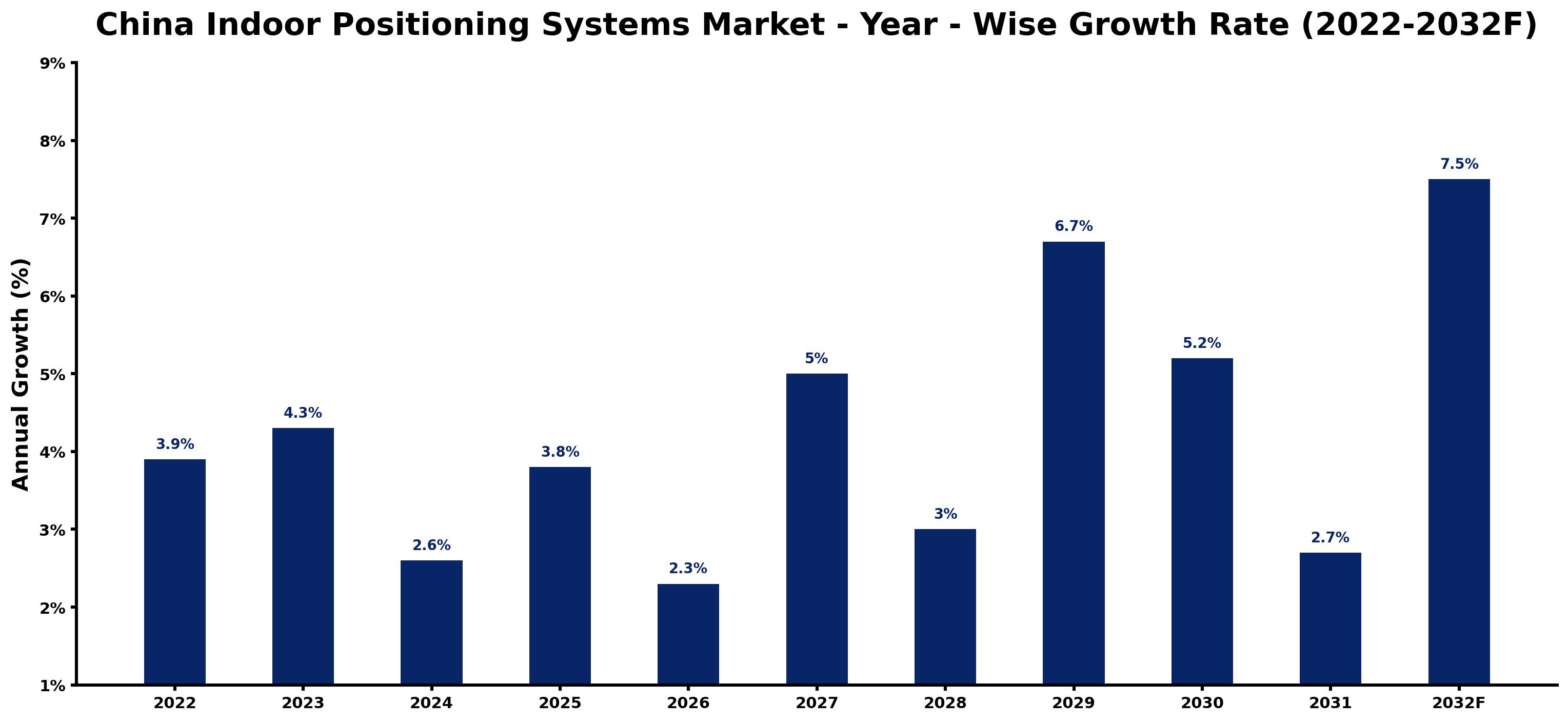
Year by year, the estimates below pair each growth rate with the development that shaped it.
| Year | Estimated Annual Growth (%) | Market Rationale |
| 2022 | 3.9 | Demand grew due to the increasing adoption of smart technologies in retail environments. |
| 2023 | 4.3 | The rise of smart malls and urban infrastructure developments accelerated demand for IPS solutions. |
| 2024 | 2.6 | Growth slowed as some sectors adjusted to technology integration challenges and market conditions. |
| 2025 | 3.8 | A resurgence in demand emerged from the retail sector's expansion and logistics improvements. |
| 2026 | 2.3 | The market is projected to see a slowdown as some projects face delays in implementation. |
| 2027 | 5.0 | Demand is expected to rebound, driven by increased investment in industrial asset tracking solutions. |
| 2028 | 3.0 | Growth will decelerate as the market adapts to evolving technology standards and user needs. |
| 2029 | 6.7 | A surge in installations is anticipated, driven by the logistics industry's rapid expansion and innovation. |
| 2030 | 5.2 | Growth is expected to slow as the market stabilises after a period of rapid adoption. |
| 2031 | 2.7 | Demand will continue to grow, albeit at a slower pace as market conditions evolve. |
| 2032 | 7.5 | A peak in growth is projected, driven by advancements in accuracy and user engagement technologies. |
Note: Market size estimations and growth projections presented in this report are based on 6Wresearch's proprietary forecasting methodology, utilizing the latest available industry data, government publications, and primary research inputs.
China Indoor Positioning Systems Market Synopsis
Indoor Positioning Systems in China are technology solutions that determine the location of objects within buildings using methods like Bluetooth beacons and Wi-Fi triangulation. These solutions improve navigation in retail spaces, track assets in industrial settings, and enhance visitor engagement in museums and airports. The anticipated increase in smart malls, expected to exceed 1,000, will further boost demand for IPS solutions.
Market Dynamics Impact Analysis (2026–2032)
| Factor | Type | Impact | Primary Segment Affected |
| Growing retail sector driving demand for navigation solutions. | Driver | High | Retail Navigation |
| Increased warehouse adoption for asset tracking improving efficiency. | Driver | High | Industrial Asset Tracking |
| Investment in smart malls creating opportunities for IPS integration. | Opportunity | High | Retail Navigation |
| Expansion of logistics facilities boosting demand for tracking technologies. | Opportunity | High | Industrial Asset Tracking |
| High implementation costs limiting adoption in smaller facilities. | Restraint | Medium | Retail Navigation |
| Limited awareness of IPS benefits among potential users. | Restraint | Medium | Industrial Asset Tracking |
| The Indoor Positioning Systems market in China faces challenges from high initial costs. | Challenge | High | Retail Navigation |
| Integration complexities with existing technologies hinder widespread adoption. | Challenge | High | Industrial Asset Tracking |
Evaluation of Drivers in China Indoor Positioning Systems Market (2026–2032)
Key forces behind demand, with the segment each one moves most, are listed below.
| Drivers | Primary Segment Affected | Why It Matters (Evidence) |
| Rising retail sector demands improved navigation solutions. | Retail Navigation | China's retail sector is projected to reach 5.5 trillion USD by 2025, increasing demand for IPS. |
| Growing number of warehouses adopting IPS for asset tracking. | Industrial Asset Tracking | In 2022, over 200,000 warehouses in China were implementing IPS for improved efficiency. |
| Increasing smartphone penetration facilitating IPS integration. | Visitor Engagement | With over 80% smartphone penetration, user engagement through mobile apps is becoming essential. |
| Government initiatives promoting smart technologies in urban areas. | Retail Navigation | The 'Smart City' initiative launched in 2021 aims to integrate IPS into urban infrastructure. |
| Expansion of logistics industry driving demand for tracking technologies. | Industrial Asset Tracking | The Chinese logistics industry is expected to grow to 1 trillion USD by 2025, boosting IPS demand. |
Growth in the Indoor Positioning Systems market in China comes from increasing end-use demand in the retail and logistics sectors. The retail sector is projected to reach 5.5 trillion USD by 2025, creating substantial demand for navigation solutions. The logistics industry, expected to grow to 1 trillion USD, will drive further demand for asset tracking technologies. Over 200,000 warehouses in China are adopting IPS for improved efficiency, responding to the need for better asset management.
Evaluation of Restraints in China Indoor Positioning Systems Market
The main factors holding the market back are set out below.
| Market Restraint | Primary Segment Affected | Why It Matters (Evidence) |
| High implementation costs limiting adoption in smaller facilities. | Retail Navigation | Many smaller retail spaces struggle to justify the investment needed for IPS, with costs reaching 30% of total project budgets. |
| Limited awareness of IPS benefits among potential users. | Industrial Asset Tracking | Small and medium enterprises often lack knowledge about the advantages of IPS, hindering adoption. |
| Integration complexities with existing technologies hinder widespread adoption. | Visitor Engagement | Many facilities face challenges in integrating IPS with their current systems, causing delays. |
| Regulatory hurdles slowing down the approval processes for IPS implementations. | Retail Navigation | Compliance with national standards can delay project timelines, impacting implementation schedules. |
| Market competition leading to price pressures on IPS solutions. | Industrial Asset Tracking | Increased competition among providers can affect pricing strategies, impacting buyers' decisions. |
China Indoor Positioning Systems Market Challenges
The China Indoor Positioning Systems market faces high implementation costs, with initial setup expenses reaching up to 30% of total project budgets, which discourages smaller retailers from investing in this technology. Intense competition among service providers leads to price wars that may compromise service quality, impacting buyers who rely on dependable systems for accurate location tracking. Supply chain issues, particularly in sourcing advanced sensors and software components, can delay project timelines by up to six months, affecting logistics companies that require timely asset tracking. A shortage of skilled professionals in the IPS sector slows development, causing deployment delays for hospitals aiming to enhance patient navigation experiences.
Trends in the China Indoor Positioning Systems Market
Four trends stand out in the China Indoor Positioning Systems Market.
- Shift towards Advanced Retail Navigation Solutions: China is experiencing a shift towards more sophisticated retail navigation solutions, with the number of smart malls projected to exceed 1,000 by 2025. This change is improving customer experiences and driving IPS demand.
- Transition from Basic to Advanced Asset Tracking: Since 2022, there has been a notable transition towards advanced asset tracking solutions in warehouses. The adoption of IPS technologies is increasing as facilities seek to improve operational efficiency, with a projected growth rate of 7.4%.
- Emergence of Visitor Engagement Technologies: Visitor engagement technologies are becoming more prevalent in museums and airports, with IPS being implemented to improve experiences. In 2022, approximately 1,500 museums in China began using IPS for this purpose, enhancing visitor navigation.
- Growing Integration of Smartphone Applications: The integration of smartphone applications with IPS is on the rise, facilitating user engagement. With over 80% smartphone penetration, this trend is likely to expand further, improving interaction with IPS.
Investment Opportunities in the China Indoor Positioning Systems Market
Below are the investment opportunities with the strongest case in the China Indoor Positioning Systems Market.
- Gap in IPS Adoption in Smaller Retail Spaces: With the retail sector projected to reach 5.5 trillion USD by 2025, there is a notable gap in IPS adoption among smaller retail spaces. Investing in tailored solutions for these businesses can yield high returns, addressing their specific needs.
- Timing for Logistics Sector Investment: As the logistics industry is expected to grow to 1 trillion USD by 2025, now is the ideal time to invest in IPS solutions. Targeting logistics firms can lead to significant contracts and enhance operational efficiency.
- Entry into Smart City Initiatives: The 'Smart City' initiative launched in 2021 presents an opportunity for IPS providers. Partnering with local governments can facilitate entry into urban infrastructure projects, expanding market reach.
- Focus on Educational Institutions: With a target of implementing IPS in 1,000 schools by 2025, there is a clear opportunity in the education sector. Suppliers can engage with educational institutions to provide navigation solutions, improving student experiences.
Government Initiatives in the China Indoor Positioning Systems Market
The 'Smart City' initiative, launched by the Ministry of Industry and Information Technology in 2021, aims to integrate IPS into urban infrastructure, targeting 100 pilot cities by 2025. This initiative promotes the adoption of smart technologies, ensuring improved navigation and asset tracking in urban areas. It builds on previous efforts to modernise technology integration, thereby improving service delivery for IPS buyers and producers.
The Standardization Administration of China oversees the implementation of the National Standard for Indoor Positioning Systems, established in 2021. This standard ensures quality and safety in IPS implementations, requiring producers to adhere to specific guidelines. The Ministry of Transport initiated a program in 2022 to improve airport navigation systems, including IPS, with a budget of 500 million RMB, supporting the integration of advanced navigation technologies for better user experiences.
Future Insight of the China Indoor Positioning Systems Market
The China Indoor Positioning Systems market is set for significant advancements by 2032, driven by the retail sector's growth, projected to reach 5.5 trillion USD by 2025. The number of warehouses in China, exceeding 200,000 in 2022, will increasingly adopt IPS for efficient asset tracking. Government initiatives like the 'Smart City' programme will promote the integration of IPS technologies in urban management. The anticipated rise in smartphone penetration, already over 80%, will facilitate seamless IPS integration across various sectors.
Market Segmentation Analysis
The analysis below covers each segmentation, its leading category in 2025 and its fastest-growing category through 2032.
By Technology Used – Wi-Fi Triangulation Dominated, Ultra-Wideband (UWB) Expected to Grow Fastest
According to Sachin Kumar Rai, Senior Research Analyst at 6Wresearch, Wi-Fi Triangulation held a 44% share of the China Indoor Positioning Systems Market by technology used in 2025. Wi-Fi Triangulation holds the largest market share because it is widely implemented in commercial spaces, particularly in retail environments where it enhances navigation and analytics. This technology's compatibility with existing Wi-Fi networks makes it a go-to choice for improving customer experiences in shopping malls. Over 2026–2032, Ultra-Wideband (UWB) is expected to post the fastest growth, at a CAGR of 6.6%. Ultra-Wideband (UWB) is experiencing rapid growth due to its superior accuracy for asset tracking in industrial applications, crucial for warehouses managing extensive inventories. As the demand for precise tracking solutions in logistics and manufacturing rises, UWB's adoption will continue to accelerate. Suppliers need to strengthen their UWB offerings while ensuring robust Wi-Fi Triangulation solutions to meet diverse client needs.
By Accuracy Level – <30 cm Dominated and Is Expected to Record the Fastest Growth
In 2025, <30 cm led the accuracy level split with a 44% share. The <30 cm accuracy level is essential for precise asset tracking in warehouses, where even minor inaccuracies can lead to significant operational setbacks. Warehouse operators increasingly require this level of precision to optimise inventory management and reduce losses. The same category is also set to grow fastest, at a CAGR of 7.2% during 2026–2032. The <30 cm accuracy level also leads in growth, as industries acknowledge the importance of high precision in asset tracking for improved operational efficiency. This dual leadership in accuracy reflects a strong market preference for precise tracking solutions. Buyers will increasingly demand high-accuracy solutions, prompting suppliers to innovate in this area.
By Use Case – Retail Navigation Dominated, Industrial Asset Tracking Expected to Grow Fastest
The largest use case category in 2025 was Retail Navigation, with a 39% share of total revenue. Retail Navigation is the leading use case, primarily because it significantly enhances shopper experiences in malls, driving foot traffic and increasing sales. The growth of smart malls in China greatly contributes to the demand for IPS tailored for retail applications. Industrial Asset Tracking is projected to grow fastest, at a CAGR of 7.4% during 2026–2032. Industrial Asset Tracking is the fastest growing use case, as warehouses increasingly adopt IPS to manage equipment and inventory effectively. With over 200,000 warehouses in China, the demand for efficient tracking solutions is surging, further accelerating this segment's growth. Suppliers must adapt their offerings to meet the distinct needs of both retail and industrial clients to capture market share.
By End User – Mall Management Firms Dominated, Warehouses Expected to Grow Fastest
Mall Management Firms took a 37% share of end user in 2025, more than any other category. Mall Management Firms dominate the market as key users of navigation solutions in shopping centres, where enhancing customer experience is vital. The anticipated growth of China's retail sector, projected to reach 5.5 trillion USD by 2025, reinforces this trend. Warehouses are set to record the highest CAGR in this split, 6.8% over 2026–2032. Warehouses represent the fastest growing end user segment, driven by the logistics industry's expected growth to 1 trillion USD by 2025, which boosts the demand for asset tracking technologies. This rapid growth highlights the need for effective inventory management solutions in warehousing. Suppliers should focus on developing tailored solutions for warehouse operators while maintaining strong partnerships with mall management firms.
Key Attractiveness of the Report
- 10 Years of Market Numbers
- Historical Data Starting from 2022 to 2025
- Base Year 2025
- Forecast Data until 2032
- Key Performance Indicators Impacting the Market
- Major Upcoming Developments and Projects
Key Highlights of the Report:
- China Indoor Positioning Systems Market Outlook
- Market Size of China Indoor Positioning Systems Market, 2025
- Forecast of China Indoor Positioning Systems Market, 2032
- Historical Data and Forecast of China Indoor Positioning Systems Revenues & Volume for the Period 2022 - 2032F
- China Indoor Positioning Systems Market Trend Evolution
- China Indoor Positioning Systems Market Drivers and Challenges
- China Indoor Positioning Systems Price Trends
- China Indoor Positioning Systems Porter's Five Forces
- China Indoor Positioning Systems Industry Life Cycle
- Historical Data and Forecast of China Indoor Positioning Systems Market Revenues & Volume By Technology Used for the Period 2022 - 2032F
- Historical Data and Forecast of China Indoor Positioning Systems Market Revenues & Volume By Bluetooth Beacons for the Period 2022 - 2032F
- Historical Data and Forecast of China Indoor Positioning Systems Market Revenues & Volume By Ultra-Wideband (UWB) for the Period 2022 - 2032F
- Historical Data and Forecast of China Indoor Positioning Systems Market Revenues & Volume By Wi-Fi Triangulation for the Period 2022 - 2032F
- Historical Data and Forecast of China Indoor Positioning Systems Market Revenues & Volume By Magnetic Field Mapping for the Period 2022 - 2032F
- Historical Data and Forecast of China Indoor Positioning Systems Market Revenues & Volume By Accuracy Level for the Period 2022 - 2032F
- Historical Data and Forecast of China Indoor Positioning Systems Market Revenues & Volume By 1 5 meters for the Period 2022 - 2032F
- Historical Data and Forecast of China Indoor Positioning Systems Market Revenues & Volume By 30 cm for the Period 2022 - 2032F
- Historical Data and Forecast of China Indoor Positioning Systems Market Revenues & Volume By 5 10 meters for the Period 2022 - 2032F
- Historical Data and Forecast of China Indoor Positioning Systems Market Revenues & Volume By Smartphone Integration for the Period 2022 - 2032F
- Historical Data and Forecast of China Indoor Positioning Systems Market Revenues & Volume By Use Case for the Period 2022 - 2032F
- Historical Data and Forecast of China Indoor Positioning Systems Market Revenues & Volume By Retail Navigation for the Period 2022 - 2032F
- Historical Data and Forecast of China Indoor Positioning Systems Market Revenues & Volume By Industrial Asset Tracking for the Period 2022 - 2032F
- Historical Data and Forecast of China Indoor Positioning Systems Market Revenues & Volume By Office Space Utilization for the Period 2022 - 2032F
- Historical Data and Forecast of China Indoor Positioning Systems Market Revenues & Volume By Visitor Engagement for the Period 2022 - 2032F
- Historical Data and Forecast of China Indoor Positioning Systems Market Revenues & Volume By End User for the Period 2022 - 2032F
- Historical Data and Forecast of China Indoor Positioning Systems Market Revenues & Volume By Mall Management Firms for the Period 2022 - 2032F
- Historical Data and Forecast of China Indoor Positioning Systems Market Revenues & Volume By Warehouses for the Period 2022 - 2032F
- Historical Data and Forecast of China Indoor Positioning Systems Market Revenues & Volume By Facility IT Teams for the Period 2022 - 2032F
- Historical Data and Forecast of China Indoor Positioning Systems Market Revenues & Volume By Museums & Airports for the Period 2022 - 2032F
- China Indoor Positioning Systems Import Export Trade Statistics
- Market Opportunity Assessment By Technology Used
- Market Opportunity Assessment By Accuracy Level
- Market Opportunity Assessment By Use Case
- Market Opportunity Assessment By End User
- China Indoor Positioning Systems Top Companies Market Share
- China Indoor Positioning Systems Competitive Benchmarking By Technical and Operational Parameters
- China Indoor Positioning Systems Company Profiles
- China Indoor Positioning Systems Key Strategic Recommendations
Market Covered
Segments analysed in this report are listed below.
By Technology Used
- Bluetooth Beacons
- Ultra-Wideband (UWB)
- Wi-Fi Triangulation
- Magnetic Field Mapping
By Accuracy Level
- 1–5 meters
- <30 cm
- 5–10 meters
- Smartphone Integration
By Use Case
- Retail Navigation
- Industrial Asset Tracking
- Office Space Utilization
- Visitor Engagement
By End User
- Mall Management Firms
- Warehouses
- Facility IT Teams
- Museums & Airports































