India Indoor Positioning Systems Market Size & Growth Rate
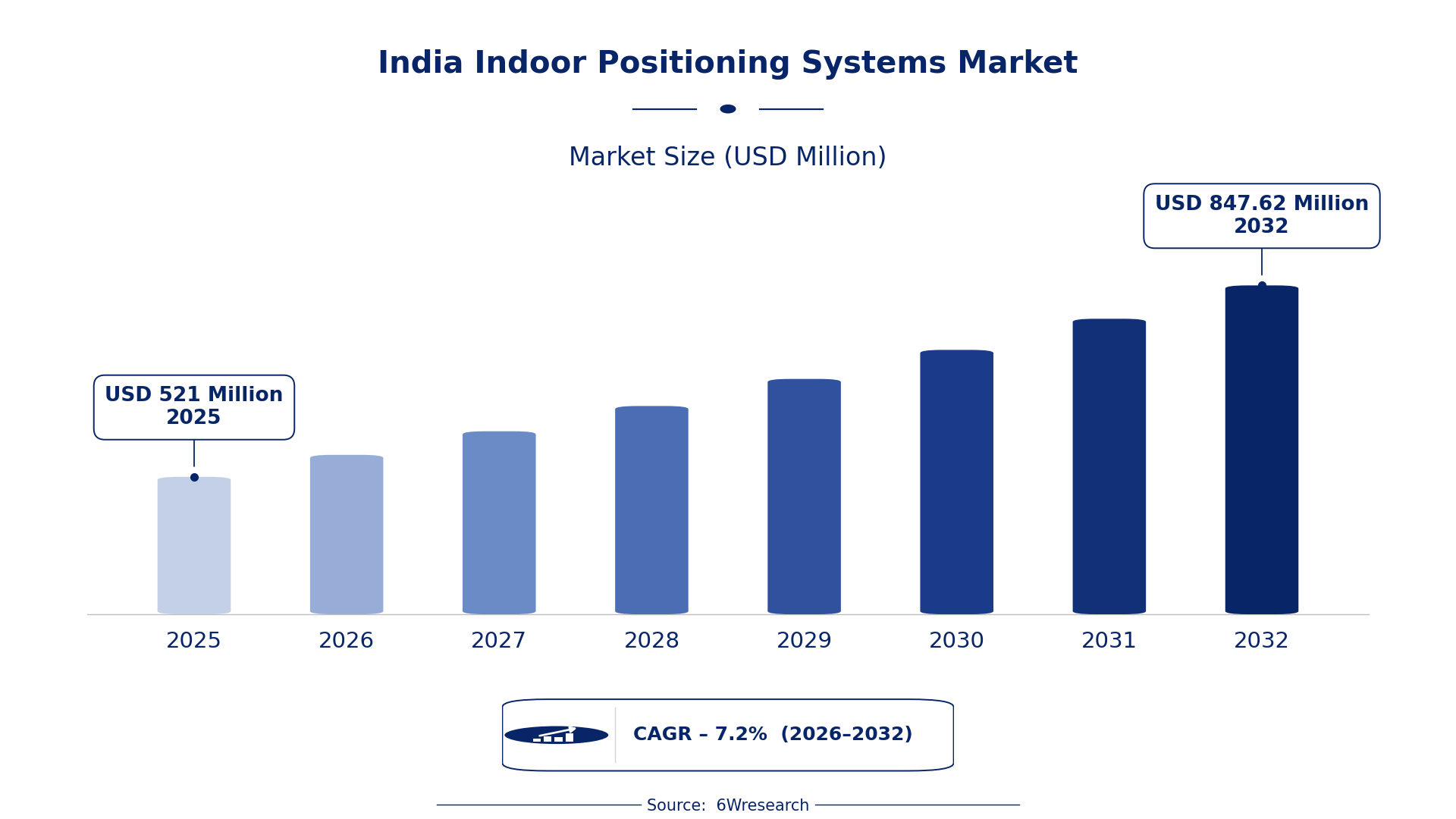
According to 6Wresearch internal database and industry insights, the India Indoor Positioning Systems Market was valued at USD 521.0 million in 2025 and is projected to reach USD 847.62 million by 2032, growing at a CAGR of approximately 7.2% during 2026–2032.
India Indoor Positioning Systems Market Highlights
| Report Metric | Details |
| Report Name | India Indoor Positioning Systems Market |
| Market Size 2025 | USD 521.0 million |
| Market Size 2032 | USD 847.62 million |
| Absolute Growth 2025–2032 | USD 326.62 million |
| CAGR 2026–2032 | 7.2% |
| Peak Annual Growth | 9.3% in 2026 |
| Forecast Period | 2026–2032 |
| Historical Data | 2022–2025 |
| Base Year | 2025 |
| Leading Technology Used, 2025 | Bluetooth Beacons (47% share) |
| Leading Accuracy Level, 2025 | 1–5 meters (48% share) |
| Leading Use Case, 2025 | Retail Navigation (49% share) |
| Leading End User, 2025 | Mall Management Firms (47% share) |
| Fastest-Growing Technology Used | Ultra-Wideband (UWB) (8.3% CAGR) |
| Fastest-Growing Accuracy Level | <30 cm (9.2% CAGR) |
| Fastest-Growing Use Case | Industrial Asset Tracking (9.0% CAGR) |
| Fastest-Growing End User | Warehouses (10.0% CAGR) |
| Growing Sector | Retail Navigation |
| Key End Users | Mall Management Firms, Logistics Companies, Facility IT Teams, Urban Planners |
India Indoor Positioning Systems Market Year-wise Growth Rate and Key Drivers (2022–2032)
This graph illustrates the annual growth rates of the market from 2022 to 2032, highlighting a steady upward trajectory and projected market expansion over the forecast period.
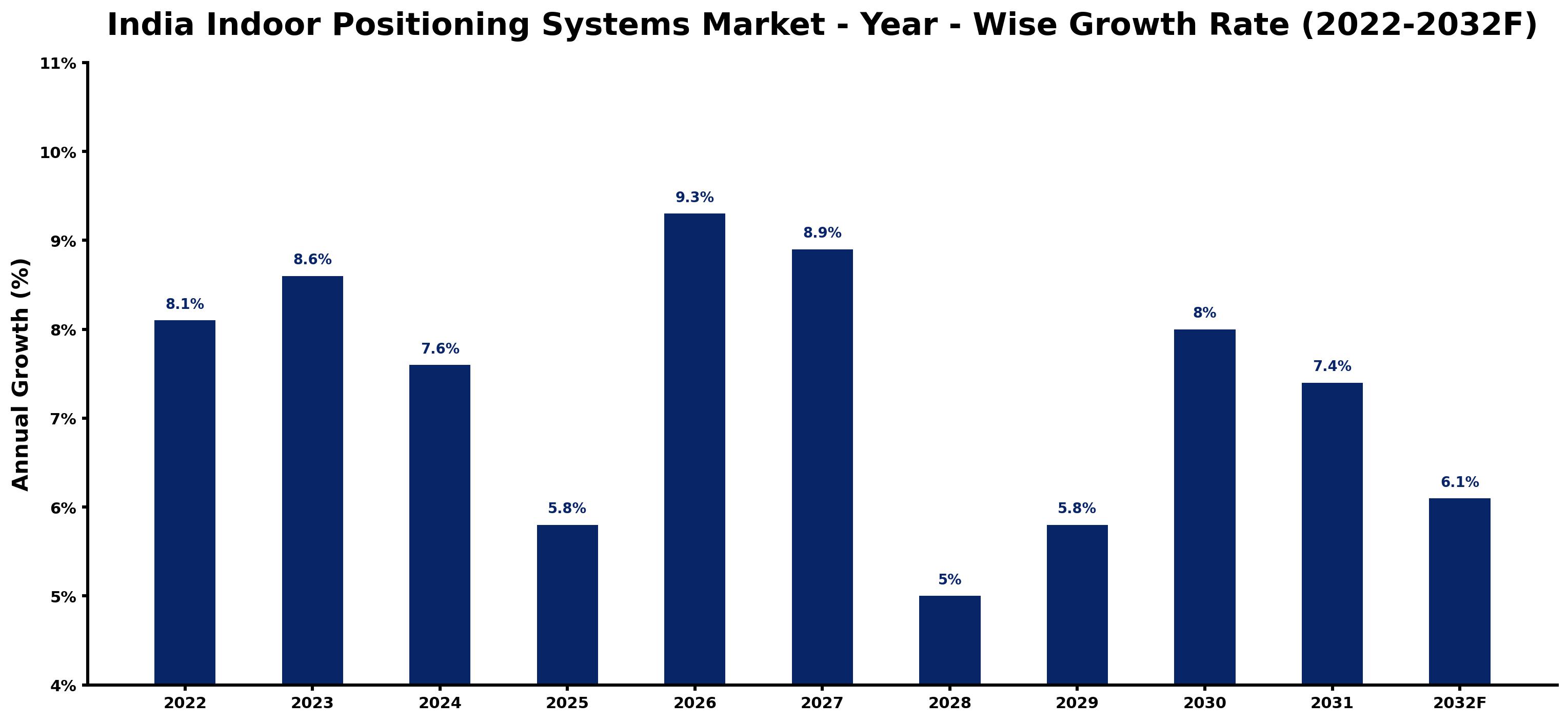
Below, each year's estimated growth is shown next to the factor that most influenced it.
| Year | Estimated Annual Growth (%) | Market Rationale |
| 2022 | 8.1 | The market experienced steady growth due to increased adoption of IPS technologies in retail environments. |
| 2023 | 8.6 | Demand surged as more shopping malls integrated IPS for enhanced customer navigation services. |
| 2024 | 7.6 | Growth slowed as the market adjusted to the saturation of IPS in major retail spaces. |
| 2025 | 5.8 | Continued expansion in logistics and smart building initiatives contributed to further growth. |
| 2026 | 9.3 | The peak growth year saw significant investments in Ultra-Wideband technology for asset tracking. |
| 2027 | 8.9 | A slight slowdown occurred as the market matured and competition intensified. |
| 2028 | 5.0 | Growth continued to decelerate as the market stabilised around established technologies. |
| 2029 | 5.8 | An uptick in demand for IPS in warehouses led to a faster growth rate. |
| 2030 | 8.0 | Increased smartphone penetration supported a rise in consumer-facing IPS applications. |
| 2031 | 7.4 | Growth slowed again as the market reached a more mature phase with established players. |
| 2032 | 6.1 | The market stabilised as demand for IPS in public transport systems continued to grow. |
Note: Market size estimations and growth projections presented in this report are based on 6Wresearch's proprietary forecasting methodology, utilizing the latest available industry data, government publications, and primary research inputs.
India Indoor Positioning Systems Market Synopsis
Indoor Positioning Systems in India encompass technologies that determine the location of objects or individuals indoors. These systems utilise hardware like beacons and software for data processing, primarily used in retail navigation and asset tracking. The India Indoor Positioning Systems Market is experiencing robust growth driven by sectors such as retail and logistics. The Smart Cities Mission promotes advanced technologies, while over 70% of major airports are implementing IPS for improved passenger services. This combination of factors is leading to increased adoption and investment in IPS solutions across various industries.
Market Dynamics Impact Analysis (2026–2032)
| Factor | Type | Impact | Primary Segment Affected |
| Rising adoption of Bluetooth beacons in over 50 shopping malls enhances navigation services. | Driver | High | Bluetooth Beacons |
| Increasing demand for Ultra-Wideband technology in logistics improves asset tracking capabilities. | Driver | High | Ultra-Wideband (UWB) |
| Expansion of smart building initiatives creates opportunities for IPS integration in urban planning. | Opportunity | High | Bluetooth Beacons |
| The growing number of operational shopping malls presents a significant market for IPS solutions. | Opportunity | High | Retail Navigation |
| Limited interoperability guidelines may hinder the adoption of IPS technologies. | Restraint | Medium | Bluetooth Beacons |
| High initial investment costs for IPS implementation can deter smaller businesses from adopting these systems. | Restraint | Medium | Bluetooth Beacons |
| The market still has to solve a few problems, including the need for standardisation across technologies. | Challenge | Medium | Bluetooth Beacons |
| Competition from alternative navigation technologies poses a threat to IPS market growth. | Challenge | Medium | Bluetooth Beacons |
Evaluation of Drivers in India Indoor Positioning Systems Market (2026–2032)
The main growth drivers and the segments they affect most are set out below.
| Drivers | Primary Segment Affected | Why It Matters (Evidence) |
| Increasing retail navigation demand boosts the use of IPS technologies. | Retail Navigation | With over 1,200 operational shopping malls in India, demand for IPS solutions is rising as retailers seek to improve customer experience. |
| Logistics companies are investing in Ultra-Wideband technology for real-time tracking. | Ultra-Wideband (UWB) | This technology is gaining traction in logistics, improving efficiency in over 70% of warehouses across the country. |
| Smartphone penetration facilitates user-friendly IPS applications for consumers. | Smartphone Integration | With over 700 million smartphones in India, the demand for IPS applications is increasing. |
| The Smart Cities Mission promotes the integration of IPS in urban environments. | Bluetooth Beacons | Government initiatives are encouraging the adoption of advanced technologies, including IPS, in urban planning projects. |
| Bluetooth beacons are widely deployed for navigation in public spaces. | Bluetooth Beacons | These beacons are used in over 50 shopping malls across major cities for improved navigation services. |
Growth across the Indoor Positioning Systems market in India is anchored in rising retail navigation demand, logistics investments, and smartphone penetration. Operational shopping malls are increasingly adopting IPS to improve customer experience, while logistics companies are investing in advanced technology for real-time asset tracking. With smartphone penetration exceeding 700 million, the demand for user-friendly IPS applications is surging. The Smart Cities Mission is promoting the integration of IPS in urban environments, encouraging advanced technology adoption. Bluetooth beacons are widely deployed in numerous shopping malls across major cities, improving navigation services and driving further interest in IPS solutions.
Evaluation of Restraints in India Indoor Positioning Systems Market
The key brakes on demand, and where they bite hardest, are shown below.
| Market Restraint | Primary Segment Affected | Why It Matters (Evidence) |
| Limited interoperability guidelines hinder IPS adoption across various sectors. | Bluetooth Beacons | The Bureau of Indian Standards has set guidelines, but many technologies lack standardisation. |
| High initial investment costs deter smaller businesses from adopting IPS. | Bluetooth Beacons | The substantial costs associated with implementation can be a barrier for many potential users. |
| Technological competition from alternative navigation solutions threatens IPS market growth. | Bluetooth Beacons | Emerging technologies may offer similar functionalities at lower costs, impacting IPS demand. |
| Market maturity leads to slower growth as competition intensifies. | Bluetooth Beacons | As the market stabilises, growth rates may slow due to increased competition among established players. |
| Consumer awareness of IPS benefits remains limited, affecting adoption rates. | Bluetooth Beacons | Many potential users are still unaware of the advantages IPS can provide in various applications. |
India Indoor Positioning Systems Market Challenges
The India Indoor Positioning Systems market still has to solve a few problems, and the first is intense competition. Numerous suppliers provide similar technologies, which drives down prices and reduces profit margins for producers. A lack of skilled professionals in the IPS sector presents another hurdle, as companies struggle to find qualified personnel to implement and maintain these systems, delaying project timelines for buyers. Compliance with guidelines set by the Bureau of Indian Standards can slow down the adoption of new technologies, impacting project initiation for suppliers. Supply chain issues arise from reliance on imported components, leading to delays in project delivery for buyers, particularly during global logistics disruptions.
Trends in the India Indoor Positioning Systems Market
Buyers and suppliers in the India Indoor Positioning Systems Market are adjusting to the following trends.
- Shift towards Improved Retail Navigation: Mall Management Firms are increasingly adopting IPS to enhance customer navigation experiences. Over 70% of major airports in India are implementing IPS for passenger services, indicating a strong trend towards better navigation solutions.
- Transition to Ultra-Wideband Technology: Since 2023, logistics companies have been transitioning to Ultra-Wideband technology for asset tracking. This shift is projected to provide real-time tracking capabilities, with a CAGR of 8.3% in the coming years.
- Integration of IPS in Smart Cities: The Smart Cities Mission, launched in 2020, is driving the integration of IPS in urban planning projects. This initiative aims to improve navigation services in public spaces, with substantial funding allocated for technology adoption.
- Increase in Smartphone-Enabled IPS Applications: With smartphone penetration exceeding 700 million, there is a growing trend towards smartphone-enabled IPS applications. This shift is facilitating user-friendly access to positioning services across various sectors.
Investment Opportunities in the India Indoor Positioning Systems Market
The following opportunities in the India Indoor Positioning Systems Market pair current demand with a clear way in.
- Current Demand for IPS in Retail: With over 1,200 operational shopping malls, there is a growing opportunity to supply IPS solutions. The retail sector is increasingly investing in navigation technologies to improve customer experience.
- Need for Logistics Solutions: As logistics companies seek to improve efficiency, there is a demand for IPS solutions. The implementation of Ultra-Wideband technology in warehouses presents a strong investment opportunity.
- Expansion of Smart Building Projects: The ongoing Smart Cities Mission creates a demand for IPS in urban environments. Investing in smart building technologies can lead to fruitful partnerships with urban planners and developers.
- Adoption in Public Transport: The government has allocated funds under the Smart Cities Mission to integrate IPS in public transport systems. This presents an opportunity for suppliers to engage with municipal authorities.
Government Initiatives in the India Indoor Positioning Systems Market
The Bureau of Indian Standards has established guidelines for indoor positioning technologies to ensure interoperability and safety. These guidelines, implemented in 2021, require producers to adhere to specific standards, improving the reliability of IPS solutions in India. Compliance with these standards is essential for market acceptance and consumer trust. The Digital India initiative, launched in 2020, encourages the use of IPS in public spaces, promoting better navigation services and user experiences.
The Ministry of Housing and Urban Affairs oversees the Smart Cities Mission, which funds the integration of IPS in urban planning projects. This agency approves various projects aimed at improving urban infrastructure and navigation services. The government has allocated substantial funds to support these initiatives, ensuring that IPS technologies are effectively implemented in public transport systems and smart building projects.
Future Insight of the India Indoor Positioning Systems Market
The India Indoor Positioning Systems market is set to transform by 2032, driven by several pivotal factors. The Smart Cities Mission will continue to promote the integration of IPS in urban planning, enhancing navigation in public spaces. The adoption of Ultra-Wideband technology will improve real-time asset tracking in logistics, streamlining operations for suppliers. With over 1,200 operational shopping malls adopting IPS, the retail sector will see improved customer experiences, attracting more buyers. The Digital India initiative will further encourage the use of IPS in public transport systems, simplifying navigation for millions.
Market Segmentation Analysis
The report offers a comprehensive study of the following market segments and their leading categories in the market.
By Technology Used – Bluetooth Beacons Dominated, Ultra-Wideband (UWB) Expected to Grow Fastest
According to Sachin Kumar Rai, Senior Research Analyst at 6Wresearch, in 2025, Bluetooth Beacons led the technology used split with a 47% share. Bluetooth beacons dominate the India Indoor Positioning Systems market due to their widespread implementation in over 50 shopping malls across major cities. These beacons are crucial for location tracking, significantly enhancing customer navigation and engagement in retail environments. The quickest growth will come from Ultra-Wideband (UWB), forecast to expand at a CAGR of 8.3% between 2026 and 2032. Ultra-Wideband technology is experiencing rapid growth in logistics for real-time asset tracking in warehouses, where precise location data is essential. This trend is propelled by the increasing demand for accurate tracking solutions in supply chain operations. Suppliers should focus on developing Ultra-Wideband solutions to capture the growing need for precision in logistics and industrial applications.
By Accuracy Level – 1–5 meters Dominated, <30 cm Expected to Grow Fastest
1–5 meters accounted for a 48% market share by accuracy level in 2025. The 1–5 meters accuracy range is prevalent in the India Indoor Positioning Systems market, particularly for retail navigation, where it enhances the overall customer experience. This accuracy level is widely accepted in various retail environments, ensuring effective navigation for shoppers. Over 2026–2032, <30 cm is expected to post the fastest growth, at a CAGR of 9.2%. The <30 cm accuracy level is rapidly gaining popularity in industrial applications, where high precision is critical for efficient operations. This demand is spurred by the need for accurate asset tracking and inventory management in warehouses. Buyers should prioritise solutions that offer high accuracy levels to optimise operational efficiencies, especially in industrial contexts.
By Use Case – Retail Navigation Dominated, Industrial Asset Tracking Expected to Grow Fastest
Retail Navigation took a 49% share of use case in 2025, more than any other category. Retail navigation is the leading use case in the market, as it is vital for enhancing customer experience in stores, allowing shoppers to find products quickly. This use case is particularly significant in India's growing retail sector, where competition is intense. Industrial Asset Tracking is projected to grow fastest, at a CAGR of 9.0% during 2026–2032. Industrial asset tracking is witnessing swift growth as companies seek to improve efficiency in warehouses through better inventory management. The increasing complexity of supply chains is driving this demand for precise tracking solutions. Suppliers should customise their offerings to address the specific needs of both the retail and industrial sectors to effectively capture market share.
By End User – Mall Management Firms Dominated, Warehouses Expected to Grow Fastest
Mall Management Firms held a 47% share of the India Indoor Positioning Systems Market by end user in 2025. Mall management firms are the primary users of Indoor Positioning Systems in India, leveraging these technologies for customer navigation in over 1,200 operational shopping malls. This large user base ensures a steady demand for IPS solutions. Warehouses are set to record the highest CAGR in this split, 10.0% over 2026–2032. Warehouses are increasingly adopting IPS for inventory management, motivated by the need for enhanced operational efficiency and accuracy. This trend is particularly strong as logistics companies aim to optimise their processes. Suppliers must engage with warehouse operators to provide tailored IPS solutions that enhance inventory management and operational efficiency.
Key Attractiveness of the Report
- 10 Years of Market Numbers
- Historical Data Starting from 2022 to 2025
- Base Year 2025
- Forecast Data until 2032
- Key Performance Indicators Impacting the Market
- Major Upcoming Developments and Projects
Key Highlights of the Report:
- India Indoor Positioning Systems Market Outlook
- Market Size of India Indoor Positioning Systems Market, 2025
- Forecast of India Indoor Positioning Systems Market, 2032
- Historical Data and Forecast of India Indoor Positioning Systems Revenues & Volume for the Period 2022 - 2032F
- India Indoor Positioning Systems Market Trend Evolution
- India Indoor Positioning Systems Market Drivers and Challenges
- India Indoor Positioning Systems Price Trends
- India Indoor Positioning Systems Porter's Five Forces
- India Indoor Positioning Systems Industry Life Cycle
- Historical Data and Forecast of India Indoor Positioning Systems Market Revenues & Volume By Technology Used for the Period 2022 - 2032F
- Historical Data and Forecast of India Indoor Positioning Systems Market Revenues & Volume By Bluetooth Beacons for the Period 2022 - 2032F
- Historical Data and Forecast of India Indoor Positioning Systems Market Revenues & Volume By Ultra-Wideband (UWB) for the Period 2022 - 2032F
- Historical Data and Forecast of India Indoor Positioning Systems Market Revenues & Volume By Wi-Fi Triangulation for the Period 2022 - 2032F
- Historical Data and Forecast of India Indoor Positioning Systems Market Revenues & Volume By Magnetic Field Mapping for the Period 2022 - 2032F
- Historical Data and Forecast of India Indoor Positioning Systems Market Revenues & Volume By Accuracy Level for the Period 2022 - 2032F
- Historical Data and Forecast of India Indoor Positioning Systems Market Revenues & Volume By 1 5 meters for the Period 2022 - 2032F
- Historical Data and Forecast of India Indoor Positioning Systems Market Revenues & Volume By 30 cm for the Period 2022 - 2032F
- Historical Data and Forecast of India Indoor Positioning Systems Market Revenues & Volume By 5 10 meters for the Period 2022 - 2032F
- Historical Data and Forecast of India Indoor Positioning Systems Market Revenues & Volume By Smartphone Integration for the Period 2022 - 2032F
- Historical Data and Forecast of India Indoor Positioning Systems Market Revenues & Volume By Use Case for the Period 2022 - 2032F
- Historical Data and Forecast of India Indoor Positioning Systems Market Revenues & Volume By Retail Navigation for the Period 2022 - 2032F
- Historical Data and Forecast of India Indoor Positioning Systems Market Revenues & Volume By Industrial Asset Tracking for the Period 2022 - 2032F
- Historical Data and Forecast of India Indoor Positioning Systems Market Revenues & Volume By Office Space Utilization for the Period 2022 - 2032F
- Historical Data and Forecast of India Indoor Positioning Systems Market Revenues & Volume By Visitor Engagement for the Period 2022 - 2032F
- Historical Data and Forecast of India Indoor Positioning Systems Market Revenues & Volume By End User for the Period 2022 - 2032F
- Historical Data and Forecast of India Indoor Positioning Systems Market Revenues & Volume By Mall Management Firms for the Period 2022 - 2032F
- Historical Data and Forecast of India Indoor Positioning Systems Market Revenues & Volume By Warehouses for the Period 2022 - 2032F
- Historical Data and Forecast of India Indoor Positioning Systems Market Revenues & Volume By Facility IT Teams for the Period 2022 - 2032F
- Historical Data and Forecast of India Indoor Positioning Systems Market Revenues & Volume By Museums & Airports for the Period 2022 - 2032F
- India Indoor Positioning Systems Import Export Trade Statistics
- Market Opportunity Assessment By Technology Used
- Market Opportunity Assessment By Accuracy Level
- Market Opportunity Assessment By Use Case
- Market Opportunity Assessment By End User
- India Indoor Positioning Systems Top Companies Market Share
- India Indoor Positioning Systems Competitive Benchmarking By Technical and Operational Parameters
- India Indoor Positioning Systems Company Profiles
- India Indoor Positioning Systems Key Strategic Recommendations
Market Covered
The report offers an extensive study of the following market segments.
By Technology Used
- Bluetooth Beacons
- Ultra-Wideband (UWB)
- Wi-Fi Triangulation
- Magnetic Field Mapping
By Accuracy Level
- 1–5 meters
- <30 cm
- 5–10 meters
- Smartphone Integration
By Use Case
- Retail Navigation
- Industrial Asset Tracking
- Office Space Utilization
- Visitor Engagement
By End User
- Mall Management Firms
- Warehouses
- Facility IT Teams
- Museums & Airports































