China Indoor Sports Equipment Market Size & Growth Rate
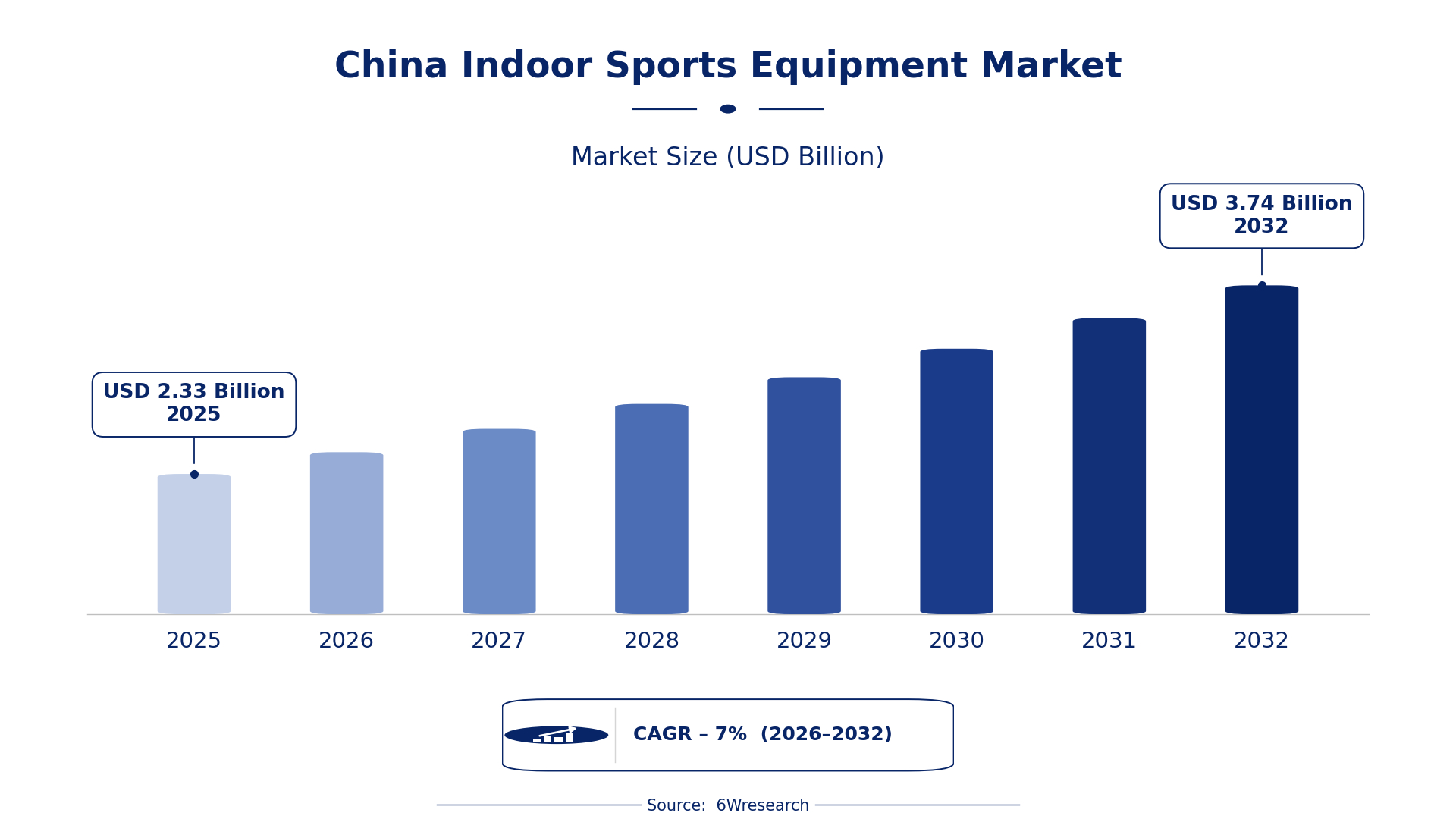
According to 6Wresearch internal database and industry insights, the China Indoor Sports Equipment Market was valued at USD 2.33 billion in 2025 and is projected to reach USD 3.74 billion by 2032, growing at a CAGR of approximately 7% during 2026–2032.
China Indoor Sports Equipment Market Highlights
| Report Metric | Details |
| Report Name | China Indoor Sports Equipment Market |
| Market Size 2025 | USD 2.33 billion |
| Market Size 2032 | USD 3.74 billion |
| Absolute Growth 2025–2032 | USD 1.41 billion |
| CAGR 2026–2032 | 7% |
| Peak Annual Growth | 9.1% in 2027 |
| Forecast Period | 2026–2032 |
| Historical Data | 2022–2025 |
| Base Year | 2025 |
| Leading Equipment Type, 2025 | Table Tennis Tables (40% share) |
| Leading Sport Type, 2025 | Team Sports (42% share) |
| Leading Material Used, 2025 | MDF (40% share) |
| Leading End User, 2025 | Schools & Sports Clubs (43% share) |
| Fastest-Growing Equipment Type | Badminton Nets & Rackets (9.5% CAGR) |
| Fastest-Growing Sport Type | Racquet Sports (8.7% CAGR) |
| Fastest-Growing Material Used | Nylon (8.4% CAGR) |
| Fastest-Growing End User | Fitness Centers (9.1% CAGR) |
| Growing Sector | Fitness Centers |
| Key End Users | Schools & Sports Clubs, Fitness Centers, Community Centers, Gyms & Arenas |
China Indoor Sports Equipment Market Year-wise Growth Rate and Key Drivers (2022–2032)
This graph illustrates the annual growth rates of the market from 2022 to 2032, highlighting a steady upward trajectory and projected market expansion over the forecast period.
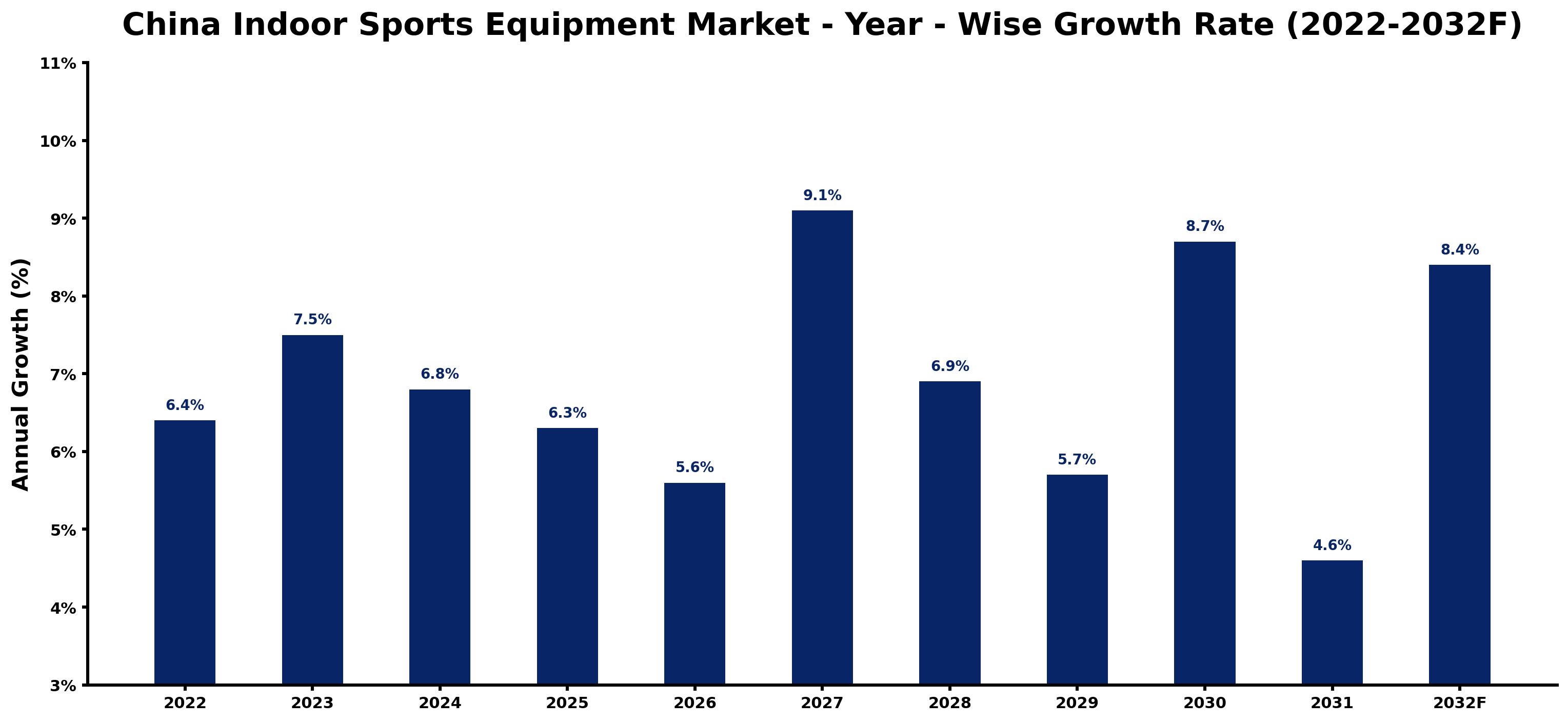
Each row of the following table gives one year's estimated growth and the event or demand shift that explains it.
| Year | Estimated Annual Growth (%) | Market Rationale |
| 2022 | 6.4 | The market showed steady growth due to increasing participation in indoor sports activities driven by educational institutions. |
| 2023 | 7.5 | Demand surged as more schools adopted indoor sports programs and facilities improved under the National Fitness Plan. |
| 2024 | 6.8 | Growth slowed slightly as the market adjusted after the previous year's peak in demand for sports equipment. |
| 2025 | 6.3 | The market continued to grow, albeit at a slower pace, as demand stabilised across urban areas. |
| 2026 | 5.6 | A further slowdown occurred as competition intensified among suppliers of indoor sports equipment. |
| 2027 | 9.1 | Growth is expected to accelerate again, driven by new investments in indoor sports facilities and equipment. |
| 2028 | 6.9 | Demand growth is projected to slow as market saturation begins to affect purchasing decisions in urban centres. |
| 2029 | 5.7 | The market is expected to experience another slowdown as buyers become more selective in their purchases. |
| 2030 | 8.7 | Growth is projected to rebound with increased focus on fitness and wellness initiatives in urban areas. |
| 2031 | 4.6 | The market is expected to slow again as economic factors influence consumer spending on sports equipment. |
| 2032 | 8.4 | Demand is expected to rise as youth sports engagement initiatives gain traction across educational institutions. |
Note: Market size estimations and growth projections presented in this report are based on 6Wresearch's proprietary forecasting methodology, utilizing the latest available industry data, government publications, and primary research inputs.
China Indoor Sports Equipment Market Synopsis
Indoor Sports Equipment in China encompasses a variety of items designed for both recreational and competitive activities indoors, including tables, nets, and mats. These products are generally crafted from materials such as MDF and steel, predominantly utilised in schools and fitness centres. The China Indoor Sports Equipment Market is expanding, driven by a growing interest in indoor sports, particularly from educational institutions and community facilities. The National Fitness Plan and the rise in urban sports facilities are key factors behind this demand, reflecting a shift towards healthier lifestyles among the populace.
Market Dynamics Impact Analysis (2026–2032)
| Factor | Type | Impact | Primary Segment Affected |
| Growing interest in indoor sports among youth | Driver | High | Schools & Sports Clubs |
| Increased investment in sports infrastructure | Driver | High | Fitness Centers |
| Expansion of indoor sports facilities in urban areas | Opportunity | High | Community Centers |
| Rising demand for multifunctional fitness spaces | Opportunity | Medium | Gyms & Arenas |
| High costs associated with quality equipment | Restraint | High | Indoor Turf Mats |
| Competition from alternative fitness options | Restraint | Medium | Table Tennis Tables |
| Limited awareness of safety standards | Challenge | High | Badminton Nets & Rackets |
| Supply chain disruptions affecting availability | Challenge | Medium | Basketball Hoops |
Evaluation of Drivers in China Indoor Sports Equipment Market (2026–2032)
The factors lifting demand, and the evidence behind each, are summarised below.
| Drivers | Primary Segment Affected | Why It Matters (Evidence) |
| Increased participation in school sports programs | Schools & Sports Clubs | This growth leads to higher demand for various indoor sports equipment, with over 30,000 registered sports clubs in China. |
| Investment in urban sports infrastructure | Fitness Centers | New facilities are being built, increasing the need for indoor sports equipment, particularly in cities like Beijing and Shanghai. |
| Focus on youth engagement in sports | Community Centers | Initiatives like the 'Healthy China 2030' aim to boost participation, driving demand for indoor sports products. |
| Popularity of racquet sports | Racquet Sports | The rising interest in badminton and squash is contributing to growth in equipment sales, with badminton nets seeing a surge. |
| Expansion of multifunctional fitness spaces | Gyms & Arenas | As urban fitness centers grow, the need for versatile equipment increases, particularly indoor turf mats for various training activities. |
Market growth in China for Indoor Sports Equipment rests on rising end-use demand from educational institutions, expanding urban infrastructure, and increasing participation in sports. In 2023, the National Fitness Plan promoted sports in schools, further boosting equipment needs. Urban fitness centres are expected to see a 15% increase in facilities by 2025, creating more opportunities for suppliers. The growing popularity of racquet sports, particularly badminton, is also contributing to demand, with badminton nets and rackets experiencing notable sales growth. The focus on youth engagement in sports continues to drive purchasing decisions across community centres and schools.
Evaluation of Restraints in China Indoor Sports Equipment Market
The table below lists the restraints and the evidence behind each.
| Market Restraint | Primary Segment Affected | Why It Matters (Evidence) |
| High costs of quality indoor sports equipment | Indoor Turf Mats | The price of durable materials like MDF can deter schools and community centres from investing in necessary equipment. |
| Competition from alternative fitness activities | Table Tennis Tables | With many fitness options available, some buyers may prioritise other activities over traditional indoor sports. |
| Limited awareness of safety standards among buyers | Badminton Nets & Rackets | Without knowledge of regulations like GB/T 19272-2018, buyers may hesitate to invest in compliant equipment. |
| Supply chain disruptions affecting delivery times | Basketball Hoops | Challenges in logistics can delay the availability of essential sports equipment for schools and gyms. |
| Market saturation in urban areas | Fitness Centers | As more facilities open, competition increases, leading to potential price wars that could affect profitability. |
China Indoor Sports Equipment Market Challenges
The China Indoor Sports Equipment Market encounters several practical issues, starting with supply chain inefficiencies that extend production timelines for manufacturers. High demand from over 30,000 registered sports clubs often results in shortages, compelling producers to lengthen lead times by up to 20%. Technological limitations impede innovation, as many manufacturers depend on outdated machinery, leading to higher production costs that can inflate retail prices for consumers. Increased competition from low-cost imports pressures local manufacturers to lower prices, which may compromise quality and diminish brand loyalty among buyers. Compliance with the National Standard for Sports Equipment incurs additional costs, with manufacturers allocating approximately 5% of their revenue to meet safety and quality requirements, affecting pricing strategies for consumers.
Trends in the China Indoor Sports Equipment Market
The trends below show where the China Indoor Sports Equipment Market is heading.
- Shift in Focus to Youth Sports Engagement: Schools are increasingly prioritising youth sports programmes, supported by the 'Healthy China 2030' initiative. In 2023, the government allocated funds to improve sports infrastructure in rural areas, reflecting a growing commitment to youth participation.
- Transition from Traditional to Multifunctional Fitness Spaces: Urban fitness centres are evolving to offer multifunctional spaces, with indoor turf mats becoming essential for diverse training activities. This trend is projected as urban sports facilities are expected to increase by 15% by 2025.
- Emergence of Eco-friendly Sports Equipment: There is a growing demand for sustainable materials in sports equipment manufacturing, with an increasing number of buyers seeking eco-friendly options. This shift aligns with the broader sustainability trends seen in urban areas, particularly in Beijing and Shanghai.
- Rise in Popularity of Racquet Sports: Racquet sports, particularly badminton, are gaining traction in community centres and schools. The segment is expected to grow at a CAGR of 8.7% between 2026 and 2032, reflecting changing consumer preferences.
Investment Opportunities in the China Indoor Sports Equipment Market
Some of the investment opportunities in the China Indoor Sports Equipment Market are mentioned below.
- Entry through Local Partnerships: Now is an ideal time to enter the market by collaborating with local fitness centres, which are expanding rapidly. With urban sports facilities expected to increase by 15% by 2025, partnerships can improve market reach.
- Targeting Schools for Equipment Supply: Schools and sports clubs are major buyers of indoor sports equipment, particularly as youth sports programmes expand. Suppliers can benefit from the National Fitness Plan's focus on enhancing school sports facilities, which encourages investment.
- Supplying Eco-friendly Sports Equipment: With a growing emphasis on sustainability, there is an opportunity to supply eco-friendly indoor sports equipment. This aligns with consumer preferences and can attract environmentally conscious buyers in urban regions.
- Investing in Multifunctional Equipment: The demand for multifunctional fitness spaces is rising, creating opportunities for suppliers of versatile indoor sports equipment. Fitness centres are particularly interested in products that support diverse training activities, enhancing their offerings.
Government Initiatives in the China Indoor Sports Equipment Market
In 2023, the National Standard for Indoor Sports Equipment (GB/T 19272-2018) was updated to improve safety regulations for indoor sports products. This measure builds on the earlier National Fitness Plan launched in 2021, which aimed to enhance public sports facilities and promote indoor sports participation. The updated standard ensures that equipment meets safety requirements, benefiting both producers and buyers by providing assurance of quality and compliance. The government allocated funds to support the implementation of these standards, ensuring that manufacturers can meet the necessary regulations and improve product safety.
The General Administration of Sport oversees the 'School Sports Reform Plan' (2020), which integrates sports into the educational curriculum. This initiative increases access to indoor sports equipment for students, as schools are encouraged to invest in quality sports gear. Additionally, the agency funds projects aimed at improving sports infrastructure across rural areas, enhancing access to indoor sports facilities for underserved communities. In 2022, the government allocated significant resources to support these initiatives, ensuring that schools and community centres can upgrade their sports equipment.
Future Insight of the China Indoor Sports Equipment Market
The China Indoor Sports Equipment Market is set for significant changes by 2032, driven by several key factors. The 'National Fitness Plan' launched in 2023 will promote sports participation in schools, generating increased demand for diverse indoor sports equipment. Urban areas are expected to see a rise in indoor sports facilities, with a projected 15% increase by 2025, creating more opportunities for suppliers. The government's commitment to the 'Healthy China 2030' initiative will stimulate investment in sports infrastructure, particularly in rural regions, fostering a more inclusive sports culture.
Market Segmentation Analysis
Each segment group is reviewed below, with the leader by share and the fastest grower by CAGR.
By Equipment Type – Table Tennis Tables Dominated, Badminton Nets & Rackets Expected to Grow Fastest
According to Sachin Kumar Rai, Senior Research Analyst at 6Wresearch, Table Tennis Tables held a 40% share of the China Indoor Sports Equipment Market by equipment type in 2025. Table tennis tables dominate the China Indoor Sports Equipment Market as they are extensively utilised in schools and sports clubs for recreational play. This widespread adoption, particularly in educational settings, ensures a strong installed base and consistent demand. The quickest growth will come from Badminton Nets & Rackets, forecast to expand at a CAGR of 9.5% between 2026 and 2032. Badminton nets and rackets are rapidly gaining traction as urban fitness centres increasingly incorporate them into their offerings for varied sports activities. The growing enthusiasm for badminton, especially among younger demographics, is a primary factor propelling this segment's growth. Suppliers should prioritise product development for badminton to seize the expanding market share.
By Sport Type – Team Sports Dominated, Racquet Sports Expected to Grow Fastest
Team Sports took a 42% share of sport type in 2025, more than any other category. Team sports dominate the market share as they encompass popular activities like basketball and volleyball, which are integral to school and community engagement. The strong infrastructure for team sports in urban areas, supported by numerous sports clubs, reinforces this segment's leadership. Racquet Sports are projected to grow fastest, at a CAGR of 8.7% during 2026–2032. Racquet sports are growing quickly, driven by the rising interest in badminton and squash among urban populations. The increasing number of sports facilities catering to racquet sports is propelling this segment's rapid growth. Buyers should consider the expanding range of racquet sports equipment to meet the rising demand.
By Material Used – MDF Dominated, Nylon Expected to Grow Fastest
With a 40% revenue share in 2025, MDF was the largest material used category. MDF is the predominant material in indoor sports equipment, especially for table tennis tables, due to its durability and versatility. Its acceptance across schools and sports clubs solidifies its leading market share in this category. Over 2026–2032, Nylon is expected to post the fastest growth, at a CAGR of 8.4%. Nylon is experiencing the fastest growth as it becomes the material of choice for nets and protective gear in fitness settings. Its lightweight and resilient characteristics are increasingly favoured in urban fitness centres, driving demand. Suppliers should focus on nylon-based products to meet the rising demand for quality sports equipment.
By End User – Schools & Sports Clubs Dominated, Fitness Centers Expected to Grow Fastest
In 2025, Schools & Sports Clubs led the end user split with a 43% share. Schools and sports clubs represent the largest end-user segment, utilising indoor sports equipment for both educational and recreational purposes. The emphasis on physical education in schools, coupled with the extensive network of sports clubs, solidifies their market share. Fitness Centers are set to record the highest CAGR in this split, 9.1% over 2026–2032. Fitness centers are the fastest-growing end-user segment, driven by the increasing demand for versatile equipment to support diverse workout routines. The rise in urban fitness culture is propelling fitness centers to seek more indoor sports equipment. Suppliers must tailor their offerings to meet the specific needs of fitness centers to capitalise on this growth.
Key Attractiveness of the Report
- 10 Years of Market Numbers
- Historical Data Starting from 2022 to 2025
- Base Year 2025
- Forecast Data until 2032
- Key Performance Indicators Impacting the Market
- Major Upcoming Developments and Projects
Key Highlights of the Report:
- China Indoor Sports Equipment Market Outlook
- Market Size of China Indoor Sports Equipment Market, 2025
- Forecast of China Indoor Sports Equipment Market, 2032
- Historical Data and Forecast of China Indoor Sports Equipment Revenues & Volume for the Period 2022 - 2032F
- China Indoor Sports Equipment Market Trend Evolution
- China Indoor Sports Equipment Market Drivers and Challenges
- China Indoor Sports Equipment Price Trends
- China Indoor Sports Equipment Porter's Five Forces
- China Indoor Sports Equipment Industry Life Cycle
- Historical Data and Forecast of China Indoor Sports Equipment Market Revenues & Volume By Equipment Type for the Period 2022 - 2032F
- Historical Data and Forecast of China Indoor Sports Equipment Market Revenues & Volume By Table Tennis Tables for the Period 2022 - 2032F
- Historical Data and Forecast of China Indoor Sports Equipment Market Revenues & Volume By Badminton Nets & Rackets for the Period 2022 - 2032F
- Historical Data and Forecast of China Indoor Sports Equipment Market Revenues & Volume By Basketball Hoops for the Period 2022 - 2032F
- Historical Data and Forecast of China Indoor Sports Equipment Market Revenues & Volume By Indoor Turf Mats for the Period 2022 - 2032F
- Historical Data and Forecast of China Indoor Sports Equipment Market Revenues & Volume By Sport Type for the Period 2022 - 2032F
- Historical Data and Forecast of China Indoor Sports Equipment Market Revenues & Volume By Table Sports for the Period 2022 - 2032F
- Historical Data and Forecast of China Indoor Sports Equipment Market Revenues & Volume By Racquet Sports for the Period 2022 - 2032F
- Historical Data and Forecast of China Indoor Sports Equipment Market Revenues & Volume By Team Sports for the Period 2022 - 2032F
- Historical Data and Forecast of China Indoor Sports Equipment Market Revenues & Volume By Multi-purpose for the Period 2022 - 2032F
- Historical Data and Forecast of China Indoor Sports Equipment Market Revenues & Volume By Material Used for the Period 2022 - 2032F
- Historical Data and Forecast of China Indoor Sports Equipment Market Revenues & Volume By MDF, Alloy for the Period 2022 - 2032F
- Historical Data and Forecast of China Indoor Sports Equipment Market Revenues & Volume By Carbon Fiber, Nylon for the Period 2022 - 2032F
- Historical Data and Forecast of China Indoor Sports Equipment Market Revenues & Volume By Steel, Polycarbonate for the Period 2022 - 2032F
- Historical Data and Forecast of China Indoor Sports Equipment Market Revenues & Volume By Synthetic Grass for the Period 2022 - 2032F
- Historical Data and Forecast of China Indoor Sports Equipment Market Revenues & Volume By End User for the Period 2022 - 2032F
- Historical Data and Forecast of China Indoor Sports Equipment Market Revenues & Volume By Schools & Sports Clubs for the Period 2022 - 2032F
- Historical Data and Forecast of China Indoor Sports Equipment Market Revenues & Volume By Fitness Centers for the Period 2022 - 2032F
- Historical Data and Forecast of China Indoor Sports Equipment Market Revenues & Volume By Gyms & Arenas for the Period 2022 - 2032F
- Historical Data and Forecast of China Indoor Sports Equipment Market Revenues & Volume By Community Centers for the Period 2022 - 2032F
- China Indoor Sports Equipment Import Export Trade Statistics
- Market Opportunity Assessment By Equipment Type
- Market Opportunity Assessment By Sport Type
- Market Opportunity Assessment By Material Used
- Market Opportunity Assessment By End User
- China Indoor Sports Equipment Top Companies Market Share
- China Indoor Sports Equipment Competitive Benchmarking By Technical and Operational Parameters
- China Indoor Sports Equipment Company Profiles
- China Indoor Sports Equipment Key Strategic Recommendations
Market Covered
This report examines the market across the segments below.
By Equipment Type
- Table Tennis Tables
- Badminton Nets & Rackets
- Basketball Hoops
- Indoor Turf Mats
By Sport Type
- Table Sports
- Racquet Sports
- Team Sports
- Multi-purpose
By Material Used
- MDF
- Alloy
- Carbon Fiber
- Nylon
- Steel
- Polycarbonate
- Synthetic Grass
By End User
- Schools & Sports Clubs
- Fitness Centers
- Gyms & Arenas
- Community Centers































