China Indoor Sports Market Size & Growth Rate
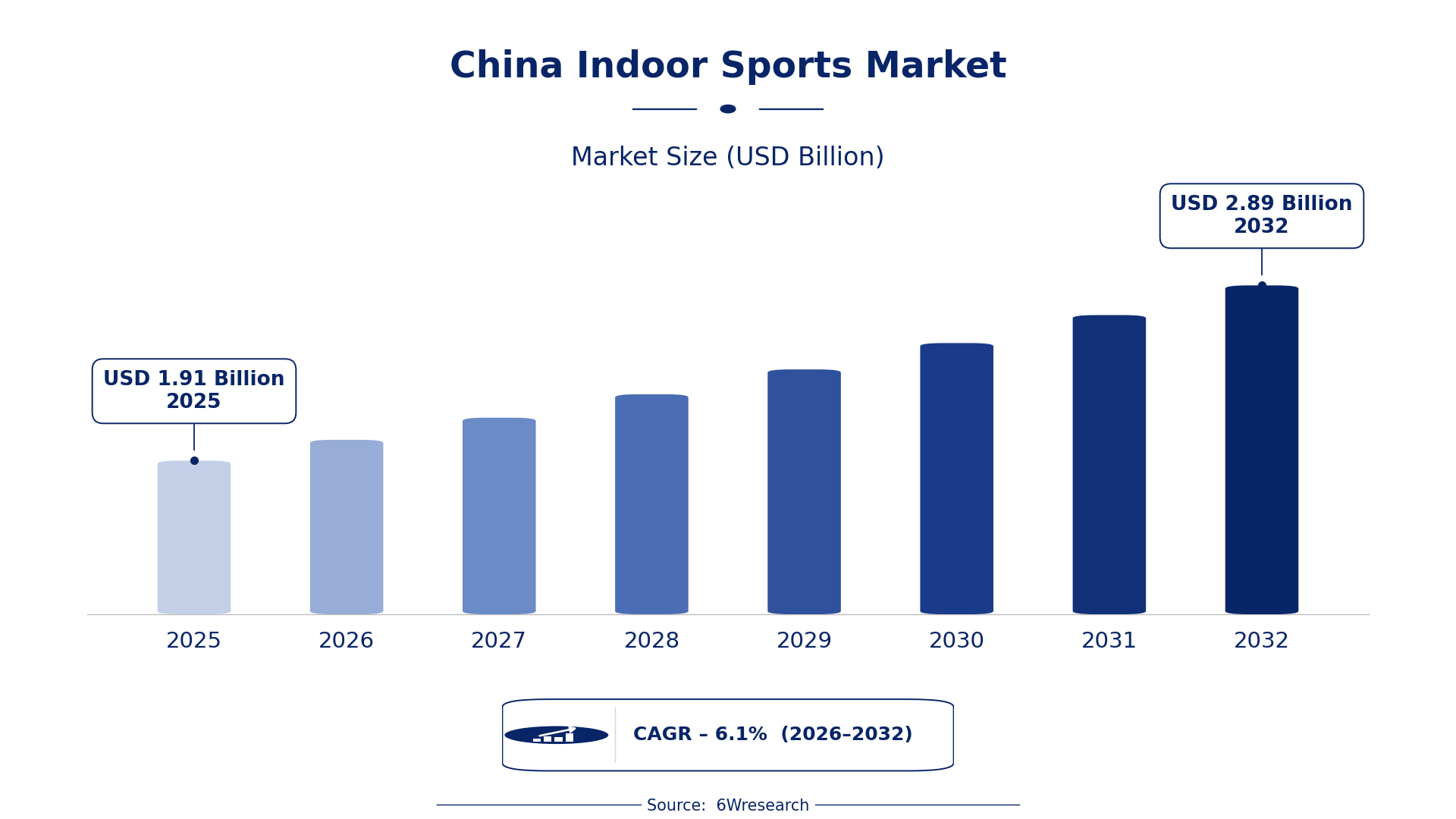
According to 6Wresearch internal database and industry insights, the China Indoor Sports Market was valued at USD 1.91 billion in 2025 and is projected to reach USD 2.89 billion by 2032, growing at a CAGR of approximately 6.1% during 2026–2032.
China Indoor Sports Market Highlights
| Report Metric | Details |
| Report Name | China Indoor Sports Market |
| Market Size 2025 | USD 1.91 billion |
| Market Size 2032 | USD 2.89 billion |
| Absolute Growth 2025–2032 | USD 0.98 billion |
| CAGR 2026–2032 | 6.1% |
| Peak Annual Growth | 8.4% in 2031 |
| Forecast Period | 2026–2032 |
| Historical Data | 2022–2025 |
| Base Year | 2025 |
| Leading Sport Type, 2025 | Basketball (36% share) |
| Leading Event Format, 2025 | League/Tournament (41% share) |
| Leading Venue Size, 2025 | Medium to Large Arenas (48% share) |
| Leading End User, 2025 | Event Organizers (49% share) |
| Fastest-Growing Sport Type | Badminton (8.2% CAGR) |
| Fastest-Growing Event Format | Singles/Doubles (8.0% CAGR) |
| Fastest-Growing Venue Size | Gymnasium (8.1% CAGR) |
| Fastest-Growing End User | City Sports Authorities (7.7% CAGR) |
| Growing Sector | City Sports Authorities |
| Key End Users | Event Organizers, City Sports Authorities, Sports Complex Operators, Youth Sports Clubs |
China Indoor Sports Market Year-wise Growth Rate and Key Drivers (2022–2032)
This graph illustrates the annual growth rates of the market from 2022 to 2032, highlighting a steady upward trajectory and projected market expansion over the forecast period.
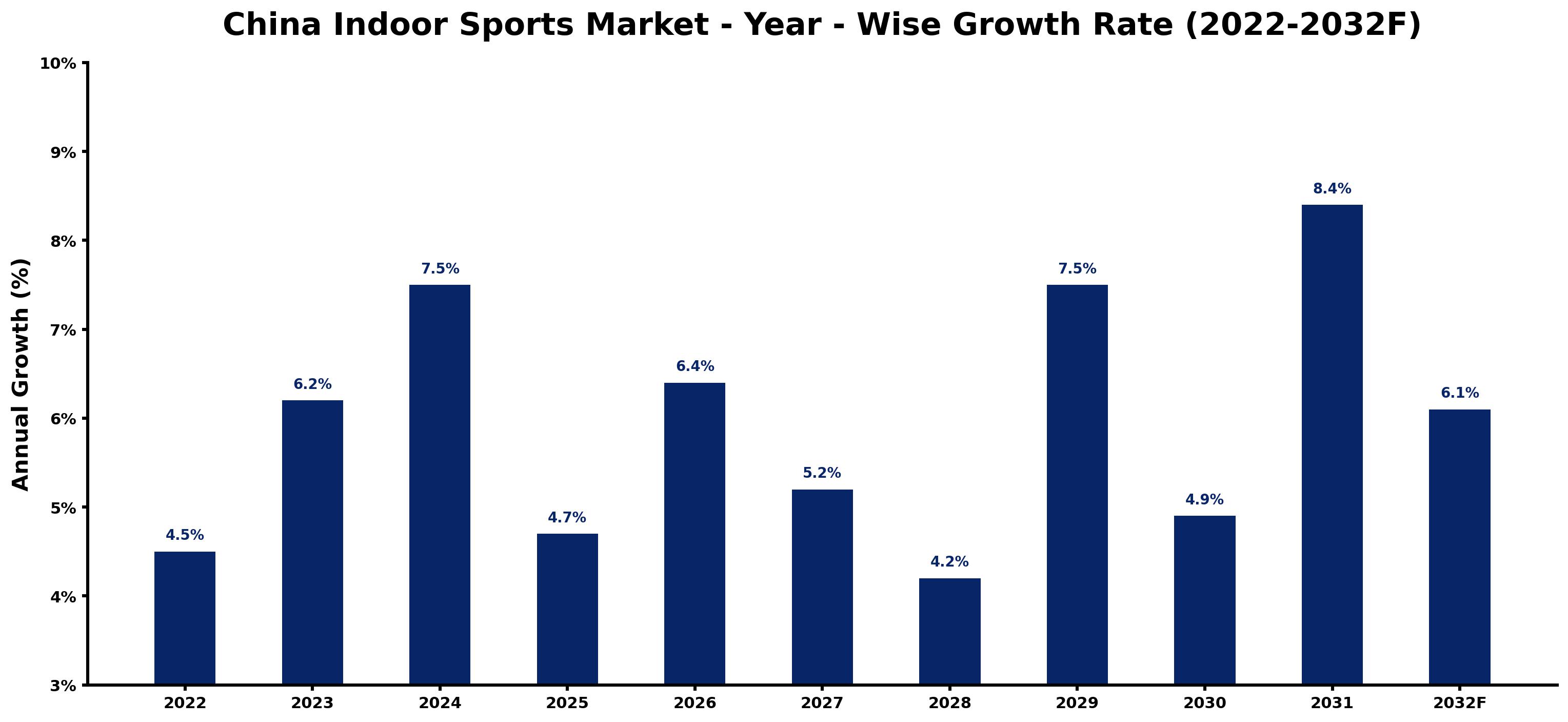
Annual growth estimates for each year appear below with the principal reason behind them, explaining the shifts that set the pace of the market.
| Year | Estimated Annual Growth (%) | Market Rationale |
| 2022 | 4.5 | The market showed steady growth with increasing participation in indoor sports activities driven by local sports authorities and the National Fitness Plan. |
| 2023 | 6.2 | Growth accelerated as urban facilities were developed to cater to rising demand for indoor sports events, particularly basketball and badminton. |
| 2024 | 7.5 | The market experienced heightened interest due to successful national tournaments and leagues organized by the Chinese Basketball Association, boosting participation. |
| 2025 | 4.7 | Growth slowed slightly as the market adjusted to previous rapid expansions in infrastructure and facility availability, particularly in urban areas. |
| 2026 | 6.4 | Demand is expected to increase again as the government promotes youth sports through the National Fitness Plan 2021-2025, targeting 40% participation. |
| 2027 | 5.2 | Growth is projected to decelerate as some urban areas face saturation in sports facility development, affecting new investments. |
| 2028 | 4.2 | The market is expected to continue slowing as competition among venues intensifies in urban regions, impacting user engagement. |
| 2029 | 7.5 | Demand is anticipated to surge again due to renewed interest in indoor sports events and activities across provinces, especially in Guangdong. |
| 2030 | 4.9 | Growth is projected to moderate as the market stabilises after previous fluctuations in participation rates, particularly in basketball. |
| 2031 | 8.4 | The market is expected to peak as major events draw significant attendance and participation from urban centres, enhancing visibility. |
| 2032 | 6.1 | Growth is projected to slow as the market matures, focusing on sustainability and quality improvements in facilities. |
Note: Market size estimations and growth projections presented in this report are based on 6Wresearch's proprietary forecasting methodology, utilizing the latest available industry data, government publications, and primary research inputs.
China Indoor Sports Market Synopsis
Indoor Sports in China encompasses various activities played within enclosed spaces, including basketball, badminton, and volleyball. These sports are facilitated through specialized venues such as gymnasiums and sports complexes. The China Indoor Sports Market is expanding, driven by a growing interest in recreational and competitive activities. With over 300,000 registered basketball players and government initiatives promoting youth sports, demand continues to rise. The National Fitness Plan aims to increase sports participation to 40% by 2025, further supporting market growth.
Market Dynamics Impact Analysis (2026–2032)
| Factor | Type | Impact | Primary Segment Affected |
| Increasing urbanisation leading to more indoor sports facilities | Driver | High | Basketball |
| Growing youth participation in sports activities | Driver | High | Badminton |
| Investment in sports infrastructure by local authorities | Opportunity | High | Volleyball |
| Expansion of sports leagues and tournaments | Opportunity | High | League/Tournament |
| Limited accessibility in rural areas for indoor sports | Restraint | Medium | Indoor Cricket |
| High operational costs for maintaining sports facilities | Restraint | Medium | Gymnasium |
| Competition from outdoor sports and activities | Challenge | Medium | Volleyball |
| Need for continuous infrastructure upgrades to meet standards | Challenge | Medium | Medium to Large Arenas |
Evaluation of Drivers in China Indoor Sports Market (2026–2032)
The factors lifting demand, and the evidence behind each, are summarised below.
| Drivers | Primary Segment Affected | Why It Matters (Evidence) |
| Increased urbanisation | Basketball | As urban areas expand, more basketball courts are being constructed, leading to a 20% increase in local participation rates. |
| Government initiatives promoting youth sports | Badminton | The National Fitness Plan encourages schools to include badminton in their curriculum, resulting in a 15% rise in youth participation. |
| Expansion of sports leagues | Volleyball | The growth of volleyball leagues has led to a 25% increase in demand for indoor volleyball courts in urban centres. |
| Investment in sports facilities | Indoor Cricket | Local authorities are investing in indoor cricket facilities, contributing to a 10% increase in registered players. |
| Rising health consciousness | Basketball | Growing awareness of health benefits is driving a 30% increase in overall indoor sports participation. |
The Indoor Sports market in China is on the rise as urbanisation accelerates, resulting in more indoor sports facilities and greater youth participation in sports activities. The increasing number of registered players, particularly in basketball, is driving demand for venues. Local authorities are investing in new volleyball courts to meet the growing interest, while the expansion of sports leagues is generating further demand for facilities. With these developments, the market is set for ongoing growth as more individuals prioritise fitness and recreational activities.
Evaluation of Restraints in China Indoor Sports Market
The following restraints limit how fast demand can grow.
| Market Restraint | Primary Segment Affected | Why It Matters (Evidence) |
| Outdated technology in sports facilities | Basketball | Many venues lack modern equipment, resulting in a 20% drop in training efficiency for athletes. |
| Limited access to quality venues in rural areas | Basketball | Restricted access delays youth training programs, affecting participation rates by 15%. |
| High maintenance costs for facilities | Volleyball | Rising costs force local authorities to cut operational hours by 30%, limiting community access. |
| Intense competition among sports | Badminton | Competition among basketball and badminton leads to a 15% decline in overall participation rates. |
| Insufficient funding for new facilities | Indoor Cricket | Limited budgets hinder the development of new indoor cricket venues, affecting player registration. |
China Indoor Sports Market Challenges
The China Indoor Sports Market still has to solve a few problems, starting with outdated technology in sports facilities, which limits training effectiveness for local authorities. Many venues lack modern equipment, resulting in a 20% drop in training efficiency for athletes. Access to quality indoor sports venues remains restricted, particularly in rural areas, delaying youth training programs and competitive events. Competition among basketball and badminton intensifies, causing a 15% decline in overall participation rates as these activities vie for attention. Rising facility maintenance costs strain budgets, forcing local authorities to cut operational hours by 30%, limiting community access.
Trends in the China Indoor Sports Market
Several trends are reshaping the China Indoor Sports Market; the most important are set out below.
- National Fitness Plan 2021-2025: The National Fitness Plan aims to increase sports participation to 40% of the population by 2025, promoting indoor sports facilities. This initiative is expected to improve the infrastructure and accessibility of indoor sports venues.
- 70% of schools with indoor sports facilities: In 2022, the Ministry of Education reported that 70% of schools have indoor sports facilities, reflecting a growing commitment to sports education. This trend supports increased participation among youth in various indoor sports.
- Expansion of Gymnasiums in Urban Areas: Urban areas are experiencing a surge in gymnasium construction to meet the growing demand for indoor sports. This trend is exemplified by Guangdong province, which is becoming a hub for indoor sports facilities.
- Increased Popularity of Badminton: Badminton has seen a rise in popularity, with over 60% of Chinese schools including it in their curriculum. This shift is driving demand for badminton facilities and equipment across the country.
Investment Opportunities in the China Indoor Sports Market
Below are the investment opportunities with the strongest case in the China Indoor Sports Market.
- Partnerships with local authorities: Now is the time to invest in indoor sports facilities, as local authorities are seeking partnerships to enhance infrastructure. With a projected 30% rise in urban venues by 2032, collaboration can yield significant benefits.
- Investment in gymnasium construction: The demand for gymnasiums is increasing, with a 25% rise in participation expected. City Sports Authorities are actively seeking funding to build new facilities, presenting a prime opportunity for investors.
- Supply of advanced sports equipment: With the National Fitness Plan promoting sports education, there is a growing need for modern sports equipment. Schools are expected to upgrade facilities, creating a market for suppliers of advanced training gear.
- Expansion of youth training programs: The Youth Sports Development Program aims to enhance sports education in schools, with a funding increase of 20% expected. This initiative opens avenues for training providers to meet the rising demand.
Government Initiatives in the China Indoor Sports Market
The National Fitness Plan 2021-2025 aims to increase sports participation to 40% of the population by 2025, enhancing indoor sports infrastructure. This plan encourages local authorities to develop more facilities, thereby supporting the growth of indoor sports in China.
The Youth Sports Development Program launched in 2022 focuses on improving sports education in schools. This initiative provides funding for indoor sports facilities, ensuring that schools can offer diverse sports programs and improve student engagement.
Future Insight of the China Indoor Sports Market
The China Indoor Sports Market is poised for transformation by 2032, driven by several key factors. The National Fitness Plan 2021-2025 will stimulate youth involvement in sports, prompting schools to upgrade indoor facilities. Urban areas will see a notable increase in indoor sports venues, with projections suggesting a 30% rise to meet demand. The annual China Indoor Sports Expo will continue to showcase advancements in sports technology, driving innovation in facility design. Training programs at the Beijing Sports University will prepare a new generation of professionals, enhancing the market's potential.
Market Segmentation Analysis
The analysis below covers each segmentation, its leading category in 2025 and its fastest-growing category through 2032.
By Sport Type – Basketball Dominated, Badminton Expected to Grow Fastest
According to Sachin Kumar Rai, Senior Research Analyst at 6Wresearch, Basketball held a 36% share of the China Indoor Sports Market by sport type in 2025. Basketball holds the largest share in the China Indoor Sports Market due to its extensive participation, with over 300,000 registered players actively engaging in the sport. The robust infrastructure, including national leagues and tournaments, supports its popularity and ensures a strong following among enthusiasts. Over 2026–2032, Badminton is expected to post the fastest growth, at a CAGR of 8.2%. Badminton's rapid growth is driven by its integration into the curriculum of over 60% of Chinese schools, leading to increased youth participation. This trend indicates a rising interest in badminton among younger demographics, which is likely to continue expanding in the future. Suppliers should focus on developing products tailored for badminton to capture the increasing youth market.
By Event Format – League/Tournament Dominated, Singles/Doubles Expected to Grow Fastest
League/Tournament accounted for a 41% market share by event format in 2025. League/Tournament formats dominate the market as they attract large audiences and significant sponsorships, creating a strong revenue share for event organizers. This structure fosters competitive spirit and community engagement, making these formats highly popular among sports fans. Singles/Doubles are projected to grow fastest, at a CAGR of 8.0% during 2026–2032. Singles/Doubles formats are gaining traction due to their appeal in schools and recreational settings, where smaller groups can participate easily. This accessibility is likely to drive growth in this format in the coming years, enhancing overall participation. Event organizers should consider incorporating more singles and doubles formats to engage a broader audience.
By Venue Size – Medium to Large Arenas Dominated, Gymnasium Expected to Grow Fastest
Medium to Large Arenas took a 48% share of venue size in 2025, more than any other category. Medium to Large Arenas capture the largest share as they accommodate major events and tournaments, providing the necessary infrastructure for large audiences. Their capacity to host significant gatherings makes them essential for the growth of indoor sports across the country. The quickest growth will come from Gymnasium, forecast to expand at a CAGR of 8.1% between 2026 and 2032. Gymnasiums are rapidly becoming the fastest-growing venue size due to the increasing number of indoor sports facilities being built in urban areas. This trend reflects the rising demand for accessible sports venues that cater to local communities and enthusiasts. Investors should prioritise the development of gymnasiums to meet the growing demand for indoor sports facilities.
By End User – Event Organizers Dominated, City Sports Authorities Expected to Grow Fastest
With a 49% revenue share in 2025, Event Organizers was the largest end user category. Event Organizers represent the largest share of the market as they play a crucial role in coordinating and promoting indoor sports events, driving participation and revenue. Their influence is evident through numerous leagues and tournaments held annually, ensuring a vibrant market for indoor sports. City Sports Authorities are set to record the highest CAGR in this split, 7.7% over 2026–2032. City Sports Authorities are the fastest-growing end users as they increasingly invest in local sports initiatives and facilities to promote community engagement. Their focus on youth sports aligns with national fitness goals, ensuring sustained growth in this segment. Suppliers should engage with city sports authorities to align their offerings with local sports development initiatives.
Key Attractiveness of the Report
- 10 Years of Market Numbers
- Historical Data Starting from 2022 to 2025
- Base Year 2025
- Forecast Data until 2032
- Key Performance Indicators Impacting the Market
- Major Upcoming Developments and Projects
Key Highlights of the Report:
- China Indoor Sports Market Outlook
- Market Size of China Indoor Sports Market, 2025
- Forecast of China Indoor Sports Market, 2032
- Historical Data and Forecast of China Indoor Sports Revenues & Volume for the Period 2022 - 2032F
- China Indoor Sports Market Trend Evolution
- China Indoor Sports Market Drivers and Challenges
- China Indoor Sports Price Trends
- China Indoor Sports Porter's Five Forces
- China Indoor Sports Industry Life Cycle
- Historical Data and Forecast of China Indoor Sports Market Revenues & Volume By Sport Type for the Period 2022 - 2032F
- Historical Data and Forecast of China Indoor Sports Market Revenues & Volume By Basketball for the Period 2022 - 2032F
- Historical Data and Forecast of China Indoor Sports Market Revenues & Volume By Badminton for the Period 2022 - 2032F
- Historical Data and Forecast of China Indoor Sports Market Revenues & Volume By Indoor Cricket for the Period 2022 - 2032F
- Historical Data and Forecast of China Indoor Sports Market Revenues & Volume By Volleyball for the Period 2022 - 2032F
- Historical Data and Forecast of China Indoor Sports Market Revenues & Volume By Event Format for the Period 2022 - 2032F
- Historical Data and Forecast of China Indoor Sports Market Revenues & Volume By League/Tournament for the Period 2022 - 2032F
- Historical Data and Forecast of China Indoor Sports Market Revenues & Volume By Singles/Doubles for the Period 2022 - 2032F
- Historical Data and Forecast of China Indoor Sports Market Revenues & Volume By Short Formats for the Period 2022 - 2032F
- Historical Data and Forecast of China Indoor Sports Market Revenues & Volume By Competitive for the Period 2022 - 2032F
- Historical Data and Forecast of China Indoor Sports Market Revenues & Volume By Venue Size for the Period 2022 - 2032F
- Historical Data and Forecast of China Indoor Sports Market Revenues & Volume By Medium to Large Arenas for the Period 2022 - 2032F
- Historical Data and Forecast of China Indoor Sports Market Revenues & Volume By Gymnasium for the Period 2022 - 2032F
- Historical Data and Forecast of China Indoor Sports Market Revenues & Volume By Enclosed Nets for the Period 2022 - 2032F
- Historical Data and Forecast of China Indoor Sports Market Revenues & Volume By School/College Gyms for the Period 2022 - 2032F
- Historical Data and Forecast of China Indoor Sports Market Revenues & Volume By End User for the Period 2022 - 2032F
- Historical Data and Forecast of China Indoor Sports Market Revenues & Volume By Event Organizers for the Period 2022 - 2032F
- Historical Data and Forecast of China Indoor Sports Market Revenues & Volume By City Sports Authorities for the Period 2022 - 2032F
- Historical Data and Forecast of China Indoor Sports Market Revenues & Volume By Sports Complex Operators for the Period 2022 - 2032F
- Historical Data and Forecast of China Indoor Sports Market Revenues & Volume By Youth Sports Clubs for the Period 2022 - 2032F
- China Indoor Sports Import Export Trade Statistics
- Market Opportunity Assessment By Sport Type
- Market Opportunity Assessment By Event Format
- Market Opportunity Assessment By Venue Size
- Market Opportunity Assessment By End User
- China Indoor Sports Top Companies Market Share
- China Indoor Sports Competitive Benchmarking By Technical and Operational Parameters
- China Indoor Sports Company Profiles
- China Indoor Sports Key Strategic Recommendations
Market Covered
The report offers an extensive study of the following market segments.
By Sport Type
- Basketball
- Badminton
- Indoor Cricket
- Volleyball
By Event Format
- League/Tournament
- Singles/Doubles
- Short Formats
- Competitive
By Venue Size
- Medium to Large Arenas
- Gymnasium
- Enclosed Nets
- School/College Gyms
By End User
- Event Organizers
- City Sports Authorities
- Sports Complex Operators
- Youth Sports Clubs































