China Industrial AMRs Market Size & Growth Rate
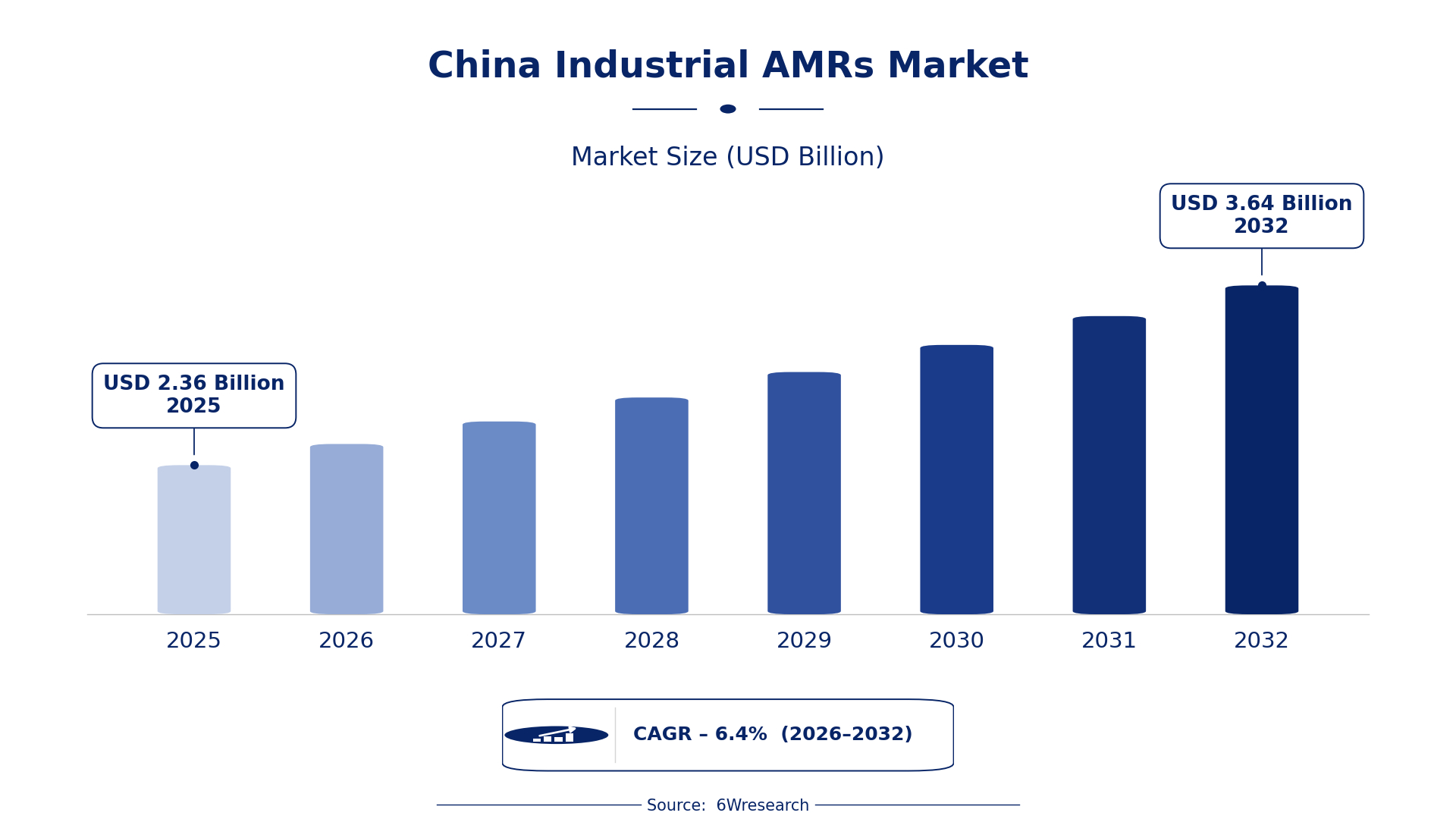
According to 6Wresearch internal database and industry insights, the China Industrial AMRs Market was valued at USD 2.36 billion in 2025 and is projected to reach USD 3.64 billion by 2032, growing at a CAGR of approximately 6.4% during 2026–2032.
China Industrial AMRs Market Highlights
| Report Metric | Details |
| Report Name | China Industrial AMRs Market |
| Market Size 2025 | USD 2.36 billion |
| Market Size 2032 | USD 3.64 billion |
| Absolute Growth 2025–2032 | USD 1.28 billion |
| CAGR 2026–2032 | 6.4% |
| Peak Annual Growth | 8.2% in 2028 |
| Forecast Period | 2026–2032 |
| Historical Data | 2022–2025 |
| Base Year | 2025 |
| Leading Robot Type, 2025 | Goods-to-Person AMRs (51% share) |
| Leading Navigation Method, 2025 | SLAM/LiDAR (46% share) |
| Leading Payload Capacity, 2025 | 100–500 kg (44% share) |
| Leading End User, 2025 | Warehouses & Fulfillment (38% share) |
| Fastest-Growing Robot Type | Inventory Robots (7.9% CAGR) |
| Fastest-Growing Navigation Method | AI-Based Pathfinding (7.6% CAGR) |
| Fastest-Growing Payload Capacity | 500–1500 kg (8.0% CAGR) |
| Fastest-Growing End User | Retail & Logistics Firms (7.6% CAGR) |
| Growing Sector | Logistics |
| Key End Users | Warehouses, Automotive Manufacturers, Retail Firms, Logistics Providers |
China Industrial AMRs Market Year-wise Growth Rate and Key Drivers (2022–2032)
This graph illustrates the annual growth rates of the market from 2022 to 2032, highlighting a steady upward trajectory and projected market expansion over the forecast period.
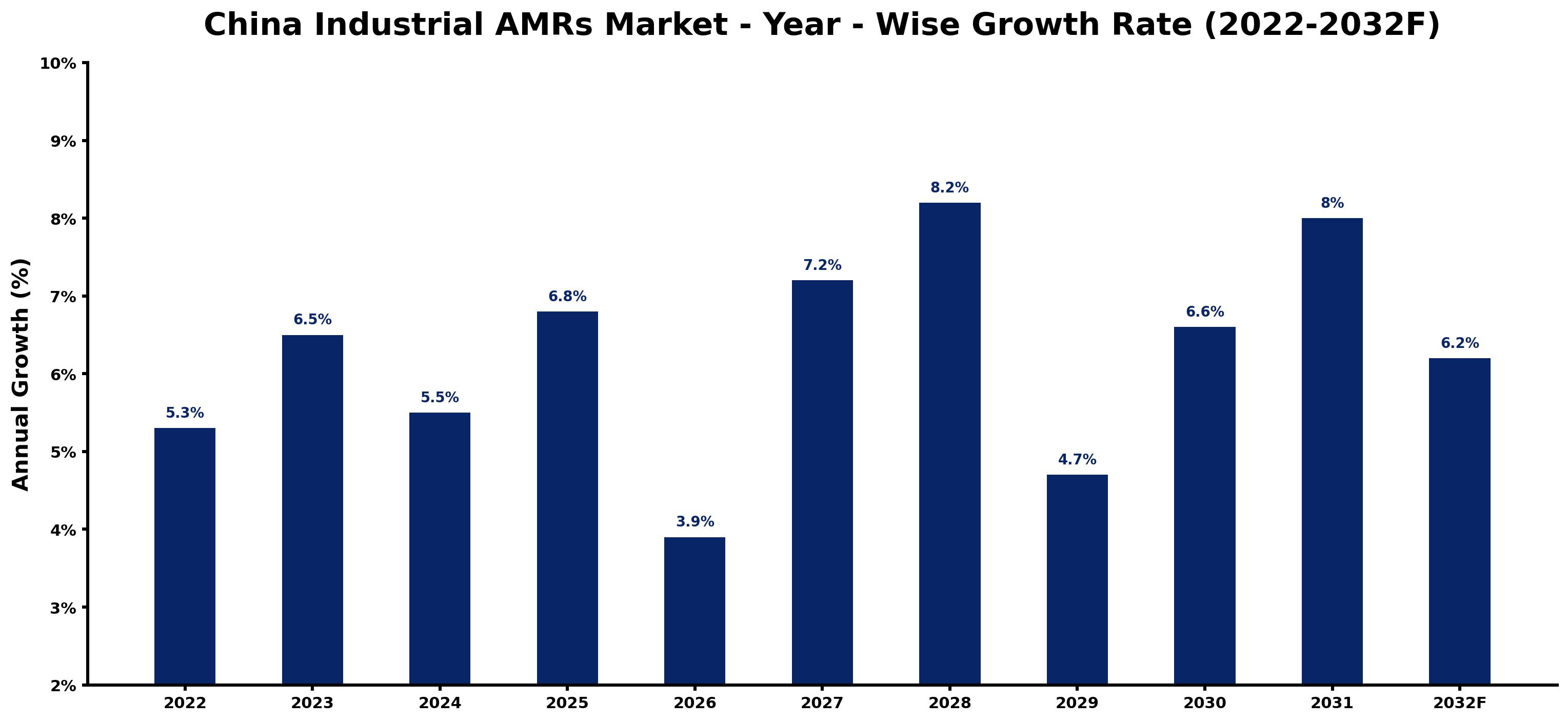
The following table presents the estimated annual growth rate for each year together with the principal factor influencing market performance.
| Year | Estimated Annual Growth (%) | Market Rationale |
| 2022 | 5.3 | The market showed steady growth due to increased automation in logistics driven by the 'Intelligent Manufacturing Development Plan'. |
| 2023 | 6.5 | Demand accelerated as more warehouses adopted AMR technology for efficiency, particularly in the Yangtze River Delta region. |
| 2024 | 5.5 | Growth slowed as some sectors adjusted their automation strategies, impacting inventory management practices. |
| 2025 | 6.8 | The automotive sector's demand surged, boosting AMR adoption as it accounted for approximately 30% of total demand. |
| 2026 | 3.9 | A slowdown occurred as investments in new technologies were reassessed, affecting AMR deployment timelines. |
| 2027 | 7.2 | Demand increased as logistics firms expanded their automation capabilities, particularly in warehouses and fulfillment centres. |
| 2028 | 8.2 | The peak growth was driven by heightened investments in smart logistics, reflecting a shift towards automation. |
| 2029 | 4.7 | Growth slowed as the market began to stabilise after rapid expansion, with firms reassessing their automation strategies. |
| 2030 | 6.6 | Demand picked up again as more facilities integrated AMRs into operations, enhancing efficiency and productivity. |
| 2031 | 8.0 | Growth accelerated as the retail sector increasingly adopted automation, driven by the need for efficient inventory management. |
| 2032 | 6.2 | The market continued to grow, albeit at a slower pace than before, as firms adapted to new operational standards. |
Note: Market size estimations and growth projections presented in this report are based on 6Wresearch's proprietary forecasting methodology, utilizing the latest available industry data, government publications, and primary research inputs.
China Industrial AMRs Market Synopsis
Industrial Autonomous Mobile Robots (AMRs) in China are advanced robots designed for material handling and logistics, primarily used in automating warehouse operations and inventory management. The China Industrial AMRs Market is growing due to strong demand from logistics and manufacturing sectors, particularly in the automotive industry, which accounted for approximately 30% of AMR demand in 2023. Initiatives like the 'Made in China 2025' programme are promoting robotics and automation, further driving market expansion. With a population exceeding 1.4 billion, the need for efficient logistics solutions remains substantial, creating opportunities for AMR adoption across various sectors.
Market Dynamics Impact Analysis (2026–2032)
| Factor | Type | Impact | Primary Segment Affected |
| Increased investment in automation technologies | Driver | High | Goods-to-Person AMRs |
| Growing demand for efficient logistics solutions | Driver | High | Warehouses & Fulfillment |
| Expansion of smart logistics projects | Opportunity | High | Inventory Robots |
| Rising demand for heavy-duty AMRs in manufacturing | Opportunity | Medium | Heavy-Duty AMRs |
| High initial costs of AMR deployment | Restraint | High | Heavy-Duty AMRs |
| Limited awareness of AMR benefits among small firms | Restraint | Medium | Inventory Robots |
| Challenges in integrating AMRs with existing systems | Challenge | High | Goods-to-Person AMRs |
| Supply chain disruptions affecting component availability | Challenge | Medium | Heavy-Duty AMRs |
Evaluation of Drivers in China Industrial AMRs Market (2026–2032)
The table below links each growth driver to the segment it affects and the evidence for it.
| Drivers | Primary Segment Affected | Why It Matters (Evidence) |
| Increased investment in automation technologies | Goods-to-Person AMRs | Investment in automation technologies is driving demand, with the automotive sector accounting for approximately 30% of AMR demand in 2023. |
| Growing demand for efficient logistics solutions | Warehouses & Fulfillment | The logistics sector employs over 50 million workers, creating a strong need for automation solutions to improve efficiency. |
| Expansion of smart logistics projects | Inventory Robots | Funding for smart logistics projects is increasing, supporting the adoption of AMRs in warehouses and distribution centres. |
| Rising demand for heavy-duty AMRs in manufacturing | Heavy-Duty AMRs | The automotive sector's growth fuels demand for heavy-duty AMRs for material transport, improving operational efficiency. |
| Adoption of safety standards for AMRs | SLAM/LiDAR | Compliance with standards like GB/T 33579-2017 boosts confidence in AMR safety and reliability, encouraging adoption. |
Market growth for Industrial AMRs in China is underpinned by increased investment in automation technologies, particularly within the automotive sector, which accounted for approximately 30% of AMR demand in 2023. The logistics sector, employing over 50 million workers, drives the need for efficient solutions. Funding for smart logistics projects is expanding, supporting AMR adoption in warehouses and distribution centres. The rising need for heavy-duty AMRs links to growth in the automotive sector, which requires efficient material transport solutions. Compliance with safety standards like GB/T 33579-2017 supports market confidence and adoption, ensuring operational safety and reliability.
Evaluation of Restraints in China Industrial AMRs Market
Below mentioned are some major restraints and their influence on market dynamics.
| Market Restraint | Primary Segment Affected | Why It Matters (Evidence) |
| High initial costs of AMR deployment | Heavy-Duty AMRs | The upfront investment required for AMRs can deter smaller manufacturers from adopting the technology, limiting market growth. |
| Limited awareness of AMR benefits among small firms | Inventory Robots | Many small firms lack understanding of AMR advantages, hindering their adoption in logistics and inventory management. |
| Challenges in integrating AMRs with existing systems | Goods-to-Person AMRs | Integration complexities can delay AMR implementation, affecting operational efficiency and increasing costs. |
| Supply chain disruptions affecting component availability | Heavy-Duty AMRs | Ongoing supply chain issues can lead to delays in AMR production and delivery, impacting market supply. |
| Regulatory compliance requirements for AMRs | SLAM/LiDAR | Compliance with safety standards can increase costs and extend the approval process for new AMR models. |
China Industrial AMRs Market Challenges
In the China Industrial AMRs market, buyers in the Yangtze River Delta region face intense competition, which can lead to price wars that reduce profit margins by up to 20%. Suppliers are grappling with rising production costs due to increased prices for raw materials, inflating their expenses by 15% and causing delays in delivery times for manufacturers. The logistics sector, employing over 50 million workers, suffers from a shortage of skilled personnel, which can postpone AMR deployment projects by several months. Additionally, rapid technological advancements make it challenging for suppliers to comply with evolving standards, such as GB/T 33579-2017, resulting in increased compliance costs for manufacturers.
Trends in the China Industrial AMRs Market
Four trends stand out in the China Industrial AMRs Market.
- Shift towards Automation in Warehousing: Warehouses are increasingly adopting AMRs to improve efficiency and reduce labour costs. The 'Intelligent Manufacturing Development Plan' launched in 2022 aims to promote automation, with a significant installed base expected by 2025.
- Transition to AI-Based Pathfinding: AI-Based Pathfinding is becoming more prevalent in AMRs, improving navigation efficiency. This trend is supported by a CAGR of 7.6% from 2026 to 2032, reflecting the growing need for smarter solutions in logistics.
- Growth in Heavy-Duty AMRs: Heavy-Duty AMRs are gaining traction in manufacturing, driven by increased demand for material transport solutions. The automotive sector's growth is a key factor, accounting for 30% of AMR demand in 2023.
- Focus on Safety Standards: There is a heightened focus on compliance with safety standards for AMRs. The updated 'National Standard for Mobile Robots' in 2022 provides operational guidelines, promoting safer deployment in logistics.
Investment Opportunities in the China Industrial AMRs Market
Investors looking at the China Industrial AMRs Market should consider the following areas.
- Rising Need for Efficient Inventory Management Solutions: With the logistics sector's growth, there is a pressing need for effective inventory management solutions. Investing in Inventory Robots can cater to logistics firms looking to improve operations, especially in the Yangtze River Delta region.
- Investment in Smart Logistics Projects: Now is an opportune moment to invest in smart logistics projects, as funding is increasing. Collaborating with local logistics firms can facilitate entry into this growing market, particularly in major hubs like Beijing.
- Supply Opportunities in Heavy-Duty AMRs: The automotive manufacturing sector's expansion presents a timely opportunity to supply Heavy-Duty AMRs. Engaging with manufacturers in Guangdong province can lead to successful partnerships.
- Compliance with Updated Safety Standards: As safety regulations tighten, there is an opportunity to offer AMRs that meet updated standards. Partnering with firms seeking compliance can improve market entry strategies.
Government Initiatives in the China Industrial AMRs Market
The 'Robotics Industry Development Plan' launched in 2021 with a budget of 10 billion RMB over five years aims to support AMR innovation. This initiative is designed to improve the capabilities of AMR producers and advance technology. The 'Smart Logistics Development Action Plan' approved in 2022 aims to enhance logistics efficiency through automation by 2025, directly impacting AMR adoption in the sector. Furthermore, the 'National Standard for Mobile Robots' was updated in 2022 by the Standardization Administration of China, establishing safety and operational guidelines for AMRs. These measures aim to strengthen the robotics industry in China, creating a conducive environment for AMR growth.
The Ministry of Industry and Information Technology oversees the approval of funding for smart logistics projects, including AMRs. In 2023, this agency announced funding initiatives to promote the integration of AI and robotics in manufacturing, focusing on AMRs. Additionally, the Standardization Administration of China (SAC) develops national standards for AMRs, ensuring compliance and safety in operations. These agencies play a significant role in facilitating the growth and adoption of AMRs across various sectors, providing the necessary support for manufacturers and buyers.
Future Insight of the China Industrial AMRs Market
Several forward-looking factors are expected to support the China Industrial AMRs market in the coming years. The 'Intelligent Manufacturing Development Plan' will drive automation across industries, significantly boosting AMR demand. By 2025, the logistics sector is projected to adopt AMRs at an accelerated pace, enhancing operational efficiency. Increased investment in AMR technology in the Guangdong province will elevate production capabilities. The '14th Five-Year Plan' prioritises robotics, enabling manufacturers to implement advanced technologies for improved logistics and material handling.
Market Segmentation Analysis
Each segment group is reviewed below, with the leader by share and the fastest grower by CAGR.
By Robot Type – Goods-to-Person AMRs Dominated, Inventory Robots Expected to Grow Fastest
According to Sachin Kumar Rai, Senior Research Analyst at 6Wresearch, Goods-to-Person AMRs accounted for a 51% market share by robot type in 2025. Goods-to-Person AMRs dominate the market share as they are crucial for efficient order picking, particularly in bustling distribution centres. Their prevalence in the Yangtze River Delta region highlights their significance in meeting the demands of fast-paced logistics operations. Inventory Robots are projected to grow fastest, at a CAGR of 7.9% during 2026–2032. The Inventory Robots segment is experiencing rapid growth due to the critical need for real-time inventory tracking, essential for optimising warehouse operations. The increasing complexity of supply chains is driving demand for these advanced solutions, ensuring a sustained upward trajectory. Suppliers should focus on enhancing Goods-to-Person and Inventory Robots to effectively address the growing needs of the logistics sector.
By Navigation Method – SLAM/LiDAR Dominated, AI-Based Pathfinding Expected to Grow Fastest
With a 46% revenue share in 2025, SLAM/LiDAR was the largest navigation method category. SLAM/LiDAR technology leads the navigation method segment, providing essential navigation and obstacle avoidance capabilities in dynamic environments like warehouses. Its widespread application across various industrial settings reinforces its status as the preferred choice for AMR navigation. AI-Based Pathfinding is set to record the highest CAGR in this split, 7.6% over 2026–2032. AI-Based Pathfinding is the fastest-growing navigation method, significantly improving navigation efficiency and route optimisation, which is increasingly vital for modern logistics operations. The complexity of warehouse layouts is driving the demand for such advanced navigation solutions, ensuring continued growth. Investing in AI-Based Pathfinding technologies will be essential for suppliers aiming to remain competitive in the rapidly evolving AMR market.
By Payload Capacity – 100–500 kg Dominated, 500–1500 kg Expected to Grow Fastest
The largest payload capacity category in 2025 was 100–500 kg, with a 44% share of total revenue. The 100–500 kg payload capacity segment captures the largest share, as it is the most common range for many warehouse applications, facilitating efficient handling of diverse goods. This versatility makes it a preferred choice for numerous logistics operations across China. The quickest growth will come from 500–1500 kg, forecast to expand at a CAGR of 8.0% between 2026 and 2032. The 500–1500 kg payload capacity segment is experiencing rapid growth, driven by the rising demand for heavy-duty applications in factories that require robust material handling solutions. As industries expand, the need for higher capacity robots will continue to rise, propelling this segment forward. Suppliers should consider expanding their product lines to include higher payload capacity options to cater to the evolving needs of heavy-duty applications.
By End User – Warehouses & Fulfillment Dominated, Retail & Logistics Firms Expected to Grow Fastest
Warehouses & Fulfillment took a 38% share of end user in 2025, more than any other category. Warehouses & Fulfillment dominate the end-user segment, being the primary sector utilising AMRs for logistics, which significantly enhances operational efficiency. The substantial installed base in this sector highlights the critical role of AMRs in modern warehouse management. Over 2026–2032, Retail & Logistics Firms are expected to post the fastest growth, at a CAGR of 7.6%. Retail & Logistics Firms represent the fastest-growing end-user segment, driven by their increasing reliance on automation for inventory and order fulfilment processes. As consumer demands escalate, these firms are rapidly adopting AMRs to streamline operations and improve service delivery. Suppliers should target Retail & Logistics Firms with tailored solutions to capitalise on the growing demand for automation in these sectors.
Key Attractiveness of the Report
- 10 Years of Market Numbers
- Historical Data Starting from 2022 to 2025
- Base Year 2025
- Forecast Data until 2032
- Key Performance Indicators Impacting the Market
- Major Upcoming Developments and Projects
Key Highlights of the Report:
- China Industrial AMRs Market Outlook
- Market Size of China Industrial AMRs Market, 2025
- Forecast of China Industrial AMRs Market, 2032
- Historical Data and Forecast of China Industrial AMRs Revenues & Volume for the Period 2022 - 2032F
- China Industrial AMRs Market Trend Evolution
- China Industrial AMRs Market Drivers and Challenges
- China Industrial AMRs Price Trends
- China Industrial AMRs Porter's Five Forces
- China Industrial AMRs Industry Life Cycle
- Historical Data and Forecast of China Industrial AMRs Market Revenues & Volume By Robot Type for the Period 2022 - 2032F
- Historical Data and Forecast of China Industrial AMRs Market Revenues & Volume By Goods-to-Person AMRs for the Period 2022 - 2032F
- Historical Data and Forecast of China Industrial AMRs Market Revenues & Volume By Inventory Robots for the Period 2022 - 2032F
- Historical Data and Forecast of China Industrial AMRs Market Revenues & Volume By Heavy-Duty AMRs for the Period 2022 - 2032F
- Historical Data and Forecast of China Industrial AMRs Market Revenues & Volume By Modular AMRs for the Period 2022 - 2032F
- Historical Data and Forecast of China Industrial AMRs Market Revenues & Volume By Navigation Method for the Period 2022 - 2032F
- Historical Data and Forecast of China Industrial AMRs Market Revenues & Volume By SLAM/LiDAR for the Period 2022 - 2032F
- Historical Data and Forecast of China Industrial AMRs Market Revenues & Volume By Barcode/RFID for the Period 2022 - 2032F
- Historical Data and Forecast of China Industrial AMRs Market Revenues & Volume By Vision Inertial Nav. for the Period 2022 - 2032F
- Historical Data and Forecast of China Industrial AMRs Market Revenues & Volume By AI-Based Pathfinding for the Period 2022 - 2032F
- Historical Data and Forecast of China Industrial AMRs Market Revenues & Volume By Payload Capacity for the Period 2022 - 2032F
- Historical Data and Forecast of China Industrial AMRs Market Revenues & Volume By 100 500 kg for the Period 2022 - 2032F
- Historical Data and Forecast of China Industrial AMRs Market Revenues & Volume By Lightweight Sensors for the Period 2022 - 2032F
- Historical Data and Forecast of China Industrial AMRs Market Revenues & Volume By 500 1500 kg for the Period 2022 - 2032F
- Historical Data and Forecast of China Industrial AMRs Market Revenues & Volume By Custom Configurable for the Period 2022 - 2032F
- Historical Data and Forecast of China Industrial AMRs Market Revenues & Volume By End User for the Period 2022 - 2032F
- Historical Data and Forecast of China Industrial AMRs Market Revenues & Volume By Warehouses & Fulfillment for the Period 2022 - 2032F
- Historical Data and Forecast of China Industrial AMRs Market Revenues & Volume By Retail & Logistics Firms for the Period 2022 - 2032F
- Historical Data and Forecast of China Industrial AMRs Market Revenues & Volume By Automotive Manufacturing for the Period 2022 - 2032F
- Historical Data and Forecast of China Industrial AMRs Market Revenues & Volume By Smart Factory Integrators for the Period 2022 - 2032F
- China Industrial AMRs Import Export Trade Statistics
- Market Opportunity Assessment By Robot Type
- Market Opportunity Assessment By Navigation Method
- Market Opportunity Assessment By Payload Capacity
- Market Opportunity Assessment By End User
- China Industrial AMRs Top Companies Market Share
- China Industrial AMRs Competitive Benchmarking By Technical and Operational Parameters
- China Industrial AMRs Company Profiles
- China Industrial AMRs Key Strategic Recommendations
Market Covered
Segments analysed in this report are listed below.
By Robot Type
- Goods-to-Person AMRs
- Inventory Robots
- Heavy-Duty AMRs
- Modular AMRs
By Navigation Method
- SLAM/LiDAR
- Barcode/RFID
- Vision + Inertial Nav.
- AI-Based Pathfinding
By Payload Capacity
- 100–500 kg
- Lightweight Sensors
- 500–1500 kg
- Custom Configurable
By End User
- Warehouses & Fulfillment
- Retail & Logistics Firms
- Automotive Manufacturing
- Smart Factory Integrators































