India Industrial AMRs Market Size & Growth Rate
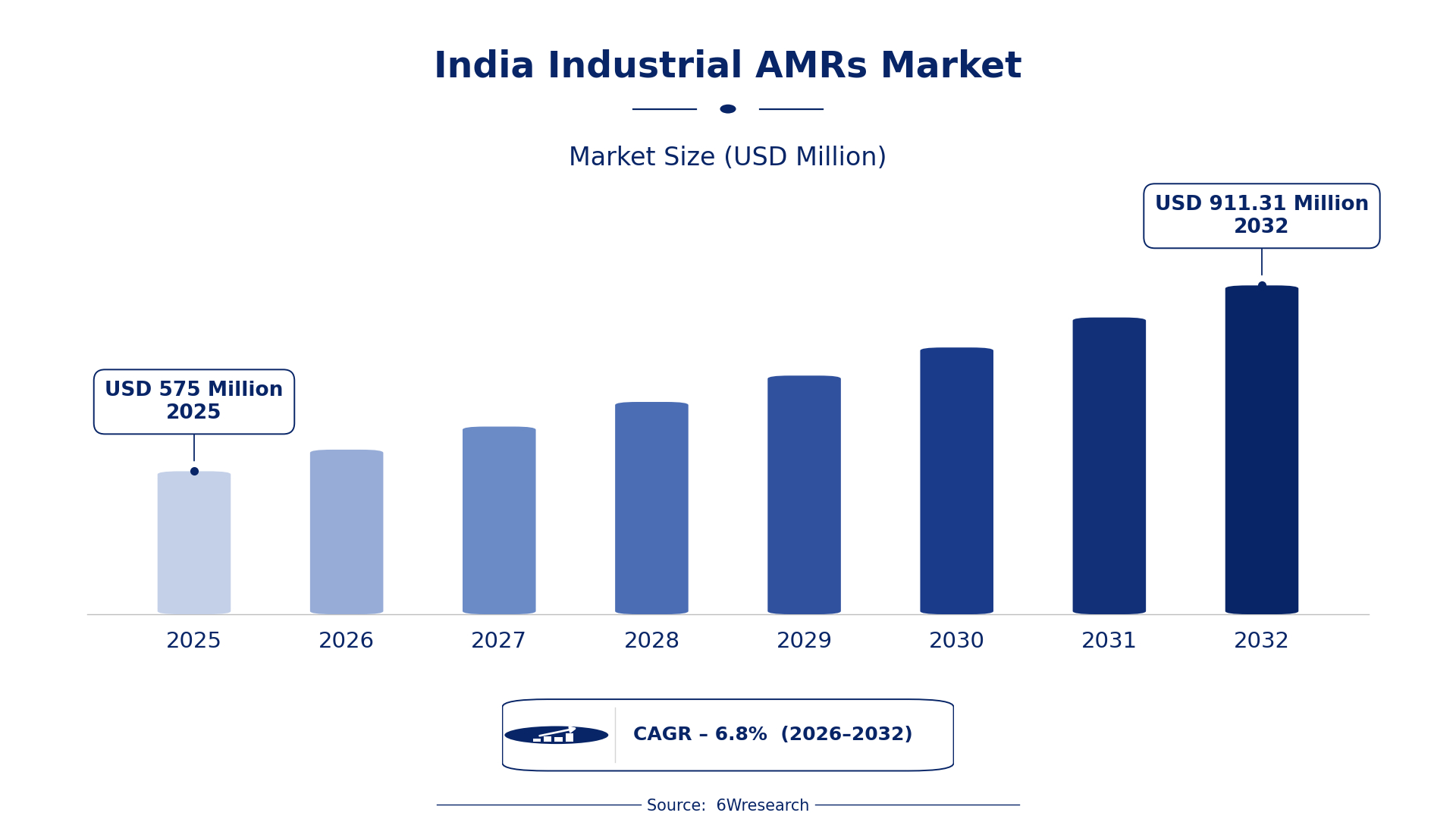
According to 6Wresearch internal database and industry insights, the India Industrial AMRs Market was valued at USD 575.0 million in 2025 and is projected to reach USD 911.31 million by 2032, growing at a CAGR of approximately 6.8% during 2026–2032.
India Industrial AMRs Market Highlights
| Report Metric | Details |
| Report Name | India Industrial AMRs Market |
| Market Size 2025 | USD 575.0 million |
| Market Size 2032 | USD 911.31 million |
| Absolute Growth 2025–2032 | USD 336.31 million |
| CAGR 2026–2032 | 6.8% |
| Peak Annual Growth | 8.8% in 2030 |
| Forecast Period | 2026–2032 |
| Historical Data | 2022–2025 |
| Base Year | 2025 |
| Leading Robot Type, 2025 | Goods-to-Person AMRs (55% share) |
| Leading Navigation Method, 2025 | SLAM/LiDAR (46% share) |
| Leading Payload Capacity, 2025 | 100–500 kg (38% share) |
| Leading End User, 2025 | Warehouses & Fulfillment (41% share) |
| Fastest-Growing Robot Type | Inventory Robots (8.3% CAGR) |
| Fastest-Growing Navigation Method | AI-Based Pathfinding (8.1% CAGR) |
| Fastest-Growing Payload Capacity | 500–1500 kg (7.9% CAGR) |
| Fastest-Growing End User | Retail & Logistics Firms (8.2% CAGR) |
| Growing Sector | Retail & Logistics Firms |
| Key End Users | Warehouses & Fulfillment, Retail & Logistics Firms, Automotive Manufacturing, Smart Factory Integrators |
India Industrial AMRs Market Year-wise Growth Rate and Key Drivers (2022–2032)
This graph illustrates the annual growth rates of the market from 2022 to 2032, highlighting a steady upward trajectory and projected market expansion over the forecast period.
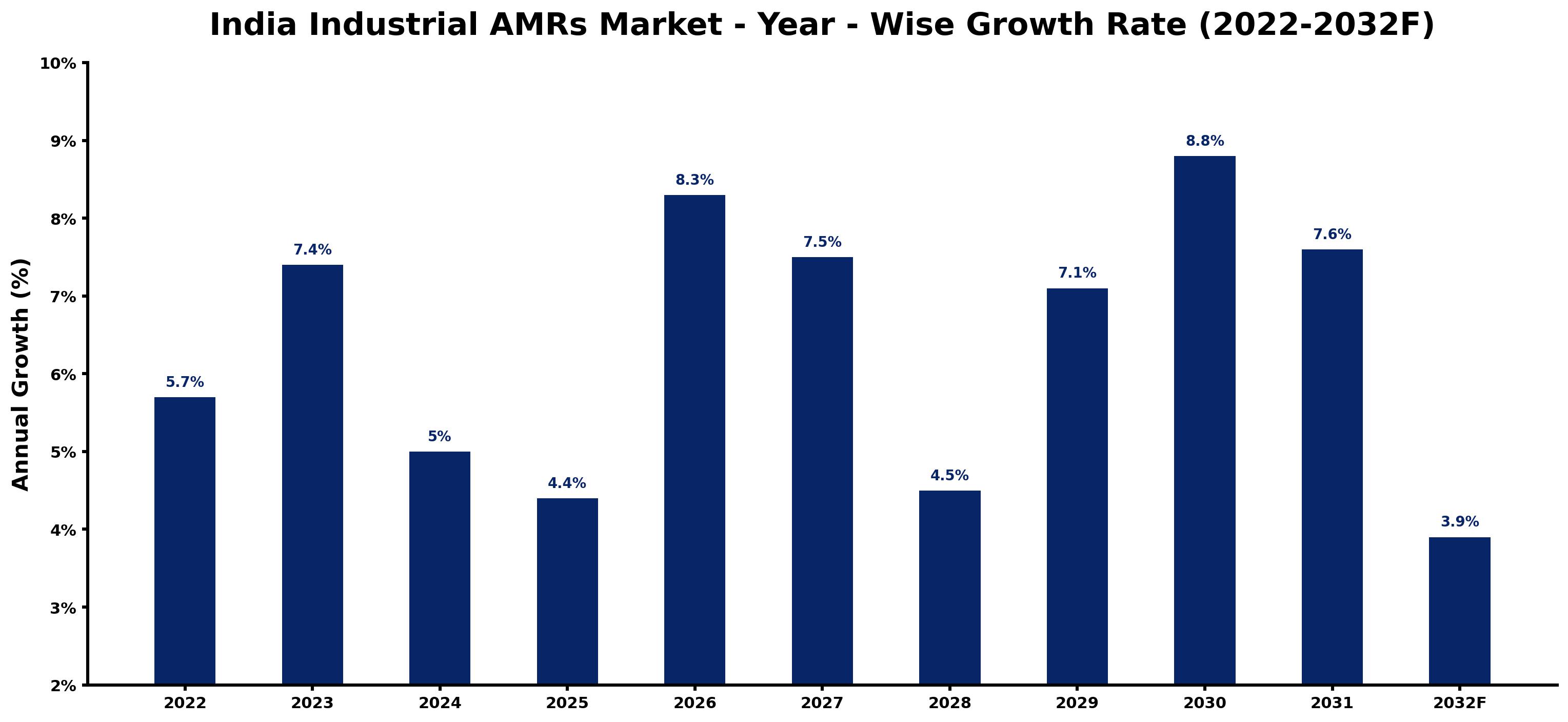
The table below sets out the estimated growth rate for each year and the main factor behind it.
| Year | Estimated Annual Growth (%) | Market Rationale |
| 2022 | 5.7 | The market showed steady growth due to increasing automation in logistics. |
| 2023 | 7.4 | Demand surged as more warehouses adopted AMRs for efficiency. |
| 2024 | 5.0 | Growth slowed as some sectors faced temporary supply chain issues. |
| 2025 | 4.4 | The market continued to grow, but at a slower pace than before. |
| 2026 | 8.3 | Renewed investment in automation technology is expected to spur faster growth. |
| 2027 | 7.5 | Growth is projected to moderate as companies adjust to new operational standards. |
| 2028 | 4.5 | The market is expected to experience a slowdown as demand stabilises. |
| 2029 | 7.1 | Increased e-commerce activity will lead to a resurgence in demand. |
| 2030 | 8.8 | The market is projected to peak as the logistics sector rapidly expands. |
| 2031 | 7.6 | Growth is expected to slow as market conditions begin to normalise. |
| 2032 | 3.9 | The market is projected to grow at a slower rate as saturation occurs. |
Note: Market size estimations and growth projections presented in this report are based on 6Wresearch's proprietary forecasting methodology, utilizing the latest available industry data, government publications, and primary research inputs.
India Industrial AMRs Market Synopsis
Industrial Autonomous Mobile Robots (AMRs) in India are advanced robotic systems designed for automated material handling and logistics. They are primarily used for transporting goods within warehouses and manufacturing facilities. The India Industrial AMRs Market is experiencing growth driven by the booming e-commerce sector and the push for automation in logistics. Initiatives like 'Make in India' are promoting local manufacturing and innovation in robotics, further stimulating demand for AMRs.
Market Dynamics Impact Analysis (2026–2032)
| Factor | Type | Impact | Primary Segment Affected |
| Growing e-commerce sector driving demand for efficient logistics solutions. | Driver | High | Warehouses & Fulfillment |
| Investment in automation technology enhances operational efficiency. | Driver | High | Heavy-Duty AMRs |
| The e-commerce sector's growth creates demand for more AMRs. | Opportunity | High | Goods-to-Person AMRs |
| Local manufacturing initiatives provide opportunities for suppliers. | Opportunity | High | Inventory Robots |
| High initial investment costs can deter potential buyers. | Restraint | Medium | Heavy-Duty AMRs |
| Limited awareness of AMR benefits restricts market penetration. | Restraint | Medium | Goods-to-Person AMRs |
| Supply chain disruptions can delay AMR availability. | Challenge | High | Inventory Robots |
| Regulatory approvals can slow down deployment of AMRs. | Challenge | Medium | Heavy-Duty AMRs |
Evaluation of Drivers in India Industrial AMRs Market (2026–2032)
The main growth drivers and the segments they affect most are set out below.
| Drivers | Primary Segment Affected | Why It Matters (Evidence) |
| Increasing demand for automation in logistics. | Warehouses & Fulfillment | Over 300 warehouses in India currently use AMRs, enhancing operational efficiency and reducing costs. |
| Growth of the e-commerce sector. | Heavy-Duty AMRs | The 'Make in India' initiative encourages domestic production of robotics, boosting local manufacturing. |
| Government initiatives promoting local manufacturing. | Heavy-Duty AMRs | The 'Make in India' initiative encourages domestic production of robotics, fostering local manufacturing growth. |
| Technological advancements in robotics. | Inventory Robots | ISO 8373:2012 provides standards for mobile robots, ensuring safety and efficiency in operations. |
| Focus on reducing operational costs in logistics. | Goods-to-Person AMRs | AMRs are increasingly adopted to lower labour costs in logistics operations, improving profitability. |
Market growth in India for Industrial AMRs rests on rising investment in automation technology, expanding e-commerce demand, and government support for local manufacturing. The e-commerce sector is projected to reach $200 billion by 2026, significantly driving demand for logistics automation. Over 300 warehouses are already utilising AMRs, which enhances operational efficiency and reduces costs. The 'Make in India' initiative promotes local production of robotics, which supports market growth and innovation. As operational costs in logistics decrease, more companies are expected to adopt AMRs to streamline their processes and improve profitability.
Evaluation of Restraints in India Industrial AMRs Market
The table below lists the restraints and the evidence behind each.
| Market Restraint | Primary Segment Affected | Why It Matters (Evidence) |
| High initial costs of AMRs can limit adoption. | Heavy-Duty AMRs | The average investment for AMRs can exceed ₹50 lakh, deterring smaller firms from purchasing. |
| Limited awareness of AMRs among potential users. | Goods-to-Person AMRs | Many logistics firms are unaware of the efficiency benefits AMRs provide, hindering adoption. |
| Supply chain disruptions can impact AMR availability. | Inventory Robots | Recent global supply chain issues have delayed AMR shipments to India, affecting logistics operations. |
| Regulatory hurdles can slow down AMR deployment. | Heavy-Duty AMRs | Approval processes for new technologies can take several months, delaying market entry for producers. |
| Concerns over job displacement can hinder acceptance. | Warehouses & Fulfillment | Some stakeholders fear that AMRs will lead to job losses, affecting their acceptance in the market. |
India Industrial AMRs Market Challenges
High costs in the India Industrial AMRs market arise from limited local manufacturing capabilities, inflating prices by up to 30% compared to imports, which burdens logistics buyers. Many warehouses lack the necessary infrastructure for technology adoption, delaying AMR integration and reducing operational efficiency for producers. Buyers face challenges in scaling operations due to a shortage of AMRs, as demand outstrips supply, particularly with over 300 warehouses already using these systems. Supply chain disruptions occur from reliance on imported components, causing delays in delivery times for manufacturers who depend on timely logistics.
Trends in the India Industrial AMRs Market
The trends below show where the India Industrial AMRs Market is heading.
- Shift from Manual to Automated Warehousing: Warehouses are increasingly adopting AMRs to improve efficiency and reduce labour costs. The 'Digital India' programme promotes automation, targeting widespread implementation by 2025. This shift is expected to streamline operations significantly.
- Transition from Traditional to Smart Logistics: The logistics sector is moving towards smart solutions, integrating AMRs for inventory management. The 'National Robotics Mission' launched in 2021 supports this transition, aiming to boost robotics technology in India.
- Emergence of AI-Based Navigation Systems: AI-based navigation is gaining traction in AMRs, improving their adaptability in complex environments. This trend is supported by the growing demand for efficient logistics solutions, with AI-based systems projected to grow significantly.
- Focus on Custom Configurable AMRs: There is a growing interest in custom-configurable AMRs, allowing for tailored solutions in logistics. This trend is driven by the need for flexibility in operations, particularly in diverse warehouse environments.
Investment Opportunities in the India Industrial AMRs Market
Below are the investment opportunities with the strongest case in the India Industrial AMRs Market.
- Investment in Local Manufacturing: With the e-commerce sector expected to reach $200 billion by 2026, there is a substantial opportunity to invest in local manufacturing of AMRs. Collaborating with logistics firms in India can facilitate market entry.
- Expansion of Robotics in Warehousing: The demand for AMRs in warehouses is growing, as over 300 facilities currently use them. Investing in solutions tailored for this sector can yield substantial returns.
- Integration of AI Technologies: The rise of AI-based navigation systems presents an opportunity to enhance AMR capabilities. Suppliers can focus on developing AI solutions to meet the evolving needs of logistics firms.
- Custom Solutions for Diverse Applications: The need for custom-configurable AMRs is increasing as logistics operations diversify. Suppliers can tap into this market by offering tailored solutions to meet specific client needs.
Government Initiatives in the India Industrial AMRs Market
The 'Digital India' programme, initiated in 2015, aims to enhance automation in various sectors, including logistics and manufacturing, promoting AMR adoption. The 'Make in India' initiative encourages local production of AMRs, aiming to increase domestic manufacturing by 2025. These policies are designed to boost the robotics sector, ensuring that producers can meet the growing demand for automation.
The 'National Robotics Mission' was launched by the Ministry of Electronics and Information Technology in 2021 to promote research and development in robotics, focusing on AMRs. This initiative allocates funding to support innovation and technological advancements, which will benefit both producers and buyers in the market.
Future Insight of the India Industrial AMRs Market
The India Industrial AMRs market is set for substantial change by 2032, driven by several key initiatives. The 'Make in India' initiative will strengthen local manufacturing, reducing costs for buyers and increasing availability. The 'National Robotics Mission' will encourage technological advancements, enabling suppliers to innovate and meet rising demand. The 'Digital India' programme aims to enhance automation in manufacturing by 2025, ensuring AMRs are integrated across various sectors, which will lead to improved efficiency and productivity.
Market Segmentation Analysis
The report offers a comprehensive study of the following market segments and their leading categories in the market.
By Robot Type – Goods-to-Person AMRs Dominated, Inventory Robots Expected to Grow Fastest
According to Sachin Kumar Rai, Senior Research Analyst at 6Wresearch, the largest robot type category in 2025 was Goods-to-Person AMRs, with a 55% share of total revenue. Goods-to-Person AMRs dominate the market share as they are crucial for efficient order picking in over 300 warehouses across India. Their widespread use in logistics operations highlights their importance in enhancing productivity and optimising material handling processes. The quickest growth will come from Inventory Robots, forecast to expand at a CAGR of 8.3% between 2026 and 2032. Inventory Robots are experiencing rapid growth, driven by the e-commerce sector's anticipated expansion to $200 billion by 2026, which necessitates advanced stock management solutions. This growth reinforces the leading position of Goods-to-Person AMRs, as they are integral to effective inventory management. Suppliers should focus on developing Goods-to-Person AMRs and Inventory Robots to align with the growing demands of the logistics sector.
By Navigation Method – SLAM/LiDAR Dominated, AI-Based Pathfinding Expected to Grow Fastest
SLAM/LiDAR took a 46% share of navigation method in 2025, more than any other category. SLAM/LiDAR technology holds the largest market share, as it is essential for navigation and obstacle avoidance in dynamic environments, ensuring safe and efficient operations in logistics. Its established use across various industries solidifies its status as the preferred navigation method for AMRs. AI-Based Pathfinding is projected to grow fastest, at a CAGR of 8.1% during 2026–2032. AI-Based Pathfinding is the fastest-growing navigation method, enhancing efficiency and adaptability in complex settings, which is increasingly vital as automation in logistics expands. This advancement is likely to further strengthen the leading position of SLAM/LiDAR by improving overall operational capabilities. Buyers should prioritise AMRs with advanced navigation methods to maximise efficiency and safety in their operations.
By Payload Capacity – 100–500 kg Dominated, 500–1500 kg Expected to Grow Fastest
100–500 kg accounted for a 38% market share by payload capacity in 2025. The 100–500 kg payload capacity segment commands the largest market share, as it is the most common range for many industrial applications, making it ideal for various logistics tasks. This versatility ensures a broad installed base across different sectors, reinforcing its dominant position. 500–1500 kg is set to record the highest CAGR in this split, 7.9% over 2026–2032. The 500–1500 kg segment is rapidly growing, driven by the increasing need for transporting larger loads in manufacturing environments that are adopting automation solutions. As demand for heavier payload capabilities rises, the 100–500 kg segment is likely to maintain its lead due to its widespread application. Suppliers should expand their product offerings to include both payload capacities to meet diverse customer requirements.
By End User – Warehouses & Fulfillment Dominated, Retail & Logistics Firms Expected to Grow Fastest
With a 41% revenue share in 2025, Warehouses & Fulfillment was the largest end user category. Warehouses & Fulfillment represent the largest market share, as they are the primary users of AMRs for logistics, facilitating efficient material handling in numerous facilities. This established infrastructure supports the ongoing demand for automation in the logistics sector. Over 2026–2032, Retail & Logistics Firms are expected to post the fastest growth, at a CAGR of 8.2%. Retail & Logistics Firms are the fastest-growing end user segment, utilising AMRs for inventory management as e-commerce continues to expand. This growth will further solidify the dominance of Warehouses & Fulfillment as they adapt to changing market demands. Suppliers should target both warehouses and retail sectors to maximise their market reach and align with industry growth trends.
Key Attractiveness of the Report
- 10 Years of Market Numbers
- Historical Data Starting from 2022 to 2025
- Base Year 2025
- Forecast Data until 2032
- Key Performance Indicators Impacting the Market
- Major Upcoming Developments and Projects
Key Highlights of the Report:
- India Industrial AMRs Market Outlook
- Market Size of India Industrial AMRs Market, 2025
- Forecast of India Industrial AMRs Market, 2032
- Historical Data and Forecast of India Industrial AMRs Revenues & Volume for the Period 2022 - 2032F
- India Industrial AMRs Market Trend Evolution
- India Industrial AMRs Market Drivers and Challenges
- India Industrial AMRs Price Trends
- India Industrial AMRs Porter's Five Forces
- India Industrial AMRs Industry Life Cycle
- Historical Data and Forecast of India Industrial AMRs Market Revenues & Volume By Robot Type for the Period 2022 - 2032F
- Historical Data and Forecast of India Industrial AMRs Market Revenues & Volume By Goods-to-Person AMRs for the Period 2022 - 2032F
- Historical Data and Forecast of India Industrial AMRs Market Revenues & Volume By Inventory Robots for the Period 2022 - 2032F
- Historical Data and Forecast of India Industrial AMRs Market Revenues & Volume By Heavy-Duty AMRs for the Period 2022 - 2032F
- Historical Data and Forecast of India Industrial AMRs Market Revenues & Volume By Modular AMRs for the Period 2022 - 2032F
- Historical Data and Forecast of India Industrial AMRs Market Revenues & Volume By Navigation Method for the Period 2022 - 2032F
- Historical Data and Forecast of India Industrial AMRs Market Revenues & Volume By SLAM/LiDAR for the Period 2022 - 2032F
- Historical Data and Forecast of India Industrial AMRs Market Revenues & Volume By Barcode/RFID for the Period 2022 - 2032F
- Historical Data and Forecast of India Industrial AMRs Market Revenues & Volume By Vision Inertial Nav. for the Period 2022 - 2032F
- Historical Data and Forecast of India Industrial AMRs Market Revenues & Volume By AI-Based Pathfinding for the Period 2022 - 2032F
- Historical Data and Forecast of India Industrial AMRs Market Revenues & Volume By Payload Capacity for the Period 2022 - 2032F
- Historical Data and Forecast of India Industrial AMRs Market Revenues & Volume By 100 500 kg for the Period 2022 - 2032F
- Historical Data and Forecast of India Industrial AMRs Market Revenues & Volume By Lightweight Sensors for the Period 2022 - 2032F
- Historical Data and Forecast of India Industrial AMRs Market Revenues & Volume By 500 1500 kg for the Period 2022 - 2032F
- Historical Data and Forecast of India Industrial AMRs Market Revenues & Volume By Custom Configurable for the Period 2022 - 2032F
- Historical Data and Forecast of India Industrial AMRs Market Revenues & Volume By End User for the Period 2022 - 2032F
- Historical Data and Forecast of India Industrial AMRs Market Revenues & Volume By Warehouses & Fulfillment for the Period 2022 - 2032F
- Historical Data and Forecast of India Industrial AMRs Market Revenues & Volume By Retail & Logistics Firms for the Period 2022 - 2032F
- Historical Data and Forecast of India Industrial AMRs Market Revenues & Volume By Automotive Manufacturing for the Period 2022 - 2032F
- Historical Data and Forecast of India Industrial AMRs Market Revenues & Volume By Smart Factory Integrators for the Period 2022 - 2032F
- India Industrial AMRs Import Export Trade Statistics
- Market Opportunity Assessment By Robot Type
- Market Opportunity Assessment By Navigation Method
- Market Opportunity Assessment By Payload Capacity
- Market Opportunity Assessment By End User
- India Industrial AMRs Top Companies Market Share
- India Industrial AMRs Competitive Benchmarking By Technical and Operational Parameters
- India Industrial AMRs Company Profiles
- India Industrial AMRs Key Strategic Recommendations
Market Covered
This report examines the market across the segments below.
By Robot Type
- Goods-to-Person AMRs
- Inventory Robots
- Heavy-Duty AMRs
- Modular AMRs
By Navigation Method
- SLAM/LiDAR
- Barcode/RFID
- Vision + Inertial Nav.
- AI-Based Pathfinding
By Payload Capacity
- 100–500 kg
- Lightweight Sensors
- 500–1500 kg
- Custom Configurable
By End User
- Warehouses & Fulfillment
- Retail & Logistics Firms
- Automotive Manufacturing
- Smart Factory Integrators































